© 2013 The Korean Academy of Medical Sciences.
This is an Open Access article distributed under the terms of the Creative Commons Attribution Non-Commercial License (http://creativecommons.org/licenses/by-nc/3.0) which permits unrestricted non-commercial use, distribution, and reproduction in any medium, provided the original work is properly cited.
pISSN 1011-8934 eISSN 1598-6357
Lung Cancer Incidence by Smoking Status in Korean Men:
16-Years of Observations in the Seoul Male Cancer Cohort Study
The relative risk (RR) of smoking and mortality of lung cancer in British doctors was previously reported to have increased throughout a 40-yr period. Here, we evaluated this RR based on the incidence of lung cancer in Korean men using a longer follow-up period.
We compared our data to the RR reported in a study using a 10-yr follow-up period; the subjects and methods were identical to those of the previous paper with the exception of the follow-up period, which ended on December 31, 2008. We found that the RR of smoking habits in patients with lung cancer did not increase, and that the data showed narrowing 95% confidence intervals over a longer observation in Korean men. Estimated lung cancers attributable to smoking were 55.6%. These results highlight the need for an intervention program to help patients quit smoking in Korea.
Key Words: Cancer Incidence; Cigarette Smoking; Cohort Study; Lung Neoplasm Jong-Myon Bae,1 Zhong-Min Li,2
Myung-Hee Shin,3 Dong-Hyun Kim,4 Moo-Song Lee,5 and Yoon-Ok Ahn6
1Department of Preventive Medicine, Jeju National University School of Medicine, Jeju, Korea;
2Department of Epidemiology & Statistics, Jilin University School of Public Health Science, Changchun, China; 3Department of Social &
Preventive Medicine, Sungkyunkwan University School of Medicine, Suwon; 4Department of Social Medicine, Hallym University College of Medicine, Chuncheon; 5Department of Preventive Medicine, University of Ulsan College of Medicine, Seoul;
6Department of Preventive Medicine, Seoul National University College of Medicine, Seoul, Korea Received: 15 December 2012
Accepted: 15 February 2013 Address for Correspondence:
Jong-Myon Bae, MD
Department of Preventive Medicine, Jeju National University School of Medicine, 102 Jejudaehak-ro, Jeju 690-756, Korea Tel: +82.64-764-3856, Fax: +82.64-725-2593 E-mail: [email protected]
This study was supported by the 2013 scientific promotion program funded by Jeju National University (2013-0144).
http://dx.doi.org/10.3346/jkms.2013.28.4.636 • J Korean Med Sci 2013; 28: 636-637
BRIEF COMMUNICATION
Oncology & Hematology
Lung cancer has been the leading cause of cancer deaths for 25 years in the Korean population (1, 2). Doll et al. (3-5) reported that the relative risks (RRs) of mortality due to lung cancer and smoking in British doctors were 8.3, 14.9, and 14.6 during 20-, 40-, and 50-yr follow-up periods, respectively. These results suggest that the RR increased through the follow-up period.
While lung cancer mortality is largely equivalent to the lung cancer incidence worldwide (6), it was previously reported that cigarette smoking increased the risk of lung cancer in Korean men by 4.18-fold during a 10-yr follow-up (7). We aimed to re- estimate the risk of lung cancer relative to cigarette smoking us- ing a longer follow-up period to confirm that the RR increases with a longer follow-up period.
The subjects were recruited from the Seoul Male Cancer Co- hort, and the methods, including the follow-up methods and statistical analyses, were identical to those previously published (7) with the exception of the follow-up period, which was ex- tended to December 31, 2008.
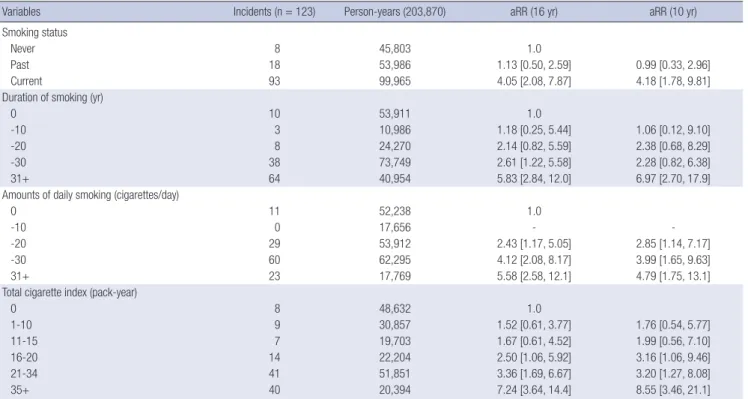
During 203,870 person-years of follow-up, 123 newly diag- nosed cases of lung cancer were identified among the partici- pants. After adjusting for potential confounders, the adjusted RRs (aRRs) of current smokers, duration of smoking of ≥ 31 yr, amount of smoking of 21 to 30 cigarettes per day, and total ciga- rette index ≥ 35 were 4.05, 5.83, 5.58, and 7.24, respectively (Ta- ble 1). Compared with the results of the 10-year follow-up (7), the RR of current smoking was 4.0 with narrowed 95% confi- dence intervals.
Our results revealed that the risk of developing lung cancer relative to smoking habit did not change with a longer follow- up period in Korean men. Compared with the results of Doll et al. (3-5), we have two main considerations. The first is related to the effects of the change in smoking habits in the cohort partici- pants during the follow-up periods. Because quitting smoking may result in an underestimation of the RR, using the smoking information gathered at the time of entry into the study would limit the interpretation. However, two reported facts would over-
Bae J-M, et al. • Smoking and Lung Cancer Risk in Korean Men
http://jkms.org 637
http://dx.doi.org/10.3346/jkms.2013.28.4.636
come this issue as follows: 1) the male British doctors that smok- ed cigarettes reported smoking the same amount at the begin- ning and half way through the study (4), and 2) the carcinogen- ic effect of smoking was presented after 20- to 25 yr (8). Second, it is necessary to consider the global difference of lung cancer occurrence in never-smokers. Thun et al. (9) concluded that Asians living in Korea and Japan had higher death rates from lung cancer than Europeans. This finding could explain why Korean men have lower risks of lung cancer relative to cigarette smoking than do British male doctors, but additional studies are needed to test this hypothesis.
In conclusion, the risk of lung cancer relative to cigarette smoking did not increase with a longer observation period in Korean men. Based on the aRR and the smoking prevalence of 0.41 in Korean adult men (10), the estimated percent of lung cancers attributable to cigarette smoking was 55.6%. These re- sults highlight the need for an intervention program for quitting smoking in Korea.
REFERENCES
1. Jung KW, Park S, Won YJ, Kong HJ, Lee JY, Seo HG, Lee JS. Prediction of cancer incidence and mortality in Korea, 2012. Cancer Res Treat 2012;
44: 25-31.
2. Jung KW, Park S, Kong HJ, Won YJ, Lee JY, Seo HG, Lee JS. Cancer statis- tics in Korea: incidence, mortality, survival, and prevalence in 2009. Can- cer Res Treat 2012; 44: 11-24.
3. Doll R, Peto R. Mortality in relation to smoking: 20 years’ observations on male British doctors. Br Med J 1976; 2: 1525-36.
4. Doll R, Peto R, Wheatley K, Gray R, Sutherland I. Mortality in relation to smoking: 40 years’ observations on male British doctors. BMJ 1994;
309: 901-11.
5. Doll R, Peto R, Boreham J, Sutherland I. Mortality in relation to smok- ing: 50 years’ observations on male British doctors. BMJ 2004; 328: 1519.
6. Alberg AJ, Samet JM. Epidemiology of lung cancer. Chest 2003; 123: 21S- 49S.
7. Bae JM, Lee MS, Shin MH, Kim DH, Li ZM, Ahn YO. Cigarette smoking and risk of lung cancer in Korean men: the Seoul Male Cancer Cohort Study. J Korean Med Sci 2007; 22: 508-12.
8. Jee SH, Samet JM, Ohrr H, Kim JH, Kim IS. Smoking and cancer risk in Korean men and women. Cancer Causes Control 2004; 15: 341-8.
9. Thun MJ, Hannan LM, Adams-Campbell LL, Boffetta P, Buring JE, Fes- kanich D, Flanders WD, Jee SH, Katanoda K, Kolonel LN, et al. Lung cancer occurrence in never-smokers: an analysis of 13 cohorts and 22 cancer registry studies. PLoS Med 2008; 5: e185.
10. Ministry of Health & Welfare, Korea. Available at http://stat.mw.go.kr/
front/customer/custBoardView.jsp?menuId=28&bbsSeq=15&nttSeq=12 177&nPage=192&searchKey=&searchWord [accessed on 19 January 2013].
Table 1. Adjusted relative risk (aRR*) and 95% confidence intervals (CI) of lung cancer relative to smoking habits with a 10-yr† and 16-yr follow-up in the Seoul Male Cancer Cohort Study‡
Variables Incidents (n = 123) Person-years (203,870) aRR (16 yr) aRR (10 yr)
Smoking status
Never 8 45,803 1.0
Past 18 53,986 1.13 [0.50, 2.59] 0.99 [0.33, 2.96]
Current 93 99,965 4.05 [2.08, 7.87] 4.18 [1.78, 9.81]
Duration of smoking (yr)
0 10 53,911 1.0
-10 3 10,986 1.18 [0.25, 5.44] 1.06 [0.12, 9.10]
-20 8 24,270 2.14 [0.82, 5.59] 2.38 [0.68, 8.29]
-30 38 73,749 2.61 [1.22, 5.58] 2.28 [0.82, 6.38]
31+ 64 40,954 5.83 [2.84, 12.0] 6.97 [2.70, 17.9]
Amounts of daily smoking (cigarettes/day)
0 11 52,238 1.0
-10 0 17,656 - -
-20 29 53,912 2.43 [1.17, 5.05] 2.85 [1.14, 7.17]
-30 60 62,295 4.12 [2.08, 8.17] 3.99 [1.65, 9.63]
31+ 23 17,769 5.58 [2.58, 12.1] 4.79 [1.75, 13.1]
Total cigarette index (pack-year)
0 8 48,632 1.0
1-10 9 30,857 1.52 [0.61, 3.77] 1.76 [0.54, 5.77]
11-15 7 19,703 1.67 [0.61, 4.52] 1.99 [0.56, 7.10]
16-20 14 22,204 2.50 [1.06, 5.92] 3.16 [1.06, 9.46]
21-34 41 51,851 3.36 [1.69, 6.67] 3.20 [1.27, 8.08]
35+ 40 20,394 7.24 [3.64, 14.4] 8.55 [3.46, 21.1]
*Adjusted for age at entry, intake of coffee, raw fish, tomatoes, and retinol; †Reference (7); ‡All P values of chi-squares test for trends across the categories are < 0.001.