서울지역 단일 3차병원 천식 및 알레르기비염 소아의 흡입항원 감작률에 대한 10년간의 변화
정영호1,2, 황금희3, 양송이2,3, 이 은2,3, 김경희3, 김민주3, 박근미3, 서주희2,4, 김형영2,5, 유진호3, 홍수종2,3
1차의과학대학교 분당차병원 소아청소년과, 2알레르기표준화센터, 3울산대학교 의과대학 서울아산병원 소아청소년과 소아천식아토피센터, 4원자력병원 소아청소년과,
5부산대학교 의과대학 양산부산대학교병원 소아청소년과
Changes of aeroallergen sensitization in children with asthma or allergic rhinitis from a tertiary referral hospital in Seoul over 10 years
Young-Ho Jung1,2 , Keum-Hee Hwang3, Song-I Yang2,3, En Lee2,3, Kyung-Hee Kim3, Min-Ju Kim3, Geun-Mi Park3, Ju-Hee Seo2,4, Hyung Young Kim2,5, Jinho Yu3, Soo-Jong Hong2,3
1Department of Pediatrics, CHA Bundang Medical Center, CHA University School of Medicine, Seongnam; 2Research Center for Standardization of Allergic Diseases, Seoul; 3Department of Pediatrics, Asan Medical Center, Childhood Asthma Atopy Center, University of Ulsan College of Medicine, Seoul; 4Department of Pediatrics, Korea Cancer Center Hospital, Seoul; 5Department of Pediatrics, Pusan National University Yangsan Hospital, Yangsan, Korea
Purpose: Allergic diseases have been increased in Korea. The aim of this study was to investigate the changes of sensitization rate to inhalant allergens over 10 years in children with allergic diseases from a tertiary referral hospital.
Methods: Skin prick tests were done in total 2,225 children in 2000, 2005, and 2010. Changes of skin reactivity to 12 major inhalant allergens, including Tree pollen mixture I (Alder, Elm, Hazel, Poplar, Willow), Tree pollen mixture II (Beech, Birch, Oak, Plane tree), Der- matophagoides pteronyssinus, Dermatophagoides farina, Alternaria, cat dander, and dog dander were investigated.
Results: The sensitization rates to Tree pollen mixture I and II were increased as 5.0%, 6.8% in 2000, 8.5%, 9.8% in 2005, and 14.8%, 17.3% in 2010, respectively (trend P< 0.001, P< 0.001, respectively). And the sensitization rates to D. pteronyssinus cat dander and dog dander were changed as 55%, 4.8%, 4.8% in 2000, 62.2%, 11.9%, 28% in 2005, and 63.1%, 12.7%, 16.7% in 2010, respectively.
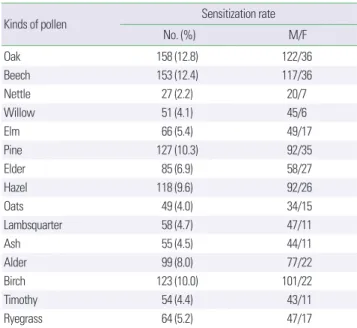
The distribution of sensitized pollens was oak (12.8%), beech (12.4%), pine (10.3%), birch (10%), hazel (9.6%), alder (8%), elder (6.9%), elm (5.4%) in the study of 2010. When allergen/histamine ratio was compared, rates of strong sensitization over 4+ to tree pollen were increased.
Conclusion: The sensitization rates to inhalant allergens were increased in children with asthma or allergic rhinitis from a tertiary re- ferral hospital in Seoul over last 10 years. Especially, an increase in the degree of skin reactivity was observed in cat dander, dog dan- der, and tree pollens. The studies to investigate the etiology of this increase and prevention will be needed. (Allergy Asthma Respir Dis 2014;2:97-102)
Keywords: Allergens, Asthma, Allergic rhinitis, Hypersensitivity, Child
서 론
지난 수십 년 동안 알레르기질환은 전 세계적으로 꾸준히 증가 해 왔으며,1-3) 국내에서도 이에 대한 보고가 여러 차례 있었다.4-9) 이 렇게 알레르기질환이 증가하는 원인으로는 대기오염의 증가,10) 생
활패턴의 변화,11) 기후 변화로 인한 화분 등의 실외 알레르겐, 집먼 지진드기, 개 비듬, 고양이 비듬 등의 실내 알레르겐 증가 등을 들 수 있다.12) 특히 최근 국내에서 화분량 및 화분 식물의 생태 변화에 대한 보고가 있었는데, 기후 변화에 의해 개화 기간이 길어지면서 국내에서도 화분에 대한 노출량이 많아졌고, 목초류(grass) 및 잡 Allergy Asthma Respir Dis 2(2):97-102, May 2014 http://dx.doi.org/10.4168/aard.2014.2.2.97 ORIGINAL ARTICLE
Correspondence to: Soo-Jong Hong
Department of Pediatrics, Childhood Asthma Atopy Center, Asan Medical Center, University of Ulsan College of Medicine, 88 Olympic-ro 43-gil, Songpa-gu, Seoul 138-736, Korea
Tel: +82-2-3010-3379, Fax: +82-2-473-3725, E-mail: [email protected]
• This study was supported by a grant from the Korea Healthcare Technology R&D Project, Ministry for Health, Welfare, Republic of Korea (grant number, A092076).
Received: May 2, 2013 Revised: December 14, 2013 Accepted: December 14, 2013
© 2014 The Korean Academy of Pediatric Allergy and Respiratory Disease The Korean Academy of Asthma, Allergy and Clinical Immunology This is an Open Access article distributed under the terms of the Creative Commons Attribution Non-Commercial License
초류(weed) 화분은 감소하는 데 비해 수목류(tree) 화분은 증가 추 세를 보였다.13) 공중 화분과 연관되어 유발되는 알레르기질환을 화 분증(pollinosis)이라고 하는데, 여기에는 천식, 알레르기비염, 알레 르기결막염 등이 속한다. 또한 중요한 실내 알레르겐으로는 집먼지 진드기를 들 수 있는데, 역시 알레르기비염과 천식을 모두 일으킬 수 있어 이에 대한 관심이 지속적으로 필요하다.14)
또 다른 실내 알레르겐은 개와 고양이로 대표되는 애완동물의 비듬이다. 서구 사회에서도 지난 60년간 지속적으로 이에 대한 알 레르기질환의 증가가 보고되고 있다.15) 미국에서의 통계에 따르면 62%의 가구가 하나 이상의 애완동물을 키우고 있고, 7천8백2십만 마리의 개와 8천6백4십만 마리의 고양이가 있다고 한다.16) 국내에 서는 2007년 통계청 자료에서 전체 가구의 10%인 1백5십5만 가구 에서 2백2만 마리의 개와 7만7천 가구에서 7만7천 마리의 고양이 를 키우고 있다고 보고되었다.17) 2011년 농림수산식품부의 자료에 따르면 17.9%의 가구가 하나 이상의 애완동물을 키우고 있고, 4백4 십만 마리의 개와 1백1십6만 마리의 고양이가 있는 것으로 보고되 었다.18) 애완동물 비듬에 대한 알레르기 감작이 발생하면 이것이 천식을 예방하는 효과가 있다는 보고도 있지만,19) 고농도에 노출될 경우에는 화분 알레르기를 유도할 수도 있다는 최근 보고도 있 다.20) 출생 코호트에서는 개 비듬 알레르겐이 천식의 발생을 증가시 킨다는 보고가 있었다.21) 최근 국내 보고로는 서울 동북지역 학동 전기 소아를 대상으로 흡입항원 감작과 알레르기질환의 연관성을 조사한 연구에서 흡입항원의 감작 개수가 증가할수록 알레르기비 염과 아토피피부염의 위험도가 증가하며, 특히 12개월 내 아토피피 부염 증상과 집먼지진드기, 동물 비듬의 상관관계를 확인하였다.22)
이상을 정리해 보면 국내에서 흡입항원이 알레르기질환의 증가 에 미치는 영향력이 높다고 추정된다. 따라서, 본 연구는 서울과 인 근지역 소아알레르기 환아에서 지난 10년간 주요 흡입항원의 변화, 특히 화분과 집먼지진드기 알레르겐의 감작률 변화에 대해 조사하 였다.
대상 및 방법
1. 연구 대상
지난 10년간 피부 반응도의 변화를 살펴보기 위해 2000년, 2005 년 및 2010년에 천식 혹은 알레르기비염으로 서울아산병원 소아천 식아토피센터에 처음 방문하여 시행한 각각 398명, 624명, 1,233명 의 피부단자시험 결과를 후향적으로 분석하였다. 이번 연구에서는 아토피피부염 및 식품알레르기 환자는 조사 대상에서 제외하였다.
분석된 환아는 모두 합하여 2,225명이었으며 연령 분포는 각각 2세 에서 17세, 3세에서 18세, 2세에서 19세였다. 평균 연령 및 남녀의 비 율은 통계적으로 연도에 따른 유의한 차이가 없었다(Table 1).
2. 연구 방법
피부단자검사는 쑥(Mugwort), 돼지풀(Ragweed), 수목류 화분 혼합1 (Treepollen mixture I; Alder, Elm, Hazel, Poplar, and Wil- low), 수목류 화분 혼합2 (Tree pollen mixture II; Beech, Birch, Oak, and Plane tree), 잡초(Weed), 아스페르길루스(Aspergillus), 알터나리아(Alternaria), 유럽 집먼지진드기(Dermatophagoides pteronyssinus), 북아메리카 집먼지진드기(Dermatophagoides fa- rina), 고양이 비듬, 강아지 비듬, 바퀴벌레의 12개 주요 알레르겐 (Allergopharma, Reinbek, Germany)에 대한 결과를 분석하였다.
2010년도에는 환삼덩굴(Hop Japanese; Allergopharma, Reinbek, Germany)을 추가하여 조사하였다. 항원에 대한 감작은 단자시험 후 15분에 양성 대조용 히스타민의 팽진과 비교하여 항원의 반응 정도를 나타내는 알레르겐/히스타민 팽진비(allergen to histamine [A/H] ratio)를 이용하여 평가하였다. 알레르겐 팽진이 히스타민 팽 진 크기의 1/2 미만이면 1+, 1/2보다 크지만 히스타민 팽진보다 작으 면 2+, 같거나 크면 3+로, 두 배 이상이면 4+, 세 배 이상과 네 배 이 상을 각각 5+와 6+로 판정하는 6등급의 기준을 사용하였다. 3+ 이 상의 등급을 감작으로 정의하였다. 지난 10년간 알레르겐의 감작률 변화를 보기 위해 2000년, 2005년, 2010년 각 연도별 전체 검사 환 자에 대한 화분 및 집먼지진드기 알레르겐 양성 환자 수의 백분율 을 구하여 비교 분석하였으며, 연도별 각 알레르겐에 대한 감작 강 Table 1. Characteristics of enrolled subjects
Characteristic 2000 year 2005 year 2010 year
No. of subjects 398 624 1,233
Male/female (%) 58.8/41.2 62.2/37.8 61.6/38.4
Age (yr) 8.16± 2.79 8.95± 3.08 8.94± 3.78
2 1 (0.2) 0 (0) 16 (1.3)
3 12 (2.5) 7 (1.1) 74 (6.0)
4 58 (12.0) 70 (11.2) 134 (10.9)
5 68 (14.0) 82 (13.1) 168 (13.7)
6 137 (28.2) 92 (14.7) 137 (11.1)
7 37 (7.6) 56 (9.0) 101 (8.2)
8 47 (9.7) 60 (9.6) 120 (9.8)
9 35 (7.2) 57 (9.1) 113 (9.2)
10 38 (7.8) 58 (9.3) 77 (6.3)
11 22 (4.5) 46 (7.4) 58 (4.7)
12 9 (1.9) 38 (6.1) 59 (4.8)
13 13 (2.7) 28 (4.5) 50 (4.1)
14 5 (1.0) 13 (2.1) 39 (3.2)
15 2 (0.4) 12 (1.9) 36 (2.9)
16 0 (0) 1 (0.2) 16 (1.3)
17 1 (0.2) 3 (0.5) 15 (1.2)
18 0 (0) 1 (0.2) 14 (1.1)
19 0 (0) 0 (0) 2 (0.2)
Values are presented as mean± standard deviation or number (%) unless otherwise indicated.
도의 변화 및 연령에 따른 감작률 변화를 비교하였다.
3. 통계 분석
감작 강도별 알레르겐 감작률 차이는 교차분석을 이용하여 비교 하였고, 연도별 알레르겐 감작률 변화에 대해서는 교차분석과 로지 스틱 회귀분석을 이용하여 비교하였다. 모든 통계분석은 PASW Statistics 18.0 (SPSS Inc., Chicago, IL, USA) 프로그램을 이용하였고 P값이 0.05보다 작은 경우 통계적으로 유의한 것으로 판정하였다.
결 과
1. 주요 흡입 알레르겐에 대한 감작률의 변화
본 연구에서 분석 대상으로 한 12종 알레르겐 각각의 감작률 변 화를 살펴보면 특히 Tree pollen mixture I (Alder, Elm, Hazel, Pop- lar, and Willow), Tree pollen mixture II (Beech, Birch, Oak, and Plane tree), 고양이 비듬, 개 비듬이 2000년에 비해 2005년, 2010년 에 통계적으로 유의하게 감작률이 증가하는 경향을 보였다. Tree pollen mixture I에 대한 감작률은 2000년 5.0%에서 2010년 14.8%
로 3배 증가하였고(trend P<0.001), Tree pollen mixture II에 대한 감작률도 2000년 6.8%에서 2010년 17.3%로 2배 증가하였다(trend P<0.001). 고양이 비듬, 개 비듬도 같은 양상으로 2000년에 비해 2010년 결과에서 감작률이 4.8%에서 12.7%, 4.8%에서 16.7%로 각 각 2배, 3배 증가한 양상을 보였다(trend P= 0.001, trend P= 0.019) (Table 2).
2. 화분별 알레르겐에 대한 감작률
2010년도에 15종의 화분별 알레르겐 피부반응검사를 시행한 환 아들에서 화분별 알레르겐 감작률을 조사한 결과, 떡갈나무(Oak) 12.8%, 너도밤나무(Beech) 12.4%로 가장 많았고 그 다음이 소나무 (Pine) 10.3%, 자작나무(Birch) 10.0%, 개암나무(Hazel) 9.6%, 오리 나무(Alder) 8.0%, 딱총나무(Elder) 6.9%, 느릎나무(Elm) 5.4%의 순서로 많았다(Table 3).
Table 2. Changes of sensitization rate
Variable 2000 year 2005 year 2010 year
Trend P-value
No. (%) M/F No. (%) M/F No. (%) M/F
Mugwort 19 (4.8) 14/5 64 (10.3) 44/20 91 (7.4) 66/25 0.878
Ragweed 17 (4.3) 12/5 30 (4.8) 18/12 57 (4.6) 41/16 0.695
Tree mix I 20 (5.0) 13/7 53 (8.5) 40/13 183 (14.8) 139/44 < 0.001*
Tree mix II 27 (6.8) 18/9 61 (9.8) 46/15 213 (17.3) 158/55 < 0.001*
Weed 21 (5.3) 15/6 61 (9.8) 41/20 116 (9.4) 85/31 0.155
Hop. Japanese NA - NA - 124 (12.5) - NA
D. pteronyssinus 219 (55.0) 137/82 388 (62.2) 252/136 778 (63.1) 511/267 0.034*
D. farinae 228 (57.3) 141/87 403 (64.6) 263/140 799 (64.8) 529/270 0.058
Alternaria 49 (12.3) 36/13 103 (16.5) 75/28 141 (11.4) 96/45 0.060
Aspergillus 10 (2.5) 8/2 43 (6.9) 26/17 60 (4.9) 45/15 0.714
Cat 19 (4.8) 12/7 74 (11.9) 48/26 156 (12.7) 111/45 0.001*
Dog 19 (4.8) 12/7 175 (28.0) 121/54 206 (16.7) 145/61 0.019*
Cockroach 10 (2.5) 7/3 59 (9.5) 36/23 66 (5.4) 53/13 0.924
Data were calculated by logistic regression analysis. Tree pollen mixture I includes Alder, Elm, Hazel, Poplar and Willow tree pollen. Tree pollen mixture II includes Beech, Birch, Oak and Plane tree pollen.
D. pteronyssinus, Dermatophagoides pteronyssinus; D. farina, Dermatophagoides farina; NA, not analyzed.
*P-values are significant.
Table 3. Sensitization rates for kinds of pollen in year 2010
Kinds of pollen Sensitization rate
No. (%) M/F
Oak 158 (12.8) 122/36
Beech 153 (12.4) 117/36
Nettle 27 (2.2) 20/7
Willow 51 (4.1) 45/6
Elm 66 (5.4) 49/17
Pine 127 (10.3) 92/35
Elder 85 (6.9) 58/27
Hazel 118 (9.6) 92/26
Oats 49 (4.0) 34/15
Lambsquarter 58 (4.7) 47/11
Ash 55 (4.5) 44/11
Alder 99 (8.0) 77/22
Birch 123 (10.0) 101/22
Timothy 54 (4.4) 43/11
Ryegrass 64 (5.2) 47/17
3. 화분 알레르겐과 집먼지진드기 알레르겐에 대한 감작 강도의 변화
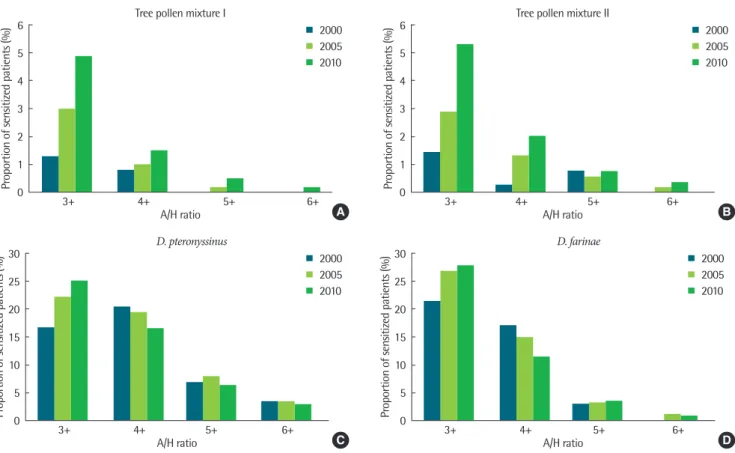
감작된 환자 내에서 알레르겐/히스타민 팽진비가 4+ 이상인 환 아가 차지하는 비율은 Tree pollen mixture I의 경우 2000년 0.8%, 2005년 1.1%, 2010년 2.1%였으며(P= 0.007), Tree pollen mixture II 의 경우 2000년 1.0%, 2005년 2.2%, 2010년 3.3%였다(P<0.001). 또 한 D. pteronyssinus의 경우 2000년 30.4%, 2005년 30.8%, 2010년 25.7%였으며(P = 0.021), D. farinae의 경우 2000년 23.6%, 2005년 22.6%, 2010년 18.6%였다(P = 0.007). 결과를 정리해 보면 알레르 겐/히스타민 팽진비가 4+ 이상의 감작률은 집먼지진드기 알레르겐 에 대해서는 감소를 보였으나 화분 알레르겐에 대해서는 증가를 보 였다.
4. 연령대에 따른 화분 알레르겐과 집먼지진드기 알레르겐에 대한 감작률의 변화
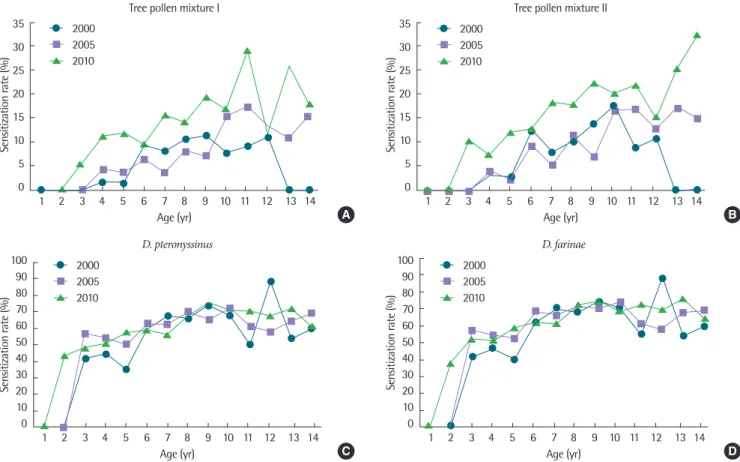
최근 10년간 연령대에 따른 화분 알레르겐에 대한 감작률의 변 화를 살펴보면 전반적으로 소아 전체 연령대에 걸쳐서 고른 증가를 볼 수 있다. 특히 학동전기인 3세에서부터 이미 감작이 시작되는 것 을 확인할 수 있었고, 그 감작률이 2000년도에 비해 증가하였다
(Tree pollen mixture I, P<0.001; Tree pollen mixture II, P<0.001) (Fig. 1A, B). 집먼지진드기 알레르겐에 대한 감작률의 변화를 살펴 보면 소아 전체 연령대에 걸쳐 높은 감작률을 볼 수 있었고, 유아기 인 2세부터 이미 감작이 시작되어 역시 그 감작률이 2005년 이후 2010년까지 점차 증가하고 있는 것이 확인되었다(D. pteronyssinus, P<0.001; D. farina, P<0.001) (Fig. 1C, D).
고 찰
10년 사이의 변화에 대한 본 연구의 분석 결과를 보면 화분 알레 르겐과 고양이 비듬, 개 비듬 알레르겐의 감작률이 2배 이상 증가하 였다. 피부단자검사상 알레르겐/히스타민 팽진비가 4+ 이상의 강양 성을 보이는 경우에 있어서 집먼지진드기 알레르겐에 대한 감작률 은 감소를 보이는 반면(D. pteronyssinus, P = 0.021; D. farina, P = 0.007), 화분 알레르겐에 대한 감작률은 증가 추세를 보였다 (Tree pollen mixture I, P= 0.007; Tree pollen mixture II, P<0.001 ).
화분 알레르겐에 대한 국내 자료를 보면 1999년, 2005년, 2008년 경기 남부 지역 대학병원에서 시행한 조사에서 지속적인 감작률의 증가가 확인되었고 10세 미만의 소아연령에서도 특히 환삼덩굴에 35
30 25 20 15 10 5 0
Sensitization rate (%)
1 2 3 4 5 6 7 8 9 10 11 12 13 14
Age (yr) Tree pollen mixture I
2010 2005 2000
A B
35 30 25 20 15 10 5 0
Sensitization rate (%)
1 2 3 4 5 6 7 8 9 10 11 12 13 14
Age (yr) Tree pollen mixture II
2010 2005 2000
C 100
90 80 70 60 50 40 30 20 10 0
Sensitization rate (%)
1 2 3 4 5 6 7 8 9 10 11 12 13 14
Age (yr) D. pteronyssinus
2010 2005 2000
D 100
90 80 70 60 50 40 30 20 10 0
Sensitization rate (%)
1 2 3 4 5 6 7 8 9 10 11 12 13 14
Age (yr) D. farinae
2010 2005 2000
Fig. 1. Changes of sensitization rate for age. (A) Tree pollen mixture I. (B) Tree pollen mixture II. (C) Dermatophagoides pteronyssinus. (D) Dermatophagoides farina.
Changes in sensitization rate in each age group between 2000 and 2010. P-values are calculated by chi-square test (linear by linear association) for ages.
6 5 4 3 2 1
0 3+ 4+ 5+ 6+
2010 2005 2000
Proportion of sensitized patients (%)
A/H ratio Tree pollen mixture I
A B
6 5 4 3 2 1
0 3+ 4+ 5+ 6+
2010 2005 2000
Proportion of sensitized patients (%)
A/H ratio Tree pollen mixture II
C 30
25 20 15 10 5
0 3+ 4+ 5+ 6+
2010 2005 2000
Proportion of sensitized patients (%)
A/H ratio D. pteronyssinus
D 30
25 20 15 10 5
0 3+ 4+ 5+ 6+
2010 2005 2000
Proportion of sensitized patients (%)
A/H ratio D. farinae
Fig. 2. Changes of rate for allergen to histamine (A/H) ratio. (A) Tree pollen mixture I. (B) Tree pollen mixture II. (C) Dermatophagoides pteronyssinus. (D) Dermatopha- goides farina. Changes in proportion of sensitized patients according to the skin prick test results between 2000 and 2010. P-values are calculated by chi-square test (linear by linear association) for allergen to histamine ratio.
서 뚜렷한 증가를 보였다.23) 비슷한 결과를 본 연구에서도 관찰할 수 있었으며, 본 연구에서는 환삼덩굴에 대해서 2010년에만 조사 를 시행하였지만 12.5%의 높은 감작률이 확인되었다. 이것은 2010 년 인천, 제주, 울산에서 초등학생부터 고등학생까지 시행한 조사 와 비교하였을 때 매우 높은 수치이다.24) 또한 화분 알레르겐 감작 이 3세 이하의 어린 연령에서도 시작되고 있음을 2010년 연령별 분 석 결과에서 알 수 있었다(Fig. 1A, B). 또한 화분 알레르겐의 감작 률에 있어서 5+ 이상의 강양성인 경우가 2010년 조사에서 확인되 었다. 이러한 변화들은 기후 온난화로 인해 식물의 개화 시기가 빨 라지고 개화 기간이 길어져 화분 알레르겐의 노출이 많아지는 것 뿐만 아니라 농도 증가에 따른 영향도 다른 원인으로 들 수 있겠 다.12) 평균 기온의 상승으로 인해 수목류(tree)와 잡초류(weed), 목 초류(grass) 화분 생성이 증가되고, 대기 중 이산화탄소 농도 상승 또한 잡초류의 성장을 촉진시키고, 개화 시기를 앞당기며, 항원성 을 증가시키며, 특히 잡초류 중 돼지풀(ragweed)은 기온 상승뿐만 아니라 이산화탄소 농도와 밀접한 연관이 있음이 밝혀졌다.25) 화분 알레르겐의 농도 증가에 대해서는 이미 여러 국내문헌에서도 보고 된 바 있었는데, weed pollen의 전국 평균의 최고치는 1997–2000년 89–128 grains/m3/day에서 2001–2004년 275–302 grains/m3/day로
급격히 증가하는 추세를 보였다.3,26,27)
집먼지진드기에 대해서는 기존의 국내 보고들에서 높은 감작률 과 증가 추세를 확인할 수 있었다.14,28) 하지만 본 연구에서는 특히 피 부단자검사상 4+ 이상의 강양성을 보이는 경우에 있어서 감소 추 세를 확인할 수 있었다(Fig. 2C, D). 이러한 결과는 다른 연구에서 재현될 필요가 전제로 되지만, 집먼지진드기 조절 환경에 대한 인식 이 높아지고 서울지역 주거환경의 개선에 의하여 최근 감작률이 감 소되었을 가능성이 있다. 그러나, 향후 이를 확인할 수 있는 추가적 인 연구가 필요하겠다. 고양이 비듬, 개 비듬의 경우 본 연구에서 2005년과 2010년에 높은 증가를 보였는데, 최근 가정에서 애완동 물을 키우는 것이 증가한 것이 이러한 결과의 원인으로 추정된다.
본 논문의 제한점으로는 2000년과 2005년 조사에서 3세 환자군 의 수가 2010년 조사에 비해 상대적으로 적어 선택 바이어스(sele- tion bias)의 가능성이 있으며, 화분 알레르겐에 대하여 혼합항원 (mixture)으로 조사하여 각각의 화분 알레르겐에 대한 조사가 이 루어지지 못한 점과, 일개 3차 병원으로 연구 대상이 한정되어 있어 전국적인 경향을 대표하지는 못한다는 점, 그리고 일반 인구가 아 니라 외래에 방문한 환자군을 대상으로 하였기 때문에 일반화하기 어렵다는 점이 있다. 그러나 서울의 강남 지역에 있는 3차 병원의 조
사이기는 하지만, 본 연구를 통하여 최근 10년 동안의 항원 감작의 변화 특히 화분 알레르겐의 감작률과 감작 강도가 같이 증가하고 있음을 관찰할 수 있어 향후 이에 대한 원인 규명과 실제 알레르기 질환의 증가와 직접 관련이 있는지 조사가 필요함을 시사한다.
결론적으로 본 연구에서 지난 10년간 3개 년도 2000년, 2005년, 2010년에 시행한 피부단자검사상에서 추정하였을 때 집먼지진드 기 알레르기는 지속적으로 높은 상태이며, 화분 및 개 비듬과 고양 이 비듬 등의 흡입항원에 대한 알레르기가 소아 천식과 비염 환자 에서 증가하는 것으로 나타났다. 특히 화분 알레르겐에 있어서는 알레르겐/히스타민 팽진비가 4+ 이상인 감작률이 증가하는 경향 을 보여 알레르겐 감작 강도 또한 증가하는 것이 확인되었다.
REFERENCES
1. Weinmayr G, Forastiere F, Weiland SK, Rzehak P, Abramidze T, Annesi- Maesano I, et al. International variation in prevalence of rhinitis and its relationship with sensitisation to perennial and seasonal allergens. Eur Respir J 2008;32:1250-61.
2. Pearce N, Ait-Khaled N, Beasley R, Mallol J, Keil U, Mitchell E, et al.
Worldwide trends in the prevalence of asthma symptoms: phase III of the International Study of Asthma and Allergies in Childhood (ISAAC).
Thorax 2007;62:758-66.
3. Oh JW. Characteristics of allergic pollens and the recent increase of sen- sitization rate to weed pollen in childhood in Korea. Korean J Pediatr 2008;51:355-61.
4. Suh M, Kim HH, Sohn MH, Kim KE, Kim C, Shin DC. Prevalence of al- lergic diseases among Korean school-age children: a nationwide cross- sectional questionnaire study. J Korean Med Sci 2011;26:332-8.
5. Hong SJ, Lee MS, Sohn MH, Shim JY, Han YS, Park KS, et al. Self-report- ed prevalence and risk factors of asthma among Korean adolescents:
5-year follow-up study, 1995-2000. Clin Exp Allergy 2004;34:1556-62.
6. Lee SI, Shin MH, Lee HB, Lee JS, Son BK, Koh YY, et al. Prevalences of symptoms of asthma and other allergic diseases in korean children: a na- tionwide questionnaire survey. J Korean Med Sci 2001;16:155-64.
7. Lee JY, Seo JH, Kwon JW, Yu J, Kim BJ, Lee SY, et al. Exposure to gene- environment interactions before 1 year of age may favor the development of atopic dermatitis. Int Arch Allergy Immunol 2012;157:363-71.
8. Kwon JW, Kim BJ, Song Y, Seo JH, Kim TH, Yu J, et al. Changes in the prevalence of childhood asthma in seoul from 1995 to 2008 and its risk factors. Allergy Asthma Immunol Res 2011;3:27-33.
9. Yi O, Kwon HJ, Kim H, Ha M, Hong SJ, Hong YC, et al. Effect of envi- ronmental tobacco smoke on atopic dermatitis among children in Korea.
Environ Res 2012;113:40-5.
10. Anderson HR, Ruggles R, Pandey KD, Kapetanakis V, Brunekreef B, Lai CK, et al. Ambient particulate pollution and the world-wide prevalence of asthma, rhinoconjunctivitis and eczema in children: Phase One of the International Study of Asthma and Allergies in Childhood (ISAAC). Oc- cup Environ Med 2010;67:293-300.
11. Wickens K, Barry D, Friezema A, Rhodius R, Bone N, Purdie G, et al.
Fast foods - are they a risk factor for asthma? Allergy 2005;60:1537-41.
12. Kim JH, Oh JW, Lee HB, Kim SW, Kang IJ, Kook MH, et al. Changes in sensitization rate to weed allergens in children with increased weeds pol- len counts in Seoul metropolitan area. J Korean Med Sci 2012;27:350-5.
13. Oh JW, Lee HB, Kang IJ, Kim SW, Park KS, Kook MH, et al. The revised edition of korean calendar for allergenic pollens. Allergy Asthma Immu- nol Res 2012;4:5-11.
14. Jeong KY, Park JW, Hong CS. House dust mite allergy in Korea: the most important inhalant allergen in current and future. Allergy Asthma Im- munol Res 2012;4:313-25.
15. Morris DO. Human allergy to environmental pet danders: a public health perspective. Vet Dermatol 2010;21:441-9.
16. Lockey RF. The myth of hypoallergenic dogs (and cats). J Allergy Clin Immunol 2012;130:910-1.
17. Kim MH, Kim BN, Han TH. Cat-scratch disease: a case report and litera- ture review of human and animal studies performed in Korea. Infect Chemother 2012;44:299-302.
18. Ministry for Food, Agriculture, Forestry and Fisheries. 2011 Statistics Annual Report for Food, Agriculture, Forestry and Fisheries. Sejong:
Ministry for Food, Agriculture, Forestry and Fisheries; 2011:126-33.
19. Kerkhof M, Wijga AH, Brunekreef B, Smit HA, de Jongste JC, Aalberse RC, et al. Effects of pets on asthma development up to 8 years of age: the PIAMA study. Allergy 2009;64:1202-8.
20. Custovic A, Simpson BM, Simpson A, Hallam CL, Marolia H, Walsh D, et al. Current mite, cat, and dog allergen exposure, pet ownership, and sensitization to inhalant allergens in adults. J Allergy Clin Immunol 2003;111:402-7.
21. Carlsten C, Brauer M, Dimich-Ward H, Dybuncio A, Becker AB, Chan- Yeung M. Combined exposure to dog and indoor pollution: incident asthma in a high-risk birth cohort. Eur Respir J 2011;37:324-30.
22. Choi MH, Kwon EM, Kim HB, Kim CK. Sensitization to inhalant aller- gens and its association with allergic diseases in preschool children. Ko- rean J Asthma Allergy Clin Immunol 2012;32:176-82.
23. Lee JW, Choi GS, Kim JE, Jin HJ, Kim JH, Ye YM, et al. Changes in sensi- tization rates to pollen allergens in allergic patients in the southern part of Gyeonggi province over the last 10 years. Korean J Asthma Allergy Clin Immunol 2011;31:33-40.
24. Park SH, Lim DH, Son BK, Kim JH, Song YE, Oh IB, et al. Sensitization rates of airborne pollen and mold in children. Korean J Pediatr 2012;
55:322-9.
25. Yang HJ, Jeon YH, Min TK, Son BS, Park KJ, Moon JY, et al. The impact of climate change on aeroalleregen and pediatric allergic diseases. J Kore- an Med Assoc 2011;54:971-8.
26. Oh JW, Kang IJ, Kim SW, Kook MH, Kim BS, Cheong JT, et al. The asso- ciation between the concentration of pollen and outbreak of pollinosis in childhood. Pediatr Allergy Respir Dis 2009;19:4-11.
27. Oh JW, Kang IJ, Kim SW, Kook MH, Kim BS, Shin KS, et al. The correla- tion between increased sensitization rate to weeds in children and the annual increase in weed pollen in Korea. Pediatr Allergy Respir Dis 2006;
16:114-21.
28. Kim J, Hahm MI, Lee SY, Kim WK, Chae Y, Park YM, et al. Sensitization to aeroallergens in Korean children: a population-based study in 2010. J Korean Med Sci 2011;26:1165-72.