D I A B E T E S & M E T A B O L I S M J O U R N A L
This is an Open Access article distributed under the terms of the Creative Commons At- tribution Non-Commercial License (http://creativecommons.org/licenses/by-nc/3.0/) which permits unrestricted non-commercial use, distribution, and reproduction in any medium, provided the original work is properly cited.
Relationship between Chemerin Levels and
Cardiometabolic Parameters and Degree of Coronary Stenosis in Korean Patients with Coronary Artery
Disease
Yu-Jin Hah*, Nam-Keong Kim*, Mi-Kyung Kim, Hye-Soon Kim, Seung-Ho Hur, Hyuck-Jun Yoon, Yoon-Nyun Kim, Keun-Gyu Park
Department of Internal Medicine, Keimyung University School of Medicine, Daegu, Korea
Background: Chemerin is a novel adipokine that is associated with inflammation and adipogenesis. However, it remains un- clear whether chemerin is involved in patients with cardiovascular disease. We investigated whether the serum chemerin levels of Korean patients with coronary artery disease correlated with specific cardiometabolic parameters.
Methods: In total, 131 patients, all of whom had coronary artery stenosis exceeding 50%, participated in this study. Their serum chemerin levels and cardiometabolic parameters were measured. The serum chemerin levels of two groups of patients were com- pared; those with one stenotic vessel (n=68) and those with multiple stenotic vessels, including left main coronary artery disease (n=63).
Results: Serum chemerin levels correlated positively with the degree of coronary artery stenosis and fasting glucose, triglycer- ide, total cholesterol, low density lipoprotein cholesterol, and high sensitive C-reactive protein levels. The group with multiple stenotic vessels, including left main disease, had higher chemerin levels than the group with one stenotic vessel (t=-2.129, P=0.035). Multiple binary logistic regression showed chemerin was not an independent risk factor of multiple vessel disease (odds ratio, 1.018; confidence interval, 0.997 to 1.040; P=0.091).
Conclusion: Serum chemerin levels have a significant correlation with several cardiometabolic risk factors and the degree of coronary artery stenosis in Korean patients with coronary artery disease. However, multiple binary logistic regression showed chemerin was not an independent risk factor of multiple vessel disease. Additional investigations are necessary to fully elucidate the role of chemerin in cardiovascular disease.
Keywords: Chemerin; Coronary artery disease; Metabolic syndrome
Corresponding author: Keun-Gyu Park
Department of Internal Medicine, Keimyung University School of Medicine, 194 Dongsan-dong, Jung-gu, Daegu 700-712, Korea
E-mail: [email protected]
Received: May 31, 2010; Accepted: Dec. 14, 2010
INTRODUCTION
Due to the essential role obesity plays in the pathogenesis of metabolic syndrome, a syndrome that is associated with car- diovascular morbidity, considerable interest has arisen in un- derstanding the role obesity plays in cardiovascular disease [1]. Adipose tissue is no longer thought to only store excess
energy; rather, it appears to be an active endocrine organ that produces many cytokines, which are known as adipokines [2- 6]. These adipokines appear to have systemic effects on the brain, liver, muscles, β-cells, gonads, lymphoid organs, and vasculature [7]. Many studies have examined the role adipose tissue plays in the development of coronary artery disease in patients with metabolic syndrome [8-13], and it is now under- pISSN 2233-6079 · eISSN 2233-6087
stood that adipose tissue can cause vascular complications ei- ther directly by causing atherosclerosis and inducing inflam- matory responses, or indirectly by promoting the development of insulin resistance [14]. These atherosclerosis-inducing path- ways are mediated by various adipokines, including adiponec- tin, leptin, retinol binding protein-4 and resistin [8-12]. Anal- yses of additional adipokines may help us to further under- stand the pathogenesis of insulin resistance and its cardiovas- cular complications.
Chemerin is a recently discovered 16 kDa chemoattractant protein that acts as a ligand for the G-protein receptor CMKLR1 (ChemR23 or DEZ) [15,16]. It is secreted by adipose tissue as prochemerin (18 kDa) [16] and is transformed into an active protein by serine protease cleavage of its C-terminal fragment [17]. In its active form, chemerin regulates the immune system and participates in inflammation by promoting the recruitment of tissue macrophages and plasmacytoid dendritic cells [15,18].
Chemerin is also associated with adipogenesis, as studies with Psammomys obesus have shown that while both chemerin and CMKLR1 are expressed by all tissues, their expression is par- ticularly high in the liver, kidney, and adipose tissue [19]. More- over, while undifferentiated adipose tissue only expresses low levels of chemerin and CMKLR1, both molecules are expressed at progressively higher levels by differentiated adipocytes [15].
The knockdown of chemerin or CMKLR1 expression in pre- adipocytes severely impairs their differentiation and reduces the expression of genes involved in glucose and lipid metabo- lism [15]. These observations suggest that chemerin may par- ticipate in insulin resistance and its cardiovascular complica- tions.
As mentioned above, chemerin is associated with inflam- mation, adipogenesis, glucose, and lipid metabolism, all of which may contribute to the development of diabetic cardio- vascular complications, especially atherosclerosis [15,18,19].
Therefore, we hypothesized that chemerin levels might be re- lated to other cardiometabolic markers and that an increase in chemerin might reflect the degree of atherosclerotic burden.
To further address this question, we examined whether the chemerin levels in Korean patients with coronary artery dis- ease correlate with specific cardiometabolic parameters.
METHODS
Subjects
Of the patients who underwent coronary angiography at Kei-
myung University Dongsan Hospital, Daegu, Korea from No- vember 2006 to April 2007, 131 were proven by coronary an- giography to have meaningful stenosis (≥50%) and were re- cruited. Patients who did not have infections or renal or liver failure were eligible for the study. The medical history of each patient was determined by a questionnaire. The present study was approved by the local Ethical Review Committee of the Keimyung University School of Medicine. All participants gave informed consent.
Anthropometric, blood pressure, and biochemical measurements
All patients provided their personal information, and their height, weight, and waist circumference were measured. Body mass index (BMI) was calculated (kg/m2). Blood pressure was measured by an electronic device (FA-94H; Fanics, Korea) af- ter sitting for 5 minutes. Blood was drawn in the morning after a 12-hour fast. The fasting serum glucose levels were measured by using the glucose oxidase method (Cobas Integra 800;
Roche, Basel, Switzerland). Fasting serum insulin concentra- tions were measured by a radioimmunoassay kit (Insulin Myria; TechnoGenetics, Milano, Italy). The homeostasis mod- el of assessment of insulin resistance (HOMA-IR) was calcu- lated as fasting in sulin×(fasting glucose/22.5). The levels of the following biochemical markers were measured by enzy- matic methods (Cobas Integra 800): serum triglyceride, total cholesterol, and high density lipoprotein (HDL) and low den- sity lipoprotein (LDL) cholesterol. High sensitive C-reactive protein (hsCRP) concentrations were measured using the la- tex method (TBA-200 FR; Tosiba, Tokyo, Japan). Serum ho- mocysteine concentrations were measured using an Axsym (Abbott, Abbott Park, IL, USA). The separated sera were stored at -70°C until the chemerin levels could be measured using a commercially available ELISA (R&D, Minneapolis, MN, USA) as previously described [19]. The capture antibody and detection antibody were used. Intra- and inter-assay coef- ficients of variance for the che merin ELISA were 5.0% and 10.0%, respectively. The sensitivity of the ELISA assay was 1 to 10 ng/dL, and the midrange of the assay was 5 ng/dL. This kit can detect human chemerin concentration by 0.5 ng/dL at least.
Coronary angiogram
Angiographic images were reviewed by an experienced cardi- ologist who was unaware of the patient’s biochemistry results.
As outlined in the Duke coronary artery index [20,21], we de- fined significant stenosis as >50% of the lumen diameter. The degree of stenosis of the diseased vessels served as a severity index. Patients were divided into two groups; those with one stenotic vessel (n=68) and those with multiple stenotic vessels, including left main disease (n=63).
Statistical analysis
The data are expressed as mean±standard deviation. We per- formed Student’s t-test to compare chemerin levels and other metabolic factors in patients divided according to the number of stenotic vessels, and checked multiple binary logistic regres- sion analysis (95% confidence interval) on risk of multiple ves- sel stenosis. We performed Pearson’s correlation analyses be- tween chemerin and cardiometabolic factors using SPSS ver- sion 12.0 software for Windows (SPSS Inc., Chicago, IL, USA).
P values of less than 0.05 were considered statistically signifi- cant.
RESULTS
Clinical and metabolic subject characteristics
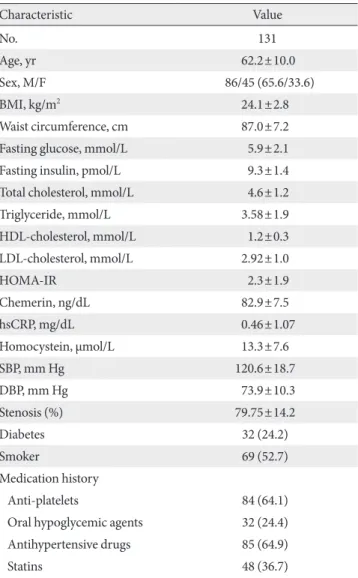
Table 1 shows the clinical characteristics of the 131 study sub- jects, of whom 86 (65.6%) and 45 (33.6%) were men and wom- en, respectively. In total, 69 (52.7%) patients were smokers, 32 (24.4%) had diabetes and 85 (64.9%) had hypertension. Mean BMI was 24.1±2.8 kg/m2. Thirty-five (26.7%) patients were overweight (BMI 23 to 24.9 kg/m2) and 51 (39.0%) patients were obese (BMI >25 kg/m2). Angiography showed that 68 (49.8%) patients had one vessel disease, 39 (32.2%) had two vessel disease, 16 (12.3%) had triple vessel disease, and 8 (5.8%) had left main disease. In addition, 84 (64.1%) patients were being treated with anti-platelet agents, 32 (24.4%) patients were being treated with an oral hypoglycemic agent, 85 (64.9%) pa- tients were being treated with an antihypertensive drug, and 48 (36.7%) patients were being treated with statins before en- rollment.
Correlation between serum chemerin concentrations and cardiometabolic parameters
There were significant but weak correlations between serum chemerin concentrations and fasting glucose, triglyceride, to- tal cholesterol, LDL-cholesterol and hsCRP (Table 2). Howev- er, serum chemerin concentrations did not correlate signifi- cantly with fasting insulin, HDL-cholesterol or homocysteine
levels, BMI, waist circumference, HOMA-IR and systolic and diastolic blood pressure.
Correlation between serum chemerin concentrations and coronary angiographic findings
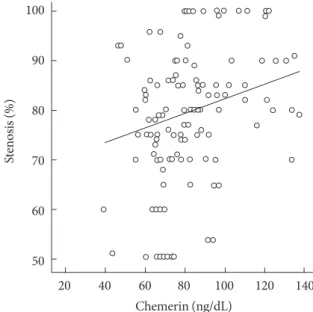
To determine whether serum chemerin concentration is asso- ciated with coronary artery disease, we analyzed the correla- tion between serum chemerin concentrations and coronary stenosis (%) in all participants. Fig. 1 shows how serum che- merin concentrations correlate with the degree of coronary ar- tery stenosis. We measured a significant positive correlation, Table 1. Clinical and metabolic characteristics of subjects
Characteristic Value
No. 131
Age, yr 62.2±10.0
Sex, M/F 86/45 (65.6/33.6)
BMI, kg/m2 24.1±2.8
Waist circumference, cm 87.0±7.2
Fasting glucose, mmol/L 5.9±2.1
Fasting insulin, pmol/L 9.3±1.4
Total cholesterol, mmol/L 4.6±1.2
Triglyceride, mmol/L 3.58±1.9
HDL-cholesterol, mmol/L 1.2±0.3
LDL-cholesterol, mmol/L 2.92±1.0
HOMA-IR 2.3±1.9
Chemerin, ng/dL 82.9±7.5
hsCRP, mg/dL 0.46±1.07
Homocystein, μmol/L 13.3±7.6
SBP, mm Hg 120.6±18.7
DBP, mm Hg 73.9±10.3
Stenosis (%) 79.75±14.2
Diabetes 32 (24.2)
Smoker 69 (52.7)
Medication history
Anti-platelets 84 (64.1)
Oral hypoglycemic agents 32 (24.4)
Antihypertensive drugs 85 (64.9)
Statins 48 (36.7)
Data are presented as mean±standard deviation or number (%).
BMI, body mass index; HDL, high density lipoprotein; LDL, low den- sity lipoprotein; HOMA-IR, homeostasis model of assessment of in- sulin resistance; hsCRP, high sensitive C-reactive protein; SBP, systol- ic blood pressure; DBP, diastolic blood pressure; Stenosis (%), percen- tage of coronary artery stenosis.
albeit weak, between these two parameters (r=0.0200, P=0.022).
Moreover, the group with multiple vessel disease, including left main disease, showed higher age and chemerin, LDL, and CRP levels than the one vessel disease group (Table 3). How-
ever, Table 4 depicts that chemerin level is not an independent risk factor in multiple vessel disease.
DISCUSSION
Accumulating evidence has suggested that adipokines play an Table 2. Correlation between chemerin and cardiometabolic
parameters
Parameter r P value
BMI -0.104 0.238
Waist circumference -0.089 0.347
Fasting glucose 0.208 0.032
Fasting insulin 0.045 0.679
Triglyceride 0.208 0.018
Total cholesterol 0.177 0.043
HDL-cholesterol -0.149 0.090
LDL-cholesterol 0.198 0.025
HOMA-IR 0.096 0.402
Log hsCRP 0.209 0.018
Homocystein 0.134 0.173
SBP -0.035 0.692
DBP -0.019 0.827
The P values are from Pearson’s correlations.
BMI, body mass index; HDL, high density lipoprotein; LDL, low den- sity lipoprotein; HOMA-IR, homeostasis model of assessment of in- sulin resistance; hsCRP, high sensitive C-reactive protein; SBP, systol- ic blood pressure; DBP, diastolic blood pressure.
Fig. 1. Correlation between chemerin levels and the degree of coronary artery stenosis. Pearson’s correlation coefficient=0.21;
P<0.022.
20 40 60 80 100 120 140
Chemerin (ng/dL) 100
90 80 70 60 50
Stenosis (%)
7.8
Table 3. Characteristics in patients divided according to the number of stenotic vessels and presence of left main lesions
Parameter One vessel
disease (n=68)
Multiple ves- sel diseasea
(n=63) t (P value) Chemerin, ng/dL 79.5±18.1 86.6±20.4 -2.129 (0.035)
Age, yr 60.1±9.9 64.5±9.7 -2.536 (0.012)
BMI, kg/m2 24.4±3.1 23.9±2.5 1.010 (0.314) HDL, mmol/L 1.2±0.3 1.2±0.2 1.030 (0.305) LDL, mmol/L 2.8±1.0 3.1±1.0 -2.031 (0.044)
TG, mmol/L 1.6±0.8 1.6±0.9 0.042 (0.967)
HbA1c, % 6.4±1.17 6.1±1.1 1.217 (0.227)
Homocystein 13.3±8.3 13.2±6.8 0.051 (0.960) SBP, mm Hg 119.6±16.3 121.3±21.1 -0.420 (0.675) DBP, mm Hg 73.1±9.2 74.7±11.4 -0.862 (0.390) Insulin, pmol/L 10.8±10.0 7.6±4.7 1.968 (0.053) Fasting glucose, mmol/L 5.6±1.3 6.3±2.7 -1.786 (0.079)
HOMA 2.6±2.2 1.9±1.6 1.511 (0.135)
hsCRP, mg/dL 0.3±0.28 0.7±1.5 -2.189 (0.032) Data are presented as mean±standard deviation.
Patients were divided according to one stenotic vessel (one vessel dis- ease) or multiple stenotic vessels (multiple vessel disease).
The P values are from Student’s t-test.
BMI, body mass index; HDL, high density lipoprotein; LDL, low den- sity lipoprotein; HOMA, homeostasis model of assessment; hsCRP, high sensitive C-reactive protein; SBP, systolic blood pressure; DBP, diastolic blood pressure.
aMultiple vessel disease included two and triple vessel disease and left main disease.
Table 4. Multiple binary logistic regression on risk of multiple vessel stenosis
OR 95% CI P value
Chemerin 1.018 0.997-1.040 0.091
Age 1.058 1.017-1.101 0.005
LDL 1.099 0.998-1.019 0.099
CRP 2.045 0.735-5.691 0.171
OR, odds ratio; CI, confidence interval; LDL, low density lipoprotein;
CRP, C-reactive protein.
important role in the development of coronary artery disease in patients with metabolic syndrome [8-13]. Recent studies have shown that chemerin levels associate significantly with metabolic components of the metabolic syndrome [19,22,23].
However, whether chemerin levels are also associated with cardiovascular parameters in patients with coronary artery disease remains to be elucidated. In this study, we investigated whether circulating chemerin concentrations correlate with the cardiometabolic parameters of Korean patients with coro- nary artery disease. We observed that serum chemerin con- centrations were positively correlated with fasting glucose, tri- glyceride, total cholesterol, LDL-cholesterol, and hsCRP. Se- rum chemerin concentrations also had a significant correla- tion with the degree of coronary artery stenosis, although we recognize this association was weak.
Chemerin is a recently identified chemoattractant protein that induces leukocyte migration; in addition, its receptor is expressed by tissue macrophages [16-18]. These observations suggest that chemerin functions in the development of inflam- matory diseases, including atherosclerosis. In this study, we found that chemerin levels correlated positively with hsCRP levels. hsCRP is a circulating marker of inflammation that is predominantly produced by the liver in response to IL-6 [24].
Patients with metabolic syndrome have higher CRP levels than healthy individuals, and this high CRP level is an independent risk factor for type 2 diabetes and cardiovascular disease [24- 26]. CRP also directly promotes the inflammatory component of atherosclerosis by inducing adhesion molecule expression by human endothelial cells [27]. Recently, Lehrke et al. [22]
analyzed the relationship between chemerin and metabolic components in patients with chest pain. In their study, chemer- in is associated with coronary plaque burden and the number of non-calcified plaques, but these correlations dropped out after adjusting for other cardiovascular risk factors. In contrast to their study, this report shows that there was a significant but weak correlation between chemerin concentrations and the degree of coronary artery stenosis even after adjusting for oth- er factors. Moreover, the group with multiple vessel disease had higher chemerin levels than the group with one vessel dis- ease. Thus, our study suggests the possibility that chemerin could be associated with coronary artery disease; however our study did not show that chemerin level was not an indepen- dent risk factor in multiple vessel disease.
In addition to having pro-inflammatory effects, chemerin is a novel adipokine that has been associated with metabolic syn-
drome phenotypes [22]. Chemerin has been shown to regulate adipocyte differentiation and the expression of adipocyte genes involved in glucose and lipid homeostasis [19]. While Bozaog- lu et al. [19] previously failed to detect a significant difference in the chemerin levels of subjects with normal glucose toler- ance and subjects with type 2 diabetes, obese subjects were found to have significantly higher chemerin levels than lean subjects. Moreover, the chemerin levels in normal glucose-tol- erant subjects were found to correlate significantly with vari- ous metabolic parameters, including BMI, waist circumfer- ence, waist-hip ratio, fasting glucose levels, fasting insulin lev- els, plasma triglyceride levels, and blood pressure [19]. How- ever, this study shows that while serum chemerin concentra- tions significantly but weakly correlated with fasting glucose, triglyceride, total cholesterol and LDL cholesterol levels, they did not correlate with fasting insulin levels, HOMA-IR, BMI, waist circumference or blood pressure. This discrepancy may be due to differences between the study populations of the pre- vious study and our own. In particular, our study included sub- jects who were taking antihypertensives, oral hypoglycemia agents and statins.
This study has certain limitations that we will address here.
First, we measured the number of significant coronary steno- ses without individualizing each coronary stenosis according to the type of lesion involved. If we had done so, we could have obtained a more accurate correlation between chemerin and coronary stenosis (%). Second, we enrolled patients with sig- nificant coronary artery stenosis (mentioned in Methods; >50%
of patients) without enrolling healthy controls with no coro- nary artery disease. Thus, we could not determine the odds ra- tio of various cardiometabolic factors in coronary atheroscle- rosis. Third, the chemerin ELISA kit used in this study mea- sures full-length chemerin form. Chemerin protein exists as a full-length protein in plasma, but this form of the protein is known to have lower bioactivity than prochemerin [28]. How- ever, despite these shortcomings, the results suggest that che- merin could be useful as a predictor of metabolic syndrome and cardiovascular complications.
In conclusion, we found that circulating chemerin concen- trations weakly but significantly correlated with several car- diometabolic parameters as well as the severity of coronary ar- tery stenosis in Korean patients with coronary artery disease.
However, multivariate analysis showed chemerin was not an independent risk factor for multiple vessel disease. Additional investigations are necessary to fully elucidate the role chemer-
in plays in the development and/or progression of cardiovas- cular disease.
CONFLICTS OF INTEREST
No potential conflict of interest relevant to this article was re- ported.
ACKNOWLEDGMENTS
This study was supported by a grant from the Korea Health- care Technology R&D Project, Ministry for Health, Welfare &
Family Affairs, Republic of Korea (A08-4335-AA2004-08N1- 00020B).
REFERENCES
1. Hubert HB, Feinleib M, McNamara PM, Castelli WP. Obesity as an independent risk factor for cardiovascular disease: a 26- year follow-up of participants in the Framingham Heart Study.
Circulation 1983;67:968-77.
2. Scherer PE. Adipose tissue: from lipid storage compartment to endocrine organ. Diabetes 2006;55:1537-45.
3. Trayhurn P, Wood IS. Adipokines: inflammation and the pleio- tropic role of white adipose tissue. Br J Nutr 2004;92:347-55.
4. Bastard JP, Maachi M, Lagathu C, Kim MJ, Caron M, Vidal H, Capeau J, Feve B. Recent advances in the relationship between obesity, inflammation, and insulin resistance. Eur Cytokine Netw 2006;17:4-12.
5. Antuna-Puente B, Feve B, Fellahi S, Bastard JP. Adipokines:
the missing link between insulin resistance and obesity. Diabe- tes Metab 2008;34:2-11.
6. Ahima RS, Flier JS. Adipose tissue as an endocrine organ. Trends Endocrinol Metab 2000;11:327-32.
7. Kahn BB, Flier JS. Obesity and insulin resistance. J Clin Invest 2000;106:473-81.
8. Steffens S, Mach F. Adiponectin and adaptive immunity: link- ing the bridge from obesity to atherogenesis. Circ Res 2008;
102:140-2.
9. Nakamura Y, Shimada K, Fukuda D, Shimada Y, Ehara S, Hi- rose M, Kataoka T, Kamimori K, Shimodozono S, Kobayashi Y, Yoshiyama M, Takeuchi K, Yoshikawa J. Implications of plas- ma concentrations of adiponectin in patients with coronary artery disease. Heart 2004;90:528-33.
10. Parhami F, Tintut Y, Ballard A, Fogelman AM, Demer LL. Lep-
tin enhances the calcification of vascular cells: artery wall as a target of leptin. Circ Res 2001;88:954-60.
11. Ingelsson E, Sundstrom J, Melhus H, Michaelsson K, Berne C, Vasan RS, Riserus U, Blomhoff R, Lind L, Arnlov J. Circulating retinol-binding protein 4, cardiovascular risk factors and prev- alent cardiovascular disease in elderly. Atherosclerosis 2009;
206:239-44.
12. Pischon T, Bamberger CM, Kratzsch J, Zyriax BC, Algenstaedt P, Boeing H, Windler E. Association of plasma resistin levels with coronary heart disease in women. Obes Res 2005;13:1764- 71.
13. Lau DC, Dhillon B, Yan H, Szmitko PE, Verma S. Adipokines:
molecular links between obesity and atheroslcerosis. Am J Phy- siol Heart Circ Physiol 2005;288:H2031-41.
14. Kowalska I. Role of adipose tissue in the development of vas- cular complications in type 2 diabetes mellitus. Diabetes Res Clin Pract 2007;78(Suppl 1):S14-22.
15. Goralski KB, McCarthy TC, Hanniman EA, Zabel BA, Butcher EC, Parlee SD, Muruganandan S, Sinal CJ. Chemerin, a novel adipokine that regulates adipogenesis and adipocyte metabo- lism. J Biol Chem 2007;282:28175-88.
16. Wittamer V, Franssen JD, Vulcano M, Mirjolet JF, Le Poul E, Migeotte I, Brezillon S, Tyldesley R, Blanpain C, Detheux M, Mantovani A, Sozzani S, Vassart G, Parmentier M, Communi D. Specific recruitment of antigen-presenting cells by chemer- in, a novel processed ligand from human inflammatory fluids.
J Exp Med 2003;198:977-85.
17. Zabel BA, Allen SJ, Kulig P, Allen JA, Cichy J, Handel TM, But- cher EC. Chemerin activation by serine proteases of the coag- ulation, fibrinolytic, and inflammatory cascades. J Biol Chem 2005;280:34661-6.
18. Zabel BA, Silverio AM, Butcher EC. Chemokine-like receptor 1 expression and chemerin-directed chemotaxis distinguish plasmacytoid from myeloid dendritic cells in human blood. J Immunol 2005;174:244-51.
19. Bozaoglu K, Bolton K, McMillan J, Zimmet P, Jowett J, Collier G, Walder K, Segal D. Chemerin is a novel adipokine associat- ed with obesity and metabolic syndrome. Endocrinology 2007;
148:4687-94.
20. Mark DB, Nelson CI, Califf RM, Harrell FE Jr, Lee KL, Jones RH, Fortin DF, Stack RS, Glower DD, Smith LR, DeLong ER, Smith PD, Reves JG, Jollis JG, Tcheng JE, Muhlbaier LH, Lowe JE, Phillips HR, Pryor DB. Continuing evolution of therapy for coronary artery disease. Initial results from the era of coronary angioplasty. Circulation 1994;89:2015-25.
21. Miller JM, Rochitte CE, Dewey M, Arbab-Zadeh A, Niinuma H, Gottlieb I, Paul N, Clouse ME, Shapiro EP, Hoe J, Lardo AC, Bush DE, de Roos A, Cox C, Brinker J, Lima JA. Diagnostic performance of coronary angiography by 64-row CT. N Engl J Med 2008;359:2324-36.
22. Lehrke M, Becker A, Greif M, Stark R, Laubender RP, von Zie- gler F, Lebherz C, Tittus J, Reiser M, Becker C, Goke B, Leber AW, Parhofer KG, Broedl UC. Chemerin is associated with markers of inflammation and components of the metabolic syndrome but does not predict coronary atherosclerosis. Eur J Endocrinol 2009;161:339-44.
23. Tan BK, Chen J, Farhatullah S, Adya R, Kaur J, Heutling D, Le- wandowski KC, O’Hare JP, Lehnert H, Randeva HS. Insulin and metformin regulate circulating and adipose tissue chemerin.
Diabetes 2009;58:1971-7.
24. Pepys MB, Hirschfield GM. C-reactive protein: a critical up- date. J Clin Invest 2003;111:1805-12.
25. Ridker PM. Clinical application of C-reactive protein for car- diovascular disease detection and prevention. Circulation 2003;
107:363-9.
26. Ridker PM, Hennekens CH, Buring JE, Rifai N. C-reactive pro- tein and other markers of inflammation in the prediction of cardiovascular disease in women. N Engl J Med 2000;342:836- 43.
27. Pasceri V, Willerson JT, Yeh ET. Direct proinflammatory effect of C-reactive protein on human endothelial cells. Circulation 2000;102:2165-8.
28. Yoshimura T, Oppenheim JJ. Chemerin reveals its chimeric nature. J Exp Med 2008;205:2187-90.