• 검색 결과가 없습니다.

Orphan nuclear receptor small heterodimer partner inhibits angiotensin II-stimulated PAI-1 expression in vascular smooth muscle cells

N/A
N/A
Protected

Academic year: 2021

Share "Orphan nuclear receptor small heterodimer partner inhibits angiotensin II-stimulated PAI-1 expression in vascular smooth muscle cells"

Copied!
9
0
0

로드 중.... (전체 텍스트 보기)

전체 글

(1)

Orphan nuclear receptor small heterodimer partner inhibits angiotensin II- stimulated PAI-1 expression in vascular smooth muscle cells

Kyeong-Min Lee

1

, Hye-Young Seo

1

, Mi-Kyung Kim

2

, Ae-Kyung Min

2

, Seong-Yeol Ryu

2

, Yoon-Nyun Kim

2

, Young Joo Park

3

, Hueng-Sik Choi

4

, Ki-Up Lee

5

, Wan-Ju Park

6

, Keun-Gyu Park

2,8

* and In-Kyu Lee

1,7,8

*

1

Department of Internal Medicine

Kyungpook National University School of Medicine Daegu 700-721, Korea

2

Department of Internal Medicine and Institute for Medical Science Keimyung University School of Medicine

Daegu 700-712, Korea

3

Department of Internal Medicine

Seoul National University College of Medicine Seoul 110-744, Korea

4

Hormone Research Center

School of Biological Sciences and Technology Chonnam National University

Gwangju 500-757, Korea

5

Department of Internal Medicine University of Ulsan College of Medicine Seoul 138-736, Korea

6

College of Nursing and Research Institute of Nursing Science Kyungpook National University

7

WCU project "Development for new drug-target in complication of metabolic syndrome"

Kyungpook National University School of Medicine Daegu 700-721, Korea

8
Corresponding authors: Tel, 82-53-250-7892;

Fax, 82-53-250-8010; E-mail, [email protected] (K.G. Park) Tel, 82-53-420-5564; Fax, 82-53-420-2046;

E-mail, [email protected] (I.K. Lee)

*These authors contributed equally to this work.

DOI 10.3858/emm.2010.42.1.002 Accepted 1 September 2009 Available Online 4 November 2009

Abbreviations: PAI-1, plasminogen activator inhibitor-1; SHP, small heterodimer partner; VSMCs, vascular smooth muscle cells

Abstract

Angiotensin II is a major effector molecule in the devel- opment of cardiovascular disease. In vascular smooth muscle cells (VSMCs), angiotensin II promotes cellular

proliferation and extracellular matrix accumulation through the upregulation of plasminogen activator in- hibitor-1 (PAI-1) expression. Previously, we demon- strated that small heterodimer partner (SHP) represses PAI-1 expression in the liver through the inhibition of TGF-β signaling pathways. Here, we investigated whether SHP inhibited angiotensin II-stimulated PAI-1 expression in VSMCs. Adenovirus-mediated over- expression of SHP (Ad- SHP) in VSMCs inhibited angio- tensin II- and TGF-β-stimulated PAI-1 expression.

Ad-SHP also inhibited angiotensin II-, TGF-β- and Smad3-stimulated PAI-1 promoter activity, and angio- tensin II-stimulated AP-1 activity. The level of PAI-1 ex- pression was significantly higher in VSMCs of SHP

-/-

mice than wild type mice. Moreover, loss of SHP in- creased PAI-1 mRNA expression after angiotensin II treatment. These results suggest that SHP inhibits PAI-1 expression in VSMCs through the suppression of TGF-β/Smad3 and AP-1 activity. Thus, agents that target the induction of SHP expression in VSMCs might help prevent the development and progression of atherosclerosis.

Keywords: angiotensin II; atherosclerosis; muscle, smooth, vascular; nuclear receptor subfamily 0, group B, member 2; plasminogen activator inhibitor 1; trans- forming growth factor β

Introduction

Plasminogen activator inhibitor-1 (PAI-1) was iden- tified as a significant biomarker and predictor of cardiovascular disease-related death in the Frami- ngham Heart Study (Wang et al., 2006), and several studies have reported an important role for PAI-1 in the development of arteriosclerosis and perivascular fibrosis (Sobel et al., 2003; Weisberg et al., 2005; Vaughan et al., 2006). Moreover, in addition to circulating PAI-1, arterial PAI-1 expre- ssion is increased by elevated angiotensin II in patients with hypertension (Vaughan et al., 1995;

Kaikita et al., 2001).

Angiotensin II is a major effector molecule in the

renin-angiotensin system. It regulates systemic

blood pressure through a direct vasopressive

effect, and through the induction of vasoactive

(2)

22 Exp. Mol. Med. Vol. 42(1), 21-29, 2010

compounds (Ito et al., 1995; Ferrario et al.,1998;

Weir and Dzau, 1999). Previous findings suggest that angiotensin II promotes cellular proliferation and extracellular matrix accumulation in vascular smooth muscle cells (VSMCs) through the upregulation of PAI-1 expression (Kato et al., 1991;

van Leeuwen et al., 1994; Papakonstantinou et al., 2001), and several transcription factors, including Smad3 and AP-1, have been implicated as important mediators of angiotensin II-stimulated PAI-1 expression in VSMCs (Ahn et al., 2001;

Binder et al., 2002; Wang et al., 2006). Thus, clarifying the signaling networks that underlie angiotensin II-induced PAI-1 expression might reveal novel, therapeutically useful targets for managing angiotensin II/PAI-1-dependent cardio- vascular disorders.

The orphan nuclear receptor SHP is an atypical member of the orphan nuclear receptor super- family because it lacks a conventional DNA bind- ing domain (Seol et al., 1996). SHP is a trans- criptional repressor that exerts its regulatory effects through protein-protein interactions with other nu- clear hormone receptors, and possibly other trans- cription factors, inhibiting or reversing transac- tivation (Seol et al., 1998; Gobinet et al., 2001;

Brendel et al., 2002; Lee and Moore, 2002; Sanyal et al., 2002; Ourlin et al., 2003; Yamagata et al., 2004). Previously, our group demonstrated that SHP represses hepatic PAI-1 expression through the inhibition of TGF-β signaling pathways and the repression of Smad3 transactivation (Suh et al., 2006). These results suggested that direct targ- eting of SHP might be a promising approach to the prevention of atherosclerosis, particularly in pati- ents with hypertension. However, little is known about the role of SHP in vascular cell function, particularly in angiotensin II-stimulated PAI-1 gene expression. Here, we examined the effect of SHP on angiotensin II-stimulated PAI-1 expression in primary cultured rat VSMCs, and elucidated a putative molecular mechanism of action of SHP in these cells.

Results

SHP inhibits angiotensin II-stimulated PAI-1 expression in primary cultured rat VSMCs

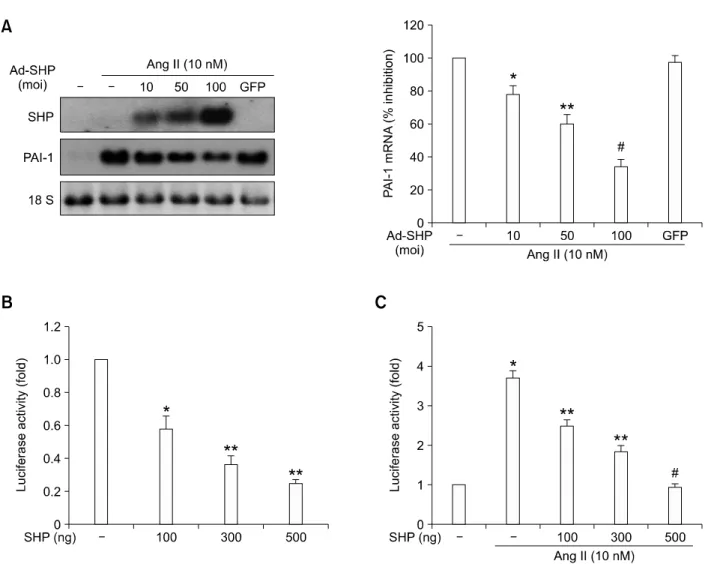
To investigate whether SHP inhibited PAI-1 expre- ssion in primary cultured rat VSMCs, we measured the effect of adenovirus-mediated overexpression of SHP in VSMCs on angiotensin II-stimulated PAI-1 mRNA expression by Northern blot analysis.

As shown in Figure 1A, Ad-SHP decreased angio- tensin II-stimulated PAI-1 expression in a dose-de-

pendent manner. Transient transfection experime- nts using a luciferase reporter gene under the control of the PAI-1 promoter revealed that SHP expression decreased PAI-1 promoter activity in a dose-dependent manner (Figure 1B). Additionally, transient SHP expression decreased angiotensin II-stimulated PAI-1 promoter activity in a dose-de- pendent manner (Figure 1C). These data sugge- sted that the inhibition of angiotensin II-stimulated PAI-1 gene expression by SHP is mediated at the transcriptional level.

SHP inhibits PAI-1 expression through the down-regulation of the TGF-β/Smad3 pathway PAI-1 activity is tightly regulated at the transcrip- tional level (Binder et al., 2002). Given that TGF-β is an important regulator of angiotensin II-induced PAI-1 transcription (Rodriguez-Vita et al., 2005;

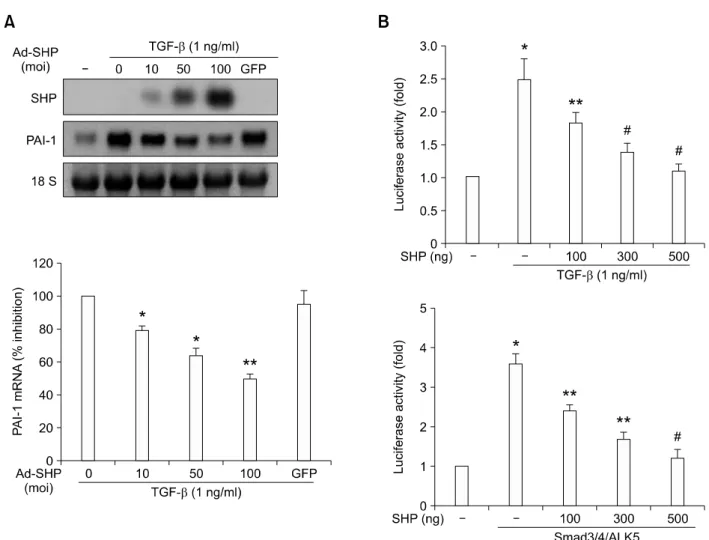
Ruiz-Ortega et al., 2007), we examined whether Ad-SHP inhibited TGF-β-stimulated PAI-1 trans- cription. Infection of cells with Ad-SHP significantly inhibited TGF-β-stimulated PAI-1 mRNA expre- ssion in a dose-dependent manner (Figure 2A).

Similarly, transient expression of SHP in VSMCs significantly inhibited TGF-β-stimulated PAI-1 pro- moter activity in a dose-dependent manner (Figure 2B upper). Transient expression of SHP also signi- ficantly inhibited Smad3-stimulated PAI-1 promoter activity in a dose-dependent manner (Figure 2B lower). Taken together, these data suggested that SHP inhibits PAI-1 expression through the inhibi- tion of the TGF-β/Smad3 signaling pathway.

SHP inhibits angiotensin-II-stimulated AP-1 activity To determine whether SHP inhibited angiotensin II-stimulated PAI-1 transcription through a TGF-β/

Smad3 independent pathway, VSMCs were co-transfected with a luciferase reporter gene under the control of a truncated form of the PAI-1 promoter, -240 PAI-1, in which two Smad binding sites were deleted (Figure 3A). Angiotensin II treatment stimulated the activity of the truncated promoter construct, although the level of activity was lower than that of the WT promoter construct (Figure 3A). These results suggested that in addition to Smad, other factors contribute to angiotensin II-stimulated PAI-1 expression. SHP inhibited angiotensin II-mediated -240 PAI-1 pro- moter activity, reinforcing the idea that SHP inhibits transcription factors other than Smad (Figure 3A).

We also examined the effect of SHP on the activity

of AP-1, which is the primary transcription factor

involved in stimulating PAI-1 promoter activity in

response to angiotensin II. AP-1 DNA binding was

(3)

Figure 1. Effect of SHP on angiotensin II-stimulated PAI-1 mRNA expression and promoter activity. (A) Northern blot analysis of the effect of over- expression of SHP on PAI-1 mRNA expression. VSMCs were infected at the indicated multiplicity-of-infection (moi) with adenovirus expressing SHP (Ad-SHP), or green fluorescent protein (GFP) as a control, for 4 h. VSMCs were incubated in medium containing 0.5% FBS for 24 h, and then treated with angiotensin II (Ang II, 10 nmol/l) for 3 h before harvest. Data represent the means ± SEM. *P < 0.05, **P < 0.01,

#

P < 0.001 as compared to Ang II alone. (B and C) Luciferase gene reporter assay of the effect of SHP on PAI-1 promoter activity. (B) VSMCs were transfected with a reporter gene under the control of the PAI-1 promoter (-840 PAI-1 promoter Luc, 300 ng) together with the indicated amounts of an SHP expression vector (pcDNA3) for 5 h, and were then incubated in medium containing 10% FBS for 24h. Data represent the means ± SEM. *P < 0.01, **P < 0.001 were as compared with the control. (C) VSMCs were transfected with a reporter gene under the control of the PAI-1 promoter (-840 PAI-1 promoter Luc, 300 ng) together with the indicated amounts of an SHP expression vector (pcDNA3) for 5 h. Cells were incubated in medium containing 0.5% FBS for 24 h, and then treated with angiotensin II (Ang II, 10 nM) for 1 h before harvest. Data represent the means ± SEM. *P < 0.001 as compared to control. **P < 0.01,

#

P < 0.001 as compared to Ang II alone.

stimulated by angiotensin II (10 nmol/l), and ade- novirus-mediated overexpression of SHP inhibited angiotensin II-stimulated AP-1 binding activity in a dose-dependent manner (Figure 3B).

To see whether SHP inhibits angiotensin II-sti- mulated PAI-1 promoter activity independently from AP-1 inhibition, AP-1 decoy ODN, which inhibits the AP-1 binding to the PAI-1 promoter, was used.

Angiotensin II stimulated the activity of the -840 PAI-1 promoter treated with AP-1 decoy OND, although the level of activity was lower than that of the -840 PAI-1 promoter treated with mismatched

AP-1 ODN. SHP inhibited angiotensin II-stimulated

PAI-1 promoter activity in a dose dependent man-

ner. AP-1 decoy efficiency was confirmed by transi-

ent transfection with AP-1 proteins. c-jun and c-fos

did not stimulate the activity of the -840 PAI-1

promoter treated with AP-1 decoy ODN (Figure

3C). Collectively, these data suggested that SHP

inhibits PAI-1 expression in VSMCs through the

downregulation of TGF-β/Smad3 and AP-1 activity.

(4)

24 Exp. Mol. Med. Vol. 42(1), 21-29, 2010

Figure 2. Effect of SHP on TGF-β-stimulated PAI-1 mRNA expression and Smad3 activity. (A) Northern blot analysis of the effect of overexpression of SHP on PAI-1 m RNA expression. VSMCs were infected at the indicated moi with Ad-SHP or GFP for 4 h. Cells were incubated in medium containing 0.5% FBS 24 h, and then treated with TGF-β (1 ng/ml) for 3 h before harvest. Data represents the means ± SEM. *P < 0.05, **P < 0.01 as compared to TGF-β alone. (B) Luciferase gene reporter assay of the effect of SHP on PAI-1 promoter activity. (Upper) VSMCs were transfected with -840 PAI-1 pro- moter Luc (300 ng) together with the indicated amounts of an SHP expression vector (pcDNA3) for 5 h. Cells were incubated in medium containing 0.5%

FBS for 24 h, and then treated with TGF-β (1 ng/ml) for 1 h before harvest. Data represents the means ± SEM. *P < 0.01 as compared to the control.

**P < 0.05,

#

P < 0.01 as compared to TGF-β alone. (Lower) VSMCs were co-transfected with -840 PAI-1 promoter Luc (300 ng) and expression vec- tors for Smad3 (100 ng), Smad4 (100 ng) and ALK5 (100 ng), together with the indicated amounts of SHP expression vector for 5 h. Cells were then in- cubated in medium containing 0.5% FBS for 24 h. Data represents the means ± SEM. *P < 0.001 as compared to control. **P < 0.01,

#

P < 0.001 as compared to Smad3/4/ALK5 alone.

PAI-1 mRNA expression is upregulated in primary cultured VSMCs of SHP

-/-

mice

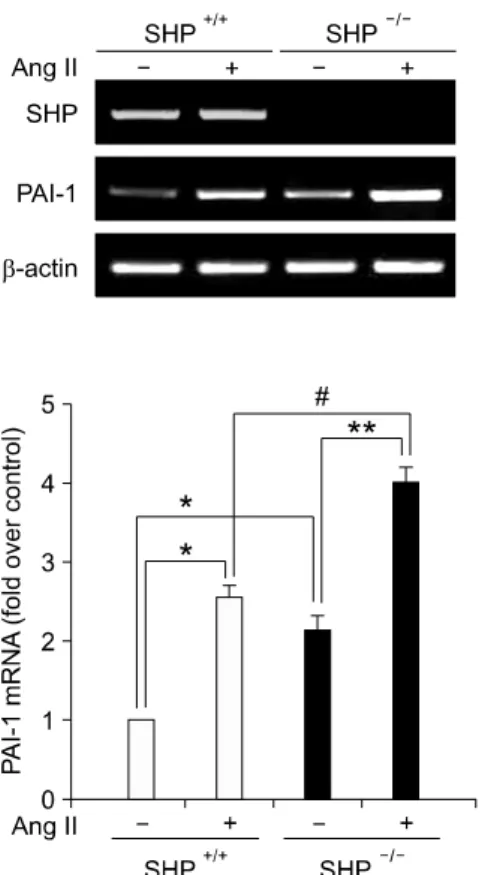
We next examined whether the loss of SHP influenced the expression of PAI-1 in VSMCs in SHP

-/-

mice. In primary cultured VSMCs from SHP

-/-

mice, PAI-1 mRNA levels were increased as compared to VSMCs of WT mice. Moreover, loss of SHP increased PAI-1 mRNA expression after angiotensin II treatment (Figure 4). These data suggested that endogenous SHP acts as negative regulator of PAI-1 expression in VSMCs in vivo.

Discussion

In the present study, we demonstrated that adeno- virus-mediated overexpression of SHP decreases angiotensin II- and TGF-β-stimulated PAI-1 mRNA expression in primary cultured rat VSMCs. We also elucidated a potential mechanism of downregula- tion of PAI-1 expression by SHP involving the inhibition of both TGF-β/Smad3 and AP-1 activity.

PAI-1 plays a critical role in cardiovascular disease

and is a key mediator in the process of vascular

fibrosis (Lyon and Hsueh, 2003). It has long been

thought that angiotensin II induces vascular fibrosis

by stimulating TGF-β (Ruiz-Ortega et al., 2003;

(5)

Wang et al., 2006). TGF-β mediates its fibrotic effects through the activation of receptor-associa- ted Smads, including Smad2 and Smad3 (Dennler et al., 1998; Javelaud et al., 2004; Ruiz-Ortega et al., 2007). Recent studies have shown that angio- tensin II activates an early Smad signaling pathway in VSMCs directly through ERK1/2 MAPK, as well as the classic late TGF-β signaling pathway (Ruiz-Ortega et al., 2003, 2007; Rodirguez-Vita et al., 2005; Wang et al., 2006). In the current study, adenovirus-mediated overexpression of SHP in

VSMCs inhibited angiotensin II-stimulated PAI-1 expression. SHP also inhibited TGF-β-stimulated PAI-1 expression and transactivation of the PAI-1 promoter by Smad3.

There is increasing evidence that, in addition to the TGF-β/Smad pathway, other transcription fac- tors, such as AP-1, are also important in angiote- nsin II-induced PAI-1 expression (Ahn et al., 2001).

In the current study, angiotensin II stimulated the activity of a luciferase reporter gene under the control of an SBE-deleted PAI-1 promoter, in which

Figure 3. Effect of SHP on angiotensin II-stimulated AP-1 activity. (A) Luciferase gene reporter assay of the effect of SHP on Smad3-independent PAI-1 promoter activity. VSMCs were transfected with a luciferase reporter gene under the control of an SBE deleted PAI-1 promoter (-240 PAI-1 promoter Luc, 300 ng), together with the indicated amounts of SHP expression vec- tor for 5 h. Cells were incubated in medium containing 0.5% FBS for 24 h, and then treated with angiotensin II (Ang II, 10 nM) for 1 h before harvest. Data represents the means ± SEM. *P < 0.001 as compared to control. **P < 0.01 as compared to Ang II alone (WT PAI-1 promoter),

#

P < 0.05 as compared to Ang II alone (SBE-deleted PAI-1 promoter). (B) Electrophoretic mobility shift assay of the effect of SHP on AP-1 DNA binding activity.

VSMCs were infected at the indicated moi with Ad-SHP or GFP

for 4 h. Cells were incubated in medium containing 0.5% FBS for

24 h, and then treated with angiotensin II (Ang II, 10 nmol/l) for 1

h before harvest. (C) VSMCs were cotransfected with the -840

PAI-1 promoter Luc (300 ng) and the AP-1 decoy ODN (10 nM)

or mismatched AP-1 decoy ODN (MD, 10 nM) together with the

indicated amounts of an SHP expression vector (pcDNA3) or

c-jun/c-fos expression vector for 5 h. Cells were incubated in me-

dium containing 0.5% FBS for 24 h, and were then treated with

angiotensin II (Ang II, 10 nmol/l) for 1 h before harvesting. Data

represents the means ± SEM. *P < 0.05,

##

P < 0.001 as

compared to the control. **P < 0.05,

#

P < 0.01 were as com-

pared to Ang II.

(6)

26 Exp. Mol. Med. Vol. 42(1), 21-29, 2010

Figure 4. PAI-1 expression in primary cultured VSMCs of SHP

-/-

mice.

RT-PCR analysis of PAI-1 and SHP mRNA expression in primary cul- tured VSMCs from WT (SHP

+/+

) and SHP-knockout (SHP

-/-

) mice. Cells were incubated in medium containing 0.5% FBS for 24 h, and were then treated with angiotensin II (Ang II, 10 nM) for 3 h before harvesting. Data represent the means ± SEM. *P < 0.05 was as compared to WT VSMC (SHP

+/+

) without Ang II, **P < 0.05 was as compared to KO VSMC (SHP

-/-

) without Ang II, and

#

P < 0.05 was as compared to WT VSMC (SHP

+/+

) with Ang II.

two Smad binding sites were deleted. These results suggest the involvement of transcription factors other than Smad3 in the action of angio- tensin II. There is ample evidence that risk factors for atherosclerosis stimulate the transactivity of AP-1, a redox sensitive transcription factor, at the PAI-1 promoter. Previously, we and others have shown that angiotensin II increases PAI-1 expre- ssion through the upregulation of AP-1 activity in VSMCs (Ahn et al. 2001; Chen and Feener, 2004).

Previous reports have demonstrated the mecha- nisms by which SHP regulates target gene trans- cription without directly binding to target promoter sequences. SHP represses transcription factor-me- diated transactivation by inhibiting DNA binding (Seol et al., 1996; Ourlin et al., 2003; Kim et al., 2004), by recruiting unknown corepressors (Johan- sson et al., 2000; Lee et al., 2000, 2002) and by interfering with the interaction with coactivator (Suh et al., 2006). Fiorucci et al. (2004) showed that the

inhibitory effect on AP-1 activity is mediated by a physical interaction between AP-1 and SHP that decreases AP-1 DNA binding. Our results, using an electrophoretic mobility shift assay, suggest that the inhibition of angiotensin II-stimulated PAI-1 expression by SHP involves in part the inhibition of AP-1-DNA binding at the PAI-1 promoter. Thus, the effect of SHP on vascular PAI-1 expression is likely to be multifactorial, involving the inhibition of Smad3 and AP-1 activity.

In conclusion, we have demonstrated that SHP inhibits PAI-1 expression by suppressing angioten- sin II-stimulated transactivation of Smad3 and AP-1.

Agents that increase SHP expression in vascular cells might help prevent the development and progression of atherosclerosis in patients with hypertension.

Methods Materials

Recombinant human TGF-β1 was purchased from R&D Systems (Minneapolis, MN). Recombinant human angio- tensin II was purchased from Calbiochem (San Diego, CA).

Radiochemicals ([α-32P] dCTP, [γ-32P] ATP) were purchased from Perkin Elmer (Boston, MA).

Cell culture

VSMCs were isolated from the thoracic aorta of 4-week-old Sprague-Dawley (Samtako, Korea) rats weighing 100 g, and from SHP

-/-

mice, using the explant method. SHP

-/-

mice were a kind gift from Dr. David D. Moore (Baylor College of Medicine, Houston, TX). VSMCs culture was performed as described previously (Kim et al., 2007).

Briefly, VSMCs were cultured in DMEM (Gibco BRL, Grand Island, NY) containing 20% FBS (Hyclone, Logan, UT).

VSMC purity was assessed by positive staining with smooth muscle specific α-actin monoclonal antibodies (Santa Cruz, Santa Cruz, CA). Cells from the third and fifth passages were used for all experiments.

Northern blot analysis

Total RNA was isolated from VSMCs using Trizol Reagent (Invitrogen, Carlsbad, CA) according to the manufacturer's instructions. Twenty-microgram aliquots of total RNA from each sample were used. The probes for SHP and PAI-1 were labeled with [α-

32

P] dCTP using a random-primer DNA-labeling system (Amersham Biosciences, Little Chal- font, UK). Northern analysis was performed as described previously (Ahn et al., 2001).

In vitro transient transfection and reporter assays

VSMCs were plated at a density 7 × 10

4

per well in a

12-well plate and cultured for 24 h. Cells were transiently

transfected with a luciferase reporter gene under the

(7)

control of the wild-type (WT) PAI-1 (-840 PAI-1 promoter) promoter, or a Smad binding element (SBE)-deleted PAI-1 (-240 PAI-1 promoter) promoter (300 ng/well), along with the indicated expression vectors, using Lipofectamine Plus reagent (Invitrogen). Cells were co-transfected with an expression plasmid for β-galactosidase as an internal control. Cells were transfected for 5 h, then washed to remove unincorporated plasmids and cultured in conditioned culture medium. Cells were harvested approxi- mately 24 h after transfection and assayed for luciferase and β-galactosidase activity. Cell lysate (20 μl) was analy- zed using the luciferase assay system, according to the manufacturer's instructions (Promega, Madison, WI), and luciferase activity was detected using a SIRUS Lumino- meter (Berthold, Pforzheim, Germany). Luciferase activity was normalized to β-galactosidase activity.

Construction of the AP-1 decoy

The construction of decoy oligodeoxynucleotides (ODN) was performed as described previously (Ahn et al., 2002).

The sequences of the dumbbell-shaped decoy ODN direc- ted against the AP-1 binding site and its mismatched AP-1 decoy ODN were constructed as described (Ahn et al., 2002) and were as follows (with consensus sequences underlined): AP-1 decoy ODN, 5'-GGATCCATGACTCAG- AAGACGACACACGTCTTCTGAGTCAT-3; Mismatched AP-1 decoy ODN, 5'-GGATCCAAATCTCAGAAGACGACACA- CGTCTTCTGAGATTT-3'. The stability and cellular uptake of the decoy ODN were similar to those previously des- cribed (Ahn et al., 2002).

Electrophoretic mobility shift assay

Nuclear extracts were isolated from cells using Nuc- Buster

TM

Protein Extraction kit (Calbiochem), according to the manufacturer's instructions. After centrifugation, super- natants (nuclear extracts) were collected and protein concentration was measured using a protein assay kit (Bio-Rad, Richmond, CA). Nuclear extracts (6 μg) were incubated with approximately 60,000 cpm of a

32

P-labeled AP-1 binding-site oligomer, 5'-CGCTTGATGACTCAGCC- GGAA-3', for 20 min at 20

o

C.

RT-PCR

Total RNA was obtained from VSMCs using Trizol Reagent (Invitrogen). cDNA was synthesized using a first-strand cDNA synthesis kit (Fermentas, Hanover, MD) and 2 μg of total RNA, according to the manufacturer's instructions.

PCR was carried out using Taq polymerase (Takara, Japan) and the following thermal cycling parameters: 94

o

C for 5 min; 35 cycles of 94

o

C for 1 min; 70

o

C for 50 s; and 72

o

C for 1 min. The following primers and thermal cycling parameters were used for mSHP: 5'-CCGCACCGCAC- CTGCAGGGAGGCCTT-3' (forward) and 5'-ACTCCAGGC- AGCGCTGCAGCCACTGAA-3' (reverse); 94

o

C for 5 min;

and then 30 cycles of 94

o

C for 50 s, 67

o

C for 50 s and 72

o

C for 2 min. The following primers were used for standard PCR of mPAI-1 and actin: for mPAI-1, 5'-CCTCA- TCCTGGGCCTGGTTCTGGTCT-3' (forward) and 5'-GGT- TTTCCCCGCTGTGGTCATCTGC-3' (reverse); for actin,

5'-GGCATCGTCACCAACTGGGAC-3' (forward) and 5'- CGATTTCCCGCTCCGTGG-3' (reverse).

Statistical analysis

Results are expressed as the means ± standard error of the mean (SEM). Variance analysis with a subsequent Duncan's test was used to determine significant differ- ences in multiple comparisons. A P value of < 0.05 was considered statistically significant. All experiments were performed at least 3 times.

Acknowledgements

We would like to thank Dr. David D. Moore for permission to use SHP KO mice. This work was supported by the Korea Science and Engineering Foundation (KOSEF) grant funded by the Korea government (MEST) (R01- 2007-000-10057-0 to K. G. P.; 2009-0063267 to I. K. L.;

2006-2005412 to K. U. L) and the Korea Research Foundation Grant funded by the Korean Government (MOEHRD, Basic Research Promotion Fund) (KRF-2008- 331-E00121 to K. G. P.).

References

Ahn JD, Morishita R, Kaneda Y, Lee KU, Park JY, Jeon YJ, Song HS, Lee IK. Transcription factor decoy for activator protein-1 (AP-1) inhibits high glucose- and angiotensin II-induced type 1 plasminogen activator inhibitor (PAI-1) gene expression in cultured human vascular smooth muscle cells. Diabetologia 2001;44:713-20

Ahn JD, Morishita R, Kaneda Y, Lee SJ, Kwon KY, Choi SY, Lee KU, Park JY, Moon IJ, Park JG, Yoshizumi M, Ouchi Y, Lee IK. Inhibitory effects of novel AP-1 decoy oligode- oxynucleotides on vascular smooth muscle cell proliferation in vitro and neointimal formation in vivo. Circ Res 2002;

90:1234-6

Binder BR, Christ G, Gruber F, Grubic N, Hufnagl P, Krebs M, Mihaly J, Prager GW. Plasminogen Activator Inhibitor 1:

Physiological and Pathophysiological Roles. News Physiol Sci 2002;17:56-61

Brendel C, Schoonjans K, Botrugno OA, Treuter E, Auwerx J. The small heterodimer partner interacts with the liver X receptor α and represses its transcriptional activity. Mol Endocrinol 2002;16:2065-76

Chen HC, Feener EP. MEK1,2 response element mediates angiotensin II-stimulated plasminogen activator inhibitor-1 promoter activation. Blood 2004;103:2636-44

Dennler S, Itoh S, Vivien D, ten Dijke P, Huet S, Gauthier JM.

Direct binding of Smad3 and Smad4 to critical TGF-inducible elements in the promoter of human plasminogen activator inhibitor-type 1 gene. EMBO J 1998;17:3091-100

Ferrario CM, Chappell MC, Dean RH, Iyer SN. Novel

angiotensin peptides regulate blood pressure, endothelial

function, and natriuresis. J Am Soc Nephrol 1998;9:1716-22

Fiorucci S, Antonelli E, Rizzo G, Renga B, Mencarelli A,

(8)

28 Exp. Mol. Med. Vol. 42(1), 21-29, 2010

Riccardi L, Orlandi S, Pellicciari R, Morelli A. The nuclear receptor SHP mediates inhibition of hepatic stellate cells by FXR and protects against liver fibrosis. Gastroenterology 2004;127:1497-512

Gobinet J, Auzou G, Nicolas JC, Sultan C, Jalaguier S.

Characterization of the interaction between androgen rece- ptor and a new transcriptional inhibitor, SHP. Biochemistry 2001;40:15369-77

Ito M, Oliverio MI, Mannon PJ, Best CF, Maeda N, Smithies O, Coffman TM. Regulation of blood pressure by the type 1A angiotensin II receptor gene. Proc Natl Acad Sci USA 1995;92:3521-5

Javelaud D, Mauviel A. Mammalian transforming growth factor-betas: Smad signaling and physio-pathological roles.

Int J Biochem Cell Biol 2004;36:1161-5

Johansson L, Båvner A, Thomsen JS, Färnegårdh M, Gustafsson JA, Treuter E. The orphan nuclear receptor SHP utilizes conserved LXXLL-related motifs for interactions with ligand-activated estrogen receptors. Mol Cell Biol 2000;

20:1124-33

Kaikita K, Fogo AB, Ma LJ, Schoenhard JA, Brown NJ, Vaughan DE. Plasminogen activator inhibitor-1 deficiency prevents hypertension and vascular fibrosis in response to long-term nitric oxide synthase inhibition. Circulation 2001;

104:839-44

Kato H, Suzuki H, Tajima S, Ogata Y, Tominaga T, Sato A, Saruta T. Angiotensin II stimulates collagen synthesis in cultured vascular smooth muscle cells. J Hypertens 1991;

9:17-22

Kim HS, Kim HJ, Park KG, Kim YN, Kwon TK, Park JY, Lee KU, Kim JG, Lee IK. Alpha-lipoic acid inhibits matrix metalloproteinase-9 expression by inhibiting NF-kappaB transcriptional activity. Exp Mol Med 2007;39:106-13 Kim JY, Kim HJ, Kim KT, Park YY, Seong HA, Park KC, Lee IK, Ha H, Shong M, Park SC, Choi HS. Orphan nuclear receptor small heterodimer partner represses hepatocyte nuclear factor 3/Foxa transactivation via inhibition of its DNA binding. Mol Endocrinol 2004;18:2880-94

Lee YK, Dell H, Dowhan DH, Hadzopoulou-Cladaras M, Moore DD. The orphan nuclear receptor SHP inhibits hepatocyte nuclear factor 4 and retinoid X receptor trans- activation: two mechanisms for repression. Mol Cell Biol 2000;20:187-95

Lee YK, Moore DD. Dual mechanisms for repression of the monomeric orphan receptor liver receptor homologous protein-1 by the orphan small heterodimer partner. J Biol Chem 2002;277:2463-67

Lyon CJ, Hsueh WA. Effect of plasminogen activator inhibitor-1 in diabetes mellitus and cardiovascular disease.

Am J Med 2003;115(Suppl 8A):62S-8S

Ourlin JC, Lasserre F, Pineau T, Fabre JM, Sa-Cunha A, Maurel P, Vilarem MJ, Pascussi JM. The small heterodimer partner interacts with the pregnane X receptor and represses its transcriptional activity. Mol Endocrinol 2003;17:1693-703 Papakonstantinou E, Roth M, Kokkas B, Papadopoulos C,

Karakiulakis G. Losartan inhibits the angiotensin II-induced modifications on fibrinolysis and matrix deposition by primary human vascular smooth muscle cells. J Cardiovasc Phar- macol 2001;38:715-28

Rodriguez-Vita J, Sanchez-Lopez E, Esteban V, Ruperez M, Egido J, Ruiz-Ortega M. Angiotensin II activates the Smad pathway in vascular smooth muscle cells by a transforming growth factor-beta-independent mechanism. Circulation 2005;111:2509-17

Ruiz-Ortega M, Ruperez M, Esteban V, Egido J. Molecular mechanisms of angiotensin II-induced vascular injury. Curr Hypertens Rep 2003;5:73-9

Ruiz-Ortega M, Rodríguez-Vita J, Sanchez-Lopez E, Carva- jal G. Egido J. TGF-beta signaling in vascular fibrosis.

Cardiovasc Res 2007;74:196-206

Sanyal S, Kim JY, Kim HJ, Takeda J, Lee YK, Moore DD, Choi HS. Differential regulation of the orphan nuclear receptor small heterodimer partner (SHP) gene promoter by orphan nuclear receptor ERR isoforms. J Biol Chem 2002;277:

1739-48

Seol W, Choi HS, Moore DD. An orphan nuclear hormone receptor that lacks a DNA binding domain and hetero- dimerizes with other receptors. Science 1996;272:1336-9 Seol W, Hanstein B, Brown M, Moore DD. Inhibition of estrogen receptor action by the orphan receptor SHP (short heterodimer partner). Mol Endocrinol 1998;12:1551-7 Sobel BE, Taatjes DJ, Schneider DJ. Intramural plasmi- nogen activator inhibitor type-1 and coronary atheroscl- erosis. Arterioscler Thromb Vasc Biol 2003;23:1979-89 Suh JH, Huang J, Park YY, Seong HA, Kim D, Shong M, Ha H, Lee IK, Lee K, Wang L, Choi HS. Orphan nuclear receptor small heterodimer partner inhibits transforming growth factor-beta signaling by repressing SMAD3 transactivation.

J Biol Chem 2006;281:39169-78

van Leeuwen RT, Kol A, Andreotti F, Kluft C, Maseri A, Sperti G. Angiotensin II increases plasminogen activator inhibitor type 1 and tissue-type plasminogen activator messenger RNA in cultured rat aortic smooth muscle cells. Circulation 1994;90:362-8

Vaughan DE, Lazos SA, Tong K. Angiotensin II regulates the expression of plasminogen activator inhibitor-1 in cultured endothelial cells. A potential link between the renin-angi- otensin system and thrombosis. J Clin Invest 1995;95:

995-1001

Vaughan DE. PAI-1 and TGF-β: unmasking the real driver of TGF-β-induced vascular pathology. Arterioscler Thromb Vasc Biol 2006;26:679-80

Wang TJ, Gona P, Larson MG, Tofler GH, Levy D, Newton- Cheh C, Jacques PF, Rifai N, Selhub J, Robins SJ, Benjamin EJ, D'Agostino RB, Vasan RS. Multiple biomarkers for the prediction of first major cardiovascular events and death. N Engl J Med 2006;355:2631-9

Wang W, Huang XR, Canlas E, Oka K, Truong LD, Deng C,

Bhowmick NA, Ju W, Bottinger EP, Lan HY. Essential role of

Smad3 in angiotensin II-induced vascular fibrosis. Circ Res

(9)

2006;98:1032-9

Weir MR. Dzau VJ. The renin-angiotensin-aldosterone system: a specific target for hypertension management. Am J Hypertens 1999;12:205-13

Weisberg AD, Albornoz F, Griffin JP, Crandall DL, Elokdah H, Fogo AB, Vaughan DE, Brown NJ. Pharmacological inhibition and genetic deficiency of plasminogen activator

inhibitor-1 attenuates angiotensin II/salt-induced aortic

remodeling. Arterioscler Thromb Vasc Biol 2005;25:365-71

Yamagata K, Daitoku H, Shimamoto Y, Matsuzaki H, Hirota

K, Ishida J, Fukamizu A. Bile acids regulate gluconeogenic

gene expression via small heterodimer partner-mediated

repression of hepatocyte nuclear factor 4 and Foxo1. J Biol

Chem 2004;279:23158-65

수치

Figure  1.  Effect of SHP on angiotensin II-stimulated PAI-1 mRNA expression and promoter activity
Figure 2.  Effect of SHP on TGF-β-stimulated PAI-1 mRNA expression and Smad3 activity
Figure  3.  Effect of SHP on angiotensin II-stimulated AP-1  activity. (A) Luciferase gene reporter assay of the effect of SHP  on Smad3-independent PAI-1 promoter activity
Figure  4.  PAI-1 expression in primary cultured VSMCs of SHP -/-  mice.

참조

관련 문서

[r]

자석 팽이는 볼록한 두 부분에는 고리 자석이 들어 있고, 받침대에는 팽이의 고 리 자석 위치와 일치하는 부분에 삼각형 모양의 자석이 네 개 들어 있다.. 그리고

[r]

약국은 당초 수집 목적과 합리적으로 관련된 범위에서 정보주체에게 불이익이 발생하는지 여부, 암호화 등 안전성 확보에 필요한 조치를 하였는지 여부 등을

- 축산업으로 인한 환경부담을 낮추고, 사회로부터 인정받아야 중장기적으로 축산업 성장 가능 - 주요과제: 가축분뇨 적정 처리, 온실가스 저감, 축산악취 저감

Our analysis has shown that automation is already widespread among both domestic and foreign investors in Vietnam, and that both groups plan to continue investing

이는 아직 지부지사에서 확인 및 승인이 완료되지 않은 상태. 지부지사에서 보완처리 및 승인처 리 시

(Taekwondo, Weight Lifting Players) (90 min × 6 days/week) Warming