Season of birth (SOB) can reflect a particular early life environ- ment during gestation and the first months or year of life, and can influence subsequent traits and disease risks.1-3 Despite the absence of any clear understanding of the biological un- derpinnings, day length, seasonal changes in maternal nutri- tional status and vitamin D levels, and seasonal alterations in the incidence of some common infectious disorders have been seen as associated with SOB.4 Some chronobiological studies have suggested that SOB can have an impact on the later de- velopment of several psychiatric disorders including schizo- phrenia,5 bipolar disorder,6 suicide,2 obsessive-compulsive dis- order,7 eating disorder,8 personality features,9 and smoking.10
Potential Relationship between Season of Birth and Clinical Characteristics in Major Depressive Disorder in Koreans: Results from the CRESCEND Study
Seon-Cheol Park
1, Jeong-Kyu Sakong
2, Bon Hoon Koo
3, Jae-Min Kim
4, Tae-Youn Jun
5, Min-Soo Lee
6, Jung-Bum Kim
7, Hyeon-Woo Yim
8, and Yong Chon Park
91Department of Psychiatry, Inje University Haeundae Paik Hospital, Busan;
2Department of Psychiatry, Dongguk University Gyeongju Hospital, Gyeongju;
3Department of Psychiatry, Yeungnam University School of Medicine, Daegu;
4Department of Psychiatry, Chonnam National University School of Medicine, Gwangju;
5Department of Psychiatry, The Catholic University of Korea College of Medicine, Seoul;
6Department of Psychiatry, Korea University College of Medicine, Seoul;
7Department of Psychiatry, Keimyung University School of Medicine, Daegu;
8Department of Preventive Medicine, The Catholic University of Korea College of Medicine, Seoul;
9Department of Psychiatry, Hanyang University Guri Hospital, Guri, Korea.
We aimed to examine the potential relationship between season of birth (SOB) and clinical characteristics in Korean patients with unipolar non-psychotic major depressive disorder (MDD). Using data from the Clinical Research Center for Depression (CRESCEND) study in South Korea, 891 MDD patients were divided into two groups, those born in spring/summer (n=457) and those born in autumn/winter (n=434). Measurement tools comprising the Hamilton Depression Rating Scale, Hamilton Anxiety Rating Scale, Brief Psychiatric Rating Scale, Scale for Suicidal Ideation, Clinical Global Impression of severity, Social and Occupa- tion Functional Assessment Scale, WHO Quality of Life assessment instrument-abbreviated version, Alcohol Use Disorder Identi- fication Test, and Temperament and Character Inventory were used to evaluate depression, anxiety, overall symptoms, suicidal ideation, global severity, social function, quality of life, drinking, and temperament and character, respectively. Using indepen- dent t-tests for continuous variables and χ2 tests for discrete variables, the clinical characteristics of the two groups were com- pared. MDD patients born in spring/summer were on average younger at onset of first depressive episode (t=2.084, p=0.038), had greater loss of concentration (χ2=4.589, p=0.032), and were more self-directed (t=2.256, p=0.025) than those born in autumn/win- ter. Clinically, there was a trend for the MDD patients born in spring/summer to display the contradictory characteristics of more severe clinical course and less illness burden; this may have been partly due to a paradoxical effect of the 5-HT system.
Key Words: Season of birth (SOB), major depressive disorder (MDD), age at onset, diminished concentration, self-directedness pISSN: 0513-5796 · eISSN: 1976-2437
Received: July 13, 2015 Revised: September 24, 2015 Accepted: October 23, 2015
Corresponding author: Dr. Yong Chon Park, Department of Psychiatry, Hanyang University Guri Hospital, 153 Gyeongchun-ro, Guri 11923, Korea.
Tel: 82-31-560-2273, Fax: 82-31-554-2599, E-mail: [email protected]
•The authors have no financial conflicts of interest.
© Copyright: Yonsei University College of Medicine 2016
This is an Open Access article distributed under the terms of the Creative Com- mons Attribution Non-Commercial License (http://creativecommons.org/licenses/
by-nc/3.0) which permits unrestricted non-commercial use, distribution, and repro- duction in any medium, provided the original work is properly cited.
Yonsei Med J 2016 May;57(3):784-789 http://dx.doi.org/10.3349/ymj.2016.57.3.784
Depressive disorders have been an important issue in a re- alm of mental health globally.11-14 Since depressive disorder is a complex disease, due to both genetic and environmental fac- tors,15 it would be useful to investigate any association between SOB and the epidemiological and clinical characteristics of depressive disorder. To our knowledge, the effect of SOB on de- pressive disorder has little been studied. In a preliminary study of 45 patients with major depressive disorder (MDD), Foun- toulakis, et al.16 found a tendency for spring-born patients to have the greater severity of depression whereas summer-born patients had a higher level of anxiety, although statistical sig- nificance was not evaluated. Most MDD patients who failed to respond to the 1 mg dexamethasone suppression test were born during the autumn/winter. More specifically, in a study of 553 outpatients with winter-type seasonal depressive disor- der, individuals with melancholic depression were more often born in autumn/winter, whereas those with atypical depres- sion were more often born in spring/summer. In addition, sea- sonal affective disorder has been shown to peak in May.17 How- ever, differences in SOB patterns between depressed patients and controls have been paradoxical.16,18 In addition, in a large sample of suicide completers from Hungary, Döme, et al.2 fo- und a significant association between SOB and risk of complet- ed suicide. Thus, using the comprehensive data from a cohort study of Korean patients with depressive disorders, we aimed to analyze the distribution and potential clinical correlates of SOB in patients with unipolar non-psychotic MDD.
As described elsewhere,11 the Clinical Research Center for Depression (CRESCEND) study was the first, largest, clinical study of a nationwide sample of patients with depressive dis- orders in Korea. In the CRESCEND study, from January 2006 to August 2008, 1183 patients beginning psychiatric treatment for first-onset or recurrent depressive disorder were recruited from 18 centers (16 university-affiliated hospitals and 2 gen- eral hospitals) in Korea. The Relevant Institutional Review Boards of all the centers approved the protocol and consent forms of the study (receipt number: CUMC07U001). All the subjects gave written informed consent before the start of the study.
Our inclusion criteria were as follows: 1) age ≥18 years and
≤80 years, 2) diagnosis of unipolar non-psychotic MDD ac- cording to the 4th edition of the Diagnostic and Statistical Man- ual of Mental Disorders (DSM-IV),19 confirmed by a Structural Clinical Interview based on DSM-IV (SCID),20 3) total score on the Hamilton Depression Rating Scale (HAMD)21 ≥8 points, by the severity classification of Zimmerman, et al.,22 and 4) avail- ability of definite SOB. Patients with diagnoses of psychotic MDD, dysthymic disorder, or depressive disorder not otherwise specified, were excluded to enhance the homogeneity of study subjects. Finally, 891 patients with non-psychotic MDD were enrolled.
Based on the daily duration of sunshine in Seoul, South Ko- rea (127° 00’ eastern longitude and 37° 06’ northern latitude), seasons were defined as follows: spring, March to May, sum-
mer, June to August, autumn, September to November, and winter, December to February. Using the definitions of Foun- toulakis, et al.16 and Pjrek, et al.18 SOB was encoded as a dichot- omous variable including spring/summer- and autumn/win- ter-births.
Based on the definitions of major depressive episode (DSM- IV),19 the presence/absence of each depressive symptom (de- pressive mood, markedly diminished pleasure, weight gain or loss, insomnia or hypersomnia, psychomotor retardation or agitation, fatigue or loss of energy, feelings of worthlessness, diminished concentration, and suicidal ideation) was evalu- ated. The presence/absence of specific MDD symptoms were determined from the SCID.20
In addition, the HAMD,21 Hamilton Anxiety Rating Scale (HAMA),23 Brief Psychiatric Rating Scale (BPRS),24 Scale for Suicidal Ideation (SSI-Beck),25 Clinical Global Impression of severity (CGI-S),26 Social and Occupation Functional Assess- ment Scale (SOFAS),27 WHO Quality of Life assessment instru- ment-abbreviated version (WHOQOL-BREF),28 Alcohol Use Disorder Identification Test (AUDIT),29 and Temperament and Character Inventory (TCI)30 were used to evaluate depression, anxiety, overall symptoms, suicidal ideation, global severity, social function, quality of life, drinking, and temperament and character, respectively. Each of the scales had been formally translated into Korean and its psychometric validity had been clearly confirmed in the Korean population.31-37 More severe symptoms or greater illness burden were indicated by higher scores on the HAMD, HAMA, BPRS, SSI-Beck, CGI-S, and AU- DIT, and lower scores on the SOFAS and WHOQOL-BREF.
Using independent t-tests for continuous variables and χ2 tests for discrete variables, we compared the demographic and clinical characteristics of non-psychotic MDD patients with spring/summer versus autumn/winter births. Statistical significance was set at p<0.05 (two-tailed). All the statistical analyses were performed with SPSS 21 for Windows (SPSS Inc., Chicago, IL, USA).
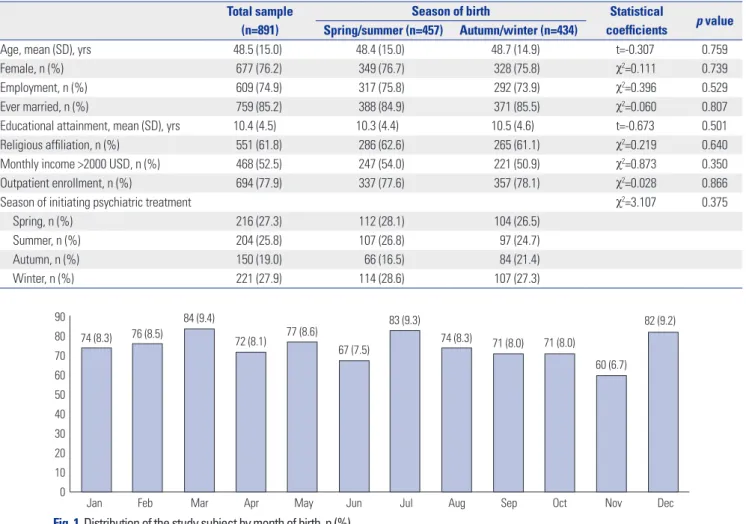
As shown in Table 1, the mean age of all subjects was 48.5 (SD=15.0) years. Most were women (76.2%), employed (74.9%), ever married (85.2%), and enrolled as outpatients (77.9%).
About half were religiously affiliated (61.8%) and had a month- ly income >2000 USD (52.5%). As shown in Fig. 1, the number (percent) of births in individual months ranged from 60 (6.7%;
November) to 84 (9.4%; March). With respect to SOB, the num- ber (percent) of subjects born in each season were 233 (25.8%) in spring, 234 (25.8%) in summer, 214 (24.3%) in autumn, and 214 (24.3%) in winter.
As shown in Table 1, there were no significant differences in age (t=-0.307, p=0.759), gender (χ2=0.111, p=0.739), employ- ment (χ2=0.396, p=0.529), marriage (χ2=0.060, p=0.807), edu- cation (t=-0.673, p=0.501), religious affiliation (χ2=0.219, p=
0.501), outpatient enrollment (χ2=0.028, p=0.866), and season when psychiatric treatment sorted (χ2=3.107, p=0.375) between MDD patients with spring/summer versus autumn/winter
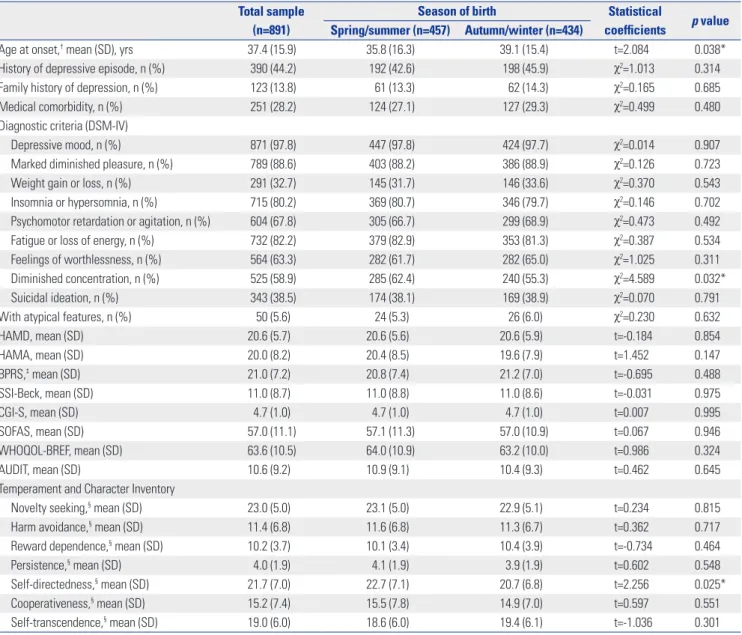
births. As shown in Table 2, MDD patients born in spring/sum- mer were significantly younger at onset of first depressive epi- sode (t=2.084, p=0.038), had diminished concentration (χ2= 4.589, p=0.032), and higher scores on the self-directedness di- mension of the TCI (t=2.256, p=0.025) than those born in au- tumn/winter. However, there were no significant differences in season when psychiatric treatment sorted (χ2=3.107, p=0.375), history of suicidal attempts (χ2=1.263, p=0.261), medical co- morbidity (χ2=0.499, p=0.480), atypical features (χ2=0.230, p=
0.632), HAMD (t=-0.184, p=0.854), HAMA (t=1.452, p=0.147), BPRS (t=-0.695, p=0.488), SSI-Beck (t=-0.031, p=0.975), CGI-S (t=0.007, p=0.995), SOFAS (t=0.067, p=0.946), WHOQOL-BREF (t=0.986, p=0.324), AUDIT (t=0.462, p=0.645), and the other characteristics between the two groups.
According to our data, spring/summer birth among MDD patients is associated with younger age at onset and more di- minished concentration. In MDD, younger age at onset may be a potential predictive indicator of more severe clinical co- urse.38-41 In 80 patients with MDD and comorbid alcohol de- pendence, younger age of onset of the first major depressive episode was associated with response to escitalopram treat- ment.38 In 1970 Han Chinese women with MDD, younger age of onset was associated with longer duration of illness, more
MDD episodes, longer index episode, and higher comorbidity of anxiety disorders.39 In 4041 MDD patients who participated in the Sequenced Treatment Alternatives to Relieve Depres- sion (STAR*D) study, younger age at onset was related to poor- er social and occupational function, higher medical and psy- chiatric comorbidity, and more lifetime depressive episodes and suicide attempts.40 Furthermore, in a sample of 1104 pa- tients with current MDD in the Netherlands Study of Depres- sion and Anxiety (NESDA),42 a greater loss of concentration was seen in subjects with early age at onset (<40 years) than in those with late age at onset (>40 years). In addition, diminished concentration was associated with a history of attempted sui- cide in 1970 Chinese women with recurrent MDD,43 and with vascular comorbidities in 39 older-elderly Taiwanese men with MDD.44 To our knowledge, our study is the first to report a link between spring/summer birth, younger onset of first ma- jor depressive episode, and diminished concentration in MDD patients. Hence, we may speculate that, in MDD patients, birth in the spring or summer may not only be an intervening vari- able between younger age at onset and diminished concen- tration, but also a potential indicator of greater illness burden.
In contrast, the potential positive relationship between self- directedness and birth in the spring or summer may suggest Table 1. Baseline Characteristics of the Study Subjects According to Season of Birth
Total sample (n=891)
Season of birth Statistical
coefficients p value Spring/summer (n=457) Autumn/winter (n=434)
Age, mean (SD), yrs 48.5 (15.0) 48.4 (15.0) 48.7 (14.9) t=-0.307 0.759
Female, n (%) 677 (76.2) 349 (76.7) 328 (75.8) χ2=0.111 0.739
Employment, n (%) 609 (74.9) 317 (75.8) 292 (73.9) χ2=0.396 0.529
Ever married, n (%) 759 (85.2) 388 (84.9) 371 (85.5) χ2=0.060 0.807
Educational attainment, mean (SD), yrs 10.4 (4.5) 10.3 (4.4) 10.5 (4.6) t=-0.673 0.501
Religious affiliation, n (%) 551 (61.8) 286 (62.6) 265 (61.1) χ2=0.219 0.640
Monthly income >2000 USD, n (%) 468 (52.5) 247 (54.0) 221 (50.9) χ2=0.873 0.350
Outpatient enrollment, n (%) 694 (77.9) 337 (77.6) 357 (78.1) χ2=0.028 0.866
Season of initiating psychiatric treatment χ2=3.107 0.375
Spring, n (%) 216 (27.3) 112 (28.1) 104 (26.5)
Summer, n (%) 204 (25.8) 107 (26.8) 97 (24.7)
Autumn, n (%) 150 (19.0) 66 (16.5) 84 (21.4)
Winter, n (%) 221 (27.9) 114 (28.6) 107 (27.3)
Fig. 1. Distribution of the study subject by month of birth, n (%).
90 80 70 60 50 40 30 20 10
0 Jan Feb Mar Apr May Jun Jul Aug Sep Oct Nov Dec 74 (8.3) 76 (8.5)
84 (9.4)
72 (8.1) 77 (8.6)
67 (7.5)
83 (9.3)
74 (8.3) 71 (8.0) 71 (8.0)
60 (6.7) 82 (9.2)
that MDD patients with spring/summer birth are associated with less illness burden than those with autumn/winter birth.
The justifications for this idea are that: lower score on the self- directedness of the TCI has been associated with a shorter time to recurrence from remission in 69 MDD patients over a 4-year prospective follow-up,45 with a higher rate of future dysphoric episodes in a cohort of the general population,46 and with greater severity of depressive symptoms in the Young Finns Study.47 The contradictory trends of the clinical features of MDD pa- tients associated with spring/summer birth cannot be simply explained. Based on the links between polymorphism in the serotonin transporter-linked polymorphic region (5-HTTLPR) and age at onset, and between 5-HTTLPR polymorphism and self-directedness,48,49 we may surmise that the contradictory
trends are partly connected with the actions of 5-HT. 5-HT has paradoxical effects of the following kinds: functional impair- ment of anterior 5-HT cells (dorsal raphe nucleus) can result in sensitization of the dopamine system leading to impulsivity and addiction, whereas functional impairment of posterior 5-HT cells (median raphe nucleus) innervating the hippocam- pus and cingulated gyrus, can result in melancholic mood, low self-esteem, and hopelessness.50 Further study of a possible association between the 5-HT system, e.g., 5-HTTLPR poly- morphism, and SOB, could clarify the origin of the mixed fea- tures of MDD patients with spring/summer birth.
There are several limitations to our study. First, it was not possible to identify an MDD-specific SOB pattern by means of a comparison with controls, since no controls were enrolled.
Table 2. Clinical Characteristics of the Study Subjects According to Season of Birth Total sample
(n=891)
Season of birth Statistical
coefficients p value Spring/summer (n=457) Autumn/winter (n=434)
Age at onset,† mean (SD), yrs 37.4 (15.9) 35.8 (16.3) 39.1 (15.4) t=2.084 0.038*
History of depressive episode, n (%) 390 (44.2) 192 (42.6) 198 (45.9) χ2=1.013 0.314
Family history of depression, n (%) 123 (13.8) 61 (13.3) 62 (14.3) χ2=0.165 0.685
Medical comorbidity, n (%) 251 (28.2) 124 (27.1) 127 (29.3) χ2=0.499 0.480
Diagnostic criteria (DSM-IV)
Depressive mood, n (%) 871 (97.8) 447 (97.8) 424 (97.7) χ2=0.014 0.907
Marked diminished pleasure, n (%) 789 (88.6) 403 (88.2) 386 (88.9) χ2=0.126 0.723
Weight gain or loss, n (%) 291 (32.7) 145 (31.7) 146 (33.6) χ2=0.370 0.543
Insomnia or hypersomnia, n (%) 715 (80.2) 369 (80.7) 346 (79.7) χ2=0.146 0.702
Psychomotor retardation or agitation, n (%) 604 (67.8) 305 (66.7) 299 (68.9) χ2=0.473 0.492
Fatigue or loss of energy, n (%) 732 (82.2) 379 (82.9) 353 (81.3) χ2=0.387 0.534
Feelings of worthlessness, n (%) 564 (63.3) 282 (61.7) 282 (65.0) χ2=1.025 0.311
Diminished concentration, n (%) 525 (58.9) 285 (62.4) 240 (55.3) χ2=4.589 0.032*
Suicidal ideation, n (%) 343 (38.5) 174 (38.1) 169 (38.9) χ2=0.070 0.791
With atypical features, n (%) 50 (5.6) 24 (5.3) 26 (6.0) χ2=0.230 0.632
HAMD, mean (SD) 20.6 (5.7) 20.6 (5.6) 20.6 (5.9) t=-0.184 0.854
HAMA, mean (SD) 20.0 (8.2) 20.4 (8.5) 19.6 (7.9) t=1.452 0.147
BPRS,‡ mean (SD) 21.0 (7.2) 20.8 (7.4) 21.2 (7.0) t=-0.695 0.488
SSI-Beck, mean (SD) 11.0 (8.7) 11.0 (8.8) 11.0 (8.6) t=-0.031 0.975
CGI-S, mean (SD) 4.7 (1.0) 4.7 (1.0) 4.7 (1.0) t=0.007 0.995
SOFAS, mean (SD) 57.0 (11.1) 57.1 (11.3) 57.0 (10.9) t=0.067 0.946
WHOQOL-BREF, mean (SD) 63.6 (10.5) 64.0 (10.9) 63.2 (10.0) t=0.986 0.324
AUDIT, mean (SD) 10.6 (9.2) 10.9 (9.1) 10.4 (9.3) t=0.462 0.645
Temperament and Character Inventory
Novelty seeking,§ mean (SD) 23.0 (5.0) 23.1 (5.0) 22.9 (5.1) t=0.234 0.815
Harm avoidance,§ mean (SD) 11.4 (6.8) 11.6 (6.8) 11.3 (6.7) t=0.362 0.717
Reward dependence,§ mean (SD) 10.2 (3.7) 10.1 (3.4) 10.4 (3.9) t=-0.734 0.464
Persistence,§ mean (SD) 4.0 (1.9) 4.1 (1.9) 3.9 (1.9) t=0.602 0.548
Self-directedness,§ mean (SD) 21.7 (7.0) 22.7 (7.1) 20.7 (6.8) t=2.256 0.025*
Cooperativeness,§ mean (SD) 15.2 (7.4) 15.5 (7.8) 14.9 (7.0) t=0.597 0.551
Self-transcendence,§ mean (SD) 19.0 (6.0) 18.6 (6.0) 19.4 (6.1) t=-1.036 0.301
AUDIT, Alcohol Use Disorder Identification Test; BPRS, Brief Psychiatric Rating Scale; CGI-S, Clinical Global Impression of severity; HAMA, Hamilton Anxiety Rat- ing Scale; HAMD, Hamilton Depression Rating Scale; SSI-Beck, Scale for Suicidal Ideation; SOFAS, Social and Occupational Functional Assessment Scale;
WHOQOL-BREF, WHO Quality of Life assessment instrument-abbreviated version.
*p<0.05, †n=489, ‡n=685, §n=251.
Second, the familywise error rate due to multiple comparisons may have been significant, since we did not use Bonferroni’s correction. Thirdly, since the seasonal type of MDD was not subcategorized, differences between seasonal and non-sea- sonal types could not be detected. Despite these limitations, to our knowledge, our study has the virtue of pioneering the study of a possible relationship between SOB and clinical fea- tures in MDD. In conclusion, unipolar non-psychotic MDD patients with spring/summer birth tended to be younger at on- set, have more severely diminished concentration, and higher scores on self-directedness in the TCI. Clinically, there was a trend for the MDD patients born in spring/summer to display the contradictory characteristics of more severe clinical course and less illness burden; this may have been partly due to a par- adoxical effect of the 5-HT system.
ACKNOWLEDGEMENTS
This study was supported by a grant from the Korea Health- care Technology R&D Project, Ministry of Health and Welfare, Republic of Korea (HI10C2020). The Ministry of Health and Welfare had no role in the study design; in the collection, analy- sis, and interpretation of data in the writing of the report, or the decision to submit the paper for publication.
REFERENCES
1. Eisenberg DT, Campbell B, Mackillop J, Lum JK, Wilson DS. Sea- son of birth and dopamine receptor gene associations with impul- sivity, sensation seeking and reproductive behaviors. PLoS One 2007;2:e1216.
2. Döme P, Kapitány B, Ignits G, Rihmer Z. Season of birth is signifi- cantly associated with the risk of completed suicide. Biol Psychia- try 2010;68:148-55.
3. Gonda X, Fountoulakis KN, Csukly G, Dome P, Sarchiapone M, Laszik A, et al. Star-crossed? The association of the 5-HTTLPR s al- lele with season of birth in a healthy female population, and possi- ble consequences for temperament, depression and suicide. J Af- fect Disord 2012;143:75-83.
4. Antonsen JH, Gonda X, Dome P, Rihmer Z. Associations between season of birth and suicide: a brief review. Neuropsychopharmacol Hung 2012;14:177-87.
5. Davies G, Welham J, Chant D, Torrey EF, McGrath J. A systematic review and meta-analysis of Northern Hemisphere season of birth studies in schizophrenia. Schizophr Bull 2003;29:587-93.
6. Soreca I, Cheng Y, Frank E, Fagiolini A, Kupfer DJ. Season of birth is associated with adult body mass index in patients with bipolar dis- order. Chronobiol Int 2013;30:577-82.
7. Cheng C, Lin CH, Chou PH, Tsai CJ, Lan TH, Nestadt G. Season of birth in obsessive-compulsive disorder. Depress Anxiety 2014;31:
972-8.
8. Winje E, Willoughby K, Lask B. Season of birth bias in eating dis- orders--fact or fiction? Int J Eat Disord 2008;41:479-90.
9. Tonetti L, Fabbri M, Natale V. Season of birth and personality in healthy young adults. Neurosci Lett 2009;452:185-8.
10. Riala K, Hakko H, Taanila A, Räsänen P. Season of birth and smok- ing: findings from the Northern Finland 1966 Birth Cohort. Chro- nobiol Int 2009;26:1660-72.
11. Park SC, Hahn SW, Hwang TY, Kim JM, Jun TY, Lee MS, et al. Does age at onset of first major depressive episode indicate the subtype of major depressive disorder?: the clinical research center for de- pression study. Yonsei Med J 2014;55:1712-20.
12. Seok JH, Lee KU, Kim W, Lee SH, Kang EH, Ham BJ, et al. Impact of early-life stress and resilience on patients with major depressive disorder. Yonsei Med J 2012;53:1093-8.
13. Whiteford HA, Degenhardt L, Rehm J, Baxter AJ, Ferrari AJ, Erskine HE, et al. Global burden of disease attributable to mental and sub- stance use disorders: findings from the Global Burden of Disease Study 2010. Lancet 2013;382:1575-86.
14. Park SC, Shinfuku N, Maramis MM, Lee MS, Park YC. Adjunctive Antipsychotic Prescriptions for Outpatients with Depressive Dis- orders in Asia: The Research on Asian Psychotropic Prescription Patterns for Antidepressants (REAP-AD) Study. Am J Psychiatry 2015;172:684-5.
15. Kendler KS, Kessler RC, Walters EE, MacLean C, Neale MC, Heath AC, et al. Stressful life events, genetic liability, and onset of an epi- sode of major depression in women. Am J Psychiatry 1995;152:
833-42.
16. Fountoulakis KN, Iacovides A, Karamouzis M, Kaprinis GS, Iero- diakonou C. Season of birth, clinical manifestations and Dexa- methasone Suppression Test in unipolar major depression. Ann Gen Psychiatry 2007;6:20.
17. Castrogiovanni P, Iapichino S, Pacchierotti C, Pieraccini F. Season of birth in psychiatry. A review. Neuropsychobiology 1998;37:175-81.
18. Pjrek E, Winkler D, Heiden A, Praschak-Rieder N, Willeit M, Kon- stantinidis A, et al. Seasonality of birth in seasonal affective disor- der. J Clin Psychiatry 2004;65:1389-93.
19. American Psychiatric Association. Diagnostic and Statistical Man- ual of Mental Disorders. 4th ed. Washington, DC: American Psy- chiatric Press; 1994.
20. First MB, Spitzer RL, Gibbon M, Wiliams JB. Structured Clinical In- terview for DSM-IV Axis I Disorders - Patient Edition. New York:
Biometrics Research Department, New York State Psychiatric Insti- tute; 1995.
21. Hamilton M. A rating scale for depression. J Neurol Neurosurg Psy- chiatry 1960;23:56-62.
22. Zimmerman M, Martinez JH, Young D, Chelminski I, Dalrymple K. Severity classification on the Hamilton Depression Rating Scale.
J Affect Disord 2013;150:384-8.
23. Hamilton M. The assessment of anxiety states by rating. Br J Med Psychol 1959;32:50-5.
24. Overall JE, Gorham DR. The brief psychiatric rating scale. Psychol Rep 1962;10:779-812.
25. Beck AT, Kovacs M, Weissman A. Assessment of suicidal intention:
the Scale for Suicide Ideation. J Consult Clin Psychol 1979;47:343-52.
26. Guy W. Early Clinical Drug Evaluation Unit (ECDEU) Assessment Manual for Psychopharmacology. Washington, DC: US Depart- ment of Health, Education, and Welfare publication, National Insti- tute of Mental Health; 1976.
27. Goldman HH, Skodol AE, Lave TR. Revising axis V for DSM-IV: a review of measures of social functioning. Am J Psychiatry 1992;149:
1148-56.
28. Development of the World Health Organization WHOQOL-BREF quality of life assessment. The WHOQOL Group. Psychol Med 1998;
28:551-8.
29. Conigrave KM, Hall WD, Saunders JB. The AUDIT questionnaire:
choosing a cut-off score. Alcohol Use Disorder Identification Test.
Addiction 1995;90:1349-56.
30. Cloninger CR, Svrakic DM, Przybeck TR. A psychobiological model of temperament and character. Arch Gen Psychiatry 1993;50:975-90.
31. Min SK, Lee CI, Kim KI, Suh SY, Kim DK. Development of Korean
version of WHO Quality of Life Scale Abbreviated Version (WHO- QOL-BREF). J Korean Neuropsychiatr Assoc 2000;39:571-9.
32. Sung SM, Kim JH, Yang E, Abrams KY, Lyoo IK. Reliability and va- lidity of the Korean version of the Temperament and Character In- ventory. Compr Psychiatry 2002;43:235-43.
33. Kim JM, Stewart R, Glozier N, Prince M, Kim SW, Yang SJ, et al.
Physical health, depression and cognitive function as correlates of disability in an older Korean population. Int J Geriatr Psychiatry 2005;20:160-7.
34. Yi JS, Bae SO, Ahn YM, Park DB, Noh KS, Shin HK, et al. Validity and reliability of the Korean version of the Hamilton Depression Rating Scale (K-HDRS). J Korean Neuropsychiatr Assoc 2005;44:
456-65.
35. Lee JY, Cho MJ, Kwon JS. Global assessment of functioning scale and social and occupational functioning scale. Korean J Psycho- pharmacol 2006;17:122-7.
36. Lee HS, Kuwn JH. Validation for the Beck Scale for Suicide Ideation with Korean university students. Korean J Clin Psychol 2009;28:
1155-72.
37. Joe KH, Chai SH, Park A, Lee HK, Shim IH, Min SH. Optimum cut- off score for screening of hazardous drinking using the Korean version of alcohol use disorder identification test (AUDIT-K). J Ko- rean Acad Addiction Psychiatry 2009;13:34-40.
38. Muhonen LH, Lönnqvist J, Lahti J, Alho H. Age at onset of first de- pressive episode as a predictor for escitalopram treatment of major depression comorbid with alcohol dependence. Psychiatry Res 2009;167:115-22.
39. Yang F, Li Y, Xie D, Shao C, Ren J, Wu W, et al. Age at onset of major depressive disorder in Han Chinese women: relationship with clin- ical features and family history. J Affect Disord 2011;135:89-94.
40. Zisook S, Lesser I, Stewart JW, Wisniewski SR, Balasubramani GK, Fava M, et al. Effect of age at onset on the course of major depres- sive disorder. Am J Psychiatry 2007;164:1539-46.
41. Zhu T, De Luca V, Gallaugher LA, Woldeyohannes HO, Soczynska JK, Szymkowicz S, et al. Admixture analysis of age at onset in ma-
jor depressive disorder. Gen Hosp Psychiatry 2012;34:686-91.
42. Korten NC, Comijs HC, Lamers F, Penninx BW. Early and late onset depression in young and middle aged adults: differential symp- tomatology, characteristics and risk factors? J Affect Disord 2012;
138:259-67.
43. Bi B, Xiao X, Zhang H, Gao J, Tao M, Niu H, et al. A comparison of the clinical characteristics of women with recurrent major depres- sion with and without suicidal symptomatology. Psychol Med 2012;42:2591-8.
44. Wang YY, Chang YH, Lee SY, Huang CC, Lee IH, Yeh TL, et al.
Symptomatological and cognitive correlates of vascular comorbid- ity in older-elderly (at least 75 years old) men with major depres- sive disorder. Kaohsiung J Med Sci 2012;28:607-12.
45. Asano T, Baba H, Kawano R, Takei H, Maeshima H, Takahashi Y, et al. Temperament and character as predictors of recurrence in remitted patients with major depression: a 4-year prospective fol- low-up study. Psychiatry Res 2015;225:322-5.
46. Rosenström T, Jylhä P, Robert Cloninger C, Hintsanen M, Elovainio M, Mantere O, et al. Temperament and character traits predict fu- ture burden of depression. J Affect Disord 2014;158:139-47.
47. Josefsson K, Merjonen P, Jokela M, Pulkki-Råback L, Keltikangas- Järvinen L. Personality Profiles Identify Depressive Symptoms over Ten Years? A Population-Based Study. Depress Res Treat 2011;
2011:431314.
48. Watanabe SY, Iga J, Numata S, Umehara H, Nishi A, Kinoshita M, et al. Polymorphism in the promoter of the gene for the serotonin transporter affects the age of onset of major depressive disorder in the Japanese population. J Affect Disord 2015;183:156-8.
49. Gonda X, Fountoulakis KN, Juhasz G, Rihmer Z, Lazary J, Laszik A, et al. Association of the s allele of the 5-HTTLPR with neuroticism- related traits and temperaments in a psychiatrically healthy pop- ulation. Eur Arch Psychiatry Clin Neurosci 2009;259:106-13.
50. Deakin JF. Depression and antisocial personality disorder: two contrasting disorders of 5HT function. J Neural Transm Suppl 2003;
(64):79-93.