• 검색 결과가 없습니다.

Prevalence of Chronic Obstructive Pulmonary Disease in Korea: The Result of Forth Korean National Health and Nutrition Examination Survey

N/A
N/A
Protected

Academic year: 2021

Share "Prevalence of Chronic Obstructive Pulmonary Disease in Korea: The Result of Forth Korean National Health and Nutrition Examination Survey"

Copied!
7
0
0

로드 중.... (전체 텍스트 보기)

전체 글

(1)

Tuberc Respir Dis 2011;71:328-334

CopyrightⒸ2011. The Korean Academy of Tuberculosis and Respiratory Diseases. All rights reserved.

Prevalence of Chronic Obstructive Pulmonary Disease in Korea: The Result of Forth Korean National Health and Nutrition Examination Survey

Yong Il Hwang, M.D.

1

*, Kwang Ha Yoo, M.D.

2

*, Seung Soo Sheen, M.D.

3

, Joo Hun Park, M.D.

3

, Sang-Ha Kim, M.D.

4

, Ho Il Yoon, M.D.

5

, Sung Chul Lim, M.D.

6

, Shin Yup Lee, M.D.

7

, Jae Yong Park, M.D.

7

, Seoung Ju Park, M.D.

8

, Ki Hyun Seo, M.D.

9

, Ki Uk Kim, M.D.

10

, Sang Yeub Lee, M.D.

11

, In-Won Park, M.D.

12

, Sang-Do Lee, M.D.

13

, Se Kyu Kim, M.D.

14

, Young Kyoon Kim, M.D.

15

, Sang-Min Lee, M.D.

16

, Sung Koo Han, M.D.

16

, Yuna Kim, M.D.

17

, Yu Mi Cho, M.D.

17

, Hye Jin Park, M.D.

17

, Kyung Won Oh, M.D.

17

, Young Sam Kim, M.D.

14†

, Yeon-Mok Oh, M.D.

13†

1

Department of Pulmonary, Allergy and Critical Care Medicine, Hallym University College of Medicine, Chuncheon,

2

Department of Internal Medicine, Konkuk University School of Medicine, Seoul,

3

Department of Pulmonary and Critical Care Medicine, Ajou University School of Medicine, Suwon, Department of Internal Medicine,

4

Yonsei University Wonju College of Medicine, Wonju,

5

Seoul National University Bundang Hospital, Seoul National University College of Medicine, Seongnam,

6

Chonnam National University Medical School, Gwangju,

7

Kyungpook National University School of Medicine, Daegu,

8

Chonbuk National University Medical School, Jeonju,

9

Soonchunhyang University College of Medicine, Cheonan,

10

Pusan National University School of Medicine, Busan,

11

Division of Respiratory and Critical Care Medicine, Department of Internal Medicine, Korea University Anam Hospital, Korea University College of Medicine, Seoul,

12

Department of Internal Medicine, Chung-Ang University College of Medicine, Seoul,

13

Department of Pulmonary and Critical Care Medicine, Asan Medical Center, University of Ulsan College of Medicine, Seoul, Department of Internal Medicine,

14

Yonsei University College of Medicine, Seoul,

15

The Catholic University of Korea College of Medicine, Seoul,

16

Seoul National University Hospital, Seoul National University College of Medicine, Seoul,

17

Korea Centers for Disease Control & Prevention, Division of Health and Nutrition Survey, Cheongwon, Korea

Background: Chronic obstructive pulmonary disease (COPD) is a major cause of chronic morbidity and mortality throughout the world and is the only major disease that is continuing to increase in both prevalence and mortality.

The second Korean National Health and Nutrition Survey revealed that the prevalence of COPD in Korean subjects aged ≥45 years was 17.2% in 2001. Further surveys on the prevalence of COPD were not available until 2007.

Here, we report the prevalence of spirometrically detected COPD in Korea, using data from the fourth Korean National Health and Nutrition Survey (KNHANES IV) which was conducted in 2007∼2009.

Methods: Based on the Korean Statistical Office census that used nationwide stratified random sampling, 10,523 subjects aged ≥40 years underwent spirometry. Place of residence, levels of education, income, and smoking status, as well as other results from a COPD survey questionnaire were also assessed.

Results: The prevalence of COPD (defined as forced expiratory volume in 1 sec/forced vital capacity <0.7 in subjects aged ≥40 years) was 12.9% (men, 18.7%; women, 7.5%). In total, 96.5% of patients with COPD had mild-to-moderate disease; only 2.5% had been diagnosed by physicians, and only 1.7% had been treated. The independent risk factors for COPD were smoking, advanced age, and male gender.

Conclusion: The prevalence of COPD was 12.9% in the KNHANES IV data. Most patients with COPD were undiagnosed and untreated. Based on these results, a strategy for early COPD intervention is warranted in high risk subjects.

Key Words: Pulmonary Disease, Chronic Obstructive; Korea; Prevalence; Spirometry; survey

Address for correspondence: Yeon-Mok Oh, M.D.

Department of Pulmonary and Critical Care Medicine, and Clinical Research Center for Chronic Obstructive Airway Diseases, Asan Medical Center, University of Ulsan College of Medicine, 388-2, Pungnap 2-dong, Songpa-gu, Seoul 138-736, Korea Phone: 82-2-3010-3136, Fax: 82-2-3010-6968, E-mail: [email protected]

Co-correspondence: Young Sam Kim, M.D.

Department of Internal Medicine, Yonsei University College of Medicine, 134, Shinchon-dong, Seodaemun-gu, Seoul 120-752, Korea

Phone: 82-2-2228-1965, Fax: 82-2-393-6884, E-mail: [email protected] Received: Aug. 17, 2011

Accepted: Sep. 22, 2011

*They are first co-authors,

They equally contributed to this article.

(2)

Introduction

Chronic obstructive pulmonary disease (COPD) is a major disease which is continuing to increase in preva- lence and mortality rate, worldwide

1-5

. In Korea, COPD ranked 6th among the causes of death in 2008

6

. Moreover, the hospitalization cost associated with COPD increased from 111 billion won in 2004 to 266 billion won in 2008. Therefore, COPD imposes a great burden on the public health

7

.

The worldwide prevalence of COPD has been esti- mated to be 7.5∼10%

8

. In a nationwide COPD preva- lence survey in Korea in conjunction with the second South Korean National Health and Nutrition Examina- tion Survey (Korean NHANES II) conducted 2001, 17.2%

of Korean adults over the age of 45 years had COPD

9

. However, there was no follow-up survey until 2007.

The Korean Academy of Tuberculosis and Respiratory Diseases and the Korea Center for Disease Control and Prevention conducted a survey on national health and nutrition, including assessment of COPD prevalence, be- ginning in 2007. Here, we report on the prevalence of COPD in Korea, using data from the fourth Korean National Health and Nutrition Examination Survey (KNHANES IV).

Materials and Methods 1. Subjects

Unlike previous surveys as short-term ones for 2∼3 months at an interval of three years, KNHANES IV (2007

∼2009) was performed as a survey all year around.

The KNHANES IV used rolling sampling survey method for the sample in each year to present the whole nation and to be similar by years.

KNHANES IV investigated 4,600 households from 200 enumeration districts per year (23 households per enu- meration district) with the data of Population and Housing Census conducted by Statistics Korea as a tool for sampling. Enumeration districts were obtained by classifying the whole nation into 11 regions (seven met- ropolitan cities; Gyeonggi, Gyeongsang/Gangwon, Chung-

cheong, Jeolla/Jeju) and they were stratified into 29 re- gional layers by considering the population composition by age in Dong, Eup and Myeon of each region. After allocating the number of Dong, Eup and Myeon in pro- portion to the number of enumeration districts of the population in each layer, 200 Dong, Eup and Myeon were selected in total. By reflecting characteristics of the selected Dong, Eup and Myeon by housing types, enu- meration districts were extracted one by one and 23 households were done from one enumeration district through systematic sampling

10

.

The survey was conducted in four enumeration dis- tricts every week or in 200 enumeration districts every year. The eligible subjects of KNHANES were persons aged over one year. Spirometry was performed for the subjects aged over 19 years.

2. Spirometry

Spirometry was conducted with Dry Rolling-seal spi- rometry (Vmax series Sensor Medics 2130; Sensor Medics, Anaheim, CA, USA) by specially trained technicians who conformed to pulmonary function test (PFT) guide- line of American Thoracic Society and European Respi- ratory Society

11

. We used the prediction equation de- rived from the KNHANES II

12

.

The results of spirometry in each enumeration dis- tricts were transmitted to the central quality control cen- ter through the Internet to investigate whether the re- sults satisfied acceptability and reproducibility criteria of spirometry for quality control and quality assurance.

The results finally confirmed by the principal inves- tigator were stored in the data management system of Korea Centers for Disease Control and Prevention (KCDC).

3. Questionnaire for COPD

Trained interviewers administered questionnaire about

COPD at the time of spirometry. The questionnaire in-

cluded questions about whether to have history of

COPD, whether to be diagnosed by a physician, wheth-

er to be currently treated and whether to utilize cur-

rently medical service

10

.

(3)

4. Definition of COPD

As KNHANES IV did not contain bronchodilator test- ing, the prevalence of COPD was calculated with pre- bronchodilator forced expiratory volume in one second (FEV

1

)/forced vital capacity (FVC). The participants aged over 40 years recording less than 0.7 of FEV

1

/FVC were defined to have COPD. The severity of COPD was determined with GOLD classification

13

. For analysis on results of spirometry, only results showing two or more acceptable curves and meeting reproducibility criteria were used

11

.

5. Other definition

1) Smoking status: Non-smokers and smokers were defined as persons having smoked less than 100 and 100 or more than 100 cigarettes in a lifetime, respectively.

Out of the smokers, persons smoking and not doing at the time of the survey were done as current smokers and former smokers, respectively.

2) Residence and income level: Persons in Eup and Myeon as enumeration districts were considered to live in rural area and those in Dong were done in urban area. Income level was divided based on equivalent in- come (=monthly income/      ) by revising monthly income per household with the num- ber of family members. In addition, because the income level was largely different by gender and age, the in- come level was classified in a participant's own gender and age group. The equivalent income by gender and age of less than lower 25% and three upper 25% were defined as 'low', 'low-middle', 'middle-high' and 'high', respectively in the order.

6. Statistical analysis

Statistical analysis was performed with SURVEY PRO- CEDURE of SAS version 9.1.3 (SAS Institute Inc., Cary, NC, USA) reflecting sample design and weight. The prevalence of COPD and relevant risk factors were ana- lyzed with SURVEYFREQ Procedure and SURVEYLO- GISTIC Procedure, respectively. The weight of spi- rometry was attached only to the data satisfying the suit-

ability and the reproducibility criteria of spirometry and it was calculated by considering sampling rate, response rate and population structure.

Results

Among subjects aged over one year around the na- tion, 23,632 participated in KNHANES IV. The partic- ipants aged over 40 years were 11,628 and they con- sisted of 4,936 males and 6,692 females. Out of the par- ticipants aged over 40 years, 90.5% (10,523) took spirometry. Of these 10,523 subjects, 6,934 (65.9%) sat- isfied the acceptability and reproducibility criteria.

Among them satisfying the conditions of the test, 22.6%, 21.7% and 55.7% were current smokers, former smokers and non-smokers, respectively. For males the current smokers, former smokers and non-smokers accounted for 41.2%, 41.9% and 16.9% and for females they did for 5.5%, 3.0% and 91.4%, respectively.

1. Prevalence of COPD

The prevalence of COPD in KNHANES IV was 12.9%

(male, 18.7%; female, 7.5%; Table 1). The prevalence of the elderly aged over 65 years recorded 28.6% (male 46.6%, female 16.3%) and the prevalence became high- er at older age by recording 4.3%, 10.1%, 19.9% and 32.0% in the participants in their 40s, 50s, 60s and 70s, respectively (Figure 1). A total 96.5% of subjects diag- nosed with COPD were found to have relatively mild disease with GOLD stage 1 and 2 (Figure 2).

Only 2.5% of the participants found to have COPD had been diagnosed by physicians. Even in subjects with GOLD stage 3 and 4 only 15.0% had been diag- nosed by physician (Table 2).

2. Risk factors of COPD

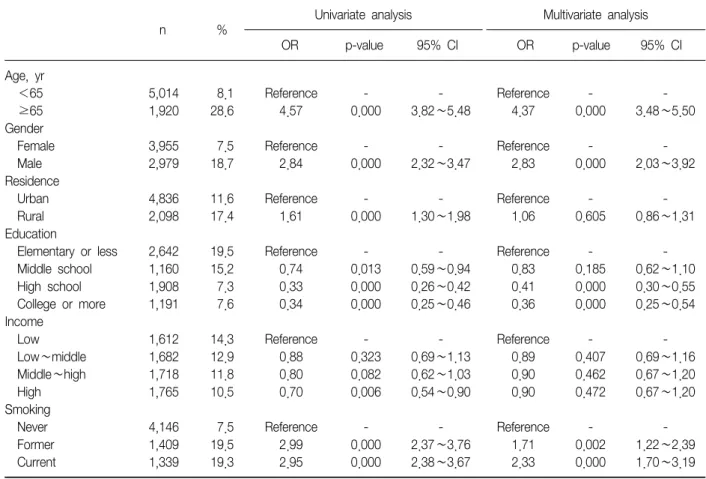
According to univariate analysis on risk factors of

COPD, old age, male, residence of rural area (Eup and

Myeon) and history of smoking increased the risk of

COPD while the income level of 'high' and higher edu-

cational status decreased it. Multivariate analysis with

these variables revealed that male, old age and history

(4)

Table 1. Prevalence of airflow obstruction stratified by residence, education, and income

Total Male Female

No. of subjects Prevalence (%) No. of subjects Prevalence (%) No. of subjects Prevalence (%) Age, yr

≥40 6,934 12.9 2,979 18.7 3,955 7.5

≥65 1,920 28.6 789 46.6 1,131 16.3

Residence

Rural (Eup, Myeon) 2,098 17.4 929 25.3 1,169 9.6

Urban (Dong) 4,836 11.6 2,050 16.7 2,786 6.9

Education

Elementary school or less 2,642 19.5 764 34.7 1,878 12.3

Middle school 1,160 15.2 554 24.4 606 5.5

High school 1,908 7.3 886 12.1 1,022 2.5

College or more 1,191 7.6 756 9.4 435 3.7

Income

Low 1,612 14.3 674 21.1 938 8.4

Low∼middle 1,682 12.9 716 19.3 966 6.7

Middle∼high 1,718 11.8 755 17.4 963 6.5

High 1,765 10.5 768 14.8 997 6.6

Table 2. Awareness of COPD

Total GOLD 1 GOLD 2 GOLD 3 & 4

Diagnosed by physician, % 2.5 1.8 2.4 15.0

Currently treated, % 1.7 1.2 1.4 11.3

Age at diagnosis of COPD, yr* 51.4 58.5 48.5 41.4

*Data are represented as mean value.

GOLD: global initiative for chronic obstructive lung disease; COPD: chronic obstructive pulmonary disease.

Figure 1. Prevalence of airflow obstruction stratified by age group.

Figure 2. Distribution of COPD severity stratified by the GOLD classification. COPD: chronic obstructive pulmo- nary disease; GOLD: global initiative for chronic ob- structive lung disease.

of smoking were risk factors of COPD and higher edu-

cational status declined its risk. However, income level

was not related with its risk (Table 3).

(5)

Table 3. Risk factor analysis for COPD by multiple logistic regression analysis

n %

Univariate analysis Multivariate analysis

OR p-value 95% CI OR p-value 95% CI

Age, yr

<65 5,014 8.1 Reference - - Reference - -

≥65 1,920 28.6 4.57 0.000 3.82∼5.48 4.37 0.000 3.48∼5.50

Gender

Female 3,955 7.5 Reference - - Reference - -

Male 2,979 18.7 2.84 0.000 2.32∼3.47 2.83 0.000 2.03∼3.92

Residence

Urban 4,836 11.6 Reference - - Reference - -

Rural 2,098 17.4 1.61 0.000 1.30∼1.98 1.06 0.605 0.86∼1.31

Education

Elementary or less 2,642 19.5 Reference - - Reference - -

Middle school 1,160 15.2 0.74 0.013 0.59∼0.94 0.83 0.185 0.62∼1.10

High school 1,908 7.3 0.33 0.000 0.26∼0.42 0.41 0.000 0.30∼0.55

College or more 1,191 7.6 0.34 0.000 0.25∼0.46 0.36 0.000 0.25∼0.54

Income

Low 1,612 14.3 Reference - - Reference - -

Low∼middle 1,682 12.9 0.88 0.323 0.69∼1.13 0.89 0.407 0.69∼1.16

Middle∼high 1,718 11.8 0.80 0.082 0.62∼1.03 0.90 0.462 0.67∼1.20

High 1,765 10.5 0.70 0.006 0.54∼0.90 0.90 0.472 0.67∼1.20

Smoking

Never 4,146 7.5 Reference - - Reference - -

Former 1,409 19.5 2.99 0.000 2.37∼3.76 1.71 0.002 1.22∼2.39

Current 1,339 19.3 2.95 0.000 2.38∼3.67 2.33 0.000 1.70∼3.19

COPD: chronic obstructive pulmonary disease; OR: odd ratio; CI: confidence interval.

Discussion

The prevalence of COPD of adults aged over 40 years recorded 12.9% in KNHANES IV. It differed from that of KNHANES II which was 17.2%. The discrepancy be- tween KNHANES II and IV was considered to be caused by different criteria of spirometry rather than actual dif- ference in the prevalence. While KNHANES II utilized the results of spirometry showing two or more accept- able curves to calculate the prevalence, KNHANES IV used the reproducibility criteria in addition to accept- able criteria. When the prevalence of COPD was calcu- lated by applying the criteria of KNHANES II using the data in the second year of KNHANES IV it recorded 17.7%

14

so that the prevalence of COPD was not sig- nificantly different between KNHANES II and IV.

In KNHANES IV, the prevalence of COPD of males was two times higher than that of females by recording

18.7% and 7.5%, respectively and the prevalence be- came higher at older age. In addition, the prevalence of smokers was higher than that of non-smokers. Multi- variate analysis found that male, old age and history of smoking were statistically significant risk factors of COPD. Although low income level had been observed to be an independent risk factor in KNHANES II, it was not related with COPD in KNHANES IV. Instead, the subjects with higher educational background showed a lower risk of COPD than those with lower one.

Despite relatively high prevalence of COPD, its diag- nosis rate is very low

15

and even patients actually treat- ed for COPD do not know their diagnosis name accu- rately in many cases

16

. This study also revealed that on- ly 2.5% of the subjects with COPD were diagnosed as COPD. Even in subjects with GOLD 3 and 4, only 15.0%

had been diagnosed by physicians and only 75.6%

(N=6) out of them were currently treated. So, efforts to

(6)

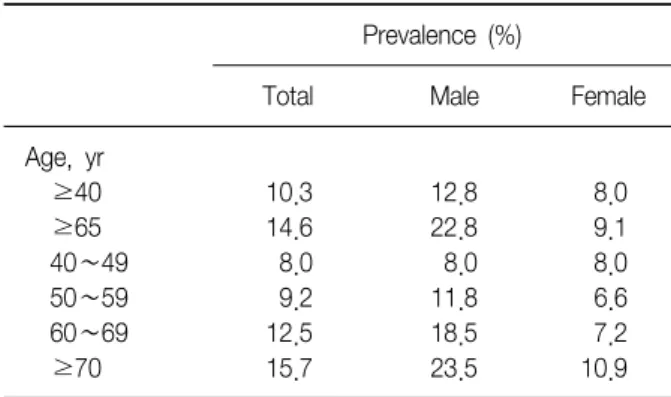
Table 4. Prevalence of COPD using the LLN Prevalence (%)

Total Male Female

Age, yr

≥40 10.3 12.8 8.0

≥65 14.6 22.8 9.1

40∼49 8.0 8.0 8.0

50∼59 9.2 11.8 6.6

60∼69 12.5 18.5 7.2

≥70 15.7 23.5 10.9

COPD: chronic obstructive pulmonary disease; LLN: lower limit of normal.

raise the awareness of COPD are needed in the future.

Although many treatments for COPD such as smoking cessation, medication, pulmonary rehabilitation and oxygen therapy have been utilized, there has been no medication slowing the rate of declining pulmonary function or reducing the mortality rate up to now.

However, recent large-scale researches have reported that some medications can decrease the rate of declin- ing of lung function and the mortality rate

17-19

in patients with moderate COPD, so that the importance of early detection of and proper treatments for COPD has been increased. This study found that 60.5% and 36.0% of the patients diagnosed as COPD recorded GOLD stage 1 and 2, respectively. Only 2.4% of those recording GOLD stage 2 had been diagnosed by physicians and only 1.4% of them were currently treated. For GOLD stage 1, the rates of being diagnosed by physicians and being treated were lower by recording 1.8% and 1.2%, respectively. This finding showed again the importance of early detection and early treatment. Until now a uni- form screening test using spirometry for early detection of COPD has not been recommended

20

, but the neces- sity of screening test for early detection for subjects with risk factors of COPD has been suggested

21

. Because KNHANES IV revealed that the diagnosis rate of COPD was very low and its risk factors including history of smoking were determined, this result supported the ne- cessity of screening test for high-risk group of COPD.

Although KNHANES IV minimized seasonal and re- gional bias by investigating all year around, secured the representativeness of results by attaching the weight through post-hoc adjustment and could obtain more ac- curate prevalence of COPD by applying stricter accept- ability and reproducibility criteria, it had some limita- tions. First, it did not exclude other diseases associated with airflow obstruction such as bronchiectasis and tu- berculous destroyed lung because it did not utilize chest radiography. Second, the existence of airflow obstruc- tion was evaluated with a fixed ratio using FEV

1

/FVC

<0.7, so that the prevalence of the elderly could be overestimated. Moreover, it could not exclude com- pletely the possibility of including asthma and other dis-

ease because bronchodilator testing was not conducted.

When COPD was diagnosed with a fixed ratio of FEV

1

/FVC, the possibility of overestimation among the elderly and underestimation among the young has been raised continuously. To minimize it, lower limit of nor- mal has been recommended

13,22

. The prevalence of COPD calculated with lower limit of normal was 10.3%

(Table 4).

To supplement these limitations, KNHANES V apply- ing stricter spirometry criteria of showing three accept- able curves and meeting reproducibility criteria is in progress. It also includes bronchodilator testing and is planned to use both of a fixed ratio and lower limit of normal to obtain the prevalence of COPD.

In summary, the prevalence of COPD among Korean adults aged over 40 years was 12.9% in KNHANES IV and 96.5% of the participants with COPD were GOLD stage 1 and 2. Most COPD patients had not been diag- nosed by physicians and consequently had not been treated appropriately. Early management for subjects with risk factors of COPD is considered to be necessary, and currently ongoing KNHANES V is expected to ob- tain more accurate prevalence of COPD.

Acknowledgement

We authors sincerely acknowledge the efforts of

KNHANES examiners of the Korea Centers for Disease

Control who conducted spirometry in enumeration

(7)

districts.

References

1. Renwick DS, Connolly MJ. Prevalence and treatment of chronic airways obstruction in adults over the age of 45. Thorax 1996;51:164-8.

2. Murray CJ, Lopez AD. Alternative projections of mortal- ity and disability by cause 1990-2020: Global Burden of Disease Study. Lancet 1997;349:1498-504.

3. World Health Organization (WHO). The Global Burden of Disease: 2004 Update. Geneva, Switzerland: WHO;

2008.

4. Celli BR, MacNee W; ATS/ERS Task Force. Standards for the diagnosis and treatment of patients with COPD:

a summary of the ATS/ERS position paper. Eur Respir J 2004;23:932-46.

5. World Health Organization (WHO). Chronic obstructive pulmonary disease (COPD). Fact sheet No. 315.

Geneva, Switzerland: WHO; 2011.

6. Korean Statistical Information Service (KSIS). The cause of death statistics [Internet]. Daejeon: KSIS; c2010.

[cited 2010 Jun 1]. Available from: http://kosis.kr/

abroad/abroad_01List.jsp?parentId=D.

7. Health Insurance Review & Assessment Service (HIRA).

Information for chronic diseases 2009. Seoul: HIRA;

c2010 [cited 2011 Jun 1]. Available from: http://www.

hira.or.kr.

8. Halbert RJ, Natoli JL, Gano A, Badamgarav E, Buist AS, Mannino DM. Global burden of COPD: systematic re- view and meta-analysis. Eur Respir J 2006;28:523-32.

9. Kim DS, Kim YS, Jung KS, Chang JH, Lim CM, Lee JH, et al. Prevalence of chronic obstructive pulmonary dis- ease in Korea: a population-based spirometry survey.

Am J Respir Crit Care Med 2005;172:842-7.

10. Korea Centers for Disease Control and Prevention (KCDC). Korean national health and nutrition examina- tion survey. Cheongwon: KCDC; c2011 [cited 2011 Jul 1]. Available from: http://knhanes.cdc.go.kr/intro/in- tro01.jsp.

11. Miller MR, Hankinson J, Brusasco V, Burgos F, Casaburi R, Coates A, et al. Standardisation of spirometry. Eur Respir J 2005;26:319-38.

12. Choi JK, Paek DM, Lee JO. Normal predictive values of spirometry in Korean population. Tuberc Respir Dis 2005;58:230-42.

13. Global Initiative for Chronic Obstructive Lung Disease (GOLD). Global strategy for diagnosis, management, and prevention of chronic obstructive pulmonary disease. [place unknown]: GOLD; 2009.

14. Yoo KH, Kim YS, Sheen SS, Park JH, Hwang YI, Kim SH, et al. Prevalence of chronic obstructive pulmonary disease in Korea: the fourth Korean National Health and Nutrition Examination Survey, 2008. Respirology 2011;16:659-65.

15. Soriano JB, Zielinski J, Price D. Screening for and early detection of chronic obstructive pulmonary disease.

Lancet 2009;374:721-32.

16. Hwang YI, Kwon OJ, Kim YW, Kim YS, Park YB, Lee MG, et al. Awareness and impact of COPD in Korea:

an epidemiologic insight survey. Tuberc Respir Dis 2011(accepted).

17. Jenkins CR, Jones PW, Calverley PM, Celli B, Anderson JA, Ferguson GT, et al. Efficacy of salmeterol/flutica- sone propionate by GOLD stage of chronic obstructive pulmonary disease: analysis from the randomised, pla- cebo-controlled TORCH study. Respir Res 2009;10:59.

18. Decramer M, Celli B, Kesten S, Lystig T, Mehra S, Tashkin DP, et al. Effect of tiotropium on outcomes in patients with moderate chronic obstructive pulmo- nary disease (UPLIFT): a prespecified subgroup analy- sis of a randomised controlled trial. Lancet 2009;374:

1171-8.

19. Celli BR, Thomas NE, Anderson JA, Ferguson GT, Jenkins CR, Jones PW, et al. Effect of pharmacotherapy on rate of decline of lung function in chronic ob- structive pulmonary disease: results from the TORCH study. Am J Respir Crit Care Med 2008;178:332-8.

20. Lin K, Watkins B, Johnson T, Rodriguez JA, Barton MB;

U.S. Preventive Services Task Force. Screening for chronic obstructive pulmonary disease using spirome- try: summary of the evidence for the U.S. Preventive Services Task Force. Ann Intern Med 2008;148:535-43.

21. Lee SW, Yoo JH, Park MJ, Kim EK, Yoon HI, Kim DK, et al. Early diagnosis and management of chronic ob- structive pulmonary disease. Tuberc Respir Dis 2011;

70:293-300.

22. Hwang YI, Kim CH, Kang HR, Shin T, Park SM, Jang

SH, et al. Comparison of the prevalence of chronic ob-

structive pulmonary disease diagnosed by lower limit

of normal and fixed ratio criteria. J Korean Med Sci

2009;24:621-6.

수치

Table  1.  Prevalence  of  airflow  obstruction  stratified  by  residence,  education,  and  income
Table  3.  Risk  factor  analysis  for  COPD  by  multiple  logistic  regression  analysis
Table  4.  Prevalence  of  COPD  using  the  LLN Prevalence  (%)

참조

관련 문서

Department of Naval Architecture and Ocean Engineering, Seoul National University of College of Engineering@. 서울대학교 조선해양공학과 학부4학년

y 데스크톱 GIS 애플리케이션 개발을 위한 개발환경 y ArcGIS Desktop 기능의 GIS 컴포넌트와

그림 3.16 그림 3.13과 마찬가지로, 움직이는 파동묶음도 많은 독립된 파들로 구성되어 있다. 그 결과로 입자가 움직임에 따라서

School of Computer Science & Engineering Seoul

School of Mechanical and Aerospace Engineering Seoul National University..

School of Mechanical and Aerospace Engineering Seoul National University..

Department of Naval Architecture and Ocean Engineering, Seoul National University of College

Department of Naval Architecture and Ocean Engineering, Seoul National University of College of