Unplanned Extubation in Patients with Mechanical Ventilation: Experience in the Medical Intensive Care Unit of a Single Tertiary Hospital
Tae Won Lee, M.D., Jeong Woo Hong, M.D., Jung-Wan Yoo, M.D., Sunmi Ju, M.D., Seung Hun Lee, M.D., Seung Jun Lee, M.D., Ph.D., Yu Ji Cho, M.D., Ph.D., Yi Yeong Jeong, M.D., Ph.D., Jong Deog Lee, M.D., Ph.D. and Ho Cheol Kim, M.D., Ph.D.
Department of Internal Medicine, Gyeongsang Institute of Health Sciences, Gyeongsang National University School of Medicine, Jinju, Korea
Background: Potentially harmful unplanned extubation (UE) may occur in patients on mechanical ventilation (MV) in an intensive care unit (ICU) setting. This study aimed to evaluate the clinical characteristics of UE and its impact on clinical outcomes in patients with MV in a medical ICU (MICU).
Methods: We retrospectively evaluated MICU data prospectively collected between December 2011 and May 2014.
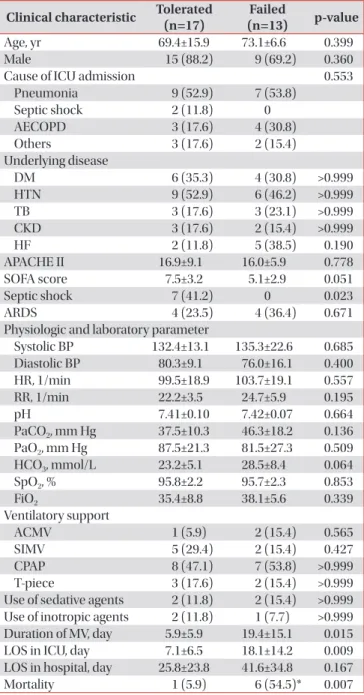
Results: A total of 468 patients were admitted to the MICU, of whom 450 were on MV. Of the patients on MV, 30 (6.7%) experienced UE; 13 (43.3%) required reintubation after UE, whereas 17 (56.7%) did not require reintubation. Patients who required reintubation had a significantly longer MV duration and ICU stay than did those not requiring reintubation (19.4±15.1 days vs. 5.9±5.9 days days and 18.1±14.2 days vs. 7.1±6.5 days, respectively; p<0.05). In addition, mortality rate was significantly higher among patients requiring reintubation than among those not requiring reintubation (54.5% vs.
5.9%; p=0.007). These two groups of patients exhibited no significant differences, within 2 hours after UE, in the fraction of inspired oxygen, blood pressure, heart rate, respiratory rate, and pH.
Conclusion: Although reintubation may not always be required in patients with UE, it is associated with a poor outcome after UE.
Keywords: Airway Extubation; Respiration, Artificial; Intensive Care Units
Introduction
Endotracheal intubation is needed in patients on mechani- cal ventilation (MV) to support ventilation and maintain lung volume and provide a suctioning route for the prevention of tracheal obstruction and hypoxia due to airway secretions
1. Endotracheal tube (ETT) removal, or extubation, is performed by a physician or nurse after successful weaning from MV and represents the final step in liberation from MV
2.
Planned extubation (PE) refers to ETT removal by a physi- cian or nurse according to a schedule or protocol. In con- trast, unplanned extubation (UE) is defined as accidental or patient-induced ETT removal and occurs in 3%–16% of patients on MV
3-8. UE can provoke injuries of the upper respi- Copyright © 2015
The Korean Academy of Tuberculosis and Respiratory Diseases.
All rights reserved.
Address for correspondence: Ho Cheol Kim, M.D., Ph.D.
Department of Internal Medicine, Gyeongsang National University School of Medicine, 15 Jinju-daero 816beon-gil, Jinju 52727, Korea
Phone: 82-55-750-8684, Fax: 82-55-750-8618E-mail: [email protected] Received: Apr. 9, 2015 Revised: Jun. 23, 2015 Accepted: Jul. 21, 2015
cc