The Comparison of Clinical Variables in Two Classifications: GOLD 2017 Combined Assessment and Spirometric Stage of Chronic Obstructive Pulmonary Disease
Ipek Candemir, M.D. , Pinar Ergun, M.D., Dicle Kaymaz, M.D., Filiz Tasdemir and Nurcan Egesel
Ataturk Chest Diseases and Chest Surgery Education and Research Hospital, Pulmonary Rehabilitation and Home Care Center, Ankara, Turkey
Background: There are limited number of studies that investigate clinical variables instead of chronic obstructive lung disease (COPD) management according to Global Initiative for Chronic Obstructive Lung Disease (GOLD) 2017 classification. The aim of the study was to investigate whether there was a difference between GOLD 2017 classification and spirometric stage in clinical variables in patients with COPD. The data of 427 male patients with stable COPD were investigated retrospectively.
Methods: Patients were allocated into combined assessment of GOLD 2017 and spirometric stage. Age, amount of smoking, pulmonary function, modified Medical Re search Council (mMRC), incremental shuttle walk test (ISWT), Hospital Anxiety-Depression Scale (HADS), St. George’s Respiratory Questionnaire (SGRQ), body mass index (BMI), and fat free mass index (FFMI) were recorded.
Results: Seventy-three (17%) patients were in group A, 103 (24%) constituted group B, 38 (9%) were included in group C, and 213 (50%) comprised group D according to the combined assessment of GOLD 2017. Twenty-three patients (5%) were in stage 1, 95 (22%) were in stage 2, 149 (35%) were in stage 3, and 160 (38%) were in stage 4 according to spirometric stage. According to GOLD 2017, age, amount of smoking, mMRC, BMI, FFMI, SGRQ, HADS, forced vital capacity, forced expiratory volume in 1 second (FEV
1), and ISWT were significantly different between groups. Ages, amount of smoking, FFMI, BMI, HADS of group A were different from B and D. Smiliar values of FEV
1were found in A‒
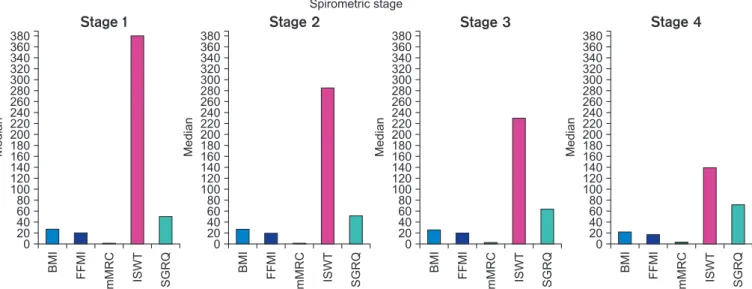
C and B‒D. A and C had smiliar ISWT. According to spirometric stage, BMI, FFMI of stage 4 were statistically different.
mMRC, ISWT, and SGRQ of stages 3 and 4 were different from other stages, amongst themselves. FEV
1was correlated with mMRC, SGRQ, anxiety scores, BMI, FFMI, and ISWT.
Conclusion: This study showed that the GOLD ABCD classification might not represent the severity of COPD sufficiently well in terms of lung function or exercise capacity. The combination of both spirometric stage and combined assessment of GOLD 2017 is important, especially for estimating clinical variables.
Keywords: Pulmonary Disease, Chronic Obstructive; Quality of Life; Dyspnea
Address for correspondence: Ipek Candemir, M.D.
Ataturk Chest Diseases and Chest Surgery Education and Research Hospital, Pulmonary Rehabilitation and Home Care Center, Kecioren, Ankara 06280, Turkey Phone: 90-5326753935, Fax: 90-3123552135, E-mail: [email protected]
Received: Oct. 12, 2017, Revised: Nov. 22, 2017, Accepted: Dec. 8, 2017, Published online: Mar. 7, 2018
cc It is identical to the Creative Commons Attribution Non-Commercial License (http://creativecommons.org/licenses/by-nc/4.0/).
Copyright © 2018
The Korean Academy of Tuberculosis and Respiratory Diseases.
Introduction
Chronic obstructive lung disease (COPD), a progressive disease, is characterized by airflow limitation with increas- ing mortality and morbidity rates
1. The accurate diagnosis of COPD is very important in terms of disease management by way of decreasing symptoms such as dyspnea, number of exacerbations, improving health status, exercise capacity, and mortality
2. COPD has been classified by the Global Initia- tive for Chronic Obstructive Lung Disease (GOLD) criteria, which appears in most literature, and is accepted and used all around the world. The first GOLD report was launched in 1997. The regurlarly revised GOLD criteria were recently updated in 2017. The 2011 GOLD report was the first to recommend the “ABCD” assessment tool instead of simple spirometric grading. The report included patient-reported outcomes and the importance of exacerbation prevention in COPD management. Some limitations were noticed over time due to the decreased prediction in mortality and other impor- tant health outcomes when it was compared with spirometric grades
3-5. Moreover, the outcomes of group D were modified by two parameters: lung function and/or exacerbation history, which caused confusion
6. For the purpose of clarifing con- cerns in the 2017 GOLD report, the ABCD classification has been adjusted and spirometric grades have been seperated from ABCD groupings. For some therapy recommendations, especially pharmacologic treatments, ABCD groups are de- rived exclusively from patient symptoms and their exacerba- tion history. However, it is still recommended that spirometry, in conjunction with patient symptoms and exacerbation history, remains vital for the diagnosis, prognostication, and consideration of other important therapeutic approaches, es- pecially non-pharmacologic therapies
1.
The aim of the study was to investigate whether there was a difference between the GOLD 2017 classification and spiro- metric stage in age, smoking status (current/former), amount of smoking, body composition, dyspnea sensation, health- related quality of life, psychological status, and exercise capac- ity in patients with COPD.
Materials and Methods
1. Data collection
The data of patients who were referred to the outpatient pulmonary rehabilitation center of our hospital between Janu- ary 2013 and May 2017 were investigated retrospectively.
Male patients with stable COPD were included. Patients with comorbidities such as uncontrolled hypertension, diabetes mellitus, cognitive dysfunction, lung cancer, and also with evi- dent bronchiectasis or sequential of tuberculosis were exclud- ed. The data of 427 male patients with COPD were recorded
after patients’ informed consent and hospital approvals were obtained (Ataturk Chest Disease and Chest Surgery Educa- tion and Research Hospital Review Board, approval number:
568).
The number of exacerbations and hospitalizations were analyzed from the records of the PR center and hospital da- tabase, and also confirmed with patients’ declarations. The definition of exacerbations was accepted as detailed below as the GOLD recommendation
6.
2. Definition of exacerbation
Exacerbations are defined as “an acute worsening of respira- tory symptoms that result in additional therapy;” the cardinal symptom is increased dyspnea, and other symptoms include increased sputum purulence and volume, together with in- creased cough and wheeze.
3. Classifications
The patients were allocated into the combined assessment of GOLD 2017 and spirometric stage
6.
1) Classification of combined assessment
- Group A: 0 to 1 exacerbation per year and no prior hos- pitalizations for exacerbation, and modified Medical Re- search Council (mMRC) grade 0 to 1.
- Group B: 0 to 1 exacerbation per year and no prior hospi- talizations for exacerbation, and mMRC grade ≥2.
- Group C: ≥2 exacerbations per year or ≥1 hospitalization for exacerbation, and mMRC grade 0 to 1.
- Group D: ≥2 exacerbations per year or ≥1 hospitalization for exacerbation, and mMRC grade ≥2.
2) Classification based on postbronchodilator forced expiratory volume in 1 second
In patients with forced expiratory volume in 1 second (FEV
1)/forced vital capacity (FVC) <70%:
- Stage 1: FEV
1≥80% predicted.
- Stage 2: 50%≤FEV
1<80% predicted.
- Stage 3: 30%≤FEV
1<50% predicted.
- Stage 4: FEV
1<30% predicted.
4. The measurements
The recorded measures were dyspnea, exercise capacity,
psychological status, health-related quality of life, and body
composition. Dyspnea was assessed using the mMRC scale
7and exercise capacity was evaluated using the incremental
shuttle walk test (ISWT). The ISWT required the patient to
walk up and down a 10-m course. The course was identified
by two cones inset 0.5 m from either end to avoid the need for
abrupt changes in direction. The speed at which the patient
walked was dictated by an audio signal, which was increased by 0.17 m/sec each minute. The distance was recorded in me- ters at the end of the test
8. Psychological status was revealed with the Hospital Anxiety and Depression Scale (HADS)
9. Health-related quality of life was assessed using the Turkish version of a standardized St. George’s Respiratory Question- naire (SGRQ)
10,11. For body composition, bioelectrical imped- ance was used with a Tanita (BIA model TBF-300; Tanita Corporation, Tokyo, Japan). Body mass index (BMI) and fat- free mass index (FFMI) were calculated using a formula in which weight (body mass for BMI, fat-free mass for FFMI) in kilograms was divided by the square of height in meters.
5. Statistical analysis
SPSS version 18.0 (SPSS, Inc., Chicago, IL, USA) for Micro- soft Windows (Microsoft Corporation, Redmond, WA, USA) was used for analysis. The variables were analyzed using the Shapiro-Wilk test to evaluate distribution. Results for descrip- tive statistics were expressed as mean±standard deviation or median (minimum:maximum). Categorical variables were expressed as numbers and percentages (%). Statistical com- parisons of continuous variables among the groups were performed using one-way analysis of variance or the Kruskal- Wallis test based on their distribution. The Tukey test was per- formed for post hoc analysis after performing the analysis of variance test. Spearman correlation analysis was performed.
Statistical significance was set to a p<0.05.
Results
The mean age of all patients was 62.7±9 years. Three hun- dred sixty-nine patients (86%) were former smokers, and 58 (13%) were current smokers with a median value of 40 (0:200) pack-years among all patients (Table 1).
Seventy-three patients (17%) were in group A, 103 (24%) constituted group B, 38 (9%) were included in group C, and 213 (50%) comprised group D according to the combined as-
Table 1. Demographic features of all patients Value Age, yr
Mean±SD 62.7±9
Median (min–max) 63 (40–86)
Smoking, pack-years
Mean±SD 44±28
Median (min–max) 40 (0–200)
Former smoker, n (%) 69 (86)
Current smoker, n (%) 58 (13) Ta ble 2. T h e r ec or de d v alu es of e ach gr oup a cc or d in g t o G OL D 2017 Ag e Sm ok in g, B MI FFMI G OL D mMR C FEV FVC IS W T (m) SG RQ Anx iety D epr es sion
221(yr) p ac k-y ears (k g/m ) (k g/m ) A Mea n± SD 59±8 33±24 0.9±0.2 27±5 20±6 55±20 69±18 342±104 41±16 8±2.5 8±2 M edi an (min–max) 60 (45–78) 30 (0–120) 1 (0–1) 27 (15–39) 20 (14–26) 57 (15–99) 69 (24–100) 350 (110–520) 40 (13–84) 8 (1–15) 8 (2–14) B Mea n± SD 64±9 43±22 2.4±0.6 25±6 19±9 40±19 57±17 221±117 64±14 9±2 10±3 M edi an (min–max) 65 (43–83) 40 (0–120) 2 (2–4) 24 (15–41) 19 (14–31) 35 (13–94) 56 (25–99) 200 (30–480) 65 (31–98) 10 (3–17) 10 (3–15) C Mea n± SD 60±8 45±27 0.9±0.2 25±5 19±2 50±19 68±16 317±98 49±12 9±2 9±2 M edi an (min–max) 61 (45–73) 40 (0–107) 1 (0–1) 25 (16–35) 20 (15–25) 46 (24–92) 69 (40–99) 305 (40–450) 49 (18–76) 10 (4–13) 9 (5–13) D Mea n± SD 64±9 49±32 2.6±0.6 24±6 19±3 34±16 50±16 174±97 71±15 10±2 10±2 M edi an (min–max) 63 (40–86) 45 (0–200) 2 (2–4) 24 (14–42) 19 (13–25) 29 (13–99) 48 (13–98) 170 (30–480) 73 (31–98) 10 (2–15) 10 (3–15) G OLD: G lob al I niti ative for C hr onic Obs tructive Lung Dise ase; mMR C : mo difie d M edic al R ese ar ch C ouncil sc ale; BMI: b od y mas s index ; FFMI: fat -fr ee mas s index ; FEV : for ce d
1expir at or y volume in 1 se cond; F V C : for ce d vital c ap acit y; IS W T : incr emental shut tle w alk t es t dis tance; S GR Q: S t. G eor ge ’s R es pir at or y Ques tionnair e.
sessment of GOLD 2017. The recorded values of each group are given in Table 2. Age (p=0.001), mMRC scale (p<0.001), amount of cigarettes (pack-years) (p<0.001), BMI (p=0.002), FFMI (p=0.001), SGRQ score (p<0.001), HADS (p<0.001), FVC (p<0.001), FEV
1(p<0.001), and ISWT distance (p<0.001) were significantly different between the groups (Figure 1).
The ages, amount of cigarettes, FFMI, BMI values, anxiety, depression scores of group A were found to be statistically significant different than group B (p=0.009, p=0.028, p=0.008, p=0.008, p=0.001, and p<0.001, respectively), and group D
(p=0.002, p<0.001, p<0.001, p=0.001, p<0.001, and p<0.001, respectively). Group C was similar to the other groups and also groups B and D were similar in these measurements.
Similar FEV
1values were in groups A and C, and B and D.
Statistically different values of FEV
1were found in groups A and B (p<0.001), A and D (p<0.001), B and C (p=0.034), and C and D (p<0.001). In the ISWT distance, only groups A and C had similar values (significant difference between groups: A–
B, p<0.001; A–D, p<0.001; B–C, p<0.001; B–D, p=0.001; C–D, p<0.001). However, SGRQ scores were different between all
Combined assessment of GOLD 2017
360 340 320 300 280 260 240 220 180 160 140 120 100 80 60 40 20 0
Median Age Pack-year BMI FFMI Anxiety Depression ISWT SGRQ
Group A
200
360 340 320 300 280 260 240 220 180 160 140 120 100 80 60 40 20 0
Median Age Pack-year BMI FFMI Anxiety Depression ISWT SGRQ
Group B
200
360 340 320 300 280 260 240 220 180 160 140 120 100 80 60 40 20 0
Median Age Pack-year BMI FFMI Anxiety Depression ISWT SGRQ
Group C
200
360 340 320 300 280 260 240 220 180 160 140 120 100 80 60 40 20 0
Median Age Pack-year BMI FFMI Anxiety Depression ISWT SGRQ
Group D
200
Figure 1. Statistically different parameters between the groups according to Global Initiative for Chronic Obstructive Lung Disease (GOLD) 2017. BMI: body mass index; FFMI: fat-free mass index; ISWT: incremental shuttle walk test distance; SGRQ: St. George’s Respiratory Ques- tionnaire.
Spirometric stage
Stage 1 Stage 2 Stage 3 Stage 4
380 340320 300 280 260 240 220 180 160 140 120 100 80 60 40 20 0
Median BMI FFMI mMRC ISWT SGRQ
200
360 380
340320 300 280 260 240 220 180 160 140 120 100 80 60 40 20 0
Median BMI FFMI mMRC ISWT SGRQ
200
360 380
340320 300 280 260 240 220 180 160 140 120 100 80 60 40 20 0
Median BMI FFMI mMRC ISWT SGRQ
200
360 380
340320 300 280 260 240 220 180 160 140 120 100 80 60 40 20 0
Median BMI FFMI mMRC ISWT SGRQ
200 360