• 검색 결과가 없습니다.

Comparative Study of Carboplatin Dosing in Lung Cancer Patients Using the Calvert Formula and Four Equations for Estimating Glomerular Filtration Rate

N/A
N/A
Protected

Academic year: 2021

Share "Comparative Study of Carboplatin Dosing in Lung Cancer Patients Using the Calvert Formula and Four Equations for Estimating Glomerular Filtration Rate"

Copied!
10
0
0

로드 중.... (전체 텍스트 보기)

전체 글

(1)

DOI 10.17480/psk.2020.64.2.156

Comparative Study of Carboplatin Dosing in Lung Cancer Patients Using the Calvert Formula and Four Equations for

Estimating Glomerular Filtration Rate

Seo Won Kim*

,†

, Young-Mo Yang**

,†

, and Eun Joo Choi***

,#

*Department of Pharmacy, Chonnam National University Hospital, Gwangju, Republic of Korea

**Department of Biomedical Informatics, Ajou University School of Medicine, Suwon, Republic of Korea

***Department of Pharmacy, College of Pharmacy, Chosun University, Gwangju, Republic of Korea

(Received February 13, 2020; Revised April 9, 2020; Accepted April 10, 2020)

Abstract Several studies have been conducted to estimate more accurate and precise glomerular filtration rate (GFR) in cancer patients; however, studies on determining carboplatin doses by the renal functions of Korean cancer patients have been rarely implemented. The aim of this study was to compare carboplatin doses calculated by the Calvert formula based on estimated GFRs with various equations with its dose prescribed by the physicians. This study was retrospectively conducted in patients (≥18 years) with lung cancer who had received carboplatin between September 2011 and August 2013. Data were collected by reviewing the electronic medical records (EMRs). Among 129 patients with lung cancer, 95 were males. Mean age was 65.0 years, and mean estimated GFRs of Cockcroft-Gault, Jelliffe, Modification of Diet in Renal Disease (MDRD), and MDRD for Japanese (J-MDRD) formulae were 65.7, 63.2, 74.1, and 57.5 mL/min, respectively. Compared with mean prescribed carboplatin dose (444.4 mg), its mean estimated doses by Cockcroft-Gault, Jelliffe, MDRD, and J-MDRD formulae were 465.8, 452.5, 508.6, and 423.3 mg, respectively. The carboplatin doses estimated by Cockcroft-Gault and Jelliffe formulae showed relatively smaller bias and better precision than those estimated by MDRD and J-MDRD formulae. The carboplatin dose calculated based on estimated GFR with MDRD formula showed the biggest bias and lowest precision. When the characteristics of patients in this study were considered, the J-MDRD formula may estimate more accurate GFRs than other formulae originated from Western patients. Further related studies are needed for Korean cancer patients.

Keywords Carboplatin dosing, Calvert formula, lung cancer, glomerular filtration rate estimation

Introduction

Carboplatin derived from cisplatin is the second generation of a platinum-containing anticancer drug which was approved by the Food and Drug Administration (FDA) for the treatment of ovarian cancer, and is used to treat reproductive cancers (e.g. cervical cancer and endometrial cancer), as well as solid cancers (e.g. lung cancer, head and neck cancer, and bladder cancer).

1,2)

The frequency of platinum-containing anticancer drug use has been low in the treatment of non-small-cell lung cancer (NSCLC), but the survival rate of NSCLC patients was increased after

carboplatin use.

3)

In employing a combination of carboplatin and docetaxel for the treatment of NSCLC, overall response rate and median overall survival time were 30.2% and 340 days, respectively.

4)

Since carboplatin has relatively a lower incidence rate of adverse reactions (ARs) (e.g. nausea, vomiting, nephrotoxicity, and neurotoxicity) than cisplatin, carboplatin is used as a substitute for cisplatin.

5)

In one study of NSCLC treatment, carboplatin was less effective than cisplatin, but displayed a lower incidence rate of serious ARs.

3)

In the treatment of small-cell lung cancer (SCLC), carboplatin caused more hematologic ARs (e.g.

anaemia, thrombocytopenia, leukopenia, and neutropenia) than cisplatin, but its use led to fewer gastrointestinal ARs, nephrotoxicity, and ototoxicity.

6)

In addition, when administered to elderly patients, carboplatin had a low incidence rate of non- hematologic ARs, such as nausea, vomiting, dizziness, and loss of appetite.

7)

Seo Won Kim and Young-Mo Yang are co-first authors and contrib- uted equally to the writing of this article.

#
Corresponding author

Eun Joo Choi, PharmD, PhD, MBA, RPh, Department of Pharmacy,

College of Pharmacy, Chosun University, 309 Pilmun-daero, Dong-

gu, Gwangju 61452, Republic of Korea

(2)

carboplatin dose is renally excreted within approximately 24 hours of administration.

2,8,9)

Thus, an appropriate carboplatin dose should be determined while taking into account patients’ renal functions by using the Calvert formula. This calculation uses a targeted area under the concentration time curve (AUC) instead of body surface area (BSA).

10-13)

Glomerular filtration rate (GFR) is the typical indicator to measure renal function in clinical practice; however, a direct measurement of GFR is difficult and inconvenient in routine clinical settings.

14)

Consequently, various simple methods to estimate GFR have been developed, that calculate creatinine clearance (CrCl) based on a serum creatinine (SCr) concentration.

Among these methods, the Cockcroft-Gault, Jelliffe, and Modification of Diet in Renal Disease (MDRD) formulae are often used to estimate GFR.

15-17)

These formulae, however, are not likely to appropriately estimate GFR in cancer patients because of several effect modifiers, including muscle mass, rate of metabolism of creatine to creatinine in muscle, creatinine filtration by renal glomerulus, and creatinine secretion by the renal proximal tubules.

12)

In particular, cancer patients lose muscle mass as the disease progresses, leading to decreases in a SCr concentration and GFR overestimation.

13)

Physicians may then prescribe higher doses of carboplatin than would be appropriate for the patient.

Several studies have been performed to measure GFR more accurately for the purpose of improving drug efficacy and safety in cancer patients.

5,12,16,18,19)

However, recommendations from studies related to determining carboplatin doses based on patients’

renal functions have been rarely implemented in Korea. Therefore, in this study, the doses of carboplatin calculated by the Calvert formula based on estimated GFRs with various GFR equations were compared with the doses of carboplatin which physicians had actually prescribed to Korean lung cancer patients.

Research Methods

Ethical approval for the study was granted by the Institutional Review Board (IRB) of Chonnam National University Hwasun Hospital, a large university-affiliated hospital in Hwasun-gun, Jeonnam, Korea (IRB 65510-56). Informed consent was waived by the IRB since patients’ records were de-identified before analysis. This was a retrospective study of inpatients and outpatients with lung cancer who had received carboplatin between September 2011 and August 2013. Chonnam National University Hwasun Hospital provides specialized medical services to patients with special illnesses, such as cancer. Inclusion criteria included patients with lung cancer who were aged ≥18 years and received carboplatin as neoadjuvant, adjuvant, or palliative chemotherapy.

Patients were excluded from the study if they had been diagnosed with chronic renal or heart failure, or did not have body weight, height, and SCr level measurements in their charts.

A retrospective chart review of electronic medical records (EMRs) was conducted by a trained hospital pharmacist to collect patient data, including demographic characteristics, type of lung cancer, prescribed carboplatin dose, and co-administered anticancer drugs. The SCr levels measured the day before administration of carboplatin or on the dosage day were recorded. In our institution, the Calvert formula (carboplatin dose (mg)=AUC×(GFR+25)) with CrCl estimated by the Cockcroft-Gault formula was used to calculate carboplatin dose.

11-13)

To compare carboplatin doses, CrCl was estimated using the Cockroft-Gault, Jelliffe, MDRD, and MDRD for Japanese (J- MDRD) formulae, and the putative carboplatin dose was calculated by the Calvert formula using the four CrCl estimates.

Target AUC was 5 or 6 mg/(mL·min). When body mass index (BMI) ≥30 kg/m

2

, ideal body weight (IBW) was used instead of

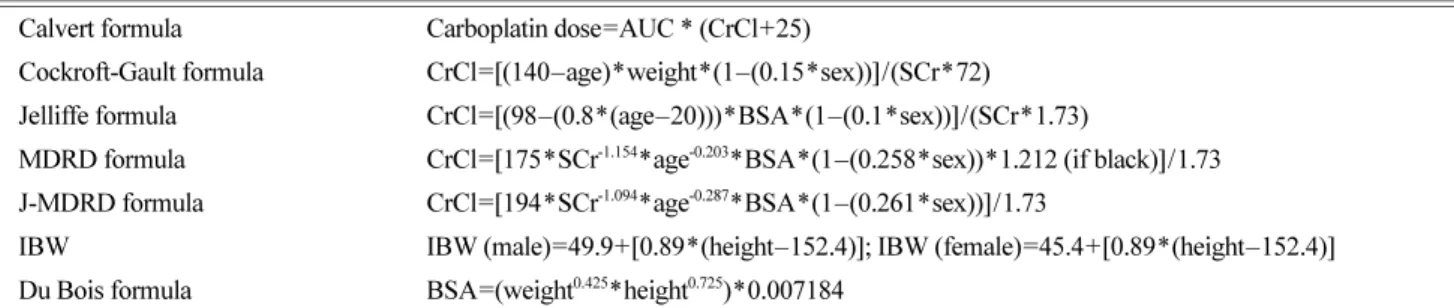
Table 1. Formulae used in this study

Calvert formula Carboplatin dose=AUC * (CrCl+25)

Cockroft-Gault formula CrCl=[(140–age)*weight*(1–(0.15*sex))]/(SCr*72) Jelliffe formula CrCl=[(98–(0.8*(age–20)))*BSA*(1–(0.1*sex))]/(SCr*1.73)

MDRD formula CrCl=[175*SCr

-1.154

*age

-0.203

*BSA*(1–(0.258*sex))*1.212 (if black)]/1.73 J-MDRD formula CrCl=[194*SCr

-1.094

*age

-0.287

*BSA*(1–(0.261*sex))]/1.73

IBW IBW (male)=49.9+[0.89*(height–152.4)]; IBW (female)=45.4+[0.89*(height–152.4)]

Du Bois formula BSA=(weight

0.425

*height

0.725

)*0.007184

MDRD, Modification of Diet in Renal Disease; J-MDRD, MDRD for Japanese; IBW, ideal body weight; AUC, area under the curve; CrCl, creatinine clearance; SCr, serum creatinine; BSA, body surface area.

Carboplatin dose (mg), AUC (mg/mL·min), CrCl (mL/min), age (years), weight (kg), sex (male=0, female=1), SCr (mg/dL), BSA (m

2

), IBW (kg),

height (cm).

(3)

actual body weight (ABW). BSA was calculated with DuBois formula. Table 1 lists the formulae used in this study.

11-15,17,18,20)

Correlations between prescribed and four estimated carboplatin doses were analysed by linear regression analysis, and the doses were also compared to each other by post-hoc Wilcoxon signed rank test. Bias was evaluated as mean percentage error (MPE), which was defined as the percentage difference between prescribed and estimated carboplatin doses (MPE=[(prescribed carboplatin dose–estimated carboplatin dose)/estimated carboplatin dose]×

100%).

14-16)

A positive bias indicated overdose of carboplatin, whereas a negative bias indicated an underdose. Precision was assessed by mean absolute percentage error (MAPE), calculated as the absolute value of MPE (MAPE=[|(prescribed carboplatin dose–estimated carboplatin dose)/estimated carboplatin dose|]×

100%).

14-16)

The greater the MAPE, the less precise the calculation of carboplatin dose.

Demographic variables and clinical characteristics of patients were assessed using descriptive statistics. Continuous variables are presented as mean±standard deviation (SD), and categorical variables were summarized in frequencies (n) and percentages (%). Bland-Altman plots were used to evaluate the agreement between the prescribed carboplatin dose and the calculated carboplatin doses. Statistical significance was assumed for p<0.05.

All analyses were implemented using SAS version 9.3 (SAS Institute Inc., Cary, NC, USA).

Results

Among 500 cancer patients using carboplatin during the study period, 129 with lung cancer who met inclusion and exclusion

criteria were included in the analysis (Fig. 1). The patients’

clinical characteristics are summarized in Table 2. Mean age was 65.0 years, and mean height, weight, BMI, and BSA were 162.3 cm, 61.1 kg, 23.2 kg/m

2

, and 1.6 m

2

, respectively. Mean estimated GFRs of the Cockcroft-Gault, Jelliffe, MDRD, and J-MDRD formulae were 65.7, 63.2, 74.1, and 57.5 mL/min, respectively.

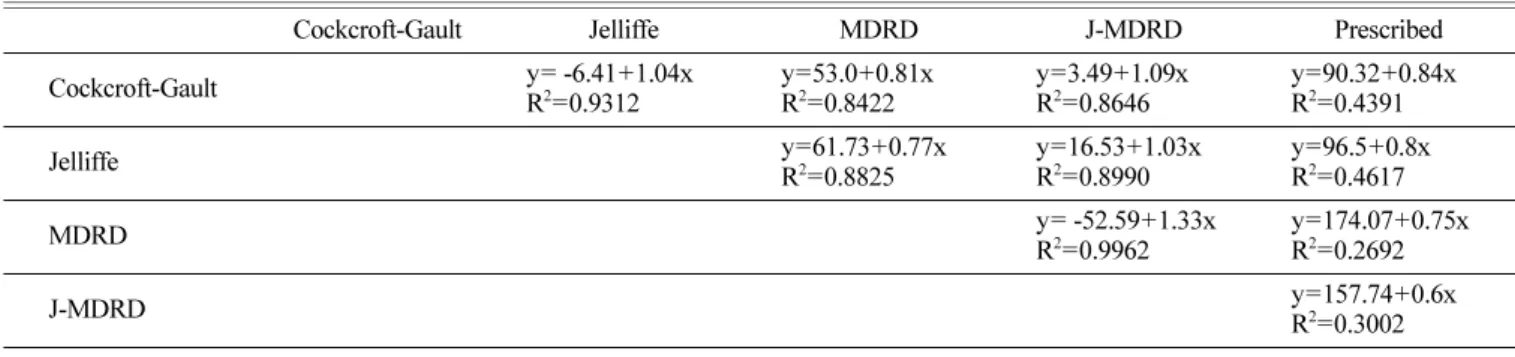
Table 3 presents the relationship between the prescribed carboplatin dose and the estimated carboplatin doses based on GFRs calculated using four different formulae. The coefficients of determination (R

2

) were between 0.3002 and 0.9962. Table 4 summarizes the prescribed carboplatin doses and calculated carboplatin doses, and their MPE and MAPE values. Compared with the prescribed carboplatin dose (444.4 mg), the estimated carboplatin doses by Cockcroft-Gault, Jelliffe, MDRD, and J- MDRD formulae were 465.8, 452.5, 508.6, and 423.3 mg, respectively. The carboplatin doses estimated by the Cockcroft- Gault and Jelliffe formulae displayed relatively smaller bias and better precision than those estimated by the MDRD and J-MDRD formulae. The MPE and MAPE values estimated by the Jelliffe, MDRD, and J-MDRD formulae were statistically significant compared with those estimated by the Cockcroft-Gault formula (p<0.001).

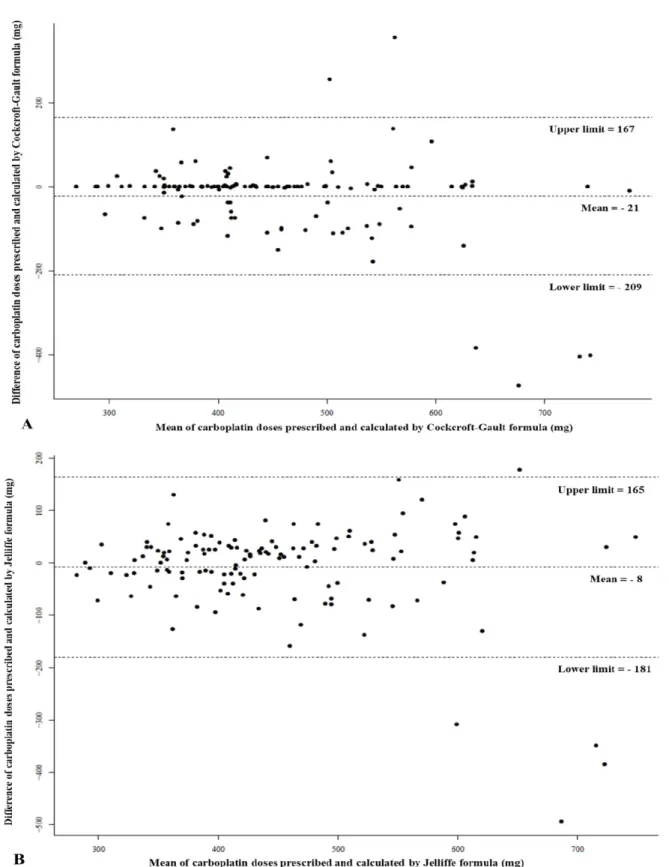
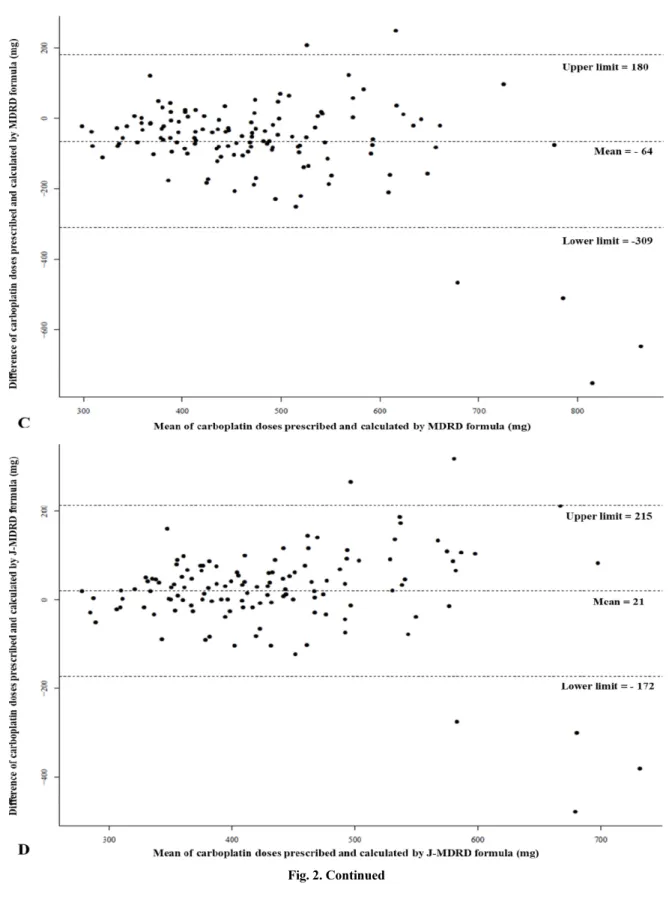
To further assess the agreement between prescribed and calculated

carboplatin doses, Bland-Altman plots were created by graphing

the association between means and differences (Fig. 2). Dots

represent the correlation between prescribed and estimated doses,

where dots located closer to zero on the y-axis signify fewer

differences between prescribed and estimated doses. The mean

differences between doses prescribed and doses calculated by the

Cockcroft-Gault, Jelliffe, and MDRD formulae were 21, 8, and

(4)

Table 2. Characteristics of patients

Characteristic Total (n=129) Male (n=95) Female (n=34) p-value

Age (years), mean±SD 65.0±9.50 65.4±8.90 64.0±11.2 0.4940

Height (cm), mean±SD 162.3±8.300 165.7±6.300 152.8±5.100 <0.0001

Weight (kg), mean±SD 61.1±10.6 62.5±10.2 57.3±10.8 0.0120

BMI (kg/m

2

), mean±SD 23.2±3.80 22.8±3.30 24.6±4.90 0.0110

BSA (Du Bois) (m

2

), mean±SD 1.6±0.2 1.7±0.1 1.5±0.1 <0.0001

Serum creatinine (mg/dL), mean±SD 1.0±0.3 1.0±0.3 0.8±0.2 <0.0001

Estimated GFR (mL/min), mean±SD

Cockcroft-Gault 65.7±23.8 67.2±24.3 61.7±22.1 0.2420

Jelliffe 63.2±22.1 63.3±22.9 62.9±200. 0.8550

MDRD 74.1±27.1 77.6±28.7 64.4±19.2 0.0140

J-MDRD 57.5±20.3 60.3±21.3 49.6±14.4 0.0070

Type of lung cancer, n (%)

Non-small cell lung cancer 86 (66.7) 63 (66.3) 23 (67.6) 0.8880

Small cell lung cancer 43 (33.3) 32 (33.7) 11 (32.4)

Anticancer drugs co-administered with carboplatin, n (%)

Gemcitabine 74 (57.4) 54 (56.8) 20 (58.8) 0.7410

Etoposide 48 (37.2) 36 (37.9) 12 (35.3)

Paclitaxel 4 (3.1) 2 (2.1) 2 (5.9)

Docetaxel 1 (0.8) 1 (1.1) 0 (0.0)

Others 2 (1.6) 2 (2.1) 0 (0.0)

BMI, body mass index; BSA, body surface area; GFR, glomerular filtration rate; MDRD, Modification of Diet in Renal Disease; J-MDRD, Modification of Diet in Renal Disease modified for Japanese.

Table 3. Relationship between prescribed carboplatin dose and estimated carboplatin doses by four different equations for GFR

Cockcroft-Gault Jelliffe MDRD J-MDRD Prescribed

Cockcroft-Gault y= -6.41+1.04x

R

2

=0.9312

y=53.0+0.81x R

2

=0.8422

y=3.49+1.09x R

2

=0.8646

y=90.32+0.84x R

2

=0.4391

Jelliffe y=61.73+0.77x

R

2

=0.8825

y=16.53+1.03x R

2

=0.8990

y=96.5+0.8x R

2

=0.4617

MDRD y= -52.59+1.33x

R

2

=0.9962

y=174.07+0.75x R

2

=0.2692

J-MDRD y=157.74+0.6x

R

2

=0.3002

*Evaluated by simple regression analysis.

GFR, glomerular filtration rate; MDRD, Modification of Diet in Renal Disease; J-MDRD, MDRD for Japanese.

Table 4. MPE and MAPE between prescribed carboplatin dose and estimated carboplatin doses by four different equations for GFR

Prescribed Cockcroft-Gault Jelliffe MDRD J-MDRD

Carboplatin dose, mg 444.4±100.1 465.8±127. 452.5±117.4* 508.6±143.7* 423.3±108.2*

MPE (%) -2.4±16.9 -0.1±14.4*0 - 10.2±17.2*0 7.1±19.1*0

MAPE (%) 8.9±14.5 10.7±9.6*00 15.5±12.6*0 15.0±13.8*0

MPE, mean percentage error; MAPE, mean absolute percentage error; GFR, glomerular filtration rate; MDRD, Modification of Diet in Renal Disease; J-MDRD, MDRD for Japanese.

*p<0.001 by post-hoc Wilcoxon signed rank test.

(5)

Fig. 2. Comparison between prescribed carboplatin dose and estimated carboplatin doses by four different equations for GFR. Bland-

Altman plots of carboplatin doses prescribed and calculated by the Cockcroft-Gault equation (A), carboplatin doses prescribed and calculated by

the Jelliffe equation (B), carboplatin doses prescribed and calculated by the MDRD equation (C), and carboplatin doses prescribed and

calculated by the J-MDRD equation (D). GFR, glomerular filtration rate; MDRD, Modification of Diet in Renal disease; J-MDRD, Modification

of Diet in Renal Disease modified for Japanese.

(6)

64, respectively, whereas the mean difference for the J-MDRD formula was 21.

Table 5 presents MPE status as determined by prescribed doses and estimated doses. Higher proportions of the MPE values

classified by Jelliffe (59.7%) and J-MDRD (69.8%) formulae

were in MPE>0 categories than those of the MPE values

classified by Cockcroft-Gault (35.7%) formula. A higher proportion

of the MPE values classified by MDRD (76.7%) formula were in

Fig. 2. Continued

(7)

MPE<0 categories than that of the MPE values classified by Cockcroft-Gault (40.3%) formula. A higher proportion of the MPE values classified by MDRD (76.7%) formula were in MPE

<0 categories than that of the MPE values classified by Jelliffe (40.3%) formula. A higher proportion of the MPE values classified by J-MDRD (69.8%) formula were in MPE>0 categories than that of the MPE values classified by Jelliffe (59.7%) formula. A higher proportion of the MPE values classified by J-MDRD (69.8%) formula were in MPE>0

Discussion

It is assumed that when carboplatin dosing is determined according to the Calvert formula, this drug is cleared through glomerular filtration.

2,8,9,12)

CrCl used as a surrogate marker for GFR is usually acceptable for calculating carboplatin doses, but it includes creatinine secretion by the renal tubules, as well as glomerular filtration.

12)

Direct GFR measurement through radiolabeled isotopes, such as chromium-51 ethylene diamine tetra-acetate Table 5. Status of MPE as determined by prescribed doses and estimated doses by four different equations for GFR

MPE-CG

Total

MPE < 0 MPE=0 MPE>0

MPE-Jelliffe

MPE<0 36 (27.9) 8 (6.2) 8 (6.2) 52 (40.3)

MPE=0 0 (0.0) 0 (0.0) 0 (0.0) 0 (0.0)

MPE>0 16 (12.4) 23 (17.8) 38 (29.5) 77 (59.7)

Total 52 (40.3) 31 (24.0) 46 (35.7) 129 (100.0)

MPE-MDRD

MPE<0 47 (36.4) 24 (18.6) 28 (21.7) 99 (76.7)

MPE=0 0 (0.0) 0 (0.0) 0 (0.0) 0 (0.0)

MPE>0 5 (3.9) 7 (5.4) 18 (14.0) 30 (23.3)

Total 52 (40.3) 31 (24) 46 (35.7) 129 (100.0)

MPE-J-MDRD

MPE<0 30 (23.3) 2 (1.6) 6 (4.7) 38 (29.5)

MPE=0 0 (0.0) 0 (0.0) 1 (0.8) 1 (0.8)

MPE>0 22 (17.1) 29 (22.5) 39 (30.2) 90 (69.8)

Total 52 (40.3) 31 (24) 46 (35.7) 129 (100.0)

MPE-Jelliffe

Total

MPE<0 MPE=0 MPE>0

MPE-MDRD

MPE<0 50 (38.8) 0 (0.0) 49 (38.0) 99 (76.7)

MPE=0 0 (0.0) 0 (0.0) 0 (0.0) 0 (0.0)

MPE>0 2 (1.6) 0 (0.0) 28 (21.7) 30 (23.3)

Total 52 (40.3) 0 (0.0) 77 (59.7) 129 (100.0)

MPE-J-MDRD

MPE<0 38 (29.5) 0 (0.0) 0 (0.0) 38 (29.5)

MPE=0 0 (0.0) 0 (0.0) 1 (0.8) 1 (0.8)

MPE>0 14 (10.9) 0 (0.0) 76 (58.9) 90 (69.8)

Total 52 (40.3) 0 (0.0) 77 (59.7) 129 (100.0)

MPE-MDRD

Total

MPE<0 MPE=0 MPE>0

MPE-J-MDRD

MPE<0 38 (29.5) 0 (0.0) 0 (0.0) 38 (29.5)

MPE=0 1 (0.8) 0 (0.0) 0 (0.0) 1 (0.8)

MPE>0 60 (46.5) 0 (0.0) 30 (23.3) 90 (69.8)

Total 99 (76.7) 0 (0.0) 30 (23.3) 129 (100.0)

MPE-CG, MPE between prescribed dose and estimated dose by Cockcroft-Gault

MPE-Jelliffe, MPE between prescribed dose and estimated dose by Jelliffe

MPE-MDRD, MPE between prescribed dose and estimated dose by MDRD

MPE-J-MDRD, MPE between prescribed dose and estimated dose by J-MDRD

(8)

settings.

12,16)

Thus, multiple formulae for GFR estimation based on SCr have been developed. In this study, we compared the doses of carboplatin calculated by the Calvert formula based on estimated GFRs using four different GFR equations with the actual dose which physicians had prescribed to lung cancer patients.

The carboplatin dose calculated based on GFR estimates of the MDRD formula had the largest bias and lowest precision compared with that calculated based on GFR estimates of the other three formulae. The MDRD formula was derived from patients with chronic kidney disease (CKD), and 88% of them were Caucasian.

18,19,21)

In our study, the patient population consisted of Koreans with lung cancer, which likely explains the lack of fit. According to studies of the MDRD formula’s accuracy, this formula may more accurately estimates GFRs than the Cockcroft-Gault formula in non-cancer patients with CKD;

conversely, the Cockcroft-Gault formula is likely to be more accurate than the MDRD formula in cancer patients.

18,21-25)

When calculated with the Cockcroft-Gault, Jelliffe, and MDRD formulae, carboplatin doses were overestimated compared with actual prescribed doses; however, using the J-MDRD formula led to an underestimation of the dose. These discrepancies may be explained by the fact that each of the GFR estimation methods was derived from different data. As mentioned above, the MDRD formula was developed from data obtained from mostly Caucasian patients with CKD.

18,19,21)

The Cockcroft-Gault formula was derived from predominantly adult males with relatively normal renal functions.

26)

The Jelliffe formula was also developed based on data from Western patients.

27,28)

However, the J-MDRD formula was developed by modifying the MDRD formula to improve the accuracy of GFR estimation in Japanese patients.

29)

Major factors affecting SCr levels include level of renal function, muscle mass, and amount of protein intake.

29)

Under steady-state conditions, renally excreted creatinine is a total of creatinine produced from muscle or protein intake.

29)

In particular, muscle mass is associated with body weight and BMI. The mean body weight of Japanese patients in the J-MDRD study was 60 kg when compared with 79 kg in the MDRD study, and mean BMIs in the J-MDRD study and the MDRD study were 23 and 27 kg/

m

2

, respectively.

29,30)

In the present study, mean body weight and BMI of the study population were 61 kg and 23 kg/m

2

, respectively.

Thus, in Koreans, GFR estimation using the J-MDRD formula may be more accurate than other formulae derived from Western patients, including whites, blacks, and Hispanics.

The package insert that comes with carboplatin in Korea recommends a starting dose of 400 mg/m

2

on the basis of BSA for cancer patients with normal kidney functions, and a reduction

of 20-25% for cancer patients with impaired renal functions.

However, since more than half of the carboplatin dose is excreted through the kidneys within 24 hours, AUC-based carboplatin dose determination with the Calvert formula instead of BSA-based or flat dosage methods could result in improving therapeutic efficacy and safety.

2,8,9,20)

To estimate GFR more accurately with regard to carboplatin dosing in Korean cancer patients, a GFR estimation formula should be developed based on the data from Korean cancer patients, but to our knowledge, developing such a formula has rarely been considered in Korea. The study which evaluated carboplatin pharmacokinetics in Japanese patients suggested that the Calvert formula might overestimate carboplatin doses in adult Japanese patients, and this study supposed that a constant value of 25, indicating the non-renal clearance of carboplatin in the Calvert formula, was likely to be too large for adult Japanese patients.

20,31)

Non-renal carboplatin clearance may also be lower in Korean cancer patients than in Western counterparts.

The present study has some limitations that should be mentioned. First, all necessary data for the analysis in this study were retrospectively acquired by reviewing patients’ EMRs, and the renal functions of patients were not directly measured by radiolabeled isotopes. Thus, although we compared the differences between estimated and actual carboplatin doses, a better method would have been to calculate the dose using directly measured GFR. Second, measures of carboplatin pharmacokinetic data (i.e.

non-renal carboplatin clearance) in our patient group were not available to us, so we could not estimate the carboplatin dose more accurately. This is an interesting area for subsequent and prospective studies. Third, a more diverse study population using carboplatin for cancer treatments should be included in future investigations.

Conclusion

A large portion of a carboplatin dose is eliminated renally;

therefore, AUC-based carboplatin dosing with the Calvert formula could be appropriate and improve therapeutic efficacy and safety.

For these reasons, multiple formulae for GFR estimation based on SCr have been created. In this study, we compared putative carboplatin doses calculated by the Calvert formula using GFRs estimated from four different equations with the actual dose prescribed. Doses calculated based on GFR estimated using the MDRD formula showed the greatest bias and lowest precision.

Considering the characteristics of patients in this study, the J-

MDRD formula may estimate GFRs more accurately than other

formulae derived from data of Western patients. Additionally, for

more accurate and precise GFR estimation in Korean cancer

(9)

patients, a GFR estimation formula should be developed based on data from Korean cancer patients, which could help to improve therapeutic safety and efficacy of carboplatin by calculating more appropriate doses.

Conflict of Interest

The authors declare that there is no conflict of interests regarding the publication of this article.

References

1. Ang, W. H., Myint, M. and Lippard, S.J. : Transcription inhibition by platinum-DNA cross-links in live mammalian cells. J. Am.

Chem. Soc. 132, 7429 (2010).

2. Micromedex. Available at: http:// www. micromedexsolutions.com [Last assessed on 2016 May 13].

3. Ardizzoni, A., Boni, L., Tiseo, M., Fossella, F. V., Schiller, J. H., Paesmans, M., Radosavljevic, D., Paccagnella, A., Zatloukal, P., Mazzanti, P., Bisset, D. and Rosell, R. : Cisplatin- versus carboplatin-based chemotherapy in first-Line treatment of advanced non–small-cell lung cancer: an individual patient data meta-analysis. J. Natl. Cancer Inst. 99, 847 (2007).

4. Jiang, H., Zhang, X., Chen, J., Zhang, L., Xiong, J., Zhong, L., Yu, F., Qian, J., Yu, L., Wang, X., Shi, G., Deng, J. and Xu, N. : A study of weekly docetaxel and carboplatin as first-line chemotherapy for advanced non-small cell lung cancer. J. Thorac.

Dis. 6, 79 (2014).

5. Murray, B., Bates, J. and Buie, L. : Impact of a new assay for measuring serum creatinine levels on carboplatin dosing. Am. J.

Health Syst. Pharm. 69, 1136 (2012).

6. Rossi, A., Di Maio, M., Chiodini, P., Rudd, R. M., Okamoto, H., Skarlos, D. V., Früh, M., Qian, W., Tamura, T., Samantas, E., Shibata, T., Perrone, F., Gallo, C., Gridelli, C., Martelli, O. and Lee, S. M. : Carboplatin- or cisplatin-based chemotherapy in first- line treatment of small-cell lung cancer: the COCIS meta-analysis of individual patient data. J. Clin. Oncol. 30, 1692 (2012).

7. Merino-Sanjuán, M., Monteiro, J. F., Porta-Oltra, B., Maestu, I., Almenar, D. and Jiménez-Torres, N. V. : Effect of age on system exposure and haematological toxicity of carboplatin in advanced non-small cell lung cancer patients. Basic Clin. Pharmacol.

Toxicol. 109, 457 (2011).

8. Kang, H. S., Choi, S. A., Yoo, S. H., Lee, B. K. and Son, I. J. : Evaluation of carboplatin dosing method. J. Kar. Soc. Hosp.

Pharm. 19, 262 (2002).

9. Ekhart, C., de Jonge, M. E., Huitema, A. D., Schellens, J. H., Rodenhuis, S. and Beijnen, J. H. : Flat dosing of carboplatin is justified in adult patients with normal renal function. Clin. Cancer Res. 12, 6502 (2006).

10. Calvert, A. H., Harland, S. J., Newell, D. R., Siddik, Z. H., Jones, A. C., McElwain, T. J., Raju, S., Wiltshaw, E., Smith, I. E., Baker, J. M., Peckham, M. J. and Harrap, K. R. : Early clinical studies with cis-diammine-1,1-cyclobutane dicarboxylate platinum II. Cancer Chemother. Pharmacol. 9, 140 (1982).

11. Calvert, A. H., Newell, D. R., Gumbrell, L. A., O'Reilly, S., Burnell, M., Boxall, F. E., Siddik, Z. H., Judson, I. R., Gore, M.

E. and Wiltshaw, E. : Carboplatin dosage: prospective evaluation of a simple formula based on renal function. J. Clin. Oncol. 7,

N. : Evaluation of carboplatin dosing in non-small cell lung carcinoma patients using Calvert formula and Cockroft and Gault equation for glomerular filtration rate estimation. Oncol. Lett. 4, 1072 (2012).

13. Shibata, K., Yasuda, Y., Kobayashi, R., Ando, Y., Shimokata, T., Kamiya, H., Hayashi, M., Maruyama, S., Matsuo, S., Nakao, M., Tsuchiya, T. and Teramachi, H. : Renal function evaluation in patients with cancer who were scheduled to receive carboplatin or S-1. Clin. Exp. Nephrol. 19, 1107 (2015).

14. Ekhart, C., Rodenhuis, S., Schellens, J. H., Beijnen, J. H. and Huitema, A. D. : Carboplatin dosing in overweight and obese patients with normal renal function, does weight matter? Cancer Chemother. Pharmacol. 64, 115 (2009).

15. Nagao, S., Fujiwara, K., Imafuku, N., Kagawa, R., Kozuka, Y., Oda, T., Maehata, K., Ishikawa, H., Koike, H., Aotani, E. and Kohno, I. : Difference of carboplatin clearance estimated by the Cockroft-Gault, Jelliffe, Modified-Jelliffe, Wright or Chatelut formula. Gynecol. Oncol. 99, 327 (2005).

16. Kaag, D. : Carboplatin dose calculation in lung cancer patients with low serum creatinine concentrations using CKD-EPI and Cockcroft-Gault with different weight descriptors. Lung Cancer 79, 54 (2013).

17. Choi, H. Y., Joo, D. J., Song, M. K., Kim, M. S., Park, H. C., Kim, Y. S. and Kim, B. S. : The Power of Renal Function Estimation Equations for Predicting Long-Term Kidney Graft Survival: A Retrospective Comparison of the Chronic Kidney Disease Epidemiology Collaboration and the Modification of Diet in Renal Disease Study Equations. Medicine (Baltimore) 95, e2682 (2016).

18. Ainsworth, N. L., Marshall, A., Hatcher, H., Whitehead, L., Whitfield, G. A. and Earl, H. M. : Evaluation of glomerular filtration rate estimation by Cockcroft-Gault, Jelliffe, Wright and Modification of Diet in Renal Disease (MDRD) formulae in oncology patients. Ann. Oncol. 23, 1845 (2012).

19. Craig, A. J., Samol, J., Heenan, S. D., Irwin, A. G. and Britten, A. : Overestimation of carboplatin doses is avoided by radionuclide GFR measurement. Br. J. Cancer 107, 1310 (2012).

20. Ando, Y., Shimokata, T., Yasuda, Y. and Hasegawa, Y. : Carboplatin dosing for adult Japanese patients. Nagoya J. Med.

Sci. 76, 1 (2014).

21. Levey, A. S., Bosch, J. P., Lewis, J. B., Greene, T., Rogers, N.

and Roth, D. : A more accurate method to estimate glomerular filtration rate from serum creatinine: a new prediction equation.

Modification of Diet in Renal Disease Study Group. Ann. Intern.

Med. 130, 461 (1999).

22. Poggio, E. D., Wang, X., Greene, T., Van Lente, F. and Hall, P.

M. : Performance of the modification of diet in renal disease and Cockcroft-Gault equations in the estimation of GFR in health and in chronic kidney disease. J. Am. Soc. Nephrol. 16, 459 (2005).

23. Froissart, M., Rossert, J., Jacquot, C., Paillard, M. and Houillier, P. : Predictive performance of the modification of diet in renal disease and Cockcroft-Gault equations for estimating renal function. J. Am. Soc. Nephrol. 16, 763 (2005).

24. Kingdon, E. J., Knight, C. J., Dustan, K., Irwin, A. G., Thomas, M., Powis, S. H., Burns, A., Hilson, A. J. and Black, C. M. : Calculated glomerular filtration rate is a useful screening tool to identify scleroderma patients with renal impairment. Rheumatology (Oxford) 42, 26 (2003).

25. Poggio, E. D., Wang, X., Weinstein, D. M., Issa, N., Dennis, V.

W., Braun, W. E. and Hall, P. M. : Assessing glomerular filtration rate by estimation equations in kidney transplant recipients. Am. J.

Transplant 6, 100 (2006).

26. Cockcroft, D. W. and Gault, M. H. : Prediction of creatinine

16, 31 (1976).

(10)

cannot be collected. Lancet 1, 975 (1971).

28. Jelliffe, R. W. : Letter: creatinine clearance: bedside estimate. Ann.

Intern. Med. 79, 604 (1973).

29. Matsuo, S., Imai, E., Horio, M., Yasuda, Y., Tomita, K., Nitta, K., Yamagata, K., Tomino, Y., Yokoyama, H. and Hishida, A. : Revised equations for estimated GFR from serum creatinine in Japan. Am. J. Kidney Dis. 53, 982 (2009).

30. Kopple, J. D., Greene, T., Chumlea, W. C., Hollinger, D., Maroni, B. J., Merrill, D., Scherch, L. K., Schulman, G., Wang, S. R. and

Zimmer, G. S. : Relationship between nutritional status and the glomerular filtration rate: results from the MDRD study. Kidney Int. 57, 1688 (2000).

31. Shimokata, T., Ando, Y., Yasuda, Y., Hamada, A., Kawada, K.,

Saito, H., Matsuo, S., Kondo, M., Imaizumi, K. and Hasegawa,

Y. : Prospective evaluation of pharmacokinetically guided dosing

of carboplatin in Japanese patients with cancer. Cancer Sci. 101,

2601 (2010).

수치

Table 1. Formulae used in this study
Table 3 presents the relationship between the prescribed carboplatin dose and the estimated carboplatin doses based on GFRs calculated using four different formulae
Table 3. Relationship between prescribed carboplatin dose and estimated carboplatin doses by four different equations for GFR
Fig. 2. Comparison between prescribed carboplatin dose and estimated carboplatin doses by four different equations for GFR
+2

참조

관련 문서

In this study, the different codes were compared and analyzed for the research on decontamination and decommissioning waste generation by using the codes

For patients treated for chin augmentation using either genioplasty with Medpor Ⓡ or osteotomy, the predictive value of the correlation of the hard and

Equivalent dose (HT) to tissues/organs in the maxillofacial region and effective doses for indirect and direct digital panoramic radiographys... Comparison of effective

- 각종 지능정보기술은 그 자체로 의미가 있는 것이 아니라, 교육에 대한 방향성과 기술에 대한 이해를 바탕으로 학습자 요구와 수업 맥락 등 학습 환경에 맞게

In this study, the RESRAD-RECYCLE 3.10 computer code was used to evaluate individual and collective doses due to the recycling of radioactive metal waste

Using the CGE model with endogenous technology progress, this study investigates economic impacts and differences of subsidy and taxation for stimulating

For my study, this being diagnosed with prostate cancer receiving treatment in patients with complementary and alternative therapies for their experience

By analyzing the parameters according to the regression formula according to the simulation of the LOADEST model, the trends according to flow rate, season, and time