Laterally Extended Endopelvic Resection Versus Chemo or
Targeted Therapy Alone for Pelvic Sidewall Recurrence of Cervical Cancer
Soo Jin Park
1†, Jaehee Mun
1†, Seungmee Lee
2, Yanlin Luo
3, Hyun Hoon Chung
1, Jae-Weon Kim
1, Noh Hyun Park
1, Yong Sang Song
1†and Hee Seung Kim
1*
†and on behalf of the FUSION study group
†1
Department of Obstetrics and Gynecology, Seoul National University College of Medicine, Seoul, South Korea,
2
Department of Obstetrics and Gynecology, Keimyung University School of Medicine, Daegu, South Korea,
3Department of Gynecologic Oncology, Af filiated Cancer Hospital of Zhengzhou University (Henan Cancer Hospital), Zhengzhou, China
Background: Laterally extended endopelvic resection (LEER) has been introduced for treatment of pelvic sidewall recurrence of cervical cancer (PSRCC), which occurs in only 8% of patients with relapsed cervical cancer. LEER can only be performed by a pro ficient surgeon due to the high risk of surgical morbidity and mortality, but there is no evidence as to whether LEER is may be more effective than chemo or targeted therapy alone for PSRCC. Thus, we aimed to compare the ef ficacy and safety between LEER and chemo or targeted therapy alone for treatment of PSRCC.
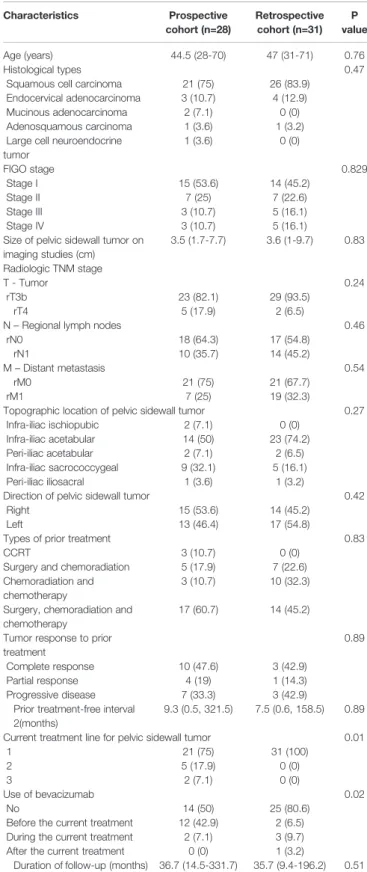
Methods: We prospectively recruited patients with PSRCC who underwent LEER between December 2016 and December 2019. Moreover, we retrospectively collected data on patients with PSRCC who received chemo or targeted therapy alone between January 2000 and December 2019. We compared treatment-free interval (TFI), progression-free survival (PFS), treatment-free survival (TFS), overall survival (OS), tumor response, neurologic disturbance of the low extremities, and pelvic pain severity in the different patient groups.
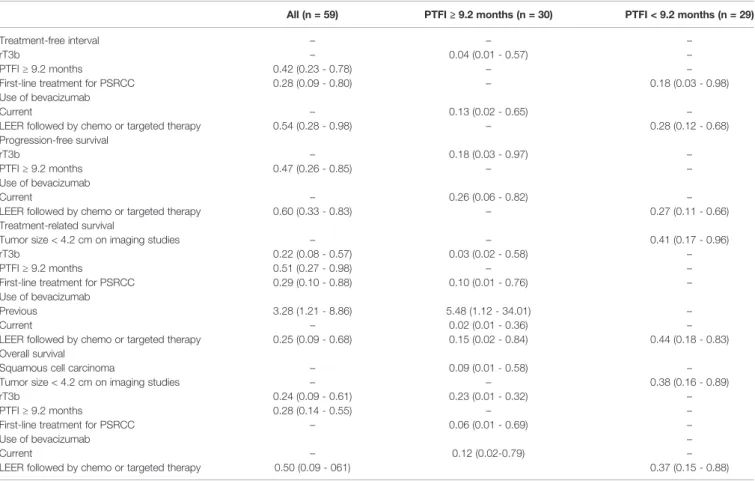
Results: Among 1295 patients with cervical cancer, we included 28 (2.2%) and 31 (2.4%) in the prospective and retrospective cohorts, respectively. When we subdivided all patients into two groups based on the median value of prior TFI (PTFI, 9.2 months), LEER improved TFI, PFS, TRS and OS compared to chemo or targeted therapy alone (median, 2.8 vs. 0.9; 7.4 vs. 4.1; 30.1 vs. 16.9 months; P ≤ 0.05) in patients with PTFI <
9.2 months despite no difference in survival in those with PTFI ≥ 9.2 months, suggesting that LEER may lead to better TFI, PFS, TRS and OS in patients with PTFI < 9.2 months (adjusted hazard ratios, 0.28, 0.27, 0.44 and 0.37; 95% con fidence intervals, 0.12-0.68, 0.11-0.66, 0.18-0.83 and 0.15-0.88). Furthermore, LEER markedly reduced the number
Edited by:
Giuseppe Vizzielli, Catholic University of the Sacred Heart, Italy Reviewed by:
Martina Arcieri, University of Messina, Italy Riccardo Tudisco, Catholic University of the Sacred Heart, Rome, Italy
*Correspondence:
Hee Seung Kim [email protected]
†