http://dx.doi.org/10.14405/kjvr.2013.53.4.217
217
<Original Article>
Expression of the S glycoprotein of transmissible gastroenteritis virus (TGEV) in transgenic potato and its immunogenicity in mice
Dong-Joo Ahn1,†, Jung Won Youm1,†, Suk Weon Kim2, Won Kee Yoon3, Hyoung Chin Kim3, Tai-Young Hur4, Young Hee Joung5, Jae-Heung Jeon1, Hyun Soon Kim1,*
1Plant System Engineering Center, and 2Microbial Resource Center, KRIBB, 125 Gwahangno, Yuseong-gu, Daejeon 305-806, Korea
3Laboratory Animal Resource Center, KRIBB, 685-1, Ochang 305-333, Korea
4National Institute of Animal Science, RDA, Cheonan 330-801, Korea
5School of Biological Sciences and Technology, Chonnam National University, Gwangju 500-757, Korea (Received: April 18, 2013; Revised: October 9, 2013; Accepted: October 16, 2013)
Abstract : Transgenic plants have been tested as an alternative host for the production and delivery of experimental oral vaccines. Here, we developed transgenic potatoes that express the major antigenic sites A and D of the glycoprotein S from transmissible gastroenteritis coronavirus (TGEV-S0.7) under three expression vector systems. The DNA integration and mRNA expression level of the TGEV-S0.7 gene were confirmed in transgenic plants by PCR and northern blot analysis. Antigen protein expression in transgenic potato was determined by western blot analysis. Enzyme-linked immunosorbent assay results revealed that based on a dilution series of Escherichia coli-derived antigen, the transgenic line P-2 had TGEV-S0.7 protein at levels that were 0.015% of total soluble proteins. We then examined the immunogenicity of potato-derived TGEV-S0.7 antigen in mice. Compared with the wild-type potato treated group and synthetic antigen treated group, mice treated with the potato-derived antigen showed significantly higher levels of immunoglobulin (Ig) G and IgA responses.
Keywords : oral administration, potato-derived antigen, transmissible gastroenteritis virus, transgenic plant
Introduction
Transmissible gastroenteritis (TGE) is a highly contagious disease in pigs that is caused by the TGE virus (TEGV). This coronavirus infection is characterized by an acute watery diarrhea, dehydration, vomiting, and high mortality in seronega- tive suckling piglets [1, 10, 11]. TGEV contains three struc- tural proteins designated as integral membrane protein (M), nucleocapsid (N), and spike (S) [17]. Among the proteins, neutralizing antibodies against the virus are induced mainly to glycoprotein S, which plays an important role in viral attachment with specific host cell receptors with subsequent penetration into the cells by membrane fusion [9, 25]. Four major antigenic sites (A, B, C, and D) are known on the amino-terminal domain of the S protein [3]. Of these well- characterized epitopes, A and to a lesser extent D are essen- tial factors for inducing neutralization.
With the development of molecular biology tools, genetic engineering of vaccines has shown advantages. Available systems for traditional and commercial vaccines include bac- terial, yeast, insect, and mammalian cell cultures. Although
these systems are highly efficient and have specific benefits, new alternative systems that take into account cost-effective- ness and greater safety are required for the next generation of vaccines. Recently, plants have been viewed as an attractive production host for heterologous protein production, as for vaccines. The advantages of plant-based vaccines include high scalability, a low cost that allows for local production and minimal plant material processing, lack of human or ani- mal pathogens, and ability to produce target proteins with desired biological functions [27]. Also, transgenic plants offer a suitable protein production option for oral subunit vaccines because the rigid wall of the plant cells delays digestion of antigenic proteins and enables the intact antigens to reach the gut-associated lymphoid tissue [2, 15]. Many research groups have demonstrated the production of functional antigens in plants that are then capable of eliciting specific immune responses in the gastrointestinal tract [18], and a number of formulations are being assessed in clinical trials, as recently reviewed by Yusibov et al. [28].
The glycoprotein S of TGEV (TGEV-S) is a valid target for developing oral plant-derived vaccines against TGE because
*Corresponding author
Tel: +82-42-860-4493, Fax: +82-42-860-4599 E-mail: [email protected]
†The first two authors contributed equally in this work.
of its immunogenicity and resistance to degradation in the gut [7]. In the present article, we used the potato plant as a host to express the glycoprotein S containing only antigenic sites A and D and to act as an antigenic carrier in oral vacci- nation of mice.
Materials and Methods
Vector construction
A 702 bp DNA fragment containing the A and D anti- genic sites of the TGEV-S protein (TGEV-S0.7) was ampli- fied with KpnI/NcoI-linked sense primer (ggtacc ccatgg atg aaa aaa cta ttt gtg gtt ttg) and SacI-linked antisense primer (gagctc tta tat aac agc tgt ggc atc taa) pairs using cDNA of TGEV-S (kindly provided by Professor Chul-Joong Kim at Chungnam National University) as the template. The PCR product was cloned into the TOPO TA cloning vector (Invit- rogen, USA), yielding TA-TGEV-S0.7 and verified by DNA sequencing (Genotech, Korea). The KpnI-SacI fragment from TA-TGEV-S0.7 was ligated into a pMBP1 [20] or pPAT [26]
expression vector to make pM-TGEV-S0.7 or pP-TGEV-S0.7 (Fig. 1A). The NcoI-SacI fragment was ligated into the pD35S [8] expression vector to make pD-TGEV-S0.7 (Fig.
1A). These transformation vectors were introduced into A.
tumefaciens strain LBA4404.
Potato transformation
Agrobacterium was cultured in YEP (10 g/L Bacto pep- tone, 10 g/L yeast extract, 5 g/L NaCl) medium supple- mented with antibiotics. In vitro-grown leaves were immersed in the suspension of Agrobacterium for 15 min, blotted on filter paper, and cultured on co-cultivation medium (MS salts with vitamins, 2 mg/L 2, 4-dichlorophenoxyacetic acid, pH 5.8) for 2 days at 22~25oC in the dark. The leaves were then transferred onto regeneration medium (MS salts with vita- mins, 2 mg/L zeatin, 0.01 mg/L a-naphthaleneacetic acid, 0.1 mg/L gibberellic acid, 100 mg/L kanamycin, 500 mg/L car- benicillin). All plant hormones and antibiotics were filter- sterilized and added to the autoclaved medium. Leaves were transferred to fresh medium every 2 weeks and incubated at 22~5oC under a 16/8-h (light/dark) photoperiod. Regener- ated shoots were transferred onto MS medium supplemented with 100 mg/L kanamycin and 500 mg/L carbenicillin. The transformants were transferred to a greenhouse, in which they were allowed to grow naturally, and were used in fur- ther analyses (Fig. 1B).
Molecular characterization of transgenic plants DNA analysis: Genomic DNA was isolated from potato leaves using a cetyltrimethylammonium bromide-based method [4]. PCR was performed using genomic DNA (100 ng) of each plant as a template for NPTII and TGEV-S0.7 genes. The Fig. 1. (A) Structure of vector constructs pM-TGEV-S0.7, pD-TGEV- S0.7, and pP-TGEV- S0.7. NPTII, neomycin phosphotransferase II; Nos-T, nopaline synthase terminator. (B) Transformation and production of transgenic plants using leaf segments as starting mate- rials. (a) Regeneration of shoots from callus cultured on the selection medium containing 50 mg/L kanamycin. (b) Well-rooted trans- genic plantlets on the MS basal medium. Plantlets in the plastic pots (c) for acclimation or in the soil pot (d). (C) PCR detection of TGEV- S0.7 gene in transgenic potato lines. The fragment (700 bp) of the TGEV-S0.7 gene was amplified as shown by an arrow. Lane M is a 1-kb ladder. WT; genomic DNA of non-transgenic potato as a negative control.
primers for NPTII gene amplification were F (5’-atg att gaa caa gat gga ttg cac-3’) and R (5’-tca gaa gaa ctc gtc aag aag gcg-3’), and the primer pair for the TGEV-S0.7 gene was F (5’-atg aaa aaa cta ttt gtg gtt ttg -3’) and R (5’-tta tat aac agc tgt ggc atc taa-3’). About 30 µg of total genomic DNA was digested with SacI to confirm the copy number of the inserted T-DNA for each vector-derived transformant. The digested DNA was hybridized with digoxigenin (DIG)-labeled TGEV- S0.7 probe, which was generated with the PCR DIG Labeling Mix (Roche Diagnostics, Germany) using the specific primer set for the TGEV-S0.7 gene. After hybridization overnight, membrane hybridization was detected using the DIG Detec- tion Kit following the manufacturer’s instructions (Roche Diagnostics).
Northern blotting: RNA for northern blotting was extracted using the RNAgents Total RNA isolation system (Promega, USA). Thirty micrograms of total RNA was separated by electrophoresis on a 1% formaldehyde-agarose gel in 1 × MOPS buffer and then blotted to a nylon membrane. The membranes were hybridized with a DIG-labeled probe at 50oC overnight and detected using the Dig Detection kit.
Northern hybridization was carried out following the same procedure as described for Southern blot analysis, with some modification where necessary.
Western blotting: Transgenic potato plants were analyzed to detect the TGEV-S recombinant protein using an immuno- blot detection method with rabbit polyclonal anti-TGEV sera (supplied by Youngin Frontier, Korea). Tubers were ground in liquid nitrogen and homogenized with extraction buffer (phosphate buffered saline [PBS], pH 7.4, 1 mM EDTA, pH8.0, 0.2% β-mercaptoethanol) and 1 × protease inhibitor (Roche), followed by centrifugation twice at 12,000 × g for 15 min at 4oC to remove insoluble cell debris. The total sol- uble protein (TSP) was fractionated on a 12% SDS-PAGE gel and transferred to a polyvinylidene fluoride (PVDF) membrane (Millipore, USA). Detection was performed with the NBT/BCIP stock solution (Sigma-Aldrich, USA) accord- ing to the manufacturer’s protocol.
Enzyme-linked immunosorbent assay (ELISA) for quanti- fication: The expression levels of potato-expressed TGEV- S0.7 protein were determined by ELISA. Briefly, microtiter plates were coated with centrifuged transgenic plant extracts (50µg of TSP) and Escherichia (E.) coli-derived recombi- nant TGEV-S0.7 with a serial dilution as a standard curve, incubated overnight at 4oC. The plates were washed three times with PBST buffer (1 × PBS with 0.05% Tween-20).
Consecutively, 200 µL/well of 5% skim milk in PBST was added for blocking, loaded with 100 µL per well of 1 : 1000 diluted rabbit polyclonal anti-TGEV sera, and incubated for 2 h at 37oC, followed by washing the wells three times with PBST buffer. The plate was then incubated with 100 µL per well of secondary antibody, a 1 : 5,000 dilution of horserad- ish peroxidase (HRP)-conjugated anti-rabbit IgG (Sigma) for 2 h at 37oC. The plate was finally incubated with 100 µL per well of 3,3’,5,5’-tetramethylbenzidine (TMB) substrates (Pierce,
USA) for 10 min at room temperature. Absorbance at OD450nm was measured in a microplate reader (Model 680; Bio-Rad Laboratories, USA).
Mouse immunization and antibody detection
Immunization of mice: Immunogenicity of potato-derived TGEV-S0.7 protein was evaluated using 5-week-old Balb/c mice. Animal study protocol was approved by the Institutional Animal Care and Use Committee of the KRIBB (approval number: KRIBB-AEC-11089), and all experiments were conducted in accordance with the Guide for the Care and Use of Laboratory Animals. The mice were divided into three groups, with five individuals in each group. One group of mice (called group TG) was immunized with 0.5 mL of the transgenic potato tuber extract containing 25 µg TGEV-S0.7 antigen in PBS buffer. The negative control (designated group NC) mice received wild-type (WT) potato extract, and the other group of mice, group PC, was immunized with 25 µg synthetic TGEV-S0.7 antigen by oral administration.
Immunization was performed using a 1 mL syringe fitted with a gavage needle. All of the immunized mice were also dosed with 10 µg of cholera toxin (CT, Sigma-Aldrich) per mouse per gavage as adjuvant. Before administration of the potato extracts to the mice, the animals were subjected to the intragastronic administration of 0.2 mL of an isotonic bicar- bonate solution (80% Hanks’ balanced salt solution and 20%
of 7.5% sodium bicarbonate; Gibco BRL, USA), to neutral- ize stomach acidity. Immunizations in mice were performed at weekly intervals for a total period of 3 weeks (on weeks 1, 2, and 3). All of the groups received intraperitoneal (i.p.) boosters at week 6 with a 5 µg E. coli-derived TGEV-S0.7 antigen.
IgG serum detection: Before the initial immunization with the transgenic potato extract and after the final immuni- zation, blood was drawn from the orbital plexus of each mouse to obtain antiserum samples. The TGEV-specific serum IgG response was measured by endpoint titer ELISA.
Briefly, the 96-well microtiter plates (Nunc-Immuno Max- isorp, Denmark) were coated with TGEV-S0.7 antigen (200 ng/well of 0.05 M carbonate/bicarbonate buffer, pH 9.6), and then incubated overnight at 4oC. The plates were then blocked with 5% skim milk in PBST for 1 h at 37oC. Subse- quently, the plates were incubated with serum samples diluted to 1 : 100 with 1% skim milk in PBST buffer for 2 h at 37oC. The secondary antibody, HRP-conjugated goat anti- rabbit IgG (Sigma-Aldrich), was diluted to 100 µL per well in appropriate concentrations (1 : 5,000) of PBST. The plates were finally incubated with chemiluminescent substrate, TMB peroxidase substrate solution (Pierce), for 30 min at 37oC. After the confirmation of sufficient color develop- ment, we added stopping solution to the samples. The plates were then assessed for absorbance at 450 nm.
Fecal IgA: Feces samples were collected every week after the mice had ingested the potato extracts and suspended at a concentration of 1 : 10 (w/v) in PBS containing 0.1% Tween 20 and 0.1 ng/µL leupeptin (Sigma-Aldrich). After 30 min of
vigorous mixing at 4oC using a vortex mixer, these fecal sus- pensions were centrifuged for 10 min at 12,000 × g at 4oC.
The supernatants were used for IgA analysis. The 96-well microtiter plates were then coated with anti-mouse IgA (1 µg/mL, Capture Antibodies; R&D Abs, USA) in PBS (100 µL per well) and incubated overnight at 4oC. The plates were blocked with 5% skim milk in PBST for 2 h at room temper- ature and washed three times in PBST. The extracted feces were diluted to 100 µL per well in appropriate concentra- tions (1 : 100) of PBS. The plates were incubated for 2 h and washed three times in PBST. The secondary antibody, HRP- conjugated goat anti-rabbit IgA (α-chain specific; R&D Abs) was diluted to 100 µL per well in appropriate concentrations (1 : 5,000) of PBST. The plates were then assessed for absor- bance at 450 nm.
All analyses for statistically significant differences were performed with the Kruskal-Wallis test, with p values of <
0.05 considered significant.
Phenotype and tuber composition analysis
Rooted plants about 5 cm in height were removed from the medium, and their roots were cleaned of agar residues. They were then transferred to plastic pots (15 cm in diameter), 5 plants from each line were grown in a greenhouse main- tained at 25oC under natural daylight. Twelve weeks after completion of growth, plant height, the number of tubers, and tuber weight were recorded. For compositional analysis of P- 2 line and WT control potato tubers, whole tuber samples were freeze-dried in liquid nitrogen and stored at −80oC before analysis. Analysis of phenolic, flavonoids, and carotenoids contents were carried out as described method in Payyavula et al. [14]. Starch content in potato tubers was measured using a Megazyme Total Starch Assay kit (Biovision, USA) and supplied manufacture’s protocols.
The differences between the NC and treatment samples were analyzed using the pair-wise t test installed in the Microsoft Office Excel program. Statistical significance was assumed when p < 0.05.
Results
Generation of transgenic plants and analysis of antigen expression
Over 50 independent in vitro shoots were obtained per each binary construct of pM-TGEV-S0.7, pD-TGEV-S0.7, and pP-TGEV-S0.7 following Agrobacterium-mediated transfor- mation on selection medium containing kanamycin. PCR analysis was performed to confirm the presence of the TGEV gene in the genomic DNA of those regenerated shoots for initial screening. PCR analysis of the TGEV gene identified the expected 700 bp product in five pM-TGEV-S0.7, six pP- TGEV-S0.7, and six pD-TGEV-S0.7 independent lines, respec- tively, whereas no products were detected from WT control plants (Fig. 1C). Only one transgenic potato per construct was confirmed as having one T-DNA insertion copy by
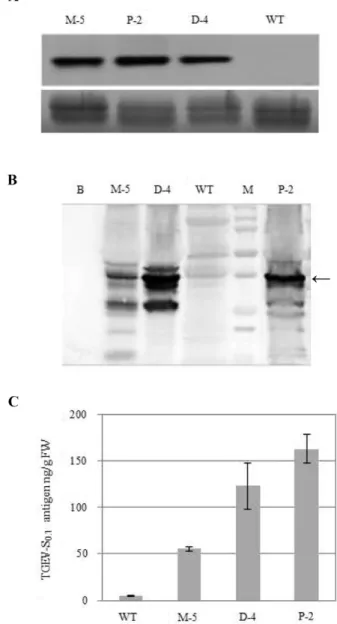
Fig. 2. (A) Northern blot analysis of transgenic potato plants, M (pM-TGEV-S0.7)-5, D (pD-TGEV-S0.7)-4, and P (pP-TGEV- S0.7)-2, selected by PCR analysis with a DIG-labeled TGEV- S0.7 probe. Total RNA loaded on the gel was confirmed by gel staining of rRNA (lower panel). (B) Immunoblot detection of TGEV- S0.7 protein in transgenic potato plants, M-5, D-4, and P-2. Total soluble protein (TSP, 50 µg) extracted from trans- genic plants was transferred to a PVDF membrane and detected with TGEV-specific anti-rabbit polyclonal antiserum.
(C) Determination of TGEV- S0.7 protein expression levels in transgenic potato tuber using ELISA analysis. Known amounts of purified TGEV-S0.7 protein derived from E. coli were used to generate a standard control. Extracts from a non-transformed plant were used as negative control. Absorbance was measured at 405 nm, and expression amounts were calculated from the TSP used in three replicates of the assay. Values are the mean
± SD of three plants per group. B; only buffer control, M;
molecular weight marker, WT; extracts from a non-transgenic control plant.
Southern blot analysis (data not included): pM-TGEV-S0.7-5, pD-TGEV-S0.7-4, and pP-TGEV-S0.7-2, designated as M-5, D- 4, and P-2, respectively. These representative transformed potatoes were transferred to greenhouse conditions for phe- notype analysis and detailed molecular characterization.
To determine TGEV transcript levels, total RNA from WT and transgenic potato tubers was assayed by northern blot- ting. Three of the transgenic lines, M-5, D-4, and P-2, which were selected based on the results of Southern blot analysis, expressed the TGEV transcript stably and at similar levels (Fig. 2A).
Immunoblot analysis was performed to detect the expres- sion of TGEV-S0.7 protein in the transgenic plant lines M-5, P-2, and D-4. Signal in P-2 and D-4 was stronger than in M- 4, suggesting that TGEV S0.7 protein was capable of expres- sion in transgenic potato plants (Fig. 2B). Expression level varied depending on the insertional effect or translational processing. No TGEV-S0.7 protein was detected from WT control plants.
An ELISA assay was performed to obtain quantitative esti- mates of TGEV-S0.7 protein levels in the potato plants of the three independent lines. The amounts were quantified by comparison with known amounts of purified TGEV antigen from E. coli. Based on the results of the ELISA, potato tuber tissue contained 55 ng, 123 ng, and 163 ng of TGEV-S0.7 pro- tein per gram of fresh weight of M-5, D-4, and P-2, respec- tively (Fig. 2C).
Investigation of the agronomic traits of transgenic lines
was conducted in the greenhouse. Plant height, number of tubers per plant, and mean weight per tuber were measured.
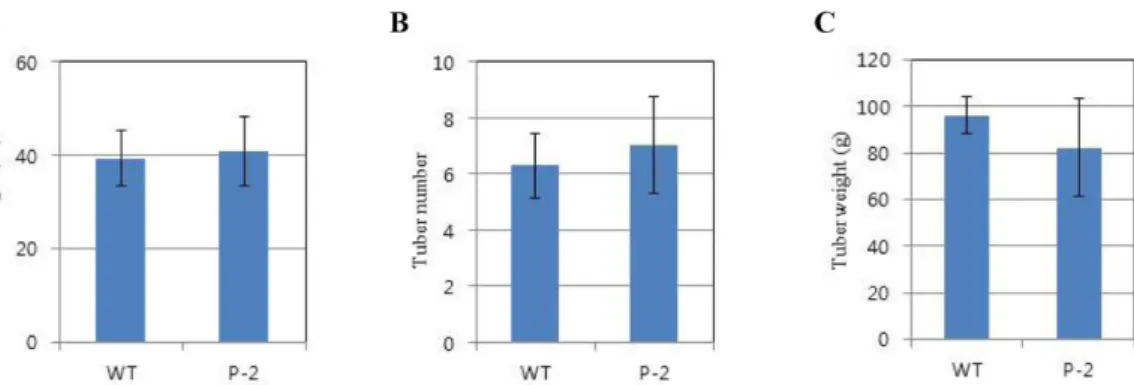
Plant height (p > 0.05), tubers (p > 0.05), and tuber weight (p > 0.05) of the transgenic lines were similar to those of the WT control under normal conditions (Fig. 3). Also, there were no phenotypic abnormalities in either type of potato (data not shown). Moreover, we carried out metabolic evalu- ation of the P-2 potato and WT control potato by composi- tion analysis, such as secondary metabolite or starch. Based on the analysis, the metabolite profiles between P-2 and con- trol potatoes did not differ significantly (Table 1). These results indicate that overexpression of TGEV-S0.7 have no adverse effect on potato growth and development, and affects neither the quantity nor the quality of metabolites (p > 0.05) relative to WT potatoes. Only carotenoid contents in the P-2 transgenic line were a little higher than in the WT control plant (p < 0.05).
Antibody response of mice to the transgenic potatoes To assess the immunogenicity of the potato-derived TGEV-S0.7 antigen protein, Balb/c mice were immunized orally with soluble protein extracted from freeze-dried potato tubers of transgenic P-2 or WT plants. Significant responses against TGEV were detected in serum from mice fed with potato-derived TGEV-S0.7 antigen (Fig. 4A). The response was clearly increased at 7 weeks after i.p. booster with 5 µg E. coli-derived TGEV-S0.7. Doses of 25 µg of TGEV-S0.7 anti- gen expressed in potato tubers were sufficient to elicit a Fig. 3. Comparison analysis of plant height (A, p value = 0.78), tuber number (B, p value = 0.18), and tuber weight (C, p value = 0.25) between non-transgenic potato (WT) contol and transgenic pP-TGEV-S0.7-2(P-2) lines under normal growth conditions. Values were measured after harvesting. Data are given as mean± SD from five plants per group. Pair-wise t test was used to compare different groups of data (p < 0.05).
Table 1. Comarison of tuber components between wild-type control and TGEV-expressing transgenic potato plant, P-2 P-2 transgenic line WT control potato p value
Carotenoids (mg/g dw) 90.157± 0.002* 90.098± 0.005* 0.0008
Flavonoids (µg catechin equivalent/100 mg dw) 596.99± 0.15 963.44± 0.06 0.174 Phenolics (µg cloroginic acid equivalent/100 mg dw 807.79± 10.3 761.34± 4.47 0.650
Starch (% w/w dw) 9952.6± 2.1 9958.4± 3.2 0.186
Each value represents mean± SD from five plants per group. *Means within a row with no common superscripts differ significantly (p <
0.05). WT: wild-type, non-transgenic potato as a negative control, dw: dry weight.
strong Ig response in serum, identifying this system as an effective oral delivery vehicle for TGEV antigen. Of inter- est, mice fed with transgenic potato expressing TGEV (the TG group) showed stronger immunogenic responses than mice administered the synthetic TGEV antigen (PC group).
No immune responses were detected in mice immunized with WT control potato tubers (NC group), even after repeated or booster inoculations.
As a guide to mucosal immunogenicity, anti-TGEV-spe- cific IgA levels were determined in fecal material from three groups of mice. As shown in Fig. 4B, small but significant production of fecal IgA was detected only in mice fed with 25 µg of potato-derived TGEV-S0.7 antigen protein after i.p.
booster immunization (p < 0.01). This result suggests that mucosal antibody responses were induced by the potato- derived TGEV-S0.7 antigen protein. As expected, no antigen- specific antibodies were detected in mice immunized with potato-derived proteins from WT control potato tubers. Of interest, there was no IgA antibody detection in mice fed
synthetic TGEV antigen as positive control. These findings demonstrated that TGEV antigen derived from the potato plant induces a much greater anti–TGEV-specific mucosal IgA response than pure TGEV antigen.
During immunization with potato-derived TGEV antigen, none of the mice died, and weight gain was the same as those inoculated with WT control potato extracts.
Discussion
Stably integrated nuclear transgenes in potato typically yield relatively low concentrations of the recombinant pro- tein with reported expression levels, for example, of approx- imately 0.01% TSP [27]. Therefore, increasing the expression level of the target protein in the plant cell is considered urgent and necessary. Generally, several factors which include transcription, translation, post-translational modification or storage of recombinant protein in the cell are involved in increasing expression level of transgene [16]. In this work, we produced TGEV-S0.7 protein at a level of 0.015% TSP in transgenic potato tuber plants. The use of different promot- ers - single 35S, double 35S, and patatin promoters - was expected to improve expression levels of TGEV-S0.7 in these plants. Although genomic PCR analysis showed bands for TGEV genes in all of the transgenic plants, three representa- tive transgenic plants (M-5, D-4, and P-2 lines) showed high- quantity mRNA bands of TGEV whereas the rest showed low expression in northern blot analysis. Because of the dif- ferent and random incorporation sites of insertion of the transferred DNA into the nuclear DNA, different levels of foreign gene expression in individual transformants are expected [6]. The transgenic potato line P-2, driven by the patatin promoter, showed a similar transcript level to the oth- ers but had the highest protein expression level (163 ng/g FW) as compared to transgenic lines containing either the single 35S (M-5, 55.3 ng/g FW) or double 35S promoter (D- 4, 123 ng/g FW). Patatins are considered to be a major stor- age protein in potato tubers, and this protein might be mani- festing the enhanced translation efficiency of the TGEV gene in the potato tuber, in agreement with a study conducted by Joung et al. [8].
Plants have emerged as attractive expression systems for the production of a broad range of heterologous molecules, such as pharmaceuticals, because they produce antigens without the danger of contamination by animal pathogens [7, 13]. Furthermore, plant-based oral vaccines offer the pros- pect of triggering the mucosal immune response for the pre- vention of infections and enable the intact antigens to reach the intestinal tissues [24]. In the late 1990s, a few efforts were made to introduce glycoprotein S of TGEV into Arabi- dopsis [6], potato [7], tobacco [24], and maize [19]. Gómez et al. [7] demonstrated that glycoprotein S of TGEV is a valid target for developing oral plant-derived vaccines against TGE because of its immunogenicity and resistance to degra- dation in the gut. They introduced full-length 4344 bp or N- Fig. 4. Serum IgG anti-TGEV antibodies (A) and fecal IgA
anti-TGEV antibodies (B) detected in mice. Mice were orally administered potato-derived TGEV-S0.7 antigen, wild-type con- trol potato, or synthetic TGEV antigen. All of the immunized mice were dosed with 10 µg of cholera toxin as adjuvant. The antigens were administered three times, at weeks 1, 2, and 3 (↑).
The black, bold arrowhead marks the boost time at week 6 with a 5 µg Escherichia coli-derived TGEV-S0.7 antigen (▲). Each bar represents an average of five samples± SD. Statistically significant differences (p < 0.01) in antibody responses between groups are indicated as follows: asterisks compared with wild- type control potato and synthetic TGEV antigen. NC; wild-type control potato, PC; synthetic TGEV antigen, TG; potato-derived TGEV-S0.7 antigen.
terminus 2250 bp of TGEV glycoprotein S into potato, resulting in 0.02 µg of purified TGEV per 30~60 µg soluble protein of leaf sample. Four major antigenic sites have been described in glycoprotein S, among which site A is immun- odominant. Recombinant protein lacking the A antigenic site, or with a deletion including the putative receptor-binding sites and the D antigenic site, cannot induce levels of neutralizing antibodies similar to what the whole S protein induces [23].
In this study, we sought to develop the transgenic potato expressing 700 bp containing only epitope A plus the D anti- genic sites. The potato-derived recombinant TGEV-S0.7 pro- tein was tested for its immunogenicity in mice. Specific IgG antibodies were detected in the sera of orally immunized mice, and IgA antibodies were detected in the fecal samples of these animals, indicating that the plant-derived TGEV-S0.7 protein could induce both systemic and mucosal immunity.
Mucosal IgA plays a critical role in the early stages of host defense against many invading pathogens [5]. Therefore, designing vaccines that can generate secretory IgA antibod- ies is important. Similar results have been reported of a high level of anti-TGEV-SN IgA observed in intestinal lavages of mice immunized with LNZ9000-rTGEV-SN [21]. Previous find- ings [12, 22] also suggest that animals would benefit from vaccines provoking immune responses in intestinal mucosa.
Although mice fed with the potato-derived TGEV-S0.7 showed lower than expected amounts of induced antibodies, a detectable TGEV-specific IgG or IgA response was suffi- ciently elicited from the immune system in this murine model. Based on these experiments, we are in the process of confirming the immune protection of the potato expressing TGEV-S0.7 antigen protein in pigs. The harmless nature of the potato tuber would make it an ideal candidate for delivering heterologous antigens in an oral vaccine.
Identity between the transformed potato plant and WT con- trol plants is considered important for developing a commer- cial product. Here we evaluated phenotypic characteristics, agronomic performance, and compositional analysis of the P- 2 transgenic line and the WT control potato. Overall, the dif- ferences in evaluation value are within the error range. We conclude that transgenic potato expressing the TGEV anti- gen could be viable for use in developing oral vaccines.
Acknowledgments
This study was supported by the Korea Research Institute of Bioscience & Biotechnology (KRIBB) Research Initiative program and IPET research program of Ministry of Agriculture, Food and Rural Affairs, Republic of Korea. The authors thank Prof. Chul-Joong Kim at Chungnam National University for providing us with the plasmid DNA containing TGEV glycoprotein S and comments.
References
1. Abid NBS, Chupin SA, Bjadovskaya OP, Andreeva OG,
Aouni M, Buesa J, Baybikov TZ, Prokhvatilova LB.
Molecular study of porcine transmissible gastroenteritis virus after serial animal passages revealed point mutations in S protein. Virus Genes 2011, 42, 212-219.
2. Chia MY, Hsiao SH, Chan HT, Do YY, Huang PL, Chang HW, Tsai YC, Lin CM, Pang VF, Jeng CR.
Immunogenicity of recombinant GP5 protein of porcine reproductive and respiratory syndrome virus expressed in tobacco plant. Vet Immunol Immunopathol 2010, 135, 234- 242.
3. Delmas B, Rasschaert D, Godet M, Gelfi J, Laude H.
Four major antigenic sites of the coronavirus transmissible gastroenteritis virus are located on the amino-terminal half of spike glycoprotein S. J Gen Virol 1990, 71, 1313-1323.
4. Doyle JJ, Doyle JL. A rapid DNA isolation procedure for small quantities of fresh leaf tissue. Phytochem Bull 1987, 19, 11-15.
5. van Egmond M, van Garderen E, van Spriel AB, Damen CA, van Amersfoort ES, van Zandbergen G, van Hattum J, Kuiper J, van de Winkel JGJ. FcáRI- positive liver Kupffer cells: reappraisal of the function of immunoglobulin A in immunity. Nat Med 2000, 6, 680- 685.
6. Gómez N, Carrillo C, Salinas J, Parra F, Borca MV, Escribano JM. Expression of immunogenic glycoprotein S polypeptides from transmissible gastroenteritis coronavirus in transgenic plants. Virology 1998, 249, 352-358.
7. Gómez N, Wigdorovitz A, Castañón S, Gil F, Ordás R, Borca MV, Escribano JM. Oral immunogenicity of the plant derived spike protein from swine-transmissible gastro- enteritis coronavirus. Arch Virol 2000, 145, 1725-1732.
8. Joung YH, Youm JW, Jeon JH, Lee BC, Ryu CJ, Hong HJ, Kim HC, Joung H, Kim HS. Expression of the hepatitis B surface S and preS2 antigens in tubers of Solanum tuberosum. Plant Cell Rep 2004, 22, 925-930.
9. Kang TJ, Seo JE, Kim DH, Kim TG, Jang YS, Yang MS. Cloning and sequence analysis of the Korean strain of spike gene of porcine epidemic diarrhea virus and expression of its neutralizing epitope in plants. Protein Expr Purif 2005, 41, 378-383.
10. Lamphear BJ, Jilka JM, Kesl L, Welter M, Howard JA, Streatfield SJ. A corn-based delivery system for animal vaccines: an oral transmissible gastroenteritis virus vaccine boosts lactogenic immunity in swine. Vaccine 2004, 22, 2420-2424.
11. Laude H, van Reeth K, Pensaert M. Porcine respiratory coronavirus: molecular features and virus-host interactions.
Vet Res 1993, 24, 125-150.
12. van der Linden IFA, van der Linde-Bril EM, Voermans JJM, van Rijn PA, Pol JMA, Martin R, Steverink PJGM. Oral transmission of porcine reproductive and respiratory syndrome virus by muscle of experimentally infected pigs. Vet Microbiol 2003, 97, 45-54.
13. Monger W, Alamillo JM, Sola I, Perrin Y, Bestagno M, Burrone OR, Sabella P, Plana-Duran J, Enjuanes L, Garcia JA, Lomonossoff GP. An antibody derivative expressed from viral vectors passively immunizes pigs against transmissible gastroenteritis virus infection when supplied orally in crude plant extracts. Plant Biotechnol J 2006, 4, 623-631.
14. Payyavula RS, Navarre DA, Kuhl JC, Pantoja A, Pillai SS. Differential effects of environmental on potato phenylpropanoid and carotenoid expression. BMC Plant Biol 2012, 12, 39.
15. Rigano MM, Dreitz S, Kipnis AP, Izzo AA, Walmsley AM. Oral immunogenicity of a plant-made, subunit, tuberculosis vaccine. Vaccine 2006, 24, 691-695.
16. Sharma AK, Sharma MK. Plants as bioreactors: Recent developments and emerging opportunities. Biotechnol Adv 2009, 27, 811-832.
17. Spaan W, Cavanagh D, Horzinek MC. Coronaviruses:
structure and genome expression. J Gen Virol 1988, 69, 2939-2952.
18. Streatfield SJ, Howard JA. Plant production systems for vaccines. Expert Rev Vaccines 2003, 2, 763-775.
19. Streatfield SJ, Jilka JM, Hood EE, Turner DD, Bailey MR, Mayor JM, Woodard SL, Beifuss KK, Horn ME, Delaney DE, Tizard IR, Howard JA. Plant-based vaccines: unique advantages. Vaccine 2001, 19, 2742-2748.
20. Suh MC, Choi D, Liu JR. Cadmium resistance in transgenic tobacco plants expressing the Nicotiana glutinosa L. metallothionein-like gene. Mol Cells 1988, 8, 678-684.
21. Tang L, Li Y. Oral immunization of mice with recombinant Lactococcus lactis expressing porcine transmissible gastroenteritis virus spike glycoprotein. Virus Genes 2009, 39, 238-245.
22. Tang L, Ou D, Ge J, Xu Y, Li Y, Shi D, Xia C, Yu Y.
Construction of recombinant Lactococcus lactis expressing
porcine transmissible gastroenteritis spike glycoprotein and analysis of immunogenicity. Wei Sheng Wu Xue Bao 2007, 47, 340-344.
23. Tuboly T, Nagy E, Dennis JR, Derbyshire JB.
Immunogenicity of the S protein transmissible gastroenteritis virus expressed in baculovirus. Arch Virol 1994, 137, 55- 67.
24. Tuboly T, Yu W, Bailey A, Degrandis S, Du S, Erickson L, Nagy É. Immunogenicity of porcine transmissible gastroenteritis virus spike protein expressed in plants.
Vaccine 2000, 18, 2023-2028.
25. Wang C, Ren X. Preparation and characterization of polyclonal antibody against severe acute respiratory syndrome- associated coronavirus spike protein. Hybridoma 2010, 29, 511-516.
26. Youm JW, Kim MS, Lee BC, Kang WJ, Jeon JH, Joung HU, Kim HS. District spatio-temporal expression patterns of patatin promoter-GUS gene fusion in transgenic potato microtubers. Korean J Plant Biotechnol 2003, 30, 13-18.
27. Yu J, Langridge W. Expression of rotavirus capsid protein VP6 in transgenic potato and its oral immunogenicity in mice. Transgenic Res 2003, 12, 163-169.
28. Yusibov V, Streatfield SJ, Kushnir N. Clinical development of plant-produced recombinant pharmaceuticals. Hum Vaccines 2011, 7, 313-321.