The Korean Journal of Mycology 한국균학회지
© The Korean Society of Mycology Kor. J. Mycol. 38(1) : 85-87 (2010)
85
버섯류로부터 항통풍성 Xanthine oxidase 저해물질의 탐색
Zanabaatar Bolormaa1·송정화1·서건식2·노형준3·유영복3·이종수1*
1배재대학교 생명유전공학과, 2한국농수산대학 특용작물학과, 3국립원예특작과학원
Screening of Anti-gout Xanthine Oxidase Inhibitor from Mushrooms
Bolormaa Zanabaatar1, Jung-Hwa Song1, Geon-Sik Seo2, Hyung-Jun Noh3, Young-Bok Yoo3 and Jong-Soo Lee1*
1Department of Life Science and Genetic Engineering, Paichai University, Daejeon, 302-735, Korea
2Korea National College of Agriculture and Fisheries, Hwaseong, 445-760, Korea
3National Institute of Horticultural & Herbal Science, Suwon, 440-706, Korea
(Received June 16, 2010. Accepted June 19, 2010)
ABSTRACT: Anti-gout xanthine oxidase inhibitory activity of water extracts from various mushrooms were deter- mined. The highest xanthine oxidase inhibitory activity was 72.9% in the water extract from fruiting body of Agaricus brazillensis and also were high in the extract from fruiting bodies of Pleurotus salmoneostramineus(60.1%), Phellinus baumii(57.7%), Agaricus bisporus(56.7%) and Hericium erinaceum(53.4%). The xanthine oxidase inhibitor was max- imally extracted when Agaricus brazillensis fruiting body was treated with water at 30oC for 24 h.
KEYWORDS : Anti-gout, Mushrooms, Xanthine oxidase inhibitor
버섯류는 전 세계적으로 약 14만종이 존재하는 것으로 추정하고 있으나 현재 300여종만이 식용 및 약용으로 이용 가능한 것으로 알려져 있으며(유 등, 2010), 최근에 건강에 대한 관심이 고조됨에 따라 버섯류의 소비는 계속해서 증가 하고 있다. 지금까지 버섯의 생리기능성으로는 생체 내 항상 성 유지, 암, 뇌졸중 및 심장병 질환의 예방효과(Mizuno et al., 1995), 콜레스테롤 저하효과(Kabir et al., 1998), 혈당강하 작용(Kiho et al., 1993), HIV-1의 역전사 효소활성 억제작용 (Muller et al., 1990) 그리고 항균작용(Erkel et al., 1992) 등이 알려져 있으며 최근에 필자 등에 의해서 혈소판응집저해 활성과 혈전용해 활성(박 등, 2003; Hyun et al., 2006), 혈관 신생억제 활성(정 등, 2003), 항고혈압 활성(이 등, 2003;
Koo et al., 2006; Lee et al., 2004), 항치매 활성(Lee et al., 2009; Seo et al., 2008), 콜레스테롤 합성 억제에 관련된 HMG-CoA 저해 활성(Yu et al., 2007), 항비만성 지질 분해 효소 저해 활성(Lee et al., 2010) 등이 보고되었다.
한편, 통풍은 일반적으로 퓨린대사계에서 xanthine oxidase 에 의해 xanthine에서 생성되는 요산(uric acid)의 관절낭 축적 에 기인되는 것으로 알려져 있으며 최근 통풍 발병률이 크게 증가하고 있는 추세이다. Xanthine oxidase(Xanthine : oxygen oxidoreductase, E.C. 1.2.3.2)는 xanthine을 기질로 하여 요산을 생성하는 과정에서 superoxide radical을 생성하거나
hydrogeneperoxide와 같은 산화제로서 작용하는 효소이다 (Ziegler et al., 1971; Duke et al., 1973).
Xanthine oxidase 저해제는 퓨린대사에 큰 영향을 주지 않으면서 혈중 요산 양을 줄일 수 있어(Granger et al., 1981), 요산혈증 치료제로 사용되어 왔고(Yu and Gutman, 1967) 시판 항통풍 제제로는 allopurinol(hypoxanthine 유도체), alloxanthine 등(Stripe and Della, 1969)과 probenecid, colchicine 등이 알려져 있으나 이들은 대체로 치료제 내성 유발, 항암제 대사 억제, 재생불량성 빈혈 등의 부작용이 있다.
항퉁풍성 xanthine oxidase 저해 효과를 갖는 천연물로는 감잎 추출물(Moon et al., 2001), 우롱차(An et al., 1992), 양파 껍질(Ra et al., 1998), 녹황색 채소류(Kohashi et al., 1993), 팥꽃나무의 꽃과 눈(Noro et al., 1983), 바나바(Unno et al., 2004) 등과 Aspergillus sp. F184(Park et al., 2000) 등이 보고되었다.
본 연구에서는 버섯으로부터 새로운 항통풍 소재를 개발 하여 이를 대체의약이나 건강식품 개발에 응용하고자 우리 나라의 대표적인 버섯들의 물 추출물을 제조하여 이들의 항 통풍성 xanthine oxidase 저해 활성을 측정 하여 우수 버섯을 선발한 후 저해 물질의 추출 최적 조건을 조사 하였다.
본 연구에 사용된 버섯류는 꽃송이버섯(Sparassis crispa), 양송이버섯(Agaricus bisporus), 새송이버섯(Pleurotus eringi), 노루궁뎅이버섯(Hericium erinaceum), 노랑느타리버섯(Pleurotus coruncopiae), 분홍느타리버섯(Pleurotus salmoneostramineus),
*Corresponding author <E-mail : [email protected]>
86 Zanabaatar Bolormaa 등 잎새버섯(Grifola frondosa), 신령버섯(Agaricus brazillensis),
차가버섯(nonotus obliquus), 팽이버섯(Flammulina velutipes), 상황버섯(Phellinus baumii), 영지버섯(Ganoderma lucidum) 등 모두 12종을 국립 원예특작과학원에서 분양 받아 사용 하였다. 이들 버섯 자실체(차가 버섯만 균사체)들을 동결건조 시킨 후 분쇄하여 분말화한 후 1 : 40의 비율로 증류수를 첨가 하여 24시간 진탕시킨 다음 여과하여 감압 농축시켜 물 추출물을 제조하였다.
각각의 물 추출물들의 xanthine oxidase 저해 활성은 Noro 등(1983), Cho(1995)의 방법에 따라 먼저 0.1 M potassium phosphate buffer(pH 7.5) 600µl에 5 mg/ml로 녹인 시료 100µl를 가하고 1 mM xanthine을 녹인 기질 용액 200 µl를 첨가하였다. 여기에 xanthine oxidase(0.1 U/ml) 100 µl를 가하여 37oC에서 5분간 반응시킨 후 1 N HCl 200 µl를 가하여 반응을 정지시켰다. 이 때 12,000 rpm으로 10분간 원심 분리하여 단백질 제거 후 생성된 uric acid를 292 nm에서 측정하였다.
Xanthine oxidase 저해 활성(%)
= [1− {A(시료구) − B(시료구 Blank)/C(대조구)}] × 100
항통풍성 우수 버섯의 선발
12종의 버섯 시료 물 추출물들의 xanthine oxidase 저해 활성을 측정한 결과 Table 1과 같이 신령버섯 자실체의 물 추출물이 72.9%로 가장 높은 저해 활성을 보였고 분홍느타리 버섯(60.1%), 상황버섯(57.7%), 양송이버섯(56.7%), 노루궁 뎅이 버섯(53.4%) 등이 비교적 높은 저해 활성을 보였다.
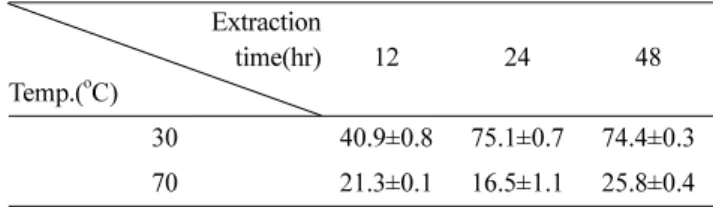
Xanthine oxidase 저해 활성이 가장 높았던 신령버섯 자실 체로부터 저해 물질 추출 최적 조건을 조사한 결과 70oC에서
보다는 30oC에서 저해 물질이 더 많이 추출되었고 추출 시간 이 길어짐에 따라 추출물이 더 많이 용출 되어 24시간 추출시 75.1%의 저해 활성을 보인 후 큰 변화가 없었다(Table 2).
본 논문은 신령 버섯 등에서 최근 급증하는 통풍을 치료 또는 예방할 수 있는 새로운 항통풍성 소재를 탐색 한 것으로 대체의약 소재나 건강 기능성 식품 개발에 크게 활용될 것 이고, 따라서 신령버섯에 함유된 새로운 항통풍성 물질의 특성 규명을 위한 정제와 효능 검증을 위한 동물 실험 등이 추가로 연구 되어야 할 것으로 사료된다.
적요
버섯으로부터 새로운 항통풍성 소재를 개발하여 이를 대체 의약의 소재나 건강 기능성 제품 개발에 응용할 수 있는 자 료를 얻고자 12종의 국내 버섯 자실체들의 물 추출물을 제조 하여 이들의 항통풍성 xanthine oxidase 저해 활성을 측정하 였다. 시료 버섯 가운데 신령 버섯 자실체의 물 추출물이 가장 높은 72.9%의 저해 활성을 보였고 이 저해 물질은 30oC에서 24시간 추출하였을 때 가장 많이 용출 되었다.
참고문헌
박정식, 현광욱, 서승보, 조수묵, 유창현, 이종수. 2003. 버섯류로부터 혈소판 응집억제물질과 혈전용해물질의 탐색. 한국균학회지 31:144-116.
유영복, 구창덕, 김성환, 서건식, 신현동. 이준우. 이창수. 장현유.
2010. 버섯학. 자연과사람. pp 385-396.
이대형, 김재호, 정종천, 공원식, 유영복, 박정식, 유창현, 이종수.
2003. 각종 버섯류로부터 안지오텐신 전환효소 저해제의 탐색.
한국균학회지 31:148-154.
정승찬, 김재호, 박정식, 이종수. 2003. 버섯으로부터 새로운 암전이 억제물질 개발을 위한 결관신생억제물질의 탐색. 한국버섯학회지 1:44-47.
An, B. J., Kim, W. K., Choi, J. Y., Kwon, I. B. and Choi, C. 1992.
Structure and isolation of xanthine oxidase inhibitor from oolong tea. Kor. J. Food Sci. Technol. 24:558-562.
Cho, D. Y. 1995. Studies on the purification of the xanthine oxidase inhibitor from Streptomyces sp. YU-101. Department of food and biotechnology, The graduate school of Yonsei University.
Duke, E. J., Joyce, P. and Ryan, J. P. 1973. Characterization of alternative molecular forms of xanthine oxidase in the mouse.
J. Biochem. 131:187-190.
Erkel, G. and Anke, T. 1992. Antibiotics from Basidiomycetes XLI, clavicoronic acid, a novel inhibitor of reverse transcriptase from Table 1. Xanthine oxidase inhibitory activity of water extracts
from various mushoorms
Scientific name(Korean name) Xanthine oxidase inhibitory activity(%)
Sparassis crispa(꽃송이버섯) 19.5±3.4
Agaricus bisporus(양송이버섯) 56.7±3.3
Pleurotus eringi(새송이버섯) 37.0±2.5
Hericium erinaceum(노루궁뎅이버섯) 53.4±2.8 Pleurotus coruncopiae(노랑느타리버섯) 30.1±0.8
Grifola frondosa(잎새버섯) 21.8±3.7
Agaricus brazillensis(신령버섯) 72.9±4.7 Pleurotus salmoneostramineus
(분홍느타리버섯) 60.1±2.1
Inonotus obliquus(차가버섯) 36.5±2.2
Flammulina velutipes(팽이버섯) 44.0±2.0
Phellinus baumii(상황버섯) 57.7±2.7
Ganoderma lucidum(영지버섯) 17.4±2.7
Table 2. Effect of extraction time and temperature on the xanthine oxidase inhibitory activity of Agaricus brazillensis
Extraction time(hr) Temp.(oC)
12 24 48
30 40.9±0.8 75.1±0.7 74.4±0.3
70 21.3±0.1 16.5±1.1 25.8±0.4
Xanthine oxidase inhibitor from mushroom 87
Clavicorona pyxidate. J. Antibiotics 45:29-37.
Granger, D. N., rutili, G. and McCord, J. M. 1981. Role of superoxide radicals in intestina; Ischemia. Gastroenterology. 81:22-29.
Hyun, K. W., Jeong, S. C., Lee, D. H., Park, J. S. and Lee, J. S.
2006. Isolation and characterization of a novel platelet aggregation inhibitory peptide from the medicinal mushroom, Inonotus obliquus.
Peptides 27:1173-1178.
Kabir, Y., Kimura, S. and Tamura, T. 1998. Dietary effect of Ganoderma lucidum: Mushroom on blood pressure and lipid levels in spontaneously hypertensive rats(SHR). J. Nutr. Sci. Vitaminol.
34:433-438.
Kiho, T., Hui, J., Yamane, A. and Ukai, S. 1993. Polysaccharides in fungi. XXXII. Hypoglycemic activity and chemical properties of a polysaccharide from the cultural mycelium of Cordyceps sinensis. Biol. Pharm. Bull. 16:1291-1293.
Kohashi, M., Kenichi, A. and Tatsuo, W. 1993. Non-thermal effect of ceramics radiation on folate structure and on xanthine oxidase inhibition by floate. J. Nutr. Sci. Vitaminol. 39:425-429.
Koo, K. C., Lee, D. H., Kim, J. H., Yu, H. E., Park, J. S. and Lee, J. S. 2006. Production and characterization of antihypertensive angiotensin I-converting enzyme inhibitor from Pholiota adiposa.
J. Microbiol. Biotechnol. 16:757-763.
Lee, D. H., Kim, J. H., Park, J. S., Choi, Y. J. and Lee, J. S. 2004.
Isolation and characterization of a novel angiotensin I-converting enzyme inhibitory peptide derived from the edible mushroom Tricholoma giganteum. Peptides 25:621-627.
Lee, J. S., Min, G. H. and Lee, J. S. 2009. Nutritional and physico- chemical characteristics of the antidementia acetylcholinesterase- inhibiting methanol extracts from Umbilicaria esculenta.
Mycobiology 37:203-206.
Lee, J. K., Jang, J. H., Lee, J. T. and Lee, J. S. 2010. Extraction and characteristics of anti-obesity lipase inhibitor from Phellinus linteus. Mycobiology 38:52-57.
Mizuno, T., Kinoshit, T. Zhung, C., Ito, H. and Mayuzumi, Y. 1995.
Antitumor-activity heteroglycans from niohshimeji, Tricholoma
giganteum. Food Reviews International 59:563-567.
Moon, S. H., Lee, M. K. and Chae, K. S. 2001. Inhibitory effects of the solvent fractions from persimmon leaves on xanthine oxidase activity. Kor. J. Food & Nutr. 14:120-125.
Muller, W. E. G., Weiler, B. E., Charubala, R. W. and Schroder, H. C. 1990. Cordycepin analogues of 2´5´-oligoadenylate inhibitor human immunodeficiency virus infection via inhibition of reverse transcriptase. Biochem. 30:2027-2033.
Noro, T., Yasushi, O., Toshio, M., Akira, U. and Fukushima, S. 1983.
Inhibitors of xanthine oxidase from the flowers and buds of Daphne genkwa. Chem. Pharm. Bull. 31:3984-3987.
Park, S. H., Yoon, S. W., Park, J. M., Ohk, S. H., Yu, J. H. and Bai, D. H. 2000. Studies on xanthine oxidase inhibitor produced from Aspergillus sp. F184. Kor. J. Appl. Microbiol. Biotechnol. 28:92-96.
Ra, K. S., Chung, S. H., Suh, H. J., Son, J. Y. and Lee, H. K. 1998.
Inhibitor of xanthine oxidase from onion skin. Kor. J. Food Sci.
Technol. 30:697-701.
Seo, D. S., Lee, E. N., Seo, G. S. and Lee, J. S. 2008. Screening and optimal extraction of a new antidementia β-secretase inhibitor- containing mushroom. Mycobiology 36:195-197.
Stripe, F. and Della, C. E. 1969. The regulation of rat xanthine oxidase conversion in vitro of enzyme activity from dehydrogenase (type D) to oxidase(type O). J. Biol. Chem. 244:3855-3863.
Unno, T., Sugimoto, A. and Kakuda, T. 2004. Xanthine oxidase inhibitors from the leaves of Lagertroemia speciosa(L.) Pers.
J. Ethnopharmacology 93:391-395.
Yu, H. E., Lee, D. H., Seo, G. S., Cho, S. M. and Lee, J. S. 2007.
Characterization of a novel β-hydroxy-β-methyl glutaryl coenzyme A reductase-inhibitor from the mushroom, Pholiota adiposa.
Biotechnology and Bioprocess engineering 12:618-624.
Yu, T. F. and Gutman, A. B. 1967. Uric acid nephrolithiasis in gout.
Ann. Int. Med. 67:1133-1148.
Ziegler, D. W., Hutchison, H. D. and Kissing, R. E. 1971. Induction of xanthine oxidase by virus infections in nweborn mice. Infect.
and Immun. 3:237-242.