A study on image area analysis and improvement using denoising technique
Yu-Sung Moon
*, Jung-Won Kim
*★Abstract
Recently, various display products are being applied to automobiles. In the process of acquiring an image from a display product, a large amount of additive white Gaussian noise(AWGN) is generated. Generally known denoising techniques focus on removing noise, so detailed components including image information are proportionally lost in the process of removing noise. The algorithm proposed in this paper proposes a method to effectively remove noise while preserving the detail of image information.
Key words:NOISE, IMAGE PROCESSING, AWGN, SSD, ES, EO
* UNITEL ELECTRONICS Co., Ltd.
★ Corresponding author
E-mail:[email protected], Tel:+82-2-783-8322
※ Acknowledgment
This research was supported by the TIPA(Korea Technology and Information Promotion Agency for SMEs) grant funded by the Korea Goverment( Ministry of SMEs and Startups) (No. S2957605).
Manuscript received Aug. 19, 2021; revised Sep. 21, 2021; accepted Sep. 24, 2021.
This is an Open-Access article distributed under the terms of the Creative Commons Attribution Non-Commercial License
`in any medium, provided the original work is properly cited.
Ⅰ. Introduction
In general, digital image noise is generated during the process of converting light into voltage in the input device and the process of compressing and transmitting the image. The original image may be contaminated with noise for unknown reasons. For this reason, the basic purpose of image processing is to reproduce the original pure image as it is by improving the image contaminated by noise, for this reason, noise reduction is the main process of all image processing.
Spatial filters generally used to remove noise are advantageous in removing noise in areas without image features such as edges, but have a disadvantage in that feature areas are blurred[1].
To overcome this problem, a method for effectively removing noise is proposed.
Ⅱ. Image Noise Removal Filter
In order to remove the noise, based on region analysis, as shown in Fig. 1(a), it is necessary to preserve image detail as much as possible in a region with many image detail components. In the smooth area, the image denoising process is performed through gray-level[2].
As can be seen in Fig.1(b), it can be confirmed that the image information is crushed due to some loss of detail information. In this paper the goal of designing an algorithm to improve the detail size of the final local area is a detail descriptor using edge connectivity in order to effectively distinguish a flat area from a detail area.
A method to improve from the problem of distinguishing the detail area with edge strength from noise, which is the existing image area analysis method, is proposed.
ISSN:1226-7244 (Print)
ISSN:2288-243X (Online) j.inst.Korean.electr.electron.eng.Vol.25,No.3,544~547, September 2021
논문번호 21-03-21 https://doi.org/10.7471/ikeee.2021.25.3.544
133
(544)
134 j.inst.Korean.electr.electron.eng.Vol.25,No.3,544~547,September 2021
Fig. 1. (a) Noisy image(Detail region keep the detail, smooth region smooth gray-level)
(b) Result by mean filtering.
For this purpose, randomness of noise is used as a main characteristic to distinguish noise from meaningful detail components as shown in Fig.
2[3].
Fig. 2. (a) Edge strength in a uniform region with noise component (b) Edge strength in an image detail region with noise component.
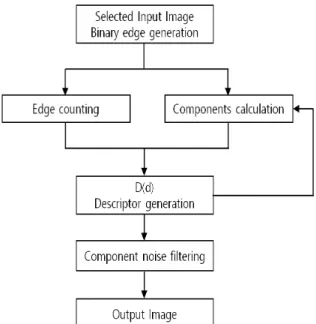
As can be seen in the flowchart of Fig. 3 for the classification of detail components, a binary edge map is primarily generated based on edge intensity and gradient orientation.
At this time, even if the noise component is not completely removed, thresholding is performed so that a meaningful detail component is not removed.
Then, the number of edges and connectivity are used to classify detail components and noise components that are not completely removed.
Then, a final detail descriptor is generated to detect the detail region of the region[4].
In order to quantitatively calculate the detail area in the noise image, a binary edge map composed of edge components was created.
For this purpose, edge strength(ES) and gradient orientation(GO) derived using the sobel operator were used. First, the ES in the x and y directions was derived as shown in Equation(1) through the sobel operator that divided the image into blocks[5].
Fig. 3. Flowchart of the proposed algorithm.
If there is no single pixel with the same orientation in ES, the GO quan(i, j) value is random orientation. Through this, the final binary edge map(Ebinary) is generated as shown in Equation(2) by additionally removing noise components that have no directionality.
=
⎛ ⎨
⎝
and
0, otherwise
In order to extract details using Ebinary, a detail descriptor(Dd) is generated by deriving information on the number of edges(Nedge) and the number of components(Ncomponent) using a connected component algorithm on the search window.
Here, Nedge(i, j) is derived from the number of pixels whose pixel value is 1 in the search window on the binary edge map, and adj is set to 2, which is the range of the patch.
If there is no component connected in the search window, the detail descriptor is displayed
(545)
A study on image area analysis and improvement using denoising technique 135
a. SSD based method. b. Proposed method.
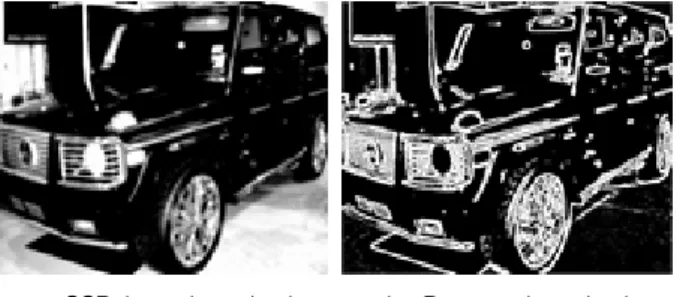
Fig. 4. The result of detail descriptor generation.
as 0. Otherwise, by dividing the number of edges by the number of components, the amount of image detail in the local image area can be expressed as an accurate numerical value. Dd is obtained by indicating the number of edges and components in the search window. Based on this, region analysis is carried out through the process of performing component based noise filtering.
After generating the Detail descriptor, noise filtering is performed by applying the detail descriptor. If Dd(i, j) is less than or equal to 1, the pixel(i, j) is classified as a noise flattening region and mean filtering is performed. Otherwise, noise filtering proceeds adaptively based on the size of the detail descriptor and the connected component according to Equation (4). This equation adjusts the weight of the original noise image G according to the similarity between pixels. Also, the denoising intensity was adjusted according to the detail descriptor[6].