․교신저자: 장인수 전북 전주시 완산구 어은로 46 우석대부속한방병원
TEL: 063-220-8608 FAX: 063-220-8616 E-mail: [email protected]
․본 연구는 한국연구재단의 연구비 지원으로 진행되었음.
뇌신경질환에 사용된 레이저 및 광선치료에 대한 임상 연구 고찰
이경구1, 신종훈1, 이경진1, 선승호2, 한창호3, 장인수4
1우석대학교 한의학대학 한의학과, 2상지대학교 한의학대학 한방내과학교실
3동국대학교 한의학대학 한방내과학교실, 4우석대학교 한의학대학 한방내과학교실
Review on Laser or LED Therapy for the Photobiomodulation of Diseases of the Cerebral Nervous System
Kyung-goo Lee1, Jong-hun Shin1, Kyung-jin Lee1, Seung-ho Sun2, Chang-ho Han3, In-soo Jang4
1Dept. of Korean Medicine, College of Korean Medicine, Woo-Suk University
2Dept. of Internal Medicine, College of Korean Medicine, Sang-Ji University
3Dept. of Internal Medicine, College of Korean Medicine, Dong-Guk University
4Dept. of Internal Medicine, College of Korean Medicine, Woo-Suk University
ABSTRACT
Objectives:
Recently, many studies have reported beneficial effects from the application of laser and light-emitting diode (LED) therapy for cerebral nervous disease. Transcranial laser therapy and LED therapy may be an effective method to treat diseases of the cerebral nervous system. This study aims to discuss the possibility of laser and LED therapy for cerebral nervous disease by reviewing literature about its effectiveness.
Methods:
We searched papers using PubMed, Science Direct, CINAHL, KTKP, Oasis and NDSL, using the keywords
“Laser therapy, low-level", “Transcranial laser", “Transcranial light emitting diode" and “stroke”, “traumatic brain injury”, “dementia”,
“anxiety”, “cognitive”, “emotional effects”, “psychiatric disorder”, “multiple sclerosis”, “Parkinson's disease”. The search range included randomized controlled trials (RCTs) and clinical case series. Reviews and animal experiments were not included. Studies not matched with inclusion criteria were excluded.
Results:
A total 1,119 studies were found. 1,100 were excluded from scanning titles and abstracts and finally 9 articles were selected. Among the 9 articles, 5 were RCTs, one was a controlled study, and the other 3 were case reports. They reported that transcranial laser therapy and LED treatment had beneficial effects from photobiomodulation to the cerebral nervous system.
Clinical evaluation factors showed favorable trends.
Conclusions:
Transcranial laser therapy and LED therapy seem to be effective to the cerebral nervous system and they may be a favorable choice for cerebral nervous disease.
Key words:
transcranial laser therapy, low level laser therapy, transcranial light emitting therapy, cerebral nervous disease, review
Ⅰ. 서 론
뇌신경계 질환은 흔히 발생하고 치료기간이 길
어 비용부담이 높은 질환이다
1. 세계보건기구(World
Health Organization, WHO)에서 지속적으로 발표
하고 있는 세계 질병부담(Global Burden of Disease, GBD) 보고서에 따르면 신경⋅정신병적 범주에 속 하는 신경학적 장애와 다른 범주에 속하는 장애 및 손상에 의한 신경학적 후유증을 종합한 신경계 질환 이 6.3%의 높은 질병부담지수를 차지하고 있다. 이 러한 수치는 5% 내외의 비중을 차지하는 HIV/AIDS, 악성종양, 허혈성 심장질환, 호흡기계 질환, 소화기 계 질환보다도 더 높은 질병부담을 나타낸다
2.
뇌신경계 질환은 손상된 신경세포로 인한 비가 역적인 병리적 변화로 인한 경우가 많아서 치료가 쉽지 않고, 후유증의 범위도 넓은 편이다. 때문에 다양한 치료방법이 시도되고 있는데, 최근에 최근 저단계레이저(low level laser therapy, LLLT)를 활 용하여 경두개레이저 치료(transcranial laser therapy, TLT)를 뇌신경계 질환에 적용하려는 연구가 보고 되고 있으며, light emitting diode(LED)를 활용한 치료 방법들이 시도되고 있다
3-6. 이같은 임상 연구 들은 지난 수년간 허혈성 뇌졸중에 대한 레이저 치료의 연구 성과가 ‘Stroke’를 비롯한 여러 권위있 는 저널에 소개되고 있으며
3-6, 이외에도 외상성 뇌 손상, 불안과 우울, 인지와 감정장애, 파킨슨병의 광선치료효과에 대한 리뷰논문과 임상연구가 활발 하게 보고되고 있다
7-12. 따라서 뇌신경계 질환을 가진 환자들의 새로운 치료방법으로써 다양한 가 능성을 보여주고 있는 광선치료에 대하여 관심을 기울일 필요가 있다고 생각된다.
그러나 아직까지 국내 관련 학술지에 뇌신경계 질 환과 관련된 레이저 및 LED 광선 치료 임상연구 내용이 구체적으로 소개된 바 없었기에 본 연구를 통하여 국내⋅외에서 이루어지고 있는 뇌신경계 질환의 레이저 및 광선치료에 대한 연구 동향을 고찰해보고자 한다.
Ⅱ. 연구 방법
문헌 검색을 위하여 뇌신경계 질환 중에서 발병 빈도가 높고 실제 photobiomodulation 치료에 활용
되고 있는 허혈성 뇌졸중, 외상성 뇌손상, 정신과 질환(불안․우울․인지․감정장애 및 기타 정신과 적 장애), 신경퇴행성질환(치매, 파킨슨병, 다발성 경화증)을 대상으로 선정하였다. 검색어는 해외 문 헌의 경우 뇌신경질환에 주로 사용되는 레이저 및 광선치료의 조사 방식에 따라 이에 해당하는 표준 검색어(Medical Subject Headings, MeSH)인 “Laser therapy, low-level", “Transcranial laser", “Transcranial light-emitting diode"와 중풍에 해당하는 표준검색어
“stroke”를 동시에 만족하는 문헌을 검색하였다. 이와 같은 방식으로 “traumatic brain injury”, “dementia”,
“anxiety”, “cognitive”, “emotional effects”, “psychiatric disorder”, “multiple sclerosis”, “Parkinson's disease”
에 대해서도 각각 동일한 방법을 적용하였다. 국내 문헌의 경우는 오아시스와 한국전통지식포탈에서
“레이저”에 해당하는 모든 관련 문헌을 검색하였 다. NDSL에서는 “레이저” 또는 “광선”과 중풍에 해당하는 “뇌졸중” 또는 “중풍”을 동시에 만족하는 문헌을 검색하였고, 역시 같은 방식으로 “뇌손상”,
“치매”, “우울”, “불안”, “인지”, “감정장애”, “정신 과 장애”, “다발성경화증”, “파킨슨병”에 대하여 같 은 방법을 적용하였다.
해외 문헌은 PubMed(http://www.ncbi.nlm.nih.gov
/pubmed), Science Direct(http://www.sciencedirect.com),
CINAHL(http://www.cinahl.com), 국내 문헌은 오
아시스(http://oasis.kiom.re.kr), 한국전통지식포탈
(http://www.koreantk.com), NDSL(http://www.ndsl.kr)
을 이용하여 검색하였다. 이외에도 뇌신경계 질환과
관련한 기타 자료를 조사하여 임상적 가치가 있는
문헌 등을 포함하여 고찰하였다. 검색기간은 각 검
색엔진이 제공하는 최초시점부터 2014년 11월까지
전자출판된 문헌을 대상으로 하였으며, 언어에 따른
제한은 두지 않았다. 뇌신경계 질환과 관련한 각종
문헌 중에서, 임상적 가치가 있는 문헌 등을 가능한
포함하기 위하여 무작위대조 임상연구(Randomized
controlled trial, RCT) 뿐만 아니라 환자대조군연구,
증례보고를 포함하여 선정하였고, 문헌고찰(review),
사설(editorial), 동물 또는 세포 실험 연구 또는 정상 인을 대상으로 한 임상연구는 제외하였다. 검색엔진 문헌 이외에 hand search로 선별된 문헌이나 학술 대회 초록 등의 회색문헌(gray literature)도 포함 하였다.
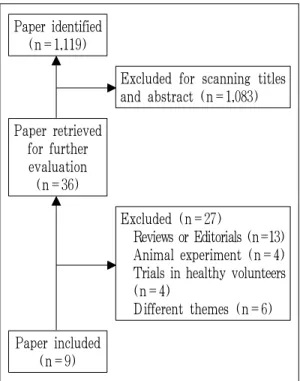
위의 검색어로 검색된 문헌에 대하여 제목과 초 록을 검토하여 문헌을 1차 선별하였고, 이후 본문 을 조사하여 연구에 사용된 레이저 적용 방식과 뇌신경계 질환을 가진 환자를 대상으로 행해진 임 상적 치료효과를 밝힌 문헌을 재차 선별하였다. 그 리고 리뷰논문, 종설논문을 비롯한 비임상연구로 구분하였다. 최초에 검색된 문헌은 1,119편이었고, 제목과 초록을 검토한 결과 중복되거나 검색 목적에 적합하지 않은 문헌을 배제하고 36편을 대상으로 2차 선별을 진행하였다. 이 중 본 연구와 무관하거나, 비임상연구에 해당하는 문헌 또는 종설논문이 13편 이었다. 또한 동물을 대상으로 한 연구가 4편, 뇌신 경계 질환을 가지지 않은 건강한 노인여성 또는 성 인을 대상으로 행해진 연구가 4편이었다. 5편은 각각 뇌신경계 질환이 아닌 구강안면통, 섬유근통, 만성 통증, 다발성경화증 환자의 삼차신경통, 알코올 중 독에 대한 광선치료를 다루었고, 1편은 중풍 후유 증 환자에 대한 말초신경 및 근골격계에 작용하는 광선치료를 다룬 논문이었다. 이들 문헌을 배제하 고 최종적으로 9편의 뇌신경계 질환을 가진 사람을 대상으로 한 임상 치료연구를 선별하였다(Fig. 1).
Paper identified (n=1,119)
Excluded for scanning titles and abstract (n=1,083) Paper retrieved
for further evaluation
(n=36)
Excluded (n=27)
Reviews or Editorials (n=13) Animal experiment (n=4) Trials in healthy volunteers
(n=4)
Different themes (n=6) Paper included
(n=9)
Fig. 1. Flow chart of the trial selection process.
Ⅲ. 연구 결과
1. 허혈성 뇌졸중
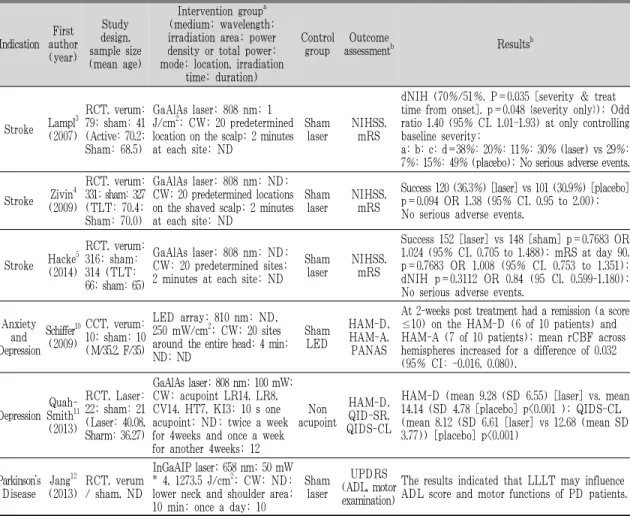
최종 선정된 9편의 연구 중 허혈성 뇌졸중의 레 이저 치료에 대한 논문 3편으로, 모두 여러 나라에 서 진행된 다기관 임상시험이자 이중맹검 무작위 대조 임상연구(Randomized controlled trial, RCT) 였다. 세 연구의 환자 선정 기준과 평가 척도의 활 용에 있어서는 약간의 차이가 있었으나 연구 방법 은 유사하였다.
세 연구 모두 발병 시점 이후 24시간이 지나지
않은 허혈성 뇌졸중 환자를 대상으로 하여 나이와
일정 범위의 NIHSS 점수를 기준으로 하여 환자를
선정하고 레이저 치료군과 대조군으로 무작위 배
정하였다. 환자들은 모두 처치 전, 5일, 30일, 60일,
90일에 평가하였다. 치료군에 대해서는 경두개레이
저치료(TLT)라고 부르는 치료 방법을 사용하였는데,
PhotoThera Inc. USA의 NeuroThera Laser System
(NTS)을 이용하여 면도된 두피에 부착하여 뇌졸 중 부위와 상관없이 20개의 일정한 위치에 808 nm 의 레이저를 각 부위당 2분씩 조사하였으며, 이를 동일한 처치를 하되 레이저 전원을 끈 상태로 유 지하여 레이저 에너지를 조사하지 않은 대조군과 비교 분석하였다
3-5.
치료 효과에 있어서 Lampl 등의 경우 NIHSS와 modified Rankin Scale(mRS)를 비롯한 다종의 뇌 질환 환자의 신경학적 증상을 평가하는 도구를 사 용하였고, 그 결과를 호전 정도에 따라 이분화하여 평가하였다
3. Zivin 등과 Hacke 등의 경우는 처음 부터 NIHSS와 mRS 척도의 결과를 이분화하여 평 가하였다
4,5. 결과적으로 Lampl 등과 Zivin 등의 연 구에서는 NIHSS에서 증상이 심할수록, 조기에 치 료받을수록 시험군에서 더 나은 호전도를 보였다 는 결과를 얻었으며, 두 군 간에 유의한 차이는 없 었으나 시험군에서 더 나은 효과를 보이는 경향을 얻었다고 평가한 반면
3,4, Hacke 등의 연구에서는 임상적으로 유의미한 효능이 없는 것으로 평가하 였다. 안전성에 있어서는 세 연구 모두에서 레이저 치료로 인한 심각한 부작용이 없었으며, 경두개레 이저치료가 안전한 치료방법이었다고 보고하였다.
52. 정신과 질환(불안, 우울, 인지, 감정장애 및 기타
정신과적 장애)
최종 선정된 9편의 연구 중 정신과 질환과 관련 하여 불안 및 우울 증상을 나타내는 환자에 대한 레이저 및 광선 치료 논문이 2편이었다. Schiffer 등 은 RCT 연구를 통해서 10명의 불안 및 우울장애 환자를 대상으로 Near-infrared laser(NIR) 조사를 무작위 순서로 배정하였다. 4가지 처치는 각각 왼쪽 이마, 오른쪽 이마의 NIR 작동 처치와 동일한 위 치의 거짓처치로 구성되었다. 각각의 치료가 끝난 후
즉시 Positive and negative affect scale(PANAS)을 반복 시행하였고 처치 후 2주, 4주 후에 Hamilton depression rating scale(HAM-D), Hamilton Anxiety rating scale(HAM-A)를 반복 시행하였다. 그 결과 HAM-D와 HAM-A 점수에서는 상당한 감소를 보 였으나 rCBF 결과는 통계적 유의성에 도달하지 못하였다. 또한 PANAS는 NIR이 작동했을 때 더 욱 상당한 정도의 향상이 나타났다
10.
한편 Smith 등은 DSM-Ⅳ를 통해 주요 우울성 장애로 진단받은 43명의 환자를 무작위 배정하였 다. 치료군은 LR14, LR8, CV14, HT7, KI3의 경혈에 레이저 침 자극을 일주일에 2번씩 4주, 일주일에 1번 씩 4주로 총 8주 동안 12회의 처치를 하였으며, 이를 비경혈점을 자극한 대조군과 비교 분석하였다. 그 결과 HAM-D와 Quick inventory for depression-self reporting(QID-SR)에서 높은 향상을 보였고, Quick inventory for depression-clinician(QIDS-CL)에서 는 두 군 모두에서 향상을 보였으나 군 간 차이는 유 의미하지 않았다
11.
3. 신경퇴행성질환(치매, 다발성 경화증, 파킨슨병)
치매, 다발성 경화증, 파킨슨병이 속한 신경퇴행
성질환의 레이저 치료에 대한 논문은 1편으로 파
킨슨병에 대한 이중맹검 RCT 연구에 관한 내용이
었다. Jang 등은 신경과 전문의에게 진단을 받은
파킨슨병 환자를 대상으로 레이저 치료군에게는
658 nm 파장을 가진 InGaAlP 레이저를 환자의 목
아래 및 어깨부위에 레이저를 조사하였고 대조군
에는 동일한 부위에 sham 레이저 치료를 행하는
방식으로 연구를 진행하였다. 하루에 30분씩 1회로
총 10회 시술한 결과, 저출력레이저 치료군의 Activities
of daily living score(ADL) 점수 및 운동기능검사
에서 호전을 보였다
12(Table 1).
Indication First author (year)
Study design, sample size (mean age)
Intervention group
a(medium; wavelength;
irradiation area; power density or total power;
mode; location, irradiation time; duration)
Control group
Outcome
assessment
bResults
bStroke Lampl
3(2007)
RCT, verum:
79; sham: 41 (Active: 70.2;
Sham: 68.5)
GaAlAs laser; 808 nm; 1 J/cm
2; CW; 20 predetermined location on the scalp; 2 minutes at each site; ND
Sham laser
NIHSS, mRS
dNIH (70%/51%. P=0.035 [severity & treat time from onset]. p=0.048 {severity only}); Odd ratio 1.40 (95% CI. 1.01-1.93) at only controlling baseline severity;
a: b: c: d=38%: 20%: 11%: 30% (laser) vs 29%:
7%: 15%: 49% (placebo); No serious adverse events.
Stroke Zivin
4(2009)
RCT, verum:
331; sham: 327 (TLT: 70.4;
Sham: 70.0)
GaAlAs laser; 808 nm; ND;
CW; 20 predetermined locations on the shaved scalp; 2 minutes at each site; ND
Sham laser
NIHSS, mRS
Success 120 (36.3%) [laser] vs 101 (30.9%) [placebo]
p=0.094 OR 1.38 (95% CI. 0.95 to 2.00);
No serious adverse events.
Stroke Hacke
5(2014)
RCT, verum:
316; sham:
314 (TLT:
66; sham: 65)
GaAlAs laser; 808 nm; ND;
CW; 20 predetermined sites;
2 minutes at each site; ND Sham
laser
NIHSS, mRS
Success 152 [laser] vs 148 [sham] p=0.7683 OR 1.024 (95% CI. 0.705 to 1.488); mRS at day 90.
p=0.7683 OR 1.008 (95% CI. 0.753 to 1.351);
dNIH p=0.3112 OR 0.84 (95 Cl, 0.599-1.180);
No serious adverse events.
Anxiety and Depression
Schiffer
10(2009)
CCT, verum:
10; sham: 10 (M/35.2, F/35)
LED array; 810 nm; ND, 250 mW/cm
2; CW; 20 sites around the entire head; 4 min;
ND; ND
Sham LED
HAM-D, HAM-A, PANAS
At 2-weeks post treatment had a remission (a score
≤10) on the HAM-D (6 of 10 patients) and HAM-A (7 of 10 patients); mean rCBF across hemispheres increased for a difference of 0.032 (95% CI: -0.016, 0.080).
Depression Quah- Smith
11(2013)
RCT, Laser:
22; sham: 21 (Laser: 40.08, Sharm: 36.27)
GaAlAs laser; 808 nm; 100 mW;
CW; acupoint LR14, LR8, CV14, HT7, KI3; 10 s one acupoint; ND; twice a week for 4weeks and once a week for another 4weeks; 12
Non acupoint
HAM-D, QID-SR, QIDS-CL
HAM-D (mean 9.28 (SD 6.55) [laser] vs. mean 14.14 (SD 4.78 [placebo] p<0.001 ); QIDS-CL (mean 8.12 (SD 6.61 [laser] vs 12.68 (mean SD 3.77)) [placebo] p<0.001)
Parkinson's Disease
Jang
12(2013)
RCT, verum / sham, ND
InGaAIP laser; 658 nm; 50 mW
* 4, 1273.5 J/cm
2; CW; ND;
lower neck and shoulder area;
10 min; once a day; 10
Sham laser
UPDRS (ADL, motor examination)
The results indicated that LLLT may influence ADL score and motor functions of PD patients.
aThe laser parameters are given in the following order: laser type; wavelength (nm); power (mW) or power density (mW/cm2); energy (J); energy density (J/cm2); mode (CW); spot size (cm2); area treated; illumination time (min);
schedule; total sessions. In many cases, the parameters are partially unavailable.
bRCT : randomized controlled trial, CCT : case controlled trial, ND : not defined, NIHSS : National institutes of health stroke scale, mRS : modified Rankin scale, bNIH : binary NIHSS, dNIH : dichotomous NIHSS, a=final NIHSS 0-1 & improved≧9 points. b=improved≧9 points. c=final NIHSS 0-1. d=non either, TLT : Transcranial laser therapy, LED : light emitting diode, HAM-D : Hamilton depression rating scale, HAM-A : Hamilton anxiety rating scale, PANAS : positive and negative affect scale, QID-SR : quick inventory for depression-self reporting, QIDS-CL: quick inventory for depression- clinician, CW : continuous wave, ADL : activities of daily living score, LLLT : low level laser therapy
Table 1. Summary of RCTs on Laser and LED Therapy for Cerebral Nervous Disease
4. 외상성 뇌손상
최종적으로 선정된 9편의 연구 논문 중 외상성 뇌손상과 관련된 레이저 치료에 대한 논문은 3편 으로 모두 증례 보고 형식의 논문이었다. 2011년 Naeser 등은 만성 외상성 뇌손상(chronic traumatic brain injury, CTBI) 증상을 호소하는 여성 환자 2명
에게 Red and Near-infrared light-emitting diode
(Red/NIR LED) 치료를 행하였다. 외상성 뇌손상
을 입은 후 7년이 흐른 뒤 내원한 59세의 여성 환
자에게 앞이마와 두개골 부위에 저출력 레이저에
해당하는 경두개레이저 치료를 매일 5년 동안 시행
하여 환자의 호전도를 살펴보았다. 그 결과 컴퓨터
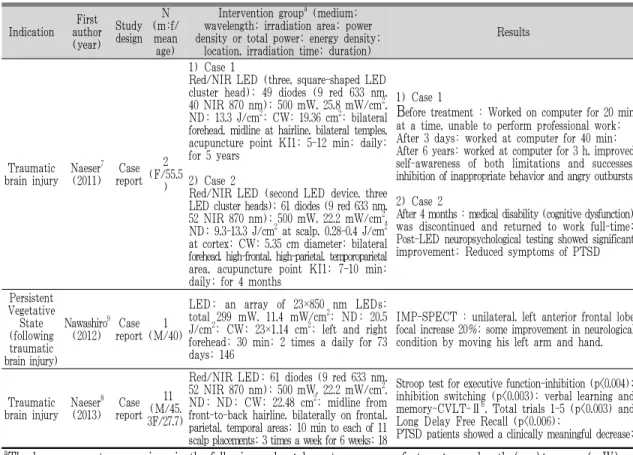
작업 시간이 치료 전 20분에서 6년 후 3시간으로 향상되었고, 스스로 분노와 부적절한 행동 등을 제 어할 수 있는 능력이 향상됨을 보였다. 또한 외상 성 뇌손상에 가까운 병력을 가진 52세 여성에게 앞 머리와 두개골, KI1 부위에 경두개레이저 치료를 매일 4개월 동안 시행하여 다니던 직장을 그만둘 정도의 인지 기능장애가 다시 일자리를 구할 수 있 을 정도로 호전되었으며, 신경정신과적 검사에서도 의미 있는 회복을 보였다
7.
2013년 수행된 Naeser 등의 연구에서는 11명의 외상성 뇌손상 환자에게 두개골 중앙선, 전두골, 두정골, 측두골 부위에 Red/NIR LED 광선 치료를
수행하여 호전도를 살펴보았다. 결과적으로 VAS 척 도에서는 유의한 결과가 없었으나 집행기능 평가를 알아보는 Stroop test 중 Trial 3와 Trial 4, 단어 기억 을 알아보는 California verbal learning test(CVLT-Ⅱ) 중 Total Trial 부분에서 유의한 결과를 얻었다
8.
한편, Nawashiro 등은 뇌손상 후 식물인간 상태에 빠진 환자에게 LED 광선을 좌우 앞이마 부위에 주 2회 30분씩 총 73일 조사한 결과 IMP-SPECT 에서 20%의 국소적 혈류 증가를 보였으며, 환자의 왼손과 팔이 움직일 정도로 신경학적 호전을 보였 다고 보고하였다
9(Table 2).
Indication First author (year)
Study design
N (m:f/
mean age)
Intervention group
a(medium;
wavelength; irradiation area; power density or total power; energy density;
location, irradiation time; duration)
Results
Traumatic brain injury Naeser
7(2011) Case report
2 (F/55.5
)
1) Case 1
Red/NIR LED (three, square-shaped LED cluster head); 49 diodes (9 red 633 nm, 40 NIR 870 nm); 500 mW, 25.8 mW/cm
2, ND; 13.3 J/cm
2; CW; 19.36 cm
2; bilateral forehead, midline at hairline, bilateral temples, acupuncture point KI1; 5-12 min; daily;
for 5 years 2) Case 2
Red/NIR LED (second LED device, three LED cluster heads); 61 diodes (9 red 633 nm, 52 NIR 870 nm); 500 mW, 22.2 mW/cm
2, ND; 9.3-13.3 J/cm
2at scalp, 0.28-0.4 J/cm
2at cortex; CW; 5.35 cm diameter; bilateral forehead, high-frontal, high-parietal, temporoparietal area, acupuncture point KI1; 7-10 min;
daily; for 4 months
1) Case 1
B efore treatment : Worked on computer for 20 min at a time, unable to perform professional work;
After 3 days: worked at computer for 40 min;
After 6 years: worked at computer for 3 h, improved self-awareness of both limitations and successes, inhibition of inappropriate behavior and angry outbursts.
2) Case 2
After 4 months : medical disability (cognitive dysfunction) was discontinued and returned to work full-time;
Post-LED neuropsychological testing showed significant improvement; Reduced symptoms of PTSD
Persistent Vegetative
State (following traumatic brain injury)
Nawashiro
9(2012) Case
report 1 (M/40)
LED; an array of 23×850 nm LEDs;
total 299 mW, 11.4 mW/cm
2; ND; 20.5 J/cm
2; CW; 23×1.14 cm
2; left and right forehead; 30 min; 2 times a daily for 73 days; 146
IMP-SPECT : unilateral, left anterior frontal lobe focal increase 20%; some improvement in neurological condition by moving his left arm and hand.
Traumatic brain injury Naeser
8(2013) Case report
11 (M/45.
3F/27.7)
Red/NIR LED; 61 diodes (9 red 633 nm, 52 NIR 870 nm); 500 mW, 22.2 mW/cm
2, ND; ND; CW; 22.48 cm
2; midline from front-to-back hairline, bilaterally on frontal, parietal, temporal areas; 10 min to each of 11 scalp placements; 3 times a week for 6 weeks; 18
Stroop test for executive function-inhibition (p<0.004);
inhibition switching (p<0.003); verbal learning and memory-CVLT-Ⅱ
b, Total trials 1-5 (p<0.003) and Long Delay Free Recall (p<0.006);
PTSD patients showed a clinically meaningful decrease;
aThe laser parameters are given in the following order : laser type or manufacturer; wavelength (nm); power (mW) or power density (mW/cm2); energy (J); energy density (J/cm2); mode (CW); spot size (cm2); area treated; illumination time (min); schedule; total sessions. In many cases, the parameters are partially unavailable.
bCVLT-Ⅱ : California verbal learning test, ND : not defined, NIR : Near-infrared, IMP-SPECT : iofetamine single photon emission computed tomography, PTSD : post-traumatic stress disorder, LED : light emitting diode