Print ISSN: 2288-4637 / Online ISSN 2288-4645 doi:10.13106/jafeb.2018.vol5.no1.63
The Relationship between Perceived Access to Finance and Social Entrepreneurship Intentions among University Students in Vietnam
Phan Tan Luc
1Received: January 23, 2018 Revised: February 9, 2018 Accepted: February 20, 2018
Abstract
Social entrepreneurship is increasingly gaining interest in developing countries for the great benefits of society. In Vietnam, the concept of social entrepreneurship is still quite new. Entrepreneurial intention is regarded as a useful and practial approach for understanding actual entrepreneurial behavior. The purpose of this paper is to develop an integrated model based on planned behavior to examine the direct and indirect effect of perceived access to finance on social entrepreneurial intention. The confirm factor analysis to study the latent constructs underlying determinants of planned behavioral theory, perceived access to finance and social entrepreneurial intention. Then, it applies the technique of structural equation modeling to explore relationships among latent constructs. There is no direct relationship between perceived access to finance and social entrepreneurial intention. Perceived access to finance only indirectly increases entrepreneurial intention through attitude towards behavior and perceived behavioral. This study focuses on the perceptual factor of financial access that affects entrepreneurial intentions. The study does not cover other in-depth issues of social entrepreneurship such as decision making, leadership, personality traits, social capital, and human capital. To establish an environment with a strong social entrepreneurial intention, a focus on developing perceived access to finance is an extremely important factor. This study also suggests that attitude towards behavior and perceived behavioral have a strong impact to social entrepreneurship
Keywords: Social Entrepreneurship, Theory of Planned Behavior, Perceived Access to Finance, Social Entrepreneurial Intentions JEL Classification Code: D9, L26, L31.
1. Introduction 1
Governments nowadays face issues of how to meet social needs for which they are
not necessarily able to provide solutions. Social enterprises are becoming increasingly important in providing solutions to social problems (Ellis, 2010). Social enterprise is seen as a form of business activity that is beneficial to the whole society as it addresses the goals of addressing the social needs that the government or business normally does not address or respond to. Social entrepreneurship helps create innovative solutions for immediate social issues, mobilizes the ideas, capacities and resources necessary for the sustainable development of society" (Alvord, Brown, & Letts, 2004). Social entrepreneurship is a topic that deals with many aspects of society from business, social and political,
1 Department of Economics, Thu Dau Mot University, Binh Duong, Vietnam [Mailing Address: Faculty of Economics, Thu Dau Mot University, 8 Tran Van On Street, Phu Hoa Ward, Thu Dau Mot City, Binh Duong, 590000 Vietnam] E-mail: [email protected]
as it pursues solutions to the social development of the society (Robinson, 2006).
Social entrepreneurship in Vietnam is still in the early stage of development despite the potential of this type of business is still very large. Social enterprises in Vietnam are those enterprises that operate not for the purpose of maximizing profits but towards the goal of solving social and environmental issues for the benefit of the community.
These enterprises use at least 51% of their annual gross
return for reinvestment in pursuit of social and
environmental goals. The important role of social business
in socio-economic has been affirmed with the legalization of
social enterprises in Enterprise Law 2014. This is an
important premise for the establishment of legal
environment and policies in line with encouragement for the
development of social enterprises. It can be said that the
revised Enterprise Law 2014 has gone into history, opening
a new chapter for the Vietnamese business community
when it first came to the concept of Social Entrepreneurship
in the legal system. However, it is a fact that increasing the
intention of social entrepreneurship in Vietnam is an urgent
desire but at this present level is very low, leading to a
question: how to increase social entrepreneurship in Vietnam.
Krueger Jr (2003) explains that entrepreneurship can only grow if quality and quantity of entrepreneur’s grow.
Entrepreneurial intentions are the best indicator for entrepreneurship behavior (Ajzen & Fishbein, 1980) and are important for business processes (Lee, Wong, Der Foo, &
Leung, 2011). Therefore, in order to have reasonable incentive and support policies, it is important to focus on the understanding of social enterprise intentions as well as the processes of forming the intention to become social entrepreneurs of students.
Access to finance is one of the barriers not only in shaping entrepreneurial intention (Evans & Leighton, 1989) but also in social entrepreneurial intention. Because social enterprises do not operate for profit, so the funds for social entrepreneurship are still limited. It is essential to identify and quantify the relationship between perceived financial access to the student's social entrepreneurial intentions. Not only does it help students to evoke the social entrepreneurship, but it is also the basis for solutions to help students to be more confident when starting social business.
Therefore, the objectives of this study are: 1) To empirically test the effect of perceived financial access on social entrepreneurial intention. 2) To develop and validate a conceptual model depicting the role of the theory of planned behavior as a mediator in predicting social entrepreneurial intention.
2. Literature Review
The literature review is focused on what is the meaning of the term social entrepreneurship, social entrepreneurial intention and its association with other related fields. This section also covered the empirical studies conducted in the field of social entrepreneurial intentions.
2.1. Social Entrepreneurship
Social entrepreneurship is considered a branch of entrepreneurship research (Steyaert, 2006). Therefore, the key to understanding the social entrepreneurship is to inherit and grow from research from the entrepreneurship (Chell, 2007). Peredo and McLean (2006) argue that "social entrepreneurship is a new and better form of creating and sustaining social values". Robinson (2006) defines starting a social business as a process that involves: identifying a specific social problem and a specific solution (or set of solutions) to solve it; assess the social impacts, business models and sustainability of the business; create a social mission to and develop towards a non-governmental
organization or non-profit organization. Therefore, it can be seen that the goal of creating social value or solving social problems through innovative solutions is central objective of social business (Alvord et al., 2004; Martin & Osberg, 2007;
Zahra, Rawhouser, Bhawe, Neubaum, & Hayton, 2008).
2.2. Social Entrepreneurship Intention
Intention is the state of awareness right before the act (Krueger Jr, 2003). According to Bird (1988), the intention to start a business is a mental state aimed at the development and implementation of new business ventures, a start-up that is a working attitude that promotes independence, creativity, accept risks and create new value in the current business.
Entrepreneurial intention involves the direction of a person to start a business in the future. Entrepreneurial intention reflects the dynamics and ability of the individual to identify opportunities, pursue it and create new value. In other words, entrepreneurial intention expresses the individual's desire and commitment to creating new business. Similarly, in the context of social entrepreneurship, social entrepreneurship intention can be understood as individual's belief, desire, and determination to establish a new social enterprise.
2.3. Intention Models in Social Entrepreneurship As research on social entrepreneurship is still in development, studies of social entrepreneurial intention have not been fully undertaken. The following are some typical studies in social entrepreneurial intention: Based on the theory of planned behaviour (TPB) (Ajzen, 1991) and entrepreneurial event (SEE) (Shapero & Sokol, 1982), Mair and Noboa (2006) developed the first social entrepreneurship model. Although there is an impact of interaction between situational and individual factors in shaping social entrepreneurial intentions, however, they only choose to focus on the individual level of their research.
Mair and Noboa (2006) also agreed that social entrepreneurial intention was shaped perceived desirability and perceived feasibility of social entrepreneurship.
Research has extended the classical models by proposing the premise for the two major dependent structures. They argue that perceived feasibility is affected by self-efficacy and social support. Similarly, empathy and moral judgment influence the perceived desirability.
Ernst (2011) conducted another study to examine social
entrepreneurial intention on a sample of 203 students from
four different German universities. He expanded a classic
TPB model with three factors (attitude towards behavior,
subjective norms and perceived behavioral control) to the
new model that impact the social entrepreneurial intentions.
In addition, he extends the model with antecedents: human capital (perceived social entrepreneurial knowledge/
experience and perceived social entrepreneurial skills), social capital (perceived knowledge of institutions, perceived network and perceived support) and social personality (risk- taking propensity, innovativeness, need for achievement, need for independence, pro-activeness and the pro-social personality including the dimensions of empathy and social responsibility).
Tran, Tran, Von Korflesch, and Von Korflesch (2016) contributed to social entrepreneurship literature by introducing new insights into social entrepreneurial intentions. This is the first model to apply the social cognitive career theory as the basis for the formation of social entrepreneurial intention. He built the model with two antecedents: social entrepreneurial self-efficacy and social entrepreneurial outcome expectations. Two factors influencing these two antecedents are mentioned by the author: personality traits (agreeableness, conscientiousness, extraversion, neuroticism, openness) and contextual factors (role models, education, perceived support). This research offers a new direction for researchers to develop a model of entrepreneurship intention on cognitive career theory.
However, in this research study, the author has only introduced the model without empirical research.
Hockerts (2017) validates the model of Mair and Noboa.
He modified the model by eliminating the moderate variables (perceived desirability and perceived feasibility) from Mair and Noboa’s model and examining the direct effect of moral obligation, entrepreneurial self-efficacy, empathy and perceived social support on social entrepreneurial intention. Hockerts (2017) added experience to the as mediating factor. He conducted this study on three different samples and found positive relationships with social entrepreneurial intentions.
Based on Ajzen's planned behavioral theory, Tiwari, Bhat, and Tikoria (2017) conducted a study to find out the relationship between cognitive styles and self-efficacy on entrepreneurial intention among undergraduate students.
This is the first research that tried to test the effect of cognitive styles on social entrepreneurial intentions as they believe that to encourage and support social entrepreneurship, it is necessary to analyze and understand the factors that affect the thinking process of individuals.
Therefore, this study provides a new approach based on cognitive theory to explore the formation of social entrepreneurial intention.
2.4. Theory of Planned Behavior (TPB)
In the field of entrepreneurial intention research, one of the most widely used models is Ajzen's theory of planned
behavior (TPB) (Engle et al., 2010). TPB is based on the idea that the intention to perform a particular behavior is shaped by the attitude of the person towards the behavior and the ability to do that behavior. He also mentioned that these intentions are the result of attitudes developed through experience and personal characteristics (Ajzen, 1996). According to Ajzen (1991), there are three determinants of intention to act. Factors in planned behavioral theory (TPB) include:
Attitude towards behavior (ATB).
According to Ajzen and Fishbein (1980) attitude towards behavior is “person’s good or bad assessment toward performing or not to perform certain behavior”. The attitude differs from the characteristics related to the nature of the assessment by a particular intention (Armitage & Conner, 2001). In the entrepreneurial intention studies, attitude towards behavior has proven to be an important factor in influencing the intention positively (Erikson, 1998; Koço ĥlu &
Hassan, 2013). Attitude toward behavior has a direct and strongly positive impact on entrepreneurial intentions. It is therefore necessary to make efforts to change one's personal behavior (Krueger & Brazeal, 1994).
Subjective norms (SN).
Subjective norms refer to the perception of social pressure to execute or not to execute that behavior including the pressure of family, friends and other important people (Ajzen, 1991). Subjective norms are always considered to be the most conflicting element in the theory of planned behavior. Some researchers have found that subjective indicators play an important role in forecasting the intentions (Kolvereid, Iakovleva, & Kickul, 2006) and some researchers completely ignore the indicators (Peterman & Kennedy, 2003; Veciana, Aponte, & Urbano, 2005). The theory states that those with high levels of subjective norm will have high levels of social entrepreneurial intentions
Perceived behavioral control (PBC).
Ajzen (2002) defined perceived behavioral control as the perceived acceptance or difficulty of performing the behavior.
Perceived behavioral control can be antecedent for the
actual levels of control (Armitage & Conner, 2001). More
specifically, perceived behavioral control is the personal
belief of its ability to perform a certain task. In of
entrepreneurship intention research, perceived behavioral
control is considered one of the strongest predictors of
intention (Liñán & Chen, 2009). For this reason, it is
believed that perceived behavioral control will have a positive effect on entrepreneurial intention
H1. Attitude towards behavior is positively associated with social entrepreneurship intention.
H2. Subjective norms are positively associated with social entrepreneurship intention.
H3. Perceived behavioral control is positively associated with social entrepreneurship intention.
2.5. Perceived Access to Finance
Evans and Leighton (1989) developed hypotheses that financial constraints are an important impediment to entrepreneurship. Gentry and Hubbard (2004) find that individuals who have access to financial capital are more likely to become entrepreneurs. Blanchflower and Oswald (1990) hypothesized that if the government wanted to increase the level of entrepreneurship, they needed to generate more financial capital for potential entrepreneurs who had limited capital. Previous studies have shown that young people have little access to financial capital to start a business so they have less time to build the necessary funds and end up not starting their own business because of their financial constraints (Evans & Jovanovic, 1989). Some empirical studies show that a lack of access to finance and difficulties in the financial system are seen as a major constraint among potential entrepreneurs in developing countries (Kristiansen & Indarti, 2004). In developed countries with effective financial infrastructure, access to financial capital may be more restrictive than business options due to high entry barriers (Kristiansen & Indarti, 2004). In social entrepreneurship, financial capital also functions similarly to conventional businesses. In this study, the perception of access to finance was considered as an assessment of the individual's ability to find, access and utilize capital effectively. As a result, a high level of perceived access to finance can directly influence social entrepreneurial intention.
H4. Perceived access to finance increases social entrepreneurship intention.
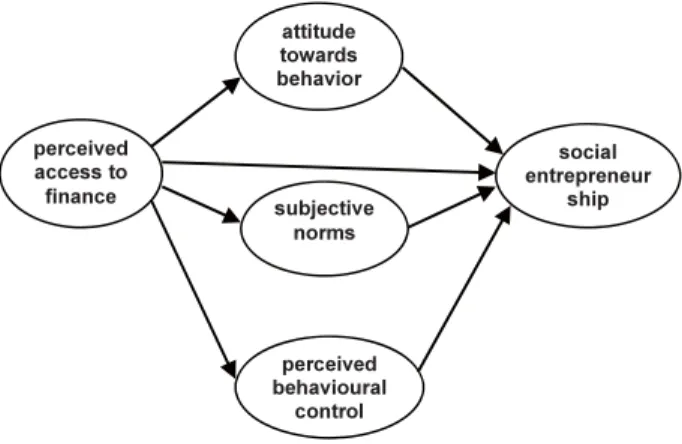
In addition to a direct impact, this paper also explores that perceived access to finance can indirectly influence social entrepreneurial intention through the three determinants of planned behavior. The mediating effect of the three determinants is likely due to the change of perceived access to finance over time. In the context of business students, an individual’s perceived access to finance as a dynamic factor can be absorbed by the three determinants: attitude towards behavior, subjective norms, perceived behavioral control.
Consequently, perceived access to finance indirectly influences social entrepreneurial intention (see Figure 1).
H5. Perceived access to finance increases social entrepreneurship intention through the determinants of planned behavior as mediator.
Figure 1. Research model
3. Data and Methodology
3.1. Sample Characteristics and Procedure
Survey data were collected from graduate business school students in Binh Duong Province. This choice are similar to the study of entrepreneurial intention (Douglas &
Shepherd, 2002; Siu & Lo, 2013). Survey data were collected from eight universities in Binh Duong province in Vietnam. They were encouraged to take the survey on a voluntary on basis. The final survey data includes 193 responses, of which 53.36 percent are from male students.
A five-point Likert-like scale, such as between strongly disagree to strongly agree, was used. There are about 25 variables, and the sample size is sufficient to conduct factor analysis (Jum, 1978). In this study, the technique of structural equation modeling (SEM) is applied to examine the proposed hypotheses. SEM is a suitable technique to test latent constructs and uncover the relationships between them (Bollen, 1989). There are five latent constructs, and three of them are the determinants of planned behavior, and the rest two are perceived access to finance and social entrepreneurship intention. The statistic software SPSS AMOS is used to run the SEM analysis.
3.2. Constructs
Liñán and Chen (2009) offer a well-recognized way of measuring entrepreneurial intentions. They developed a
perceived behavioural
control perceived
access to finance
attitude towards behavior
subjective norms
social entrepreneur
ship
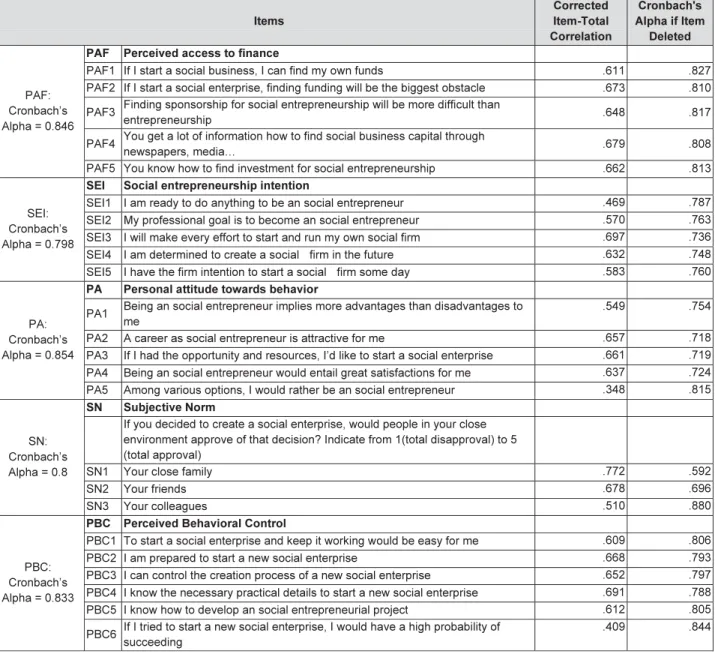
questionnaire with the intention of measuring exactly this. It is normally an advantage to use the questions developed by others, because it has already been adequately tested and found sufficiently good. To measure attitude towards behavior, subjective norms and perceived behavioral control, authors used scales developed by Ajzen (2002) and Liñán and Chen (2009). In this study, authors designed to measure perceived access to finance scale, the author interviews 15 experts, including lecturers and social entrepreneurs (see Table 1).
3.3. Measurement Model
Cronbach’s α was used to check the reliability of the constructs (Bollen, 1989). A value of 0.70 is considered satisfactory for most studies (Jum, 1978). Cronbach's Alpha of five factors: perceived access to finance (0.846), personal attitude towards behavior (0.854), subjective norms (0.8), perceived behavioral control (0.822), social entrepreneurship intention (0.798). Total item correlation are satisfactory (> 0.30) (see Table 1).
Table 1. Showing the reliability for each factor (n=193)
ItemsCorrected Item-Total Correlation
Cronbach's Alpha if Item
Deleted
PAF:
Cronbach’s Alpha = 0.846
PAF Perceived access to finance
PAF1 If I start a social business, I can find my own funds .611 .827
PAF2 If I start a social enterprise, finding funding will be the biggest obstacle .673 .810 PAF3 Finding sponsorship for social entrepreneurship will be more difficult than
entrepreneurship .648 .817
PAF4 You get a lot of information how to find social business capital through
newspapers, media… .679 .808
PAF5 You know how to find investment for social entrepreneurship .662 .813
SEI:
Cronbach’s Alpha = 0.798
SEI Social entrepreneurship intention
SEI1 I am ready to do anything to be an social entrepreneur .469 .787
SEI2 My professional goal is to become an social entrepreneur .570 .763
SEI3 I will make every effort to start and run my own social firm .697 .736
SEI4 I am determined to create a social firm in the future .632 .748
SEI5 I have the firm intention to start a social firm some day .583 .760
PA:
Cronbach’s Alpha = 0.854
PA Personal attitude towards behavior
PA1 Being an social entrepreneur implies more advantages than disadvantages to me
.549 .754
PA2 A career as social entrepreneur is attractive for me .657 .718
PA3 If I had the opportunity and resources, I’d like to start a social enterprise .661 .719 PA4 Being an social entrepreneur would entail great satisfactions for me .637 .724 PA5 Among various options, I would rather be an social entrepreneur .348 .815
SN:
Cronbach’s Alpha = 0.8
SN Subjective Norm
If you decided to create a social enterprise, would people in your close environment approve of that decision? Indicate from 1(total disapproval) to 5
(total approval)
SN1 Your close family .772 .592
SN2 Your friends .678 .696
SN3 Your colleagues .510 .880
PBC:
Cronbach’s Alpha = 0.833
PBC Perceived Behavioral Control
PBC1 To start a social enterprise and keep it working would be easy for me .609 .806
PBC2 I am prepared to start a new social enterprise .668 .793
PBC3 I can control the creation process of a new social enterprise .652 .797 PBC4 I know the necessary practical details to start a new social enterprise .691 .788
PBC5 I know how to develop an social entrepreneurial project .612 .805
PBC6 If I tried to start a new social enterprise, I would have a high probability of succeeding
.409 .844
Confirmato the measurem PA5 and SEI standardized indices were These indice model. The r which is critic among latent
Table 2. CFA
CMIN/df RMSESA CFI TLI
Figure
ry factor analy ment model fi I6 was elimina
regression w used with th s are sufficie results show cal to perform constructs (se
A measuremen
Obse 1.839 0.066 0.925 0.9122. Results of
ysis (CFA) was it by using SP ated from the weights are le
he result pres nt to evaluate a good meas m further analy ee Figure 2).
nt model fit ind
erved value 96 5 2
confirmatory fa
s used to dete PSS AMOS. P
model becaus ess than 0.5 sented in Ta e the measure surement mod ysis of relation
dices
Ideal thresh
< 2
< 0.08
> 0.9
> 0.9
actor analysis ermine
PBC6, se the . Five ble 2.
ement del fit, nships
hold
4.
T Onl rep whe is sug beh soc con sign inte sub entr ther the pos
H a d and the exa fina T rela attit and soc pos tow betw entr
T acc sub ther and nor and Per acc per the pos 0.27
Results
The final result ly significant orted. The str ere CFI is 0.92
reported at 0 ggests that t havior is sign cial entrepren nstruct of pe nificant and p ention as we bjective norm repreneurship re is a evidenc
perceived be sitively associa H1 and H3 are direct relations d social entrep direct impac amines the me ance and socia The first med ationship betw
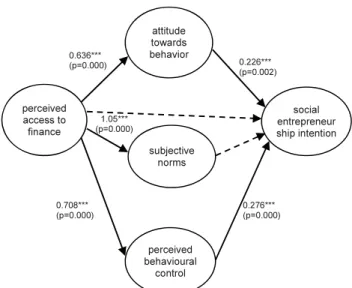
tude towards d the relations cial entrepren sitive (0.226, p wards behavio ween perce repreneurship The second m cess to finan bjective norms re is no signifi d social entrep rms as the med d entrepreneu rceived behav cess to finan rceived behav same time w sitively enhan
76 (p=0.000)
ts of the mod relationships ructural model 2, TLI is 0.98, 0.068. The r the latent co ificantly asso eurship inten erceived beha
positive effect ell (0.276, p=
ms has a intention, but ce suggesting ehavioral cont ated with socia
accepted and ship between preneurship int ct is not sign ediating effect al entrepreneu diator is attitu ween perceiv
behavior is hip between a eurship inten p=0.002). The or significantly
ived access intention.
mediator is s ce significant at 1.05 (p=0.0 cant relations preneurship in
diator between urial intention ioral control is ce significant ioral control a which, at the nces social e
el are presen s between l also offers a
Cmin/df is 1.8 result of the onstruct of a
ciated with th ntion (0.226, avioral contro t on social e
=0.000). The positive effe t it is not sign attitude towar rol and subjec al entrepreneu d H2 is rejecte perceived ac tention. The re nificant. H4 i
between perc urship intention ude towards ved access t
significant (0 attitude toward ntion is also e result sugge
y mediates t s to finance
subjective no tly and posit 000), which, a hip between s ntention (p=0.8
n perceived ac n do not re s the last med
tly and posit at 0.708 (p=0
same time, s entrepreneursh
ted in Figure constructs a good model f 875 and RMSE SEM analys attitude towar
he construct p=0.002). Th ol also has entrepreneursh e dimension ect on soc nificant. Overa rds the behavi ctive norms a rship intention ed. H4 examin ccess to financ
esult shows th is rejected. H ceived access n.
behavior. Th to finance an .636, p=0.000 ds behavior an significant an ests that attitud the relationsh e and soc
rms. Perceive tively increase at the same tim subjective norm 863). Subjectiv ccess to finan eceive suppo diator. Perceive
tively increase .000), which, significantly an hip intention
3.
are fit, EA sis ds of he a hip of cial all, ior, are n.
es ce hat H5 to
he nd 0), nd nd de hip cial
ed es me, ms
ve ce ort.
ed
es
at
nd
at
subjective norms
0.276***
(p=0.000) 0.708***
(p=0.000) 1.05***
(p=0.000) 0.636***
(p=0.000) 0.226***
(p=0.002)
perceived access to finance
attitude towards behavior
social entrepreneur ship intention
perceived behavioural
control
Notes: CMIN/DF =1.875, CFI=0.92, RMSEA=0.068 and TLI=0.98.
***p<0.001
Figure 3. Direct and mediator effects on entrepreneurial intention
When establishing mediation effect, it is necessary to evaluate the direct link between perceived access to finance and social entrepreneurship intention without mediators (Baron & Kenny, 1986). A simple regression analysis between perceived access to finance and social entrepreneurship intention was thus conducted. The result shows perceived access to finance significantly increases social entrepreneurship intention, where the standardized coefficient is 0.658 with p= 0.000. However, the significant impact disappears when mediators are included in the model. This result is also reflected in the structural model (see Figure 3).
Therefore, there is evidence suggestion the effect between perceived access to finance and social entrepreneurship intention has been mediated through determinants of planned behavior. It is also important to evaluate the model fit without perceived access to finance.
Although the integrated model combining three planned behavior and perceived access to finance, where the CMIN/DF =1.875, CFI=0.92, RMSEA=0.068 and TLI=0.98, it is prudent to investigate the additional model without it. A follow-up test is being conducted, which examines planned behavior model alone. The fit indexes of the planned behavior model show that RMSEA is 0.109, CMIN/df is 3.292, CFI is 0.839 and TLI is 0.808. The indexes present a poorer fit than the integrated model. The integrated model thus provides a better analysis than planned behavior model.
Perceived access to finance is an important part of the analysis of entrepreneurial intention.
Overall, there is evidence suggesting that determinants of planned behavior model mediate the relationship between perceived access to finance and social entrepreneurial intention. H5 receives support. To sum up, the results support H1, H3 and H4 with the significant relationships presented in Table 3. That is, determinants of planned behavior predict social entrepreneurship intention.
Table 3. Results of the integrating mode
Explanatory variables Significant results H1 Attitude towards behavior 0.226 (p=0.002)
H2 Subjective norms Rejected
H3 Perceived behavioural control 0.276 (p=0.000) H4 Perceived access to finance Rejected
H5
Perceived access to finance through
attitude towards behavior 0.636 (p=0.000) Perceived access to finance through
subjective norms 1.05 (p=0.000)
Perceived access to finance through
perceived behavioural control 0.708 (p=0.000)