신평장림 공단 폐수처리장 발생의 악취 조사연구
손현근·
Subpiramaniyam Sivakumar
†· 윤영훈*고신대학교 보건환경학부, *한국환경산업기술원 녹색기술개발실
Survey on Public Responses to Odor Produced at Jangrim-Sinpyoeng Municipal and Industrial Wastewater Treatment Plant in Busan
Hyun-Keun Son, Subpiramaniyam Sivakumar
†, and Young Hun Yoon
*Department of Health and Environment, Kosin University, Busan, Korea
*
Green Technology Development Office, Korea Environmental Industry and Technology Institute, Seoul, Korea
ABSTRACT
Objective: Emissions of volatile organic compounds (VOCs) from municipal wastewater treatment plants and industrial wastewater are often overlooked as sources of exposure to toxic chemicals. VOCs from such sources evaporate readily into the air and may have significantly adverse impacts on public health. The present study aimed to establish the concentration of VOCs released from Jangrim-sinpyoeng Municipal and Industrial Wastewater Treatment plant (JWTP) in Busan, South Korea and assess the causes of the odor/stench in the surrounding residential facilities. Stench intensity, frequency and release time, and wind direction were also monitored.
Methods: Onsite data were collected on a daily basis from a laboratory located on the JWTP premises through a period spanning 2006 to 2010. A second set of data was obtained in 2006 by conducting a questionnaire survey with 210 respondents living near JWTP. The experimental and survey data were analysed statistically using the SPSS package.
Results: The survey results showed that people residing around JWTP strongly perceive a stench from the plant. The intensity of the stench was influenced significantly by wind direction and the location of the apartments facing the JWTP. Public participation formed a significant step in determining the quality of the study environment.
Conclusion: Onsite data and survey data obtained in 2006 indicate that the nature of the odor experienced by residents is due to the intensity of total VOCs released by JWTP. However, additional research is needed to determine the effects of the VOC pollution on public health and quality of life.
Key words: Volatile organic compounds, Wastewater, Odor, Stench, VOCs I. Introduction
Various domestic and industrial activities result in the production of industrial and municipal wastes which then act as emission sources of hazardous substances.
1)Decomposition of these municipal
and industrial wastes results in the release of odor into the surrounding air thus impacting residentials.
2-6)Odor nuisances are becoming more frequent because of urbanization and the consequent location of treatment sites near residential places.
7)Efforts to reduce emissions are very limited since protests
†
Corresponding author: Department of Health and Environment, Kosin University, Busan 606-701, Korea, Tel:+82-10-8108-4978, Fax: +82-51-911-2514, E-mail: [email protected]
Received: 16 March 2011, Revised: 18 May 2011, Accepted: 17 June 2011
from people perceiving the odor is also very limited.
8)Odor is a sensation caused by odorant molecules in the air. Odor perception is the result of reaction between volatile molecules inhaled through the air by the human nose and olfactory sensory neurons situated in the upper parts of the nasal cavity in man.
8)Pilpel
et al.9)described the transduction mechanisms involved in the stimulus generation at a molecular level in humans. The degree of odor perception by humans is determined by several factors such as individual physiology, individual perception of smell and interaction with factors such as physiology, weather phenomena, and various other odors
10-12)Estimation of odor intensity using instrumental techniques have been reported.
13,14)Similar studies were carried out in swine farms in upper mid West USA.
15)According to analysis of ambient odors from air samples collected from feeding yards, pen yards, and a wastewater storage site in USA, such odors were dominated by hydrogen sulphides and ammonia, in excess of EPA guideline levels. Lim
et al.15)found that the intensity of stench/odor in the study area was significantly influenced by the direction of the wind.
Volatile organic compounds (VOCs) are known to produce the widest range of odors in the air
16)with their inorganic counterparts like hydrogen sulfide and ammonia. Generally, odor is perceived physically by the nose receptors and psychologically processed in the brain, thus rendering it difficult for quantitative measurements. Odor perception is personal and is confounded by a number of factors such as gender, age, state of health and individual effects which is why people may not be bothered by odors from their own bodies.
Wind speed and direction can exert a direct effect on the dispersion of odorous compounds.
17)High speed winds will spread the odor rapidly, thereby diluting its intensity over a wider area under the low wind speed conditions; the odor is close to the ground, thereby strengthening its intensity. The specific weight/density of the odorant molecule will also influence its dispersion by wind. As heavy odors stay close to the ground they can be detected more easily by humans.
During decomposition of organic waste (such as sewage), 80 to 200 different gases are produced.
18)A combination of several gases together can
produce odors either higher intensity or lower intensity than the individual gases.
18,19)Studies on Creeks that acted as open sewers carrying wastewater from industry and residential areas in Izmir city in Turkey revealed that volatile sulphur compounds caused most of the odor.
20)A similar study, on the effects of exposure to biosolids used on farms in Wood County in Ohio, USA, reported that health hazards were significantly elevated among the residents.
21)The symptoms reported included increased secretion of tears, abdominal bloating, jaundice, skin ulcers, dehydration, weight loss and general body weakness. The report also showed increased cases of bronchitis, upper respiratory infection and giardiasis.
22)Little information is available on the relationship between odor and human, as most studies emphasize the effect of individual gases like ammonia rather than the odor as a whole.
18)The aim of this research was 1) to establish if the Jangrim-Sinpyoeng Municipal and Industrial Wastewater Treatment Plant (JWTP) in Busan City release any bad odor and 2) if they are released, how serious it will be on the local residents. It was also intended to assess the possible management practices to mitigate the effects.
II. Materials and Methods
1. Data from onsite laboratory
The 5 years data (2006 to 2010) in this study was collected from two major sources. The first form of the data with different chemical parameters were obtained from the onsite laboratory at the Jangrim-Sinpyoeng area in Busan city (035
o04' 51''N and 128
o58' 18''E), which was maintained by the Korea Institute of Public Health and Environment.
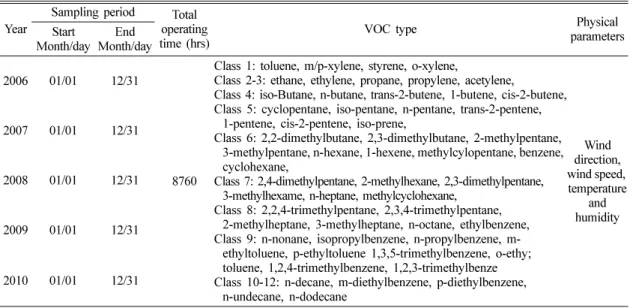
The detailed information about the data collection of chemical and physical parameters is given in Table 1. The sampling was done every hours by the instrument installed at the onsite laboratory was online gas chromatography – flame ionization detector (GC-FID) for the analysis of VOC sub- stances. All data were calculated to average ppm per day. All the VOC compounds were computed as prescribed by Son and Striebig
7)(2003) (Table 1). Also, the release of odor substances was correlated with wind direction and speed.
The stench/odor intensity (Y) data for all VOC
Table 1. Sampling period and parameters of interest on onsite data Year Sampling period Total
operating
time (hrs) VOC type Physical
parameters Start
Month/day End Month/day
2006 01/01 12/31
8760
Class 1: toluene, m/p-xylene, styrene, o-xylene,
Class 2-3: ethane, ethylene, propane, propylene, acetylene, Class 4: iso-Butane, n-butane, trans-2-butene, 1-butene, cis-2-butene, Class 5: cyclopentane, iso-pentane, n-pentane, trans-2-pentene,
1-pentene, cis-2-pentene, iso-prene,
Class 6: 2,2-dimethylbutane, 2,3-dimethylbutane, 2-methylpentane, 3-methylpentane, n-hexane, 1-hexene, methylcylopentane, benzene, cyclohexane,
Class 7: 2,4-dimethylpentane, 2-methylhexane, 2,3-dimethylpentane, 3-methylhexame, n-heptane, methylcyclohexane,
Class 8: 2,2,4-trimethylpentane, 2,3,4-trimethylpentane, 2-methylheptane, 3-methylheptane, n-octane, ethylbenzene, Class 9: n-nonane, isopropylbenzene, n-propylbenzene, m-
ethyltoluene, p-ethyltoluene 1,3,5-trimethylbenzene, o-ethy;
toluene, 1,2,4-trimethylbenzene, 1,2,3-trimethylbenze Class 10-12: n-decane, m-diethylbenzene, p-diethylbenzene,
n-undecane, n-dodecane
Wind direction, wind speed, temperature humidity and
2007 01/01 12/31
2008 01/01 12/31
2009 01/01 12/31
2010 01/01 12/31
Table 2. Variables included in the questionnaire
Sl. No. Variables Value
1. Sex Male (1), Female (2)
2. Age >20 (1), 21-30 (2), 31-40 (3), 41-50 (4), 51-60 and above (5)
3. Living area Dongwon royal (1), Jangrim-dong (2), Business area (3), working area (4), others (5) 4. Frequency Every day (1), 4-5 times per day (2), 2-3 times per day (3), weekly once (4), 1 or 2 days
(5), does not occur (6)
5. Responses about smell Every day (1), 4-5 times per day (2), 2-3 times per day (3), weekly once (4), 1 or 2 days (5), does not occur (6)
6. Happening time 6-12 am (1), 12-18 pm (2), 12-24 pm (3), 0-6 am (4), irregular (5)
7. Duration of happening One or more days per week (1), less then one day bur more than 1 hr (2), less than 1 hr but more than 15 min (3), less than 15 minutes (4), not feel any odor (5), does not occur 8. Wind direction East (1), west (2), south (3), north (4), northwest (5), southwest (6), northeast (7),
southeast (8)
9. Displeasure level Not at all unpleasant (1), Almost does not offend (2), yes I just (3), somewhat Offensive (4), very offensive (5)
10. Seriousness Not at all serious (1), almost no serious (2), serious (3), less seriousness (4), very seriousness (5)
11. Living environment Very satisfied (1), somewhat satisfied (2), usual (3), somewhat dissatisfied (4), very dissatisfied (5)
12. Air environment Very satisfied (1), somewhat satisfied (2), usual (3), somewhat dissatisfied (4), very dissatisfied (5)
13. Who’s responsibility to
protect the environment Municipal corporation (1), NGOs (2), Media (3), Residents (4), factories (5), Others (6) 14. Regulation status Very weak (1), slightly weak (2), keep current (3), slightly enhanced (4), much enhanced (6) 15. Way of handling by the
environmental protection authority
Very satisfied (1), satisfied (2), usual (3), some dissatisfied (4), very dissatisfied (5) 16. Involvement of local
residents to protect the environment
Do not participate (1), depends on the situation (2), active participation (3)
substances were calculated from the following formulae,
Y = [a
×Log (X) + b]
1+ [a
×Log (X) + b]
2+ …..[a
×Log (X) + b]
nX: headspace in ppm, a and b: threshold level in ppm, Y: higher than fixed ppm level based on smell)
2. Data from questionnaire
The second source of data was surveyed in the year 2006 from individuals living around JWTP area. Two types of respondents were selected, one category was native residents (experimental group) and other was floating population (control group), working in that area for a long time. Totally 210 residents were interviewed
23,24)(Table 2). The questionnaire data were correlated using the statistical package for social sciences (SPSS 12.1).
III. Results
1. Onsite laboratory analysis
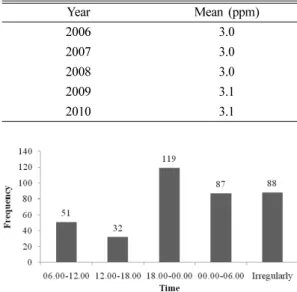
The summary of the concentration data for the VOC substances in air is shown in Table 3. VOC concentrations in the air varied widely in the measuring site with an overall range from less than1 ppm to >9 ppm (Table 3) with a mean of 3.0 to 3.1 ppm (Table 4). Data clearly show that the maximum intensity of total VOCs released every year (2006 to 2010) into the air was >9 ppm (Table 3). At >9 ppm, the highest duration of VOC release (400 and 360 hrs) was observed in
Table 3. Annual VOC intensity level Intensity
level (ppm)
2006 2007 2008 2009 2010
Time
(hours) %* Time
(hours) %* Time
(hours) %* Time
(hours) %* Time
(hours) %*
> 1 8595 98.1 8592 98.1 6792 77.3 7056 80.5 7015 80.1
> 2 4677 53.9 4680 53.4 5016 57.1 5184 59.2 5281 60.3
> 3 3301 37.7 3312 37.8 3696 42.1 3384 38.6 3655 41.7
> 4 2326 26.5 2376 27.1 2616 29.8 2352 26.8 2214 26.5
> 5 1739 19.8 1728 19.7 1608 18.3 1704 19.5 1672 19.1
> 6 1255 14.3 1248 14.2 1008 11.5 1152 13.2 1456 16.6
> 7 857 9.8 864 9.9 528 6.0 648 7.4 1264 14.4
> 8 560 6.4 600 6.8 264 3.0 384 4.4 386 4.4
> 9 400 4.6 360 4.1 168 1.9 216 2.5 272 3.1
* % = (total hours released / hours per year) × 100
Table 4. Annual mean values of VOC’s released from Jangrim-Sinpyoeng Municipal and Industrial Wastewater Treatment Plant, Busan
Year Mean (ppm)
2006 3.0
2007 3.0
2008 3.0
2009 3.1
2010 3.1
Fig. 1. Frequency of odor in different time period.
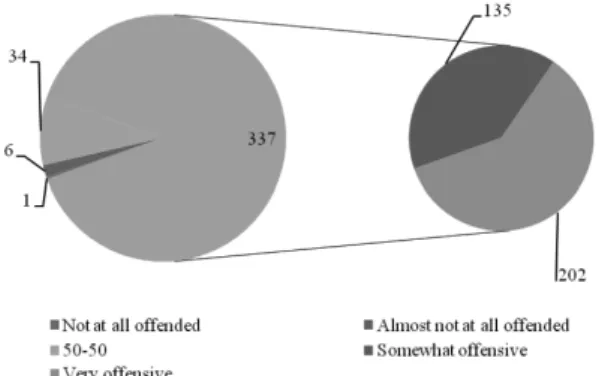
Fig. 2. Resident responses about the industrial stench.
the year 2006 and 2007 (Table 3). At above 1 ppm level, the highest duration occurred in the year 2006 (8595 hrs) and 2007 (8592 hrs).
2. Responses to questionnaire