ORIGINAL ARTICLE
Polysulfone으로 carbon nanotubes (CNT)와 di-(2-ethylhexyl) -phosphoric acid (D2EHPA)를 고정화한 PSf/D2EHPA/CNT 비드에 의한 Cu(II)의 제거특성
이창한
1)
이민규*
부경대학교 화학공학과, 1) 부산가톨릭대학교 환경행정학과
Removal Characteristics of Cu(II) by PSf/D2EHPA/CNT Beads Prepared by Immobilization of Carbon Nanotubes (CNT) and Di-(2-ethylhexyl)-phosphoric acid (D2EHPA) on Polysulfone (PSf)
Chang-Han Lee
1)
, Min-Gyu Lee*
Department of Chemical Engineering, Pukyong National University, Busan 48513, Korea
1) Department of Environmental Adminstration, Catholic University of Pusan, Busan 46252, Korea
Abstract
PSf/D2EHPA/CNT beads were prepared by immobilizing di-(2-ethylhexyl)-phosphoric acid (D2EHPA) and carbon nanotubes (CNT) on polysulfone (PSf) and used to remove Cu(II) from aqueous solutions. Optimum pH was in the range of 4 to 6. The removal kinetic of Cu(II) by the prepared PSf/D2EHPA/CNT beads was mainly governed by internal diffusion, and the diffusion coefficient of Cu(II) by PSf/D2EHPA/CNT beads was found to be 2.19×10 -4 ∼2.64×10 -4 cm 2 /s. The Langmuir isotherm model predicted the experimented data well. The maximum removal capacity of Cu(II) obtained from this isotherm was 7.32 mg/g. Calculated thermodynamic parameters such as ΔG o , ΔH o and ΔS o showed that the adsorption of Cu(II) ions onto PSf/D2EHPA/CNT beads was feasible, spontaneous and endothermic at 293–323 K.
Key words : Carbon nanotube (CNT), D2EHPA, Polysulfone, Immobilization, Copper ion
1)
1. 서 론Cu(II)는 전기공업, 운송업, 산업장비 그리고 군용 물품 등에서 많이 사용되고 있으며, Cu(II)가 함유된 산업폐수는 수중에 심각한 오염을 유발시킬 뿐만 아 니라 인체에 지속적으로 노출되면 암과 같은 질병을 유발하는 것으로 알려져 있다(Yu et al., 2000).
수중에 Cu(II)와 같은 금속 이온을 제거하기 위하 여 액-액 추출(Arslan et al., 2009)을 이용한 방법이 주 로 연구되고 있다. 액-액 추출법은 수중 금속이온에 대해 높은 선택성을 가지고 있으며, 공정이 간단하여 금속 이온을 제거하는데 사용되고 있다(Yang et al., 2005). 금속 이온을 제거하기 위하여 사용되고 있는 추출제로는 tri-n-octylphosphine oxide(Hac-Wydro et
Received 1 August, 2016; Revised 19 September, 2016;
Accepted 30 September, 2016
* Corresponding author : Min-Gyu Lee, Department of Chemical Engineering, Pukyong National University, Busan 48513, Korea Phone: +82-51-629-6435
E-mail: [email protected]
ⓒ The Korean Environmental Sciences Society. All rights reserved.
This is an Open-Access article distributed under the terms of the Creative Commons Attribution Non-Commercial License (http://
creativecommons.org/licenses/by-nc/3.0) which permits unrestricted
non-commercial use, distribution, and reproduction in any medium,
provided the original work is properly cited.
al., 2008), tri-n-butyl phosphate(Seyfi and Abdi, 2009), Cyanex 921(Mishra and Devi, 2011) 등이 사 용되고 있으며, 추출제 중 di-(2-ethylhexyl)phosphoric acid(D2EHPA)는 유기 인계 추출제로써 수중의 Cu(II), Zn(II), Pb(II), Cd(II) 등의 중금속 이온을 제거 하는데 높은 효율과 선택성을 가지는 것으로 알려져 있다(Belkhouche et al., 2005; Ren et al., 2007). 그러 나 액-액 추출법은 많은 양의 유기용매가 사용되며, 유기용매의 손실로 인해 수중에 오염을 일으킬 수 있 다(Ochoa et al., 2006).
Yang et al.(2004)은 추출제 D2EHPA를 고분자 물 질 polysulfone (PSf)로 고정화하여 크기가 80 인 마 이크로캡슐로 제조 가능하였다고 하였으며, 제조한 PSf/D2EHPA 마이크로캡슐로 Cu(II)의 제거가 가능 하다고 하였다. Ciopec et al.(2011)은 PSf 내에 D2EHPA를 고정화한 PSf/D2EHPA 마이크로캡슐을 제조하였으며, Cu(II)의 제거량이 2.8 mg/g이었다고 하였다. 본 연구자들은 선행연구(Kam et al., 2014)에 서 PSf를 사용하여 추출제인 D2EHPA를 고정화하여 크기가 2.5 mm인 비드를 제조하였으며, 제조한 PSf/D2EHPA 비드에 의한 Cu(II)의 제거량은 2.58 mg/g이었다.
최근에는 탄소 물질중의 하나인 carbon nanotube (CNT)에 대한 연구가 주목받고 있다(Sitko et al., 2012). CNT는 분산성이 우수하고, 그라핀 시트에 탄 소원자가 육각형 배열을 이루고 있어 Pb(II)(Li et al., 2005), Ni(II)(Chen and Wang, 2006), Cu(II)(Wu, 2007) 및 Cd(II) 이온(Li et al., 2003)과 같은 중금속을 제거하는 데 있어서 잠재력을 가진 새로운 흡착제로 인식되고 있다. 그러나 CNT는 미세 분말상으로 되어 있기 때문에 흡착 공정 후 처리수에서 CNT 분말을 제 거 또는 회수가 용이하지 않으며, Tofighy and Mohammadi(2010)는 CNT가 환경에 유출되게 되면 건강과 환경에 심각한 위험을 초래할 수 있기 때문에 CNT가 누출되지 않는 처리방안이 필요하다고 하였 다. 따라서 이러한 문제를 해결하기 위한 방안으로 본 연구에서는 PSf로 D2EHPA와 CNT를 고정화한 비드 를 사용하여 Cu(II)의 제거특성을 검토하였다. 그리고 등온실험자료를 Langmuir 등온식에 적용하여 검토하 였으며, 시간에 따른 Cu(II)의 제거속도는 Weber와
Morris 모델식을 적용하여 고찰하고 확산계수를 계산 하였다. 또한 온도변화에 따른 제거특성을 조사하고 열역학적 해석을 수행하였으며, pH 변화에 따른 영향 을 살펴보았다.
2. 실험재료 및 방법
2.1. PSf/D2EHPA/CNT 비드의 제조
PSf/D2EHPA/CNT 비드의 제조는 100 mL 비커에 1-Methyl-2-pyrrolidone(NMP, Samchun, EP) 17 mL 와 Polysulfone(PSf, Sigma-aldrich) 2.125 g을 넣고 용해시킨 후 D2EHPA(IS Chemical Co. Ltd., >95%) 2 mL와 CNT(Carbon nano-material Technology Co., Korea) 0.6 g을 넣어 균일하게 혼합되도록 충분히 교 반하였다. 혼합된 슬러리는 직경이 1 mm인 주사기를 사용해 증류수와 에탄올 혼합액에 떨어뜨려 PSf/
D2EHPA/CNT를 제조하였다. 제조한 PSf/D2EHPA/
CNT 비드는 증류수로 수차례 세척하여 사용하였다.
2.2. 실험 방법
Cu(II) 용액은 CuSO
4
·5H2
O(Junsei, EP)를 증류수 에 녹여 1,000 mg/L의 모액을 제조하여 사용하였다.Cu(II)의 제거 실험은 회분식으로 수행하였으며, 250 mL 삼각플라스크에 Cu(II) 용액 100 mL와 PSf/
D2EHPA/CNT 비드 5 g을 넣고 수평 진탕기 (Johnsaem Co., Js-Fs-2500)를 사용하여 170 rpm으로 교반하면서 일정 시간 간격으로 시료를 채취하였다.
Cu(II) 이온의 농도는 원자흡광광도계(Shimadzu.
AA-7000)를 사용하여 분석하였으며, Cu(II) 이온의 제거량은 식 (1)을 사용하여 구하였다.
(1) 여기서, C
i
는 초기 농도(mg/L), Ct
는 시간 t에서 농도(mg/L), V는 용액의 부피(L), W은 비드의 양(g) 이다.그리고 분배 계수 K
D
는 다음과 같다.
×
(2)
여기서, C
e
는 평형 농도(mg/L)이다.pH
1 2 3 4 5 6 7
R e m o v a l ef fi c ienc y , %
0 20 40 60 80 100
E qui libr iu m pH
0 2 4 6 8
Removal efficiency Equilibrium pH
t, min
0 15 30 45 60 75 90
q
t, m g /g
0 2 4 6 8
25 mg/L 50 mg/L 75 mg/L 100 mg/L
150 mg/L 200 mg/L 300 mg/L
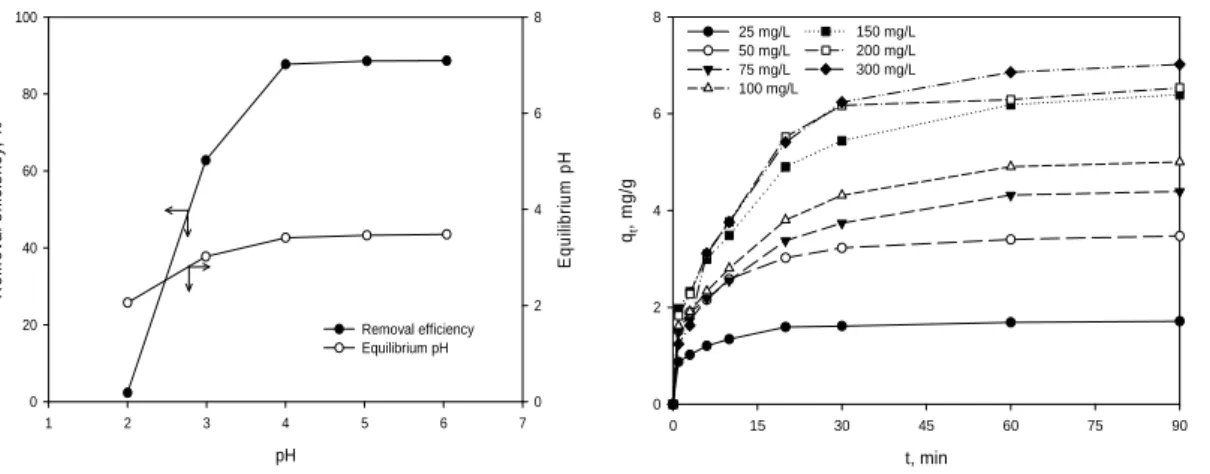
Fig. 1. Effect of pH on the Cu(II) removal by PSf/
D2EHPA/CNT beads (initial concentration = 20 mg/L, PSf/D2EHPA/CNT beads = 5.0 g/0.1 L, temperature = 293 K).
Fig. 2. Effect of contact time on the Cu(II) removal at different initial Cu(II) concentrations (PSf/D2EHPA /CNT beads = 10.0 g/0.2 L, initial pH = 5.2, temperature = 293 K).
3. 실험결과
3.1. pH의 영향
일반적으로 Cu(II)는 pH 6 이하에서는 Cu
2+
가 자유 이온의 상태로 존재하지만 pH가 높아짐에 따라 Cu(OH)-
형태의 착이온과 Cu(OH)2
, Cu(OH)3 -
, Cu(OH)4 2-
와 같은 수화물형태로 존재한다(You et al., 2014). 따라서 본 연구에서는 Cu
2+
가 자유이온의 상태 로 존재하는 pH 6 이하에서 실험을 수행하였다. Fig.1은 pH 변화가 Cu(II)의 제거효율에 미치는 영향을 알아보기 위하여 Cu(II)용액의 초기농도를 20 mg/L 로 일정하게 하고서 pH를 2 6으로 조절하여 실험을 행한 결과를 나타낸 것이다. 그림에서 보는 바와 같이 pH가 4 이하에서는 Cu(II)의 제거효율이 크게 감소하 지만, pH가 4 6 사이의 범위에서는 안정적인 제거효 율을 보였다. 이는 pH가 감소함에 따라 수소 이온과 Cu(II)의 경쟁으로 인해 제거효율이 낮아지는 것으로 생각되었다(Vellaichamy and Palanivelu, 2011). 한편 초기 pH에 따른 평형 pH 변화를 살펴보면 Cu(II) 용 액의 초기 pH가 4이하에서는 평형 pH가 초기 pH와 비슷하였으며, 초기 pH가 5 6에서는 평형 pH가 3.6
3.8정도로 감소하는 것으로 나타났다. 이는 산성 추 출제인 D2EHPA에 의한 Cu(II) 제거는 D2EHPA의 H
+
와 Cu(II) 사이의 이온교환에 의해 일어나며(Belkhouche et al., 2005), 이로 인해 수중에 H
+
의 농 도가 증가하기 때문에 초기 pH가 감소하는 것으로 사 료되었다. 또한, 선행 연구(Kam et al., 2014)에서 제 시한 Visual MINTEQ(Ver 3.0)를 이용한 수용액 pH 와 Cu(II) 이온종 분포의 관계와 본 연구결과를 비교 해 보면, pH가 4 6일 때 Cu2+
와 Cu(OH)+
가 공존하 지만 pH 5.5 지점까지 대부분 Cu2+
이온으로 존재하 기 때문에 수화물에 의한 침전효과를 배제할 수 있어 PSf/D2EHPA/CNT 비드의 의한 Cu(II) 제거효율이 높은 pH 5.2를 최적조건으로 판단하였다.3.2. 시간에 따른 영향
Fig. 2는 초기 농도를 25 300 mg/L로 달리한 경우 에 시간에 따른 Cu(II)의 흡착량의 변화를 나타낸 것 이다. PSF/D2EHPA/CNT 비드에 의한 Cu(II) 흡착은 30 min 까지는 흡착량이 급격하게 증가하지만, 그 이 후에는 Cu(II)의 흡착량이 더 이상 증가하지 않으며, 60 min 이후에는 평형에 도달하는 것으로 나타났다.
이러한 현상은 초기 단계에서는 PSf/D2EHPA/CNT 비드 내의 D2EHPA와 CNT의 많은 활성점이 비어 있 어 쉽게 흡착이 일어나지만, 시간이 경과함에 따라 비 어있는 활성점이 채워지게 되어 Cu(II)와 PSf/
D2EHPA/CNT 비드 사이의 물질전달 구동력이 감소 하기 때문으로 생각된다.
3.3. 속도식
PSf/D2EHPA/CNT 비드에 의한 Cu(II)의 제거속 도는 Weber와 Morris 모델식을 적용하여 검토하였다.
(3)여기서 k
d
는 내부입자 확산속도상수(mg/g min1/2
) 이다.Fig. 3은 Fig. 2의 결과를 식 (3)에 적용하여 나타낸 것이다. 그림에서 보는 바와 같이 첫 번째 직선 구간 (t
1/2
<4.5 min1/2
의 직선 영역)에서는 외부물질전달이 일어나며, 이 후의 두 번째 직선 구간(t1/2
>4.5 min1/2
의 직선 영역)에서는 내부 확산에 의해 진행된다는 것을 나타낸다. 첫 번째 직선구간으로부터 얻은 속도상수 는 0.42 mg/g·min1/2
1.25 mg/g·min1/2
인데 비해 두 번째 직선 구간에서의 속도상수는 0.03 mg/g·min1/2
0.30 mg/g·min1/2
로 두 번째 구간의 속도상수가 약 1.540배 정도로 낮은 값을 나타내었다. 이는 PSf /D2EHPA/CNT 비드에 의한 Cu(II)의 제거가 내부입 자확산보다 외부물질전달이 빠르게 일어나며, Cu(II) 의 제거속도는 내부 확산단계에 의해 지배되는 것으 로 생각된다.
t
1/2, min
1/20 2 4 6 8 10
q
t, m g /g
0 2 4 6 8
25 mg/L 50 mg/L 75 mg/L 100 mg/L 150 mg/L 200 mg/L 300 mg/L
Fig. 3. Plots of q t vs t 1/2 for the Cu(II) removal by PSf/
D2EHPA/CNT beads.
따라서 PSF/D2EHPA/CNT 비드에 의한 Cu(II)의 내부 확산계수를 구하기 위하여 다음의 식을 사용하
였다(Naiya et al., 2008).
exp
(4)여기서 D
e
는 확산계수(cm2
/min), r은 비드의 입자 반경(cm), F는 시간 t에서 제거량(qt
)과 평형 제거량 (qe
)의 비이다.식 (4)는 다음과 같이 나타낼 수 있다.
ln
(5)식 (5)에 의거하여 구한 확산계수 D
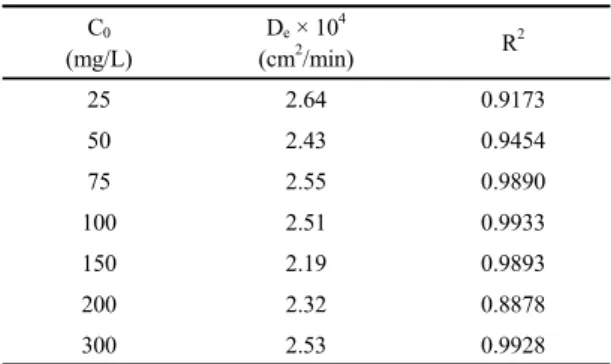
e
값을 Table 1 에 나타내었다. Table 1에서 보는 바와 같이 PSf/D2EHPA/CNT 비드에 의한 Cu(II)의 확산계수는 2.19×10⁻⁴
2.64×10⁻⁴
cm2
/min로 구해졌다. Kam et al.(2014)이 PSf-D2EHPA 비드로 Cu(II)를 제거하는 경우에 Cu(II)의 확산계수 값은 1.32×10⁻⁴
3.98×10⁻⁴
cm2
/min으로써 본 연구에서 Cu(II)의 확산계수와 유 사한 값을 보였다.Table 1. Kinetic data calculated for the Cu(II) removal by PSf/D2EHPA/CNT beads
C 0
(mg/L)
D e × 10 4
(cm 2 /min) R 2
25 2.64 0.9173
50 2.43 0.9454
75 2.55 0.9890
100 2.51 0.9933
150 2.19 0.9893
200 2.32 0.8878
300 2.53 0.9928
3.4. 등온식
Cu(II)의 초기농도(C
0
)를 25 ~ 300 mg/L으로 조절 하고 흡착평형시간은 60 min으로 고정한 조건에서 PSf/D2EHPA/CNT 비드에 의한 Cu(II)의 평형실험 결과로부터 Langmuir 등온식에 적용하여 검토하 였다.Langmuir 등온식은 다음과 같다.
Sorbents q m
(mg/g) pH Temp.
( ) Reference
PSf/D2EHPA microcapsule 2.80 5 25 Ciopec et al.(2011)
PSf/D2EHPA beads 2.58 5 20 Kam et al.(2014)
TOPO/D2EHPA/MWCNT mixture 4.78 5 25 Vellaichamy and Palanivelu(2011)
Chitosan/poly(vinyl) alcohol thin adsorptive membranes modified amino functionalized MWCNTs
11.1 5.5 30 Salehia et al.(2012)
PSf/D2EHPA/CNT beads 8.87 5.2 25 In this study
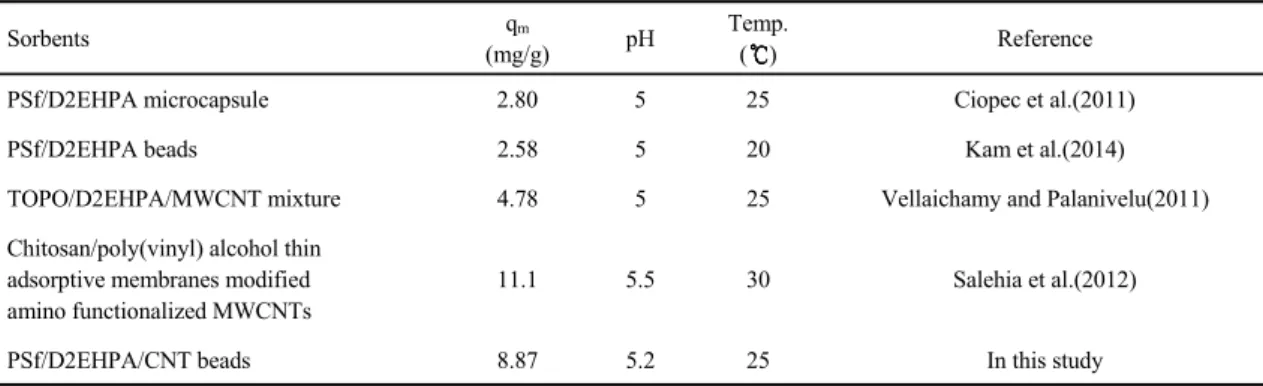
Table 2. Comparison of PSf/D2EHPA/CNT beads and other typical sorbents for Cu(II) removal
(6)
여기서 q
m
은 최대 제거량(mg/g), kL
는 Langmuir 상 수(L/mg)이다.Fig. 4는 등온실험결과에서 얻은 Cu(II)의 평형 농 도와 평형 제거량의 관계를 나타낸 것이며, 실선은 식 (6)에 의거하여 계산한 결과를 나타낸 것이다. 실험 자 료를 Langmuir 식에 적용한 경우에 결정계수(R
2
) 값 은 0.988 0.998로 Langmuir 등온식에 잘 부합하였 다. 그리고 용액의 온도가 293 K, 308 K 및 323 K으 로 증가함에 따라 Cu(II)의 최대 제거량은 각각 7.32 mg/g 및 8.87 mg/g 및 10.35 mg/g으로 증가하는 것으 로 나타났다. Table 2에 나타낸 것과 같이 PSf/D2EHPA/CNT 비드에 의한 Cu(II)의 흡착량은 PSf/D2EHPA 및 CNT를 이용한 흡착제와 비교하였 을 때 다른 연구결과와 유사하거나 약간 높은 결과를 나타내었다. Ciopec et al.(2011)은 PSf-D2EHPA 마 이크로캡슐을 사용하여 Cu(II)를 제거한 경우에 Cu(II)의 최대 제거량이 2.8 mg/g이었고, Kam et al.(2014)이 PSf-D2EHPA 비드를 사용한 경우에 Cu(II)의 최대 제거량은 2.58 mg/g으로써 본 연구에 서 제조한 PSf/D2EHPA/CNT 비드를 사용한 경우에 Cu(II)의 최대 제거량이 약 3배 높게 나타났다. 따라서 PSf로 추출제 D2EHPA만을 고정화한 마이크로캡슐 이나 비드를 사용한 경우보다 CNT를 첨가한 PSf/D2EHPA/CNT 비드의 경우에 Cu(II)의 제거량이 향상되는 결과를 보였다.C
e, mg/L
0 30 60 90 120 150 180 210 240 270
q
e, m g /g
0 2 4 6 8 10 12
293K 308K 323K Langmuir
R
2= 0.988 R
2= 0.997 R
2= 0.998
Fig. 4. Langmuir isotherm for the Cu(II) removal at different temperatures (PSf/D2EHPA/CNT beads = 5.0 g/0.1 L, initial pH = 5.2).
3.5. 열역학적 해석
열역학적 파라미터인 엔탈피( H
o
)와 엔트로피(S
o
)는 다음과 같은 관계를 갖는다.ln
∆
∆
(7)
여기서 T는 절대 온도(K), K
D
은 분배계수, R은 이 상기체 상수(kJ/mol·K)이다.그리고 Gibbs 자유에너지( G
o
)는 다음과 같다.∆
∆
∆
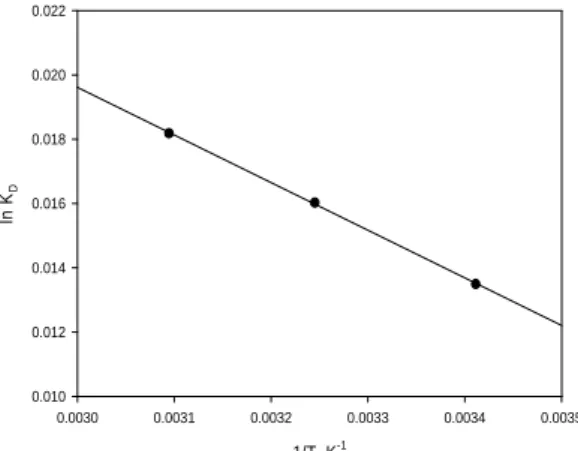
(8) Fig. 5는 1/T에 대해 lnKD
를 도시한 것이며, 이로부터H o (kJ/mol) S o (J/mol K) G o (kJ/mol)
293 K 308 K 323 K
6.71 32.70 -3.03 -3.52 -4.01
Table 3. Thermodynamic parameters for the Cu(II) removal by PSf/D2EHPA/CNT beads
구한 열역학적 파라미터 값들을 Table 3에 나타내었 다. 표에서 보는 바와 같이 Cu(II)의 경우에 H
o
와 Go
값은 각각 6.71 kJ/mol 및 -4.01 -3.03 kJ/mol로써 제거 과정이 흡열반응이고 자발적으로 일어나는 것을 의미한다. 또한 So
가 32.70 J/mol·K로 양의 값을 가 지는 것은 PSf/CNT/D2EHPA 비드에 대한 Cu(II)의 친 화도가 좋다는 것을 말해준다(Senthilkumaar et al., 2006).1/T, K
-10.0030 0.0031 0.0032 0.0033 0.0034 0.0035
ln K
D0.010 0.012 0.014 0.016 0.018 0.020 0.022
Fig. 5. Application of Van't Hoff plot for the Cu(II) removal.
4. 결 론
본 연구에서는 PSf로 D2EHPA와 CNT를 고정화한 비드를 제조하였으며, 제조한 PSf/D2EHPA/ CNT 비 드에 의한 Cu(II)의 제거특성을 살펴보았다. PSf/
D2EHPA/CNT 비드에 의한 Cu(II)의 제거는 60 min 후에 평형에 이르는 것으로 나타났다. PSf/D2EHPA /CNT 비드에 의한 Cu(II)의 제거속도는 내부 확산단 계에 의해 지배되는 것으로 나타났으며, Cu(II)의 확 산계수는 2.19×10
-4
2.64×10⁻⁴
cm2
/min이었다. 용액 의 온도를 293 K, 308 K 및 323 K로 달리한 경우에 PSf/D2EHPA/CNT 비드에 의한 Cu(II)의 최대 제거량은 각각 7.32 mg/g, 8.87 mg/g 및 10.35 mg/g으로 증가하는 것으로 나타났다. Cu(II)의 제거에서 H
o
는 6.71 kJ/mol이고, Go
는 -4.01 -3.03 kJ/mol의 값을 가져 흡열반응이고, 자발적으로 일어나는 반응임을 알 수 있었다.감사의 글
이 논문은 부경대학교 자율창의학술연구비(2016 년)에 의하여 연구되었음.
REFERENCES