JKSCI
The Difference in Bone metabolism markers and Adipocytokine according to the applying Modern Dance with Osteopenia elderly women
1)Chan-Yang Kim*, Jin-Wook Lee**
*Student, School of Kinesiologic Medical Science, Dankook University, Cheon-An, Korea
**Professor, Dept of Exercise Prescription Rehabilitation, Dankook University, Cheon-An, Korea
[Abstract]
The purpose of this study is to propose an effective exercise for the prevention of osteoporosis by analyzing changes in bone metabolism markers and adipocytokines according to the application of modern dance. The objects were selected between t-score -1.0 to -2.5 and subjects were random assigned to the modern dance group(n=10) and control group(n=10). Modern dance was held three times a week for 60min, for 12weeks. For data analysis, two-way repeated measures ANOVA was analyzed using SPSS. As a result of the study, both osteocalcin(p<.01) and T-score(p<.05) were significantly increased in the modern dance group. Adiponectin(p<.05) was increased significantly and Both TNF-α (p<.05) and IL-6(p<.05) were significantly decreased in the modern dance group. As a result, modern dance is considered to be an effective strategy to prevent osteoporosis, and it is expected to have a positive effect on metabolism and function improvement in elderly women with osteopenia.
▸Key words: Modern dance, Ostocalcin, Adiponectin, TNF-α, IL-6, Adipocytokine
[요 약]
본 연구는 골감소증 노인 여성들을 대상으로 모던댄스 적용에 따른 골대사 지표 및 아디포사이 토카인의 변화를 분석하여 골다공증 예방을 위한 효과적인 운동 방법을 제안하는데 있다. 연구의 대상자는 T-score -1.0 ~ -2.5사이 여성노인을 선정하였고, 모던댄스 그룹(n=10), 컨트롤 그룹(n=10) 으로 무선 배정했다. 모던댄스는 주3회, 60분씩 12주간 실시하였고 자료 분석은 SPSS를 이용해 이 원반복분산분석(two-way repeated measures ANOVA)으로 분석했다. 본 연구 결과 모던댄스 그룹에 서 osteocalcin(p<.01), T-score(p<.05)가 유의하게 증가했다. Adiponectin(p<.05)은 모던댄스 그룹에서 유의하게 증가했고, TNF-α(p<.05), IL-6(p<.05)는 모두 모던댄스 그룹에서 유의하게 감소하였다. 이 상의 결과를 종합해 보면 모던댄스는 골감소증 노인여성의 골다공증 예방을 위해 효과적인 전략 이 될 것으로 사료되며 더불어 신진대사 및 기능 향상에도 긍정적인 영향을 미칠 것으로 생각된 다.
▸주제어: 모던댄스, 오스테오칼신, 아디포넥틴, 종양괴사인자-α, 인터루킨-6, 아디포사이토카인
∙First Author: Chan-Yang Kim, Corresponding Author: Jin-Wook Lee
*Chan-Yang Kim ([email protected]), School of Kinesiologic Medical Science, Dankook University **Jin-Wook Lee ([email protected]), School of Electronic and Computer Science, Dankook University
∙Received: 2020. 04. 27, Revised: 2020. 05. 18, Accepted: 2020. 05. 18.
Copyright ⓒ 2020 The Korea Society of Computer and Information http://www.ksci.re.kr pISSN:1598-849X | eISSN:2383-9945
I. Introduction
최근 초고령화에 따른 지역사회의 문제를 해결을 위해 여러 여가 활동과 운동이 활발하게 이루어지고 있으며, 노 인 여성의 노화 예방과 건강 증진을 위한 적절한 운동프로 그램으로 리듬감 있는 운동을 추천하고 있다[1].
모던댄스는 단순한 저항운동이나 걷기 및 조깅과 같은 유산소성 운동을 벗어나 음악에 맞춰 지루함 없이 전신을 이용하여 할 수 있는 운동으로[2], 걷기, 뛰기, 전진, 후진, 회전 등 다양한 동작과 민첩한 반복적인 동작이 요구되어 근력, 근지구력, 유연성, 평형기능 증가에 효과적이다 [3][4]. 또한 운동 실시 중 다소 높은 심장박동수가 유지되 는 형태로 심폐기능 및 근력향상, 혈액순환 촉진 등 긍정 적인 역할을 하여 체지방 관리 및 골 대사에도 효과적인 운동중재 방법이 될 수 있다[5-7].
골다공증(osteoporosis)은 단위 용적 내 골 양(bone mass)이 감소되는 대사적 장애를 특징으로 과도한 골 흡 수 증가가 주된 원인이다[8][9]. 골다공증은 골의 미세 구 조가 약화되어 경미한 충격에도 쉽게 골절이 발생되는 전 신 골격질환이며, 특히 고령 인구의 이환율이 높아 전 세 계적으로 중요한 보건 문제이다[10][11].
우리나라 노인여성의 골다공증 유병률은 60-69세는 17.5%, 70세 이상은 23.6%으로 연령이 높아질수록 그 수 치가 높게 나타나며 운동여부와 대사증후군 지표의 차이 에 따라서도 유병률에 영향을 미친다고 보고하고 있어 그 중요성이 대두되고 있는 실정이다[12].
골은 지속적이고 역동적인 형성과 재흡수를 수반하는 모델링과 리모델링(modeling & remodeling) 과정이 연 속적으로 일어나 골을 유지하기 때문에 항상성 즉 균형이 매우 중요하다[13].
폐경 후 여성은 골 흡수와 형성의 항상성 유지에 중추적 역할을 하는 에스트로겐의 감소로 뼈의 미네랄 감소가 빠 르게 나타나 골다공증 발생 가능성이 높은 것으로 알려져 있으며 남성보다도 골다공증 유발 가능성이 5배나 높다 [14-16]. 또한 폐경 이후 이러한 신체구성, 대사요인, 호르 몬 수치 등의 변화는 지방 질량의 증가시키고 이러한 지방 의 증가는 골 대사와도 밀접한 관련이 있다[17]. 실제로 골 세포와 지방세포는 모두 동일한 중간엽세포 (mesenchymal cell)에 의해 유도되는데[18], 골세포와 지 방세포는 세포 분화 상 같은 근원으로 두 세포간의 높은 연관성을 알 수 있으며, 이에 대한 근거로 지방조직에서 분비하는 호르몬이 RANKL, RANK, OPG pathway를 통 해 조골세포(osteoblast) 생성을 조절한다고 보고한 연구
[19]와 높은 수준의 체지방량은 골다공증과 취약성 골절 (fragility fracture)을 야기한다고 보고한 임상연구와 역 학 조사 결과 등을 통해서 알 수 있다[20-23].
이러한 복합적인 대사 기전에 작용하는 물질로 오스테 오칼신(osteocalcin)이 있는데[24-28], 이는 조골세포에서 직접적으로 분비되어 골의 교체율 정도를 알 수 있는 생화 학 지표로 임상에서 많이 사용되고 있다[29].
조골세포에서 분비되는 골유래 단백질 osteocalcin은 골 대사 및 무기질 대사에 관여하는 것으로[30][31], 최근 osteocalcin이 골 외에도 췌장 베타세포, 지방조직 및 근 육 등에 작용하여 당대사와 에너지 대사를 조절하는 호르 몬으로서의 역할을 한다고 알려지고 있다[30][31].
지방은 오랫동안 에너지 저장소로 에너지 대사의 역할 자로 알려지다 렙틴(leptin)의 발견과 다른 지방조직 (adipose tissue) 유도 호르몬과 혈청 매개로 밝혀진 이후 [32-34] 활동적인 내분비 기관으로 간주되고 있다. 또한 에너지 항상성의 변조에 관여하고 있으며 실제로 지방조 직에서 아디포넥틴(adiponectin), TNF-α(Tumor Necrosis Factor-α), IL-6(Interleukin-6)등 다양한 사이 토카인을 분비하는데 이 호르몬은 골 대사에 영향을 준다 고 하였으며[35], Magni et al.[36]의 연구에서도 지방조 직에서 유도되는 항 염증성 사이토카인 adiponectin과 염 증성 사이토카인 TNF-α와 IL-6은 사람의 에너지 항상성 뿐만 아니라 골 대사에 직접적인 영향을 주어 골조직과 지 방조직 사이의 복합적인 관계를 밝히고 있다.
최근 지방조직에 의한 에스트로겐 합성 증가가 골 대사 에 대한 잠재적인 메커니즘 중 하나로 제시되고 있으며 [17][35], 에스트로겐의 결핍은 TNF-α 및 IL-6 등 여러 사이토카인에 대한 골 조직의 변화를 촉진 시키는 것으로 보고되고 있어[11], 지방조직에 의해 분비되는 호르몬의 변화와 골 조직에서 분비되는 호르몬에 대한 관찰이 필요 할 것으로 사료된다.
이에 지방세포 또는 골세포에서의 세포 “전환”은 상호 배 타적이지 않을 수 있으며 병태생리학적 상태에서 중요 할 수 있을 것으로 사료되어 골감소증을 가진 노인여성을 대상 으로 모던댄스 운동 적용에 따른 골 대사지표(T-score, osteocalcin)와 지방조직에서 분비되는 아디포사이토카인 (adiponetcin, TNF-α 및 IL-6)의 변화를 분석하여 골다공 증예방을 위한 운동프로그램을 제시하고자 한다.
N Age(yr) Height(cm) Weight(kg) SMM(kg) Body fat(%) T-score
MDG(n=10) 72.10±4.70 155.54±5.25 62.86±7.56 21.54±1.95 36.39±5.47 -2.15±0.46
CG(n=10) 73.00±3.71 153.81±2.86 60.69±2.88 20.55±1.09 34.67±3.44 -1.95±0.53
P-value .640 .071 .104 .187 .511 .654
Means±S.D, MDG: mordern dance group, CG: control group, SMM; Skeltal Muscle Mass.
Table 1. Characteristics of Participants
II. Methods
1. Subjects
본 연구에 참여한 연구 대상자는 최근 6개월간 특별한 신체활동에 참여하지 않은 노인 여성들 중 사전 BMD(bone mineral density)검사 결과 골감소증 T-score -1.0 ~ -2.5g/m² 기준[37]에 충족하는 대상자 20명을 대상으로 모던댄스 그룹(n=10)과 컨트롤그룹 (n=10)을 무선배정 하였다. 실험 전 통증의학과 전문의의 참여 하에 실험 목적을 충분히 설명하였으며, 참여 동의서 를 받아 실시하였다. 연구 기간 동안 특별한 약물 섭취는 제한하도록 하였으며, 또한 실험 기간 중 이상이 있을 경 우 통증의학과 전문의 진료를 받도록 권장하였다. 연구 대 상자의 신체적 특성은 <Table 1>과 같다.
2. Measurement 2.1 Body composition
신체구성은 체성분분석기(Inbody 720, Inbody, Korea) 를 이용해 분석하였으며 BIA(bioelectriclal impedance analysis)방법으로 운동 전·후 신장(cm), 체중(kg), 체지방 률(percent body fat, %) 그리고 골격근량(soft lean mass, kg)을 총 2회 측정하여 분석하였다<Table 1>.
2.2 BMD(Bone Mineral Density)
골밀도는 측정 장비(Osteopro DEXA, BMTECH, Korea)를 사용하였으며 피험자들은 간편한 복장을 한 후 스캐닝 위에 앙아위 자세(supine)로 누운 상태에서 요추 (L1-L4)를 측정하였다.
2.3 Hemanalysis
채혈은 정확한 검사를 위해 채혈 전 48시간동안 과도한 신체활동 및 음주·흡연을 금하였고 8시간 이상 공복 상태 를 유지 한 상태로 9시까지 실험실에 도착하도록 하였으 며, 30분간 안정을 취한 후 전문 간호사가 채혈을 실시하 였다. 채혈 한 혈액은 EDTA tube에 전혈을 넣은 후 충분 히 Mixing 한 후 원심분리기(Microspin, Hanil, Korea)
를 이용해 3000rpm으로 15분 간 원심 분리 후 혈장 (plasma)과 혈청(serum)을 분리하여 보관 튜브에 넣고 – 70°C에 보관 하였다.
2.3.1 Osteocalcin
Osteocalcin은 15분간 원심분리 후 상층액을 채취해 OSCA test Osteocalcin kit(BRAHMS, USA)로 COBRA 5010Ⅱ, QUANTUM(PACKARD, USA) 장비를 사용하여 분석하였다.
2.3.2 Adiponectin
Adiponectin은 15분간 원심분리 한 혈청을 Microplate Reader(VERSA Max, Molecular device, USA) 장비를 사용하여 Human Adiponectin ELISA EIA kit로 enzyme-linked immunosorbent assay(ELISA) 방법을 이용해 분석하였다.
2.3.3 TNF-α
TNF-α는 15분간 원심분리 한 혈청을 검사 시약 Human TNF-α Immunoassay(R&D, USA)을 이용해 분 석 장비 Microplate Reader(VERSAMax, Molecular device, USA)를 사용하여 분석하였다. Microplate Reader 파장은 450nm에서 read 하였다.
2.3.4 IL-6
IL-6는 15분간 원심분리 한 혈청을 검사 시약 Human IL-6 Immunoassay(R&D, USA)를 사용하여 분석 장비 Microplate Reader(VERSAMax, Molecular device, USA)를 이용해 분석하였으며 mircroplate reader로 490nm 파장에서 read 하였다.
3. Exercise Program
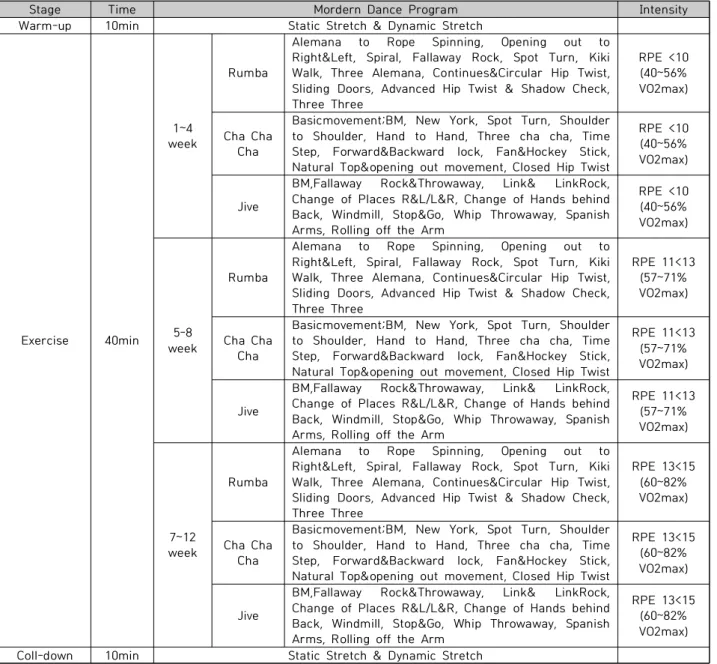
중재 방법은 모던댄스 프로그램을 12주간 주 3회 준비·정 리운동 10분, 본 운동 40분간 실시하였으며 운동 강도는, Borg. [38]의 운동자각도(Rating of Perceived Exertion, RPE)를 이용해 운동 기간에 따라 점진적으로 증가하였다.
Stage Time Mordern Dance Program Intensity Warm-up 10min Static Stretch & Dynamic Stretch
Exercise 40min
1~4 week
Rumba
Alemana to Rope Spinning, Opening out to Right&Left, Spiral, Fallaway Rock, Spot Turn, Kiki Walk, Three Alemana, Continues&Circular Hip Twist, Sliding Doors, Advanced Hip Twist & Shadow Check, Three Three
RPE <10 (40~56%
VO2max)
Cha Cha Cha
Basicmovement;BM, New York, Spot Turn, Shoulder to Shoulder, Hand to Hand, Three cha cha, Time Step, Forward&Backward lock, Fan&Hockey Stick, Natural Top&opening out movement, Closed Hip Twist
RPE <10 (40~56%
VO2max) Jive
BM,Fallaway Rock&Throwaway, Link& LinkRock, Change of Places R&L/L&R, Change of Hands behind Back, Windmill, Stop&Go, Whip Throwaway, Spanish Arms, Rolling off the Arm
RPE <10 (40~56%
VO2max)
5-8 week
Rumba
Alemana to Rope Spinning, Opening out to Right&Left, Spiral, Fallaway Rock, Spot Turn, Kiki Walk, Three Alemana, Continues&Circular Hip Twist, Sliding Doors, Advanced Hip Twist & Shadow Check, Three Three
RPE 11<13 (57~71%
VO2max)
Cha Cha Cha
Basicmovement;BM, New York, Spot Turn, Shoulder to Shoulder, Hand to Hand, Three cha cha, Time Step, Forward&Backward lock, Fan&Hockey Stick, Natural Top&opening out movement, Closed Hip Twist
RPE 11<13 (57~71%
VO2max) Jive
BM,Fallaway Rock&Throwaway, Link& LinkRock, Change of Places R&L/L&R, Change of Hands behind Back, Windmill, Stop&Go, Whip Throwaway, Spanish Arms, Rolling off the Arm
RPE 11<13 (57~71%
VO2max)
7~12 week
Rumba
Alemana to Rope Spinning, Opening out to Right&Left, Spiral, Fallaway Rock, Spot Turn, Kiki Walk, Three Alemana, Continues&Circular Hip Twist, Sliding Doors, Advanced Hip Twist & Shadow Check, Three Three
RPE 13<15 (60~82%
VO2max)
Cha Cha Cha
Basicmovement;BM, New York, Spot Turn, Shoulder to Shoulder, Hand to Hand, Three cha cha, Time Step, Forward&Backward lock, Fan&Hockey Stick, Natural Top&opening out movement, Closed Hip Twist
RPE 13<15 (60~82%
VO2max) Jive
BM,Fallaway Rock&Throwaway, Link& LinkRock, Change of Places R&L/L&R, Change of Hands behind Back, Windmill, Stop&Go, Whip Throwaway, Spanish Arms, Rolling off the Arm
RPE 13<15 (60~82%
VO2max) Coll-down 10min Static Stretch & Dynamic Stretch
Table 2. Mordern Dance
모던댄스 프로그램은 김송은 & 양상훈[39]의 운동 프로 그램을 수정·보완하여 실시하였으며, Rumba (25-27beats/min), Cha Cha Cha(30-32beats/min),
Jave(42-44beats/min)로 선정하여 팝송과 왈츠 곡 및 모던음악 등을 활용하여 템포를 조절하면서 실시하였다
<Table 2>.
4. Statistical analysis
본 연구의 모든 자료는 SPSS(version22.0 for Window) 통계프로그램을 이용해 각 변인들의 평균(M)과 표준편차(SD)를 산출 하였다. 사전 집단 간의 동질성 검증 을 위하여 독립표본(independent-sample) t-test를 실시 하였으며, 운동 전·후 차이 검증을 위해 이원 반복측정 분
산분석(two-way repeated measures ANOVA)을 실시하 였다. 또한 각 종속 변인들에 대한 집단 내 전·후의 차이 분석을 위해 대응표본(paired sample) t-test를 실시하였 다. 모든 유의성 검증 신뢰 수준은 α=.05로 하였다.
III. Results
1. Body composition
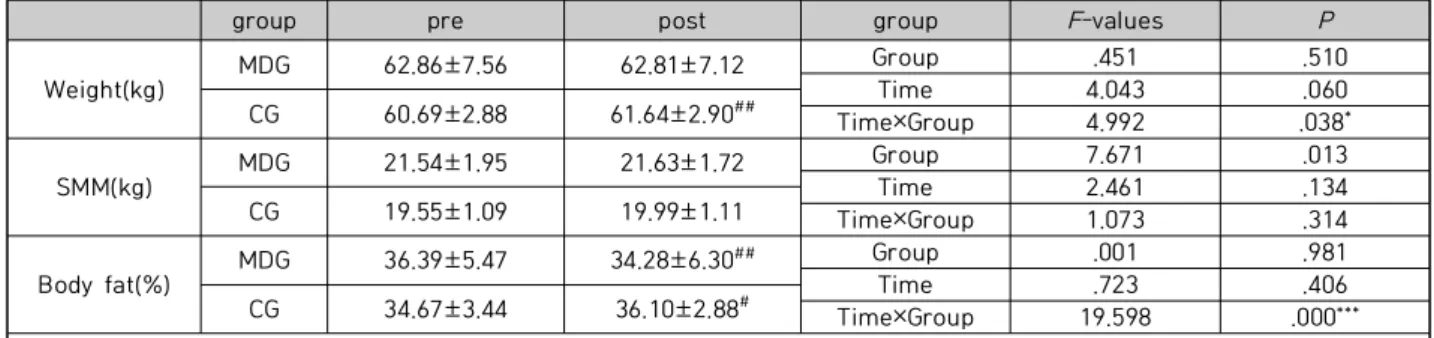
신체조성 변화를 분석한 결과는 <Table 3>에 나타난 바와 같다. 체중은 그룹과 시기 간 상호작용에서 효과가 나타났으며(p<.05), 컨트롤 그룹에서 유의하게 증가하였다 (p<.01). 골격근량은 그룹과 시기 간 유의한 상호작용의
효과가 나타나지 않았다. 체지방률은 그룹과 시기 간 상호 작용의 효과가 나타났으며(p<.001), 모던댄스 그룹에서 유 의하게 감소하였고(p<.01), 컨트롤 그룹에서는 체지방률이 유의하게 증가하였다(p<.05).
2. Bone metabolism markers
T-score와 osteocalcin의 변화는 <Table 4>에 나타난 바와 같다. T-score는 그룹과 시기 간 유의한 상호작용의 효과는 나타나지 않았으나 모던댄스 그룹에서 유의하게 증가하였다(p<.05). Osteocalcin의 경우 그룹과 시기 간 유의한 상호작용의 효과가 나타났으며(p<.01), 모던댄스 그룹에서 유의하게 증가하였다(p<.01).
group pre post group F-values P
Weight(kg) MDG 62.86±7.56 62.81±7.12 Group .451 .510
Time 4.043 .060
CG 60.69±2.88 61.64±2.90## Time×Group 4.992 .038*
SMM(kg) MDG 21.54±1.95 21.63±1.72 Group 7.671 .013
Time 2.461 .134
CG 19.55±1.09 19.99±1.11 Time×Group 1.073 .314
Body fat(%) MDG 36.39±5.47 34.28±6.30## Group .001 .981
Time .723 .406
CG 34.67±3.44 36.10±2.88# Time×Group 19.598 .000***
Mean±S.D, MDG; mordern dance group, CG: control group, SMM; Skeltal Muscle Mass, Two-way repeated ANOVA;
*p<.05, **p<.01, ***p<.001, Significant difference between pre and post; #p<.05, ##p<.01, ###p<.001.
Table 3. Body Composition
group pre post group F-values P
T-score MDG -2.15±0.46 -1.53±0.67# Group 0.88 .771
Time 7.480 .014
CG -1.95±0.53 -1.86±0.60 Time×Group 4.168 .056
Osteocalcin (pg/mL)
MDG 6.23±2.77 8.49±2.39## Group .233 .635
Time 7.124 .016
CG 7.96±1.25 7.56±1.10 Time×Group 14.571 .001**
Mean±S.D, MDG; mordern dance group, CG: control group, Two-way repeated ANOVA; *p<.05, **p<.01, ***p<.001, Significant difference between pre and post; #p<.05, ##p<.01, ###p<.001.
Table 4. Bone Metabolism Markers
group pre post group F-values P
Adiponectin (µg/mL)
MDG 9.94±5.28 11.18±5.43# Group .002 .969
Time .905 .354
CG 10.71±3.21 10.26±3.05 Time×Group 4.226 .055
TNF-α (pg/mL)
MDG 1.47±0.46 1.19±0.21# Group .108 .746
Time 2.525 .129
CG 1.33±0.29 1.42±0.30 Time×Group 8.682 .009**
IL-6 (pg/mL)
MDG 1.03±.43 0.81±0.39# Group 1.782 .199
Time 2.858 .108
CG 1.12±0.37 1.18±0.41 Time×Group 8.935 .008**
Mean±S.D, MDG; mordern dance group, CG: control group, Two-way repeated ANOVA; *p<.05, **p<.01, ***p<.001, Significant difference between pre and post; #p<.05, ##p<.01, ###p<.001.
Table 5. Adipocytokine
3. Adipocytokines
아디포사이토카인의 변화는 <Table 5>에 나타난 바와 같다. Adiponectin은 그룹과 시기 간 상호작용의 효과가 나타나지 않았으나 모던댄스 그룹에서 유의하게 증가하였 다(p<.05). TNF-α의 경우 그룹과 시기 간 상호작용의 효 과가 나타났으며(p<.01), 모던댄스 그룹에서 유의하게 감 소하였다(p<.05). IL-6는 그룹과 시기 간 상호작용의 효과 가 나타났으며(p<.01), 모던댄스 그룹에서 유의하게 감소 하였다(p<.05).
IV. Discussion
초고령화 사회로의 진입과 더불어 근·골격 질환 중 골다 공증은 노인에게 있어 흔히 발생하는 건강 문제이다[40].
2017년 우리나라 통계청에서 발표한 자료에 의하면 국 내 여성노인의 골다공증 유병률은 22.1%로 남성노인 2.7%보다 8배 가까이 높은 것으로 보고되었다[41].
골감소증은 T-score -1.0 ~ -2.5 사이로 10년 내 20%
이상 골다공증으로 발전 한다고 보고하고 있어[42-45], 골 감소증 노인여성들을 대상으로 한 연구가 우리나라 노인 의 골 건강 문제를 위해 의미가 있을 것으로 사료된다.
골의 미세구조는 파골세포(osteoclast)에 의한 골 흡수 와 조골세포에 의한 골 형성의 지속적이고 연속적 과정에 의해 영향을 받고 골의 질량 유지를 위해 이 과정은 매우 중요하다[46]. 골 형성과 흡수 과정은 각종 면역 및 골세포 의 성숙과 발달에 중요한 역할을 하는데[47], 특히 에스트 로겐 결핍에 의한 골 대사의 항상성 저하가 골다공증과 직 접적으로 관련이 있으며 이는 미세한 충격에도 쉽게 골절 이 발생한다[48].
골다공증과 같은 근골격 질환에 대해서 운동 중재를 바 탕으로 한 기계적 자극 및 체중지지는 골 형성과 골다공증 예방에 매우 중요한 요소로[49-51], 본 연구에서는 골감소 증 노인여성을 대상으로 골 대사지표와 아디포사이토카인 에 대한 모던댄스 중재 효과를 규명하고자 하였다.
선행 연구에 의하면 여성노인에게 댄스 운동은 당뇨, 심 혈관계 질환 인슐린 저항성 그리고 면역 기능에도 효과적 인 운동 프로그램으로[52], 골 대사 즉 골 형성과 관련된 지표의 변화 뿐 만 아니라 골밀도에도 긍정적인 영향을 미 친다고 보고하고 있다[53-55].
본 연구의 골밀도 T-score 결과 모던 댄스그룹에서 유 의하게 증가하였다. 이러한 결과는 Friesen et al.[56]의 댄스운동을 바탕으로 한 기계적 부하가 골밀도 향상에 긍 정적인 영향을 준다는 연구결과와 일치한 결과이며 Wu et al. [57]의 댄스 운동과 일상생활을 비교한 연구 결과에서 도 댄스 운동이 노인여성의 골밀도를 향상 시킨다고 하였 다. 특히 Ahn, & Kim.[58]의 연구를 보면 노인여성을 대 상으로 12주간의 댄스 운동 후 요추 L2-L4의 골 질량과 골밀도가 증가했고 Qin et al.[59]의 연구에서도 댄스 운 동이 폐경 여성들의 L2-L4 골밀도를 증가에 긍정적인 영 향을 미친다고 보고해 본 연구와 동일한 결과를 보였다.
또 다른 직접적인 골 형성과 관련 된 생화학 지표 osteocalcin은 조골세포에서 직접적으로 분비되어 골의 교체율 정도를 알 수 있는 골 단백질 호르몬으로서[27] 골
세포외 기질에 축적되며 새로 합성 된 것 중 약 30%가 혈 중으로 방출되는 이유로 골 형성의 정도를 예측 할 수 있 으며 직접적인 골 형성의 증가를 유도한다[60].
본 연구의 osteocalcin의 변화는 모던댄스 그룹에서 유 의하게 증가하였다. Wadiah et al.[55]의 연구에 의하면 댄스 운동 적용 후 여성들의 osteocalcin 농도가 유의하 게 증가하였고 그 외의 골 합성 지표에서도 유의한 효과를 보고하였으며, Barene el al.[61]의 연구에서도 줌바 댄스 후 여성들의 혈중 osteocalcin 농도가 유의하게 증가하였 다고 보고하였다.
이러한 결과는 높은 강도의 운동 적용은 노인 여성의 골 밀도를 유의하게 증가시키며[62], Saunders et al.[63]의 동물실험 연구에서도 기계적 자극을 유발한 운동 적용이 파골세포 형성을 억제시키고 조골세포 형성 OPG/RANKL 비율을 증가시킨다고 보고해 본 연구의 모던댄스 운동 강 도의 점진적 증가와 파트너와 함께 하는 낮은 범위에서의 점프동작 및 뛰기 동작들이 골밀도 향상에 긍정적인 영향 을 미친 것으로 생각된다.
또한 댄스 움직임은 낮은 높이에서의 점핑 동작은 하체 근육의 강도를 증가시키며 체중지지 및 움직임에 의한 자 극과 스트레칭 효과가 있고 음악 BPM(beats per minute) 에 의한 자극과 운동 및 휴식에서 오는 근육의 수축 이완 에 대한 근력 향상에도 효과가 있어[52][64] 본 연구 결과 를 뒷받침하고 있으며 모던댄스가 골다공증 예방에 긍정 적인 역할을 할 것으로 사료된다.
댄스 운동은 여성의 아디포사이토카인 조절에도 유의미 한 역할을 한다[65]. 골세포와 지방조직은 서로 밀접하게 위치해 아디포사이토카인은 지방조직에 의해 분비되어지 는 세포신호물질(cytokine) 호르몬으로 골 대사에 직접적 영향을 준다[36]. 아디포사이토카인은 지방의 정도에 따라 서 다르게 분비되며 지방의 증가에 따라 adiponectin의 증가와 감소된 TNF-α 및 IL-6를 유도한다[36].
Osteocalcin에 의해서도 발현이 자극 되는 adiponectin[66]은 혈중 농도가 감소 될 경우 골 밀도가 감소하고 증가 할 경우 골밀도가 증가한다고 하였으며 [67], adiponectin 농도 증가 시 감소된 파골세포수 에 의 해 골밀도가 증가한다고 하였다[68].
본 연구의 모던댄스 운동 중재 전·후 adiponectin 변화 는 모던댄스 그룹에서는 유의하게 증가하여 선행연구들의 결과를 증명하고 있다.
이 결과는 Suksom et al.[69]의 스텝댄스 운동 후 여성 들의 adiponectin 수치가 유의하게 증가하였다는 연구와 Murphy et al.[70]의 댄스 운동 후 adiponectin 수치가
증가하는 경향을 보인 연구 결과와도 일치 하였다.
이러한 결과는 신체구성 결과를 보면 모던댄스 그룹의 체지방률이 유의하게 감소하였으며 컨트롤 그룹에서는 체 지방률이 유의하게 증가하여 지방의 증가가 골감소증 노 인여성의 adiponectin 농도 증가에 긍정적인 영향을 미친 것으로 사료된다.
Adiponectin은 대사 조절자로서 골 대사를 활성화 역 할뿐만 아니라 인슐린 감수성을 향상시키고 지방산화 작 용 뿐 아닌 TNF-α, IL-6와 같은 면역 조절자를 억제하는 기능을 한다[71][72].
TNF-α, IL-6와 같은 염증성 아디포사이토카인은 골 흡 수와 파골세포의 분화 중재자로 만성염증 뿐만 아니라 파 골세포를 활성화 시켜 골 흡수와 감소를 유발 한다[73-75]
특히 폐경기 여성의 골 감소는 염증성 사이토카인 TNF-α 와 IL-6과 관련이 있는 것으로 보고되고 있어[76] 염증성 아디포사이토카인 관리가 강조되어야 할 것으로 보인다.
본 연구의 TNF-α, IL-6의 변화 결과 모던댄스 그룹에 서 유의하게 감소하였다. 선행연구를 살펴보면 Rodrigues-Krause et al. [52]는 노인여성들에게 댄스운 동 적용 후 TNF-α가 유의하게 감소하였고 Domene et al.[78]의 연구에서도 IL-6 감소에 효과가 있다고 보고하 였다. 또한 노인여성을 대상으로 한 Borges et al.[77]의 연구와 Murphy et al. [70] 연구에서도 TNF-α와 IL-6 감 소하는 경향을 보인 연구와 일치하였다
이러한 결과는 노인여성의 규칙적인 운동은 근육량과 인슐린 감수성과 부적 상관관계인 TNF-α와 IL-6에 긍정 적인 영향을 미친다고 보고한 Alemán et al.[79]의 연구 결과가 본 연구의 결과를 뒷받침 한다.
아디포사이토카인 adiponectin, TNF-α 및 IL-6의 긍 정적인 변화에 대해 Ertek, & Cicero.[80]은 항염증 호르 몬인 adiponectin이 미토콘드리아의 기능과 산화적 대사 작용에 긍정적인 영향을 주며 인슐린 저항성을 향상시킨 다고 하였으며, 실제로 일상생활만 할 경우 많은 지방축적 을 유도하고 이는 에너지 소비의 불균형을 가져와 과도한 지방축적에 의해 TNF-α와 IL-6 같은 염증 호르몬을 증가 시키고 이러한 불균형 현상 조절을 위해 운동은 필수 요소 라고 하였다[81]. 또한 Lee et al.[82]는 높은 강도의 운동 의 운동은 여성들의 복부 및 신체 전체의 체지방 감소에 긍정적인 영향을 준다고 하였는데, 댄스는 높은 강도의 유 산소성 트레이닝 효과를 유도하는 형태의 운동으로 체지 방 감소와 심장 혈류 및 기능 그리고 미토콘드리아와 산화 효소의 크기 및 부피의 밀도 증가 그리고 혈관 내피세포손
상 예방 및 자율신경계 기능 개선 등의 효과가 있는 것으 로 보고하고 있다[55][83].
이러한 연구 결과와 함께 본 연구 결과의 신체구성에서 모던댄스 그룹의 체지방률의 유의한 감소와 컨트롤 그룹 의 체지방률 증가가 아디포사이토카인 수치에 긍정적인 영향을 미친 것으로 보이며 또한 스트레칭과 관절의 움직 임은 노인들의 염증지표에 긍정적인 영향을 주는 것으로 [84] 본 연구의 모던댄스 본 운동 전·후 정적스트레칭과 동 적 스트레칭 적용이 초기 대사 적응에 적절한 중재가 된 것으로 생각되어지고 12주간 주 3회의 운동 기간과 적절 한 운동 강도 증가가 본 연구의 각 종속변인들에 긍정적인 변화는 영향을 준 것으로 사료된다.
Ⅴ. Conclusions
본 연구는 골감소증 노인여성들을 대상으로 모던댄스 운동 적용에 따른 골 대사 지표 및 아디포사이토카인의 변 화를 분석하였으며 다음과 같은 결론을 얻었다.
첫째. 모던댄스 중재 전·후 체중은 그룹과 시기 간 유의 한 상호작용에서 효과가 나타났으며(p<.05), 컨트롤 그룹 에서 유의하게 증가하였다(p<.01). 체지방률은 그룹과 시 기 간 상호작용의 효과가 나타났으며(p<.001), 모던댄스 그룹에서 유의하게 감소하였고(p<.01), 컨트롤 그룹에서는 체지방률이 유의하게 증가하였다(p<.05).
둘째. 모던댄스 중재 전·후 골대사 지표 T-score는 그 룹과 시기 간 유의한 상호작용의 효과는 나타나지 않았으 나, 모던댄스 그룹에서 유의하게 증가하였다(p<.05).
Osteocalcin의 경우 그룹과 시기 간 유의한 상호작용의 효과가 나타났으며(p<.01), 모던댄스 그룹에서 유의하게 증가하였다(p<.01).
셋째. 모던댄스 중재 전·후 아디포사이토카인 adiponectin은 그룹과 시기 간 상호작용의 효과가 나타나 지 않았으나 모던댄스 그룹에서 유의하게 증가하였다 (p<.05). TNF-α의 경우 그룹과 시기 간 상호작용의 효과 가 나타났으며(p<.01), 모던댄스 그룹에서 유의하게 감소 하였다(p<.05). IL-6는 그룹과 시기 간 상호작용의 효과가 나타났으며(p<.01), 모던댄스 그룹에서 유의하게 감소하였 다(p<.05).
이상의 결과를 종합해 보면 모던댄스 중재가 노인여성 들의 신진대사, 기능 및 골 건강 향상에 적절한 전략이 될 것으로 보인다.
더불어 본 연구의 한계와 추가 분석을 위해 대상자 수를 더해 운동중재에 따른 지방세포에서 분비되는 사이토카인 과 골세포에서 분비되는 골 단백질 호르몬과의 상관관계 에 대한 연구도 되어져야 할 것으로 사료된다.
REFERENCES
[1] G. J. Baek, and J. Y. Ha, "Effects of Line Dance and Walking on Cardiovascular Risk Factors in Obese Older Women," Global Health Nurs, Vol. 10, No.1, pp. 4-13, January 2020. DOI:
10.35144/ghn.2020.10.1.4
[2] C. S. In, M. K. Lee. and J. S. Kim, "Effects of motion beat training during dance sport on cardiorespiratory functions, metabolic risk factors and energy regulation hormones in middle-aged women,"
The Korean Journal of Physical Education, Vol. 55, No. 1, pp.
701-713, January 2016.
[3] J. E. Oh, "The effects of Participation in dance sport on health related fitness and bone mineral density in the elderly woman".
unpublished a master's thesis, Korea National Sport University.
February 2011
[4] K. C. Jo, "Theory and facts of dance sportsⅡ" seoul, HangKyoung, 2000.
[5] A. D. Kriketos, T. A. Sharp, H. M. Seagle, J. C. Peters, and J.
O. Hill, "Effect for aerobic fitness on fat oxidation and body fatness," Medicine & Sciencein, Sports & Exercise, Vol. 32, No.
4, pp. 805-811, September 2000. DOI: 10.1159/000357338 [6] L. A. Talbot, C. J. Metter, and J. I. Fleg, "Leisure-time physical
activities and their relationship to cardiorespiratory fitness in healthy men and woman 19-95 years old," Medicine in Sports &
Exercise, Vol. 32, No. 2, pp. 417-425, February 2000. DOI:
10.1097/00005768-200002000-00024
[7] H. S. Roh, "The Effect of Dance sports on Osteosarcopenic obesity index, Body composition in post menopause obesity," Official Journal of Korean Society of Dance Science, Vol. 35, No. 4, pp.
173-182, October 2018 DOI : 10.21539/ksds.2018.35.4.173 [8] W. A. Peck, "Consensus development conference: diagnosis,
prophylaxis, and treatment of osteoporosis," Am J Med, Vol. 94, No. 6, pp. 646-650, Jun 1993. DOI: 10.1016/0002-9343(93)90 218-e
[9] M. G. Sweet, J. M. Sweet, M. P. JereMiah, and S. S. Galazka, S. S. "Diagnosis and treatment of osteoporosis," American family physician, Vol. 79, No. 3, pp. 193-200, February 2009.
https://www.aafp.org/afp/2009/0201/p193.html
[10] A. Klibanski, L. Adams-Campbell, T. L. Bassford, S. N. Blair, S. D. Boden, K. Dickersin, ... and S. R. Johnson, "Osteoporosis prevention, diagnosis, and therapy," Journal of the American
Medical Association, Vol. 285, No. 6, pp. 785-795, February 2001. DOI: 10.1001/jama.285.6.785
[11] J. Li. X. Chen, L. Lu. and X. Yu, "The relationship between bone marrow adipose tissue and bone metabolism in postmenopausal osteoporosis," Cytokine & Growth Factor Reviews, Vol. 52, pp. 88-98, February 2020. DOI:
10.1016/j.cytogfr.2020.02.003
[12] H. H. Lee, M. A. Han, J. Park, "Association between Metabolic Syndrome and Osteoporosis in Korean Adults Aged Over 50 Years Old Using the Korea National Health and Nutrition Examination Survey 2016-2017," J Health Info Stat, Vol. 44, No.
3, pp. 245-252, July 2019. DOI: https://doi.org/10.21032/jhis.2 019.44.3.245
[13] D. V. Novack, and S. L. Teitelbaum, "The osteoclast: friend or foe?," Annu. Rev. Pathol. Mech. Dis, Vol. 3, pp. 457-484, October 2007. DOI:10.1146/annurev.pathmechdis.3.121806.151431 [14] J. Farr, J. Rowsey, B. Eckhardt, B. Thicke, D. Fraser, T. Tchkonia,
J. Kirkland, D. Monroe, and S. Khosla, "Independent roles of estrogen deficiency and cellular senescence in the pathogenesis of Osteoporosis: Evidence in young adult mice and older humans"
Journal of Bone and Mineral Research, Vol. 34, No. 8, pp.
1407-1418, Jun 2019. DOI: 10.1002/jbmr.3729
[15] X. Han, S. Gong, N. Li, X. Wang, P. Liu, Y. Xu, X. He, W.
Jiang, and S. Si, "A novel small molecule which increases Osteoprotegerin expression and protects against ovariectomyrelated bone loss in rats," Frontiers in Pharmacology, Vol. 10, pp. 103, March 2019. DOI: 10.3389/fphar.2019.00103 [16] S. O. Skouby, J. Gram, L. E. Andersen, J. Sidelmann, K. R.
Petersen, and J. Jespersen, "Hormone replacement therapy:
estrogen and progestin effects on plasma C-reactive protein concentrations," American journal of obstetrics and gynecology, Vol. 186, No. 5, pp. 969-977, May 2002. DOI: 10.1067/mob.
2002.122414
[17] E. A. Greco, A. Lenzi, and S. Migliaccio, "The obesity of bone"
Therapeutic advances in endocrinology and metabolism, Vol. 6 No. 6, pp. 273-286, June 2011. DOI: 10.1177/2042018815611 004.
[18] C. J. Rosen, and A. Klibanski, "Bone, fat, and body composition:
evolving concepts in the pathogenesis of osteoporosis," The American journal of medicine, Vol. 122, No. 5, pp. 409-414, May 2009. DOI: 10.1016/j.amjmed.2008.11.027
[19] J. J. Cao, "Effects of obesity on bone metabolism," Journal of orthopaedic surgery and research, Vol. 6, No. 1, pp. 30, June 2011. https://link.springer.com/article/10.1186/1749-799X-6-30 [20] J. E. Compston, J. Flahive, D. W. Hosmer, N. B. Watts, E. S.
Siris, S. Silverman, ... and J. W. Nieves, "Relationship of weight, height, and body mass index with fracture risk at different sites in postmenopausal women: the Global Longitudinal study of Osteoporosis in Women (GLOW)," Journal of Bone and Mineral
Research, Vol. 29, No. 2, pp. 487-493, February 2014. DOI:
10.1002/jbmr.2051
[21] E. A. Greco, R. Fornari, F. Rossi, V. Santiemma, G. Prossomariti, C. Annoscia, ... and G. Spera, "Is obesity protective for osteoporosis? Evaluation of bone mineral density in individuals with high body mass index," International journal of clinical practice, Vol. 64, No. 6, pp. 817-820, May 2010. DOI:
10.1111/j.1742-1241.2009.02301.x
[22] E. A. Greco, D. Francomano, R. Fornari, C. Marocco, C. Lubrano, V. Papa, ... and A. Aversa, "Negative association between trunk fat, insulin resistance and skeleton in obese women," World journal of diabetes, Vol. 4, No. 2, pp. 31, April 2013. DOI:
10.4239/wjd.v4.i2.31
[23] H. J. Kim, "New understanding of glucocorticoid action in bone cells," BMB reports, Vol. 43, No. 8 pp. 524-529, August 2010.
DOI: 10.5483/bmbrep.2010.43.8.524
[24] M. Ferron, E. Hinoi, G. Karsenty, and P. Ducy, "Osteocalcin differentially regulates β cell and adipocyte gene expression and affects the development of metabolic diseases in wild-type mice,"
Proceedings of the National Academy of Sciences, Vol. 105, No.
13, pp. 5266-5270, April 2008. DOI: 10.1073/pnas.0711119105 [25] L. E. Polgreen, D. R. Jacobs Jr, B. M. Nathan, J. Steinberger,
A. Moran, and A. R. Sinaiko, "Association of osteocalcin with obesity, insulin resistance, and cardiovascular risk factors in young adults," Obesity, Vol. 20, No. 11, pp. 2194-2201, November 2012. DOI: 10.1038/oby.2012.108
[26] J. Wei, T. Hanna, N. Suda, G. Karsenty, and P. Ducy,
"Osteocalcin promotes β-cell proliferation during development and adulthood through Gprc6a," Diabetes, Vol. 63, No. 3, pp.
1021-1031, March 2014. DOI: 10.2337/db13-0887
[27] M. L. Zoch, T. L. Clemens, and R. Riddle, "New insights into the biology of osteocalcin," Bone, Vol. 82, pp. 42-49, January 2016. DOI: 10.1016/j.bone.2015.05.046
[28] K. Baek, "An overview of the endocrine functions of osteocalcin,"
International Journal of Oral Biology, Vol. 44, No. 4, pp. 125-129, August 2019. DOI : https://doi.org/10.11620/IJOB.2019.44.4.125 [29] J. H. Kang, “Association of Serum Osteocalcin with Metabolic Syndrome in Korean Adult Women," Korean J Health Promot, Vol. 17, No. 3, pp. 145-151, September 2017. DOI : 10.15384/kjhp.2017.17.3.145
[30] A. Patti, L. Gennari, D. Merlotti, F. Dotta, and R. Nuti, "Endocrine actions of osteocalcin," International journal of endocrinology, April 2013. DOI: 10.1155/2013/846480
[31] I. Kanazawa, "Osteocalcin as a hormone regulating glucose metabolism," World journal of diabetes, Vol. 6, No. 18, pp. 1345, December 2015. DOI: 10.4239/wjd.v6.i18.1345
[32] T. Kadowaki, and T. Yamauchi, "Adiponectin and adiponectin receptors," Endocr Rev Vol. 26, pp.439–451, May 2005. DOI:
10.1210/er.2005-0005
[33] C. M. Steppan, D. T. Crawford, K. L. Chidsey-Frink, H, Ke, and A. G. Swick, "Leptin is a potent stimulator of bone growth in ob/ob mice," Regulatory peptides, Vol. 92, No.1-3, pp. 73-78, August 2000. DOI: 10.1016/s0167-0115(00)00152-x
[34] J. Vendrell, M. Broch, N. Vilarrasa, A. Molina, J. M. Gómez, C. Gutiérrez, ... and C. Richart, "Resistin, adiponectin, ghrelin, leptin, and proinflammatory cytokines: relationships in obesity,"
Obesity research, Vol. 12, No. 6, pp. 962-971, June 2004. DOI:
10.1038/oby.2004.118
[35] H. Tilg, and A. Moschen, "Inflammatory mechanisms in the regulation of insulin resistance," Mol Med Vol. 14, No. 3-4, pp.
222–231, March-Amril 2008. DOI: 10.2119/2007-00119.Tilg [36] P. Magni, E. Dozio, E. Galliera, M. Ruscica, and M. M. Corsi,
"Molecular aspects of adipokine-bone interactions," Current molecular medicine, Vol. 10, No. 6, pp. 522-532, August 2010.
DOI: 10.2174/1566524011009060522
[37] World Health Organization, "WHO Scientific Group on Prevention, Management of Osteoporosis, & World Health Organization," Prevention and management of osteoporosis:
report of a WHO scientific group, No. 921, 2003.
[38] G. A. Borg, "Psychophysical bases of perceived exertion,"
Medicine & Science in Sports & Exercise. Vol. 14, No. 5, pp.
377-381, 1982. https://doi.org/10.1249/00005768-198205000-00 012
[39] S. E. Kim, and S. H. Yang, "The Effect of 12-Week Dance Sports of Body Composition, Daily Living Fitness, Blood Lipid in the Old Age Elderly Women," The Korean Journal of Sport, Vol.
15, No. 2, pp. 645-654, June 2017. http://lps3.www.earticle.ne t.libproxy.dankook.ac.kr/Article/A304209
[40] K. S. Park, J. I. Yoo, H. Y. Kim, S. Jang, Y. Park, and Y. C.
Ha, "Education and exercise program improves osteoporosis knowledge and changes calcium and vitamin D dietary intake in community dwelling elderly," BMC public health, Vol. 17, No. 1, pp. 966, December 2017. DOI: 10.1186/s12889-017-4 966-4
[41] Statistics Korea, "Future population special estimate. Seoul:
Statistics," Retrieved March 5, 2018. http://kostat.go.kr/portal/
korea/kor_nw/1/1/index.board
[42] B. Dawson-Hughes, A. N. A. Tosteson, L. 3. Melton, S. Baim, M. J. Favus, S. Khosla, and R. L. Lindsay, "Implications of absolute fracture risk assessment for osteoporosis practice guidelines in the USA," Osteoporosis International, Vol. 19, No.
4, pp. 449-458, April 2008. DOI: 10.1007/s00198-008-0559-5 [43] B,\. Ettinger, D. M. Black, B. Dawson-Hughes, A. R. Pressman,
and L. J. Melton, "Updated fracture incidence rates for the US version of FRAX®," Osteoporosis international, Vol. 21, No. 1, pp. 25-33, January 2010. DOI: 10.1007/s00198-009-1032-9 [44] J. A. Kanis, H. Johansson, A. Odén, B. Dawson-Hughes, L. J.
Melton, and E. V. McCloskey, "The effects of a FRAX® revision
for the USA," Osteoporosis international, Vol. 21, No. 1, pp.
35, January 2010. DOI: 10.1007/s00198-009-1033-8
[45] H. K. Kamel, and C. J. Z. Vamc, "FALLS 'GUIDELINES AND OSTEOPOROSIS ASSESSMENT," Journal of the American Geriatrics Society, Vol. 50, No. 6, pp. 1167-1168, June 2002.
DOI: 10.1046/j.1532-5415.2002.502831.x
[46] N. A. Sims, and C. Vrahnas, "Regulation of cortical and trabecular bone mass by communication between osteoblasts, osteocytes and osteoclasts," Archives of biochemistry and biophysics, Vol. 1, No.
561, pp. 22-28, November 2014. DOI: 10.1016/j.abb.2014.05.015 [47] M. C. Walsh, N. Kim, Y. Kadono, J. Rho, S. Y. Lee, J. Lorenzo,
and Y. Choi, "Osteoimmunology: interplay between the immune system and bone metabolism," Annu. Rev. Immunol., Vol. 24, pp. 33-63, October 2005. DOI: 10.1146/annurev.immunol.24.0 21605.090646
[48] T. Katsumata, T. Nakamura, H. Ohnishi, and T. Sakurama,
"Intermittent cyclical etidronate treatment maintains the mass, structure and the mechanical property of bone in ovariectomized rats," Journal of Bone and Mineral Research, Vol. 10, No. 6, pp. 921-931, June 1995. DOI: 10.1002/jbmr.5650100613 [49] T. E. Howe, B. Shea, L. J. Dawson, F. Downie, A. Murray, C.
Ross, ... and G. Creed, "Exercise for preventing and treating osteoporosis in postmenopausal women," Cochrane database of systematic reviews, No. 7, July 2011. DOI: 10.1002/14651858.
CD000333.pub2
[50] J. Rittweger, "Can exercise prevent osteoporosis?," Journal of Musculoskeletal and Neuronal Interactions, Vol. 6, No. 2, pp.
162-166, April-June 2006. http://www.ismni.org/jmni/pdf/24/11 RITTWEGER.pdf
[51] F. A. Schulte, D. Ruffoni, F. M. Lambers, D. Christen, D. J.
Webster, G. Kuhn, and R. Müller, "Local mechanical stimuli regulate bone formation and resorption in mice at the tissue level," PloS one, Vol. 8, No. 4, e62172, April 2013. DOI:
10.1371/journal.pone.0062172
[52] J. Rodrigues-Krause, J. B. Farinha, T. R. Ramis, R. C. O. Macedo, F. P. Boeno, G. C. dos Santos, ... and R. S. Pinto, "Effects of dancing compared to walking on cardiovascular risk and functional capacity of older women: A randomized controlled trial," Experimental gerontology, Vol. 114, pp. 67-77, December 2018. DOI: 10.1016/j.exger.2018.10.015
[53] M. Rahim, F. K. Ooi, and W. Z. W. A. Hamid, "Changes of bone metabolism markers and muscular performance with combined aerobic dance exercise and honey supplementation in adult women," Sport Exerc Med Open J, Vol. 1, No. 6, pp.
186-197. April 2016. DOI: 10.17140/SEMOJ-1-129
[54] J. Qin, X. Rong, G. Zhu, and Y. Jiang, "The Effects of Square Dancing on Bone Mineral Density and Bone Turnover Markers in Patients with Postmenopausal Osteoporosis," Journal of Mechanics in Medicine and Biology, Vol. 18, No. 8, pp. 8,
November 2018. DOI: 10.1142/S0219519418400274
[55] A. N. A. Wadiah, F. K. Ooi, C. K. Chen, and W. D. W. Nudri,
"Effects of chocolate malt drink consumption combined with aerobic dance exercise on blood bone metabolism markers, antioxidant enzymes and aerobic capacity in young females,"
Sport Exerc Med Open J, Vol. 1, No. 3, pp. 71-80, July 2015.
DOI: 10.17140/SEMOJ-1-111
[56] K. J. Friesen, R. Rozenek, K. Clippinger, K. Gunter, A. C. Russo, and S. E. Sklar, "Bone mineral density and body composition of collegiate modern dancers," Journal of Dance Medicine &
Science, Vol. 15, No. 1, pp. 31-36, March 2011.
[57] H. Y. Wu, T. H. Tsao, C. H. Hsu, J. H Tu, and C. B. Yang,
"The effects of low-impact dance on knee torque and lower extremity mobility in middle-aged and older women," Journal of Nursing Research, Vol. 19, No. 4, pp. 267-274. December 2011. DOI: 10.1097/JNR.0b013e318236cfb2
[58] N. Ahn, and K. Kim, "Effects of 12-week exercise training on osteocalcin, high-sensitivity C-reactive protein concentrations, and insulin resistance in elderly females with osteoporosis,"
Journal of physical therapy science, Vol. 28, No. 8, pp.
2227-2231, August 2016. DOI: 10.1589/jpts.28.2227
[59] J. Qin, X. Rong, G. Zhu, and Y. Jiang, "The Effects of Square Dancing on Bone Mineral Density and Bone Turnover Markers in Patients with Postmenopausal Osteoporosis," Journal of Mechanics in Medicine and Biology, Vol. 18, No. 8, pp.
18400279(8page), November 2018. DOI: 10.1142/S02195194184 00274
[60] K. Åkesson, P. H. Vergnaud, P. D. Delmas, and K. J. Obrant,
"Serum osteocalcin increases during fracture healing in elderly women with hip fracture," Bone, Vol. 16, No. 4, pp. 427-430, April 1995.
[61] S. Barene, P. Krustrup, O. L. Brekke, and A. Holtermann, "Soccer and Zumba as health-promoting activities among female hospital employees: a 40-weeks cluster randomised intervention study,"
Journal of sports sciences, Vol. 32, No. 16, pp. 1539-1549, April 2014. DOI: 10.1080/02640414.2014.906043
[62] P. D. Delmas, D. E. B. R. A. Stenner, H. W. Wahner, K. G.
Mann, and B. L. Riggs, "Increase in serum bone gamma-carboxyglutamic acid protein with aging in women.
Implications for the mechanism of age-related bone loss," The Journal of clinical investigation, Vol. 71, No. 5, pp. 1316-1321, May 1983. DOI: 10.1172/jci110882
[63] M. M. Saunders, A. F. Taylor, C. Du, Z. Zhou, V. D. Pellegrini Jr, and H. J. Donahue, "Mechanical stimulation effects on functional end effectors in osteoblastic MG-63 cells," Journal of biomechanics, Vol. 39, No. 8, pp. 1419-1427, June 2005. DOI:
10.1016/j.jbiomech.2005.04.011
[64] Y. Koutedakis, A. Stavropoulos-Kalinoglou, and G. Metsios, "The significance of muscular strength in dance," Journal of dance
medicine & science, Vol. 9, No. 1, pp. 29-34, November 2005.
https://www.researchgate.net/profile/Yiannis_Koutedakis/publicat ion/32117167_The_Significance_of_Muscular_Strength_in_Danc e/links/571baa6d08aee3ddc569dfe8.pdf
[65] M. G. S. Amorim, M. D. de Oliveira, D. S. Soares, L. da Silva Borges, A. Dermargos, and E. Hatanaka, "Effects of exergaming on cardiovascular risk factors and adipokine levels in women,"
The Journal of Physiological Sciences, Vol. 68, No. 5, pp.
671-678, September 2018. DOI: 10.1007/s12576-017-0581-5 [66] Y. Zhang, P. Zhou, and J. W. Kimondo, "Adiponectin and
osteocalcin: relation to insulin sensitivity," Biochemistry and Cell Biology, Vol. 90, No. 5, pp. 613-620, October 2012. DOI:
10.1139/o2012-022
[67] D. Naot, M. Watson, K. E. Callon, D. Tuari, D. S. Musson, A.
J. Choi, ... and G. D. Gamble, "Reduced bone density and cortical bone indices in female adiponectin-knockout mice,"
Endocrinology, Vol. 157, No. 9, pp. 3550-3561, September 2016.
DOI: 10.1210/en.2016-1059
[68] K. Oshima, A. Nampei, M. Matsuda, M. Iwaki, A. Fukuhara, J. Hashimoto, ... and I. Shimomura, "Adiponectin increases bone mass by suppressing osteoclast and activating osteoblast,"
Biochemical and biophysical research communications, Vol. 331, No. 2, pp. 520-526, June 2005. DOI: 10.1016/j.bbrc.2005.03.210 [69] D. Suksom, Y. Phanpheng, S. Soogarun, and S. Sapwarobol, "Step
aerobic combined with resistance training improves cutaneous microvascular reactivity in overweight women," The Journal of sports medicine and physical fitness, Vol. 55, No. 12, pp.
1547-1554, December 2015. PMID: 25303169
[70] E. C. Murphy, L. Carson, W. Neal, C. Baylis, D. Donley, and R. Yeater, "Effects of an exercise intervention using Dance Dance Revolution on endothelial function and other risk factors in overweight children," International Journal of Pediatric Obesity, Vol. 4, No. 4, pp. 205-214, February 2009. DOI:
10.3109/17477160902846187
[71] G. Fantuzzi, "Adiponectin in inflammatory and immune-mediated diseases," Cytokine, Vol. 64, No. 1, pp. 1-10, July 2013. DOI:
10.1016/j.cyto.2013.06.317
[72] D. K. Oh, T. Ciaraldi, and R. R. Henry, "Adiponectin in health and disease," Diabetes, obesity and metabolism, Vol. 9, No. 3, pp. 282-289, May 2007. DOI: 10.1111/j.1463-1326.2006.00610.x [73] S. Khosla, "Minireview: The opg/rankl/rank system,"
Endocrinology, Vol. 142, No. 12, pp. 5050-5055, December 2001. DOI: 10.1210/endo.142.12.8536
[74] J. Pfeilschifter, R. Köditz, M. Pfohl, and H. Schatz, "Changes in proinflammatory cytokine activity after menopause,"
Endocrine reviews, Vol. 23, No. 1, pp. 90-119. February 2002.
DOI: 10.1210/edrv.23.1.0456
[75] T. E. Van Dyke, and C. N. Serhan, "Resolution of inflammation:
a new paradigm for the pathogenesis of periodontal diseases,"
Journal of dental research, Vol. 82, No. 2, pp. 82-90, February 2003. DOI: 10.1177/154405910308200202
[76] G. R. Mundy, "Osteoporosis and inflammation," Nutrition reviews, 65(suppl_3), S147-S151, December 2007. DOI:
10.1111/j.1753-4887.2007.tb00353.x
[77] L. Borges, M. E. Passos, M. B. Silva, V. C. Santos, C. M.
Momesso, T. C. Pithon-Curi, ... and E. Hatanaka, "Dance Training Improves Cytokine Secretion and Viability of Neutrophils in Diabetic Patients," Mediators of Inflammation, November 2019. DOI: 10.1155/2019/2924818
[78] P. A. Domene, H. J. Moir, E. Pummell, A. Knox, and C. Easton,
"The health-enhancing efficacy of Zumba® fitness: An 8-week randomised controlled study," Journal of sports sciences, Vol. 34, No. 15, pp. 1396-1404, August 2016. DOI: 10.1080/02640414 .2015.1112022
[79] H. Alemán, J. Esparza, F. A. Ramirez, H. Astiazaran, and H.
Payette, "Longitudinal evidence on the association between interleukin-6 and C-reactive protein with the loss of total appendicular skeletal muscle in free-living older men and women," Age and ageing, Vol. 40, No. 4, pp. 469-475, July 2011.
DOI: 10.1093/ageing/afr040
[80] S. Ertek, and A. Cicero, "Impact of physical activity on inflammation: effects on cardiovascular disease risk and other inflammatory conditions," Archives of medical science: AMS, Vol. 8, No. 5, pp. 794-804, November 2012. DOI:
10.5114/aoms.2012.31614
[81] M. A. Nimmo, M. Leggate, J. L. Viana, and J. A. King, "The effect of physical activity on mediators of inflammation,"
Diabetes, Obesity and Metabolism, Vol. 15(s3), pp. 51-60, September 2013. DOI: 10.1111/dom.12156
[82] M. G. Lee, K. S. Park, D. U. Kim, S. M. Choi, and H. J. Kim,
"Effects of high-intensity exercise training on body composition, abdominal fat loss, and cardiorespiratory fitness in middle-aged Korean females," Applied Physiology, Nutrition, and Metabolism, Vol. 37, No. 6, pp. 1019-1027, December 2012. DOI:
10.1139/h2012-084
[83] R. Belardinelli, F. Lacalaprice, C. Ventrella, L. Volpe, and E.
Faccenda, "Waltz dancing in patients with chronic heart failure:
new form of exercise training," Circulation: Heart Failure, Vol.
1, No. 2, pp. 107-114, July 2008. DOI: 10.1161/CIRCHEART FAILURE.108.765727
[84] N. Apostolopoulos, G. S. Metsios, A. D. Flouris, Y. Koutedakis, and M. A. Wyon, "The relevance of stretch intensity and position
—a systematic review," Frontiers in psychology, Vol. 6, 1128.
August 2015. DOI: 10.3389/fpsyg.2015.01128
Authors
Chan-Yang Kim, Master degree in sports rehabilitation from Dankook University.
He is studying Kinesiologic Medical Science in Dankook University as a Ph. D candidate.
He is interested in exercise injury and sports
rehabilitation. The most recent he is working on metabolic syndrome and bone metabolic risk factors.
Jin-Wook Lee, Visiting Professor Ph.D. M.S.
degrees in Physical Education from Dankook University. B.S. Korea University. Lee Ph.D.
is currently a Visiting Professor in the Department of Exercise Prescription
Rehabilitation, Dankook University. He is interested in sports medicine, exercise prescription, sports Rehabilitation, exercise physiology.