효율적인 비즈니스 프로세스 진단 및 설계를 위한 프로세스 마이닝과 시뮬레이션 통합 프레임워크
Integrated Framework of Process Mining and Simulation Approaches for the Efficient Diagnosis and Design of Business Process
아체 사레이도렛하니*, 한관희**
경상대학교 산업시스템공학부*, 경상대학교 산업시스템공학부/공학연구원**
Atieh Sahraeidolatkhaneh([email protected])*, Kwan Hee Han([email protected])**
요약
급변하는 외부 환경에서 생존하기 위해 대부분의 기업은 비즈니스 프로세스를 혁신하거나 개선하고자 노 력하고 있으며, 이를 위해 많은 기업들이 프로세스 운영에 BPM (Business Process Management) 개념을 도입하고 있다. 기업에서 BPM 단계는 진단-설계-구현-실행 순으로 진행되는데, BPM 생애 주기에서 통상 적으로 비즈니스 프로세스의 진단은 지금까지 주로 인터뷰나 설문지 또는 프로세스를 직접 관찰하는 방식 과 같이 수작업으로 이루어졌다. 비즈니스 프로세스의 (재)설계 방법도 주로 백지 상태에서 시작하여 전문 가의 지식에 의존하는 수작업 방식으로 이루어져 왔다.
이 연구의 목적은 프로세스 진단 단계에서 프로세스 마이닝을 이용하여 자동으로 생성된 프로세스 모델 과 통계량을 (재)설계 단계에서도 공유함으로써 별개로 행해지던 진단과 설계 업무를 통합하려는 것이다.
이러한 시도의 궁극적인 목표는 비즈니스 프로세스 진단과 설계 업무를 자동화하려는 것이다. 제안 프레임 워크를 구현하고 유용성을 제시하기 위해 두 개의 사례 연구를 행하였다.
■ 중심어 :∣프로세스 마이닝∣시뮬레이션∣진단 및 설계∣비즈니스 프로세스∣프로세스 혁신∣
Abstract
To survive in the ever-changing environment, organizations need to improve or innovate their business processes. As a result, to attain this objective, BPM (Business Process Management) concept is widely adopted in modern enterprises. BPM life cycle consists of diagnosis, design, implementation and enactment. Conventionally, diagnosis of business process within the BPM life cycle is usually conducted by manual methods such as interviews, questionnaires and direct observations of process. And (re)designing business processes is also usually done manually under supervision of business experts from scratch. It is time-consuming and error-prone tasks.
The objective of this research is to integrate the diagnosis and (re)design phase of BPM life cycle by sharing automatically generated process model and basic statistics in the diagnosis phase based on the process mining method. Eventually, this approach will lead to automate the tasks of diagnosis and design of business process. To implement and to show the usefulness of the proposed framework, two case studies were conducted in this research.
■ keyword :∣Process Mining∣Simulation∣Diagnosis & Design∣Business Process∣Process Innovation∣
접수일자 : 2017년 02월 15일
수정일자 : 2017년 02월 24일
심사완료일 : 2017년 02월 24일
교신저자 : 한관희, e-mail : [email protected]
I. Introduction
With intensified globalization, many factors such as the rise in frequency of goods demand, the need for quick transferring of information, the need of quick decision making, the need to adapt to change in demand, the emergence of international competitors, and demands for shorter cycle times are challenging the profitability and survival of big and small companies[1][2].
To survive in this ever-changing environment, organizations need to improve and innovate their business processes. A business process is an ordered set of related, structured activities, which express how the work is done within an organization across the time.
In order to tackle the constantly changing and competitive world, companies use the approach of BPR (Business Process Re-engineering) or CPI (Continuous Process Improvement) to remain competitive.
The term BPR was first introduced by Hammer[3], and Davenport and Short have described BPR as the analysis and design of workflows and business processes within and between organizations[4].
As mentioned in the above, BPR and CPI is mostly related to the (re) design and diagnosis phases of the BPM (Business Process Management) life cycle.
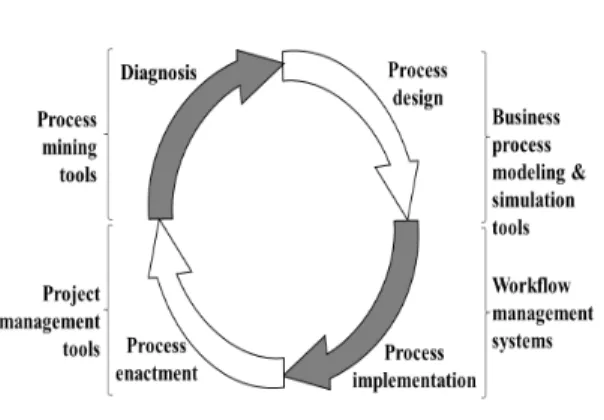
According to van der Aalst et al. (2003), BPM is defined as “supporting business processes using methods, techniques and software to design, enact, control and analyze operational processes involving humans, organizations, applications, documents and other sources of information”[5]. The BPM life cycle as depicted in [Fig. 1], describes the various phases in support of operational business processes.
Fig. 1. BPM Life cycle
In the diagnosis phase, the operational processes are analyzed to identify problems and to find things that can be improved. In the (re) design phase a new process model is created or an existing process model is adapted. In the configuration phase, designs are implemented by configuring a process aware information system (e.g., a WFMS (Workflow Management System)). After configuration, the enactment phase starts where the operational business processes are executed using the system configured. Given the appropriate analysis and monitoring tools, the BPM analyst can identify and improve on bottlenecks in the business processes.
Conventionally, in the diagnosis phase, existing business process was treated as a block box.
Therefore, problem identification was usually done by manual approaches such as interviews and questionnaires. Until now, few tools to support any form of diagnosis are offered by the traditional BPM systems[6].
And (re)designing business processes is also usually done manually under supervision of business experts from scratch. Especially, newly designed business process needs to be justified. It is usually done by simulation method which needs process model. However, conventionally, this process model is constructed manually.
Nowadays, many information systems that support execution of business processes, like ERP, WFM, CRM and B2B systems, are characterized by the omnipresence of logs. Typically, these information systems record information about the usage of the system by its users, which is called as event log.
These logs contain information about the instances processed in the system (also called cases), the activities executed for each instance, at what time the activities were executed and by whom[4][7].
Process mining as a new approach is recently used in the diagnosis stage to find weak points for making improvements in the business processes. In other words, process mining approach considers executed business process as a white box.
As a side effect, process mining made the management aware of the visibility of irregular behavior. The availability of event logs results in an increased interest in monitoring business processes, and also to improve the performance and efficiency of business processes[5].
Proposed in this research is the integrated framework of process mining and simulation approach for the efficient diagnosis and (re)design of business processes. In other words, diagnosis and design phase in the BPM life cycle is seamlessly integrated by automatically generated process model constructed by process mining method.
In the proposed approach, the automatically generated process model and basic statistics based on the process mining of diagnosis phase is shared with the simulation model in the design phase to validate the performance of newly (re)designed business process. By sharing the automatically generated process model of diagnosis phase, simulation model is built more easily and rapidly and more realistically in the design phase.
Eventually, this approach leads to automate the
tasks of diagnosis and design of business process.
The remaining parts of this paper are as follows:
section 2 is an overview of related works, and section 3 is the main parts of this paper which explains proposed framework. And section 4 is a case study to implement the proposed framework. Finally, conclusions and some suggestions for future works are summarized in section 5.
II. Related Works
Application of simulation in business process management is undeniable, because of its capability to validate business process performance using “what if”
scenarios. In the other sides, the application of process mining approach for analyzing business processes saw a big rise recently, and plenty of researchers used process mining in their studies.
Greasley (2003) made a case study of the use of business process simulation within the context of a BPR approach to change[8]. In his research, he used simulation approach to predict the performance of the to-be model, and to construct a model of the as-is state. He used business process simulation in a custody of prisoner process within the context of a BPR approach to change. The as-is process map was constructed by discussions with police staff involved in the custody process. In order to measure and analyze process performance, a business process simulation was constructed using the ARENA simulation system, and the to-be simulation model was designed to explore the reduction of staffing cost by re-allocating staff roles to processes. In[9], Akin Aksu (2001), proposed a new process model for a five-star hotel using a simulation technique to compare the current situation with the new situation.
Van der Aalst et al. (2007) also made a case study
which describes the application of process mining, in order to evaluate the performance of process and to identify opportunities for improvement. They applied process mining approach using ProM software[2].
Blickle and Hess (2009) used ARIS Process Performance Manager (ARIS PPM) to monitor and analyze the performance and structure of business processes to identify optimization opportunities[10].
Rebuge and Ferreira (2012) introduced a methodology for the application of process mining techniques to identify irregular behavior, process variants, and exceptional medical cases for improvement[11].
Tumay (1995) reviewed the business process simulation and described modeling elements and performance measures and classified business processes by simulation procedure and analysis considerations. He illustrated the power and suitability of simulation for analyzing a purchasing business processes[12].
Mans et al (2008) conducted a case study in a hospital and process mining was used to analyze the care-flow of gyneocological oncology patients[13][14].
In another study[15], the authors analyzed radiology workflows using process mining. And they concluded that process mining has a great potential to facilitate the understanding of medical processes and their variants despite the limitations.
Process mining approach was applied for mitigating financial transaction fraud of a European financial institution. Process mining was used as a diagnostic methodology, which consists of five phases: log preparation, log inspection, control flow analysis, performance analysis and role analysis. In this study, the process mining is used as a diagnostic approach, and moreover is used for building simulation model of as-is and to-be business process models[7].
In[16], repair processes of electronic devices are analyzed using process mining approach. In this
research, the method for finding major failure patterns is proposed by multi-dimensional data analysis. Kim and Shin (2006) proposed ISO 9001 Quality Management System based on BPM, and implemented quality management system called KQMS (KISTI Quality Management System)[17].
Suriadi et al. (2017) proposes an approach to analyse the manner in which a resource prioritizes his/her work[18]. Garg and Agarwal (2016) applied some of the process mining techniques with the help of petri net on the real time data of a private community hospital to get meaningful information and knowledge about these flow, for example discover paths followed by particular groups of patients[19].
However, related works were mostly concerned with the usefulness of each process mining and simulation approach separately.
III. Integrated Framework of Process Mining and Simulation for the Efficient Diagnosis and (Re)Design of Business Processes
The most current and past researches applied process mining and simulation separately for BPR and CPI applications of real-life business processes. The analysis and diagnosis of business processes conventionally was conducted by interviews with users, questionnaires, and direct observation of business processes. On the other side, design of new business processes was usually done by experts from scratch.
If the event data exists within the application system, the above tasks can be done efficiently and rapidly. The application system of enterprises usually records event data such as tasks that have been executed, their order of execution, and the process instance they belong to. These event data can be used
to extract knowledge about the process, and therefore they are especially useful for the purpose of business process diagnosis and design.
Event data can be analyzed using process mining approaches such as the process discovery for discovering control flow, the organizational perspective to find relationships between performers, and the data perspective and performance perspective to find bottlenecks.
In this research, the role of process mining is to support both design and diagnosis phases of the BPM life cycle by constructing the process model automatically.
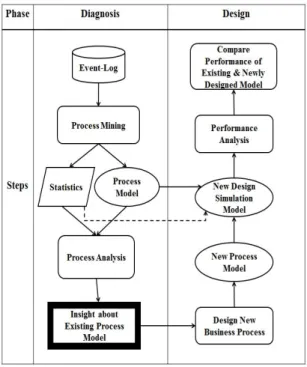
Proposed integrated framework of process mining and simulation for the efficient diagnosis and (re)design of business process is shown in [Fig. 2], which represents the seamless integration of diagnosis phase and design phase by sharing the automatically generated process model based on process mining.
In this framework, the information gained from log data and process model is analyzed in the diagnosis phase to identify bottlenecks and weak points. In the design phase, the new process model is built.
After that, the simulation model is built to evaluate the performance of new process model.
In this step, the statistics such as inter-arrival time of cases and probability distribution of processing time of each activity and discovered process model which represents the activity sequence and control flow already built in the diagnosis phase based on the process mining method is directly used.
In other words, process mining helps to make more realistic simulation model because of direct usage of statistics collected from event logs and process models constructed based on process mining by means of operational systems, instead of personal experiences and experience of experts.
Fig. 2. Integrated framework of process mining and simulation
IV. Implementation of Proposed Framework Using a Case Study
The purpose of proposed framework is to extract knowledge from event data automatically and its direct use to build the simulation model for newly designed business process. In order to achieve this purpose, process mining approach is applied to the event log to discover the current behavior or control flow of the business processes and eventually process model.
The primary discovered control-flow is called
‘as-is process model’, which shows the current behavior of the system before making any improvements. Discovered process model and some other statistics help to find deviations and bottlenecks in the behavior of the process.
These identified problems help researchers or
Fig. 3. Petri net-based process model of telephone repair process experts to find improvement points, which leads to
design the new process model. After that, newly designed business process needs to be justified for its performance. In this time, statistics and process
model in the diagnosis phase can be directly used to build simulation model of new business process.
To implement the proposed framework, two case studies was applied as follows: 1) telephone repair process, and 2) purchasing process.
1. Case 1: The Telephone repair process
The Case of repair process is a sequence of activities to repair telephones. The process starts by registering a telephone device sent by a customer.After that, ‘analyze’-‘repair’-‘test’ activity is conducted sequentially. After test, if the defect is not fixed, the telephone is again sent to the repair department. If the telephone is indeed repaired, the case is archived and the telephone is sent to the customer. To save on throughput time, the company only tries to fix a defect with a limited number of trials.
In a diagnosis phase, event log having attributes such as case id, activity, resource, start time stamp and complete time stamp are investigated by process mining method to find bottlenecks and problems.
ProM[20] and Disco[21] softwares were used in this research.
[Table 1] shows the basic statistics extracted from event log in the diagnosis phase. This information is used for diagnosis and design of business process.
Especially, in the design phase, the number of activities in [Table 1] is used as the number of servers in the simulation model of newly designed process.
Cases 1,104
Events 7,734
Activities 8
Resources 13
Start time 01.01.2016 14:36:00 End time 24.01.2016 17:16:00
Table 1. Basic statistics extracted from event log of telephone repair process
Fig. 4. Performance view of telephone repair process Number of resources in [Table 1] is used as the
capacity of servers in the simulation model of design phase. Start and end time are used as a duration of the simulation run in the simulation model, and also used for estimating the inter-arrival time of repair request events.
An important aspect of process mining approach is control flow discovery, i.e., to reflect the causal dependencies of activities observed in an event log, which eventually results in the process model.
Algorithms for control flow discovery include the α -algorithm, the heuristic miner, the fuzzy miner, and the genetic miner. Business process model which is extracted by control flow discovery should have a formal foundation. Well-known reasons include: 1)
formal models do not leave any scope for ambiguity, and 2) formal models increase the potential for analysis.
It is desirable that a business process model can be understood by the various stake holders in a straightforward manner as possible.
This could be achieved through the use of graphical representations. Business process models can be quite complex, and the use of a formal language for their specification is the only sure way to guarantee that alternative interpretations are ruled out. The discovered model is typically a formal process model such as Petri net, BPMN, EPC, or UML activity diagram[22].
Control flow discovery in this research, is done
using alpha algorithm and fuzzy miner[23]. [Fig. 3]
shows the control flow of telephone repair process model. This map visualizes the actual flow of the process as time elapses. This process map is constructed directly by process mining method without any pre-existing process model, and is represented by Petri net.
The aim of performance analysis is to find bottleneck activities in the process model and find routes with long execution or waiting time. Animation view in process mining softwares like Disco also provides a good visualization of activity flows to find bottlenecks during the process execution.
[Fig. 4] demonstrates the result of performance analysis of as-is telephone repair process. Searching for bottlenecks in the telephone repair process resulted in 3 activities which are bottlenecks as shown in [Fig. 4.] There are dark thick lines from
‘analyze defect’ to ①‘inform user’, to ②‘repair (simple)’, and to ③‘repair (complex)’ activities. The two dark rounded rectangles in [Fig. 4] represent that the average duration time of ‘repair complex’ and
‘repair simple’ activity is longer than other activities, and therefore these activities are causing longer waiting times causing bottlenecks.
Furthermore, the information about resources and the relationship among them were discovered using organizational mining. The organizational perspective focuses on information about resources hidden in the log, i.e., which actors (e.g., people, systems, machines, roles, or departments) are involved, and how are they related. The goal is to either structure the organization by classifying people in terms of roles and organizational units or to show the social network[22].
In this research, the organizational miner was used to discover number of resources belong to each activity in the as-is process model using
organizational miner plug-in of the ProM software.
After finishing the diagnosis of as-is process, to-be process should be constructed in the (re) design phase based on the results of diagnosis phase. In this step, simulation model is needed to evaluate the performance of to-be process.
In order to build the simulation model, time statistics information such as inter-arrival time and the probability distribution of each activity duration is needed. These basic statistics can be extracted directly from the log data. The probability distribution of each activity can be extracted using the Kolmogorov Smirnov, Anderson Darling and Chi-Squared tests by distribution fitting softwares like EasyFit, Sigma Magic and Minitab.
By using the above mentioned softwares, some of the activities are fitted to known distributions like normal or exponential distribution. But, some of them may not be fitted to any well-known distribution. In this situation, triangular distribution is recommended to use[24]. Based on the statistics and already built process model of as-is process based on process mining, the to-be process simulation model was made in the design phase. In this research, Simio simulation software was used[25].
Most important task in the simulation of business processes is to evaluate the process performance and to find bottlenecks in the to-be process. After identifying bottlenecks in the to-be model, the experts can propose different scenarios to make changes in the process model to remove the bottlenecks or to improve them. By executing several alternatives, the new optimal business process can be chosen.
As a final step, the performance criteria of the as-is and to-be simulation models are compared and the best alternative which makes more improvement is chosen.
To design new process model, the result of
Fig. 5. Performance view of purchasing process (part) diagnosis phase can be used directly. As we found in
the [Fig. 4] that ‘inform user’, ‘repair (simple)’, and
‘repair (complex)’ activities in telephone repair process are bottlenecks, different scenarios were made for each of these activities.
For ‘inform user’ activity, 3 scenarios were considered by changing the number of capacity for
‘inform user’ activity. The initial capacity of ‘inform user’ activity was 1 person. The new two other scenarios had capacity of 2 and 3.
Execution of to-be simulation model based on the 3 scenarios demonstrated that ‘the scenario of 3 person’
is the best scenario based on average time in the system and average waiting time in queue as a performance indicators as shown in [Table 2].
Scenario
Name Capacity
Performance Indicator Avg. waiting
time in queue (H)
Avg. time in system
(H)
Scenario1 1 0.0818 0.6258
Scenario2 2 0.0058 0.5487
Scenario3 3 0.0002 0.5418
Table 2. Experiment results for ‘inform user’ activity
Average time in the system is the average time a case spends in the system, and average waiting time in the queue is the average time a case spends waiting in front of the queue for the server.
The third scenario in [Table 2], shows more decrease in the average time in system and average waiting time in queue.
Next, new experiment was designed for 3 scenarios by changing the processing time of ‘repair (complex)’
activity, and the performance indicator is the average time in the system. As shown in [Table 3], results illustrated that by decreasing the processing time of
‘repair (complex)’ activity, the average time that each case spends in the system is decreased.
Scenario
Name Parameter
Performance Indicator Processing Time
(Min)
Capacity (Person)
Avg. time in system
(Hour) Scenario 1
(As-Is)
Triangular (15,25,37)
1 0.6459
Scenario 2 (To-Be: A)
Triangular (10,20,30)
3 0.6281
Scenario 3 (To-Be: B)
Triangular (5,15,25)
3 0.6128
Table 3. Comparison of as-is and to-be telephone repair process
2. Case 2: The purchasing process
The case of purchasing process is about purchasing goods from outside vendor company.
The process starts with creation of purchasing requisition by the employee within the company, and at the end, the invoice is paid by financial manager.
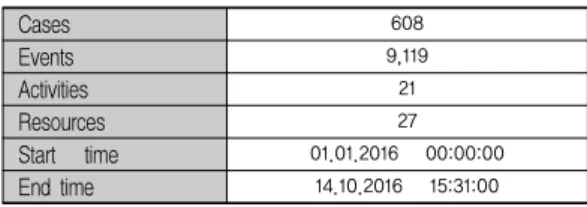
[Table 4] shows the basic statistics extracted from event log in the diagnosis phase.
Cases 608
Events 9,119
Activities 21
Resources 27
Start time 01.01.2016 00:00:00 End time 14.10.2016 15:31:00 Table 4. Basic statistics from purchasing process
event log
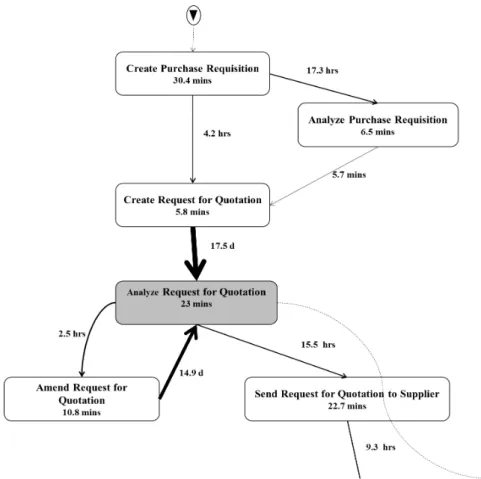
By filtering the event log to extract cases with long duration as shown in [Fig. 5], it is found that there is a bottleneck in the process model which caused cases
with more than 70 days duration. Checking the performance result of mean duration of activities and paths, the dark thick lines in [Fig. 5], which ended to
“analyze request for quotation” activity, reveals that it is a bottleneck.
In order to improve the “analyze request for quotation” activity, 4 scenarios were designed by changing the capacity of this activity.
The third scenario was the best scenario as shown in [Table 5] because the average time in the system is less than the first two scenarios and same with the last scenario which costs much due to requiring more resources.
[Table 6] shows the comparison between as-is and to-be model of purchasing process. Therefore, diagnosis task is conducted directly by means of process mining method, and based on the results of diagnosis phase, simulation experiment is executed by sharing the result of process mining to evaluate the performance of the newly designed processes.
Scenario Name
Capacity
Performance indicator (Avg. time in
system)
Scenario 1 1 1.2561
Scenario 2 2 1.2277
Scenario 3 3 1.2258
Scenario 4 4 1.2258
Table 5. Experiment results for “analyze request for quotation” activity
Parameter As-Is Model To-Be Model Capacity of ‘analyze
request for quotation’
activity
1 2
Table 6. Comparison of as-is and to-be purchasing process
V. Conclusions
This research proposed an integrated framework of
process mining and simulation approaches for the efficient analysis and design of business process to align business processes with ever-changing environment.
Conventionally, process diagnosis is usually conducted by manual method such as interviews, questionnaires and direct observations of process.
And (re)designing business processes is also usually done manually under supervision of business experts from scratch. It is time-consuming and error-prone tasks.
With emersion of information systems, which record the foot prints of business processes, it is easier to discover the execution flows, and easier to diagnose the existing processes. Process mining makes this approach more smooth, by automatically discovering control flow of business processes, and analyze them, in order to find the deviation in their process.
The objective of this study is to integrate both diagnosis and (re) design phases of BPM life cycle by sharing results in the diagnosis phase based on process mining. The process model and basic statistics from the process mining method is shared with the simulation model to validate the newly (re)designed processes by measuring their performance indicators.
To implement the proposed framework, two case studies were conducted. Application of these two case studies showed that process mining approach can help to discover the real control flow or real behavior of processes, and can find the deviations and bottlenecks. Process mining result made a straightforward way of designing to-be simulation models.
Therefore, using a process mining and simulation approach in an integrated way yields to faster diagnosis and design of business processes to create
a real benefits in the business process improvement or innovation.
As a further research, the inclusion of data mining approach within the proposed framework in the diagnosis phase is needed in order to find more plentiful and accurate diagnostic results from historical data. Also, application of the proposed framework on more real world business processes needed to validate the usefulness of this research.
참 고 문 헌
[1] W. M. P. van der Aalst, A. H. M. ter Hofstede, and M. Weske, “Business process management:
A survey,” Lecture Notes in Computer Science, Springer, Vol.2678, pp.1-12, 2003.
[2] W. M. P. van der Aalst, H .A. Reijers, A. J. M.
M. Weijters, B. F. van Dongen, A. K. Alves de Medeirosa, M. Song, and H. M. W. Verbeek,
“Business process mining: An industrial application,” Information Systems, Vol.32, No.5, pp.713-732, 2007.
[3] P. O'Neill and A. S. Sohal, “Business Process Reengineering A review of recent literature,”
Technovation, Vol.19, No.9, pp.571-58, 1999.
[4] W. M. P. van der Aalst and A. K. A. de Medeiros, “Process mining and security: Detecting anomalous process executions and checking process conformance,” Electronic Notes in Theoretical Computer Science, Vol.121, pp.3-21, 2005.
[5] R. K. Ko, S. S. Lee, and E. Wah Lee, “Business process management (BPM) standards: a survey,” Business Process Management Journal, Vol.15, No.5, pp.744-791, 2009.
[6] W. M. P. van der Aalst, “Business process management: a personal view,” Business Process Management Journal, Vol.10, No.2,
pp.135-141, 2004.
[7] M. Jans, J. M. van der Werf, N. Lybaer, and K.
Vanhoof, “A business process mining application for internal transaction fraud mitigation,” Expert Systems with Applications, Vol.38, No.10, pp.13351-13359, 2011.
[8] A. Greasley, “Using business process simulation within a business process reengineering approach,”
Business Process Management Journal, Vol.9, No.4, pp.408-420, 2003.
[9] A. A. Aksu, “Re-engineering revisited: a simulation approach,” Business Process Management Journal, Vol.7, No.2, pp.131-138, 2001.
[10] T. Blickle and H. Hess, Automatic Process Discovery with ARIS Process Performance Manager (ARIS PPM), Expert Paper, IDS Scheer, 2009.
[11] A. I. Rebuge and D. R. Ferreira, “Business process analysis in healthcare environments: A methodology based on process mining,”
Information Systems, Vol.37, No.2, pp.99-116, 2012.
[12] K. Tumay, “Business process simulation,”
Proceedings of the 27th conference on Winter simulation, Arlington, Virginia, USA, pp.55-60, 1995.
[13] R. Mans, H. Schonenberg, G. Leonardi, S.
Panzarasa, A. Cavallini, S. Quaglini, and W. M.
P. van der Aalst, “Process mining techniques:
an application to stroke car,” Studies in health technology and informatics, Vol.136, pp.573-578, 2008.
[14] R. Mans, M. H. Schonenberg, M. Song, W. M.
P. van der Aalst, and P. J. M. Bakker,
“Application of process mining in healthcare: a case study in a dutch hospital,” Communications in Computer and Information Science, Vol.25, pp.425-438, 2008.
[15] M. Lang, T. Bürkle, S. Laumann, and H. U.
Prokosch, “Process mining for clinical workflows: challenges and current limitations,”
Studies in Health Technology and Informatics, Vol.136, pp.229-234, 2008.
[16] 최상현, 한관희, 임건훈, "프로세스 마이닝 기법 을 활용한 고장 프로세스 분석," 한국콘텐츠학회 논문지, 제13권, 제4호, pp.399-406, 2013.
[17] 김상국, 신성호, “BPM을 기반으로 한 ISO 9001 품질 경영 시스템 구축,” 한국콘텐츠학회논문지, 제6권, 제4호, pp.38-45, 2006.
[18] S. Suriadi, M. T. Wynn, J. Xu, W. M. P. van der Aalst and A. H. M. ter Hofstede, “Discovering Work prioritisation patterns from event logs,”
Decision Support Systems, Available on line 8 February 2017.
[19] N. Garg and S. Agarwal, “Process Mining for clinical workflows,” Proceedings of the International Conference on Advances in Information Communication Technology & Computing, Bikaner, India, 2016.
[20] http://www.processmining.org [21] https://fluxicon.com/disco/
[22] W. M. P. van der Aalst, “Process mining manifesto,” Proceedings of BPM 2011 Workshop, pp.169-194, 2012.
[23] C. W. Gunther and W. M. P. van der Aalst,
“Fuzzy mining: adaptive process simplification based on multi-perspective metrics,” Lecture Notes in Computer Science, Vol.4714, pp.328-343, 2007.
[24] A. M. Law and W. D. Kelton, Simulation modeling and analysis, McGraw-Hill New York, 1991.
[25] http://www.simio.com
저 자 소 개
아체 사레이도렛하니(Atieh Sahraeidolatkhaneh) 정회원
▪2014년 2월 : 이란 Sadjad University of Technology(공학사)
▪2017년 2월 : 경상대학교 산업시 스템공학과(공학석사)
<관심분야> : BPM, Process Mining, Data Mining
한 관 희(Kwan Hee Han) 정회원
▪1982년 2월 : 아주대학교 산업공 학과(공학사)
▪1984년 2월 : 한국과학기술원 산 업공학과(공학석사)
▪1996년 8월 : 한국과학기술원 자 동화및설계공학과(공학박사)
▪2000년 3월 ~ 현재 : 경상대학교 산업시스템공학부 교수
<관심분야> : BPM, Process Mining, Digital Manufacturing, Modeling & Simulation

![Fig. 4. Performance view of telephone repair processNumber of resources in [Table 1] is used as the](https://thumb-ap.123doks.com/thumbv2/123dokinfo/5340647.394516/7.799.102.699.514.952/fig-performance-view-telephone-repair-processnumber-resources-table.webp)