고령/비고령 보행자와 차량간의 상충위험도 측정연구
장정아1*・ 이현미1・ 최기주2
1
아주대학교 TOD기반 도시교통연구센터,
2아주대학교 교통시스템공학과
A Study on the Risk of Conflict between Elderly or Non-elderly Pedestrians and Vehicles
JANG, Jeong Ah
1*・ LEE, Hyunmi
1・ CHOI, Keechoo
21
TOD-based Sustainable City Transportation Research Center, Ajou University, Gyeonggi 16499, Korea
2
Department of Transportation Systems Engineering, Ajou University, Gyeonggi 16499, Korea
*Corresponding author: [email protected]
Abstract
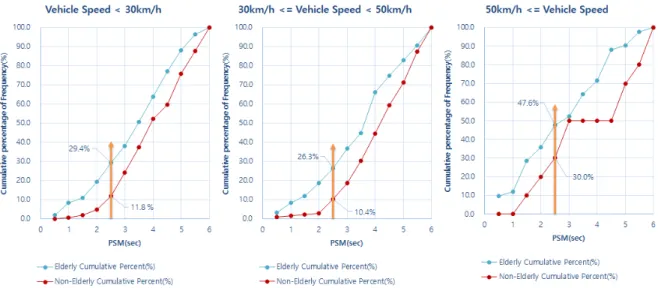
Traffic accident fatalities in Korea in 2016 was 4,292 and 1,732 cases were deaths of elderly people. In spite of this, the researches on behaviors of the elderly when crossing roads, are rather limited. The purpose of this study is to investigate and analyze road crossing behavior characteristics of the elderly, when crossing roads, especially focusing on the characteristics of pedestrians and vehicles. Cross-sectional data was collected from six different sites in two regions and the following results was identified. First, at road crossings, 528 cases(84.3%) out of 626 conflict situations of the elderly and 303 cases(63.3%) out of 478 conflict situations of the non-elderly pedestrians were found to be dangerous, respectively. The elderly tend to face a statistically significant risk of 3.11 times higher than that of non-elderly people. Second, 519 cases(82.9%) of jaywalking occurred in 626 conflict cases of the elderly and 375 cases(78.5%) of jaywalking in 478 conflict events of non-elderly persons, which indicates the elderly’s 1.34 times higher trend compared with the non-elderly’s . Third, the pedestrian safety margin (PSM) analysis showed that the PSM of the elderly and the non-elderly were 3.33 seconds and 4.04 seconds respectively, which is 17.5% high. Fourth, the difference in pedestrian safety interval was examined by dividing the speed of approaching vehicle into less than 30km/h, above 30km/h and less than 50km/h, and over 50km/h. There was no significant difference between the PSM of coming vehicles with the speed less than 30km/h and the PSM of approaching with the speed 30km/h~50km/h, but the conflicts with vehicle of the speed above 50km/h show significantly lower PSM than with vehicle speed of 30km/h~50km/h. Finally, when the risk threshold is set to less than 2.5 seconds, the analysis shows that older pedestrians tend to cross roads dangerously 1.59~2.53 times than younger pedestrians. The results set forth here can be used as a basis for constructing the elderly safety measures at present and a potential basis for autonomous vehicle safety application in the future for solving the issue of the difference in crossing behavior between elderly and non-elderly pedestrians.
Keywords: elderly pedestrians, pedestrian safety margin(PSM), risk analysis, walking behavior, walking risk
Received: 7 October 2017 Revised: 20 November 2017 Accepted: 23 December 2017
Copyright Ⓒ
Korean Society of Transportation
This is an Open-Access article distributed under the terms of the Creative Commons Attribution Non-Commercial License(http://creativecommons.org/licenses/by-nc/3.0) which permits unrestricted non-commercial use, distribution, and reproduction in any medium, provided the original work is properly cited.
J. Korean Soc. Transp.
Vol.35, No.6, pp.499-510, December 2017 https://doi.org/10.7470/jkst.2017.35.6.499 pISSN : 1229-1366
eISSN : 2234-4217
초록
2016년 우 리나라 교통사고 사망자 수 4,292명 중, 노인사고 사망자 수는 1,732명에 달한다. 그럼에도, 고령 보행자 의 도로 횡단 특성에 대한 연구는 많지 않다. 본 연구는 보행자와 차량 간의 횡단특성을 고령 보행자 측면에서 조사 및 분석한 연구이다. 연구에서는 2개 지 역, 6개 지점에 대한 횡단 조사를 실시하였으며 주요 결과를 간략히 살펴보면 다 음과 같다. 첫째, 도로 횡단 시 고령자는 626건의 상충상황 중에서 528건(84.3%), 비고령자는 478건의 상충상황 중에서 303건(63.3%)이 위험상황으로 나타나, 고령자가 비고령자에 비하여 3.11배의 높은 통계적으로 유의한 위험 상황에 직 면하는 경향을 보였다. 둘째, 고령자의 경우 전체 626건의 상충상황 중에서 519건(82.9%)의 무단횡단이 나타났고, 비고 령자의 경우 478건의 상충 상황 중에서 375건(78.5%)를 보여, 고령자가 비고령자에 비하여 1.34배의 높은 통계적으로 유의한 무단 횡단 경향을 보였다. 셋째, 보행자안전간격(Pedestrian Safety Margin, PSM)을 분석 결과 고 령자의 PSM은 3.33초, 비고령자의 PSM은 4.04초로 고령자의 PSM은 비고령자보다 약 17.5%가 작은 경향 을 보였다. 넷째, 접근하는 차량의 속도를 30km/h 이하 차량, 30-50km/h 차량, 50km/h 이상인 차량으로 나누어 보 행자 안전간 격의 차이를 검토해 본 결과 속도30km/h 미만 차량과 속도 30km/h 이상 50km/h 미만 차량의 PSM은 유의미한 차이를 보이지 않지 만, 속도가 50km/h 이상인 차량과의 상충은 30km/h 미만과 30km/h 이상 50km/h 미 만보다 PSM 이 유의미하게 작아진다. 다섯째, 위험상황의 임계치를 PSM 2.5초 이하로 설정한 경우, 고령자가 비 고 령자 보다 1.59-2.53배 위험하게 횡단하는 경향을 보였다. 이러한 연구 결과는 향후 고령 보행자와 비고령보행자 의 횡단 행태 차이를 토대로 고령 보행자안전대책, 자율주행차량의 안전 등의 기반 연구로 활용할 수 있다.
주요어: 고령 보행자, 보행행태, 보행 위험, 보행자안전간격, 위험분석
서론
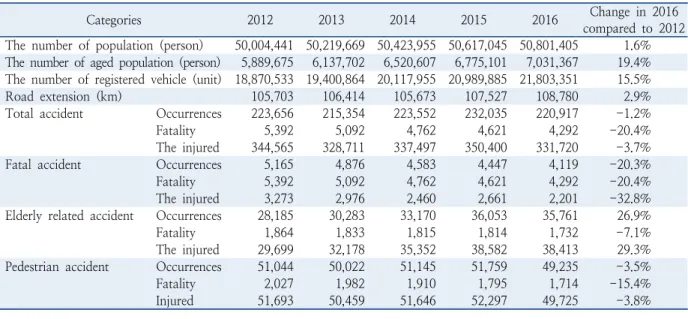
2017년 8월 말 기준 Statistics Korea(2017)의 인구총조사 자료에 따르면 65세 이상 고령 인구는 전체 인구의 14%를 넘는 7,257,288명으로 고령사회(Aged Society) 1) 로 진입하였다. 우리나라의 경우 2000년에 고령화 사회 2) 로 진입한 후 2017년에 고령사회가 되었는데 이는 세계에서 가장 빠른 속도라고 한다. 고령화 사회에서 고령사회로 된 기간은 프랑스의 경우 115년, 미국이 73년, 일본은 24년이 걸렸다. 이러한 우리나라의 빠른 고령화의 원인은 출 생 률의 저하와 사망률의 저하에 있다. 교통안전분야의 통계 지표 3) 를 살펴보면, 2016년 전체 사망사고는 4,292명이 며, 이 중 노인사고 사망자수는 1,732명에 달한다. 사고건수 측면에서는 전체 220,917건이며, 노인사고 건수는 35,761건이다. 두 가지 통계에서 전체 사고건수의 16.1%가 고령자사고이나, 사망사고 측면에서는 전체사고의 40.3%에 달한다. 고령 인구와 고령 교통사고의 현황을 볼 때 고령자의 교통사고 심각도는 비고령자에 비해 매우 높 다고 볼 수 있다. 고령화 추세는 급속히 진행되고 있어 사회전반적인 문제인식과 함께, 교통 분야에서도 고령 교통사 고와 관 련한 대책을 수립하고 이에 대한 연구들도 증가하고 있다. 국토교통부 제 8차 국가교통안전기본계획 (2017-2021)의 중점과제 중 하나로 보행 중 교통사고 사망자 43%(759명) 감축(‘15년 1764명 → ’21년 1,005명)으 로 제시하고 보행자 안전대책 수 립, 어린이 ․ 노인보호구역 확대, 보행자 사고 상시점검체계 구축 등을 수행하고 있 다. 고 령자 교통안전대책으로 고령운전자 맞춤형 사고예방대책이나 노인 질환자(치매 등)에 대한 면허 관리강화, 고 령자 교통사고예방 캠페인 등 다각적인 노력을 수행할 것으로 보인다. 그러나 학술적 측면에서는 고령 운전자에 대 한 연구는 활발 히 진행되었으나 고령 보행자에 대한 행태분석 및 사고 원인 분석 등의 국내 연구는 미비한 실정이다.
이에 비해 이미 고 령화 사회로 진입한 프랑스, 미국 등에서는 관련 고령 보행자 연구를 활발히 수행하고 고령 보행자 의 훈련 등에 활용하는 방법 등을 제시하고 있다.
1) 65세 이상 인구의 총인구를 차지하는 비율이 14% 이상인 사회 2) 65세 이상 인구의 총인구를 차지하는 비율이 7% 이상인 사회 3) http://taas.koroad.or.kr