• 검색 결과가 없습니다.

Application of Motion Analysis to User Participation Behavior Model: Focused on Interactive Space

N/A
N/A
Protected

Academic year: 2021

Share "Application of Motion Analysis to User Participation Behavior Model: Focused on Interactive Space"

Copied!
15
0
0

로드 중.... (전체 텍스트 보기)

전체 글

(1)

JESK http://jesk.or.kr eISSN:2093-8462

Application of Motion Analysis to User Participation Behavior Model: Focused on Interactive Space

Jieun Kwon

1

, Ken Nah

2

1

Emotion Engineering, Sangmyung University, Seoul, 110-743

2

Design Management, International Design school of for Advanced Studies (IDAS), Hongik University, Seoul, 110-460

Corresponding Author Ken Nah

Design Management, International Design school of for Advanced Studies (IDAS), Hongik University, Seoul, 110-460 Mobile : +82-10-3054-7858 Email : [email protected]

Received : January 02, 2014 Revised : April 19, 2014 Accepted : April 21, 2014

Objective: The goal of this research is to develop new user behavior model using user motion analysis with microscopic perspective for attracting user's participation in interactive space.

Background: The interactive space is 'human's place', which is made up of complex elements of digital virtual space and traditional analog and physical environment based on human-computer interaction system. Human behavior has changed in it at the same time. If the user couldn't make participation in interaction, the purpose of the system is not met, which reduces its effect. Therefore, we need to focus on interactive space that is potential future direction from a new point of view.

Method: For this research, we would discuss and study fields of interactive space;

(1) finding definition of interactive space and studying background of theory about it. (2) providing base of user behavior model with study of user's context that is to be user information and motion. (3) examining user motion, classify basic motion type and making user participation behavior model in phases.

Results: Through this process, user's basic twenty motions which are systematized are taken as a standard for analysis of interaction process and participation in interactive space. Then, ‘NK-I

5

(I Five)' model is developed for user participation types in interactive space. There are five phases of user participation behavior: Imperception, Interest, Involvement, Immersion, and Influence. In this analysis, three indicators which are time, motion types, and user relationship are found to be related to participation.

Conclusion: The capabilities and limitation of this research is discussed to attract user participation. This paper focuses especially on contribution of design to lead user's participation in interactive system and expectation to help adapt to user centered design of various interactive space with new aspect of user behavior research.

Application: The results of the ‘NK-I

5

(I Five)' model might help to realize successful interactive space based on user centered design.

Keywords: Interactive Space, Motion Analysis, User Behavior, Participation

Copyright@2014 by Ergonomics Society of Korea. All right reserved.

cc This is an open-access article distributed under the terms of the Creative Commons Attribution Non-Commercial License (http://

creativecommons.org/licenses/by-nc/3.0/), which permits unrestricted non-commercial use, distribution, and reproduction in any medium, provided the original work is properly cited.
1. Introduction

Interactive space which is made by high technology and multimedia lets users

participate in it and give them experience if interaction is achieved. For these positive

effects, interactive space is rapidly developed in public place and commercial media

such as OOH (Out-Of-Home) advertisement. Interactive space is futuristic media which

(2)

can develop with ubiquitous computing environment and due to this interactive space is increasing on the other hand, in the point of effectiveness these hasn't been great results. The research into user entered interactive space design is insufficient. The study into the user and space system relationship within the interactive space is also weak. Therefore we need to study on user behavior that is suitable for expanded space concept using user's motion as characteristic of the interactive space.

While recognizing these needs, we would research users and their behavior from a new point of view for effective design in interactive space which is made by complicated form. Usually user behavior has been studied from a macroscopic view but we would analysis user's detailed motion in micro perspective. A goal of this article is to develop new participation behavior model in microscopic point of view to suggest method of attracting user's participation in interactive space.

For this research, first, we would find the definition of interactive space and then look into the scope and target of which we would test. The concept and theory would follow from literature investigation using theses, books, dictionaries, papers and internet information. Second, user's motions are analyzed in interactive space. Then motion data are gathered and analyzed as four steps as follows: motion enumeration, motion classification, motion mapping, and motion analysis. Third, we would find user participation relationship indicator and develop participation behavior model based on the analyzed data.

Through this process, we systematized user 20 basic motions. This could be the standard for analysis of interaction and participation process in interactive space. Also 'NK-I

5

(I Five)' is established for user participation phases. The five phases are Imperception, Interest, Involvement, Immersion, and Influence. Each phase is defined by user motion condition and specified by its characteristics. These results would contribute design which attracts user participation in interactive space that is futuristic system. We expect that new point of view of user behavior will be applied to a variety of human centered design in the future.

2. Interactive Space

2.1 The concept of interactive space

One of the core elements which expand to interactive space from traditional space is 'interaction'. Therefore we defined a concept of interaction in interactive space. Through the definition of interface based on communication, we interpret precise meaning and term and clarify dilatational interactive space.

2.1.1 Interaction

'Interface' has two dictionary definitions. The first, interface is a surface forming a common boundary of two bodies, spaces, or phases. The second, it is the place at which independent and often unrelated systems meet and act on or communicate with each other, or the means by which interaction or communication is achieved at an interface (Merriam-Webster Online Dictionary, 2013).

The first definition of interface means place where two independent systems. In the past, meaning of place of contact is strong between human and human, space and human, object and human and object and object. However, now, the meaning has expanded to coordinate point due to the increasing physical UI such as touch screen and high technology computer. Actually, another dictionary define interface as not place but point (Oxford Dictionaries, 2013).

Secondly the ways and methods between the two independent systems mean communication on the view point of interaction.

There are various methods such as physical behavior, contact with object, frequency and electronic signal.

(3)

As mentioned above, interface is the place at which independent systems, or the means of communication. The two types of systems and means of communication mentioned here can change its meaning and target due to the flowing trend. The specific methods also emphasized. This communication is connected with 'Interaction'. Based on the concept of interaction interactive space is an independent system.

2.1.2 Space

Current space seeks movement and establishes new order which breaks away from the action previous static place architecture rules and forms. Also hybrid space is increasing because of digitalizing. Space is expanding along with physical movement and interaction.

In this article, we would like to call interactive space based on concept of interaction we have defined. We would say that the concept of space is included in the following three point of view; perceptive space, space as system, inclusion of virtual space.

First, interactive space means the scale of perception. There are three scales of space which is the environment that surrounds people. The first scale is perceived space which allows people to detect things through all five senses. The second scale is that humans could recognize the scope of space even though it breaks away from the boundaries of what we can feel. For example, 'city' is recognized as a boundary of space. The third scale, which is the largest of the three, is geographical space.

The geographical space is difficult to recognize concretely but it is the scale to understand idea of space. For instance, it means like a 'country' (Lucy Bullivant, 2006). In this paper, interactive space is target which communication with humans five senses. That’

so why we would discuss perceived space which is the smallest space in point of view of physical and user could feel five senses.

The perceived space makes interactive space which is composed by physical environments including interactive media.

Second, space is a system based on idea of interface. A space including interaction matches with the conception of system like human-computer or human-object (Mark S. Sanders, et al., 1992). In the past, machine is physically seen as an interrelated assembles such as engine, delivering equipment, or working machinery. However, since modern period, the concept of machine has been expanded. Philosopher, Gilles Deleuze and Felix Guattari said that individuated material, in other words, object, is machine. They were focused more on the usage of machine than the mechanical character. Namely, everything which runs with methods of cutting and gathering material flow is machinery. The flow could be visible matter, sound, and human's movement.

Therefore, we would define that human is the user and space is the machinery system and discuss interaction in human-machine system.

Thirdly, I will use the concept of space not only physical space but also digitalized virtual space. The virtual reality is expressed by visual method such as holographic which includes 3D graphics. And user could have experience with hardware like gesture sensor, HMD and so on. Also the ways of stimulating two senses at the same time is used more frequently than stimulating one sense at a time because synesthesia realization amplifies sense of reality.

2.2 The scope of analysis

In this research, I chose the scope of interactive space and will analyze user motions. There are two interactive spaces: one is noncommercial interactive space, "Your Destiny", which is my interactive installation artwork. Another is commercial interactive space, "IFC Mall brand OOH advertisement".

The test environment was considered by greatly distinguished online interaction and the clearly shown characteristics of interactive

(4)

space. Especially, whole body interaction which can express all the motions of the users was selected. A method of input is camera motion tracking that take in the data of users' body motions and the means of output is video projection and sound through stereo speakers.

Basically the users were unspecified in interactive space. We didn't specifically select any to observe natural motion and situation.

All users were recorded without distinction of age or gender in view of the public space which is one of the characteristics of interactive space. Target of observation includes not only individual user but also group users. The video is shot on the spot where we can see whole space and recognize interactive media.

This test was performed when the interactive space was installed. ‘Your Destiny’ was shot in March, 2013, when it was displayed in a museum and the 'IFC Mall brand OOH advertisement' was recorded in December, 2012. We made the conditions and contents of interactive space as standard.

First, interactive space, 'Your Destiny' is the interactive installation art piece created by myself suing camera motion tracking.

There is independent space shaped like a room made by fake wall to display 'Your Destiny' in the Hangaram Design Museum, Seoul Art Center. When the audience comes into the installation space, they will first see a projection of the backside of the cards on a screen. A camera will recognize the visitor's movements. Cards will flip over in the shape of the visitor's silhouette, revealing the front of the cards. A pre-recorded voice will be heard by the audiences as the symbolic meaning of each revealed card. As the visitor moves and creates new silhouettes, a new display of front facing cards and voices are revealed like <Figure 1>.

Second, 'IFC Mall brand advertisement' which you could see <Figure 2> is installed in IFC (International Finance Centre) shopping

Mall, Yeouido, Seoul. It is made for brand commercial in Northartrium square, first basement level. This is a type of augmented

(5)

reality which is composited by live and virtual video with camera. The main interaction technology is real time response through tracking of passersby's movement.

3. User Motion Analysis

3.1 The first step: motion enumeration

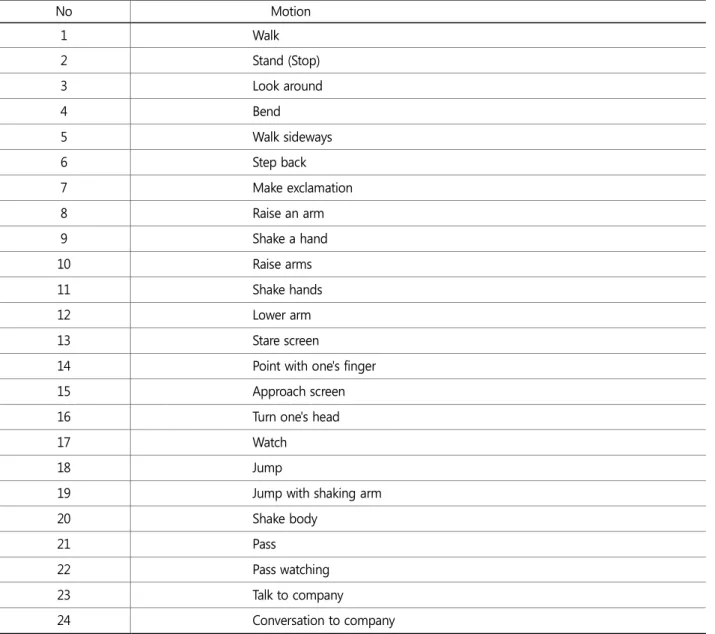
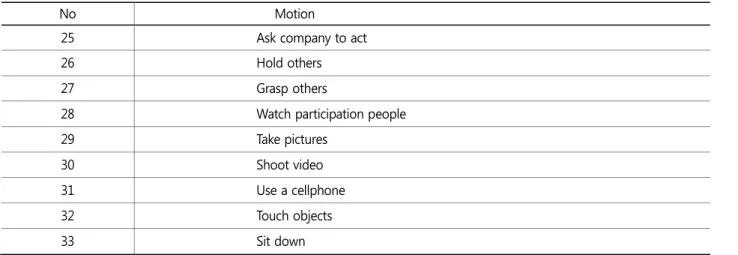
We extract users' action and motion using video ethnography in "Your Destiny" and "IFC Mall brand OOH advertisement". The scope of extracting motion is from the time of entering specific interactive space to the time of getting out of the interactive space. All recorded users' motions are enumerated randomly. The overlapped motions are filtered out and are organized based on the verb of the action. <Table 1> displays the thirty three motions.

Table 1. Motion enumeration

No Motion

1 Walk

2 Stand (Stop)

3 Look around

4 Bend

5 Walk sideways

6 Step back

7 Make exclamation

8 Raise an arm

9 Shake a hand

10 Raise arms

11 Shake hands

12 Lower arm

13 Stare screen

14 Point with one's finger

15 Approach screen

16 Turn one's head

17 Watch

18 Jump

19 Jump with shaking arm

20 Shake body

21 Pass

22 Pass watching

23 Talk to company

24 Conversation to company

(6)

3.2 The second step: motion classification

Thirty three motions which are enumerated in the first step are classified by body parts that make motions.

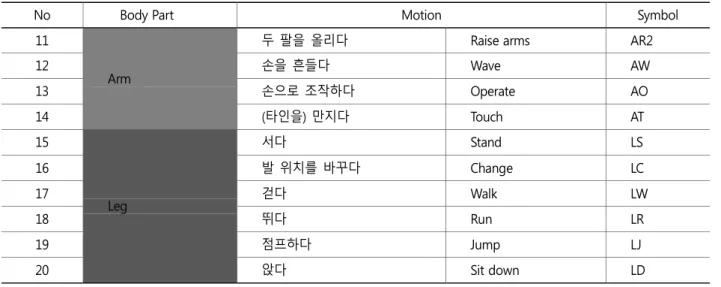
We organized the twenty basic motion types from, the thirty three enumerated into four categories: head, trunk, arm, and leg like <Table 2>. More two overlapping or continuing motions are combined into one motion unit. Similar motions are combined by the verb of the motion. For example, 'Pass Watching' is divided into two motions which are 'Pass' and 'Watching' and 'Pass' is included in the 'Walk' motion unit.

Each motion is designated by a representative verb and marked by a symbol which is matched by the noun and verb. For instance, the case of 'Watch' is shown by the 'HW' symbol, which is composed by 'H' that comes from the first alphabet of 'Head' and 'W' comes from the first alphabet of 'Watch'. For visual distinction, head is yellow, trunk is blue, arm is yellowgreen, and leg is purple.

However, they are replaced from bright to dark grey steps because of the black and white condition of publication in this paper.

Table 1. Motion enumeration (Continued)

No Motion

25 Ask company to act

26 Hold others

27 Grasp others

28 Watch participation people

29 Take pictures

30 Shoot video

31 Use a cellphone

32 Touch objects

33 Sit down

Table 2. Basic motion classification

No Body part Motion Symbol

1

Head

보다 Watch HW

2 머리를 돌리다 Turn HT

3 말하다 Speak HS

4 대화하다 Converse HC

5

Trunk

(똑바로) 유지하다 Keep TK

6 돌리다 (돌아서다) Turn TT

7 구부리다 Bend TB

8 흔들다 Shake TS

9

Arm 팔을 내리다 Down AD

10 한 팔을 올리다 Raise arm AR1

(7)

This basic motion built based on interactive space can be compared with the motion study which Frank B. Gilbreth and Lilian Gilbreth set up in traditional industrial engineering. The goal of Gilbreth's motion study is to reduce ineffective element and to improve efficiency through examination of each motion of the human body working in the industrial site. They would like to make work performance speedy and effective (Andris Freivalds, 2008). They developed eighteen basic motions, 'Therbrig' as follows:

Search, Find, Select, Grasp, Hold, Transport Loaded, Transport Empty, Position, Assemble, Use, Disassemble, Inspect, Preposition, Release Load, Unavoidable Delay, Avoidable Delay, Plan, Rest (Hak Whang, 2003). These basic motions are expressed by a graphical symbol, color. There are two types of Therbrig, one is efficient Therbig which helps promote work, and the other is inefficient Therbrig which doesn't.

The aim of the twenty basic motions which we have studied is the same as Gilbreth's Therbrig in point of view of microscopic analysis about human motion and promoting effectiveness. However, motions of Therbrig are classified by worker's motions which are centered in working behavior. Our twenty basic motions are focused on basic actions of the human body which measures the degree of participation with unspecified people. In other words, motions are organized by human's body part considering interactive space which consists of whole body interaction. Each motion has a symbol and specific color according to body part not action.

Therefore, this basic motion can judge the degree of participation with quantification of user's motion.

3.3 The third step: motion mapping

In the third step, we divided the thirty three basic motions into 5 phases depending on the degree of participation which ranges from passive degree to active degree. And then each degree is mapped in user's motion like <Figure 3>. We took representative samples in each phase and exported each frame per second from the recorded video of 'Your Destiny' and ‘IFC Mall brand OOH'.

Finally, we mapped symbols for each frame for microscopic motion analysis. It is possible to arise more than two motions simultaneously at each time.

Table 2. Basic motion classification (Continued)

No Body Part Motion Symbol

11

Arm

두 팔을 올리다 Raise arms AR2

12 손을 흔들다 Wave AW

13 손으로 조작하다 Operate AO

14 (타인을) 만지다 Touch AT

15

Leg

서다 Stand LS

16 발 위치를 바꾸다 Change LC

17 걷다 Walk LW

18 뛰다 Run LR

19 점프하다 Jump LJ

20 앉다 Sit down LD

(8)

3.4 The fourth step: motion analysis

Through this process, we got analysis results of three parts as follows: motion time, number of motion, and relationship among users.

3.4.1 Motion analysis according to time flow

First, the result of mapping the thirty three basic motions of users according to time flow for each type is shown in <Table 3>.

Second, the total time of whole process of user's participation is different in each phase. Total time extends to a longer period Table 3. Motion according time flow

1

st

Phase 2

nd

Phase 3

rd

Phase 4

th

Phase 5

th

Phase

Pass surroundings Pass surroundings Pass surroundings Pass surroundings Pass surroundings Get out of the

interactive space

Enter the interactive space

Enter the interactive space

Enter the interactive space

Enter the interactive space Perceive the

interactive media

Perceive the interactive media

Perceive the interactive media

Perceive the interactive media Get out of the

interactive space

The basic

motions come out

The basic

motions come out

The basic

motions come out Get out of the

interactive space

The active motions come out

The active motions come out Shoot videos Shoot videos Get out of the

interactive space

Communicate

information to others

Get out of the

interactive space

(9)

as the phase progresses. Relatively the first phase doesn't have action of participation. Therefore users just pass by interactive space without perception and are interested in other elements. That's why total time is short within 30 seconds. The third or fourth phase period becomes more than one minute because the user is moving and responding continuously with interesting interaction media.

Third, the performing time of each motion according to participation phase changes. The time of a motion extends to a long period as it progresses into the latter phase. For example, the time rate of 'Watch (HW)' and 'Change (LC)', and 'Raise arm (AR1)' increases in the latter phases. These motions are shown by interest and respondent in interactive media, because the user pays attention at the screen and raises arms to try to participate with interaction. As the phase progresses, the rate of 'Change (LC)' which can be factor to pass by space without perception is increasing more than the rate of 'Walk (LW)' which can be a factor to look and perceive interactive media. It shows active participation.

3.4.2. Motion analysis according to motion type

The second part is about the number of motion. We recorded the sum of the number of times each motion appeared which analyze motion mapping to each second frame put it in a graph <Figure 4> to visually show the results.

First, we analyze the number of motion. The most number of motions are 'Watch (HW)' in head part, 'Keep (TK)' in trunk part, 'Down (AD)' in arm part, and 'Stand (LS)' in leg part. These are fundamental positions which we can see in general space. The number of each motion increases in the latter phase. Basically, as the phase progresses, the time of total motion is prolonged and the number of motion which is corresponded to one frame perks up. In other words, increasing of total number of motion presents quantity of user's motion.

Increasing number of motion within one frame means that complicated motions are happening. Multiple body parts move at

one go such as moving arm with staring screen and taking picture. These multiple motions show that user move actively with

his will and his participation is more involved.

(10)

Second, types of motion which are classified by body parts vary depending on phases. Some types of body parts are more prominent in the latter phases. The part of arm shows up in the third phase and raising and waving arm turns up in the fourth and fifth phases. Usually, user arms are relaxed comfortably at their sides but if he raises and waves arm, it means active participation. Shooting video or taking a picture is appeared in latter phase and 'Converse (HC)' and 'Touch (AT)' turn up in the fifth phase. Therefore, motion type is in relationship with the phase of participation.

Third, there is a point of the time when motion change becomes a continual action. Motion change presents more in latter phases than in the former phases relatively shown in <Figure 5>. Especially, when we look at each body part separately, the frequency of arm, and leg changes increases in latter phases. Motion change is continually occurring in interactive space. This means that response of interaction is realized continually.

The time of motion change corresponds to when visual and auditory display in interactive space is perceived. This means that user checks display of output through the senses and then participates to control system in process of interaction.

3.4.3 Motion analysis according to relationship among users

This is relationship among users. First, user makes individual participation and group participation with companies. Characteristics of motions present differently according to individual or group users. 'Speak (HS)', 'Converse (HC)', 'Touch (AT)' and 'Operate (AO)' which users use cellphone are also visible in case of being with company, even though they could be shown in individual users.

This motion within group users is presented in presents in the latter phase. 'Converse (HC)', 'Touch (AT)' only presents in group user setting as these motions helps to share information and lead to other's participation.

Directly, users speak and touch others to attract participation. On the other hand, user provides others indirect experience which is not in interactive space while he shoots the video or takes pictures and upload files on SNS. The fifth phase contains the most active participation which a user influences others with these motions.

Second, users observe each other. In the case of the second phase, there is no specific motion and motion of arm part, but the

rate of 'Watch (HW)' is high. This describes that the user stands and watches the screen and others in interactive space, but he

doesn't act actively. Users could unintended influence each other in interactive space. Someone could learn through watching

others who participate in interaction and provide motivation to take part in interactive space. Therefore user's relationship could

be a factor to intensify participation with each other.

(11)

4. User Participation Behavior Model 4.1 Participation Indicator

As the result of mapping user's motion based on motion the time and analysis, we found that the relationship of motion attracts participation in interactive space. There are three main indicators related to participation which are as follows; motion time, type of motion, and relationship among users. These factors which are taken as the indicator could be expressed in the following function.

Participation = f(Motion time(t), Motion type(m), Relationship among users(u))

<Figure 6> is organized by whole participation indictors. We arrange total time, number of motion type, relationship to among users according to the five phases. The number of each motion is marked in the relevant parts of the human model using large, medium, and small size circles. In relationship among users, individual and group users are written partitively.

4.2 NK-I

5

Model

We gave the name to five phases based on analysis of user motion and built the definition for each phase. Finally, the user

behavior model, 'NK-I

5

(I Five)' Model is developed like <Figure 7>. The title of the model is composed of the alphabet 'I' of each

(12)

phase and the alphabet 'N', and 'K' which derived from the last names of the two developers.

4.2.1 Imperception

The first phase doesn't strictly show much participation. Users can't perceive interactive space and just pass by it. Therefore, we called this phase, "Imperception". Some users don't join with their intention in interaction. Others could not participate without their will. Even though users reach interactive space, they don't have a chance to judge to enter or not without perception. In this phase, there is no specific motion such as motion of arm part and watching a screen. However, there are only motions of passerby's walking and stop. The total time of user's motion is very short. However, passerby who just passes by interaction system without perception could influence other's perception in interactive space which has automatic feedback.

4.2.2 Interest

The second phase, 'Interest' is a type of observation of other participants and the process of participation without joining in interaction by oneself. Therefore, the rate of fundamental motion such as 'Stand (LS)', is high and specific motion of arm part isn't shown. Users have interest and curiosity but he doesn't involve himself in interaction. So the rate of motion change is low and total time of motion is short.

4.2.3 Involvement

The third phase, 'Involvement' takes trial of participation as it enters in interactive space and perceiving interaction. Users notice interaction but he has passive response such as raising arm or change foot. However, there are no aggressive movement such as jumping and shaking body.

4.2.4 Immersion

The fourth phase, 'Immersion' contains more active participation types compared to 'Involvement'. The user of this type precisely

perceived process and methods of interaction. Multiple motions are continually shown to respond actively and check feedback

about display of interaction. There are a lot of motion of leg part such as 'Jump (LJ)' and 'Change (LC)'. And the number of

waving arm is high. However, only individual user participates in interactive space and he doesn't share information directly.

(13)

4.2.5 Influence

The fifth phase is the most active type. Users not only take part in interaction actively but also attract other's participation and share information. That's why we called this phase, 'Influence'. Users let others know directly about the process of participation and interaction system in the same space. Users share data which was taken through video or picture in the Immersion phase with others through online and social community. This does not only reach the original goal of interactive space but also influences other users indirectly in commercial interactive space. Therefore, motion of group user is presented more than the motion of an individual and the motion rate of arm part is very high. Multiple motions that contain more than two motions at the same time are displayed in large numbers. This phase shows increased active participation according to the prolonged total time of motion.

<Figure 8> is the summary of five phases.

5. Conclusion

In this research, behavior model which could attract participation using user's motion is developed. We would like to make a foundation of effective interactive design for creating interactive space which is expected to grow. For this study, we focused on classifying and analysis of user behavior.

First, we analyzed the relationship between user participation and user motion in a microscopic point of view. We tried to turn

(14)

to the microscopic view from macroscopic view to study user motion. The relationship of participation phase is built and time of motion, type of motion, and relationship among users are set up as indicators.

Second, user behavior is observed and analyzed through detail motion type and movement in interactive space which is a new concept. Basic motions are classified by body part as follows; Head, Trunk, Arm, and Leg. Each body part is divided into through motions and finally twenty motions are extracted. User’s motion are classified and analyzed quantitatively as mapping in the five participation phases. The result of the analysis is that function is defined by indicators related to time, motion type, and user relationship. Visualization of the indicators and graphs of the analyzed data help compare the phases with each other. This definition of indicator and quantitive analysis could suggest a standard for evaluation and help apply a framework to design interactive space. It could judge which phase interactive space is developed. We could study effective methods and apply an upgraded design to enhance latter phases.

Third, five phases are found by degree of user's participation as follows; Imperception, Interest, Involvement, Immersion, Influence and this model is called 'NK-I

5

(I Five)'. The most former phase is Imperception in which user could not perceive interactive space.

There are the phase of Interest in which user observes others, the phase of Involvement in which user joins in interactive space by oneself, and the phase of Immersion in which user is absorbed in participation. The most latter phase is Influence in which user mediates others. In a new point of view based on the concepts and features of interactive space, the core point of this paper is the development of user participation behavior model according to participation phase which has been studied in other media.

Fourth, after this research, behavior study on more complicated interactive space will be needed in the future. Recently, interactive space is emerging not only through camera and electronic displays but also through combined media linked with the mobile.

Particularly, it is expected that continuous study on measures effectiveness of interactive space in commercial area will be asked.

We anticipate that user participation behavior model would apply to framework for commercial design and use to predict effectiveness. This behavior model would be a foundation to progress for interactive space which is becoming more complicated.

References

Andrea cornwall. Unpacking 'Participation': models, meanings and practices, Oxford University Press and Community development Journal , Advance Access Publication, 2008.

Andris Freivalds, Benjamin Niebel, Niebel's Methods, Standards & Work Design , McGraw-Hill, 2008.

Chul-Jae Lee, The Epistemological Interpretation of the Spatial Configuration of Digitalism, Hongik University , 2003.

Dan Saffer, Designing for Interaction: Creating Innovative Applications and Devices , Voice That Matter, 2009.

Donald Norman, The Psychology of Everyday Things, Basic Books, 1988.

Hak Whang, Work Management Theory ,Youngchi Publishers, 2008.

Jinhee Park, A Study on Reorganization of Space Perception in Stereoscopic Images, Yonsei University, 2008.

John Wiley, et al. Interaction Design, beyond human-computer interaction, Wiley, 2007.

Ken Nah, Design Power Station , Visual Story Gongjang, 2008.

(15)

Kevin. F., et al. A New Framework for Building Participation in the Art , RAND Corporation, 2001.

Kyung Ah Lee, A Study of FEEM (Function-Emotion-EXPERIENCE-Meaning) Model and Development of its Evaluation Tool of Conceptual Model for Space Design, Hongik University , 2012.

Lucy Bullivant, Responsive Environments: Architecture, Art and Design , Victoria & Albert Museum, 2006.

Mark S. Sanders, et al. Human Factors in Engineering and Design , McGraw-Hill, 1992.

Merriam-Webster Online Dictionary , http://www.merriam-webster.com (retrieved October, 2013).

Michael Fox, et al. Interactive Architecture , Princeton Architectural Press, 2009.

Mja Pantic, Alex Pentland, Anton Nijholt and Thomas Huang T.S., Human Computing and Machine Understanding of Human Behavior: A Survey, Human Computing , LNAI 4451, 2007.

Noah Wardrip-Fruin, et al. the New Media Reader . The MIT Press, 2003.

Oxford Dictionaries , http://oxforddictionaries.com (retrieved October, 2013)

Panero, J. and Zelnik, M., Anthropometric (body) measurements of most use to designers of interior spaces, 1979.

Philip, N., et al. Mental Models . Harvard University Press, 1986.

Wicken, et al. Engineering Psychology and Human Performance , Haper Collines, 1992.

Wu, G., Conceptualizing and Measuring the Perceived Interactivity of Websites, Journal of Current Issues & Research in Advertising, Volume 28, Issue 1, 2006.

Author listings

Jieun Kwon: [email protected]

Highest degree: Ph.D. in Design, Hongik University

Position title: Professor, Department of Emotion Engineering, Sangmyung University Areas of interest: UX Design, Interaction Design, HCI

Ken Nah: [email protected]

Highest degree: Ph.D. in Engineering Design, Tufts University.

Position title: Professor, Department of Design Management, International Design school of for Advanced Studies (IDAS), Hongik University

Areas of interest: HCI, Design Management

수치

Table 1. Motion enumeration
Table 1. Motion enumeration (Continued)
Table 2. Basic motion classification (Continued)

참조

관련 문서

The purpose of this study is to analyze the effects of sports marketing strategy fit on organizational attitude and organizational citizenship behavior

The purpose of this study is to analyze the influence of dance leaders' inst ructional behavior patterns on participants' desire to participate and

That is, the aim of this research is to investigate the military strategy in North Korea on Jeong Eun Kim era from Military Science point of view by analyzing the change

The results of analysis on the difference of psychological happiness according to frequency of participation of external physical activity of female middle school

As for the number of participation, significant difference was found in accessibility, attractiveness and comfort of physical environment, recognition and

A Study on the Evaluation of Space Recognition Space Recognition Space Recognition in the Space Recognition in the in the in the Concourse of Hospital using the

In this paper, the power line characteristics as the view point of communication channel are investigated and the technologies of PLC are proposed to

This study was conducted to develop and evaluate the effects of a posture management program based on the theory of planned behavior (TPB) which was