Effect of Olive Oil Substitution Ratio on Quality Characteristics of Low-fat Pork Patty
Si-Hyung Lee1, Young-Joon Choi1, Kyoung-Sook Lee1, In-Chul Jung1, Kyung-Soo Lee2 and Gang-Won Choi1*
1Division of Hotel Culinary Arts, Daegu Technical University, Daegu 42734, Korea
2Division of Food Beverage and Culinary Arts, Youngnam University College, Daegu 42415, Korea Received March 10, 2020 /Revised June 14, 2020 /Accepted June 16, 2020
This study investigated the effect of olive oil substitution ratio on physicochemical quality of pork patty. Five treatments were performed as follows: control (T0, 20% pork fat), T1 (pork fat 15% and olive oil gel 5%), T2 (pork fat 10% and olive oil gel 10%), T3 (pork fat 5% and olive oil gel 15%), and T4 (olive oil gel 20%). The moisture increased and fat amount was decreased in proportion to olive oil substitution ratio. The L* and a* values were highest levels in raw and cooked pork patty of T0, and the b* value was highly enhanced in of cooked pork patty of T4. The water holding ca- pacity, moisture and fat retention were significantly increased, and the cooking loss, diameter reduc- tion and shrinkage ratio were decreased by olive oil substitution ratio. The hardness, springiness and chewiness showed the highest level in T4, and the cohesiveness and gumminess were highest in T0.
The reduction ratio of cholesterol in T1, T2, T3 and T4 were 13.8%, 21.6%, 34.5% and 49.0%, re- spectively, indicating that the content was lowest level in T4. The palmitic acid was the most abun- dant saturated fatty acid, and the oleic acid was the most abundant unsaturated fatty acid. The un- saturated fatty acid of pork patty was increased in proportion to olive oil substitution ratio. Therefore, the olive oil gel substitution of low-fat pork patty results in a positive effect on the physicochemical qualities due to reduced cholesterol and saturated fatty acids.
Key words : Cholesterol, fatty acid composition, low-fat pork patty, olive oil substitution
*Corresponding author
*Tel : +82-53-560-3857, Fax : +82-53-560-3859
*E-mail : [email protected]
This is an Open-Access article distributed under the terms of the Creative Commons Attribution Non-Commercial License (http://creativecommons.org/licenses/by-nc/3.0) which permits unrestricted non-commercial use, distribution, and reproduction in any medium, provided the original work is properly cited.
Journal of Life Science 2020 Vol. 30. No. 7. 606~613 DOI : https://doi.org/10.5352/JLS.2020.30.7.606
서 론
올리브유는 올리브 열매를 압착하여 얻어지는 담황색의 천 연유지로서 지중해 연안 지역에서 주요 식용 유지로 사용되어 왔으며, 우리나라에서도 최근에 드레싱, 튀김 등에 사용하면 서 소비량이 증가하고 있다. 올리브유는 단일 불포화지방산인 oleic acid가 다량 함유되어 있고, phytosterols, carotenoids, tocopherols 등과 hydroxytyrosol, tyrosol, oleuropein 등의 페 놀화합물을 가지고 있어서 인간의 생명유지에 중요한 식용유 이다[12, 16]. 올리브유의 생리활성 기능으로서는 혈압저하, 혈 청 콜레스테롤 감소, 심혈관 질환 예방, 손상된 조직과 세포 회복, 항암 작용, HDL 콜레스테롤 증가, 천식 완화, 항산화 작용 등이 있는 것으로 보고되고 있다[22, 30]. 최근에는 세절 하여 제조하는 육제품에 동물성 지방의 대체 유지로서의 이용 가능성에 대한 연구도 활발하게 이루어지고 있다.
현대사회의 식생활은 맞벌이 가정 및 1인 가구 증가, 음식문 화의 서구화, 외식산업 발전 등으로 쉽게 이용할 수 있는 패스 트푸드 형태의 육제품 소비량이 증가하고 있다. 패스트푸드 중에서 고기를 세절하여 제조하는 햄버거 패티, 너겟, 미트볼, 떡갈비, 소시지 등은 고유의 품질 및 관능 특성을 유지하기 위하여 지방을 20-30% 정도 첨가하고 있다[14]. 육제품에 함유 된 지방은 동물성지방으로서 필수지방산, 지용성비타민 등을 공급하고, 유화 안정성, 조직 특성, 다즙성, 풍미 등의 특성을 부여하는 효과가 있다[2]. 그러나 동물성 지방은 포화지방산 함량이 높으며, 과다 섭취할 경우 고혈압, 비만, 심혈관 질환, 당뇨병, 대장암 같은 질환의 원인이 된다[28, 33]. 따라서 최근 세절한 육제품의 연구에 대한 초점은 식물성유를 첨가하여 육제품 본연의 품질을 유지하면서 지방 함량을 감소시키고, 지방산조성을 개선하는 것이다.
동물성지방을 식물성유로 대체한 연구에서 Choi 등[6]은 돈 육 패티에 올리브유, 대두유 및 카놀라유를 첨가한 경우 보수 력, 맛, 풍미 등이 향상되고, 불포화지방산 비율이 증가한다고 하였으며, Monteiro 등[24]은 소시지에 카놀라유를 첨가한 경 우 지방산조성이 개선된다고 하였다. Wang 등[33]은 소시지 에 동백 기름을 대체한 경우 지방함량이 감소되고, oleic acid 가 증가한다고 하였으며, Silva 등[31]은 해바라기 기름으로 대체한 소시지는 콜레스테롤 함량이 감소한다고 보고하였다.
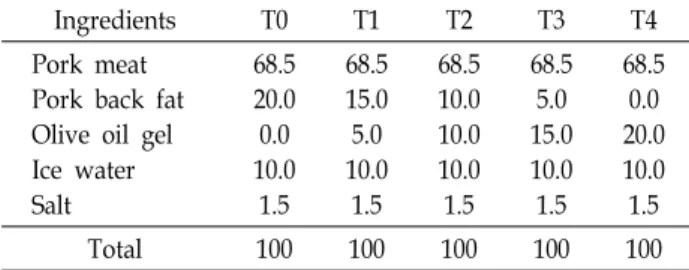
Table 1. Formulation of pork patty mixed with olive oil gel (%)
Ingredients T0 T1 T2 T3 T4
Pork meat Pork back fat Olive oil gel Ice water Salt
68.5 20.0 0.0 10.0
1.5 68.5 15.0 5.0 10.0
1.5 68.5 10.0 10.0 10.0 1.5
68.5 5.0 15.0 10.0 1.5
68.5 0.0 20.0 10.0 1.5
Total 100 100 100 100 100
T0 with pork fat 20%, T1 with pork fat 15% + olive oil gel 5%, T2 with pork fat 10% + olive oil gel 10%, T3 with pork fat 5% + olive oil gel 15%, and T4 with olive oil gel 20%.
따라서 본 연구는 기능성 성분과 불포화지방산 함량이 높은 액상의 올리브유를 친수성 콜로이드인 카라기난으로 겔화시 켜 저지방 돈육 패티 제조 과정에 첨가하고, 돼지 지방을 올리 브유 겔로 부분적으로 대체한 경우 대체 비율에 따라 콜레스 테롤, 지방산 조성 및 품질 특성에 미치는 긍정적인 효과를 얻기 위하여 연구를 수행하였다.
재료 및 방법 올리브유 겔 제조
올리브유 겔은 올리브유(Sajo Co., Incheon, Korea) 80 g, i-carrageenan (MSC Co., Yangsan, Korea) 20 g 및 냉각수 100 g을 혼합기(K5SS, Kitchen Aid Inc., Benton Harbor, MI, USA) 로 10분간 혼합하였다.
돈육 패티 제조
돈육 패티 제조에 사용한 국내산 뒷다리 살과 등지방은 경 매 당일의 것을 식육 전문 매장에서 구입하였으며, 과도하게 붙어 있는 지방과 결체 조직은 제거하여 3 mm (IS-12S, Ilshin Machine Co., Daegu, Korea)로 분쇄하였다. 배합 비율은 Table 1과 같이 돈육 68.5%, 냉각수 10%, 소금 1.5%에 대조군(T0)은 돼지 지방 20%, T1은 돼지 지방 15%와 올리브유 겔 5%, T2는 돼지 지방 10%와 올리브유 겔 10%, T3는 돼지 지방 5%와 올리 브유 겔 15%, 그리고 T4는 올리브유 겔 20%를 첨가하여 혼합기 (SP-800, Spar Food Machinery MFG Co., Taichung, Taiwan) 로 혼합하고 무게 100±3 g, 직경 80±1 mm, 두께 20±1 mm로 성형하여 2일 동안 숙성한 후 실험에 사용하였다.
일반 성분 측정
일반 성분은 식품공전[18]에 준하여 수분 함량은 105℃ 상 압가열건조법, 조단백질 함량은 micro Kjeldahl법, 조지방 함 량은 Soxhlet 추출법, 그리고 조회분 함량은 550℃ 직접 건식 회화법으로 측정하였다.
표면 색도 측정
표면 색도는 색도계(CR-400, Konica Minota Inc., Osaka,
Japan)로 백색도(L*), 적색도(a*) 및 황색도(b*)를 측정하였으며, 색도 보정을 위한 standard color는 L* 94.29, a* -1.26 및 b* 3.94였다. 가열 전 생육은 패티 표면에 색도계를 직접 접촉하 여 측정하였으며, 가열 패티는 200℃로 예비 가열된 가스 오븐 (RFO-900, Rinnai Co., Incheon, Korea)에서 중심 온도가 75℃
가 되도록 하여 측정하였다.
보수력 및 조리 특성
보수력은 Hoffman 등[15]의 방법에 따라 70℃의 건조기 (Jeio Tech Co., Daejeon, Korea)에서 건조시킨 여과지(No.2, Whatman, Maidstone, England) 위에 시료를 놓고 planimeter (X-Plan, Ushikata 360d II, Worth Point Co., Atlanta, GA, USA)로 눌러 여과지 위에 나타난 육의 면적을 수분의 면적에 대한 백분율로 나타내었다. 조리 감량은 200℃로 가열시킨 가 스 오븐(RFO-900, Rinnai Co.)에 거름망이 부착된 오븐용 트레 이 위에 놓고, 가열로 인한 수분과 지방이 배출될 수 있도록 하여 중심부 온도가 75℃되도록 가열하고 가열 전후 무게의 백분율로 나타내었다. 직경 감소율, 수분 보유율 및 지방 보유 율은 El-Magoli 등[8]의 방법, 수축율은 Murphy 등[25]의 방법 에 따라 아래의 식으로 계산하였다.
Diameter reduction (%) =
Raw diameter-Cooked diameter
× 100 Raw diameter
Shrinkage (%) =
(Raw thickness-Cooked thickness) + (Raw diameter-Cooked diameter) ×100
Raw thickness + Raw diameter Moisture retention (%) =
Cooking yield (%) × Cooked moisture content (%) 100
Fat retention (%) =
Cooked weigh (g) × Cooked fat (%) Raw weight (g) × Raw fat (%) ×100
기계적 조직 특성 측정
기계적 조직 특성은 가로×세로×높이를 40×15×5 mm로 자 른 후 rheometer (CR-200D, Sun Scientific Co., Tokyo, Japan) 를 이용하였다. 경도(hardness), 탄력성(springiness), 응집성 (cohesiveness)은 점탄성용 원형 adapter 25번(직경 10 mm)을 이용하여 table speed 120 mm/min, graph interval 30 m/sec, load cell (Max) 2 kg의 조건으로 측정하였다. 그리고 검성 (gumminess)은 peak max×cohesiveness로, 씹힘성(chewi- ness)은 (peak max÷distance)×springiness×cohesiveness로 계 산하였다.
Table 2. Chemical composition of pork patty containing different concentrations of olive oil gel (%)
Traits T0 T1 T2 T3 T4
Moisture Crude protein Crude fat Crude ash
64.8±1.0d 15.6±1.2 17.4±0.8a 2.2±0.3
67.9±1.0c 15.4±0.8 14.4±1.3b 2.3±0.3
69.6±1.1b 15.2±1.0 12.2±0.8c 2.7±0.5
71.2±0.8ab 15.0±0.9 11.6±0.9cd 2.3±0.2
72.1±1.0a 15.3±1.0 10.3±0.5d 2.4±0.4 All values are mean ± standard deviation.
a-dMeans within each row with different superscripts are significantly different (p<0.05).
콜레스테롤 함량 측정
콜레스테롤 함량은 시료 1 g을 ethanol (Samchun Chemical Co., Pyungtaek, Korea)로 추출하여 50% KOH (Samchun Chemical Co.)로 검화시켜, toluene (Samchun Chemical Co.) 으로 재 추출한 다음 0.5 M KOH (Samchun Chemical Co.)와 증류수로 toluene (Samchun Chemical Co.) 층을 수회 씻어준 다. 그리고 이 용액은 감압농축하고 demethyl formamide (Sigma Aldrich Co., St. Louis, MO, USA) 3 mL를 가하여 혼합 하고[3] GC (HP 5890 Series II, Hewlett Packard Co., Palo Alto, CA, USA)로 분석하였다. 분석 칼럼은 Agilent J&W HP-5 (30 m×0.320 mm, 0.25 μm, Agilent, Sata Clara, CA, USA)를 사용하였다. 검출 온도는 300℃이였고, carrier gas는 질소를 3 ml/min으로 사용하였다. 추출액의 주입부 온도는 300℃이 였으며, 칼럼 온도는 초기 260℃로 설정한 후 3℃/min의 속도 로 300℃까지 충분히 warming up시켰다.
지방산 조성 측정
지방산 조성은 Folch 등[9]의 방법으로 추출한 총 지질을 BF3-methanol를 이용하여 fatty acid methyl ester로 methyl- ation시킨 것을 capillary column (0007-1 PHATTM, 30 m×
0.25 mm, i.d. 0.25 μm, Quadrex Co., Bethany, CT, USA)이 부착된 gas chromatography (8610C, SRI Ins., Santa Clara, CA, USA)로 분석하였다. Carrier gas는 He (54.0/min)을 사용 하였고, sprit ratio는 1:50으로 하였다. Injector 온도는 250℃, detector 온도는 270℃로 설정하였다. Column oven 온도는 180℃에서 8분간 유지한 후 3℃/min 속도로 230℃까지 상승 시킨 후 10분간 유지하였다.
통계분석
본 연구의 결과는 항목별로 3회 반복하여 측정하고, 그 결과 는 SPSS Statistics (ver. 18.0, SPSS Inc., Chicago, IL, USA)로 통계분석하여 평균과 표준편차를 구하였다. 시료들 사이의 유 의성 검정은 분산분석(ANOVA)을 한 다음 유의성이 있는 경 우 Duncan의 다중범위검정으로 유의차(p<0.05)를 구하였다.
결과 및 고찰
올리브유 겔을 첨가한 돈육 패티의 일반 성분
돼지 지방 20%(T0), 돼지 지방 15%와 올리브유 겔 5%(T1), 돼지 지방 10%와 올리브유 겔 10%(T2), 돼지 지방 5%와 올리 브유 겔 15%(T3) 그리고 올리브유 겔 20%(T4)를 첨가한 돈육 패티의 일반 성분 함량은 Table 2에서 보는 바와 같다. 올리브 유 겔의 첨가 비율이 높을수록 수분 함량은 증가하였으며, 조 지방 함량은 감소하는 경향을 보였지만(p<0.05), 조단백질 및 조회분 함량은 시료들 사이에 유의한 차이가 없었다. 일반적 으로 제품의 일반 성분 함량은 구성하고 있는 원료의 성분 함량에 따라서 다르게 나타나는데, 돼지지방에는 약 15%의 수분과 약 80%의 지방이 함유되어 있고[34], 본 연구에서 제조 한 올리브유 겔에는 50%의 수분과 40%의 올리브유가 함유되 어 있어서 올리브유 겔 첨가량에 따라서 수분과 지방 함량이 다르게 나타난 결과다. 이와 같은 결과는 Choi 등[6]과 Wang 등[33]이 보고한 돼지 지방을 식물성유 겔로 대체한 경우 수분 함량은 증가하고, 지방 함량은 감소한다는 결과와 Alejandre 등[1]의 식물성유 겔의 첨가 비율이 높을수록 수분과 지방 함 량은 증가하고, 단백질과 회분은 차이가 없었다는 결과와도 일치한다.
올리브유 겔을 첨가한 돈육 패티의 색도
올리브유 겔 첨가 비율에 따른 가열 전후 돈육 패티의 색도 측정에 대한 결과는 Table 3에서 보는 바와 같이, 즉 가열 전 돈육 패티의 명도(lightness)인 L*값과 적색도(redness)인 a*값 은 올리브유 겔의 첨가 비율이 높을수록 감소하는 경향이었고 (p<0.05), 황색도(yellowness)인 b*값은 시료들 사이에 유의한 차이가 없었다. 가열 후 돈육 패티의 L*값과 a*값은 올리브유 겔 첨가 비율이 높을수록 감소하는 경향을 보였으나 가열 전 보다 감소하는 폭은 낮았다(p<0.05). 그리고 b*값은 T0보다 올 리브유 겔을 첨가한 돈육 패티가 높았으며(p<0.05), 첨가군 사 이에는 유의한 차이가 없었다. 육제품의 색깔은 myoglobin의 화학적 상태와 첨가하는 원료의 색깔이 영향을 미친다[29]. 올 리브유에는 담황색의 carotene과 녹색의 chlorophyll이 함유 되어 있어서[23] 돈육 패티의 가열 전 L*값과 a*값에 영향을 미쳤으며, 가열 후 올리브유 겔을 첨가한 돈육 패티의 경우 황색도가 높은 것은 가열에 의하여 올리브유에 함유된 녹색의 chlorophyll이 산화되어 나타난 결과로 판단된다[27]. 올리브 유는 chlorophyll이 11 mg/kg 내외 함유되어 있으며[4], 본 연구에 사용한 올리브유는 전체 중량에 대하여 T0, T1, T2 및
Table 3. Surface color of pork patty containing different concentrations of olive oil gel
Traits T0 T1 T2 T3 T4
Raw patty Lightness (L*) Redness (a*) Yellowness (b*)
62.7±0.5a 11.2±0.1a 12.26±0.6
61.1±1.1ab 11.0±0.6a 12.63±1.0
60.5±0.8b 11.3±0.5a 12.17±0.4
58.3±1.5c 10.1±0.1b 11.42±0.8
56.4±0.3d 9.4±0.3c 12.31±1.2 Cooked patty
Lightness (L*) Redness (a*) Yellowness (b*)
64.4±1.2a 5.6±0.2a 12.2±0.6b
64.3±0.6a 5.4±0.2a 14.5±0.6a
63.4±0.8ab 4.8±0.1b 14.9±0.4a
63.4±0.5ab 4.9±0.4b 14.7±0.8a
62.7±0.6b 4.9±0.2b 14.9±0.3a All values are mean ± standard deviation.
a-dMeans within each row with different superscripts are significantly different (p<0.05).
Table 4. Cooking properties of pork patty containing different concentrations of olive oil gel (%)
Traits T0 T1 T2 T3 T4
Water holding capacity Cooking loss
Diameter reduction Shrinkage ratio Moisture retention Fat retention
88.7±1.3d 25.8±1.1a 9.4±0.8a 6.4±0.2a 45.1±0.8d 79.3±1.2d
90.2±0.8cd 19.3±0.8b 7.8±1.0bc 6.1±0.4ab 51.6±1.2c 87.5±1.0c
91.1±1.5bc 15.0±2.4c 6.1±0.6cd 5.8±0.2b 54.9±0.6b 93.4±1.0b
94.4±1.8ab 11.6±1.8d 5.6±0.6d 5.2±0.2c 59.4±0.8a 97.5±0.8a
95.2±1.2a 10.7±1.6d 5.1±0.8d 4.4±0.5d 60.8±1.0a 99.7±1.2a All values are mean ± standard deviation.
a-dMeans within each row with different superscripts are significantly different (p<0.05).
T3가 각각 2%, 4%, 6% 및 8%이기 때문에 돈육 패티에 함유된 chlorophyll은 각각 0.22, 0.44, 0.66 및 0.88 mg/kg으로 미량 함유되어 있다. 즉, 가열 돈육 패티의 올리브유 겔 첨가량에 따른 황색도의 차이가 없는 것은 chlorophyll이 미량 함유되어 있어서 나타난 결과로 사료된다. 따라서 식물성유를 첨가한 육제품의 색깔 차이에 대한 연구에서 올리브유를 첨가한 분쇄 돈육의 L*값과 a*값이 대조군보다 낮았다는 Sim [32]과 Yoon 등[37]의 결과와 일치하는 경향을 보였다.
올리브유 겔을 첨가한 돈육 패티의 보수력 및 조리 특성 올리브유 겔을 첨가한 돈육 패티의 보수력과 조리 특성으로 서 조리 감량, 직경 감소율, 수축율, 수분 보유율, 지방 보유율 등을 측정하고 그 결과를 Table 4에 나타내었다. 올리브유 겔 첨가 비율이 높을수록 보수력, 수분 보유율 및 지방 보유율은 유의하게 증가하였다(p<0.05). 그러나 조리 감량, 직경 감소율 및 수축율은 올리브유 겔 첨가 비율에 따라 유의하게 감소하 는 경향을 보였다(p<0.05). 보수력 및 조리 특성은 생육 및 가 열육의 저장, 조리 등에 의한 수분 및 지방의 유출 억제, 근섬 유 단축 정도를 나타내는 지표로서 관능적인 탄력성, 다즙성 등에 영향을 미친다[5, 6]. 본 연구의 결과 올리브유 대체 비율 이 높을수록 돈육 패티의 수분과 지방의 유출을 억제하고, 근 섬유의 유연성을 확장하여 관능적 특성을 개선할 수 있을 것 으로 판단된다. 이러한 결과는 돼지 지방을 식물성유의 첨가 로 보수력이 높고, 조리 감량이 낮았다는 Lee 등[18]의 결과와
올리브유, 대두유 및 카놀라유로 대체한 돈육 패티의 보수력, 수분 보유율, 지방 보유율이 높고, 가열 감량, 직경 감소율 및 수축율이 낮았다는 Choi 등[6]의 결과와도 일치하였다. 또한 식물성유 겔을 첨가한 육제품의 보수력 및 조리 특성이 개선 된 것은 액상의 식물성유를 겔화시키는데 사용된 친수성의 carrageenan이 영향을 미쳐서 나타난 결과[13]로 판단된다. 본 연구에 사용한 carrageenan은 T1, T2, T3 및 T4가 시료 전체 중량의 각각 0.5%, 1.0%, 1.5% 및 2.0%였는데, carrageenan 첨 가량이 많을수록 돈육 패티에 함유되어 있는 수분과 지방의 결합력이 커짐으로써 보수력 및 조리 특성이 더 많이 개선되 었으며, 돈육 패티는 유화형 제품이기 때문에 향후 유화안전 성에 대한 연구도 이루어져야 하겠다.
올리브유 겔을 첨가한 돈육 패티의 기계적 조직 특성 올리브유 겔을 첨가하였을 때 돈육 패티의 기계적 조직감, 즉 경도(hardness), 탄력성(springiness), 응집성(cohesiveness), 검성(gumminess) 및 씹힘성(chewiness) 등을 측정한 결과는 Table 5에서 보는 바와 같다. 올리브유 겔 첨가 비율이 높을수 록 돼지 지방을 첨가한 대조군에 비하여 경도, 탄력성 및 씹힘 성 등은 증가하였으나, 응집성 및 검성은 감소하는 경향을 보 였다(p<0.05). 즉, 육제품 제조에 있어서 지방 첨가량이 증가할 수록 경도와 씹힘성을 낮추는 요인이 되고[38], 원료의 신선도 저하로 발생한 단백질 산화로 결합력이 약화되면 기계적 조직 감이 저하된다고 알려져 있다[20]. 본 연구에서 액상의 올리브
Table 5. Texture properties of pork patty containing different concentrations of olive oil gel
Traits T0 T1 T2 T3 T4
Hardness (g/cm2) Springiness(%) Cohesiveness(%) Gumminess (kg) Chewiness (g)
2.3±0.2d 48.8±1.8d 61.5±2.0a 104.1±7.5a 9.8±1.2c
2.7±0.2c 50.5±1.3cd 60.2±1.2a 101.9±5.3a 10.2±0.8bc
2.9±0.4bc 52.1±1.1bc 59.3±1.1ab 98.7±6.2ab 11.0±0.6ab
3.3±0.2ab 54.3±2.0ab 57.1±1.4bc 96.8±5.5ab 11.8±0.8ab
3.5±0.2a 55.3±1.2a 55.6±1.2c 94.7±2.4b 12.5±0.6a All values are mean ± standard deviation.
a-dMeans within each row with different superscripts are significantly different (p<0.05).
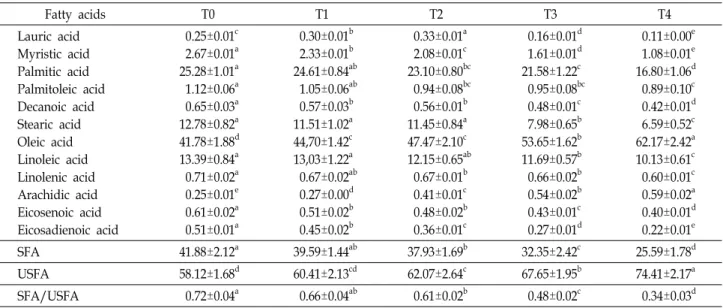
Table 7. Fatty acid composition of pork patty containing different concentrations of olive oil gel (%)
Fatty acids T0 T1 T2 T3 T4
Lauric acid Myristic acid Palmitic acid Palmitoleic acid Decanoic acid Stearic acid Oleic acid Linoleic acid Linolenic acid Arachidic acid Eicosenoic acid Eicosadienoic acid
0.25±0.01c 2.67±0.01a 25.28±1.01a 1.12±0.06a 0.65±0.03a 12.78±0.82a 41.78±1.88d 13.39±0.84a 0.71±0.02a 0.25±0.01e 0.61±0.02a 0.51±0.01a
0.30±0.01b 2.33±0.01b 24.61±0.84ab 1.05±0.06ab 0.57±0.03b 11.51±1.02a 44,70±1.42c 13,03±1.22a 0.67±0.02ab 0.27±0.00d 0.51±0.02b 0.45±0.02b
0.33±0.01a 2.08±0.01c 23.10±0.80bc 0.94±0.08bc 0.56±0.01b 11.45±0.84a 47.47±2.10c 12.15±0.65ab 0.67±0.01b 0.41±0.01c 0.48±0.02b 0.36±0.01c
0.16±0.01d 1.61±0.01d 21.58±1.22c 0.95±0.08bc 0.48±0.01c 7.98±0.65b 53.65±1.62b 11.69±0.57b 0.66±0.02b 0.54±0.02b 0.43±0.01c 0.27±0.01d
0.11±0.00e 1.08±0.01e 16.80±1.06d 0.89±0.10c 0.42±0.01d 6.59±0.52c 62.17±2.42a 10.13±0.61c 0.60±0.01c 0.59±0.02a 0.40±0.01d 0.22±0.01e
SFA 41.88±2.12a 39.59±1.44ab 37.93±1.69b 32.35±2.42c 25.59±1.78d
USFA 58.12±1.68d 60.41±2.13cd 62.07±2.64c 67.65±1.95b 74.41±2.17a
SFA/USFA 0.72±0.04a 0.66±0.04ab 0.61±0.02b 0.48±0.02c 0.34±0.03d
All values are mean ± standard deviation.
a-eMeans within each row with different superscripts are significantly different (p<0.05).
Table 6. Cholesterol content of pork patty containing different concentrations of olive oil gel
Pork patty
Cholesterol content (mg/100 g)
Cholesterol reduction ratio (%) T0
T1 T2 T3 T4
47.8±2.1a 41.2±1.8b 37.5±1.6c 31.3±2.3d 24.4±1.2e
0 13.8±1.2d 21.6±2.1c 34.5±1.8b 49.0±1.0a All values are mean ± standard deviation.
a-eMeans within each column with different superscripts are sig- nificantly different (p<0.05).
유를 겔화하기 위하여 사용한 carrageenan은 육제품의 경도와 탄력성 향상시킨다[19]. Choi 등[6]은 carrageenan으로 겔화시 킨 식물성유를 첨가하였을 경우 돈육 패티의 경도, 탄력성 및 씹힘성이 증가한다고 하였으며, Cierach 등[7]은 carrageenan 첨가량이 많을수록 저지방 소시지의 경도, 탄력성 및 씹힘성이 증가한다고 하여서 본 연구의 결과와 유사한 경향을 보였다.
올리브유 겔을 첨가한 돈육 패티의 콜레스테롤 함량 올리브유 겔을 첨가한 돈육 패티의 콜레스테롤 함량은 Table 6과 같다. 대조군(T0)의 콜레스테롤 함량은 47.8 mg/100 g이었으나 올리브유 겔 대체 비율이 높을수록 감소하여 올리 브유 겔을 100% 대체한 T4의 경우 24.4 mg/100 g을 나타내었 다(p<0.05). 또한 콜레스테롤 감소 비율도 올리브유 겔로 전부 대체한 T4가 올리브유 겔을 첨가하지 않은 T0보다 49.0% 감소 하였다(p<0.05). 이와 같은 결과는 돼지 지방을 홍화씨로 대체 한 경우 콜레스테롤 함량이 64.79% 감소하였다는 Park 등[26], 개암 오일을 50% 대체한 경우 70.3% 감소하였다는 Yildiz- Turp와 Serdaroğlu [36], 양귀비 씨를 20% 대체하였을 경우 88.1% 감소하였다는 Gök 등[11]의 결과와도 유사한 것으로 나타났다.
올리브유 겔을 첨가한 돈육 패티의 지방산 조성
육제품에 일반적으로 사용하는 동물성 지방은 포화지방산 의 비율이 높아 고혈압, 당뇨병, 심장병, 대장암 등 만성질환을 유발할 수 있다[28]. 본 연구는 동물성지방 대체제로서 올리브 유 겔을 첨가한 돈육 패티를 제조하고 지방산 조성을 측정하
였다(Table 7). 가장 많이 함유된 포화지방산은 palmitic acid 이고, 불포화지방산은 oleic acid였다. 돼지 지방을 올리브유 겔로 대체한 경우 대체 비율이 높을수록 포화지방산인 pal- mitic acid와 stearic acid는 유의하게 감소하였다(p<0.05). 또 한 육제품의 대표적인 불포화지방산인 oleic acid는 T0가 41.78%이던 것이 대체 비율이 높아질수록 증가하다가 100%
대체한 T4의 경우 62.17%를 나타내었다(p<0.05). 전체적으로 올리브유 대체 비율이 높을수록 포화지방산은 감소하고 불포 화지방산은 증가하는 경향을 보였다(p<0.05). 포화지방산과 불포화지방산의 비율을 나타내는 SFA/USFA 비율도 T0가 0.72에서 대체 비율이 높아짐에 따라 점점 낮아져 T4는 0.34를 나타내었다(p<0.05). 이러한 결과는 첨가하는 지방의 지방산 조성이 다르기 때문에 나타난 결과이며, 돼지 지방의 경우 pal- mitic acid 25-28%, oleic acid 42-44% 함유되어 있고[35], 올리 브유는 palmitic acid 9-20%, oleic acid 63-80% 함유되어 있다 [10]. 따라서 본 연구에서는 올리브유를 첨가할 경우 육제품의 포화지방산인 palmitic acid는 감소하고, 불포화지방산인 ole- ic acid는 증가한다는 Choi 등[6], Koo 등[17] 및 Yoon 등[37]의 결과와 일치하는 경향을 보여준다.
결론적으로 돈육 패티에 돼지 지방 대체제로 올리브유 겔을 여러 비율로 첨가할 경우 첨가량 증가에 따라 수분함량은 증 가하고 지방함량은 감소하며, 또한 돈육 패티의 색도 변화는 올리브유 겔 첨가 시 명도와 적색도의 경우 약간 감소하였지 만 황색도는 증가하였다. 조리 특성에 따른 변화 중 보수력, 수분 및 지방 보유율은 증가하였으나, 조리 감량이 발생하고 수축율은 감소하는 것으로 나타났다. 돈육 패티의 기계적 조 직 특성은 올리브유 겔 첨가 시 경도, 탄력성 및 씹힘성은 증가 하였으나, 응집성 및 검성은 감소하였으며, 콜레스테롤 함량 의 경우에도 49% 감소하는 경향을 보였다. 또한 지방산 조성 의 경우 올리브유 겔 첨가에 의해 포화지방산인 palmitic acid 함량은 감소하였으나, 불포화지방산인 oleic acid 함량은 증가 하였다. 따라서 돈육 패티의 돼지 지방을 올리브유 겔로 대체 함에 따라 물리화학적 특성들이 증가하며, 콜레스테롤 감소 및 지방산 조성이 개선되고, 고품질의 돈육 패티 생산 적용에 의한 상품성이 증가할 것으로 사료된다.
The Conflict of Interest Statement The authors declare that they have no conflicts of interest with the contents of this article.
References
1. Alejandre, M., Poyato, C., Ansorena, D. and Astiasaran, I.
2016. Linseed oil gelled emulsion: A successful fat replacer in dry fermented sausage. Meat Sci. 121, 107-113.
2. Almedia, C. M., Wagner, R., Mascarin, L. G., Zepka, L. O.
and Campagnol, P. C. B. 2014. Production of low-fat emulsi- fied cooked sausage using amorphous cellulose gel. J. Food Quality 37, 437-443.
3. AOAC. 1993. Official Methods of Analysis. 17th eds., Associ- ation. Official Methods of Analysis of AOAC International, Chap. 4, 5-37.
4. Cho, E. A. and Lee, Y. S. 2014. A study on the classifying quality standard by comparison with physicochemical char- acteristics of virgin, pure, pomace olive oil. Kor. J. Food Nutr.
27, 339-347.
5. Choi, G. W. and Lee, J. W. 2016. Effect of grape skin phys- icochemical and sensory characteristics of ground pork meat. Kor. J. Food Cook. Sci. 32, 290-298.
6. Choi, Y. J., Lee, S. H., Lee, K. S., Choi, G. W., Lee, K. S., Jung, I. C. and Shim, D. W. 2019. Quality characteristics of low-fat plant oil emulsion pork patties. J. Life Sci. 29, 1351- 1357.
7. Cierach, M., Modzelewska-Kapitula, M. and Szacilo, K.
2009. The enfluence of carrageenan on the properties of low- fat frankfurters. Meat Sci. 82, 295-229.
8. El-Magoli, S. B., Laroia, S. and Hansen, P. T. M. 1996. Flavor and texture characteristics of low fat ground beef patties formulated with whey protein concentrate. Meat Sci. 42, 179- 193.
9. Folch, J., Lees, M. and Sloane-Stanley, G. H. 1957. A simple method for the isolation and purification of total lipids from animal tissues. J. Biol. Chem. 226, 497-507.
10. Gavahian, M., Khaneghah, A. M., Lorenzo, J. M., Munekata, P. E. S., Garcia-Mantrana, I., Collado, M. C., Meléndez-Mar- tínez, A. J. and Barba, F. J. 2019. Health benefits of olive oil and its components: impacts on gut microbiota anti- oxidant activities, and prevention of noncommunicable dis- eases. Trends Food Sci. Technol. 88, 220-227.
11. Gök, V., Akkaya, L., Obuz, E. and Bulut, S. 2011. Effect of ground poppy seed as a fat replacer on meat burgers. Meat Sci. 89, 400-404.
12. Grossi, M., Palagano, R., Bendini, A., Ricco, B., Servili, M., Garcia-Gonzalez, D. L and Toschi, T. G. 2019. Design and in-house validation of a portable system for the determi- nation of free acidity in virgin olive oil. Food Control 104, 208-216.
13. Han, J. S. and Han, J. A. 2014. Preparation and character- ization of gel food for elderly. Kor. J. Food Sci. Technol. 46, 575-580.
14. Han, M. Y. and Beruam, H. C. 2017. Designing healthier comminuted meat products: Effect of dietary fibers on water distribution and texture of a fat-reduced meat model system. Meat Sci. 133, 159-165.
15. Hoffman, K. R., Hamm, R. and Blüchel, E. 1982. Neues über die Bestimmung der Wasserbindung des Fleisches mit Hilfe der filterpapier press methode. Fleischwirtschaft 62, 87-93.
16. Kaliora, A. C., Dedoussic, G. V. Z. and Schmidt, H. 2006.
Dietary antioxidants in preventing atherogensis. Atheroscle- rosis 181, 1-17.
17. Koo, B. K., Kim, J. M., La, I. M., Choi, J. H., Choi, Y. S., Han, D. J., Kim, H. Y., An, K. I. and Kim, C. J. 2009. Effects
of replacing tallow with canola, olive, corn, and sunflower oils on the quality properties of hamburger patties. Kor. J.
Food Sci. An. 29, 466-474.
18. Korea Food & Drug Administration. 2009. Food Code. Moo- nyoungsa, Seoul, pp. 212-251.
19. Koutsopoulos, D. A., Koutsimanis, G. E. and Bloukas, J. G.
2008. Effect of carrageenan level and packaging during rip- ening on processing and quality characteristics of low-fat fermented sausages produced with olive oil. Meat Sci. 79, 188-197.
20. Lala, M. S., Gutierrez, J. I. and Andrés, A. I. 2011. Evaluation of two natural extracts (Rosmarinus officinalis L. and Melissa officinalis L.) as antioxidants in cooked pork patties packed in MAP. Meat Sci. 88, 481-488.
21. Lee, H. J., Jung, E. H., Lee, S. H., Kim, J. H., Lee, J. J. and Choi, S. I. 2015. Effects of replacing pork fat with vegetable oils on quality properties of emulsion type pork sausages.
Kor. J. Food Sci. An. 35, 130-136.
22. Meenu, M., Cai, Q. and Xu, B. 2019. A critical review on analytical techniques to detect adulteration of extra virgin olive oil. Trends Food Sci. Technol. 91, 391-408.
23. Moon, J. S., Lee, O. H. and Son, J. Y. 2005. The oxidation stability of virgin and pure olive oil on autoxidation and thermal oxidation. J. Kor. Soc. Food Sci. Nutr. 34, 93-98.
24. Monteiro, G. M., Souza, X. R., Costa, D. P. B., Faria, P. B.
and Vicente, J. 2017. Partial substitution pork fat with canola oil in Toscana sausage. Innov. Food Sci. Emerg. Technol. 44, 2-8.
25. Murphy, E. W., Criner, P. E. and Grey, B. C. 1975. Compar- ison of methods for calculating retentions of nutrients in cooked food. J. Agric. Food Chem. 23, 1153-1157.
26. Park, K. S., Choi, Y. J., Moon, Y. H., Park, H. S., Kim, M.
J. and Jung, I. C. 2012. Physicochemical characteristics of ground pork with safflower seed powder as an animal fat replacer. J. Life Sci. 22, 928-935.
27. Park, K. S., Park, H. S., Choi, Y. J., Moon, Y. H., Lee, K.
S., Kim, M. J. and Jung, I. C. 2011. Quality change of pork patty containing Lotus (Nelumbo nucifera) leaf and root pow- der during refrigerated storage. J. Life Sci. 21, 1732-1739.
28. Phang, S. C., Palanisamy, U. D. and Kadir, K. A. 2019.
Effects of geraniin (rambutan rind extract) on blood pres- sure and metabolic parameters in rats fed high-fat diet. J.
Integrative Med. 17, 100-106.
29. Rodrígeuz-Carpena, J. G., Morcuende, D. and Estévez, M.
2011. Avocado by-products as inhibitors of color deterio- ration and lipid and protein oxidation in raw porcine patties subjected to chilled storage. Meat Sci. 89, 166-173.
30. Roselli, L., Cledoveo, M. L., Corbo, F. and De Gennaro, B.
2017. Are health claims a useful tool to segment the category of extra virgin olive oil? Threats and opportunities for the Italian olive oil supply chain. Trends Food Sci. Technol. 68, 176-181.
31. Silva, S. L., Amaral, J. T., Ribeiro, M., Sebastião, E. E., Varges, C., Lima Franzen, F., Schneider, G., Lorenzo, J. M., Fries, L. L. M., Cichoski, A. J. and Campagnol, P. C. B. 2019. Fat replacement by oleogel rich in oleic acid and its impact on the technological, nutritional, oxidative, and sensory proper- ties of Bologna-type sausages. Meat Sci. 149, 141-148.
32. Sim, D. W. 2019. Quality properties of low fat pork patties with olive, soybean and canola oil gel as pork fat replacers during cold storage. J. East Asian Soc. Diet. Life 29, 459-468.
33. Wang, X., Xie, Y., Li, X., Liu, Y. and Yan, W. 2018. Effects of partial replacement of pork back fat by a camellia oil gel on certain quality characteristics of a cooked style Har- bin sausage. Meat Sci. 146, 154-159.
34. Wolfer, T. L., Acevedo, N. C., Prusa, K. J. and Sebranek, J. G. 2018. Replacement of pork fat in frankfurter-type sau- sages by soybean oil oleogels structured with rice bran wax.
Meat Sci. 145, 352-362.
35. Yang, S. J., Jung, I. C. and Moon, Y. H. 2006. Feeding effect of dried citrus byproducts on the quality of Jeju native pig meat. J. East Asian Soc. Diet. Life 16, 592-599.
36. Yildiz-Turp, G. and Serdaroğlu, M. 2008. Effect of replacing beef fat with hazelnut oil on quality characteristics of suck-A Turkish fermented sausage. Meat Sci. 78, 447-454.
37. Yoon, D. H., Park, K. S., Lee, K. S., Jung, I. C., Park, H.
S., Moon, Y. H. and Yang, J. B. 2007. Quality and sensory score of ground pork meats on the addition of pork fat, olive oil and soybean oil. J. Life Sci. 17, 964-969.
38. Young, L. L., Garcia, J. M., Lillard, H. S., Lyon, C. E. and Papa, C. M. 1991. Fat content effects on yield, quality, and microbiological characteristics of chicken patties. J. Food Sci.
56, 1527-1528.
초록:올리브유 대체 비율이 저지방 돈육 패티의 품질 특성에 미치는 영향 이시형1․최영준1․이경숙1․정인철1․이경수2․최강원1*
(1대구공업대학교 호텔외식조리계열, 2영남이공대학교 식음료조리계열)
본 연구는 돼지 지방 대체제로 올리브유 겔 첨가 비율을 달리하여 제조한 저지방 돈육 패티의 이화학적 품질 특성을 검토하였다. 돈육 패티는 돼지 지방 20%(대조군, T0), 돼지 지방 15%와 올리브유 겔 5%(T1), 돼지 지방 10%와 올리브유 겔 10%(T2), 돼지 지방 5%와 올리브유 겔 15%(T3), 그리고 올리브유 겔 20%(T4)를 첨가하여 제조 하였다. 올리브유 겔 첨가 비율에 따라 수분 함량은 증가하고, 지방 함량은 감소하였다. 가열 전후 돈육 패티의 명도(L*)와 적색도(a*)는 T0가 가장 높았으며, 가열 후 돈육 패티의 황색도는 T4가 가장 높았다. 올리브유 겔 대체 비율이 높을수록 보수력, 수분 보유율 및 지방 보유율은 증가하였고, 조리 감량, 직경 감소율 및 수축율은 유의하 게 감소하였다. 경도, 탄력성 및 씹힘성은 T4가 가장 높았고, 응집성 및 검성은 T0가 가장 높았다. 콜레스테롤 함 량은 T4가 가장 낮았으며, 대조군(T0)에 대한 감소율은 T1, T2, T3 및 T4가 각각 13.8%, 12.6%, 34.5% 및 49.0%였 다. 포화지방산은 palmitic acid가 가장 높았고, 불포화지방산은 oleic acid가 가장 높았다. 돈육 패티의 불포화지방 산은 올리브유 겔의 첨가 비율에 따라 증가하였다. 그러므로 돼지 지방을 올리브유 겔로 대체하면 이화학적 특성 들이 향상되고, 콜레스테롤 함량이 감소하며, 지방산 조성이 개선된 육제품의 제조가 가능하다.