• 검색 결과가 없습니다.

Surface Treatment Technology for Metal Corrosion Layer Focusing on Copper Alloy

N/A
N/A
Protected

Academic year: 2021

Share "Surface Treatment Technology for Metal Corrosion Layer Focusing on Copper Alloy"

Copied!
7
0
0

로드 중.... (전체 텍스트 보기)

전체 글

(1)

http://dx.doi.org/10.12925/jkocs.2014.31.2.176

Surface Treatment Technology for Metal Corrosion Layer Focusing on Copper Alloy

Eun-Hee Yang․Won-Sik Han․Kwang-Sun Choi Young-Hoon Lee․Chul-Hee Ham․Tae-Kee Hong

Department of Chemistry, Hanseo University, Seosan, 357-953, Korea (Received March 14, 2014; Revised June 25, 2014; Accepted June 26, 2014)

Abstract : Using alkali treatment solution, neutrality treatment solution and acid treatment solution, the surface corrosion layer of copper plates and bronze plates that have been artificially corroded using HCl, H

2

SO

4

and HNO

3

solutions were removed. In the case of alkali treatment solution, only air oxidation in the form of black tenorite and white cuproous chloride remained without being removed. In the case of using a neutrality treatment solution, a anhydrous type layer of reddish brown cupric chloride remained without being removed, together with this black and white corrosion substance. In the case of using an acid treatment solution, this red corrosion substance also remained, but all of the oxide was removed on the surface of the specimen that was treated by alternatively using alkali treatment solution and acid treatment solution. In the case of this treatment solution with the order of alkali-acid, oxidation no longer proceeded only through the distilled water cleaning process after treatment, thereby showing that oxidation from the cleaning solution no longer proceeded.

Keywords : copper, copper alloy, corrosion, anti-corrosion, copper oxide, oxide removal

1. Introduction

Surface treatment of metal is a process of changing the property of a metal’s surface and various types and methods are used. Although coloring and anti-corrosion were mainly used for the surface treatment of metal in the past, various types of treatment methods have been developed recently for more extensive function and role and they are now being used in almost every area of industry. As for metal surface treatments, washing, grinding, etching,



Corresponding author

(E-mail: [email protected])

shot peening, pressing, painting, lining, wet

plating and hot plating & treatment,

conversion treatment, anodizing, ion injection,

surface heat treatment, spraying, etc. are being

used

1)

. In the case of metal for which these

treatments have been used, changes occur in

any type of form on the metal surface

compared to before the treatment and through

this change, changes in the metal appearance

on the surface or to certain parts of metal

inside. In these cases, abrasion resistance,

fatigue resistance and corrosion resistance are

improved as surface properties of every treated

metal change according to the intended

purpose or hardened in general. They have the

(2)

demand characteristics of not affecting the basic material without deterioration and consistent surface treatment. Their suitability to usage environment after treatment also becomes a major interest and from a commercial perspective, the simplicity &

suitability of treatment process and low price also become important

2)

. Such surface washing method is also used to remove the pollutant source on the silicon wafer surface by being applied to semiconductor manufacturing process. This washing technique is a very important process as it occupies about 20% of semiconductor processing, and alkali metal, alkali earth metal, transition metal and metallic oxide are removed through photoresist ashing, dry etching, ion implantation, wet washing method, etc. Wet washing among them is known to be the most effective in removing various particle metal pollutants, particularly natural oxidation film but this has the issue of re-corrosion after treatment with alkali or acid solution and its solution is becoming the most important issue

3,4)

. Phosphate system inhibitor or silicate system inhibitor is being used to treat the metal oxidation residue inside deteriorated metal water pipes in everyday life

5)

and it has also been reported to be highly effective in preventing corrosion or removing sediment metal impurities or oxides by using the deoxidation methods that use ETA, NH

3

and N

2

H

4

for metal oxide treatment and corrosion prevention of water and steam circulation system within power plants

6)

. As for the metal residue treatment agent in addition to these treatment agents, there was a recent report on the study of heavy metal control using H

2

O

2

under the existence of citric acid and organic materials or metal oxide treatment with highly effective results

7)

. In addition, a method of forming CaCO

3

film on a metal surface or a method of adding various anti-corrosion agents have also been studied

8)

. In the case of bronze that is a representative copper alloy, benzotriazole or ethylenediamine, petroleum sulphonate,

cysteine, 2-amino-5-mercapto-1,3,4-tridiazole, tolitriazole are being used as corrosion substance treatment and inhibitor

9,10)

. In the case of using them independently, however, it showed the result of partial treatment instead of full treatment of metal oxide and being used only as a corrosion resistant agent

11,12)

.

In this paper, the study was conducted on manufacturing treatment agents for treating the metal surface corrosion substances created in different forms in various industry fields via chemical method

13-15)

. Accordingly, acid, neutral and alkali corrosion substance removing agents were manufactured, and copper and bronze that are representative copper alloys were artificially corroded, and the treatment process of corrosion substances was presented for comparison before and after treatment. The purpose was to manufacture the agents to prevent the re-corrosion and re-contamination of the surface that appears after the treatment with wet treatment agents that have been an issue, as well as remove surface corrosion substances by directly applying the treatment agent to modern bronze products with significant corrosion.

2. Experiment 2.1. Reagent & Instruments

As for phosphoric acid, sulfuric acid,

hydrogen peroxide, ethylenediaminetetrachloric

acid, ammonium fluoride, ammonium chloride,

citric acid, copper chloride and potassium

hydroxide, reagents by Aldrich were used, and

Glupon 215 UP was used for surfactant. As

for 2-(2-butoxyethoxy) ethanol, sodium

metasilicate and nitric acid, reagents by

Samchun Chemical were used, and reagents by

OCI were used for 1,2,3-Benzotriazole, mono

ethanol amine and sodium gluconate. As for

distilled water used to manufacturing washing

agent, deionized water was used, and analysis

level reagents were used for every other

reagent used. As for the agitator used to

(3)

manufacture solution, P-Mixer 3,000 rpm and 30 mm stainless impeller was used, and 40 kHz SD-200H was used for ultrasonic cleaner.

2,2. Sample Manufacturing

As for copper metal plate, Fough-pitch copper plate with over 99.2% purity (0.01 ~ 0.06% oxygen content) was used (hereafter,

"copper plate"), and as for copper alloy, alloy plate of 21.% Sn content and 79.7% Cu content manufactured through punching method was used (hereafter, "bronze plate").

The two specimen were cut in 4.0 x 40.0 x 40.0 mm using Water jet, and the surface of both sides after cutting were etching by about 0.8 ~ 0.9 mm for adjustment in the thickness of 2.0 ~ 2.1 mm. As for cut oblique plane, it was used without adjustment. As for the surface sanding of metal specimen, JEG-520M by Jin Young Precision Machine was used.

2.3. Corroded Specimen Manufacturing As for copper plate and bronze plate, 0.1 M HCl, HNO

3

, H

2

SO

4

were respectively used in glass Schale to manufactured them during 14 days by repeating atomizing and drying. As for corroded layer for 14 days, corrosion proceeded to about 5 mm in thickness including the basic material with green corrosion layer in the case of HCl corrosion based on bronze plate. In the case of HNO

3

corrosion, corrosion proceeded to about 4 mm in thickness including the basic material with blue corrosion layer. In the case of H

2

SO

4

corrosion, corrosion proceeded to about 2.5 mm in thickness including the basic material with clear and bright blue corrosion layer and the number of six types of specimen manufactured was respectively 30.

2.4. Surface Oxide Treatment Agent Manufacturing

As for neutral treatment solution, EDTA and citric acid, mono ethanol amine, Sodium gluconate, 2-(2-butoxyethoxy) ethanol, Glupon 215 UP were added to 3.5% KOH

solution for agitation and dissolution at 3,000 rpm, and pH was adjusted to 6.5 ~ 7.5 by using 10% phosphoric acid solution. In addition, about 3% sodium meta-silicate was added for manufacturing. As for acid treatment solution, sulfuric acid and 35%

hydrogen peroxide were mixed by 1 : 1 in distilled water, and benzotriazole and copper chloride, ammonium chloride were added in the respective order for manufacturing. As for alkali treatment solution, ammonium fluoride, sodium gluconate, EDTA, sodium meta-silicate, mono ethanol amine and 2-(2-butoxyethoxy) ethanol were added to pH 13 potassium hydroxide solution that has been added with Glupon 215 UP for manufacturing.

2.5. Corroded Oxide Treatment

Copper plate and bronze plate with corrosion in process were deposited in respectively 100 mL acid, neutral and alkali solutions, and they were exposed to ultrasonic waves at 1 hour interval from 1 to 10 hours at room temperature inside ultrasonic cleanser to observe the changes of surface condition.

Afterwards, specimen were alternatively deposited for 4-hour interval in solutions of acid & alkali, alkali & acid, neutral & acid, acid & neutral, alkali & neutral, neutral &

alkali, acid & alkali and neutral to observe surface residual level and treatment level.

3. Result and Discussion

Six types of corroded specimen and

specimen condition prior to corrosion were

shown in Fig. 1. The condition of these

specimen through alkali solution treatment is

as shown in Fig. 2. The green, blue and bright

blue corrosion layer on the surface of alkali

solution treated specimen were removed as

time went on but black and white corrosion

substances remaining on surface remained

without being removed, and surface cleansing

no longer proceeded even after changing the

(4)

a b c d e f g Fig. 1. Surface corrosion product (a; standard, b; HCl with bronze, c; HNO

3

with bronze, d;

H

2

SO

4

with bronze, e; HCl with Cu plate, f; HNO

3

with Cu plate, g; H

2

SO

4

with Cu plate)

solution concentration or extending the ultrasonic cleansing time to over 10 hours.

Based on Cu alone, it appears that the anhydrous type of light brown color cupric chloride with distorted CdI

2

structure, as well as dihydrous type of blue green color have been removed. In addition, it appears that green cuprous chloride with sphalerite structure has also been removed in alkali solution. As for deep blue green color cupric nitrate, anhydrous type of orthorhombic structure and hydrate type of rhombohedral structure have been removed. As for cupric sulfate, it appears that bright blue pentahydrous form has also been removed, as well as pale green anhydrous form with orthorhombic structure. Although it appears that blue or blue-green color cupric hydroxide form has also been removed, it appears that black cupric oxide (tenorite) with monoclinic structure has not been removed judging by color alone. In addition, it was also seen that white zincblende structure that is a part of cuprous chloride oxidized in air and chalcocyanite form that is a part of gray white anhydrous form among cupric sulfate have not been removed. However, it was seen that black tenorite and white cuproous chloride air oxidation form was not removed based on solubility of distilled water (243 g/L at 0℃) of gray-white cupric sulfate.

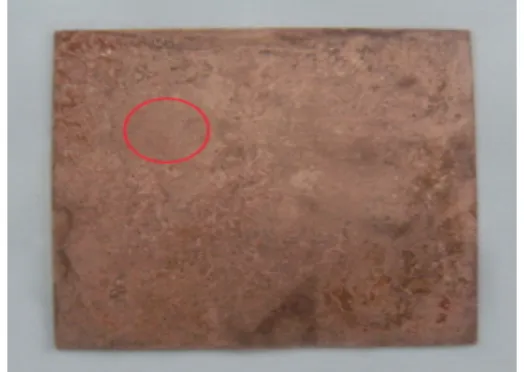
The condition of treating specimen with corrosion in process with neutral solution is as shown in Fig. 3. As for these results, green, blue and bright blue corrosion layer on the surface of specimen treated with alkali solution were removed as time went on, but white and

black corrosion substances were not removed.

In addition, anhydrous type of reddish brown cupric chloride was also not removed with Cu chloride compound. It was also showing the same removal level result as the result after first 1 hour even after changing the concentration of solution or extending ultrasonic cleansing time.

Fig. 2. After treatment with neutral solution for 1 hr.

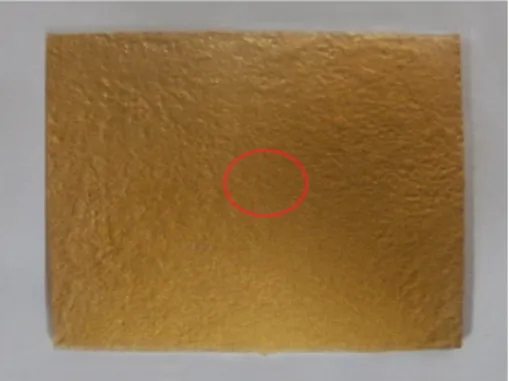
Fig. 3. After treatment with Alkalic solution

for 1 hr.

(5)

neutral sol. Alkalic sol. Acidic sol. Aklaic and Acidic sol.

67.1 46.3 17.1 15.8

Table 1. Variation of Surface color (△E

Lab

) before and after Treatment in Various Solutions The condition of treating specimen with

corrosion in process with acid solution is as shown in Fig. 4. As for these results, green, blue, bright blue and black corrosion layer on the surface of treated specimen were removed as time went on, but it was found that anhydrous type layer of reddish brown cupric chloride became very thin. It was also showing the same removal level result as the result after first 1 hour even after changing the concentration of solution or extending ultrasonic cleansing time.

Fig. 4. After treatment with Acidic solution for 1 hr.

In the case of specimen that have been alternatively treated with alkali, neutral and acid solutions, it was found that oxidation residues existed on the metal surface after treatment in most cases, but all of the oxidation substances were removed on the surface of specimen that were alternatively treated with alkali treatment solution and acid treatment solution. In the case of specimen that were treated in alkalinity, white oxidation substances and black oxidation substances remained but they were immediately removed when they are once again treated with acid

treatment solution (Fig. 5). This could be seen as the air oxidation form of black tenorite and white cuprous chloride that remained in alkali treatment solution being completely removed in acid treatment solution. When the order of treatment solution was alkali-acid, oxidation no longer proceeded upon distilled water cleansing after treatment, thereby not showing any changes on surface level. In the case of acid-alkali, however, oxidation proceeded once again even after distilled water cleansing. Accordingly, it was seen that oxidation no longer proceeded from cleansing agent during cleansing phase after acid solution treatment that is followed by alkali solution treatment. In the case of specimen for which acid treatment solution was used, surface corrosion did not proceed for over two months even after being exposed to over 60%

humidity air, and the weight of metal basic material specimen that are not corroded did not change even after being exposed to alkali and acid treatment solutions. Accordingly, it also showed the result that there is no reactivity of treatment solution to basic material in addition to corrosion substance that occurred in copper or copper alloy (Table 1).

The result of treating the surface corrosion substances of bronze bowl with corroded surface from extended exposure to air and inside soil using this treatment solutions and treatment order has been shown in Fig. 6.

Also in the case of this bronze bowl, black

and partially white corrosion substances

remained on surface upon alkali solution

treatment, as in the case of previous specimen,

but corrosions on surface were completely

removed upon treating once again with acid

(6)

treatment solution and no changes have been observed on surface for over two months.

Fig. 5. After treatment with Alkalic and Acidic solution for 1 hr.

A (△E

Lab

= 23.6)

B (△E

Lab

= 51.3)

Fig. 6. Before and after surface state of the bronze vessel with alkalic and acidic two step treatment for 1 hr respectively.

4. Conclusions

In the case of alternatively treating corroded copper and bronze specimen with manufactured alkali treatment solution and acid treatment solution, black tenorite and white cuprous chloride air oxidation form that

remained even after alkali solution treatment has been completely removed. Oxidation from alkali could no longer be seen upon conducting chemical removal task for corroded substances by using acid solution to remove corroded layer after using alkali treatment solution. Furthermore, anti-corrosion effect of preventing metal surface from corroding could also be expected. Also in the case of treating bronze bowl that had already been significantly corroded, corrosion substances that occurred on the surface could be completely removed by using alkali solution and acid solution for treatment in order, thereby showing that the surface treatment of oxidation substances of copper and copper alloy is sufficiently possible upon using these treatment solutions and treatment order.

References

1. N. Nihe, J. Mitsuo, Surface treatment technology, Japan Investment of industrial, p.13 (2001).

2. M. Y. Wey, Technical Materials : On The Surface Treatment Technology of Metals, J.

Kor. Soc. for Heat Treat. , 18(3), 190-194 (2005).

3. W. kern, Handbook of semiconductor wafer cleaning technology, NOYES, p.201 (1994).

4. H. S. Yun, K. K. Rue, A Study on environmental-friendly Cleaning for Si-wafers, Clean technology , 6(1), p.79-84 (2000).

5. H. D. Lee, J. H. Park, C. H. Bae, Evaluation of corrosion prevention and cleaning effects on old water service pipes by inhibitor, magnetic and ionic treatment apparatuses, J. Kor. Soc. Water Quality , 18(5), 553-562 (2002).

6. H. K. Ahn, I. H. Lee, B. G. Park, Surface

complexation modeling on metal oxide,

Kor. water environ. , 397-398 (2010).

(7)

7. J. H. Kim, S. H. Kong, G. I. Son, Y. S.

Kim, decomposition of hydrogen peroxide on geothite in the presence of citric acid, Bull. Environ. Sci., 22, 73-81 (2001).

8. C. F. Voyles, Determining Internal Corrosion potential in water supply system, J. AWWA 67(8), p83-88 (1984).

9. M. Y. Wey, Technical Materials : On The Surface Treatment Technology of Metals, Journal of the Korean Society for Heat Treatment , 18(3), p190-194 (2005).

10. J. B. Park, J. S. Oh, E. L. Gil, S. J.

Kyoung, Polyimide Surface Treatment by Atmospheric Pressure Plasma for Metal Adhesion, Journal of the Electrochemical Society , 157(12), D614 (2010).

11. A. D. Scott, Copper and Bronze in Art, Getty publication, (2002).

12. D. R. Woo, Comparison of the capability of corrosion inhibitors to conserve of bronze artifacts, graduate school of Chungbuk Univ., master thesis in 2013.

13. H. T. Shin, An effect of metallic oxide disposal to precision cast in grain refining, research bulletin in Seoul National University of Technology, p17-28 (1975).

14. Y. Taga, T. Ohwaki, Hydrophobic Surface

Treatment of Metal Oxides, The journal of

the surface finishing society of Japan ,

47(7), p571-574 (1996).

수치

Fig.  2.  After  treatment  with  neutral  solution  for  1  hr.
Table  1.  Variation  of  Surface  color  (△E Lab )  before  and  after  Treatment  in  Various  SolutionsThe  condition  of  treating  specimen  with
Fig.  5.  After  treatment  with  Alkalic  and  Acidic  solution  for  1  hr.

참조

관련 문서

Therefore depending on the size of the fracture in the veneering porcelain, intraoral repair methods using surface treatment and composite resins may

The corrosion behaviors of Al5454 alloy was investigated by potentiodynamic and potentiostatic polarization tests in 5 wt.% NaCl solution.. The pitting potential of the

"Solution treatment and Sr Addition Effect on Microstructure and Mechanical Properties of Al-6Si-2Cu Aluminum Alloy for Automotive Parts." Master's Thesis

다양한 번역 작품과 번역에 관한 책을 읽는 것은 단순히 다른 시대와 언어, 문화의 교류를 넘어 지구촌이 서로 이해하고 하나가

In view of the essential relevance of mission in history (and not only in the history of religion), on the one hand, and in theology (and not only in missiology),

The index is calculated with the latest 5-year auction data of 400 selected Classic, Modern, and Contemporary Chinese painting artists from major auction houses..

1 John Owen, Justification by Faith Alone, in The Works of John Owen, ed. John Bolt, trans. Scott Clark, "Do This and Live: Christ's Active Obedience as the

The total charge density from the metal surface and specifically adsorbed anions in inner layer is equal to the charge from solvated ions in diffuse layer. σ metal + σ inner =