Journal of the Korean Chemical Society 2015,Vol.59, No. 4
Printed inthe Republicof Korea
http://dx.doi.Org/10.5012/jkcs.2015.59.4.284
Synthesis of 2-Amino-3-cyano-7-hydroxy-4H-chromenes Using L-Proline as a Biocatalyst
Farahnaz K.Behbahani* and Sima Mehraban
Department of Chemistry, Karaj Branch, Islamic Azad University, Karaj, Iran.
E-mail: Farahnazkargar@yahoo. com (Received May 6, 2015; Accepted June 4, 2015)
ABSTRACT. Three-component one-pot synthesis of 2-amino-3-cyano-7-hydroxy-4H-chromenes, which have been reported from condensation of malononitrile, aryl aldehydes and resorcinol in the presence of L-proline under reflux conditions in ethanol.
Key words: L-proline, Resorcinol, Chromene, Synthesis, Multicomponent reaction
INTRODUCTION
Chromene derivatives are an important class of com
pounds, widely present in plants, such as edible vegeta
bles and fruits,1 and natural products of the chromene- based structure has been associated with the capacity to prevent disease.2 Various catalyst such as piperidine,3 triethyl amine,4 K2CO3,5 CTABr6 and basic ionic liquid7 have been used for the synthesis of 2-amino-4H chromenes. Recently electrochemically induced multicomponent condensation of resorcinol, malononitrile and aldehyde in propanol in an undivided cell in the presence of NaBr as an electro- lyte.8 Many of the methods reported for the synthesis of these compounds9-12 are associated with the use of haz
ardous organic solvents, long reaction time, use of toxic amine-based catalysts, and lack of general applicability.
Along with other reaction parameters, the nature of the cata
lyst plays a significant role in determining yield, selec
tivity, and general applicability. Thus, development of an inexpensive, mild, general, and reusable catalyst for MCRs remains an issue of interest.
Also, recently, L-proline has gained importance as a ver
satile catalyst for effecting various organic transformations such as the synthesis of coumarone in ionic liquid,13 density functional study of the L-proline-catalyzed a-aminoxyl- ation of aldehydes,14 unsymmetrical dihydro-1H-indeno [ 1, 2-b]pyridines15 and 2-amino-4H-benzochromenes.16 In recent years, L-proline and L-proline derivatives were successfully used as organocatalysts in asymmetric aldol and Michael addition reactions.17 To the best of our knowledge, there was no attempt to use L-proline as a catalyst for the syn
thesis of 2-amino-4H-chromenes. In this study, malono- nitrile, resorcinol and aromatic aldehydes in the gained
Scheme 1. Synthesisof 2-amino-3-cyano-7-hydroxy-4H-chromenes using L-proline.
considerable attention in presence of L-proline under reflux condition in ethanol was subjected for the synthesis of 2- amino-3-cyano-7-hydroxy-4H-chromenes, in good-to-excel- lent yields, regarding to fully simple and efficient route, using less hazardous solvent and easy separation (Scheme 1).
EXPERIMENTAL
Mps were measured by using the capillary tube method with an electro thermal 9200 apparatus. IR spectra were recorded on Perkin Elmer FT-IR spectrometer did scan
ning between 4000-400 cm-1. 1HNMR spectra were obtained on Bruker DRX-300 MHZ NMR instrument. All products were characterized and compared with those of authentic sample in literature.
Synthesis of 2-amino-3-cyano-7-hydroxy-4-aryl-4H- chromenes. General procedure: A mixture of malono
nitrile (1 mmol), aromatic aldehyde (1 mmol), resorcinol (1 mmol), and L-proline (10 mol%) in ethanol was stirred under reflux condition for an appropriate time. After com
pletion of the reaction which was monitored by TLC (ethyl acetate: n-hexane 1:1). Then ethanol was removed, water (10 ml) was added and the crude product was extracted by ethyl acetate (2x15 ml). The pure product was obtained by recrystallized from ethanol.
RESULTS AND DISCUSSION
The first efforts were focused on the evaluation of cat
alytic amount of the catalyst on rate and the yields of obtained 2-amino-3-cyano-7-hydroxy-4H-chromenes by reacting resorcinol, 4-chlorobenzaldehyde, malononitrile and L- proline in refluxing ethanol. The results on these reactions claimed that 10 mol% of L-proline is the best in terms of yield and reaction time (entry 4, Table 1).
Of solvents including ethanol, water, and ethanol/water, ethanol proved to be the best in terms of yield. Thus in present work has been used only ethanol, which is relatively benign organic solvent (entry 3; Table 2).
On the basis of the optimization of the reaction condi
tions, the scope of L-proline-catalyzed multicomponent reaction was explored. Not only electron-rich aryl alde
hydes, but also electron-deficient aryl aldehydes in the reactions resulted 2-amino-3-cyano-7-hydroxy-4-aryl- 4H-chromenes in 85-98% yields (Table 3). Compara
tively, the rate of the reaction electron-deficient aryl alde
hydes (4-Cl, 2-Cl, 2-Nitro, 3-Nitro, 3-OH) is faster than electron-rich (4-Me, 4-Me?N-, 3,4-DiMeO) aryl aldehydes.
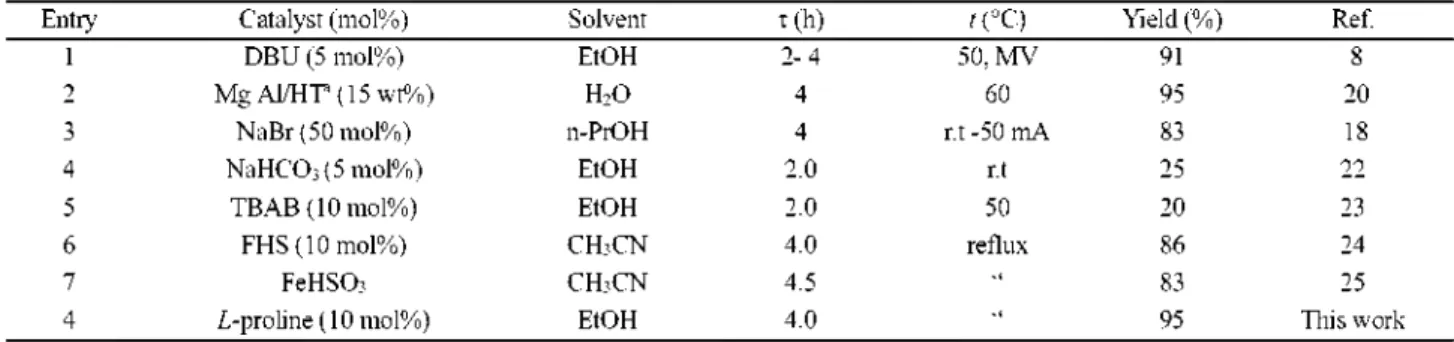
To show the fairly advantages of using L-proline as a biocatalyst in the synthesis of 2-amino-4-phenyl-7-hydroxy- 4H-chromene-3-carbonitrile, our protocol was compared with previously reported methods (Table 4). From the results given in Table 3, the advantages of this work are evident regarding the yields of the reactions which are very important in chemical industry especially when it is
Table 1. One-pot synthesisof 2-amino-4-(4-chlorophenyl)-7-hydroxy- 4H-chromene-3-carbonitrile
Entry L-proline (mol%) T (h) Yield (%a)
1 free 48 -
2 5 5.0 83
3 10 4.0 98
4 15 4.0 98
aReaction condition:4-Chlorobenzaldehyde (1 mmol), resorcinol (1.0 mmol), malononitrile (1mmol) and ethanol (5 ml) under reflux conditions.
Table 2. One-pot synthesis of 2-amino-4-(4-chlorophenyl)-7-hydroxy- 4H-chromene-3-carbonitrile
Entry Solvent (5ml) Yield(%a)
1 free 65
2 H2O 48
3 EtOH 98
aReaction condition:4-Chlorobenzaldehyde (1 mmol),resorcinol (1.0 mmol),malononitrile (1mmol), L-proline(10mol%)and under reflux conditions.
combined by easy separation and reusability of the cat
alyst.
The following mechanism can be proposed for conden
sation of different aldehydes, resorcinol and malononitrile to afford 2-amino-4H-chromenes catalyzed by L-prolin in refluxing ethanol (Scheme 2). According to the results obtained, formation of the Knoevenagel product (inter
mediate I) is the first step of this condensation. Subse
quent Michael like addition of resorcinol was facilitated by L-prolin to give intermediate II, which produced the desired products IV through intermediate III.
Finally, the reusability of the catalyst was investigated.
At the end of the reaction, the aqueous layer was separated and washed with diethyl ether and reused in reaction. As indicated in Table 5, the recycled catalyst was used for three consecutive reactions without significant decrease of the yields, the yields regard from 88 to 98% (Table 5).
PHYSICAL AND SPECTRAL DATA
Compound 1: C6H5CHO: Yield: 95%; m.p: 232-234 °C;
IR (KBr, cm-1): 3426 (-OH stretching), 3363(-NH stretch
ing of amin), 2198(-CN stretching), 1622 (C=C Vinyl nitrile), 1593 (C=C aromatic); 1H-NMR (300 MHz, DMSO-d6, 5 / ppm): 4.61 (s,1H, H-4), 6.85(s, 2H, NH2), 6.40-7.31 (m, 8H, Ar-H), 9.68 (s, 1H, OH).
Compound 2: 4-CLC6H4CHO: Yield: 98%; m.p: 159 161 oC; IR (KBr, cm-1): 3450 (-OH stretching), 3335 (- NH stretching of amine), 2191 (-CN stretching), 1642 (C=C Vinyl nitrile), 1589 (C=C aromatic); 1H NMR (300 MHz, DMSO-d6, 5 / ppm): 4.62 (s, 1H, H-4), 6.85 (s, 2H, NH2), 6.37-7.33 (m,7H, Ar-H), 9.68 (s, 1H, OH).
Compound 3: 2-CLC6H3CHO: Yield: 96%; m.p: 94 96 oC; IR (KBr, cm-1): 3419 (-OH stretching), 3335 (-NH stretching of amine), 2192 (-CN stretching), 1654 (C=C Vinyl nitrile), 1588 (C=C aromatic); 1H NMR (300 MHz, DMSO-d6, 5 / ppm): 4.62 (s, 1H, H-4), 6.85 (s, 2H, NH2), 6.37-7.33 (m,7H, Ar-H), 9.68 (s,1H,OH).
Compound 4: 4-Me-C6HKHO: Yield: 90%; m.p: 182 184 oC; IR (KBr, cm-1): 3409 (-OH stretching), 3369 (-NH stretching of amine), 2191 (-CN stretching), 1615 (C=C Vinyl nitrile), 1510 (C=C aromatic); 1H NMR (300 MHz, DMSO-d6, 5 / ppm): 4.56 (s, 1H, H-4), 2.24 (s, 3H, CH3), 6.81 (s, 2H, NH2), 6.38-7.10 (m,7H, Ar-H), 9.66 (s, 1H, OH).
Compound 5: 2-Nitro-C6HKHO: Yield: 89%; m.p:
160-162 oC; IR (KBr, cm-1): 3409 (-OH stretching), 3343 (-NH stretching of amine), 2185 (-CN stretching), 1688 (C=C Vinyl nitrile), 1591/25 (C=C aromatic); 1H NMR
286 Farahnaz K. Behbahani and Sima Mehraban
Table 3. 2-Amino-3-cyano-7-hydroxy-4-aryl-4H-chromenesusing L-proline
Entry ArCHO ProdUct T (h) Yield(%)Found '( Reported [lit.]
Table 4. The synthesisof 2-amino-4-phenyl-7-hydroxy-4H-chromene-3-carbonitrile usingvariety of catalysts was compared
Entry Catalyst (mol%) Solvent T (h) t (°C) Yield (%) Ref.
1 DBU(5 mol%) EtOH 2- 4 50, MV 91 8
2 Mg Al/HT1 (15wt%) H2O 4 60 95 20
3 NaBr(50mol%) n-PrOH 4 r.t-50 mA 83 18
4 NaHCO3 (5mol%) EtOH 2.0 r.t 25 22
5 TBAB (10mol%) EtOH 2.0 50 20 23
6 FHS(10mol%) CH3CN 4.0 reflux 86 24
7 FeHSO3 CH3CN 4.5 “ 83 25
4 L-proline (10 mol%) EtOH 4.0 “ 95 Thiswork
-L・Pr 이 ine
Scheme 2. Probable mechanism for the synthesisof 2-amino-3-cyano-7-hydroxy-4-aryl-4H-chromenes.
L-Prohne-H
Table 5. Reusabilityof the catalyst for synthesis of 2-amino-4-(4- chlorophenyl)-7-hydroxy-4H-chromene-3-carbonitrile
Run 1 2 3 4
Yield (%)a 98 95 91 88—
aReaction condition: 4-Chloro benzaldehyde (1 mmol), resorcinol (1.0 mmol), malononitrile (1mmol), L-proline / 10 mol% in etha
nol under reflux conditions.
(300 MHz, DMSO-d6, 8 / ppm): 5.14 (s,1H, H-4), 7.0 (s, 2H, NH2), 6.43-7.86 (m,7H, Ar-H), 9.80 (s, 1H, OH).
Compound 6: 3-Nitro-C6H4CHO: Yield: 97%; m.p:
188-190 oC; IR (KBr, cm-1): 3438 (-OH stretching), 3329 (-NH stretching of amine), 2194 (-CN stretching), 1642 (C=C Vinyl nitrile), 1589 (C=C aromatic); 1H NMR (300 MHz, DMSO-必,8 / ppm): 4.90 (s, 1H, H-4), 7.02 (s, 2H, NH2), 6.44-8.10 (m, 7H, Ar-H), 9.77 (s, 1H, OH).
Compound 7: 3-OH-C6H4CHO: Yield: 85%; m.p: 212 216 oC; IR (KBr, cm-1): 3427 (-OH stretching), 3360 (-NH stretching of amine), 2192 (-CN stretching), 1600 (C=C Vinyl nitrile), 1506 (C=C aromatic); 1H NMR (300 MHz, DMSO-必,8 / ppm): 4.49 (s, 1H, H-4), 6.87 (s, 2H, NH2), 6.31-7.08 (m,7H, Ar-H), 9.68 (s,1H, OH).
Compound 8: 4-(Me)2NC6H4CHO: Yield: 95%; m.p:
193-194 oC; IR (KBr, cm-1): 3437 (-OH stretching), 3340 (-NH stretching of amine), 2190 (-CN stretching), 1638 (C=C Vinyl nitrile), 1583 (C=C aromatic); 1H NMR (300 MHz, DMSO-必,8 / ppm): 4.46 (s, 1H, H-4), 2.84 (s, 6H, N(CHs)2), 6.72 (s, 2H, NH2), 6.37-6.97 (m,7H, Ar-H), 9.66 (s, 1H, OH).
Compound 9: 3,4-DiMeOC6HaCHO: Yield: 88%; m.p:
213-216 oC; IR (KBr, cm-1): 3447 (-OH stretching), 3350 (-NH stretching of amin), 2186 (-CN stretching), 1645
(C=C Vinyl nitrile), 1586 (C=C aromatic); 1H NMR (300 MHz, DMSO-必,8 / ppm): 4.55 (s, 1H, H-4), 3.69 (s, 6H, OCH3), 6.38 (s, 2H, NH2), 6.45-7.12 (m, 6H, Ar-H), 9.66 (s, 1H, OH).
CONCLUSION
Disclosed work has demonstrated a protocol for the cat
alytic synthesis of 2-amino-3 -cyano-7 -hydroxy-4-aryl-4H- chromenes which proceeds efficiently in ethanol under reflux conditions. The reaction conditions are mild and the reac
tion gives excellent yields of products. This method does not involve the use of hazardous organic solvents and thus, is an environmentally friendly process.
Acknowledgments. Publication cost of this paper was supported by the Korean Chemical Society.
REFERENCES
1. Smith, D. N.; Bond, A. D. J. Org. Chem., 1983, 19, 5997.
2. Curini, M.; Cravotto, G; Epifano, F.; Giannone, G Curr Med. Chem., 2006, 13, 199.
3. Coumarins: Biology, Applications and Mode of Action; O5 Kennedy, P., Thornes, P. D., Eds.; J. Wiley & Sons:
Chichester, U.K, 1997.
4. Al-Matar, H. M.; Khalil, K.D.; Meter, H.; Kolshorn, H.;
Elnagdi, M. H. ARKIVOC, 2008, 16, 288; Al-Mousawi, S. M.; Elkholy, Y.M.; Mohammad, A.M.; Elnagdi, M.H.
Org. Prep. Proced. Int., 1999, 31, 305; Elagameyu, A. G.
A.; Sawllima, S. Z.; El-Taweela, F. M. A.; Elnagdlh, M.H.
Collection Czechoslovak Chem. Comm., 1988, 53, 1534.
5. Shestopalov, A. M.; Emelianov, Y. M.; Nesterov, V. N.
Russ. Chem. Bulletin, 2002, 51, 2238.
288 Farahnaz K. Behbahani and Sima Mehraban
6. Poddar, R.; Kidwai, M. Cat Lett., 2008, 124, 311; Kid
wai, M.; Saxena, S.; Khalilur, R. K. M.; Thukral, S. S.
Bioorg. Med. Chem. Lett., 2005, 15, 4295.
7. Tong-Shou, J.; Xiao, J. C.; Wang, S. J.; Li, T. S. Ultrason Sonochem., 2004, 11, 393.
8. Gong, K.; Wang, H. L.; Luo, J.; Liu, Z. L. J. Heterocyclic Chem.,2009, 46, 1145.
9. Makarem, S.; Mohammadi, A. A.; Fakhari, A. R. Tetra
hedron Lett., 2008, 49, 7194.
10. Yang, G; Luo, C.; Mu, X.; Wang, T.; Liu, X.-Y. Chem.
Commun, 2012, 48, 5880.
11. Kabalka, G W.; Venkataiah, B.; Das, B. C. Synlett, 2004, 2194.
12. Shaabani, A.; Ghadari, R.; Ghasemi, S.; Pedarpour, M.;
Rezayan, A. H.; Sarvary, A.; Ng, S. W. J. Comb. Chem., 2009, 11, 956.
13. Khurana, J. M.; Nand, B.; Saluja, P. Tetrahedron, 2010, 66, 5637.
14. Wang, H.; Yang, C.; Han, K. Struct. Chem., 2006, 17, 97.
15. Behbahani, F. K.; Alaei, H. S. J. Chem. Sci., 2013, 125, 623.
16. Behbahani, F. K.; Ghorbani, M.; Sadeghpour, M.; Mirzaei, M. Lett. Org. Chem., 2013, 10, l91.
17. Liu, Y; Zhiwei, M.; Chuanchuan, W.; Jingchao, T. Chinese J. Catal., 2011, 32, 1295.
18. Kale, S. R.; Kahandal, S. S.; Burange, A. S.; Gawande, M. B.; Jayaram, R. V. Catal. Sci. Technol., 2013, 3, 2050.
19. Safari, J.; Zarnegar, Z.; Heydarian, M. Bull. Chem. Soc.
Jpn., 2012, 85, 1332.
20. Raghuvanshi, D. S.; Singh, K. N. ARKIVOC, 2010, X, 305.
21. Abdel-Latif, F. F. Indian. J. Chem., 1990, 29B, 664.
22. Sharma, S. K.; Parikh, P. A.; Jasra, R. V. J. Mol. Catal.
A., 2007, 278, 135.
23. Peng, C. J.; Li, B.; Wang, L. Cat. Lett., 2009, 131, 618.
24. Parida, K.; Das, J.; J. Mol. Catal. A., 2010, 151, 185.