1. Introduction
Once Ancient Rome became a dominating world power, a revolution in architecture began.
It was the explosion of being freed from customs that brought this architectural rebirth and was inspired by Greece. The rebirth of architecture challenged Romans to build with more imagination and freedom. One of the architectural techniques that came into use by experimentation was the arch and vault. Later, the Ancient Romans applied these techniques tremendously to their structures of architecture.
This renewed architecture art also was the origin of the amphitheater, monumental avenue, and public baths.
2. Background
2.1 Differences between Roman and Greek Architecture
The cut-stone construction by the Greeks was largely replaced after the invention of concrete in the second century B.C. This enabled Roman architects to cover vast interior spaces with vaults of increasing complexity and without interior supports. Vault buttresses, instead of forming exterior projections, became an integral part of the interior support system
in Ancient Roman Architecture.
Unlike the Greek temple, essentially a structure for the play of light and shade, with little interior space accommodating a small sanctuary, Roman builders typically little interior space accommodating a small sanctuary, Roman builders typically used arches, vaults, matching domes, or sweeping areas of concrete to cover huge spaces.
The Greeks used the static design: two pillars or columns supporting an architrave- in effect, a pair of vertical supports linked by a horizontal lintel, which absorbed the stresses of the building. The Romans, on the other hand, employed a dynamic structure based on elements deployed in a succession of circular load-bearing arcs to cope with the tensions that ran through the entire construction.
The architectural vocabulary of the two traditions is very different as well. That the Romans built temples with peristyles and saddle backed roofs based on the Greek model is true.
However, the vault was unknown in classical Greek architecture and starts to appear only at the beginning of the Hellenistic period. And through the Greeks created semicircular tiers of seating for their theaters set into the flanks of hills excavated for this purpose, the technique
* 인천대학교 도시과학대학 도시건축학부 조교수 ([email protected]).
The dynamic spatial organization found in Ancient Roman architecture
Kim, Jin-Ho* 11)
Abstract: The purpose of this study is to review and evaluate the proper planning for 2030 Incheon Urban Parks & Green Space Master Plan. Some of the plans are aimed at multiple small districts within the city's old town, as local governments are planned to be sub-subsidized by Incheon Metropolitan City. However, these plans have become simple plans for each district and therefore find it difficult to collect from the perspective of the using system of the residents who are directly used. First, the construction of the urban park and green space network requires the construction of a service using system that can be felt by the users. Second, the basic idea of each district planned as the detailed strategy of the master plan should be planned through consultation with nearby the district. Third, specific targets and directions for the urban park and green space plan through the urban development project are needed.
키 워 드 : 인천 원도심, 공원녹지, 기본계획, 이용 평가
Key Words : Incheon Old Town, Urban Parks and Green Spaces, Master Plan, Evaluation of Use
of using arches as a way of creating the cavea’s substructure remained unknown to them. However, the tholos, or round temple, was already evolving during the classical period.
In addition, the skill of Roman architects in their development of the arch and the ever-increasing load-bearing vault in the form of relatively thin layers of concrete found perfect expression in thermal baths, nymphaea, places of worship, and palaces dedicated to court rituals. In a similar way, the ingenuity of engineers, from the end of the Hellenistic period onward, resulted in the construction of sophisticated hydraulic systems such as aqueducts, prompting Frontinus to admire their functionality, when he contrasted them to the pyramids of Egypt, “which obviously serve no useful purpose. [1]”
2.2 The rise of vaulted construction
As the religious architecture of small Republican sanctuaries was evolving, major improvements were also being made in the techniques used in major civic projects. Indeed, it was for utilitarian buildings, such as warehouses and depots, that vaulting was first employed. In 179 B.C., the Porticus Aemilia built by the Tiber was a huge covered area, with pillars supporting no less than two hundred vaults. It was not long before the apsidal vault began to appear in this type of building.
Figure 1. The Porticus Aemilia, 3rd B.C.
The most important construction of Republican Rome is the Tabularium, built in the time of Sulla. Traces of it remain at the edge
of the Forum. Built against the Capitoline hill, this huge edifice was intended to house the state archives and the treasury. The lower level had a row of small windows running the length of its seventy meters. On the first floor, the portico, built by 78 B.C. consisted of vaulted arcades resting on solid pillars decorated with embedded Doric columns.
Thereafter, the principle of arcades and vaults, a main characteristic of Roman architecture, continued to evolve. It was applied equally to basilicas, such as Basilica Aemilia and then later Basilica Julia, and dockside warehouses and was also used in the construction of the huge basements beneath sanctuaries and palaces. This solid roofing of vast areas, involved widespread application of both the voussoired arch already used in aqueducts, which was frequently used to intersect arcades, and also of the vault. The latter was usually created by means of a type of concrete composed of mortar made of pozzolana, volcanic dust from Pozzuoli near Naples, mixed with gravel, tufa, and pulverized brick [2].
2.3 The principles of Roman vaults and dome
Figure 2. Roman vaults and domes
A Roman architect had to have an understanding of engineering principles when it came to building arches and vaults. A stone arch is composed of separate wedge-shaped blocks, termed voussoir, struck from a common centre. An arch depends upon the compressive strength of the material from which it is made.
Stone has great strength in compression, but most stones are not strong in tension.
Therefore a horizontal lintel, which puts stone
into tension, cannot span great distances, whereas an arch, which puts stone into compression, is capable of far wider spans. The fact that each voussoir is wider at the top than the bottom prevents it from falling vertically under the action of gravity, and forces it to transmit its thrust to its nearest neighbor. For this reason an arch can be flat or nearly flat and still stay up because of the shape of its elements. Flat or nearly flat stone lintel arches occur, for example, in the Colosseum. In these arches the thrust is almost totally horizontal and the supports at the sides need to be firmly fixed. An arch is made more stable by its curve and the larger the curve the stronger the vertical component of the thrust. An arch has to be supported until the last voussoir is in place, and therefore arches cannot normally be erected without the use of centering [3].
2.4 Design characteristics of Ancient Roman Architecture
In many respects design and structure cannot be separated. The way Roman vaulted buildings were erected resulted in specific technical features and in stylistic characteristics as well.
Moreover, although the orders were taken bodily from the Greeks, the columns in Roman architecture carried arches as well as entablature, permitting more varied linear patterns, wider intercolumniation, and greater freedom in articulating spatial forms.
Characteristics in design were its space-shaping, space bordering quality.
Whatever the décor, however integrated the trabeation, this quality predominated. Its omnipresent, generative force was the circular curve, occasionally modulated to polygonal shape, upon which progressive architects based their volumetric and spatial creations and with which they resolved and fixed their axes and vistas. The curve gave them the radial focus that more than anything else established the viewer’s relationship to their designs. Not only the major spaces, but their entrances, openings, niches, and décor were evolved from a preoccupation-almost an obsession-with the embracing and focusing qualities of circular lines and surfaces. The indispensable curve gave Roman vaulted architecture its
overwhelming sense of place, and its use in three dimensions as the boundary of architectural space is the quintessential feature of the style [4].
The following examples have dynamic spatial relationship especially through exedra, a recess in an architectural structure usually semicircular or something rectangular. We can find that those chronological examples which characterize axis, symmetry, and vaulted terminal volumes became the formula for design.
3. Case Studies
3.1 Temple of Fortuna Primigenia
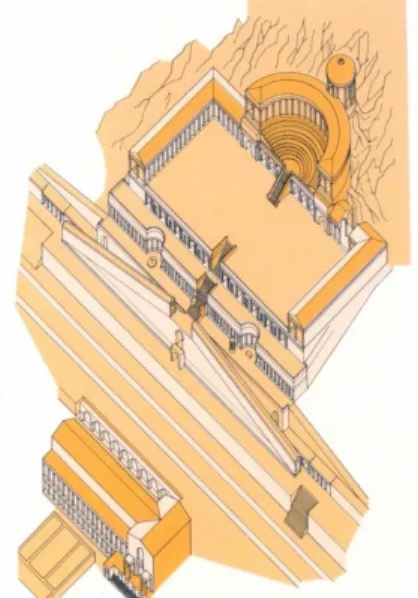
Roman contribution at Praeneste was the introduction of a new architectural vocabulary:
semicircular exedras with barrel-vaulted porticoes, supporting walls cul-de-four niches, a general use of curvilinear and circular forms, the integration of a tholos and a cavea crowned with its semicircular ambulatory, all contained within a grand plan based on a strict symmetrical and axial organization. The eastern exedra of Praeneste possesses a circular concrete. This solid roof-covering rests on a concrete retaining wall with a reticulated covering on the side abutting the hill and, at the front, on Ionic columns arranged in a semicircle on the other side [5].
Figure 3. Temple of Fortuna Primigenia
3.2 Trajan’s Market
The ground floor and the first story stand in a vast semicircular sweep of sixty meters in diameter, punctuated with semicircular arched bays with alternately triangular and semicircular pediments. A third level stood recessed a little from the first two. Its shops overlooked the via Biberactica, which ran through the complex. On the other side of this street a rectilinear covered market survives, arranged on two stories forming the fourth and fifth levels of the overall structures. This large hall was covered by concrete cross-vaulting. Windows above the lateral gallery-like corridors provided ventilation and supplied indirect light [6].
Figure 4. Trajan’s market floor plan and section
Figure 5. Trajan’s Market – General view of the semicircular exedra
Figure 6. Upper level of the Trajan’s Markets.
The concrete vault is made up of a series of lateral projections opening on to trading galleries.
3.3 Hadrian’s Villa
General plan of the central zone of the Villa Hadriana at Tivoli. This imperial palace that Hadrian built from A.D118 comprises some thirty buildings. It had no orthogonal ground plan, no central focus, and no dominant orientation. Everything was dictated by imagination and spontaneity. As a result, a great variety of styles, and techniques, forms and structures exist at Hadrian’s Villa [7].
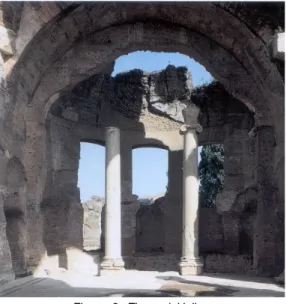
3.3.1 Thermal Halls in Hadrian Villa
Structures of the thermal halls are built by means of vaults made of thin layers of concrete.
Figure 7. General plan of Hadrian’s villa
Figure 8. Thermal Halls
3.3.2 Temple of Serapis
Built against the hill and forming a vast concrete covered exedra, the Sanctuary of Serapis, at the farthest end of the canopus, is a place of chthonian worship at Hadrian’s Villa. A system of concentric canals and rooms that penetrate deep into the hill formed the stage for initiation ceremonies.
Figure 10. Concrete covered exedra at Sanctuary of Serapis
3.3.3 Teatro Marittimo
Covered by a curved vault, the portico of the Teatro Marittimo rests, on one side, on the cylindrical exterior wall and, on the other, on the colonnade at the edge of the moat. The whole is governed by a centripetal scheme.
Figure 11. Teatro Marittimo with circular colonnade