무경운 벼 유기농업이 토양 미생물 생태에 미치는 영향
이영한†·안병구1†·곽연식2*
경상남도농업기술원, 1전라북도농업기술원, 2경상대학교
Impacts of Organic Farming System on the Soil Microbial Ecology in No-till Paddy
Young-Han Lee
†, Byung-Koo Ahn
1†, and Youn-Sig Kwak
2*
Gyeongsangnam-do Agricultural Research and Extension Services, Jinju 660-370, Korea
1
Jeollabuk-do Agricultural Research and Extension Services, Iksan 570-704, Korea
2
Department of Applied Biology, Gyeongsang National University, Jinju 660-701, Korea
The seasonal changes were evaluated in the soil microbial populations by selected media in an organic farming system (OFS) with no-till management compared to those in a conventional farming system (CFS) with tillage and synthetic amendments in a flooded paddy from 2009 to 2010. The populations of aerobic bacteria and fungi in the OFS were significantly higher than those in the CFS at the harvesting stages, whereas those of Gram-negative bacteria was significantly higher in the OFS than in the CFS before the submerging stages. In addition, populations of aerobic bacteria, Gram-negative bacteria, and fungi tended to rapidly decreased after the submerging stages may be due to insufficient oxygen. Gram-negative bacteria should be considered as potential factor responsible for the microbial population differentiation observed between the OFS and the CFS in flooded paddy fields.
Key words: Paddy, Microbial population, Gram-negative bacteria, Organic farming
접수 : 2011. 8. 25 수리 : 2011. 9. 22
†공동 제1저자
*연락저자 : Phone: +82557721922 E-mail: [email protected]
서 언
토양 미생물의 분포는 환경변화에 민감하게 반응하며 환경에 적응한 미생물이 우점하게 된다 (Lee and Ha, 2011;
Lee and Lee, 2011; Lee and Yun, 2011; Lee and Zhang, 2011). 미생물에 의한 토양 건전성 유지는 환경 보전을 위 해 매우 중요하며 미생물의 수, 미생물체량, 효소활성 등 의 특성이 토양 비옥도와 관련되어 있다 (Suh, 1998). 따 라서 토양의 건강 회복 (Health Recovery), 즉 친환경농업 을 통해 먹을거리의 건강, 생태계의 건강, 지역사회의 건 강, 농민 삶의 건강이 모두 회복되기 위해서는 토양 비옥 도 관리와 더불어 토양 미생물의 다양성을 함께 검토해야 한다. 무경운 벼 유기농업에서는 유기물 피복이 필수적인 조건이며 (Erenstein, 2002; Lal, 1991; Lee, 2010) 토양 물리성과 미생물 생체량이 향상되는 효과가 있다 (Busscher et al., 1997; Lee et al., 2010; Wright et al., 2005).
무경운 피복작물 작부체계에서 자운영은 벼 뿌리 생육 과 활성 유기물 함량을 증대시키는 것으로 알려져 있다
(Son and Lee, 2011). 또한, 무경운 논에서 유기물 투입이 논물의 미소동물 개체수 증가에 기여하였으며 분해가 느 린 호밀과 유채 보다 분해가 빠른 두과작물이 미소동물 개체수 증가에 유리하였고 벼 유기농업의 지표로 물벼룩 의 개체수를 적용하였다 (Lee and Sonn, 2011). 그러나 토양 건강성의 지표로 사용되는 미생물 다양성에 대한 연 구결과는 매우 미흡하여 논에서 무경운 유기농업을 적용 하는데 어려움이 있다.
따라서 본 연구는 논에서 무경운 유기농업과 관행농업 의 토양 미생물 다양성에 대한 계절적 변화를 연구하여 생태적 원리에 부합하는 유기농업의 장점을 밝혀내고 나 아가 유기농업 발전에 기여코자 수행하였다.
재료 및 방법
시험장소 논에서 무경운 유기농업과 관행농업의 미 생물 다양성 변화를 조사하기 위해 경남 하동군 양보면 (35°02′47″N, 128°51′27″E)에서 2009년 5월부터 2010년 10월 까지 수행하였다. 토성은 지산양토 (모래 34.3%, 미사 42.5%, 점토 23.2%) 였으며 시험구 면적은 1,500 m2 (50 m × 30 m) 으로 2요인 난괴법 3반복으로 수행하였다. 시험품종은 일
Fig. 1. Changes in populations of aerobic bacteria in paddy soils during rice plant growth stages. The system was not significant, the date was significant at p<0.001, and system × date interaction was significant at p<0.001.
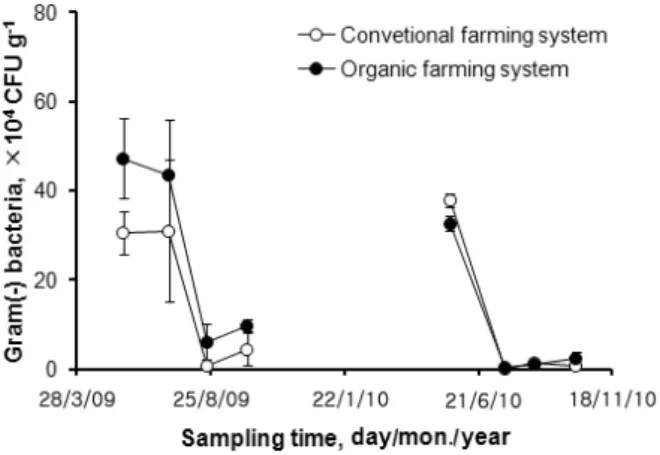
Fig. 2. Population dynamic of Gram-negative bacteria in paddy soils during rice plant growth stages. The system was significant at p<0.05, the date was significant at p<0.001, and system × date interaction was not significant.
미벼로 매년 6월 10일에 재식거리 30 cm × 15 cm 길이로 기계이앙 하였으며 10월 15일에 수확하였다. 시험 전 토양 화학성은 토양 및 식물체 분석법 (NIAST, 2000)으로 분석 한 결과 pH 5.8-6.2, 유기물 39.8-42.8 g kg-1, 유효인산 181-195 mg kg-1, 치환성 칼륨 0.87-0.96 cmolc kg-1, 치환 성 칼슘 9.0-9.7 cmolc kg-1, 치환성 마그네슘 2.0-2.3 cmolc
kg-1, 치환성 나트륨 0.32-0.37 cmolc kg-1, 암모니아태 질소 13- 27 mg kg-1, 유효규산 213-232 mg kg-1의 전형적인 논토양 이었다. 무경운 유기농업 시험구는 무경운으로 유기 질비료를 N-P2O5-K2O=90-15-60 kg ha-1 시용하였고 경운 관행농업 시험구는 유기농업 시험구와 같은 비율의 합성화 학비료를 시용하고 경운하였으며 6월 20일에 제초제 살포 와 8월 7일에 살층제를 살포하였다. 제초제는 penoxsulam (성분량 0.08%) 입제를 토양에서 2.0 mg kg-1의 농도가 되 도록 살포하였고 살충제는 pencycuron (성분량 25%) 수화 제를 토양에서 0.15 mg kg-1의 농도가 되도록 살포하였다.
토양 미생물 다양성 변화를 조사하기 위해 토양 시료는 담수 전, 분얼기, 출수기 및 수확기에 0-15 cm 깊이에서 3반복으 로 채취하였다.
토양 미생물 조사방법 채취한 토양은 냉장고에 보 관하면서 1주일 이내에 토양 미생물을 조사하였다. 토양 호기성 세균은 cyclohaximide 50 ㎍ mL-1 (Dindal, 1990) 을 가한 yeast extract medium (James, 1958), 곰팡이는 streptomycin-rose bengal medium (Martin, 1950)을 사 용하였다. 또한, 그람음성세균은 crystal violet 내성균 medium을 이용하였고 바실러스균은 Suh and Shin (1997)의 방법을 사용하였다.
다변량 주성분 분석 및 통계분석 미생물 자료는 SAS 프로그램 9.1.3 버전 (2006)을 이용하여 통계분석 하
였다. 무경운 유기농업 시험구와 경운 관행농업 시험구의 계절적인 토양 미생물 분포변화와 시험구와 조사시기에 따른 상호관계를 검토하기 위하여 two-way ANOVA 분석 을 실시하여 0.1%, 1.0% 그리고 5.0% 유의수준에서 F 검 정을 실시하였다. 또한, 분석된 토양 미생물 개체수는 주 성분 분석을 통하여 무경운 유기농업 시험구와 경운 관행 농업 시험구의 차이를 비교 검토하였다.
결과 및 고찰
미생물 개체수 변화 무경운 유기농업 시험구와 경 운 관행농업 시험구의 토양 미생물 변화를 조사하였다. 담 수 전 호기성 세균 개체수는 2009년에 유기농업 18.1×10⁶ CFU g-1, 관행농업 17.1×10⁶ CFU g-1으로 유의적인 차이 가 없었으나 2010년에는 무경운 유기농업이 23.5×10⁶ CFU g-1로서 경운 관행농업 16.2×10⁶ CFU g-1에 비해 유의적 인 증가를 나타냈다 (Fig. 1). 또한, 수확기에는 무경운 유 기농업이 2009년에 21.8×10⁶ CFU g-1, 2010년에 11.2×10⁶ CFU g-1로서 경운 관행농업의 9.0×10⁶ CFU g-1, 6.5×10⁶ CFU g-1보다 유의적으로 많았다. 이러한 경향은 Beare et al. (1994)이 보고한 바와 같이 무경운 토양은 물리적인 교란이 적어 미생물의 먹이인 유기물의 분해가 느리게 진 행됨으로 호기성 세균 개체수가 관행농업 보다 많은 것으 로 판단되었다. 그러나 분얼기와 출수기에는 경운 관행농 업이 무경운 유기농업 보다 호기성 세균 개체수가 많은 경향이었으나 유의적인 차이는 없었다. 그리고 무경운 유 기농업과 경운 관행농업 모두 담수 이후 호기성 세균 개 체수가 급격히 감소되는 추세를 나타냈다. 이것은 담수 조 건과 유기물 분해로 인한 산소부족으로 토양의 호기성 세 균 개체수가 크게 감소된 것으로 판단되었으며 (Drenovsky et al., 2004) 무경운 유기농업이 경운 관행농업 보다 민
Fig. 3. Seasonal Bacillus spp. density changes in paddy soils during rice plant growth stages. The system was not significant, the date was significant at p<0.001, and system × date interaction was not significant.
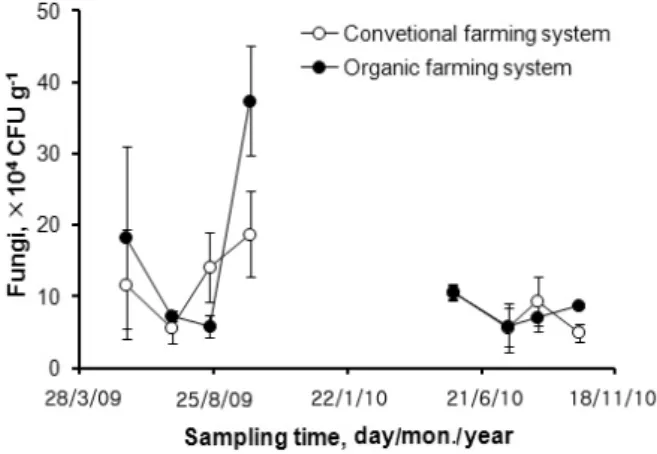
Fig. 4. Changes in populations of fungi in paddy soils during rice plant growth stages. The system was not significant, the date was significant at p<0.001, and system × date interaction was significant at p<0.01.
감하게 반응하는 것으로 나타났다. 벼 생육단계 전반에 걸 쳐 호기성 세균 개체수는 무경운 유기농업과 경운 관행농 업은 유의적인 차이가 없었으며 벼 생육단계는 담수 전 시기가 유의적으로 높았고 (p<0.001) 재배방법과 생육단계 의 상호작용도 유의적인 차이가 있었다 (p<0.001).
그람음성 세균 개체수의 변화는 2010년 담수 전 단계를 제외한 대부분의 생육단계에서 무경운 유기농업이 경운 관 행농업에 비해 높은 경향을 보였다 (Fig. 2). 이러한 결과 는 Lee and Yun (2011)이 보고한 바와 같이 동일한 담수 조건의 논에서 그람음성 세균의 분포가 무경운 유기농업 이 경운 관행농업 보다 높다고 보고한 결과와 일치하였다.
실제 그람음성 세균은 불리한 토양 환경조건에서 그람양성 세균 보다 빠르게 생육하고 활동적인 것으로 알려져 있다 (Mechri et al., 2010). 또한, 경운 관행농업은 제초제와 살 충제를 사용함으로 토양 그람음성 세균의 개체수가 무경운 유기농업에 비해 감소된 것으로 판단되었다 (Rillig et al., 2003; Wang et al., 2008). 그람음성 세균은 2010년에 재 배방법에 상관없이 담수 이후 분얼기에 급격한 개체수의 감 소를 보였다. 이러한 결과는 그람음성 세균은 호기성 세균 보다 산소부족에 민감한 것으로 판단되었다. 그리고 2009년 담수 전 단계에서 그람음성 세균 개체수는 무경운 유기농 업에서 47.3×10⁴ CFU g-1으로 경운 관행농업 30.7×10⁴ CFU g-1 보다 유의적으로 높았다. 그람음성 세균 개체수는 벼 생 육단계 전반에 걸쳐 무경운 유기농업이 경운 관행농업에 비 해 유의적으로 많았고 (p<0.001) 담수 전 단계가 분얼기, 출 수기 및 수확기 보다 유의적으로 많았으나 (p<0.001) 재배방 법과 벼 생육단계의 상호작용은 유의적인 차이가 없었다.
바실러스 개체수의 변화는 Fig. 3과 같이 무경운 유기 농업은 2009년 출수기에 11.1×10⁵ CFU g-1, 2010년 담수 전 단계에서 9.9×10⁵ CFU g-1으로 경운 관행농업의 33.9×
105 CFU g-1와 15.5×10⁵ CFU g-1에 비해 유의적으로 낮았
다. 바실러스 개체수는 재배방법 및 재배방법과 벼 생육단 계의 상호작용에는 유의적인 차이가 없었으나 벼 생육단 계는 유의적인 차이를 나타냈다 (p<0.001).
곰팡이 개체수의 변화는 출수기를 제외한 담수 전 단 계, 분얼기 및 수확기에 무경운 유기농업이 경운 관행농업 보다 높은 경향이었다 (Fig. 4). 특히 수확기 무경운 유기 농업에서 곰팡이 개체수는 2009년 37.4×10⁴ CFU g-1, 2010 년 8.7×10⁴ CFU g-1으로 경운 관행농업 18.7×10⁴ CFU g-1 과 5.0×10⁴ CFU g-1에 비해 유의적으로 높았다. 곰팡이 개체수의 변화는 호기성 세균 및 그람음성 세균의 개체수 변화와 같이 담수 조건에서 감소되는 것으로 나타났다. 곰 팡이 분포 비율은 세균의 분포 비율에 비해 유기물이나 담수조건의 변화에 민감하게 반응하는 것으로 알려져 있 으나 (Hamman et al., 2007; Lee and Yun, 2011; Mamilov and Dilly, 2002) 본 연구에서는 담수조건에서 세균 개체 수의 변화가 곰팡이 개체수의 변화 보다 민감한 것으로 나타났다. 따라서 미생물의 개체수와 분포비율은 항상 일 치하지는 않는 것으로 판단되었으며 향후 토양 미생물 건 전성을 평가할 때 개체수 뿐만 아니라 분포비율도 함께 검토해야 할 것이다. 곰팡이 개체수는 재배방법에 따른 유 의성은 없었으나 벼 생육단계 (p<0.001) 그리고 재배방법 과 벼 생육단계의 상호작용 (p<0.01)은 유의적인 차이가 있었다.
토양 미생물 주성분 분석 토양 미생물 개체수의 변 화를 설명하기 위하여 여러 가지 요인을 몇 가지의 성분 으로 추출하여 설명하고 예측할 수 있는 주성분 분석방법 을 이용하였다 (Lee and Ha, 2011; Lee and Zhang, 2011;
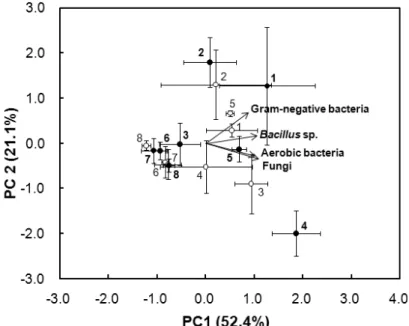
Lee et al., 2011). 무경운 유기농업과 경운 관행농업 토양 의 미생물 개체수를 주성분으로 분석한 결과는 Fig. 5와 같다. 주성분 분석결과 제1주성분이 52.4%, 제2주성분이
Fig. 5. Principal component analyses of soil microbial populations from an organic farming system (●) and a conventional farming system (○). The variance explained by each principal component (PC) axis is shown in parentheses. PC analysis shows loading values for the individual population of microbes. The bars represent one standard deviation of the mean. 1, May 20, 2009; 2, Jul. 10, 2009; 3, Aug. 21, 2009; 4, Oct. 5, 2009; 5, May 20, 2010; 6, Jul. 21, 2010; 7, Aug. 23, 2010, and 8, Oct. 8, 2010. Significant effects of PC1 were obtained from two- way analysis of variance. The system was not significant, the date was significant at p<0.001, and system × date interaction was significant at p<0.001.
21.1%로서 전체 73.5%의 자료를 설명할 수 있는 것으로 나타났다. 제1주성분은 곰팡이 개체수가 가장 크게 기여하 였으며 바실러스 개체수, 호기성 세균 개체수, 그람음성 세균 개체수의 순으로 정의 기여를 하는 것으로 나타났다.
또한, 토양 호기성 세균 개체수와 곰팡이 개체수는 고도의 정의 상관관계를 나타냈다. 재배방법에 따라 무경운 유기 농업과 경운 관행농업의 토양 미생물 개체수는 유의적인 차이가 없었으나 벼 생육단계별 토양 미생물 개체수 (p<0.001) 그리고 재배방법 및 벼 생육단계별 토양 미생물 개체수의 상호작용 (p<0.001)은 유의적인 차이가 있었다. 벼 생육단 계별 무경운 유기농업과 경운 관행농업의 토양의 미생물 개체수는 담수조건이라는 환경요인에 가장 크게 영향을 받 는 것으로 나타났으며 그람음성 세균 개체수는 무경운 유 기농업과 경운 관행농업 토양 미생물 특성을 가장 잘 구분 할 수 있는 특성을 보였다. 향후 토양 미생물의 효소활성 이나 토양 이화학적 특성 변화 등을 고려한 토양 미생물의 변화에 대한 연구가 필요할 것으로 생각된다.
요 약
무경운 유기농업과 경운 관행농업의 벼 생육 단계별 토 양 미생물 개체수 변화를 분석하였다. 수확기 토양의 호기 성 세균 개체수와 곰팡이 개체수는 무경운 유기농업이 경 운 관행농업 보다 유의적으로 많았으며 담수 이전 그람음
성 세균 개체수도 경운 관행농업 보다 유의적으로 많았다.
호기성 세균, 그람음성 세균 그리고 곰팡이 개체수는 담수 이후 급격하게 감소하였다. 그람음성 세균 개체수는 무경 운 유기농업과 경운 관행농업 토양 미생물 생태를 가장 잘 구분할 수 있는 특성을 보였다.
사 사
본 연구는 농촌진흥청 공동연구사업 (과제번호: PJ0069 06222011)의 지원에 의해 이루어진 것임.
인 용 문 헌
Beare, M.H., P.F. Hendrix, and D.C. Coleman. 1994. Water- stable aggregates and organic matter fractions in conventional- and no-tillage soils. Soil Sci. Soc. Am. J. 58:777-786.
Busscher, W.J., P.J. Bauer, C.R. Camp, and R.E. Sojka.
1997. Correction of cone index for soil water content differences in a coastal plain soil. Soil Till. Res. 43:205-217.
Dindal, D.L. 1990. Soil sampling and method of analysis.
Soil Biology Guide. Wiley Interscience.
Drenovsky, R.E., D. Vo, K.J. Graham, and K.M. Scow.
2004. Soil water content and organic carbon availability are major determinants of soil microbial community composition.
Microb. Ecol. 48:424-430.
Erenstein, O. 2002. Crop residue mulching in tropical and semi-tropical countries: an evaluation of residue availability and other technological implications. Soil Till. Res. 67:115-133.
Hamman, S.T., I.C. Burke, and M.E. Strombeerger. 2007.
Relationships between microbial community structure and soil environmental conditions in a recently burned system. Soil Biol. Biochem. 39:1703-1711.
James, N. 1958. Soil extract in soil microbiology. Can. J.
Microbiol. 4:363-370.
Lai, R. 1991. Tillage and agricultural sustainability. Soil Till.
Res. 20:133-146.
Lee, Y.H. 2010. Evaluation of no-tillage rice cover crop cropping systems for organic farming. Korean J. Soil Sci. Fert. 43:200-208.
Lee, Y.H., B.K. Ahn, and J.H. Lee. 2010. Impacts of rice straw application and green manuring on selected soil physical properties and microbial biomass carbon in no-till paddy field. Korean J. Soil Sci. Fert. 43(1):105-112.
Lee, Y.H. and H.D. Yun. 2011. Changes in microbial community of agricultural soils subjected to organic farming system in Korean paddy fields with no-till management.
J. Korean Soc. Appl. Biol. Chem. 54(3):434-441.
Lee, Y.H. and S.K. Ha. 2011. Impacts of chemical properties on microbial populaton from upland soils in Gyeongnam Province. Korean J. Soil Sci. Fert. 44(2):242-247.
Lee, Y.H. and S.T. Lee. 2011. Comparison of microbial community of orchard soils in Gyeongnam Province. Korean J. Soil Sci. Fert. 44(3):492-497.
Lee, Y.H. and Y.K. Sonn. 2011. Evaluation of aquatic animals on the water in a rice field with no-tillage rice cover crop cropping systems. Korean J. Soil Sci. Fert.
44(3):371-374.
Lee, Y.H. and Y.S. Zhang. 2011. Response of microbe to chemical properties from orchard soil in Gyeongnam Province.
Korean J. Soil Sci. Fert. 44(2):236-241.
Lee, Y.S., J.H. Kang, K.J. Choi, S.T. Lee, E.S. Kim, W.D.
Song, and Y.H. Lee. 2011. Response of soil microbial communities to different cultivation systems in controlled horticultural land. Korean J. Soil Sci. Fert. 44:118-126.
Mamilov, A.S. and O.M. Dilly. 2002. Soil microbial eco-physiology as affected by short-term variations in environmental conditions. Soil Biol. Biochem. 34:1283-1290.
Martin, J.P. 1950. Use of acid, rose Bengal and streptomycin in the plate method for estimating soil fungi. Soil Sci.
69:215-232.
Mechri, B., H. Chehab, F. Attia, F.B. Mariem, M. Braham, and M. Hammami. 2010. Olive mill wastewater effects on the microbial communities as studied in the field of olive trees by analysis of fatty acid signatures. Eur. J.
Soil Bio. l46:312-318.
NIAST (National Institute of Agricultural Science and Technology). 2000. Analytical methods of soil and plant.
NIAST, Suwon, Korea.
Rillig, M.C., P.W. Ramsey, S. Morris, and E.A. Paul.
2003. Glomalin, an arbuscular-mycorrhizal fungal soil protein, responds to land-use change. Plant Soil 253:293-299.
SAS Institute. 2006. SAS Version 9.1.3. SAS Inst., Cary, NC.
Son, D. and Y.H. Lee. 2011. Effects of no-tillage rice cover crop cropping systems on rice root growth. Korean J. Soil Sci. Fert. 44(3):375-379.
Suh, J.S. and J.S. Shin. 1997. Soil microbial diversity of paddy field in Korea. Korean J. Soil Sci. Fert. 30:200-207.
Wang, M.C., Y.H. Liu, Q. Wang, M. Gong, X.M. Hua, Y.J.
Pang, S. Hu, and Y.H. Yang. 2008. Impact of methamidophos on the biochemical, catabolic, and genetic characteristics of soil microbial communities. Soil Biol. Biochem. 40:778-788.
Wright, A.L., F.M. Hons, and J.E. Matocha Jr. 2005.
Tillage impacts on microbial biomass and nitrogen dynamics of corn and cotton rotations. Appl. Soil Ecol. 29:85-92.