Introduction
Industrialized forms of conventional agriculture are dependent on large inputs of fertilizers and pesticides, and these farming systems tend to be unstable ecosystems in which the potential for maximum yield is inevitably associated with a risk due to ecosystem instability (Vogtmann, 1984). Organic farming is often contrasted with conventional farming, and it is a form of agriculture which excludes the use of synthetic fertilizers, pesticides, and other chemical amendments.
Soil fertility management in organic farming systems is based on feeding the soil plant residues, animal manures, and compost. In contrast, conventional agriculture simplifies crop nutrient and soil fertility management by feeding the plant soluble nutrients. Thus crop nutrition in conventional agriculture can be managed by adding the amounts of fertilizer nutrients that need to account for
differences between crop nutrient needs and available soil nutrients. However, nutrient management in organic farming systems is more complex. It is very difficult to provide the exact balance of nutrients needed by the plant in organic farming system. Most organic materials, including compost and manure, have only a small component of soluble nutrients and most of their nutrients must be transformed through biological processes before they become available to plants. Also most manures and composts do not have a consistent nutrient content, and contain a ratio of nutrients different from that needed for optimal plant growth. Therefore organic amendments may not provide nutrients in the amounts and at the times needed for optimal plant performance.
Organic farming systems have been found to have a greater soil organic matter and nutrient status than the conventional agricultural systems (Liebig and Doran, 1999; Blaise et al., 2004; Martini et al., 2004; Marriott and Wander, 2006). These results are mostly due to application of organic amendments, less frequent tillage,
Received : December 13. 2007 Accepted : January 12. 2008*Corresponding author: Phone : +82538506755, E-mail : [email protected]
Comparison of Soil Nutrient Status in Conventional and Organic Apple Farm
Jong-Bae Chung,
*and Yoon-Jung Lee
Division of Life and Environmental Sciences, Daegu University, Gyeongsan 712-714, Korea
Soil nutrient status in an organic apple farm was evaluated in relation to a conventional farm to better understand the effects of organic farming system on soil fertility. Soil organic matter, total and mineral N, available P, exchangeable cations, and available micronutrients were monitored at depth of 5-20 cm from May to October in 2006. Average soil organic matter content was 63.3 and 31.0 g kg
-1in organic and conventional farm, respectively. Total N content was 3.3 and 1.7 g kg
-1in average for organic and conventional farm, respectively. Ammonium and nitrate N in organic farming were maintained at relatively stable levels, but in the conventional farm the levels were very high in early season due to the chemical fertilizer application. In the organic apple farm, available P content in May was lower than that found in the conventional farm, but during the growing season available P content was continuously increased and in August the content was more than 1000 mg P
2O
5kg
-1. The organic farm maintained relatively greater exchangeable K, Ca, and Mg levels than the conventional farm. Available Cu, Fe, and Mn contents in the conventional farm were relatively greater than those found in the organic farm. However, available Zn extracted in 0.1 M HCl was much greater in the organic farm. Nutrient levels above crop needs were observed in both conventional and organic apple farm suggesting a more appropriate management of soil nutrients in organic farming to secure its fundamental functions for the sustainable agriculture.
Key words : Apple orchard, Exchangeable cations, Micronutrients, Nitrogen, Nutrient status, Organic farming,
Organic matter, Phosphorus.
and more diverse crop rotations. The higher levels of C, N and P on organic farms were consistent with deeper topsoil, lower bulk density, greater available water- holding capacity, and more diverse and greater microbial populations and activities (Liebig and Doran, 1999;
Reganold, 1988). Organic farming soil, which received five annual applications of composted poultry manure, had significantly higher N, P, and K than conventional plots (Martini et al., 2004). Kim et al. (2001) also found greater accumulation of available P in soils of organic farming plastic film houses. Lee et al. (2004) found that available P and exchangeable cations were above the optimum levels for crop growth due to excessive application of compost in organic farms in Korea. Liebig and Doran (1999) also observed nitrate N and available P levels above crop needs in both organic and conventional farms in Nebraska and North Dakota, USA. However, Gosling and Shepherd (2005) found that soils in England under mixed organic arable rotation were able to maintain soil organic matter and N levels as found under conventional systems but a decline in P and K on conversion to organic farming. Animal manure or various biosolid based composts contain large amounts of mineral micronutrients including Cu and Zn, and compost application can increase the availability of those nutrients in soils (Moreno-Caselles et al., 2005; Ozores- Hampton et al., 2005; Guerra-Rodriguez et al., 2006).
And Blaise et al. (2004) reported relatively greater contents of DTPA-extractable Cu, Mn, and Zn in cotton field of organic farming than in conventional farming.
The above results indicate that it is essential to manage appropriate balance of soil nutrients to promote a more sustainable agriculture, whether the farming system is
conventional or organic. Levels of nutrients in soil that exceed plant requirements lower nutrient-use efficiency and potentially contribute to non-point source pollution.
In our country, the history of organic farming is relatively short and few farms have followed the regulations for organic farming for more than one decade. However, organic farming has been rapidly expanding, and the development of organic farming systems necessarily must be based on value judgments for key properties of importance for farming.
In this study, the soil nutrient levels in conventional and organic apple farm were monitored during the growing season to evaluate how the organic soil management system maintains nutrient status in the soil.
Materials and Methods
Apple orchards Two apple orchards located in Yeongchun, Gyeongbuk (36°01、N and 128°60、E) were selected for this study. One orchard was managed by organic farming system and the other was a conventional farming orchard. The selected apple orchards were two adjacent fields to ensure the same pedological conditions except management system. The soil type in the area is classified as Daegu series. Daegu soils are loamy skeletal, nonacid, mesic family of Lithic Eutrudepts. The organic based apple orchard has been managed without using of synthetic fertilizers and pesticides since 1999. Soil fertility management of the two fields differs markedly but is representative for the conventional and organic farming (Table 1). Compost used in the organically managed apple orchard was prepared by the farmer using various plant residues and
pH
(1:5 H2O) EC Organic matter Total N NH4-N NO3-N Total P
dS m-1 --- g kg-1---
7.4 8.9 6.39 33.6 659 70 15.8
--- mg kg-1--- g kg-1 Table 2. Characteristics of the fermented compost used in the organically managed apple farm.
Farming system
Conventional farming
Organic farming
Tillage method Chemical input
Organic matter input Composted manure application
(10 Mg ha-1) in December
1 Mg ha-1(N-P-K=17-21-17) in February and 100 kg ha-1 (N-P-K=17-21-17) in June
Frequent ploughing 0.2 m deep
Fermented compost application (30 Mg ha-1) on the surface of the soil
within the drip line in December
Several foliar applications of nutrients between May and September
Rye cultivation as cover crop and soil in drip line mulched with organic materials Table 1. Management practices employed on the conventionally and organically managed apple farms.
animal manures, and characteristics of the compost were listed in Table 2.
Soil sampling Soil samples were collected at the middle spot of the two adjacent trees along the tree line at 5 to 20 cm depth from May to October in 2006. Three sampling sites were selected in both conventional and organic apple farms and two replicated soil samples were collected in each sampling site. Large pieces of raw organic material were removed from the soil surface before collecting samples. Soil samples were air-dried, and ground to pass a 2 mm sieve prior to analyses.
Chemical analyses Organic carbon was determined by dichromate oxidation using Walkley-Black procedure (Nelson and Sommers, 1982). Total nitrogen was determined by Kjeldahl distillation method after sulphuric acid digestion using Se, CuSO
4, and K
2SO
4as catalyst (Bremner and Mulvaney, 1982). Ammonium (NH
4-N) and nitrate (NO
3-N) in the soils were extracted with 2 M KCl and determined using the FIA-5000 autoanalyzer (FOSS Tecator, Hoganas, Sweden).
Available P was determined following Lancaster method (NIAST, 1988). Exchangeable cations were determined using Varian Liberty Series II (Mulgrave, Australia) inductively coupled argon plasma emission spectrometer (ICP-ES) following soil extraction with 1 M NH
4OAc (Thomas, 1982). Micronutrients Cu, Fe, Mn, and Zn were determined using ICP-ES after extraction with 0.1 M HCl and DTPA (Soltanpour et al., 1976; NIAST, 1988).
Results and Discussion
Organic matter Soil organic matter content was much greater in the organic farm than in the conventional apple farm (Fig. 1). Average organic matter contents were 63.3 and 31.0 g kg
-1in the organic and conventional apple farm soil, respectively. Recommended soil organic matter content is 25-35 g kg
-1for fruit trees (NIAST, 1999). Comparing with the recommended level, organic matter content in the conventional farming orchard was in the optimum condition but the organic farming orchard had much higher level of soil organic matter. This result could be due to the higher rate of organic material input in the organically managed apple farm (Table 1).
Although several years of contrasting soil management are not enough to produce a consistent difference in soil
organic matter content, the steady use of organic materials on an organic farm is considered important in maintaining the level of soil organic matter (Marinari et al., 2006). Depending on soil type, climate, management, and the capacity of a soil to store organic matter, organic C levels may increase linearly with the amount of organic matter input (Carter, 2002).
Organic matter is an essential component in improving physical, chemical, and biological soil properties. The high organic matter content in the organic farming orchard would be a factor which can enhance the soil quality. However, it should be also considered that the excessive accumulation of mineral nutrients in the soil with the continuous application of compost can deteriorate soil and environmental quality.
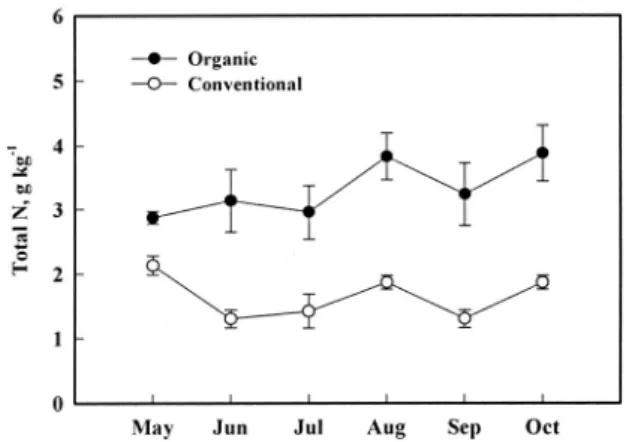
Total and mineral N The organically managed apple farm soil had a higher total N content than the soil of conventionally managed orchard (Fig. 2). Average total N content was 3.3 and 1.7 g kg
-1in organic and conventional apple farm soil, respectively. Total N content was not much changed during the growing season, and the relatively higher content of total N in the conventional farming orchard found in May could be due to the basal application of chemical fertilizer. The high total soil N content in organically managed apple farm could be due to the application of organic materials. The higher total N concentration in the organic systems compared with the conventional systems has been reported in many previous researches (Gerhardt, 1997;
Blaise et al., 2004; Marriott and Wander, 2006).
Ammonium N in the soil of organic apple farm was 2.6 mg kg
-1in average and the content was not much
Fig. 1. Organic matter content in the soil of conventional and organic apple farms. Bars represent standard deviation (n=6).¨ ¨
changed during the growing season (Fig. 3). But in conventional apple farm, NH
4-N in the soil was about 96 mg kg
-1in May and declined to 3.3 mg kg
-1in August.
The greater NH
4-N content in earlier period in conventional apple farm could be due to the applications of chemical nitrogen fertilizer. Nitrate N content was also greater in conventional apple farm soil in May and June, and this result could be due to the nitrification of the
applied ammonium fertilizer (Fig. 4). The NO
3-N content was lowered to 10 mg kg
-1after July. In organic apple farm, NO
3-N content was maintained at the level of around 10 mg kg
-1until August and increased after then and the level was greater than that found in conventional apple farm. Blaise et al. (2004) observed relatively greater contents of NH
4-N and NO
3-N in organic farming compared with those found in conventional farming cotton field. However, soil NO
3-N levels in the surface 30.5 cm were higher on conventional farms at most locations in North Dakota and Nebraska, USA (Liebig and Doran, 1999). This inconsistent trends in soil NO
3-N levels between organic and conventional farms could be resulted from the kind and input rate of nutrient source materials, time of soil test, climate of the regions, growing crop and so on.
Available P Available P content in the soil of conventional and organic apple farm was shown in Fig.
5. Conventional farming had greater available P in May and the content of available P was lowered to around 920 mg P
2O
5kg
-1from June to October. The greater available P in earlier season could be due to the input of soluble P through chemical fertilizer application, and later the soluble P level could be lowered by absorption, immobilization, leaching, and fixation. In organic apple farm, available P content in May was lower than that found in conventional farming orchard. But during the growing season available P content was continuously increased and in August the content was more than 1000 mg P
2O
5kg
-1. The increasing pattern of available P in organic farming soil could be due to the mineralization of organic amendments.
There are considerable evidence to suggest that the application of organic material to soil may increase P
Fig. 2. Total N content in the soil of conventional and organicapple farms. Bars represent standard deviation (n=6).
Fig. 3. Ammonium N content in the soil of conventional and organic apple farms. Bars represent standard deviation (n=6).
Fig. 4. Nitrate N content in the soil of conventional and organic apple farms. Bars represent standard deviation (n=6).
Fig. 5. Available P content in the soil of conventional and organic apple farms. Bars represent standard deviation (n=6).
availability (Kwabiah et al., 2003; Kim et al., 2001;
Liebig and Doran, 1999; Edmeades, 2003). The improvement of soil P availability in organic farming can come from either P released from organic inputs or increased availability of native soil P following addition of organic fertilizers. Organic acids produced during the decomposition of organic amendments can effectively reduce P sorption to the soil and increase P availability (Laboski and Lamb, 2003).
The available P contents in the apple farm soils were much greater than the recommended level of 200-300 mg P
2O
5kg
-1for fruit trees (NIAST, 1999). Excessive accumulation of P in organic farming soils is mostly caused by application of animal manure that containing high rate of P (Martini et al., 2004; Liebig and Doran, 1999). In most of manure-based organic farms application of manure on an N basis leads to soils becoming excessively enriched with respect to P. Under this condition greater runoff of P may result, and for soils with low P retention greater leaching losses may occur.
Exchangeable cations Relatively greater contents of exchangeable K, Ca, and Mg were observed in the apple farm soil of organic than conventional farming (Fig. 6).
Many other studies have shown that the use of organic amendments relative to inorganic fertilizers can result in soils becoming excessively enriched with K, Ca, and Mg in addition to P (Blaise et al., 2004; Bulluck et al., 2002;
Edmeades, 2003; Martini et al., 2004; Reganold, 1988).
Considering those previous results and the same inherent soil characteristics of the two apple orchards, the higher contents of exchangeable cations in the organic apple farm soil found in this study could be attributed to the release of cations from organic amendments and increase of exchange sites due to organic matter added.
Available Micronutrients Available Cu, Fe, and Mn extracted in both 0.1 M HCl and DTPA solution were greater in the conventional farming orchard soil compared with those found in the organic farming orchard soil (Fig. 7). However, available Zn extracted in 0.1 M HCl was greater in the organic farming orchard soil than that found in the conventional farming orchard soil. The Zn content extracted in DTPA solution was relatively greater in organic farming orchard during the mid-season, but the difference between conventional and organic farming orchards was not significant.
It is well documented that the availability of Cu, Fe,
Mn, and Zn is associated with soil pH and organic matter
(Kabata-Pendias, 2001). The greater availability of Cu,
Fe, and Mn in conventional apple farm observed in this
study could be basically resulted from the lower soil pH
as compared to organic farming. Average soil pH values
of conventional and organic apple farm were 5.4 and 7.8,
respectively, during the growing season. Overall
solubility of both cationic and anionic forms of Cu, Fe,
and Mn decreases at about pH 7 to 8 (Kabata-Pendias,
2001). Also the higher organic matter content in organic
farming soil could affect the availability of these
micronutrients. It is well known that humic substances
strongly immobilize metal ions in direct coordination
Fig. 6. Exchangeable cation content in the soil of conventional and organic apple farms. Bars represent standard deviation (n=6).with functional oxygens of the organic substances (McBride, 1982). The stability of metal organic matter complexes increases with increasing pH (Khan, 1969). In the case of Zn, considering soil pH, the solubility should be higher in acidic soil of conventional apple farm, but the extractable Zn was greater in high pH soil of organic apple farm. This result indicates that input of Zn with manure-based compost in organic farming orchard is greater in comparison to the conventional farming system. However, the apparent availability of micronutrients in soil can be controlled by various and complicate reactions, and therefore the difference of micronutrient availability between conventional and organic apple farms cannot be simply explained.
Typical ranges in critical levels for Cu, Fe, Mn, and Zn determined in 0.1 N HCl extracts are 1.0-2.0, 10-16, 1.0- 4.0, and 1.0-5.0 mg kg
-1, respectively, for most crop plants (Sims and Johnson, 1991). And the suggested critical levels of DTPA extractable Cu, Fe, Mn, and Zn for plant growth are 0.2, 4.5, 1.0, and 0.6 mg kg
-1, respectively (Lindsay and Norvell, 1978). Comparing with these critical levels, extractable micronutrients contents in the apple farm soils were found to be in excessive levels in both conventional and organic farming systems. Although any toxicity problems in
relation to the micronutrients were not found in the apple farms, more careful management of those nutrients is required.
Conclusions
The results of this study indicate that soil in organic apple farm is able to maintain higher levels of organic matter and total nitrogen than those found under typical conventional system. Soil mineral N levels in conventional system were much higher in early season and lowered after June and this trend was due to the fertilization time, but in organic farming system NH
4-N level was quite stable during the growing season and NO
3-N level was considerably increased in late season.
Contents of available P, exchangeable cations, and available micronutrients (except Zn) were also higher in organic farming compared with conventional farming system. And the levels of available P, exchangeable cations, and micronutrients exceeded the suggested critical levels in both organic and conventional farming system.
The excessive enrichment of N, P, and other nutrients in
organic farming soil indicates that one production
practice is not consistently better at minimizing potential
Fig. 7. Micronutrient content extracted in 0.1 M HCl and DTPA solution in the soil of conventional and organic apple farms. Bars represent standard deviation (n=6).negative off-site impacts due to nutrient loss to the environment. Although organic inputs cannot easily provide the amount and balance of nutrients required by the plant, careful and efficient use of composts under organic farming system is essential to avoid any threat to soil and surrounding environments.
Acknowledgement
This research was supported by the Daegu University Research Grant, 2007.
References
Blaise, D., T. R. Rupa, and A. N. Bonde. 2004. Effect of organic and modern method of cotton cultivation on soil nutrient status.
Commun. Soil Sci. Plant Anal. 35:1247-1261.
Bremner, J. M., and C. S. Mulvaney. 1982. Nitrogen Total. p. 595- 624. In A. L. Page et al. (ed.) Methods of soil analysis, Part 2:
Chemical and microbiological properties. SSSA, Madison, WI, USA.
Bulluck, L. R., M. Brosius, G. K. Evanylo, and J. B. Ristaino. 2002.
Organic and synthetic amendments influence soil microbial, physical and shemical properties on organic and conventional farms. Appl. Soil Ecol. 19:147-160.
Carter, M. R. 2002. Soil quality for sustainable land management:
organic matter and aggregation interactions that maintain soil functions. Agron. J. 94:38-47.
Edmeades, D. C. 2003. The long-term effects of manures and fertilizers on soil productivity and quality: A review. Nutr. Cycl.
Agroecosys. 66:165-180.
Gerhardt, R. A. 1997. A comparative analysis of the effects of organic and conventional farming systems on soil structure. Biol.
Agric. Hort. 14:139-157.
Gosling, P., and M. Shepherd. 2005. Long-term changes in soil fertility in organic farming systems in England, with particular reference to phosphorus and potassium. Agric. Ecosyst. Environ.
105:425-432.
Guerra-Rodriguez, E., J. Alonso, M. J. Melgar, and M. Vazquez.
2006. Evaluation of heavy metal contents in co-composts of poultry manure with barley wastes or chestnut burr/leaf litter.
Chemosphere 65:1801-1805.
Kabata-Pendias, A. 2001. Trace elements in soils and plants. CRC Press, Boca Raton, FL, USA.
Khan, S. U. 1969. Interaction between the humic acid fraction of soils and certain metallic cations. Soil Sci. Soc. Am. Proc. 33:851- 854.
Kim, P. J., D. Y. Chung, and D. Malo. 2001. Characteristics of phosphorous accumulation in soils under organic and conventional farming in plastic film houses in Korea. Soil Sci. Plant Nutr.
47:281-289.
Kwabiah, A. B., N. C. Stoskopf, C. A. Palm, R. P. Voroney, M. R.
Rao, and E. Gacheru. 2003. Phosphorus availability and maize
response to organic and inorganic fertilizer inputs in a short term study in western Kenya. Agric. Ecosyst. Environ. 95:49-59.
Laboski, C. A. M., and J. A. Lamb. 2003. Changes in soil test phosphorus concentration after application of manure or fertilizer.
Soil Sci. Soc. Am. J. 67:544-554.
Lee, Y. J., D. H. Choi, S. H. Kim, S. M. Lee, Y. H. Lee, B. M. Lee, and T. W. Kim. 2004. Long-term changes in soil chemical properties in organic arable farming systems in Korea. Korean J.
Soil Sci. Fert. 37:228-234.
Liebig, M. A., and J. W. Doran. 1999. Impact of organic production practices on soil quality indicators. J. Environ. Qual. 28:1601- 1609.
Lindsay, W. L., and W. A. Norvell. 1978. Development of a DTPA soil test for zinc, iron, manganese, and copper. Soil Sci. Soc. Am.
J. 42:421-428.
Marinari, S., R. Mancinelli, E. Campiglia, and S. Grego. 2006.
Chemical and biological indicators of soil quality in organic and conventional farming systems in Central Italy. Ecol. Indic. 6:701- 711.
Marriott, E. E., and M. M. Wander. 2006. Total and labile soil inorganic matter in organic and conventional farming systems.
Soil Sci. Soc. Am. J. 70:950-959.
Martini, E. A., J. S. Buyer, D. C. Bryant, T. K. Hartz, and R. F.
Denison. 2004. Yield increases during the organic transition:
improving soil quality or increasing experience? Field Crop. Res.
86:255-266.
McBride, M. B. 1982. Electron spin resonance investigation of Mn2+
complexation in natural and synthetic organics. Soil Sci. Soc Am.
J. 46:1137-1143.
Moreno-Caselles, J., R. Moral, M. D. Perez-Murcia, A. Perez- Espinosa, C. Paredes, and E. Agullo. 2005. Fe, Cu, Mn, and Zn input and availability in calcareous soils amended with the solid phase pig slurry. Commun. Soil Sci. Plant Anal. 36:525-534.
Nelson, D. W., and L. E. Sommers. 1982. Total carbon, organic carbon, and organic matter. p. 539-579. In A. L. Page et al. (ed.) Methods of soil analysis, Part 2: Chemical and microbiological properties. SSSA, Madison, WI, USA.
NIAST. 1988. Methods of soil chemical analysis. National Institute of Agricultural Science and Technology, Suwon, Korea.
NIAST. 1999. A guidance of fertilization for crops. National Institute of Agricultural Science and Technology, Suwon, Korea.
Ozores-Hampton, M., P. A. Stansly, and T. A. Obreza. 2005. Heavy metal accumulation in a sandy soil and in pepper fruit following long-term application of organic amendments. Compost Sci. Util.
13:60-64.
Reganold, J. P. 1988. Comparison of soil properties as influenced by organic and conventional farming systems. Am. J. Altern. Agric.
3:144-155.
Sims, J. T., and G. V. Johnson. 1991. Micronutrient in soil. p. 427- 479. In J. J. Mortvedt (ed.) Micronutrients in agriculture. 2nd ed.
SSSA Book series No. 4. SSSA, Madison, WI, USA.
Soltanpour, P. N., A. Khan, and W. L. Lindsay. 1976. Factors affecting DTPA-extractable Zn, Fe, Mn, and Cu from soils.
Commun. Soil Sci. Plant Anal. 7:797-821.
Thomas, G. W. 1982. Exchangeable cations. p. 159-165. In A. L.
Page et al. (ed.) Methods of soil analysis, Part 2: Chemical and microbiological properties. SSSA, Madison, WI, USA.
Vogtmann, H. 1984. Organic farming practices and research in
Europe. p. 19-36. In D. M. Kral et al. (ed.) Organic farming:
Current technology and its role in a sustainable agriculture. ASA Special Publication No. 46. American Society of Agronomy, Madison, WI, USA.
유기농업체계가 토양의 비옥도와 지속가능성에 미치는 영향을 파악하기 위하여 유기농 사과과수원 토양의 양 분상태를 관행농과 비교하여 조사하였다. 동일한 토양에 조성된 인접한 유기농 및 관행농 사과과수원을 선정하 여 2006년 5월부터 10월까지 월별로 5-20 cm 깊이의 토양을 채취하였으며, 유기물, 총 질소 및 무기질소, 유효 인산, 교환성 양이온, 가용성 미량원소의 함량을 조사하였다. 평균 유기물 함량은 유기농과 관행농 과수원 토양 에서 각각 63.3 및 31.0 g kg-1으로 유기농 과수원 토양에서 훨씬 높았다. 총 질소 함량은 평균값으로 유기농과 관행농 과수원 토양에서 각각 3.3 및 1.7 g kg-1이었다. 유기농 과수원 토양에서는 암모늄 및 질산태 질소 함량 이 작기 중에 비교적 안정한 수준을 지속적으로 유지하였으나 관행농 과수원 토양에서는 화학비료 시용으로 인하여 조사 초기에 그 함량이 아주 높았으며 8월까지 급격히 감소하였다. 유기농 과수원의 경우 유효인산은 5 월에는 관행농 과수원에 비하여 낮았으나, 작기가 진행되면서 지속적으로 증가하여 8월에는 그 함량이 1000 mg P2O5 kg-1 이상으로 나타났다. 유효인산은 관행농과 유기농 과수원 모두에서 적정수준인 200-300 mg P2O5 kg-1보다 훨씬 높았다. 교환성 K, Ca, Mg 함량은 관행농에 비하여 유기농 과수원 토양에서 상대적으로 높았다.
가용성 Cu, Fe, Mn 함량은 관행농 과수원 토양에서 높았으며, 0.1 N HCl 가용성 Zn 함량은 반대로 유기농 과 수원 토양에서 높았다. 이상의 결과에서 보면 관행농과 유기농 과수원 토양 모두에서 각종 양분함량이 적정수 준보다 높은 것으로 나타났으며, 화학비료를 사용하는 관행농에 비하여 유기농 과수원 토양에서 각종 양분 함 량이 오히려 높았다. 이러한 양분 과다 현상은 토양과 주변 환경에 부정적인 영향을 미칠 것이며, 유기농업의 근본 목적에도 벗어나는 결과이다.
관행농 및 유기농 사과과수원 토양의 양분함량 비교
정종배*·이윤정 대구대학교 생명환경학부