Introduction
Rice straw is mostly the only organic source available in most of paddy fields. Incorporation of the remaining stubble and straw into the soil returns most of the nutrient and helps to conserve soil properties even though some problems such as temporary immobilization of nitrogen (N), significant increase of methane (CH4) emission, and buildup of disease problem might be happened with the straw incorporation (Dobermann and Fairhurst, 2002).
Similar to the crop residue (rice straw) application, green manure crops play very valuable roles in agri- culture. Green manuring involves the soil incorporation of any crops, whether originally intended or not, irrespective of its state of maturity, for purpose of soil improvement.
Major benefits obtained from green manures are addition
of organic matter to the soil and its other advantageous impacts such as increase of aggregate that makes well aerated soil (Mac Rac and Mehuys, 1985; Sullivan, 2003).
In addition, the effects of different tillage systems on soil chemical, physical, and biological properties have been discussed over the last several decades. No-tillage is not a brand new issue. The undisturbed soil under no-tillage system is closely related to soil strength (measured commonly by bulk density, soil porosity, and penetration resistance), water content, microbial biomass, and soil carbon (C) sequestration (Busscher et al., 1997;
Lampurlanes and Cantero-Martinez, 2003; Wright et al., 2005). Bulk density is closely related with soil porosity and penetration resistance, and it also affects field soil water content. Higher bulk density with lower porosity decreases soil aeration and water infiltration and percolation. Besides, the higher bulk density, the greater penetration resistance, which is restricting plant root growth (Cassel, 1982; Lampurlanes and Cantero- Martinez, 2003). Also, there were several controversial
Effects of Rice Straw Application and Green Manuring on Selected Soil Physical Properties and Microbial Biomass Carbon in No-Till Paddy Field
Young-Han Lee, Byung-Koo Ahn1, and Jin-Ho Lee2*
Gyeongsangnam-do Agricultural Research and Extension Services, Jinju 660-370, Korea.
1Jeollabuk-do Agricultural Research and Extension Services, Iksan 570-704, Korea.
2Department of Bioenvironmental Chemistry, College of Agricultural and Life Sciences, Chonbuk National University, Jeonju 561-756, Korea.
Applications of plant residues and green manures generally improve the properties of soil underconventional farming system. Therefore, we investigated the improvement of selected soil physical properties, bulk density, porosity, and watercontent, soil penetration resistance, and soil microbial biomass carbon (SMBC) content as affected by different management practices: 1) conventional tillage without rice straw or green manure crop treatment (TNT, check plot), 2) no-tillage amended with rice straw (NTRS), 3) no-tillage amended with rye (NTR), 4) no-tillage amended with Chinese milk vetch (NTCMV), 5) no-tillage without rice straw or green manure crop treatment (NTNT), The values of bulk density, porosity, and water content ranged from 1.22 to 1.37 Mg m3, from 48.3 to 54.0%, and from 35.0 to 40.2%, respectively. The management practices might positively influencethe changes in the selected soil properties, especially in the second experimental year. The soil penetration resistance and SMBC content were also improved afterapplying rice straw and green manure crops as comparing with TNT. Therefore, applications of the rice straw and green manure crop management practices underno-tillage system positively influenced soil physical properties and soil microbial activities in paddy field.
Key words: Rice straw, Green manure, Bulk density, Penetration resistance, Microbial biomass carbon
Received : December 22. 2009 Accepted : January 6. 2010
*Corresponding author : Phone: +82632702545 Email: [email protected]
reports relating to impacts of different tillage systems on those soil properties, which were ineffective (Shear and Moschler, 1969; Blevins et al., 1983) and effective (Cannell et al., 1980). On the other hand, plant residue and green manure crop management under no-tillage system were positively affected to the content of soil organic matter and microbial community dynamics including C sequestration even though it depends on soil type, management practice system, cropping sequence, and climate (Follett and Peterson, 1988; Paustian et al., 1997;
Wright et al., 2005).
No-till planting systems can improve soil conservation, soil moisture retention, organic matter conservation, and weed control. Also, the system may have some additional advantages, which include reduced number of machine passes over the field, less fuel consumption, shortened field time during tillage operations (Juergens et al., 2004), reduced soil loss due to better aggregate stability, and the protective effect of crop residues left over the soil (Dabney et al, 2004).
Therefore, the objective of thisstudy was to investigate impacts of rice straw and green manure crops, rye, and Chinese milk vetch, applications on selected soil properties, bulk density, porosity, and water content, soil penetration resistance, and microbial biomass C content in paddy field under different tillage systems.
Materials and Methods
Experimental site description This study was conducted at the rice paddy fields in Sacheon, Gyeongsangnam-do, Korea, from May 2005 through October 2006. The experimental fields were located at 35°06 33 N latitude and 128°07 07 E longitude. Annual′ ″ ′ ″ average temperature and precipitation in the study area were 13.5℃ and 1,394 mm, respectively, during the experimental period. Soil in the study sites was Juggog series (silty clay loam: 12.8% sand, 56.0% silt and 31.2%
clay) that classified fine-silty mixed, mesic Fluvaquentic Eutrudepts. Selected soil chemical properties in the experimental sites ranged 5.6~5.7 for soil pH (1:5), 0.16~0.20 dS m-1 for electrical conductivity (EC), 14.3~14.8 g kg-1for soil organic matter (SOM) content, 24~25 mg kg-1 for available phosphorus (P2O5) concentration, 0.12~0.17, 4.9~5.4, 1.8~2.0, and 0.09~0.13 cmolc kg-1 for exchangeable K+, Ca2+, Mg2+, and Na+ concentrations, 1.0~5.1 mg kg-1 for NH4+-N
content, and 113~176 mg kg-1for available SiO2content, respectively.
Experimental plots prepared with the applications of green manure crop under different tillage systems were 1) conventional tillage without rice straw or green manure crop treatment (TNT, check plot), 2) no-tillage amended with rice straw (NTRS), 3) no-tillage amended with rye (NTR), 4) no-tillage amended with Chinese milk vetch (NTCMV), 5) no-tillage without rice straw or green manure crop treatment (NTNT), and the size of each experimental plot was 200 m2 (20 m × 10 m), and all experiments were conducted by a randomized complete block design with three replications. The experimental plots were submerged from June to the middle of July, and from August to the middle of September of the study years.
Determination of selected nutritional chemicals in rice straw and green manure crops Green manure crops were annually seeding in the late of September and maintained until next May. The quantity of seeds sown was 30 kg ha-1for Chinese milk vetch and 80 kg ha-1for rye, respectively. Rice straw after harvestwas chopped into 10 cm lengths and spread on the soil surface. The samples of green manure crop, rice straw, and dominant weeds grown in untreated plot were collected before submerging the experimental fields, washed with tap water, and then rinsed with deionized water. The samples were dried in an air-forced drying oven at 70ºC for 72 hrs and weighed. The dried plant samples were ground using a grinding mill (RM100 Mortar Grinder, Retsch, Germany).
Selected nutritional chemicals were determined using methods proposed by Rural Development Administration (RDA), Korea (2000). The results were presented in our precious research outcome (Lee et al., 2009), which is shown in Table 1.
Determination of selected properties of soil Bulk density was determined by using a soil core method (Blake and Hartge, 1986a). Three replications of the core samples were taken from each plot between 5 and 10 cm depths. We removed upper 5 cm of soils and then prepared clean soil surfaces using a knife. The core cylinders, 100 cm3in volume, were placed and hammered into the soil layer until the top edge of the samplers was completely put in the soil surfaces. The core samples were dug out with taking care not to damage them. Both ends of the core cylinders were closed with caps and placed in polye-
thylene bags after tightening them thoroughly. After transporting to the laboratory, the cores were weighed and oven-dried at 105°C for 24 hrs and then the dried samples were reweighed. Also, their diameters and lengths were measured to determine the bulk density and water content of the soil as well. In addition, soil particle density was determined by the Pycnometer method (Blake and Hartge, 1986b) to estimate soil porosity.
Soil porosity was determined from the results of soil bulk density and particle density using a following equation: P = (1 – ρs/ρp) × 100, where P is the soil porosity (%), ρsis the soil bulk density (Mg m-3) and p is the soilρ particle density (Mg m-3). The water content was calculated from the mass of water in the soil sample using a following equation: W = (mass of wetting soil mass of– drying soil)/core volume × 100, where W is water content (%).
Penetration resistance of soil was expressed as a force divided by the vertical projection of the cone area. It was measured at each soil surface by using a hand-driven cone penetrometer (Eijkelkamp, The Netherlands) installed with1.0 cm2of conical point in area, which draws a graph of the resistance to penetration versus depth to a depth of 40 cm. The measurement was conducted after harvesting rice in paddy field.
Measurement of soil microbial biomass carbon (C) Amount of soil microbial biomass C was measured by the
chloroform fumigation-extraction method (Vance et al., 1987). Soil samples were fumigated with ethanol-free chloroform at 25°C for 24 hrs, and the organic C was extracted from unfumigated and fumigated samples with 0.05 M K2SO4solution. The values of microbial biomass C (SMBC) was calculated from the equation as follows:
SMBC = 2.64 × EC, where ECis refers to the difference in extractable organic between the fumigated and unfumi- gated treatment, and 2.64 is the proportionality factor of SMBC released by fumigation extraction.
Statistical analyses Statistical analyses were con- ducted using SAS software (SAS Institute, 1995). The results of each parameter in all five applications were subjected to analysis of variance, and treatment means were compared by Duncan’s multiple range test (DMRT) at the 5% probability level.
Results and Discussion
Selected soil physical properties, bulk density, water content, and porosity, in the experimental plots as affected by the applications of green manure crops under different tillage systems are presented in Table 2. The values of bulk density in the experimental plots ranged from 1.22 to 1.37 Mg m3in 2005 and from 1.24 to 1.35 Mg m3in 2006.
The bulk density values in 2005 were the highest in the conventional tillage plot without rice straw or green Table 1. The concentrations of selected nutritional chemicals in green manure crops/plants applied in the no-till paddy experimental fields.
Exp. year Exp. plot Green manure applied Dry weight T-N SiO2 P2O5 K2O CaO MgO C:N ratio --- kg ha-1 ---
2005 Plot 1 Check - - - -
Plot 2 Rice straw 6,120 43 523 12 18 12 16 125
Plot 3 Rye 5,150 53 60 23 78 7 4 93
Plot 4 Chinese milk vetch 6,810 139 41 42 210 59 28 45
Plot 5 No treatment (weeds) 2,540 24 64 17 52 5 4 99
2006 Plot 1 Check - - - -
Plot 2 Rice straw 2,910 15 232 4 6 16 2 77
Plot 3 Rye 3,790 18 46 12 73 9 3 92
Plot 4 Chinese milk vetch 7,330 123 43 54 241 67 27 25
Plot 5 No treatment (weeds) 1,530 11 38 6 28 4 3 59
manure crop treatment (TNT) and the lowest in the plot under no-tillage system amended with rye (NTR), even though the values might not be statistically different among the study plots, except in the plots applied with rye under no-tillage system. The values of soil bulk density in 2006 showed similar trend to those in 2005; however, the value markedly increased in the plot under no-tillage system without rice straw or green manure crop treatment (NTNT). As comparison of the bulk density values between the study years, despite the applications of management practices, they slightly decreased, except in TNT plot. Those results indicate that no-tillage amended with rice residue and green manures would decrease soil compaction, but it may not be very effective in the shot-term management practice period.
In relation to soil compaction, soil porosity was also determined in the experimental plots because the soil porosity is inversely related to soil bulk density. The values of soil porosity in the experimental plots ranged between 48.3 and 54.0% in 2005 and between 49.0 and 53.2% in 2006, and they might not be also significantly different among the plots, except in TNT and NTR plots, which were the highest in the NTR plot and the lowest in the TNT plot. As relating to the bulk density and soil porosity, soil water content was also measured. The water contents ranged from 35.6 to 36.7% in 2005 and from 35.0 to 40.2% in 2006. The values of water contents were not different among the different management plots in each year, but the values in 2006 increased approximately 3%
more in the no-till plots amended with rice straw (NTRS), with Chinese milk vetch (NTCMV), and in the NTR plot.
Generally, 1% of water content is equal to 12 t ha-1of soil surface water (up to 10 cm in depth). Therefore, no-tillage
systems with rice straw or green manure crop treatments saved about 36 t ha-1. The similar results were reported by Drury et al. (1999), which were no-tillage systems with green manures increased soil water availability.
Thus, our results of bulk density, soil porosity, and water content indicate that soils in the TNT plot tended to be more compacted than in other plots. However, impacts of different tillage systems on bulk density and porosity related to soil compaction were controversial. Gantzer and Blake (1978) reported that bulk density increased in the surface of no-till soil and air-filled porosity was lowered.
Also several scientists reported that the bulk density increased in the surface 15 cm of direct-drilled soil as comparing with that in soils plowed (Pidgeon and Soanev, 1977 Ellis et al., 1979; Cannell et al., 1980). In contrast, Shear and Moschler (1969) found no difference in bulk density values between no-tillage and conventional tillage systems. Also, there was no difference in bulk density values after applying various tillage systems for 7 to 10 years, (Costamagna et al., 1982; Blevins et al., 1983).
Furthermore, the bulk density even decreased under no-tillage system (Moran et al., 1988; Crovetto, 1998), especially when an increase in organic matter was observed in the first layer of the soil (Crovetto, 1998).
Therefore, the bulk density and porosity of soil are probably dependent upon regional factors, such as soil types and conditions, climate, and specific management practices applied.
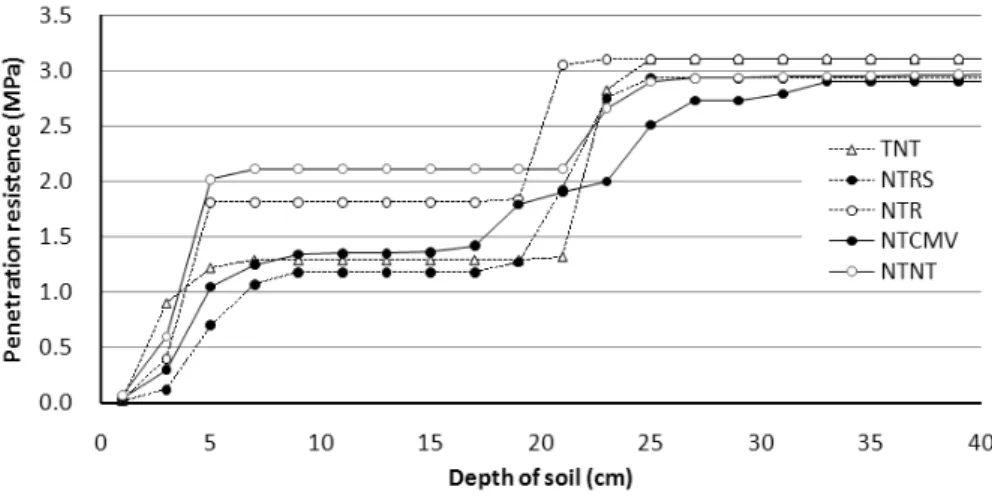
Soil penetration resistances as affected by the applications of management practices in 2005 and 2006 are presented in Fig. 1 and 2, respectively. They show clear differences in the penetration resistance among the different management practices and between the study Table 2. Selected physical properties of soils in the experimental paddy plots.
Exp. Plot Management practice† Bulk density (Mg m3) Porosity (%) Water content (%)
2005 2006 2005 2006 2005 2006
Plot 1 TNT (Check) 1.37a‡ 1.34a 48.3b 49.3b 35.7a 35.0b
Plot 2 NTRS 1.28ab 1.33a 51.6ab 50.0b 36.0a 36.5b
Plot 3 NTR 1.22b 1.24b 54.0a 53.2a 35.6a 39.2a
Plot 4 NTCMV 1.28ab 1.29ab 51.8ab 51.3ab 36.7a 39.2a
Plot 5 NTNT 1.29ab 1.35a 51.3ab 49.0b 36.4a 40.2a
†TNT: tillage with no treatment (conventional farming practice, check plot), NTRS:no-tillage amended with rice straw, NTR: no-tillage amended with rye, NTCMV: no-tillage amended with Chinese milk vetch, NTNT: no-tillage with no treatment.
‡Values within a column followed by the same letter are not significantly different at 5% level by DMRT.
years. The soil penetration resistance drastically increased at two depth areas, from 0 to 5 cm and from 15 to 25 cm in depth) in both study years. However, the value and order of soil penetration resistances were greatly different among the study plots in each year, especially at depth of 5 to 15 cm and 25 to 40 cm. In 2005, the soil penetration resistances in the experimental plots were in order of NTNT >> TNR >> NTCMV > TNT > NTRS at depth of 5 to 15 cm and in order of NTR≈TNT > NTRS≈NTNT NTCMV at depth of 25 to 40 cm. In 2006, the penetration resistances were in order of TNT >> NTNT≥NTCMV
>> NTRS >> NTR at depth of 5 to 15 cm and in order of TNT≈NTNT > NTCMV > NTRS≈NTR at depth of 25 to 40 cm. These results indicated that the management
practices might not affect soil strength in the first experimental year, but from the second year the soil strength was considerably influenced by the applications of rice straw and green manure crop practices under no-tillage system at the top 20 cm depth as well as even at deeper soils. Karamanos et al. (2004) also reported similar results, which was that reducing tillage practice decreased soil penetration resistance in upland soil.
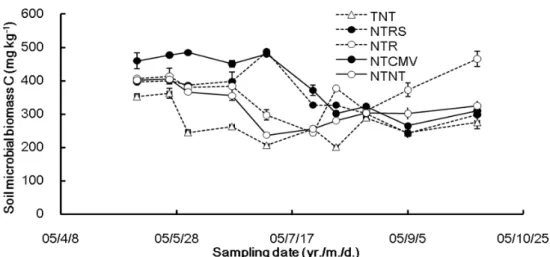
Soil microbial biomass carbon (SMBC) as affected by the applications of management practices in 2005 and 2006 are presented in Fig. 3 and 4, respectively. The SMBC contents in the plots were varied with the different management practices and different seasons in the both study years. The SMBC content in the plots was generally Fig. 1. Change of soil penetration resistance in 2005 as influenced by the applications of rice straw and green manure crops under different tillage systems. TNT: tillage with no treatment (conventional farming practice, check plot), NTRS:
no-tillage amended with rice straw, NTR: no-tillage amended with rye, NTCMV: no-tillage amended with Chinese milk vetch, NTNT: no-tillage with no treatment.
Fig. 2. Change of soil penetration resistance in 2006 as influenced by the applications of rice straw and green manure crops under different tillage systems. TNT: tillage with no treatment (conventional farming practice, check plot), NTRS:
no-tillage amended with rice straw, NTR: no-tillage amended with rye, NTCMV: no-tillage amended with Chinese milk vetch, NTNT: no-tillage with no treatment.
reduced with the lapse of time (from May through October) in 2005, whereas it gradually increased with time, except in August, in 2006, even though overall SMBC content was higher in 2005 than in 2006, especially in the plots with the applications of rice straw and green manure cropsunder no-tillage systems. However, the SMBC content was the lowest in August of each experimental year. This result was probably caused by decreasing microbial population due to submerged conditions in the paddy plots. In 2005, anyhow, the SMBC contents in the plots were in order of NTCMV > NTRS ≥ NTR ≥NTNT > TNT until August, and after August, they were the highest in the NTR plot and followed in order of NTNT≥NTCMV≥NTRS≥TNT. In particular,
the highest SMBC content in the NTCMV plot might be caused by low C/N ratio of Chinese milk vetch (Table 1).
Smith and Paul (1990) reported that increases in easily decomposable organic C observed in soils after addition of Chinese milk vetch with a moderate C/N ratio likely contributed to the enhanced SMBC and microbial activity.
Also, high SMBC often lead to high nutrient availability to crops (Wang et al., 2004), through enhancing both the microbial biomass turnover and the degradation of non-microbial organic materials. On the other hand, the SMBC contents were in order of NTRS≈NTCMV≈ NTR≥NTNT > TNT until August, and then in order of NTR≈NTCMV > NTNT≥NTRS > TNT from August through October in 2006. They were also higher in the Fig. 3. Change of soil microbial biomass C contents in 2005 as influenced by the applications of rice straw and green manure crops under different tillage systems. TNT: tillage with no treatment (conventional farming practice, check plot), NTRS: no-tillage amended with rice straw, NTR: no-tillage amended with rye, NTCMV: no-tillage amended with Chinese milk vetch, NTNT: no-tillage with no treatment. The variation represents standard error (n=3).
Fig. 4. Change of soil microbial biomass C contents in 2006 as influenced by the applications of rice straw and green manure crops under different tillage systems. TNT: tillage with no treatment (conventional farming practice, check plot), NTRS: no-tillage amended with rice straw, NTR: no-tillage amended with rye, NTCMV: no-tillage amended with Chinese milk vetch, NTNT: no-tillage with no treatment. The variationbar represents standard error (n=3).
plots with the applications of rice straw and green manure crop under no-tillage systems as comparing with those in the TNT plot. These results indicated that applications of the rice straw and green manure crop management practices positively influenced soil physical properties and soil microbial activities in no-till paddy fields.
Conclusions
Applications of rice straw and green manure crops might influence bulk density, porosity, and water content in paddy field under no-tillage system; especially these practices was affected to improve the selected physical properties of soils in the second study year. However, soil penetration resistance and soil microbial biomass carbon (SMBC) content in the paddy field were greatly influenced by the different management practices. The soil penetration resistances were mostly higher in the tillage without rice straw or green manure crop treatment (TNT) plot but lower in the no-tillage amended with rice straw, rye, and Chinese milk vetch treatment (NTRS, NTR, and NTCMV) plots. Also, the SMBC contents were much greater in the management practice plots than in the TNT plot. Therefore, the management practices with rice straw and green manure crop applications improved the physical and biological properties of soils in paddy fields.
Acknowledgment
This study was carried out with the support of
"Research Cooperating Program for Agricultural Science
& Technology Development (Project No. PJ0063142009)", RDA, Republic of Korea.
References
Blake, G.R., and K.H. Hartage. 1986a. Bulk density. P. 363-375.
In A. Klute (ed.) Methods of soil analysis. Part 1. 2nd ed.
Agron. Monogr. 9. ASA, and SSSA, Madison WI.
Blake, G.R., and K.H. Hartage. 1986b. Particle density. P.
377-382. In A. Klute (ed.) Methods of soil analysis. Part 1.
2nded. Agron. Monogr. 9. ASA, and SSSA, Madison WI.
Blevins, R.L., G.W. Thomas, M.S. Mith, W.W. Frye, and P.L.
Conelius. 1983. Changes in soil properties after 10 years no-tilled and conventionally tilled corn. Soil Till. Res. 3:135–
146.
Busscher, W.J., P.J. Bauer, C.R. Camp, and R.E. Sojka. 1997.
Correction of cone index for soil water content differences in
a coastal plain soil. Soil Till. Res. 43:205-217.
Cannell, R.Q., F.B. Ellis, D.G. Christian, J.P. Gram, and J.T.
Douglas. 1980. The growth and yield of winter cereals after direct drilling, shallow cultivation, and ploughing on non-calvareous clay soils, 1974-8. J. Agric. Sci. Camb.
94:345-359.
Cassel, D.K. 1982. Tillage effects on soil bulk density and mechanical impedance. p. 45 67.– In P.W. Unger and D.M.
Van Doren (ed.) Predicting tillage effects on soil physical properties and processes. ASA Spec. Publ. 44. ASA and SSSA, Madison, WI.
Costamagna, O.A., R.K. Stivers, H.M. Galloway, and S.A.
Barber. 1982. Three tillage systems affect selected properties of a tilled naturally poor-drained soil. Agron. J. 74:442-446.
Crovetto, C.C.. 1998. No-till development in Chequen farm and its influence on some physical, chemical and biological parameters. J. Soil Water Conserv. 53:194-199.
Dabney, S.M., G.V. Wilson, K.C. McGregor, and G.R. Foster.
2004. History, residue, and tillage effects on erosion of loessial soil. Trans ASAE 47:767-775.
Dobermann, A. and T.H. Fairhurst. 2002. Rice straw management. Better Crop International, Special Supplement, 16:7-11.
Ellis, F.B., J.G. Elliott, F. Pollard, R.Q. Cannell, and B.Y.
Barnes. 1979. Comparison of direct drilling reduce cultivation and ploughing on growth of cereals. 3. Winter wheat and spring barley on a calcareous clay. J. Agric. Sci.
Camb. 93:391-401.
Follett, R.F., Peterson, G.A. 1988. Surface soil nutrient distribution as affected by wheat-fallow tillage systems. Soil Sci. Soc. Am. J. 52, 141 147.–
Gantzer, C.J., and G.R. Blake. 1978. Physical characteristics of Le Sueur clay loam soil following no-till and conventional tillage. Agron. J. 70:853 -857.
Juergens, L.A., D.L. Young, W.F. Schillinger, and H.R.
Hinman. 2004. Economics of alternative no-till spring crop rotations in Washington’s wheat-fallow region. Agron. J.
96:154-158.
Karamanos, A.J., D. Bilalis, and N. Sidiras. 2004. Effects of reduced tillage and fertilization practices on soil characteristics, plant water status, growth and yield of upland cotton. J. Agron. Crop Sci. 190:262-276.
Lampurlanes, J., and C. Cantero-Martinez. 2003. Soil bulk density and penetration resisyance under different tillage and crop management systems and their relationship with barley root growth. Agron. J. 95:526-536.
Lee, Y.H., D. Son, and Z.R. Choe. 2009. Effects of rice-winter cover crops cropping systems on the rice yield and quality in no-tillage paddy field. Korean J. Environ. Agri. 28(1): 53-58.
Mac Rae, R.Y., and G.R. Mehuys. 1985. The effect of green manuring on the physical properties of temperate area soils.
Adv. Soil Sci., Vol. 3. Springer-Verlag, Inc., NY, pp71-94.
Moran, C.J., A.J. Koppi, B.W. Murphy, and A.B. McBrantney.
1988. Comparison of the macropore structure of a sandy loam surface soil horizon subjected to two tillage treatments. Soil Use Manage. 4:96-102.
Paustian, K., Collins, H.P., and Paul, E.A. 1997. Management controls in soil carbon. In: Paul, E.A., Paustian, K., Elliott, E.T., Cole, C.V. (Eds.), Soil Organic Matter in Temperate Ecosystems: Long Term Experiments in North America.
CRC Press, Boca Rotan, FL, pp. 15 49.–
Pidgeon, J.D., and B.D. Soane. 1977. Effects of tillage and direct drilling on soil properties during the growing season in a long-term barley mono-culture system. J. Agric. Sci. Camb.
88:431-442.
RDA. 2000. Methods of analysis of soil and plant. National Institute of Agricultural Science and Technology, Rural Development Administration, Korea.
Shear, G.M., and W.W. Moschler. 1969. Continuous corn by the no-tillage and conventional tillage method: A six-year comparion. Agron. J. 61:524-526.
Smith, J.L., and E.A. Paul. 1990. The significance of soil microbial biomass estimations. In: Bollag, J.M., Stotzky, G.
(Eds.), Soil Biochemistry, vol. 6. Marcel Dekker, Inc., New York, NY, pp. 357-396.
Sullivan, P. 2003. Overview of cover crops and green manures:
Fundamentals of sustainable agriculture. Appropriate Technology Transfer for Rural Areas (ATTRA), the National Center for Appropriate Technology (NCAT), Fayetteville, AR.
Vance, E.D., P.C. Brookes, and D.S. Jenkinson. 1987. An extraction method for measuring soil microbial biomass carbon. Soil Biol. Biochem. 19:703-707.
Wang, W.J., C.J. Smith, and D. Chen. 2004. Predicting soil nitrogen mineralization dynamics with a modified double exponential model. Soil Sci. Soc. Am. J. 68:1256-1265.
Wright, A.L., F.M. Hons, and J.E. Matocha Jr.. 2005. Tillage impacts on microbial biomass and nitrogen dynamics of corn and cotton rotations. Appl. Soil Ecol. 29:85-92.
무경운 답에서 토양 물리성과 미생물 생체량 탄소 함량에 미치는 녹비작물 시용효과
이영한 안병구· 1·이진호2*
경상남도농업기술원, 1전라북도농업기술원, 2전북대학교 농업생명과학대학 생물환경화학과
벼 유기농업은 한국에서 빠르게 확산되고 있다 유기재배에서 벼 생육은 토양 물리적 특성과 토양 미생물의 기능에 크게.
의존한다 본 연구는 무경운 답에서 유기농업을 위하여 토양 물리성과 미생물 생체량에 미치는 녹비작물의 효과를 검토하.
였다 시험구는 무경운 무경운 볏짚 무경운 호밀 무경운 자운영 그리고 경운구를 반복으로 죽곡통에서. , + , + , + 3 2005년 월5 에서 2006년 10월까지 수행하였다 경운구는. 2005년과2006년 모두 토양 가밀도가 가장 높은 반면 공극률은 가장 낮았
다 무경운 호밀 처리구는 공극률이 가장 높았으며 무경운 처리구의 표토 관입저항은 경운구 보다 낮았다 담수 전. + . 2005
년과2006년 토양 미생물 생체량 탄소 함량은 무경운 자운영 처리구가+ 477 mg kg-1및485 mg kg-1으로 가장 높았고 무 경운 호밀 처리구는+ 413 mg kg-1 및 484 mg kg-1였으며 경운 처리구는 363 mg kg-1 및 445 mg kg-1을 나타냈다 시기.
적으로 토양 미생물 생체량 탄소 함량은 유수형성기에 낮아지는 경향이었다 연구결과 녹비작물을 시용한 무경운 재배기술.
은 경운에 비해 토양 공극률과 토양 미생물 생체량 탄소 함량을 크게 개선하였다.