유기농법과 관행농법에 의해 재배한 ‘신고’배 과원 토양의 물리화학적 및 미생물학적 특성 비교*
1)
최현석**․이 웅***․김월수****․이 연*****․지형진******
Compar i s onofSoi lPhys i c o- c hemi c alandMi c r obi alChar ac t e r i s t i c s i nSoi lof‘ Ni i t aka’Pe arOr c har dsbe t we enOr g ani cand
Conv ent i onalCul t i v a t i ons
Choi,Hyun-Sug․Li,Xiong․Kim,Wol-Soo․Lee,Youn․Jee,Hyeong-Jin
Consumers’ interest and government’s support for the fruits rapidly increased organic fruit productions. This study was examined to compare the soil physico- chemical and microbial properties of orchards soil in conventionally and organi- cally management systems. Organic cultivation had lower soil bulk density, solid phase, and penetration resistance than the conventional cultivation. Soil pH and organic matter contents increased from March to August, and the values were greater in the organic cultivation than the conventional cultivation. Total nitrogen (N) and phosphorous concentrations decreased from March to August, and the organic soils had greater N but lower phosphorous concentrations than the conventional soils. Soil microbial carbon biomass increased 36% and 15% for organic and conventional cultivations, respectively, from March to August. Soil microbial N biomass was greater in June than March or August, and the organic cultivation had a greater biomass N compared to the conventional cultivation. Soil dehydrogenase and chitinase activities were greater in June than in March or August. β-glucosidase activity declined in both cultivations, while the phosphatase activity increased. Organic cultivation had greater enzyme activities in March, June, and August, except for the acid phosphatase activity in June.
* 본 연구는 전남대학교 원예학과 농업특성화센터의 지원에 의해서 수행되었습니다. 국립농업과 학원 유기농업과의 지원에도 감사드리는 바입니다.
** 국립농업과학원 유기농업과 *** 교신저자, 전남대학교 원예학과
**** 전남대학교 원예학과([email protected]) ***** 국립농업과학원 유기농업과
****** 국립농업과학원 유기농업과
Key words : organic cultivation, pear, dehydrogenase, chitinase, β-glucosidase,
phosphatase, soil chemistryⅠ.서 언
최근 생활여건의 향상 및 소비자들의 안전 농산물에 대한 요구를 충족시키기 위해 전 세 계적으로 유기적인 재배시스템이 증가하고 있다. 유럽과 미국을 중심으로 1990년대 후반부 터 유기농 재배면적이 급속도로 확대되었고(Granatstein, 2002; Peck et al., 2005; Young, 2002) 연간 20~30% 이상 유기농 생산물이 증가하고 있다(Granatstein, 2002; Peck et al., 2005;
Young, 2002). 한국에서는 유기 농산물 출하량이 2005년부터 2008년까지 4년 동안에 68%
이상 증가하였는데, 과수품목에서는 4배 정도의 증가량을 나타내었다(Choi et al., 2010).
배 유기농 재배는 합성농약과 화학비료의 사용을 금하고 유기농 인증 재배프로그램에 따라 한정된 천연자재를 사용하여야 한다. 유기농 배 과원에서의 양분관리는 투입된 유기 질 비료나 멀칭에 의하여 이루어지기 때문에 양분의 형태와 양에 관련된 균형과 공급에서 관행 과원과는 다른 양상을 보인다. 유기질 비료나 식물성 재료를 토대로 하는 멀칭에는 식물이 직접 흡수할 수 없는 유기태 형태로 토양 내 존재하고, 대부분 미생물의 분해과정 을 거쳐 가용성 형태로 되어야만 식물이 흡수할 수 있는데, 국내에서는 지속적인 유기재배 에 의한 과원 토양은 유기질 비료의 과다 투입으로 무기태 질소와 유효인산 및 기타 금속 양이온의 토양 내 집적을 초래하여 2-3년 후에 용탈에 의한 지하수 오염 등이 우려된다고 보고하였다(Chung and Lee, 2008; Kim et al., 2000).
유기농 사과과원에서는 관행구에 비하여 토양 가비중이 낮았다고 보고되었으며(Glover et al., 2000; Swezey et al., 1998), 밭 토양에서도 유기질 퇴비의 연용으로 용적밀도가 감소 하였고 퇴비의 시용 량이 증가할수록 물리성 개선효과가 높다고 하였다(Cho et al., 2009;
Kim et al., 2001). 토양 pH, 유기 탄소, 전질소 및 가용성 인 함량은 유기농 토양에서 높다 고 보고되었으나(Cavero et al., 1997; Clark et al., 1998; Poudel et al., 2002), Mader 등(2002) 은 유기 탄소와 유기 인과 같은 토양 화학성분은 별다른 차이가 없었다고 보고하였다. Van Diepeningen 등(2006)은 네덜란드의 유기농 채소농가와 부근의 관행재배 농가의 토양 화학 성과 생물학적 특성을 조사한 연구에서 많은 관행농가에서도 퇴비를 사용하기 때문에 재 배시스템에 의한 차이는 유기농 재배농가에서 전질소함량이 낮게 나타났으나 기타 유기물 함량과 인산 및 유기탄소 함량 등은 재배 시스템보다는 토성에 의한 차이로 나타났다고 하 였다.
토양 미생물은 생태계의 생물지구화학적 순환에 중심적인 역할을 하기 때문에 생태계 안정성과 토양 비옥도에 직접적으로 영향을 끼친다. 토양에 존재하는 미생물의 생체량은
유기물의 무기화(mineralization)와 고정화(immobilization)를 통해 작물 생산성에 큰 영향을 끼치는 것으로 알려져 있다(Duxbury et al., 1989; McGill et al., 1986). Sakamoto와 Oba(1993) 는 미생물 생체량이 가용성 질소의 주요 공급원이고 유기질 비료를 시용함에 따라 미생물 생체량이 증가되어 토양의 가용성 질소가 축적되었다고 보고하였다.
하지만 국내에서 유기농 과수 재배에 따른 시기별 토양 물리성, 화학성 및 미생물성에 대한 관행재배와의 비교와 연구는 현재까지 다루어진 바는 없다. 따라서 본 실험은 배 과 수원에서 2004년부터 2009년까지 6년 동안 유기재배와 관행재배를 하면서 시기별 토양 물 리성, 화학성 및 미생물성에 대한 변화를 구명하고자 수행하였다.
Ⅱ.재료 및 방법
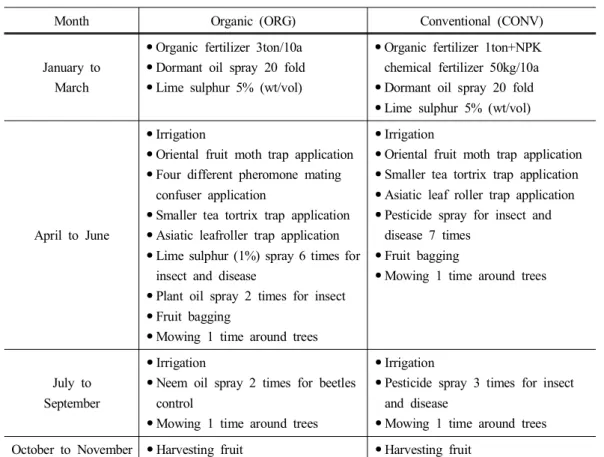
1.시험장소 및 과원 특성전남 보성군 회천면 벌교리(34°40´N, 127°22´E)에 있는 유기농 배 재배농가(Organic)와 인 근에 있는 저농약으로 인증 받은 농가(Conventional)를 선정하였다. 과원은 모두 ‘신고’ 배 로, 수령은 15~20년생이고 덕식 수형이며, 재식거리는 5×7m이었다. 두 과원은 재배 면적은 2 hectare이며, 수관하부는 자연 초생재배를 하였다. 토양은 동일한 토양통에 속하며, 토심 이 50~100cm이고 표토의 토성은 양토이고 심토는 식양질로 자갈함량이 적으며 토양통은 우곡통이며, 15~30% 경사지 과원이었다. 유기농 재배 농가는 3년간 무농약을 실시한 후, 유기농 전환기 1년을 한 후에 유기농 인증을 받았으며, 2009년에 유기농 2년차 과원이며, 관행농가는 저농약 인증 6년차 과원이었다. 과원 관리 체계에 관한 정보는 Table 1에 서술 하였다.
2.토양 물리성
토양물리성은 soil core(용량 100mL)를 이용하여 수관하부 주간으로부터 1.5m 떨어진 곳 에서 깊이 30cm에서 채취한 토양을 이용하여 가비중(Bulk density), 고상, 액상 및 기상을 계산하였고, 토양경도(Penetration resistance)는 30cm 깊이에서 산중식 경도계를 이용하였다.
3.토양 화학성
표토 0~30cm 토양을 Ф5cm auger를 이용하여 채취하였고, 음지에서 자연 건조시킨 후 2 mm체를 통과한 토양을 시료로 사용하였다. 토양 분석은 농업 과학기술원 토양 화학분석법
(NIAST, 2000)에 의하여 조사하였는데 즉, 토양 pH는 토양과 물을 1:5로 혼합하여 30분간 진탕한 후 pH meter(Its teK, 702, Korea)로 측정하였고 토양 유기물은 tyurin법, 전질소는 kjeldahl 분해법으로 측정하였고 유효인산은 vanadate 법으로 조사하였다. 치환성 양이온 Ca, K, Mg는 ICP(Inductively Coupled Plasma Atomic Emission Spectrometer, Leemans, USA)로 측 정하였다.
Table1.Comparisonondifferenttreatmentsofmanagingpearorchardbetweenorganic andconventionalcultivationfor6yearsfrom 2004to2009
Month Organic (ORG) Conventional (CONV)
January to March
• Organic fertilizer 3ton/10a
• Dormant oil spray 20 fold
• Lime sulphur 5% (wt/vol)
• Organic fertilizer 1ton+NPK chemical fertilizer 50kg/10a
• Dormant oil spray 20 fold
• Lime sulphur 5% (wt/vol)
April to June
• Irrigation
• Oriental fruit moth trap application
• Four different pheromone mating confuser application
• Smaller tea tortrix trap application
• Asiatic leafroller trap application
• Lime sulphur (1%) spray 6 times for insect and disease
• Plant oil spray 2 times for insect
• Fruit bagging
• Mowing 1 time around trees
• Irrigation
• Oriental fruit moth trap application
• Smaller tea tortrix trap application
• Asiatic leaf roller trap application
• Pesticide spray for insect and disease 7 times
• Fruit bagging
• Mowing 1 time around trees
July to September
• Irrigation
• Neem oil spray 2 times for beetles control
• Mowing 1 time around trees
• Irrigation
• Pesticide spray 3 times for insect and disease
• Mowing 1 time around trees October to November • Harvesting fruit • Harvesting fruit
4.토양 미생물 생체량
습토 10g을 25℃에서 24시간 chloroform 훈증 후 0.5M K2SO4로 추출하였고 비 훈증 토양 도 훈증 토양과 동일한 방법으로 배양하고 0.5M K2SO4로 추출하였다. Microbial carbon biomass는 Tate 등(1988)의 방법에 따라 측정하였다. Biomass C=Ec/Kec의 공식에 의하여 계 산하였는데, 여기서 Ec=훈증 토양중의 가용성 탄소량과 비훈증 토양 중의 가용성 탄소량과 의 차이이고 Kec=0.38이다. Microbial nitrogen biomass는 유기태 질소량을 구하는 ninhydrin
발색법으로 구하였다. 즉 추출액 2mL에 ninhydrin 시약 1mL를 가하고 끓는 수조안에서 30 분간 발색시켜 570nm에서 비색정량 하였다(Joergensen and Brookes, 1990). 이때 사용한 표 준곡선은 leucine을 용해하여 0~0.1mM 농도에서 작성하였다.
5.토양 미생물성
Dehydrogenase activity는 건토 1g에 0.25M Tris 완충액(pH 7.6) 1.0mL를 넣고 거기에 0.4%
2, 3, 5 TTC 0.5mL와 0.1mL 1% glucose 기질을 30℃, 6시간동안 반응에서 생성된 triphenyl formazan(TPF)를 A 485nm에서 측정한 흡광도를 표준곡선에 의하여 구한 값을 μg TPF/h/g 건토로 표시하였다(Trevors, 1984).
Acid-phosphatase activity는 토양 1g에 0.2mL toluene, 4mL modified universal buffer solution (pH 6.5)을 넣고, 1mL 0.025M ρ-nitrophenyl phosphate 용액(PNP)에 배양하였다. 배양이 끝 난 후 1mL의 0.5M CaCl2와 4mL의 0.5M NaOH를 넣어 진탕하여 여과한 후 A 400nm에서 흡광도를 측정하여 이미 얻은 표준곡선에 의하여 구한 값을 μg PNP/g/h로 표시하였다 (Tabatabai, 1982).
β-glucosidase activity는 토양 1g에 0.2mL toluene, 4 mL modified universal buffer solution (pH 6.5)을 넣고, 1mL 0.025M ρ-nitrophenyl-β-D-gluside(PNG) 용액으로 배양한 후 1mL의 0.5M CaCl2와 4mL의 0.5M THAM 완충액(pH 12)을 넣어 진탕한 다음 여과액을 A 400nm에 서 측정하여 이미 얻은 표준곡선에 의하여 구한 값을 μg PNP/g/h로 표시하였다(Skujins, 1976).
Chitinase activity는 Trotta 등(1996)의 방법을 변경하여 조사하였는데, colloidal chitin에 서 유래된 N-acetyl glucosamine(NAG)의 소모되는 양을 측정하였다(Yedidia, et al., 2000).
Chitinase의 활성은 420nm에서 흡광도를 측정한 후 NAG 표준곡선에 따라 계산하였고, ug NAG/g/h로 표시하였다.
6.통계분석
토양 시료는 임의 배치법으로 과원 중 3곳에서 각각 3반복을 선정하였으며, 실험수치는 SPSS statistics 17.0 software program을 이용하여 독립표본 T-test을 사용하여 분석하였다.
Ⅲ.결과 및 고찰
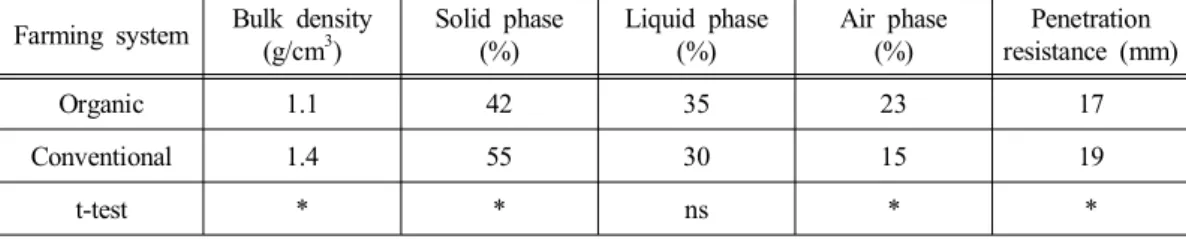
1.토양 물리성토양 물리성 조사결과는 Table 2에 나타나 있다. 유기농 과원의 토양 가비중은 1.12 g/cm3 로 관행과원 1.45g/cm3보다 낮게 나타났는데 이러한 결과는 유기농 과원에서 고상의 비율 이 42%로 관행과원의 55%보다 낮게 나타났기 때문인 것으로 추정된다. 액상은 통계학적으 로는 유의성 있는 차이가 나타나지 않았으나(p>0.05) 유기농 과원(ORG)에서 35%로 관행 재배과원(CONV) 30%보다 높은 경향이 나타났다. 토양경도는 뿌리의 신장과 밀접한 관계 가 있어 산중식 경도계로 18~20mm일 때는 배나무 미세근 발달이 용이하나, 24~25mm에 서는 저해를 받으며, 29mm 이상에서는 뿌리가 전혀 자라지 못한다고 하였다(Kim et al., 2004). 본 조사결과에서 토양경도는 유기농 과원과 관행 과원에서 각각 17mm와 19mm로 유기농 과원에 통계학적으로 유의성있는 차이가 나타나서(p<0.05) 뿌리의 생장에 좋을 것 으로 생각되며, 보성과원의 토양경도는 양호하다고 생각된다. 미국 워싱톤주 유기농 사과 원과 관행과원의 토양에서 4년 후 토양 가비중은 0~7.5cm와 7.5~15cm 깊이에서 유기농 토 양은 각각 0.93Mg/m3과 1.22Mg/m3으로 관행농법의 1.18Mg/m3(0~7.5cm)과 1.30 Mg/m3(7.5~
15cm)에 비하여 통계학적으로 유의성 있게(p<0.05) 낮았다고 하였다(Glover et al., 2000). 국 내 초생재배 실험에서도 피복처리가 관행재배 방식을 대표하는 청경관리구보다 강후 15일 후에 3.6% 더 높은 토양 수분함량을 나타내었다(Choi et al., 2009). 퇴비나 유기질 비료의 투여는 결과적으로 토양의 높은 유기물 함량을 유지시키고, 토양 가비중의 감소와 수분 함 유량의 증가는 유기질 비료와 퇴비의 시용에 의한 결과로 이전 토양관리 연구에서 보고되 었다(Khaleel et al., 1981; Riley et al., 2008).
Table2.Soilphysicalpropertiesat0to30cm depthinorganic(ORG)andconventional (CONV)pearorchardsinBoseong
Farming system Bulk density (g/cm
3)
Solid phase (%)
Liquid phase (%)
Air phase (%)
Penetration resistance (mm)
Organic 1.1 42 35 23 17
Conventional 1.4 55 30 15 19
t-test * * ns * *
Sampling Date: August, 21 2009.
*, **, *** Significantly different means among the farming systems for soil physical properties at P < 0.05, 0.01, and 0.001, respectively.
ns = not significantly different.
2.토양 화학성
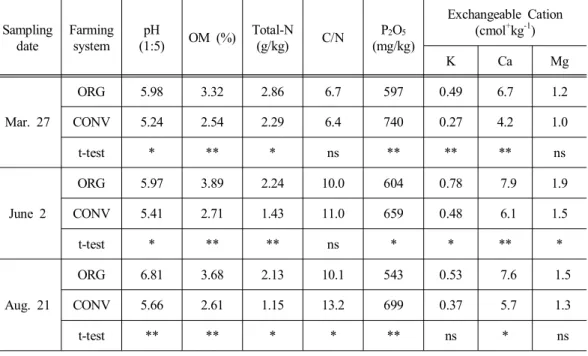
토양 화학성 조사결과는 Table 3에 제시하였다. 토양 pH는 3월에서 8월까지 증가하는 경 향이 나타났고, 유기농 과원은 관행과원에 비하여 통계학적으로 유의성 있게(p<0.05) 높은 수치를 나타내었다. 토양 유기물 함량은 3월부터 6월까지 증가하였고 8월에 다시 감소하는 경향을 보였는데, 이는 재배 초기에 두 과원 모두에 투입된 유기질 비료에 의해 유기물 함 량이 증가되었고 온도 상승으로 유기물의 무기태화(Mineralization)가 진행되어서 재배 후기 에는 유기물 함량이 감소된 것으로 추정된다. 재배기간 내내 유기농 과원의 유기물 함량 (3.3~3.9%)이 관행과원(2.5~2.7%)보다 약 1% 높은 분포를 나타내었다. 지속적인 유기질 퇴 비의 시용은 토양의 유기물 함량을 유지하는 중요한 수단인데(Marinari et al., 2006), 유기농 과원에서 매년 많은 유기질 퇴비를 시용한 결과로 추정되며, 관행 과원에서도 화학비료와 퇴비를 함께 시용하였으므로 이 지역의 유기물 함량은 과수원의 유기물 권장량인 2.5~3.5%
(NIAST, 1999)에 속하였다.
Table3.Soilchemicalpropertiesat0to30cm soildepthinorganic(ORG)andconven- tional(CONV)pearorchardsduringagrowingseasoninBoseong
Sampling date
Farming system
pH
(1:5) OM (%) Total-N
(g/kg) C/N P
2O
5(mg/kg)
Exchangeable Cation (cmol
+kg
-1)
K Ca Mg
Mar. 27
ORG 5.98 3.32 2.86 6.7 597 0.49 6.7 1.2
CONV 5.24 2.54 2.29 6.4 740 0.27 4.2 1.0
t-test * ** * ns ** ** ** ns
June 2
ORG 5.97 3.89 2.24 10.0 604 0.78 7.9 1.9
CONV 5.41 2.71 1.43 11.0 659 0.48 6.1 1.5
t-test * ** ** ns * * ** *
Aug. 21
ORG 6.81 3.68 2.13 10.1 543 0.53 7.6 1.5
CONV 5.66 2.61 1.15 13.2 699 0.37 5.7 1.3
t-test ** ** * * ** ns * ns
*, **, *** Significantly different means among the farming systems for soil chemical properties at P <
0.05, 0.01, and 0.001, respectively.
ns = not significantly different.
토양 전질소 함량은 계절별로는 감소하는 경향이 나타났는데(Table 3), 유기농 과원에서 는 3월에서 8월 사이 감소하는 경향이 완만한(25%) 반면, 관행과원에서는 감소량(49%)이 크게 나타났다. 재배방법에 따른 비교에서, 유기농 과원은 관행과원에 비하여 시기에 관계 없이 높은 전질소 함량을 유지하였는데, 이는 유기질 비료 투여에 따른 결과로 판단되었다.
하지만, 선행연구 결과에서는 전질소 투입양 보다는 투입된 무기태 질소원의 종류와 양에 따른 차이에 기인한 것이라고 하였는데(Blaise et al., 2004; Gerhardt, 1997; Melero et al., 2006), 질소의 분획별 함량. 즉 무기태질소(질산태, 암모니아태), 유기태질소(단백질태, 핵산 태, 기타)로 분리하여 데이터를 도출하기 위한 보다 더 심도 깊은 연구가 필요하다고 하겠 다. Chung과 Lee(2008)는 유기농 사과원에서 유기물 함량이 63.3mg/kg, 전질소 3.3g/kg으로 관행과원에 비하여 각각 두 배 가까이 많은 것으로 나타났다고 보고하였다. 시기별 토양의 C/N율은 관행과원과 유기농과원 즉 작물재배방법에 따라 차이 없이 증가하는 것으로 나타 났다. 이러한 결과는 생육기중 작물에 의한 무기태 질소흡수량이 증가함에 따라 상대적으 로 C/N율이 증가한 것으로 평가된다. 재배방법에 따른 비교에 있어서, 3월과 6월에는 유기 농과 관행과원간의 통계적으로 유의성 있는 차이는 나타나지 않았으며(p>0.05) 8월에는 유 기농이 일반적인 토양유기물의 C/N율인 10:1을 유지해서 관행과원(13.2)보다 낮게 나타났 다. 이는 관행과원에서의 전질소함량의 감소량(49%)이 유기농 과원(25%)보다 커서 나타난 결과로 추정된다. 따라서 관행재배에서 C/N율의 증가는 질소기아(Nitrogen starvation) 현상 을 일으킬 수 있는 수준은 아니지만 무기태 질소공급 차원에서 각별한 주의가 필요하다고 하겠다.
유효인산은 시기별로 감소하는 경향을 보였고, 관행과원에서 유기농 과원에 비하여 50~
100mg/kg 정도 높은 경향이 나타났다. 보성지역 유효인산 함량은 과원 적정범위 200~300 mg/kg(NIAST, 1999)보다 2배 이상 높게 나타났다. Van Diepeningen 등(2006)은 네덜란드의 점질토에서 유효 인산함량은 유기농 재배에서 관행재배보다 낮았다고 하였다. 본 연구결과 는 위 두 유기농 과원보다 전질소 함량과 유기물 및 유효인산 함량이 낮게 나타났으나, 양 분의 투입과 수확량 및 수체생장에 필요한 양분의 양적 추정에 관한 연구도 시급하다고 생 각된다. Kim 등(2000)의 연구결과에서는 본 연구결과와 비교하여 반대의 경향을 나타내었 는데, 인산함량이 높은 가축분뇨퇴비를 과다 사용하여 배 과원에서 유효인산 함량이 754 mg/kg으로 관행과원에 비하여 높게 나타났다고 하였다. 양이온 가운데 치환성 칼륨함량은 처리구에 상관없이 6월에 가장 높게 나타났다. 유기농 과원에서 치환성 칼륨의 함량이 관 행과원에 비해 높게 나타났으나 월별로는 약간의 차이를 보이고 있다(3월: p<0.01, 6월:
p<0.05). 시기별로 치환성 칼륨의 함량은 3월에서 6월까지 증가하였으나 그 이후에는 일정 하게 유지되었다. 재배방법별로는 유기농 과원이 관행농 과원보다 높게 나타났다(p<0.05).
치환성 마그네슘은 시기별로는 6월에 가장 높은 경향을 보였으며, 유기농 과원에서 치환성 마그네슘의 함량이 관행과원에 비해 높게 나타났으나 월별로는 약간의 차이를 보이고 있
다(3월: p>0.05, 6월: p<0.05, 8월: p>0.05). Clark 등(1998)은 유기질 퇴비 투여와 초생재배를 수행한 유기농 재배방식은 관행 방식에 비해 치환성 양이온인 칼륨, 마그네슘, 그리고 칼슘 의 함량을 증가시킨 것으로 보고하였는데, 본 조사결과도 이와 유사하게 나타났다.
3.토양 미생물성
토양 미생물은 토양 유기물을 구성하는 일부분으로, 유기물의 분해를 조절하고 양분을 공급하여 기타 생물체가 이용하도록 하는 역할을 한다. 미생물 생체량은 작지만, 사멸과 증 식과정에서 양분의 방출과 고정에 의한, 양분의 저장고로서 농작물의 지속적인 재배에 기 여한다(Melero et al., 2006)고 알려져 왔다. 본 실험에서 microbial carbon biomass(MCB)와 microbial nitrogen biomass(MNB) 함량은 figure 1에 제시하였다. MCB는 3월부터 8월까지 유 기농 과원에서 36% 증가하였고 관행과원에서는 15%의 증가율을 보였으며, 유기농 과원에 서 조사기간 동안 관행과원에 비하여 높은 경향을 나타내었다. MNB는 시기별로 생육중기 (6월)에 가장 높은 수치(유기농 263μg N/g, 관행 191μg N/g)를 보였고 다시 감소하는 경향 이 나타났는데, 조사 시기동안 유기농 과원에서는 6월과 8월의 결과에서 관행재배에 비하 여 통계적으로 유의성 있게 높게 나타났다. Goyal 등(1992)은 유기질 퇴비 시용으로 유기물 함량과 미생물 생체량이 증가한다고 하였고, 미생물 생체량은 가용성질소의 주요 공급원이
Fig.1.Microbialcarbonbiomass(MCB)andmicrobialnitrogenbiomass(MNB)inorganic (ORG)andconventional(CONV)pearorchardsduringagrowingseason.
Errorbarsrepresentstandarderrorofthemean.
므로, 유기물을 시용함에 따라 미생물 생체량이 증가되어 토양의 가용성 질소가 축적되었 다는 보고(Sakamoto and Oba, 1993)가 있다. 본 연구에서 MCB와 MNB가 전 조사기간 동안 유기농 과원에서 항상 높게 나타난 것은 유기물 함량이 전반적으로 관행과원에 비하여 높 게 나타난 결과(Table 3)로 생각된다. 그리고 Mazzarino 등(1992)에 의하면 MCB와 MNB는 기후와 수분 등의 영향을 받아 연간 변동이 달라질 수 있으며, Weon 등(2004)은 돈분퇴비 시용구에서 화학비료 시용구에 비하여 MCB 및 MNB가 높았고, 돈분 시용량에 따라 증가 한다고 하였다. 하지만 Lee 등(2003)은 쌀겨와 키틴분해물 퇴비를 시용한 배 과원에서 MCB는 시용 직후에 가장 높았고 점차 감소하였다고 보고하였다.
토양 효소의 활성은 토양관리에 따른 급속한 변화를 신속히 반영하고 토양특성을 나타 내는 적합한 지표로서, 유기농과 관행재배 토양을 비교하는데 사용되어 왔다(Benitez et al., 2006). Dehydrogenase activity는 일반적으로 살아있는 미생물 세포에서 나타나는데, 이 효소 의 측정은 보통 미생물 수나 산화능력(Oxidative capability)과 연관된다고 하였다(Trevors, 1984). 본 실험에서 dehydrogenase activity는 두 처리구 모두 6월에 가장 높은 수치를 나타내 었고 다시 8월에 감소하는 경향을 보였는데, 유기농 과원은 6월에서 8월까지 별다른 감소 폭이 없었지만, 관행과원은 41%의 높은 감소율을 나타내었다(Fig. 2-A). 재배방법에 따른 비교에서는 유기농 과원은 관행과원에 비하여 3월을 제외한 6월과 8월에 통계적으로 유의 성 있게(p<0.05) 높게 나타났다. 가수분해효소 중에서 β-glucosidase activity와 acid phos- phatase activity는 토양유기물의 함량과 질의 변화를 나타내는 지표로 사용되어 왔다(Gil- Sotres et al., 2005; Lagomarsino et al., 2009). β-glucosidase activity는 시기별로 3월에서 6월 까지는 두 처리구 모두 별다른 활성변화가 없었고 8월에는 6월에 비해 감소하는 경향(유기 농 38%, 관행 48%)이 나타났다(Fig. 2-B). 재배방법에 따른 비교에서, 유기농 과원이 관행구 보다 시기에 상관없이 통계적으로 유의성 있게 높게(p<0.05) 나타났다. Acid-phosphatase activity는 처리구에 상관없이 3월에서 8월까지 증가하는 경향이 나타났다(Fig. 2-C). 유기농 은 관행에 비하여 acid-phosphatase activity는 3월과 6월에는 통계적으로 유의성 있는 차이 (p<0.05)가 나타나지 않았으나, 8월에는 유의성(p<0.05) 있게 높게 나타났다. 토양속의 식물 의 병과 관련된 사상균의 세포벽이나 선충의 난낭은 22~44%가 키틴성분으로 구성되어 있 는데(Miller et al., 1998), chitinase는 이런 키틴성분을 분해하여 amino sugar로 전환시킨다.
때문에 chitinase는 토양 내에서의 C와 N 무기화와 직접적으로 관여되어있는 주요 효소로 알려져 있다(Lagomarsino et al., 2009). 토양 중 chitinase activity는 처리구에 상관없이 3월에 서 6월까지 증가하는 경향이 나타났고, 8월에 다시 감소하는 경향이 나타났다(Fig. 2-D). 재 배방법에 따른 chitinase activity는 통계적으로 유의성 있는 차이(p<0.05)가 나타나지 않았으 나 유기농 재배에서 약간 더 높은 활성을 나타내었다. 이전 보고에서, Lagomarsino 등(2009) 은 토마토, 콩 및 밀 등 3 종류의 유기농과 관행재배 비교에서 시기별로 dehydrogenase activity, chitinase activity는 재식 전 수확시기까지 증가하는 경향을 나타냈으나, β- glucosi-
dase activity는 반대로 감소하는 경향이 나타났으며, acid phosphatase activity는 유의적인 차 이를 보이지 않았다고 하였다. 그리고 chitinase와 β-glucosidase activity는 유기농 재배토양 에서 관행재배보다 유의적으로 높게 나타났다고 하였다.
Fig.2.Dehydrogenaseactivity(A),β-glucosidaseactivity(B),acid-phosphataseactivity (C)andchitinaseactivity(D)inorganic(ORG)andconventional(CONV)pear orchardsduringagrowingseason.
Errorbarsrepresentstandarderrorofthemean.
Ⅳ.요 약
최근에 소비자들의 안전 농산물에 대한 관심과 정부의 정책적인 친환경농업에 대한 지 원은 유기농 재배를 지속적으로 발전시켜 왔다. 본 연구는 유기농 재배 과원과 관행 과원 간의 토양 물리성과 화학성 및 미생물성에 대한 시기별 비교분석을 통하여 변화양상을 구 명하고자 수행되었다. 토양 가비중과 고상 및 경도는 유기농 과원에서 통계적으로 유의성 있게 낮게 나타났다. 토양 pH와 유기물 함량은 3월에서 8월까지 증가하는 경향이 나타났 고, 유기농 과원에서 관행과원에 비하여 높은 경향을 나타내었다. 전질소와 유효인산은 처 리구에 상관없이 3월에서 8월까지 각각 감소하는 경향을 보였으며, 유기농 과원에서 관행 과원보다 전질소는 높았으나 유효인산은 낮은 경향을 나타내었다. 토양 미생물 탄소 생체 량은 처리구에 상관없이3월부터 8월까지 증가(유기농 36%, 관행 15%)하였고, 미생물 질소
생체량은6월에 가장 높았고, 유기농 과원에서 관행과원보다 지속적으로 높은 미생물 생체 량을 나타내었다. 토양중 dehydrogenase와 chitinase activity는 3월과 8월보다 6월에 가장 높 았고, β-glucosidase activity는 시기적으로 점차 감소(유기농 38%, 관행 48%)하였으며, acid phosphatase activity는 증가하였다. 유기농 배 과원토양에서 관행재배에 비하여 6월에 조사 된 acid phosphatase activity를 제외하고는 모든 효소활성이 시기에 상관없이 높은 분포를 나 타내었다.
[논문접수일 : 2010. 2. 26. 논문수정일 : 2010. 11. 16 최종논문접수일 : 2011. 6. 22]
참 고 문 헌
1. Benitez, E., R. Nogales, M. Campos, and F. Ruano. 2006. Biocemical variability of olive orchard soils under different management system. Appl. Soil Ecol. 32: 221-231.
2. Blaise, D., T. R. Rupa, and A. N. Bonde. 2004. Effect of organic and modern method of cotton cultivation on soil nutrient status. Commun. Soil Sci. Plant Anal. 35: 1247-1261.
3. Cavero, J., R. E. Plant, C. Shennan, and D. B. Friedman. 1997. The effct of nitrogen source and crop rotation on the growth and yield of processing tomatoes. Nutr. cycl. Agroecosys.
47: 271-282.
4. Cho, H. J., S. W. Hwang, K. H. Han, H. R. Cho, J. H. Shin, and L. Y. Kim. 2009.
Physicochemical properties of upland soils under organic farming. Kor. J. Soil Sci. Fert. 42:
98-102.
5. Choi, D. G., B. S. Seo, and I. K. Kang. 2009. Changes of soil, growth, and fruit quality by soil surface management under tree in sod culture of apple orchard. Kor. J. Hort. Sci.
Technol. 27: 174-180.
6. Choi, K. H., D. H. Lee, Y. Y. Song, J. C. Nam, and S. W. Lee. 2010. Current status on the occurrence and management of disease, insect and mite pests in the non-chemical or organic cultured apple orchards in Korea. Kor. J. Organic Agric. 18: 221-232.
7. Chung, J. B. and Y. J. Lee. 2008. Comparison of soil nutrient status in conventional and organic apple farm. Kor. J. Soil Sci. Fert. 41: 26-33.
8. Clark, M. S., W. R. Horwath, C. Sherman, and K. M. Scow. 1998. Changes in soil chemical properties resulting from organic and low-input farming practices. Agron. J. 90: 662-671.
9. Duxbury, J. M., M. S. Smith, and J. W. Doran. 1989. Soil organic matter as source and a
sink of plant nutrients, pp. 33-68. In: Colenman, D.C. et al. (eds.). Dynamics of soil organic matter in tropical ecosystems, Univ. Hawaii Press, Honolulu, U.S.A.
10. Gerhardt, R. A. 1997. A comparative analysis of the effects of organic and conventional farming systems on soil structure. Biol. Agric. Hort. 14: 139-157.
11. Gil-Sotres, F., C. Trasar-Cepeda, M. C. Leiros, and S. Seoane. 2005. Different approaches to evaluating soil quality using biochemical properties. Soil Biol. Biochem. 37: 877-887.
12. Glover, J. D., J. P. Reganol, and P. K. Andrews. 2000. Systematic method for rating soil quality of conventional, organic, and integrated apple orchards in Washington State. Agric.
Ecosys. Environ. 80: 29-45.
13. Goyal, S., M. M. Mishra, I. S. Hooda, and R. Singh. 1992. Organic matter-microbial bio- mass relationships in field experiments under tropical conditions: effects of inorganic fertili- zation andorganic amendments. Soil Bio. & Biochem. 24: 1081-1084.
14. Granatstein, D. 2002. North American trends for organic tree fruit production. Compact Fruit Tree 35: 83-87.
15. Joergensen, R. G. and P. C. Brookes. 1990. Ninhydrin-reactive N measurements of microbial biomass in 0.5M K2SO4 soil extracts. Soil Biol. Biochem. 19: 1023-1027.
16. Khaleel, R., K. R. Reddy, and M. R. Overcash. 1981. Changes in soilphysical properties due to organic waste applications: a review. J. Environ. Qual. 10: 133-141.
17. Kim, P. J., S. M. Lee, H. B. Yoon, Y. H. Park, J. Y. Lee, and S. C. Kim. 2000. Char- acteristics of phosphorus accumulation in organic farming fields. Kor. J. Soil Sci. & Fert.
33: 234-241.
18. Kim, J. G., S. B. Lee, and S. J. Kim. 2001. The effect of long-term application of different organic material sources on soil physical property and microflora of upland soil. Kor. J. Soil Sci. Fert. 34: 365-372.
19. Kim, J. H. 2004. Soil Management, pp. 157-173. In: New technology in pear culture, Ohsung Publication, Seoul, Korea.
30. Lagomarsino, A., M. C. Moscatelli, A. Di Tizio, R. Mancinelli, S. Grego, and S. Marinari.
2009. Soil biochemical indicators as a tool to assess the short-term impact of agricultural management on changes in organic C in a mediterranean environment. Ecolog. Indic. 9:
518-527.
21. Lee, S. H., W. S. Kim, K. Y. Kim, T. H. Kim, H. Whangbo, W. J. Jung, and S. J. Chung.
2003. Effect of chitin compost incorporated with chitinolytic bacteria and rice bran on chemical properties and microbial community in pear orchard soil. J. Kor. Soc. Hort. Sci.
44: 201-206.
22. Mader, P., A. Flieβbach, D. Dubois, L. Gunst, P. Fried, and U. Niggli. 2002. Soil fertility and biodiversity in organic farming. Science 296: 1694-1697.
23. Marinari, S., R. Mancinelli, E. Campiglia, and S. Grego. 2006. Chemical and biological indicators of soil quality in organic and conventional farming systems in Central Italy. Ecol.
Indic. 6: 701-711.
24. Mazzarino, M. J., L. Szott, and M. Jimenes. 1992. Dynamics of soil total C and N, micro- bial biomass, and water-soluble C in tropical agro-ecosystems. Soil Biol. Biochem. 25: 205- 214.
25. McGill, W. B., K. R. Cannon, J. A. Roberson, and F. D. Cook. 1986. Dynamics of soil microbial biomass and water-soluble organic carbon in Breton L after 50 years of cropping to two rotations. Can. J. Soil Sci. 66: 1-19.
26. Melero, S., J. C. R. Porras, J. F. Herencia, and E. Madejon. 2006. Chemical and biochemical properties in silty loam soil under conventional and organic management. Soil. Till. Res. 90:
162-170.
27. Miller, M., A. Palojarvi, A. Rangger, M. Reeslev, and A. Khioller. 1998. The use of fluoro- genic sustrates to measure fungal presence and activity in soil. Appl. Environ. Microbiol. 64:
613-617.
28. NIAST. 1999. A guidance of fertilization for crops. National Institute of Agricultural Science and Technology. Suwon, Korea.
29. NIAST. 2000. Analysis method of Soil and plant body. National institute of Agricultural Science and Technology. Suwon, Korea.
30. Peck, G. M., P. K. Andrews, C. Rhichter, and J. P. Reganold. 2005. Internationalization of the organic fruit market: The case of Washington State’s organic apple exports to the European Union. Renewable Agr. Food Sys. 20: 101-112.
31. Poudel, D. D., W. R. Horwarth, W. T. Lanini, S. R. Temple, and A. H. C. van Bruggen.
2002. Comparison of soil N availability and leaching potential, crop yields and weeds in organic, low-input and conventional in northern California. Agric. Ecosys. Environ. 90:
125-137.
32. Riley, H., R. Pommeresche, R. Eltun, S. Hansen, A. Korsaeth. 2008. Soil structure, organic matter and earthworm activity in a comparison of cropping systems with contrasting tillage, rotations, fertilizer levels and manure use. Agric. Ecosyst. Environ. 124: 275-284.
33. Sakamoto, K. and Y. Oba. 1993. Relationship between available N and soil biomass in upland field soils. Jpn. J. Soil Sci. Plant Nutr. 64: 42-48.
34. Skujins, J. 1976. Extracellular enzymes in soil. CRC Crit. Rev. Microbiol. 4: 383-421.
35. Swezey, S. L., M. R. Werner, M. Buchanan, and J. Allison. 1998. Comparison of con- ventional and organic apple production systems during three years of conversion to organic management in coastal California. Amer. J. Alter. Agric. 13: 162-180.
36. Tabatabai, M. A. 1982. Soil enzymes, pp. 903-947. In: Page, A. L., R. H. Miler, and D. R.
Keeney. (eds.). Methods of soil analysis, Part 2. Chemical and Microbiological properties, Amer. Soc. Agron. Madison, WI(USA).
37. Tate, K. R., D. J. Ross, and C. W. Feltham. 1988. A direct extraction method to estimate soil microbial C: effect of experimental variables and some different calibration procedure.
Soil Biol. Biochem. 20: 329-335.
38. Trevors, J. T. 1984. Effect of substrate concentration, inorganic nitrogen, O2 concentration, temperature and pH on dehydrogenase activity in soil. Plant Soil 77: 285-293.
39. Trotta, A., G. C. Verese, E. Gnavi, A. Fusconi, S. Sampo, and G. Gerta. 1996. Interaction between the soilborne root pathogen Phytoptthora nicotianae var. parasitica and the arbuscular mycorrhizal fungus Glomos mosseae in tomato plants. Plant Soil. 185: 199-209.
40. Van Diepeningen, A. D., O. J. de Vos, G. W. Korthals, and A. H. C. van Bruggen. 2006.
Effect of organic versus conventional management on chemical and biological parameters in agricultural soils. Appl. Soil Ecol. 31: 120-135.
41. Weon, H. Y., J. S. Kwon, Y. K. Shin, S. H. Kim, J. S. Suh, and W. Y. Choi. 2004. Effect of composted pig manure application on enzyme activities and microbial biomass of soil under chinese cabbage cultivation. Kor. J. Soil Sci. Fert. 37: 109-115.
42. Yedidia, I., N. Benhamou, Y. Kapulnik, and I. Chet. 2000. Induction and accumulation of PR protein activities during early stages of root colonization by the mycoparasite Tricho- derma harzianum strain T-203. Plant Physiol. Biochem. 38: 863-873.
43. Young, G. 2002. A fieldman’s perspective on growing and packing organic fruit. Compact Fruit Tree 35: 90-91.