후지 사과의 산지에 따른 부위별 항산화 활성 비교
방혜열1․조순덕1․김동만2․김건희1
1덕성여자대학교 식품영양학과
2한국식품연구원
Comparison of Antioxidative Activities of Fuji Apples Parts according to Production Region
Hye-Yeol Bang1, Sun-Duk Cho1, Dongman Kim2, and Gun-Hee Kim1
1Department of Food & Nutrition, Duksung Women's University
2Korea Food Research Institute
ABSTRACT To observe the functionality of Fuji apples, this study compared and analyzed the general and anti-oxida- tive components of apples based on production region. This study found that DPPH radical scavenging activities among parts of apple from the Chungju region were 82.84% in peels, 26.98% in peel-flesh, and 18.89% in apple flesh, and these values were lower than those from other regions (P<0.01). Antioxidative was 48.64% in the apple core, which was higher than those in peel-flesh and apple flesh. ABTS radical scavenging activity was highest (79.80%) in peels of apples from the Andong region, whereas values in peel-flesh and apple flesh were highest in apples from the Yesan region (P<0.01). For antioxidative activities in the apple core, apples from the Chungju region showed more than twice the value (52.34%) of other regions. Phenol contents in peels were significantly high [12.03 mg gallic acid equivalent (GAE)/g] in apples from the Muju region, whereas phenol contents in peel-flesh were high (6.01 mg GAE/g) in those from the Andong region. Antioxidative activity in apple flesh was significantly high (5.57 mg GAE/g) in apples from the Yesan region. For antioxidative activities in the apple core, apples from Chungju region showed a relatively high value (6.53 mg GAE/g) (P<0.01), although values were low in apple peel, peel-flesh, and apple flesh. For the combined amount of flavonoids, values in apples from the Yesan region were high in apple peel, peel-flesh, and apple core [56.23 mg quercetin equivalent (QE)/g (P<0.01), 4.05 mg QE/g (P<0.05), and 4.00 mg QE/g (P<0.01), respectively], whereas flavonoid content in apples from the Andong region was high in apple flesh [4.35 mg QE/g (P<0.01)]. The results show that anti-oxidative activities were relatively higher in apple peel than flesh.
Key words: DPPH, ABTS, phenol contents, flavonoid, peel
Received 5 December 2014; Accepted 12 March 2015 Corresponding author: Gun-Hee Kim, Department of Food &
Nutrition, Duksung Women's University, Seoul 132-714, Korea E-mail: [email protected], Phone: +82-2-901-8496
서 론
사과(Malus domestica)의 원산지는 중앙아시아로 전 세 계적으로 많이 재배되고 있는데 우리나라에는 20세기 초반 에 도입되어 품종개량 및 재배기술의 향상으로 전체 과수 재배면적의 약 40%를 차지하고 있으며 재배산지도 다양할 뿐 아니라 저장기간도 길어 사계절 우리 국민의 즐겨먹는 과일 중 하나로 알려져 있다(1). 그중 Fuji 사과는 일본 후지 사키 지역에서 개발된 사과 품종으로 크기가 크고 당도 (9~11%)와 경도가 높아 대한민국, 중국, 미국 등지에서도 선호되는 품종이다. 2014년 우리나라의 사과 재배면적은 3,702 ha로 전년에 비해 0.8% 늘어났으나 전통적으로 사과
재배지로 알려진 대구 경북 지역의 재배면적은 올해 18,889 ha로 최근 5년간 줄어들고 있고(2) 기후변화로 인한 사과산 지의 이동이 그 원인이 되는 것으로 보인다. 사과에는 식이 섬유와 비타민 C가 풍부해 영양학적 가치가 높은 과일로 알려져 왔으며(3) 최근에는 폴리페놀, 플라보노이드 등 파이 토케미컬이 다량 함유되어 있는 것으로 밝혀져 사과의 다양 한 기능성 성분으로 인한 효과가 조명되고 있다(4-7). 현재 까지 연구된 바에 의하면 사과 추출물의 생리활성 효능으로 항산화, 항암(8), 항당뇨 및 항바이러스, 천식의 완화(9), 염 증 완화, 뇌경색 억제(10), 심혈관계 질환 개선(11-14) 등이 보고되었다. 특히 과육뿐 아니라 과피와 씨 부분에 다량의 항산화 물질이 존재하는 것으로 알려져 있으나(15,16) 기후 변화로 인한 재배지의 이동이 보고되고 있음에도 산지에 따 른 사과의 부위별 유효성분에 대한 연구는 미비한 실정이다.
따라서 본 연구에서는 경북지역의 사과 재배지인 안동, 충남 지역의 사과 재배지인 예산, 충북 지역의 사과 재배지
인 충주, 전북 지역의 사과 재배지인 무주, 경남 지역의 사과 재배지인 거창의 다섯 개 재배지의 동종 사과를 부위별로 분리 추출하여 그 유효성분을 분석함으로써 과육뿐 아니라 부산물을 이용한 기능성 식품 소재 및 가공품 개발을 위한 기초자료로 활용하고자 한다.
재료 및 방법
실험재료
본 실험에 사용한 재료는 2013년 생산되어 2014년 6월 까지 한국식품연구원(Gyeonggi, Korea)에서 저온저장 중 인 Fuji 품종의 사과를 5개 산지별(안동, 예산, 충주, 무주, 거창) 각각 1상자(20 kg)씩 제공받아 4°C에 냉장 보관하여 사용하였으며 각각의 시료를 10과씩 임의 선별하여 중량, 가용성 고형분, 색도, 경도의 내・외부의 품질 특성을 분석하 였다.
항산화 활성 분석용 추출물 제조를 위해 상기 10과를 제 외한 시료 전량을 자동박피기(Fruit and vegetable peeler, Rotato express, B2NE, Zhejiang, China)를 이용하여 1.5 mm의 일정한 두께로 박피하였다. 이를 과피 부분으로 하고 과피가 제거된 상태에서 다시 1.5 mm 두께로 절단한 것을 과피 근접 과육 부분으로 하였다. 과피와 과심의 중앙이 되 는 부분을 1.5 mm 두께로 절단한 것을 중심과육 부분으로 하고 씨를 포함한 씨방 부분을 과심 부분으로 하여 총 4개의 부분으로 분리하였다. 이를 다시 동결건조기(FD5510, Il- shin Lab Co., Ltd., Seoul, Korea)에서 72시간 동결건조 후 분말 형태로 분쇄하여 -70°C에서 보관하여 추출물 제조 에 사용하였다.
추출물 제조
상기 기술된 동결건조 분말 시료 50 g에 80% ethanol을 가하여 시료 대비 1:10(w/v)이 되도록 총 부피를 500 mL로 하여 40분간 sonicator(Powersonic 420, 700W, Hwashin Tech, Seoul, Korea)를 사용하여 추출하였다(17,18). 이 추출액을 No.2 여과지(Whatman plc., Kent, UK)로 여과하 여 진공회전농축기(ELISA Evaporator NVC-2000, SB- 1000, DPE-1210, CA-1112, ELISA, Tokyo, Japan)로 40°C에서 농축한 후 동결건조기(FD5510, Ilshin Lab Co., Ltd.)를 통해 고형물을 제조하여 -20°C 냉동고에 보관하면 서 각 실험에 사용하였다.
품질 특성 분석
일반성분 분석 중 중량은 각 산지별 임의 선별된 시료 전 량을 digital balance(ARB120, Ohaus Corp., Florham Park, NJ, USA)를 이용하여 측정하였다(19). 색도는 시료 의 표면색도를 표준백판(L=97.40, a=-0.49, b=1.96)으로 보정된 chromameter(CR-400, Minolta Co., Osaka, Japan) 를 사용하여 측정하였으며, 시료 과피는 가장 붉은 부위와
반대편(180°) 부위를 상중하로 구분하여 총 6 point, 과육은 종으로 1/2 절단하여 과육의 중앙부분 1 point를 Hunter 색차계인 L, a 및 b 값을 측정하였다. 경도는 시료를 종으로 1/2 절단하여 과피 있는 상태의 경도를 측정하고 과피 표면 으로부터 3 cm 깊이의 시료를 제거한 후 과육 부분의 경도 를 측정하였으며, 측정도구로는 texture analyser(LLOYD Instrument, Ametek, Inc., Fareham, Hants, UK)를 이용 하여 speed 60 mm/min, trigger 0.5 N으로 측정하였다.
가용성 고형분은 종으로 절단한 시료 1/5을 취하여 착즙하 고 여과한 액으로 식품당도측정기(GMK-703F, G-won Hitech Co., Ltd., Seoul, Korea)를 사용하여 측정하였다.
가용성 고형분, pH 및 총 산도의 부위별(과피, 과피근접과 육, 과육, 과심 부분) 측정은 추출물 제조를 위해 분리한 시 료 중 일부를 취하여 식품당도측정기(GMK-703F, G-won Hitech Co., Ltd.) 및 automatic titrator(Titroline easy, Schott Instruments, Mainz, Germany)를 사용하여 측정하 였다.
항산화 활성 분석
DPPH radical 소거능: 추출물의 DPPH(1,1-diphenyl- 2-picrylhydrazyl) radical 소거능은 Ramos 등(20)을 96 well에 변형하여 측정한 Park과 Kim(21)을 참고하여 각 추 출물을 80% ethanol로 50배 희석한 추출액 50 μL에 0.3 mM DPPH 에탄올 용액 150 μL를 가하여 37°C에서 30분간 반응시킨 후, microplate reader(M2, Molecular Device, Union City, CA, USA)를 이용하여 515 nm에서 흡광도를 측정하고 아래의 식으로부터 DPPH 라디칼 소거 활성을 계 산하였다.
DPPH radical scavenging
activity (%) =
(
1- AB)
×100A: 시료 첨가구의 흡광도, B: 시료 무첨가구의 흡광도
ABTS radical 소거능: ABTS radical의 소거 활성은 7.4 mM ABTS(2,2'-azino-bis(3-ethylbenzthiazoline- 6-sulfonic acid)와 2.6 mM potassium persulphate를 하 루 동안 암소에 방치하여 ABTS 양이온을 형성시킨 후 이 용액을 732 nm에서 microplate reader(M2, Molecular Device)를 이용하여 흡광도 값이 0.7±0.03이 나오도록 phosphate buffered saline(pH 7.4)으로 희석하여 사용하 였다. 각 추출물을 80% ethanol로 50배 희석한 추출액 10 μL에 흡광도를 맞춘 ABTS 용액 190 μL를 가하여 10분간 반응시키고, 732 nm에서 흡광도를 측정하여 아래의 식으로 부터 ABTS 라디칼 소거 활성을 계산하였다(22,23).
ABTS radical scavenging
activity (%) =
(
1- AB)
×100A: 시료 첨가구의 흡광도, B: 시료 무첨가구의 흡광도
총 페놀 함량: 각 추출물을 80% ethanol로 50배 희석한
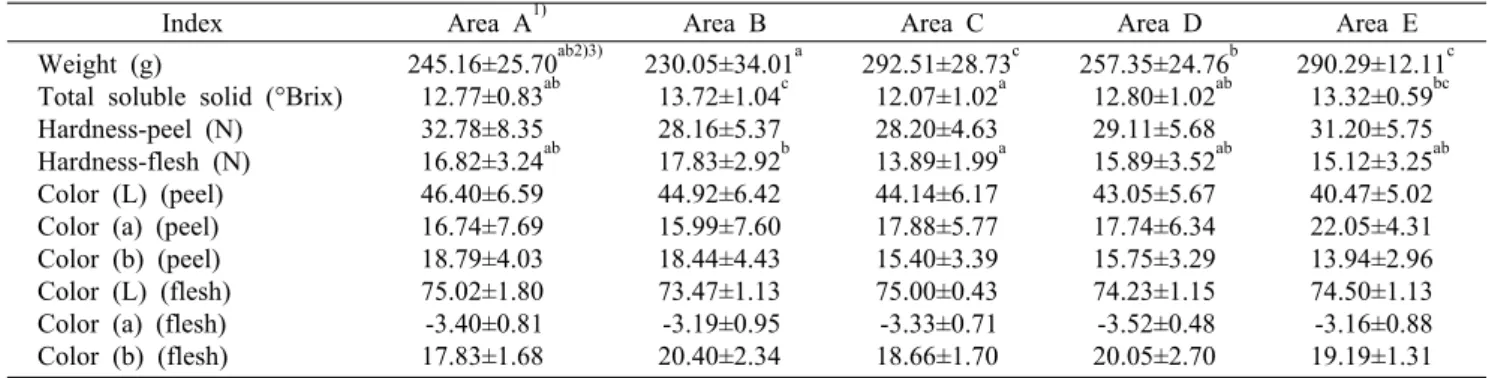
Table 1. Quality characteristics of Fuji apples by cultivated areas
Index Area A1) Area B Area C Area D Area E
Weight (g)
Total soluble solid (°Brix) Hardness-peel (N) Hardness-flesh (N) Color (L) (peel) Color (a) (peel) Color (b) (peel) Color (L) (flesh) Color (a) (flesh) Color (b) (flesh)
245.16±25.70ab2)3) 12.77±0.83ab 32.78±8.35 16.82±3.24ab 46.40±6.59 16.74±7.69 18.79±4.03 75.02±1.80 -3.40±0.81 17.83±1.68
230.05±34.01a 13.72±1.04c 28.16±5.37 17.83±2.92b 44.92±6.42 15.99±7.60 18.44±4.43 73.47±1.13 -3.19±0.95 20.40±2.34
292.51±28.73c 12.07±1.02a 28.20±4.63 13.89±1.99a 44.14±6.17 17.88±5.77 15.40±3.39 75.00±0.43 -3.33±0.71 18.66±1.70
257.35±24.76b 12.80±1.02ab 29.11±5.68 15.89±3.52ab 43.05±5.67 17.74±6.34 15.75±3.29 74.23±1.15 -3.52±0.48 20.05±2.70
290.29±12.11c 13.32±0.59bc 31.20±5.75 15.12±3.25ab 40.47±5.02 22.05±4.31 13.94±2.96 74.50±1.13 -3.16±0.88 19.19±1.31
1)Area A: Andong, B: Yesan, C: Chungju, D: Muju, E: Geochang.
2)Each value represented mean±SD (n=10).
3)Means with different letters (a-c) within same row followed by different letters are significantly different by Duncan's multiple range test (P<0.05).
추출액 70 μL에 2 N Folin-Ciocalteu 용액 70 μL를 가한 후 3분간 실온에서 반응시키고 2% Na2CO3 70 μL를 첨가하 여 1시간 동안 암소에서 반응시킨 다음 microplate read- er(M2, Molecular Device)를 이용하여 760 nm에서 흡광 도 값을 측정하였다(24). 이때 총 페놀 함량은 gallic acid를 이용하여 작성한 표준곡선으로부터 구하였다(mg gallic acid equivalent (GAE)/g).
총 플라보노이드 함량: 각 추출물을 80% ethanol로 50배 희석한 추출액 10 μL에 95% ethanol 60 μL를 가하고 10%
AlCl3・6H2O 4 μL와 증류수 122 μL를 첨가하여 실온에서 30분간 반응시킨 후 microplate reader(M2, Molecular Device)를 이용하여 415 nm에서 흡광도 값을 측정하였다 (25). 이때 총 플라보노이드 함량은 quercetin을 이용하여 작성한 표준곡선으로부터 구하였다(mg quercetin equiv- alent(QE)/g).
통계처리
모든 실험은 3번 이상 반복하여 평균값과 오차를 나타내 었고 각 항목의 측정값은 SPSS Win program(Version 19.0, Chicago, IL, USA)을 이용하여 ANOVA 분석을 실시 하였으며 Duncan's multiple range test로 P<0.05 수준에 서 검증하였다.
결과 및 고찰
산지별 사과의 품질 특성 비교
산지별 사과의 중량, 가용성 고형분, 경도, 색도를 각각 측정한 결과를 Table 1에 나타내었다. 중량 측정 결과 충주 지역의 사과가 292.51 g으로 가장 무거웠으며(P<0.05) 충 주, 무주, 거창 지역의 사과가 250 g 이상으로 농산물품질관 리원의 표준규격 ‘특’에 해당했으며, 가용성 고형분의 경우 농산물품질관리원의 표준규격 ‘특’에 해당하는 14°Brix 이 상에 해당하는 지역은 없으나 다섯 개 지역 모두 표준규격
‘상’에 해당하는 12~13.9°Brix에 해당하여 Lee 등(19)이
예산, 봉화, 예천, 청송, 상주의 5개 지역 후지 사과로 한 연구와 동일하게 크기에 있어 지역 간 품질 격차가 크지 않 은 것으로 나타났다(26). 품질에 큰 영향을 미치는 경도는 과피의 경우 안동지역의 사과가 32.78 N으로 가장 단단한 것으로 나타났으나 유의적인 차이는 없었으며, 실제 과육의 경우에는 예산지역의 사과가 17.83 N으로 가장 단단한 것 으로 확인되었다(P<0.05). 소비자의 선호도와 가장 밀접한 색도는 과피의 경우 L값과 b값에 있어서는 안동지역 사과가 가장 높은 수치를, a값에 있어서는 거창지역 사과가 가장 높은 수치를 나타내었으며, 과육의 경우 L값에 있어서는 안 동지역 사과가, a값에 있어서는 거창지역의 사과가, b값에 있어서는 예산지역의 사과가 가장 높은 수치를 나타내었다.
맛에 주된 영향을 미치는 가용성 고형분과 산도의 경우 과 피, 과피근접과육, 과육, 과심의 네 부분으로 나누어 부위별 로 측정한 결과를 Fig. 1과 Table 2에 나타내었다. 안동지역 사과는 과피로부터 과심까지 11.40~12.13°Brix로 상당히 균일한 분포를 나타내고 있으나 충주, 무주, 거창 지역은 과 피근접과육 및 과육> 과피> 과심 순으로, 예산지역은 과피 근접과육 및 과육> 과심> 과피 순으로 최대 2.2°Brix 이상 의 차이를 보이고 있다(P<0.01). pH는 과피 부분에서 안동 지역의 사과가 가장 낮았고 과육 부위에서는 예산지역의 사 과가 가장 낮았으며 총 산도는 모든 부위에서 거창지역의 사과가 가장 높게 나타났다(P<0.01).
산지별 사과의 항산화 활성 비교
DPPH radical 소거 활성: 항산화 활성 측정을 위해 산지 별 사과의 DPPH radical 소거능을 조사한 결과는 Fig. 2와 같다. 과피의 경우 안동지역의 사과가 90.06%로 가장 높았 고 충주지역의 사과가 82.84%로 가장 낮았으나 다섯 지역 모두 80% 이상의 높은 소거 활성을 보였다(P<0.01). 과피 근접과육의 경우 안동지역의 사과가 57.71%로 가장 높았고 충주지역의 사과가 26.98%로 가장 낮았으며, 과육의 경우 예산지역의 사과가 56.73%로 가장 높았고 충주지역의 사과 가 18.89%로 가장 낮았다. Won 등(27)의 결과와 같이 다섯
a a b
a a
0.0 2.0 4.0 6.0 8.0 10.0 12.0 14.0 16.0
Area A Area B Area C Area D Area E
Total soluble solid contents (%) .
Peel
c
a
c b b
0.0 2.0 4.0 6.0 8.0 10.0 12.0 14.0 16.0
Area A Area B Area C Area D Area E
Total soluble solid contents (%) .
Peel-flesh
b c b
a c
0.0 2.0 4.0 6.0 8.0 10.0 12.0 14.0 16.0
Area A Area B Area C Area D Area E
Total soluble solid contents (%) .
Flesh
a b b
a b
0.0 2.0 4.0 6.0 8.0 10.0 12.0 14.0 16.0
Area A Area B Area C Area D Area E
Total soluble solid contents (%) .
Core
Fig. 1. Total soluble solid in peel, peel-flesh, flesh, and core of Fuji apples by cultivated areas. Area A, Andong; B, Yesan; C, Chungju; D, Muju; E, Geochang. Means with different letters (a-c) on the bars within same group are significantly different by Duncan's multiple range test (P<0.01).
Table 2. pH and titratable acidity in peel, peel-flesh, flesh, and core of Fuji apples by cultivated areas
Treatment pH (%) Titratable acidity (%)
Area A1) Area B Area C Area D Area E Area A Area B Area C Area D Area E Peel
Peel-flesh Flesh Core
4.47±0.062) 4.72±0.20 4.70±0.18 0.31±0.02
4.62±0.04 4.57±0.06 4.42±0.06 0.14±0.01
4.88±0.05 4.72±0.03 4.80±0.09 0.23±0.05
4.97±0.03 4.77±0.05 4.70±0.18 0.22±0.02
4.78±0.18 4.58±0.07 4.64±0.08 0.25±0.02
0.27±0.03 0.22±0.02 0.12±0.01 0.31±0.02
0.36±0.05 0.25±0.02 0.27±0.03 0.14±0.01
0.23±0.03 0.19±0.05 0.14±0.04 0.23±0.05
0.20±0.02 0.12±0.01 0.17±0.02 0.22±0.02
0.41±0.01 0.30±0.02 0.21±0.02 0.25±0.02
1)Area A: Andong, B: Yesan, C: Chungju, D: Muju, E: Geochang.
2)Each value represented mean±SD (n=3).
지역 모두 과육에 비하여 과피의 DPPH radical 소거 활성이 크게 높은 것으로 확인되었으며 과피와 과피근접과육, 과육 의 차이도 현저하였으나 예산지역의 경우에는 과육의 DPPH radical 소거 활성이 56.73%에 달하여 과피근접과육과의 차이가 근소한 것으로 나타났다. 과심의 경우 안동, 예산, 거창 지역의 사과에서는 과육에 비하여 낮은 DPPH radical 소거 활성을 보이고 있으나 충주지역은 48.64%로 과피근접 과육이나 과육보다 높게 나타났고 무주지역에서도 과육보 다 더 큰 것으로 나타나 부산물로서의 과심의 중요성을 보여 주고 있다.
ABTS radical 소거 활성: 산지별 사과의 ABTS radical 소거능을 측정한 결과 Fig. 3에서 보여주는 것과 같이 안동 지역이 79.80%, 과피근접과육과 과육은 예산지역이 각각 30.29%, 30.48%로 유의적으로 가장 높게 나타났으나(P<
0.01) 과심은 충주지역이 52.34%로 타 지역에 비해 2배 이
상의 높은 활성을 보였다. 다섯 지역 모두 과피가 과육에 비하여 최대 3.7배 높은 ABTS radical 소거능을 나타내었 고 과심의 경우 안동, 충주, 무주 지역의 사과에서 과육보다 높은 ABTS radical 소거능을 나타내었으며, 충주의 경우 52.34%로 타 지역의 과피근접과육보다 더 높은 활성을 보 였다.
산지별 사과의 항산화 성분 함량 분석
총 페놀 함량: 산지별 사과의 추출물에서의 총 페놀 함량 을 조사한 결과는 Table 3과 같다. 총 페놀의 경우 과피에서 는 무주지역(12.03 mg GAE/g, P<0.05), 과피근접과육에 서는 안동지역(6.01 mg GAE/g, P<0.01), 과육에서는 예산 지역(5.57 mg GAE/g, P<0.01)이 유의적으로 높게 나타났 으나 과심에서는 과피, 과피근접과육, 과육에서 유의적으로 가장 낮았던 충주지역의 사과가 6.53 mg GAE/g으로 상대
a a a b
a
0.0 10.0 20.0 30.0 40.0 50.0 60.0 70.0 80.0 90.0 100.0
Area A Area B Area C Area D Area E
DPPH radical scavening activity (%) .
Peel
cd bc
d a ab
0.0 10.0 20.0 30.0 40.0 50.0 60.0 70.0 80.0 90.0 100.0
Area A Area B Area C Area D Area E
DPPH radical scavening activity (%) .
Peel-flesh
b b
b a
b
0.0 10.0 20.0 30.0 40.0 50.0 60.0 70.0 80.0 90.0 100.0
Area A Area B Area C Area D Area E
DPPH radical scavening activity (%) .
Flesh
e b
a
d c
0.0 10.0 20.0 30.0 40.0 50.0 60.0 70.0 80.0 90.0 100.0
Area A Area B Area C Area D Area E
DPPH radical scavening activity (%) .
Core
Fig. 2. DPPH radical scavenging activity in peel, peel-flesh, flesh, and core of Fuji apples by cultivated areas. Area A, Andong;
B, Yesan; C, Chungju; D, Muju; E, Geochang. Means with different letters (a-d) on the bars within same group are significantly different by Duncan's multiple range test (P<0.01).
c
e d
a b
0.0 10.0 20.0 30.0 40.0 50.0 60.0 70.0 80.0 90.0 100.0
Area A Area B Area C Area D Area E
ABTS radical scavening activity (%) .
Peel
d
a
e
b c
0.0 10.0 20.0 30.0 40.0 50.0 60.0 70.0 80.0 90.0 100.0
Area A Area B Area C Area D Area E
ABTS radical scavening activity (%) .
Peel-flesh
d c e
a b
0.0 10.0 20.0 30.0 40.0 50.0 60.0 70.0 80.0 90.0 100.0
Area A Area B Area C Area D Area E
ABTS radical scavening activity (%) .
Flesh
d e a
b c
0.0 10.0 20.0 30.0 40.0 50.0 60.0 70.0 80.0 90.0 100.0
Area A Area B Area C Area D Area E
ABTS radical scavening activity (%) .
Core
Fig. 3. ABTS radical scavenging activity in peel, peel-flesh, flesh, and core of Fuji apples by cultivated areas. Area A, Andong;
B, Yesan; C, Chungju; D, Muju; E, Geochang. Means with different letters (a-e) on the bars within same group are significantly different by Duncan's multiple range test (P<0.01).
Table 3. Contents of total phenolics in peel, peel-flesh, flesh, and core of Fuji apples by cultivated areas Treatment Total phenol contents (mg GAE/g extract powder)
Area A1) Area B Area C Area D Area E
Peel* Peel-flesh**
Flesh**
Core**
11.13±0.05bc 6.01±0.05c 5.09±0.05b 5.01±0.03ab
8.54±0.15abc 5.45±0.05ab 6.21±0.05d 5.11±0.05b
6.58±0.03a 5.15±0.03a 4.57±0.03a 6.53±0.05c
12.03±0.45c 5.51±0.01b 5.57±0.05c 5.02±0.05ab
7.51±0.10ab 5.13±0.03a 4.51±0.03a 4.58±0.03a
1)Area A: Andong, B: Yesan, C: Chungju, D: Muju, E: Geochang.
2)Each value represented mean±SD (n=3).
*Means with different letters (a-c) within same row are significantly different by Duncan's multiple range test (P<0.05).
**Means with different letters (a-d) within same row are significantly different by Duncan's multiple range test (P<0.01).
Table 4. Contents of total flavonoids in peel, peel-flesh, flesh, and core of Fuji apples by cultivated areas Treatment Total flavonoid contents (mg QE/g extract powder)
Area A Area B Area C Area D Area E
Peel**
Peel-flesh* Flesh**
Core**
28.10±0.17a 3.90±0.01abc 4.35±0.01b 4.00±0.01b
56.23±0.16b 4.05±0.01c 3.75±0.01a 3.85±0.01ab
62.10±0.09b 4.00±0.01bc 3.90±0.01a 3.90±0.01ab
28.30±0.03a 3.80±0.01ab 3.75±0.01a 3.90±0.01ab
35.05±0.21a 3.75±0.01a 3.60±0.01a 3.65±0.01a
1)Area A: Andong, B: Yesan, C: Chungju, D: Muju, E: Geochang.
2)Each value represented mean±SD (n=3).
*Means with different letters (a-c) within same row are significantly different by Duncan's multiple range test (P<0.05).
**Means with different letters (a-c) within same row are significantly different by Duncan's multiple range test (P<0.01).
적으로 높은 활성(P<0.01)을 보여주었으며, 이는 DPPH, ABTS radical 소거 활성의 결과와 일치한다.
총 플라보노이드 함량: 산지별 사과의 추출물에서의 총 플라보노이드 함량을 조사한 결과, Table 4와 같이 과피에 존재하는 총 페놀의 함량은 충주와 예산 지역의 사과가 각각 62.10 mg QE/g과 56.23 mg QE/g(P<0.01)으로 타 지역에 비해 높게 나타났다. 과피근접과육에서는 예산 지역의 사과 가, 과육 및 과심에서는 안동지역의 사과가 유의적으로 높게 나타난 것을 알 수 있으며 과피 부분의 플라보노이드 함량이 페놀 함량의 결과와 같이 과피 부분에서 크게 높은 수치를 나타낸 것을 볼 때 사과에 있어서 과피 부분의 유효성을 보 여주고 있다. 또한 Lee 등(28)이 배의 부산물을 연구한 결과 와 같이 과심의 경우 과피에는 미치지 못하나 과육이나 근접 과피과육에 근사한 양의 플라보노이드를 함유하고 있어 기 능성 식품 또는 소재 개발에 있어 과심 부분의 유용성을 나 타내고 있다. 다른 연구에 따르면 사과박의 플라보노이드의 성분으로 phluridzin과 quercetin-3-glucoside가 확인 (29)된 바 있으나 본 실험에서는 플라보노이드의 함량만을 확인하였으므로 차후 다른 실험을 통하여 각 부위별 항산화 물질의 성분 분석이 필요가 있을 것으로 생각된다.
요 약
본 연구에서는 Fuji 사과의 기능성 확인을 위해 산지별, 부위 별 일반 성분 및 항산화 성분을 비교 분석하였다. 에탄올 추출물을 이용하여 항산화 활성을 분석한 결과 DPPH radi- cal 소거 활성은 충주지역 사과에서 과피 82.84%, 과피근접 과육 26.98%, 과육 18.89% 등으로 다른 지역에 비해 낮은
값을 나타냈으나(P<0.01) 과심은 48.64%로 과피근접과육 이나 과육보다 높았다. ABTS radical 소거 활성 측정 결과 과피는 안동지역 사과가 79.80%, 과피근접과육 및 과육은 예산지역이 각각 30.29%, 30.48%로 가장 높게 나타났으나 (P<0.01) 과심은 충주지역이 52.34%로 타 지역에 비해 2배 이상의 높은 활성을 보였다. 총 페놀 함량의 경우 무주지역 사과의 과피에서 12.03 mg GAE/g, 안동지역 과피근접과육 6.01 mg GAE/g, 예산지역 과육 5.57 mg GAE/g 등에서 유의적으로 높은 함량을 보였으나 과심에서는 과피, 과피근 접과육, 과육에서 유의적으로 가장 낮은 충주지역의 사과가 6.53 mg GAE/g으로 상대적으로 높은 활성(P<0.01)을 보 여주었다. 총 플라보노이드의 경우 과피, 과피근접과육 및 과심에서는 예산지역의 사과가 각각 56.23 mg QE/g(P<
0.01), 4.05 mg QE/g(P<0.05), 4.00 mg QE/g(P<0.01)으 로 높은 함량을 보였으며, 과육에서는 안동지역의 사과가 4.35 mg QE/g(P<0.01)으로 비교적 높은 함량을 나타내었 다. 이상의 결과를 통해 전통적으로 후지 사과의 주 재배지 로 인식하고 있는 경남지역과 비교할 때 나머지 지역이 후지 사과의 품질 특성 및 항산화 활성에 있어 충분한 경쟁력을 갖고 있는 것으로 판단되었다. 5개 지역 모두 부위별로는 과육에 비하여 과피 부분의 항산화 활성이 상대적으로 높게 나타났으며 과피근접 부분의 항산화 활성 역시 높게 나타나 섭취 시 과실의 가식 부위를 최대화시킬 필요가 있음을 알 수 있었다. 또한 과심 부분 역시 과육에 상당하는 항산화 활성이 나타나 식량자원의 효과적인 활용을 위해 비가식부 위로 인식되는 사과 부산물의 적극적인 활용방안 및 제품개 발 제고의 필요성을 확인할 수 있었다.
감사의 글
본 논문은 한국식품연구원의 연구비 지원과 연구의 일부는 2014년도 정부재원(미래창조과학부 여성과학기술인R&D 경력복귀지원사업)으로 한국연구재단과 한국여성과학기술 인지원센터의 지원을 받아 연구되었습니다.
REFERENCES
1. Kim MJ, Kim YG, Kim HS, Cheong C, Hang KH, Kang SA. 2014. Effects of antioxidant activities in ethanol of ap- ple peel, grape peel and sweet potato peel as natural anti- oxidant. J Korea Acad-Ind Coop Soc 15: 3766-3773.
2. Korean Statistical Information Service. 2014. Crop pro- duction survey-Vegetable production. http://kosis.kr/statis- ticsList/statisticsList_01List.jsp?vwcd=MT_ZTITLE&
parmTabId=M_01_01#SubCont (accessed Dec 2014).
3. Park JY, Ryu HU, Shin HS, Lim HK, Son IC, Kim DI, Jeong HS, Lee JS. 2012. Effects of CuEDTA and FeEDTA foliar spray on antioxidant activities of apple. J Korean Soc Food Sci Nutr 41: 1305-1309.
4. Kim SH, Park I. 2013. Comparison of antioxidant activities of various meat broths served with oriental noodles. Korean J Food & Nutr 26: 150-153.
5. Heras-Ramirez ME, Quintero-Ramos A, Camacho-Davila AA, Barnard J, Talamas-Abbud R, Torres-Munoz JV, Salas- Munoz E. 2012. Effect of blanching and drying temperature on polyphenolic compound stability and antioxidant capaci- ty of apple pomace. Food Bioprocess Technol 5: 2201-2210.
6. Alvarez-Parrilla E, De La Rosa LA, Torres-Rivas F, Rodrigo- Garcia J, González-Aguilar GA. 2005. Complexation of ap- ple antioxidants: chlorogenic acid, quercetin and rutin by β-cyclodextrin (β-CD). J Inclusion Phenom Macrocyclic Chem 53: 121-129.
7. Stracke BA, Rüfer CE, Bub A, Seifert S, Weibel FP, Kunz C, Watzl B. 2010. No effect of the farming system (organic/
conventional) on the bioavailability of apple (Malus domes- tica Bork., cultivar Golden Delicious) polyphenols in healthy men: a comparative study. Eur J Nutr 49: 301-310.
8. Le Marchand L, Murphy SP, Hankin JH, Wilkens LR, Kolonel LN. 2000. Intake of flavonoids and lung cancer.
J Natl Cancer Inst 92: 154-160.
9. Tabak C, Arts IC, Smit HA, Heederik D, Kromhout D.
2001. Chronic obstructive pulmonary disease and intake of catechins, flavonols, and flavones: the MORGEN Study. Am J Respir Crit Care Med 164: 61-64.
10. Knekt P, Isotupa S, Rissanen H, Heliövaara M, Järvinen R, Häkkinen S, Aromaa A, Reunanen A. 2000. Quercetin in- take and the incidence of cerebrovascular disease. Eur J Clin Nutr 54: 415-417.
11. Bortolotto V, Piangiolino C. 2013. Apple biophenol syner- gistic complex and its potential benefits for cardiovascular health. Nutrafoods 12: 71-79.
12. Ravn-Haren G, Dragsted LO, Buch-Andersen T, Jensen EN, Jensen RI, Németh-Balogh M, Paulovicsová B, Bergström A, Wilcks A, Licht TR, Markowski J, Bügel S. 2013. Intake of whole apples or clear apple juice has contrasting effects on plasma lipids in healthy volunteers. Eur J Nutr 52: 1875- 1889.
13. Jiang H, Ji G, Liang J, Zhou F, Yang Z, Zhang G. 2006.
Changes of contents and antioxidant activities of poly- phenols during fruit development of four apple cultivars. Eur Food Res Technol 223: 743-748.
14. Kim SI, Sim KH, Ju SY, Han YS. 2009. A study of anti- oxidative and hypoglycemic activities of Omija (Schizandra chinensis Baillon) extract under variable extract conditions.
Korean J Food & Nutr 22: 41-47.
15. Byun MW. 2013. Immunomodulatory activities of apple seed extracts on macrophage. J Korean Soc Food Sci Nutr 42:
1513-1517.
16. Jeong HR, Jo YN, Jeong JH, Jin DE, Song BG, Hoe HJ.
2011. Whitening and anti-wrinkle effects of apple extracts.
Korean J Food Preserv 18: 597-603.
17. Kim JY, Kim SY, Kwon HM, Kim CH, Lee SJ, Park SC, Kim KH. 2014. Comparison of antioxidant and anti-in- flammatory activity on chestnut, chestnut shell and leaves of Castanea crenata extracts. Korean J Medicinal Crop Sci 22: 8-16.
18. Shin SL, Lee CH. 2011. Effective extraction of phytoecdys- teroids from fronds of Matteuccia struthiopteris and Osmun- da japonica. Korean J Plant Res 24: 351-357.
19. Lee JW, Kim SH, Hong SI, Jeong MC, Park HW, Kim DM.
2003. Internal and external quality of fuji apples. Korean J Food Preserv 10: 47-53.
20. Ramos A, Visozo A, Piloto J, García A, Rodríguez CA, Rivero R. 2003. Screening of antimutagenicity via antioxi- dant activity in Cuban medicinal plants. J Ethnopharmacol 87: 241-246.
21. Park MJ, Kim GH. 2013. The antioxidative and antibrown- ing effects of citrus peel extracts on fresh-cut apples. Kore- an J Food Sci Technol 45: 598-604.
22. Re R, Pellegrini N, Proteggente A, Pannala A, Yang M, Rice-Evans C. 1999. Antioxidant activity applying an im- proved ABTS radical cation decolorization assay. Free Radic Biol Med 26: 1231-1237.
23. Jeong CH, Choi SG, Heo HJ. 2008. Analysis of nutritional compositions and antioxidative activities of Korean com- mercial blueberry and raspberry. J Korean Soc Food Sci Nutr 37: 1375-1381.
24. Richard-Forget FC, Goupy RF, Nicolas JJ. 1992. Cysteine as an inhibitor of enzymatic browning. 2. Kinetic studies.
J Agric Food Chem 40: 2108-2113.
25. Quettier-Deleu C, Gressier B, Vasseur J, Dine T, Brunet C, Luyckx M, Cazin M, Cazin JC, Bailleul F, Trotin F.
2000. Phenolic compounds and antioxidant activities of buckwheat (Fagopyrum esculentum Moench) hulls and flour. J Ethnopharmacol 72: 35-42.
26. Chung DS, Cho MA. 2010. Research on quality grading and standardization on high quality of apple fruits. Kor J Hort Sci Technol 28(Suppl Ⅰ): P-2-3-230.
27. Won HR, Park MW, Choi MY. 2005. Antioxidant properties of unripened apple extracts. Korean J Community Living Science 16: 11-16.
28. Lee PH, Park SY, Jang TH, Yim SH, Nam SH, In MJ, Kim DC, Chae HJ. 2014. Effects of complex carbohydrase treat- ment on physiological activities of pear peel and core. J Korean Soc Food Sci Nutr 43: 404-410.
29. Lee JH, Kim YC, Kim MY, Chung HS, Chung SK. 2000.
Antioxidative activity and related compounds of apple pom- ace. Korean J Food Sci Technol 32: 908-913.