• 검색 결과가 없습니다.

IgG4-Related Sclerosing Disease Involving the Superior Vena Cava and the Atrial Septum of the Heart

N/A
N/A
Protected

Academic year: 2022

Share "IgG4-Related Sclerosing Disease Involving the Superior Vena Cava and the Atrial Septum of the Heart"

Copied!
4
0
0

로드 중.... (전체 텍스트 보기)

전체 글

(1)

Yonsei Med J http://www.eymj.org Volume 54 Number 5 September 2013 1285

Case Report http://dx.doi.org/10.3349/ymj.2013.54.5.1285

pISSN: 0513-5796, eISSN: 1976-2437 Yonsei Med J 54(5):1285-1288, 2013

IgG4-Related Sclerosing Disease Involving the Superior Vena Cava and the Atrial Septum of the Heart

Changho Song, 1 Myoung Ju Koh, 2 Yong-Nam Yoon, 3 Boyoung Joung, 1 and Se Hoon Kim 2

1

Division of Cardiology, Department of Internal Medicine, Departments of

2

Pathology and

3

Cardiothoracic Surgery, Yonsei University College of Medicine, Seoul, Korea.

Received: September 4, 2012 Revised: October 20, 2012 Accepted: October 31, 2012

Corresponding author: Dr. Se Hoon Kim, Department of Pathology,

Yonsei Cardiovascular Hospital, Yonsei University College of Medicine, 50 Yonsei-ro, Seodaemun-gu, Seoul 120-752, Korea.

Tel: 82-2-2228-1769, Fax: 82-2-362-0860 E-mail: [email protected]

∙ The authors have no financial conflicts of interest.

© Copyright:

Yonsei University College of Medicine 2013 This is an Open Access article distributed under the terms of the Creative Commons Attribution Non- Commercial License (http://creativecommons.org/

licenses/by-nc/3.0) which permits unrestricted non- commercial use, distribution, and reproduction in any medium, provided the original work is properly cited.

A 55-year-old woman presented with frequent episodes of syncope due to sinus pauses. During ambulatory Holter monitoring, atrial fibrillation and first-degree atrioventricular nodal block were observed. Magnetic resonance imaging and CT scans showed a tumor-like mass from the superior vena cava to the right atrial sep- tum. Open chest cardiac biopsy was performed. The tumor was composed of pro- liferating IgG4-positive plasma cells and lymphocytes with surrounding sclerosis.

The patient was diagnosed with IgG4-related sclerosing disease. Because of fre- quent sinus pauses and syncope, a permanent pacemaker was implanted. The car- diac mass was inoperable, but it did not progress during the one-year follow-up.

Key Words: IgG4-related sclerosing disease, sinoatrial node dysfunction, pace- maker

INTRODUCTION

IgG4-related sclerosing disease is a systemic disease characterized by extensive IgG4-positive plasma cells and T-lymphocyte infiltration of various organs. Hama- no, et al.

1

reported that patients with sclerosing pancreatitis had a high serum IgG4 concentration with abundant and diffuse infiltration of IgG4-positive plasma cells in the pancreas. Since that original report, abundant IgG4-positive plasma cell in- filtrates have been demonstrated in many extrapancreatic sclerotic lesions.

2

In- volvement of the heart in IgG4-related sclerosing disease is rare.

3

The clinical pre- sentation depends on the involved tissues; however, the histopathologic findings seem to be similar regardless of location.

4

We report a case of IgG4-related scle- rosing disease involving cardiac conduction system, that induced recurrent synco- pe in a middle aged female patient.

CASE REPORT

A 55-year-old woman was admitted to our institution with recurrent episodes of

syncope and dizziness. She had no underlying disease, including autoimmune dis-

eases. The patient’s past medical history was not significant for any medications or

(2)

Changho Song, et al.

Yonsei Med J http://www.eymj.org Volume 54 Number 5 September 2013 1286

ry Holter monitoring, frequent episodes of sinus pauses and atrial fibrillation were observed.

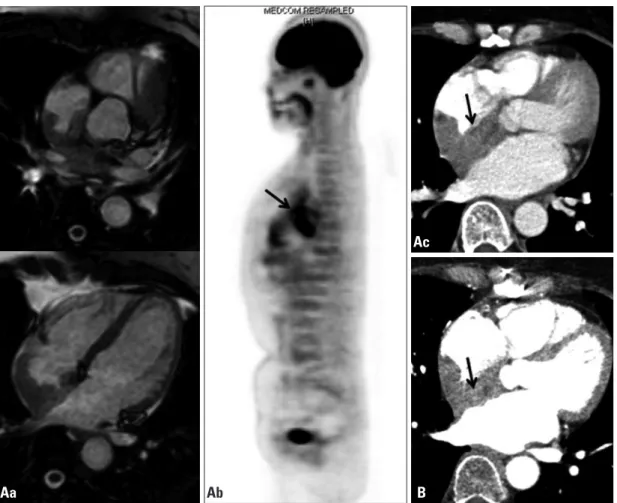
Transthoracic echocardiography and magnetic resonance imaging demonstrated a mass extending from the superior venacava (SVC)-right atrium (RA) junction to the right atrium posterior wall and interatrial septum (Fig. 2Aa). Flu- orodeoxyglucose positron emission tomography showed increased uptake in a mass involving the RA wall and inter- atrial septum (Fig. 2Ab). No other evidence of abnormal uptake was noted. Transcutaneous cardiac biopsy was per- formed, however, failed to obtain enough tissue to confirm the histologic diagnosis. Therefore, the patient underwent open chest biopsy. Histologically, the lesion was composed of proliferating IgG4-positive plasma cells and lympho- cytes (Fig. 3). The ratio of IgG4/IgG positive cells was 68% in average. And absolute number of IgG4-positive cells was approximate 146.5 per high-power field in the hottest area. These findings are consistent with IgG4-relat- ed sclerosing disease.

2

The cardiac mass involved the SVC and interatrial sep- illicit drugs. The electrocardiogram on admission showed

first-degree atrioventricular block with a prolonged PR in- terval of 240 ms (Fig. 1A). Furthermore, the patient dem- onstrated atrial fibrillation (Fig. 1B) and a sinus pause of six seconds during an exercise test (Fig. 1C). During ambulato-

Fig. 1. (A) ECG taken on admission. First-degree AV block was observed with a PR interval of 240 ms. (B) Recovery phase during an exercise test.

(C) Note the six-second sinus pause that was associated with dizziness.

ECG, electrocardiogram; AV, atrioventricular.

A

B

C

Aa Ab

Ac

B

Fig. 2. (Aa) Heart MRI showing a low-density mass lesion from the SVC and RA junction (left panel) to the right atrium of the heart (right

panel). (Ab and Ac) Positron emission tomography-computed tomography showing increased FDG uptake at the SVC-RA junction and in-

terartrial septum. (B) Heart multidetector computed tomography taken one year after diagnosis. No remarkable change of the mass. SVC,

superior venacava; RA, right atrium; FDG, fluorodeoxyglucose.

(3)

IgG4-Related Sclerosing Disease Involving the Heart

Yonsei Med J http://www.eymj.org Volume 54 Number 5 September 2013 1287

ever, to our knowledge, involvement of the cardiac conduc- tion system has not been reported.

The cause and clinical progress of IgG4-related sclerosing disease remain undefined. Some studies report a rapidly fatal outcome of this disease.

8

As the cause is unknown, there is no consensus on the optimal treatment approach. IgG4-relat- ed sclerosing disease has previously been suggested to be managed by corticosteroid and/or immunosuppressive thera- pies.

9-11

In this case, we did not perform chemotherapy or corticosteroid therapy because of patient refusal. Instead, the patient’s symptoms were managed by pacemaker implanta- tion. Interestingly, tumor progression was not observed dur- ing a one-year follow-up period. Although the follow-up duration was short, we suggest that symptomatic manage- ment alone might be a possible option for treatment of this disease.

In summary, there has been no case in the literature of in- tracardiac IgG4-related sclerosing disease that involves the sinus and atrioventricular nodes. Our report suggests that IgG4-related sclerosing disease has a favorable prognosis tum, and was inoperable. Additional chemotherapy or ste-

roid therapy was not performed because of patient’s prefer- ence. A permanent VVI-type pacemaker was implanted due to frequent sinus pauses and syncope. During a one-year follow-up, the patient had no additional episodes of synco- pe, and the mass showed no evidence of progression (Fig 2Ac and B).

DISCUSSION

IgG4-related sclerosing disease is a relatively newly found entity with distinct clinicopathologic characteristics. The dis- ease was originally discovered in patients with autoimmune pancreatitis and an elevated serum level of IgG4. It is charac- terized by extensive IgG4-positive plasma cells and T lym- phocyte infiltration of various organs. Cardiac involvement of this disease is extremely rare. Recent reports described cardiovascular IgG4-related sclerosing disease as pericardi- tis and periarteritis related to heart failure or angina.

5-7

How-

A

D

G

B

E

H

C

F

Fig. 3. (A) Low-power view showing multifocal vague lymphoid follicle formations (H-E ×40). (B) High-power view showing dense extensive lymphoplasma-

cytic infiltrations (H-E ×200). (C) IgG4 immunohistochemical staining shows many positive plasma cells (IgG4, ×100). (D and E) More than 50 IgG4-positive

plasma cells are observed (D, IgG4 ×400). The ratio of IgG4/IgG positive cells is greater than 40% (E, IgG ×400). (F) Trichrome staining does not show marked-

ly abundant collagen deposition. (G and H) The immunohistochemical staining for CD20 and CD3 reveals a lot of T cell infiltration, mainly in paracortical area.

(4)

Changho Song, et al.

Yonsei Med J http://www.eymj.org Volume 54 Number 5 September 2013 1288

fibrosclerosis and IgG4-related disease involving the cardiovascu- lar system. J Cardiol 2012;59:132-8.

4. Neild GH, Rodriguez-Justo M, Wall C, Connolly JO. Hyper-IgG4 disease: report and characterisation of a new disease. BMC Med 2006;4:23.

5. Inoue D, Zen Y, Abo H, Gabata T, Demachi H, Yoshikawa J, et al.

Immunoglobulin G4-related periaortitis and periarteritis: CT find- ings in 17 patients. Radiology 2011;261:625-33.

6. Omura Y, Yoshioka K, Tsukamoto Y, Maeda I, Morikawa T, Koni- shi Y, et al. Multifocal fibrosclerosis combined with idiopathic ret- ro-peritoneal and pericardial fibrosis. Intern Med 2006;45:461-4.

7. Baur M, Hulla W, Kienzer H, Klimpfinger M, Dittrich Ch. [Peri- carditis as the initial manifestation of retroperitoneal fibrosis--a case report]. Wien Med Wochenschr 2002;152:230-2.

8. Sakamoto A, Nagai R, Saito K, Imai Y, Takahashi M, Hosoya Y, et al. Idiopathic retroperitoneal fibrosis, inflammatory aortic aneu- rysm, and inflammatory pericarditis--retrospective analysis of 11 case histories. J Cardiol 2012;59:139-46.

9. Kamisawa T, Egawa N, Nakajima H, Tsuruta K, Okamoto A.

Morphological changes after steroid therapy in autoimmune pan- creatitis. Scand J Gastroenterol 2004;39:1154-8.

10. Kamisawa T, Yoshiike M, Egawa N, Nakajima H, Tsuruta K, Oka- moto A. Treating patients with autoimmune pancreatitis: results from a long-term follow-up study. Pancreatology 2005;5:234-8.

11. Kamisawa T, Okamoto A, Wakabayashi T, Watanabe H, Sawabu N. Appropriate steroid therapy for autoimmune pancreatitis based on long-term outcome. Scand J Gastroenterol 2008;43:609-13.

and withhold steroid therapy. If there is no deterioration of symptoms, symptomatic management and regular follow- up might be a reasonable treatment option.

ACKNOWLEDGEMENTS

This study was supported in part by research grants from Yon- sei University College of Medicine (6-2009-0176, 6-2010- 0059, 7-2009-0583, 7-2010-0676) and the Basic Science Re- search Program through the National Research Foundation of Korea, funded by the Ministry of Education, Science and Technology (2010-0021993 & 2010-0021092).

REFERENCES

1. Hamano H, Kawa S, Horiuchi A, Unno H, Furuya N, Akamatsu T, et al. High serum IgG4 concentrations in patients with sclerosing pancreatitis. N Engl J Med 2001;344:732-8.

2. Cheuk W, Chan JK. IgG4-related sclerosing disease: a critical ap- praisal of an evolving clinicopathologic entity. Adv Anat Pathol 2010;17:303-32.

3. Ishizaka N, Sakamoto A, Imai Y, Terasaki F, Nagai R. Multifocal

수치

Fig. 2. (Aa) Heart MRI showing a low-density mass lesion from the SVC and RA junction (left panel) to the right atrium of the heart (right  panel)
Fig. 3. (A) Low-power view showing multifocal vague lymphoid follicle formations (H-E ×40)

참조

관련 문서

Oxidative injury and inflamma- tory periodontal disease: The challenge of anti-oxidants to free radicals and reactive oxygen species.. The role of oxygen and

The purpose of this study was to identify the frequency and related factors of advanced airway management for patients with cardiac arrest by the

Objective: The purpose of this study is to use it as a basis for the health care guidelines for the muscle mass and cardiovascular disease of Korean population by

1 John Owen, Justification by Faith Alone, in The Works of John Owen, ed. John Bolt, trans. Scott Clark, "Do This and Live: Christ's Active Obedience as the

The histological course of nonalcoholic fatty liver disease: a longitudinal study of 103 patients with sequential liver biopsies.. McPherson S, Hardy T, Henderson

Severe disease activity and cy- tomegalovirus colitis are predictive of a nonresponse to infliximab in patients with ulcerative colitis. Guidelines for the management of

Local and global asymptotic stability of the disease steady state Firstly, we present sufficient conditions leading to locally asymptotically stable disease steady

The purpose of this study is to examine whether internet addiction is related with ADHD (Attention Deficit Hyperactivity Disorder) that is characterized