
G Supratentorial Gangliocytoma Mimicking Extra-axial Tumor: A Report of Two Cases
5
0
0
전체 글
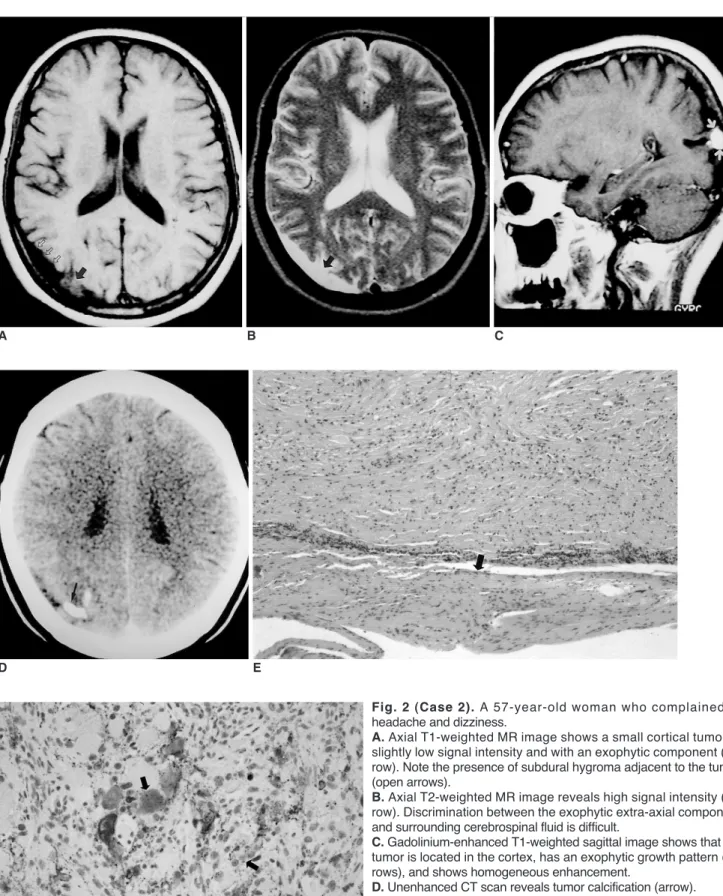
(2) Supratentorial Gangliocytoma Mimicking Extra-axial Tumors. and lymphocytes were observed (Fig. 1D). Both the cytoplasm of the ganglion cells and stromal cytoplasmic processes stained positively with antibody for synaptophysin, though glial fibrillary acidic protein (GFAP) staining failed to reveal a glial component. Finally, gangliocytoma was diagnosed. Case 2 A previously healthy 59-year-old woman presented with stubborn headache and dizziness which had begun six months earlier. She also complained of intermittent facial palsy and had a seven-year history of hypertension. The results of neurological examination were perfectly normal, and routine EEG showed no epileptic or epileptiform discharge. MR images of the brain demonstrated a small duralbased mass, and adjacent to it, in the right parieto-occipital region, was a small amount of subdural hygroma. Relative to gray matter, the mass was hypointense on T1-weighted images (Fig. 2A) and hyperintense on T2-weighted images. A. B. (Fig. 2B). On gadolinium-enhanced T1-weighted images, homogeneous enhancement was observed (Fig. 2C). The tumor appeared to have both intra- and extra-axial components; tumor-cell infiltration of brain parenchyma was thought to arise from the intra-axial portion (Fig. 2B). Gadolinium-enhanced T1-weighted sagittal images showed that the major portion of the tumor was located intra-axially (Fig. 2C), and CT scanning demonstrated calcification within the tumor (Fig. 2D). The preferred preoperative radiologic diagnosis was an extra-axial mass such as atypical meningioma. Surgery revealed that the tumor was located in the cortical area of the brain parenchyma, showed partly exophytic growth, and adhered to the adjacent leptomeninges. The clinical symptoms resolved postoperatively. Grossly, the tumor was well demarcated. Its cut surface was soft and whitish, and it contained yellowish friable granular material. Microscopic examination showed that it was composed of ganglion cells, and there was marked desmoplastic reaction and lymphocytic infiltration. The ganglion cells varied. C Fig. 1 (Case 1). A 22-year-old woman who complained of right hemiparesis and hemiparesthesia. A. Axial T1-weighted MR image shows a well demarcated tumor in the left para-midline area, with peritumoral edema. The tumor is of slightly low signal intensity and has a broad dural base on the falx cerebri and crescentic peritumoral cysts (arrow). B. Axial T2-weighted MR image shows a high signal intensity tumor with marked peritumoral edema. C. Gadolinium-enhanced coronal T1-weighted MR image demonstrates strong homogeneous enhancement, with the dural tail (arrow) attached to the falx cerebri. D. Microscopic examination indicates that the tumor is composed of ganglion cells (arrow) that contain prominent and eccentric nucleoli, and abundant bluish cytoplasm (hematoxylin-eosin, original magnification 200).. D Korean J Radiol 2(2), June 2001. 109.
(3) Kim et al.. A. D. F. 110. B. C. E Fig. 2 (Case 2). A 57-year-old woman who complained of headache and dizziness. A. Axial T1-weighted MR image shows a small cortical tumor of slightly low signal intensity and with an exophytic component (arrow). Note the presence of subdural hygroma adjacent to the tumor (open arrows). B. Axial T2-weighted MR image reveals high signal intensity (arrow). Discrimination between the exophytic extra-axial component and surrounding cerebrospinal fluid is difficult. C. Gadolinium-enhanced T1-weighted sagittal image shows that the tumor is located in the cortex, has an exophytic growth pattern (arrows), and shows homogeneous enhancement. D. Unenhanced CT scan reveals tumor calcification (arrow). E. Microscopic examination (low-power field) shows that the tumor is attached to the dura mater (arrow). (magnification 40; hematoxylin-eosin stain). F. Immunohistochemical staining demonstrates positive staining of the cytoplasm and process of some ganglion cells with synaptophysin (arrows).. Korean J Radiol 2(2), June 2001.
(4) Supratentorial Gangliocytoma Mimicking Extra-axial Tumors. considerably in size and shape, but a glial component was not clearly demonstrated. Numerous eosinophilic granular bodies were also observed. Microscopic examination (lowpower field) showed that the mass was attached to the dura mater (Fig. 2E). Immunohistochemistry demonstrated positive staining of the cytoplasm and process of some tumor cells with synaptophysin, but negative staining with GFAP.. DISCUSSION Ganglion cell tumors include gangliogliomas, gangliocytomas, dysplastic cerebellar gangliocytomas (LhermitteDuclos disease) and desmoplastic infantile gangliogliomas (2). Among these, gangliogliomas and gangliocytomas are not always distinct. A tumor is designated ‘ganglioglioma’ if it has a neoplastic glial component, while one in which only abnormal neurons are present is a gangliocytoma. Considering the group of differentiated ganglion cell tumors of the CNS as a whole, it is apparent that in the glial component there are varying degrees of neoplastic evolution, and this variability makes clear-cut separation of gangliocytomas and gangliogliomas difficult. In the two cases described in this paper, the tumors were composed mainly of ganglion cells, while immunohistochemical staining for GFAP failed to unequivocally identify a glial component. In both cases, ‘gangliocytoma’ is thus an appropriate designation. Gangliocytomas are extremely rare, with a reported frequency of only 0.1% (5). They are almost always benign, so preoperative study of their radiological features is important (2). Supratentorial gangliocytomas have on occasion been cited as the cause of epileptic foci (3, 6), though discussion of their specific clinicoradiological features has been limited to individual case reports (3, 4, 7). Previous reports have failed to document clearly the imaging findings of supratentorial gangliocytoma. According to reports by Sherazi and Peretti-Viton et al. (4, 7), MR imaging of gangliocytomas revealed masses of low signal intensity on T1-weighted images and high signal intensity on T2-weighted images, while gadolinium-enhanced scanning frequently demonstrated enhancement. In terms of MR signal intensity and degree of contrast enhancement, our two cases were similar to those of Sherazi and Peretti-Viton et al. Altman (3), however, reported that MR imaging of supratentorial gangliocytomas demonstrated intra-axial tumors of mixed signal intensity on T1weighted and proton-density images, low signal intensity on T2-weighted images, and little mass effect in three cases involving children with intractable seizure. Altman suggested that the low signal intensity seen on T2-weighted Korean J Radiol 2(2), June 2001. images might be the result of large nuclei and prominent nucleoli with long-chain nucleic acids. The high signal intensity seen on T2-weighted images, as in our two cases and two previous reports (4, 7), might be attributed in part to the abundant cytoplasm of the ganglion cells. PerettiViton et al. reported that CT scanning of these tumors often revealed calcification and cysts. In our second case report, calcification was observed. In both our cases, tumor location was also quite interesting. Both tumors were located peripherally, with some exophytic components. In the first case, a broad-based mass was attached to the falx cerebri and had a dural tail, mimicking falx meningioma. In the second case, the tumor showed partly exophytic growth, mimicking an extra-axial tumor, and adjacent to it there was a small amount of subdural hygroma. According to Altman and Peretti-Viton et al. (3, 7), supratentorial gangliocytomas occurred in cortical and subcortical locations. In the case described by Itoh et al. (8), the gangliocytoma was also cortically located. In previous reports (3, 7, 8) and in our cases, tumors were peripherally located. This predominantly cortical location might be because the tumor originated from ganglion cells in the cortex. In previous reports, however, MR findings suggesting an extra-axial or exophytic component such as a dural tail or subdural hygroma, as in our cases, were not mentioned, and the tumors seen on CT or MR images were evidently considered to be intra-axial. The dural tail of the tumor in our first case might have resulted from fibrous adhesion to the falx. In both our cases, microscopic examination revealed that tumor cells were diffusely positive for Masson’s trichrone staining and there was a marked desmoplastic reaction, characteristics which might result in fibrous adhesion to the falx or meninges. The subdural hygroma adjacent to the tumor, as seen in our second case, might be secondary to the exophytic component of the tumor and the fibrous adhesion to the leptomeninges. We believe that the presence of these extra-axial components and fibrous adhesion to the falx or leptomeninges could be important imaging findings of supratentorial gangliocytoma. The differential diagnoses of supratentorial gangliocytoma include ganglioglioma or meningioma, but a rigid separation between gangliocytoma and ganglioglioma on either histological or clinical grounds is difficult. As already described (4, 7), the MR and CT findings of gangliocytomas showed significant overlap with those of gangliogliomas, and differentiation between them on the basis of imaging findings is thus difficult or impossible. Differentiation from meningiomas can sometimes be problematic, as in our cases. Since meningiomas usually show iso or low signal intensity on T2-weighted images, high signal intensity in these 111.
(5) Kim et al.. circumstances can provide a means of differentiation. In summary, supratentorial gangliocytoma, a very rare benign neuronal tumor, can manifest as a cortical or subcortical lesion which shows high signal intensity on T2weighted MR images and homogeneous enhancement on contrast-enhanced images, and calcification may be observed. It can, however, as we report here, mimick an extra-axial tumor such as meningioma.. References 1. Zulch KJ. Brain Tumours: Their Biology and Pathology. Berlin: Springer-Verlag, 1986: 184 2. Furie DM, Felsberg GJ, Tien RD, et al. MRI of gangliocytoma of the cerebellum and spinal cord. J Comput Assist Tomogr 1993;17(3):488-491. 112. 3. Altman NR. MR and CT characteristics of gangliocytoma, a rare cause of epilepsy in children. AJNR 1988;9:917-921 4. Sherazi ZA. Gangliocytoma: magnetic resonance imaging characteristics. Singapore Med J 1998;39(8):373-375 5. Izukawa 7, Lach B, Benoit B. Gangliocytoma of the cerebellum: ultrastructure and immunohistochemistry. Neurosurgery 1988; 22:576-581 6. Kawamoto K, Yamanouchi Y, Suwa J, Kurimoto T, Matsumura H. Ultrastructural study of a cerebral gangliocytoma. Surg Neurol 1985;24:541-549 7. Peretti-Viton P, Perez-Castillo AM, Raybaud C, et al. Magnetic resonance imaging in gangliogliomas and gangliocytomas of the nervous system. J Neuroradiol 1991;18(2):189-199 8. Itoh Y, Yagishita S, Chiba Y. Cerebral gangliocytoma. An ultrastructural study. Acta Neuropathol 1987;74: 169-178. Korean J Radiol 2(2), June 2001.
(6)
수치

관련 문서
The mass in the left groin showed iso signal intensity on the T1-weighted images and ( B ) high signal intensity on the T2- weighted images. On the coronal T2-weighted image, the
Study Type of mass T1 weighted image T2 weighted image Gadolinium enhanced T1 weighted image Hong et al., 2006 [13] Epidermoid cyst Low signal intensity High signal
T1-weighted images (T1WI), T2-weighted images (T2WI), FLAIR (Fluid Attenuated Inversion Recovery) images, Gadolinium enhanced T1-weighted images (Gd-T1WI), Diffusion weighted
Coronal T2-weighted MR image shows linear low signal intensity (arrowhead), with surrounding increased marrow signal in- tensity in right sacrum(arrows)C. T1-weighted image
Results: AII vascular masses demonstrated higher than muscle signal intensity on T1-weighted images , bright signal intensity on T2-weighted images , and prominent
MR images demonstrated low signal intensity on T1-weighted images, high signal intensity on T2-weighted images, and significant enhancement on Gd- DTPA images, with lateral
On T1-weighted MR image, mass (high attenuated mass on CT) shows slightly increased signal intensity (arrow).. On gadolinium-enhanced MR image, mass shows intense
MR imaging revealed a well-defined mass lesion that showed intermediate signal intensity at T1-weighted imaging (T1WI) and slightly high signal intensity at T2-weighted imaging
