DOI: http://doi.org/10.15205/kschs.2017.12.31.1015.
신발 유형과 행동 과제에 따른 보행 속도 분석
5)
김재원, 조연하, 이선엽, 이무렬, 김소정, 김진아*
한국국제대학교 물리치료학과
Analysis of Walking Speed According to Shoe type and Behavioral tasks
Jae-Won Kim, Yeon-Ha Jo, Sun-Yeop Lee, Mu-Ryeol Lee, So-Jeong Kim, Jin-A Kim*
Department of Physical Therapy, International University of Korea
(Received August 30, 2017; Revised September 22, 2017; Accepted October 17, 2017) Abstract
Purpose. Walking depends on the speed and type of shoe to be worn, and the degree of impact varies with the muscle used. In addition, the speed can be changed by moving objects and using objects when walking. This study analyzed the change of walking speed by applying various factors influencing walking.
Methods. A total of 60 patients who had not undergone musculoskeletal diseases during the last 1 year were included. Shoe type was divided into slippers and shoe heels. Behavioral types were div- ided into bagging, books, and cell phone use. The walking speed was measured by the general walking, the middle walking, and the fast walking. The time was measured using a 10M linear dis- tance test. The collected data were analyzed with SPSS program for independent samples t-test, one-way ANOVA.
Results. There was a statistically significant difference according to the type of shoes when walking. Walking speed was slow in shoe heel. In addition, There was statistically significant dif- ference according to type of behavior task at walking. Walking speed was slow in task type using mobile phone during walking.
Conclusions. The walking speed were appeared difference in each type of shoe heel, using mobile phone.
key words: Behavioral type, Mobile phone, Shoe heel, Shoe type, Walking speed
*Corresponding author : [email protected]
1. 서 론
걷기는 우리의 일상생활에 밀착되어, 모든 동 작의 기본이 되고, 인체의 움직임을 추구하는 것 중에서 가장 기본이 되는 활동이다1). 보행은 여러 관절과 협응을 이루어야 가능한 복합적인 동작이 며 호흡작용이나 심장박동 등 여러 신체활동의 협응으로 이루어지는 동작이라 할 수 있다2).
보행의 일반 형태는 발바닥이 바닥에 닿아있는 입각기와 유각기로 나눠지고, 입각기인 최초 접지 기(Initial Contact)부터 반대발 발가락 들림기 (Opposite toe-off)를 하중 반응기(Loading Response)이며, 반대 발가락 들림기부터 반대발 최 초 접지기(Opposite Initial Contact)를 중간-말기 입 각기(Mid-Terminal Stance)구간, 반대발 최초 접지 기부터 발가락 들림기를 전 유각기(Pre- swing)라 고 한다3). 유각기는 가속기, 간 유각기, 감속기의 3단계로 구성되어 진다4).
보행은 속도 및 착용하는 신발형태에 따라 사 용되는 근육과 충격의 정도가 달라지며, 일반적으 로 신발은 보행 시 착지에 따른 충격을 흡수하고, 관절을 보호하는 기능을 한다5). 운동 보행 시 착 용하는 신발의 종류는 디자인과 기능에 따라 매 우 다양하고, 신발의 디자인과 기능에 따라서 개 개인의 보행의 형태에 많은 변화를 가져온다6).
특히 신발의 굽 높이는 보행의 정상적인 운동 역학에 영향을 준다7). 굽이 높은 신발은 보행 중 체중이 발 앞쪽으로 쏠리게 하며 발의 변형과 통 증을 유발시키는 주요 원인이다. 특히, 좁은 구두 를 착용하는 여성들의 경우, 연령이 증가할수록 발의 변형이 발생된다8). 구두 굽의 높이가 높을수 록, 굽이 지면에 닿는 넓이가 좁을수록 인체중심 점(center of body mass)이 이동하여 허리근육과 하지 부하에 더 많은 영향을 미치는 것으로 나타 났다9). 또한 구두 굽의 높이에 따라 근육 부하의 변화뿐 만 아니라 인체 중심점의 상하좌우 변화 가 증가하여 보행 자세가 불안정해진다10).
특정 도구를 들고 보행을 하는 것은 일상생활 에서 중요한 움직임이라고 할 수 있으며, 이러한 움직임 수행 시 신체의 협응을 통하여 균형을 유 지하거나 신체의 중심을 이동시키는 능력이 필요
하다11). 가방 및 무게가 있는 물건을 가지고 보행 을 할 경우 중력 중심선이 바뀌게 되며 인체의 분 절은 부정렬로 인하여 균형 유지를 하는데 많은 에너지를 사용하게 된다12).
최근 다양한 연령에서 보행 중에 휴대폰을 사 용한 경험이 있으며, 보행 중 문자메시지 보내기, 인터넷 검색, 음악 감상 등 핸드폰 사용이 보편화 되고 보행 중 휴대폰 사용으로 그 위험이 인식되 고 있다13).
본 연구는 신발 유형과 행동과제를 부여하고 각 군에 보행 속도를 분석해 보고자 한다.
2. 연구방법
2.1. 연구기간 및 연구대상
본 연구의 대상자는 최근 1년 동안 하지 근골 격계 질환이 없었던 20대 대학생 남자 30명, 여자 30명 총 60명을 대상으로 하였다. 연구결과에 영 향을 미칠 가능성을 배제하기 위해 평소 일상생 활에서 5cm 굽 이상의 신발은 착용하지 않는 자 들로 선정하였다. 또한 하지길이를 측정하여 오른 쪽과 왼쪽 하지 길이가 1cm 이상 차이 나지 않는 사람으로 선정하였다.
본 연구는 2017년 09월 4일부터 2017년 10월 31일까지 실시하였으며 본 연구에 참가한 모든 대상자에게 연구의 목적과 내용을 충분히 설명한 후에 실시하였다. 연구대상의 일반적 특성은 Table 1과 같다.
Categorie Mean(SD)
Age 21.20(1.11)
Height(cm) 167.52(5.14)
Weight(kg) 62.45(10.88)
Foot Size(cm) 249.75(10.03) Left Leg Length(cm) 85.73(4.29) Right Leg Length(cm) 85.87(4.20) Table 1. General Characteistics
2.2. 측정도구 및 방법 2.2.1. 연구도구
대조군(control group)은 신발을 신지 않고 과제 수행 없이 보행하였다. 신발 유형 1(shoe-type 1, ST1)은 굽이 없는 슬리퍼를 신고 보행을 하였으 며, 신발 유형 2(shoe-type 2, ST2)는 신발 굽 5cm 를 신고 보행하였다. 행동과제 1(behavioral task 1, BT1)은 6kg의 책을 가방에 넣어 등에 매고 보행 하였다. 행동과제 2(behavioral task 2, BT2)는 4kg 의 책을 한손에 들고 보행하였다. 행동과제 3(behavioral task 3, BT3)은 양손에 핸드폰을 들고 사용하면서 보행하도록 하였다.
2.2.2. 측정방법
2.2.2.1. 하지 길이 측정
위앞엉덩뼈가시(ASIS)에서 안쪽복사뼈(medial malleolus)까지의 거리를 측정하였다14).
2.2.2.2. 보행속도 검사
보행 속도는 속도(m/s)=거리(m)×시간(sec)으로 계산하였다15). Tirosh O의 연구16)에서 일반 (1.38m/s), 중간(1.81m/s), 빠른(2.41m/s)보행 속도 에 입각한 속도의 범위를 가지고 실시하였다.
보행 속도를 측정하기 위해 이용희17)의 선행 연 구와 같이 10m 직선거리를 최고 속도로 걷게 한 후 시작과 끝 지점 각 2m를 제외한 중앙의 6m를 지나는데 소요되는 시간(sec)을 스톱워치를 사용 하여 측정하였다.
10M 직선거리를 “준비”라는 예비령과 “시작”의 본령이 떨어지는 순간부터, 신체의 일부가 10M 지 점을 지나는 순간까지의 시간을 측정하였다. 2.3. 자료분석
본 연구의 통계분석은 IBM SPSS Statistics Ver.20 프로그램을 사용하였다. 유형에 따른 근육 속성을 분석하기 위해 일원배치분산분석(One- Way ANOVA)을 이용하여 분석하였다. 또한 그룹
간 비교를 위하여 독립표본 T-검정을 이용하여 분 석하였다. 통계학적 유의 수준은 p<0.05로 하였다.
3. 연구 결과
3.1. 신발유형에 따른 속도 변화
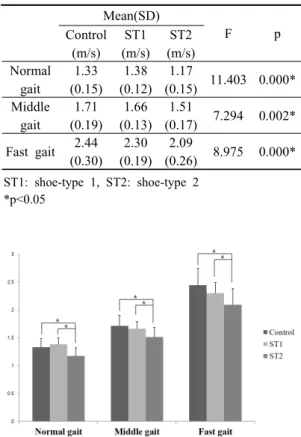
일반보행에서 신발유형2는 대조군과 신발유형1 보다 속도가 1.17m/s로 느려짐을 보였고 통계적으 로 유의한 차이를 보였다. 중간보행에서 신발유형 2는 대조군과 신발유형1보다 속도가 1.51m/s로 느 려짐을 보였고 통계적으로 유의한 차이를 보였다.
빠른보행에서 신발유형2는 대조군과 신발유형1보 다 속도가 2.09m/s로 느려짐을 보였고 통계적으로 유의한 차이를 보였다(Table 2, Figure 1).
Mean(SD)
F p
Control (m/s)
ST1 (m/s)
ST2 (m/s) Normal
gait
1.33 (0.15)
1.38 (0.12)
1.17
(0.15) 11.403 0.000*
Middle gait
1.71 (0.19)
1.66 (0.13)
1.51
(0.17) 7.294 0.002*
Fast gait 2.44 (0.30)
2.30 (0.19)
2.09
(0.26) 8.975 0.000*
ST1: shoe-type 1, ST2: shoe-type 2
*p<0.05
Table 2. Analysis of Walking Speed by Shoe Type
Figure 1. Group Comparison by Shoe Type 3.2. 행동과제유형별 보행 속도 변화
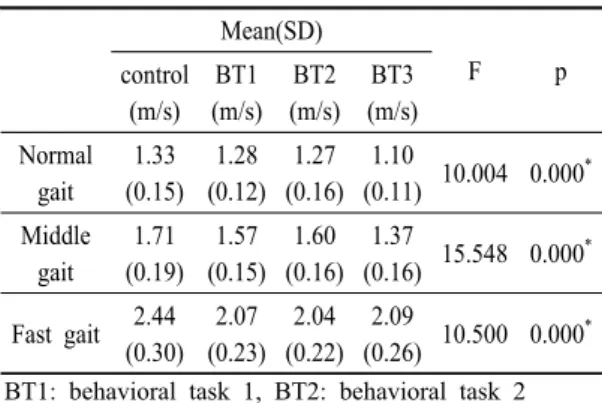
일반보행에서 행동과제3는 대조군과 행동과제
1,2보다 속도가 1.10m/s로 가장 느렸으며 통계적으 로 유의한 차이를 보였다. 중간보행에서 행동과제 3는 대조군과 행동과제1,2보다 속도가 1.37m/s로 가장 느렸으며 통계적으로 유의한 차이를 보였다. 빠른보행에서 행동과제3는 대조군과 행동과제1,2 보다 속도가 2.09m/s로 가장 느렸으며 통계적으로 유의한 차이를 보였다(Table 3, Figure 2).
Mean(SD)
F p
control (m/s)
BT1 (m/s)
BT2 (m/s)
BT3 (m/s) Normal
gait
1.33 (0.15)
1.28 (0.12)
1.27 (0.16)
1.10
(0.11) 10.004 0.000* Middle
gait
1.71 (0.19)
1.57 (0.15)
1.60 (0.16)
1.37
(0.16) 15.548 0.000* Fast gait 2.44
(0.30) 2.07 (0.23)
2.04 (0.22)
2.09
(0.26) 10.500 0.000* BT1: behavioral task 1, BT2: behavioral task 2 BT3: behavioral task 3
*p<0.05
Table 3. Analysis of Walking Speed by Behavioral Type
Figure 2. Group Comparison by Behavioral Type
4. 고찰
본 연구는 신발 유형과 행동과제가 주어짐에 따라 보행의 속도가 어느 정도의 차이를 보이는 지를 규명하는 목적으로 수행되었다.
보행에서의 하지는 머리, 체간, 팔과 상호 연관 성을 가지며, 기본적으로 체중 부하 구조를 가지 고 안정성과 균형을 유지하여 신체를 전방으로
추진시켜 이동에 필요한 기본적인 운동을 제공한 다고 하였다18,28).
속도가 증가할 경우에는 인체의 움직임이 커져 걷기 패턴에도 큰 변화가 나타나며, 지면반발력 또한 증가하게 됨으로써 인체는 부하를 받게 된 다고 보고하였다19).
20대 건강한 여성들이 높은 굽 혹은 낮은 굽의 일상적 신발 착용 습관에 따라 체감각계와 균형 에 영향을 미쳐 체감각계에서 민감도가 저하되고, 균형능력이 감소하게 된다고 하였다20). 최근 남성 또한 외모에 대한 관심이 커지고 있고 키높이 구 두 및 깔창을 이용하여 자신의 키를 높이고자 하 는 남성의 수가 늘어나고 있으며 남성이 사용하 는 키높이 깔창으로 신체전반에 대한 기능변화를 분석한 결과 균형 능력 감각 관절가동범위에 영 향을 미친다고 보고하였다21). 본 연구에서도 신발 의 유형에 따라 보행속도가 통계적으로 유의한 차이가 나타났다.
가방을 메고 보행을 할 경우 가방의 무게와 휴 대 방식, 가방의 위치, 가방 무게의 분산 정도가 자세와 보행 패턴에 많은 영향을 준다22). 가방의 무게가 증가할수록, 부하의 위치가 비대칭일수록 보행 속도가 느려지고, 한걸음 길이(stride length) 와 한발짝 길이(step length)가 짧아질 뿐만 아니 라, 무게를 든 쪽 발의 접촉 시간 시간이 증가한 다23). 또한 한발짝 너비(step width)가 넓어지고, 보행 속도와 분속수의 감소를 통해 안정감 있는 보행을 하려는 기전이 발생한다24).
아동에게 무게 부하 시 현저하게 느린 보행이 나타났다25). 본 연구에서도 무게 부하를 적용한 결과 대조군과의 속도의 차이를 보여 유사한 결 과가 나타났다.
휴대폰 사용이 자세조절의 변화에 영향을 주며, 특히 문자메세지를 보내면서 균형을 잡는 과제에 서 자세조절 능력이 현저히 감소함을 보였다26). 학생들을 대상으로 핸드폰으로 이메일을 사용할 때 일반보행에 비해 보행속도와 보폭의 감소를 보였다27). 본 연구에서도 보행 시 핸드폰 사용이 무게 부하가 적용된 보행보다 일반보행, 중간보 행, 빠른보행에서 통계적으로 유의한 차이가 나타 나 선행연구와 유사함을 보였다.
본 연구의 제한점은 연구대상자의 연령대를 20 대로 하였기 때문에 모든 연령대를 일반화하기 부 족하다. 하지만 본 연구는 일상생활에서 보행과 관 련하여 다양한 요인을 포괄적으로 접근하였다는 점에 그 연구의 의의가 있다. 추후 신발의 디자인 과 기능을 고려한 보행 속도 분석과 성별에 따른 보행 속도 분석이 필요할 것으로 사료됩니다.
5. 결론
본 연구는 신발 유형과 행동과제가 주어짐에 따라 보행의 속도를 분석하였고 그 결론은 다음 과 같다.
1. 일반보행, 중간보행, 빠른보행에서 신발유형 2(굽)는 대조군과 신발유형1(슬리퍼)보다 보 행 속도에서 통계적으로 유의한 차이를 보였 다.
2. 일반보행, 중간보행, 빠른보행에서 행동과제 2(핸드폰 사용)는 대조군과 행동과제1(가방 매기), 행동과제2(책 들기)보다 보행 속도에 서 통계적으로 유의한 차이를 보였다.
References
1. Lee DS, Cho GL. The effect of walking exercise on physique and physical fitness. Journal of Physical Growth and Motor Development, 2001;9(2):73-79.
2. Whittle MW. Gait analysis: An introduction.
Oxford: Orthopaedic Engineering Center University of Oxford, 1990.
3. Park SH, Kim YH, Park SJ. Evaluation method in gait analysis. Korean Journal of the science of Emotion & sensibility, 2003;6(4):25-32.
4. Cho YH. Analysis of Gait Velocity, Lower Muscles Activity on Obstacle and Dual Task Gait in Elderly Women. J Korean Soc Phys Med, 2011;6(4):465-473.
5. Yi KO. Mechanical Calory Expenditure Map based on the Effects of Shoe and Road Types.
KPEAW, 2009;23(3):23-38.
6. Moon GS, Choi JY, Kim RB. kinetic analysis of the ankle joint and Lower Limbs muscle for the different walking speed. KAHPERD, 2005;44(6):621-632.
7. Esnyel M, Walsh K, Walden JG et al. Kinetics of high-heeled gait. Journal of American Podiatrics and Medicine Association, 2003;93(1):27-32.
8. Dawson J, Thorogood M, Marks S et al. The prevalence of foot problems in older women: a cause for concern. Journal of Public Health, 2002;24(2):77-84.
9. Lee CM, Jeong EH. The Study on Musculoskeletal Effects of Heel Types. Journal of the ergonomics society of Korea, 2004;
23(1):39-48.
10. Lee CM, Jeong EH, Andris F. Biomechanics effects of wearing high-heeled shoes, International Journal of Industrial Ergonomics, 2001;28:321-326.
11. Chae WS. The Effects of Wearing Roller Shoes on Ground Reaction Force Characteristics During Walking. Korean journal of sport biomechanics, 2006;16(1):101-108.
12. Cho SC. Effects of Backpack Weight on Elementary School Boy's Walking. The Korean Journal of Sports Medicine, 2001;19(2):
303-310.
13. Schabrun SM, van den Hoorn W, Moorcroft A et al. Texting and Walking: Strategies for Postural Control and Impli cations for Safety.
PLoS ONE, 2014;9(1):e4312
14. Hanada E, Kirby RL, Mitchell M, Swuste JM.
Measuring leg-length discrepancy by the "iliac crest palpation and book correction" method:
reliability and validity. Arch Phys Med Rehabil, 2001;82(7):938-942.
15. Goldie PA, Matyas TA, Evans OE. Gait after stroke: Initial deficit and changes in temporal patterens for each gait phase, Arch Phys Med Rehabil, 2001;82:1057-1065.
16. Tirosh O, Sparroe WA. Age and walking speed effects on muscle recruitment in gait termination. Gait and Posture, 2005;21:
279-288.
17. Lee YH, Park SH, Yoon ES et al. Association Between Gait Velocity and Arterial Stiffness in Individuals with Chronic Hemiplegia. Journal of Adapted Physical Activity, 2012;20(1):
137-146.
18. Gallery PM, Foster AL. Human Movement.
Churchill Livingstone, 1987;228-237.
19. Cho JH, Kim RB. Effect of the MBT shoes on lower extremity joints dynamics during walking. Journal of Sports and Leisure Studies, 2012;48:825-834.
20. Kim WH, Park EY. Effects of the High-Heeled Shoes on the Sensory System and Balance in Women. KAUTPT, 1997;4(2):10-17
21. Jung JH, Kim JE, Moon YY et al. Effect of height increase elevator shoes insole on whole body functional changes -Focused on adult male in their twentiesThe Korea Journal of Sports Science, 2009;18(2):1403-1418.
22. Matsuo T, Hashimoto M, Koyanagi M et al.
Asymmetric load-carrying in young and elderly women; Relationship with lower coordination.
Gait Posture. 2008;28(3):517-520
23. Ahn JS. The effects of asymmetric load of shoulder bag on trunk and pelvis movement patterns of normal adult during gait. Dept. of Ergonomic Therapy. The Graduate School of Health and Environment. Yonsei University.
Master’s thesis, 2006.
24. Cho HY. The analysis of the kinematic variable on loading response during the walking.
Honam University, 1998;19(2):1305-1316.
25. We WR. Biomechanical analysis of comparison between normal and obese children according to weight load walking. Yongin University, 2009.
26. Won JI. Effects of using a mobile phone on postural control. Phys Ther Kor, 2012;19(3):
61-71.
27. Demura S, Uchiyama M. Influence of cell phone email use on characteristics of gait.
European Journal of Sport Science, 2009;
9(5):303-309.
28. Kim JM, Kim JJ, Park SY et al. Walking Analysis in Dementia using GAITRite Ambulation System. Journal of Korean Clinical Health Science, 2017;5(1):816-824.