Introduction
Natural oils such as plant oils or microalgal oils are val- uable resources for the production of high value-added oleochemicals. Because major components of almost all the vegetable oils or microalgal oils are oleic acid and linoleic
acid [1-4], development of techniques producing high val- ue-added chemicals from oleic acid and linoleic acid can be valuable in utilizing natural oils. One of the examples may include biological production of medium chain fatty acids (MCFAs) from natural oils [5,6].
MCFAs including α,ω-dicarboxylic acids and ω
* Corresponding author
Phone: +82-2-3277-4509 Fax: +82-2-3277-4213 E-mail: [email protected]
This is an open-access journal distributed under the terms of the Creative Commons Attribution Non-Commercial License
(http://creativecommons.org/licenses/by-nc/4.0/)
https://doi.org/10.15433/ksmb.2018.10.2.044 ISSN 2383-5400 (Online)
Whole-cell Biotransformation of Chlorella Oil Hydrolysates into Medium Chain Fatty Acids
Joo-Hyun Seo
1,†, Won-Ki Min
2,†, Jung-Hoo Lee
3, Sun-Mee Lee
4, Choul-Gyun Lee
5, Jin-Byung Park
3,*1
Department of Pharmaceutical Engineering & Biotechnology, Sunmoon University, Asan, Chungcheongnam-do 31460, Republic of Korea
2
Department of Food Science and Industry, Kyungil University, Gyeongsan, Gyeongsangbuk-do 38428, Republic of Korea
3
Department of Food Science and Engineering, Ewha Womans University, Seoul 03760, Republic of Korea
4
Department of Food and Nutrition, Daejeon University, Daejeon 34520, Republic of Korea
5
National Marine Bioenergy Research Consortium & Department of Biological Engineering, Inha University, Incheon 22212, Republ ic of Korea
† Both authors contributed equally to this work
(Received 15 October 2018, Revised 30 October 2018, Accepted 1 November 2018)
Abstract A synthetic pathway, which consisted of fatty acid double bond hydratase, alcohol de- hydrogenase, and Baeyer-Villiger monooxygenase, was applied to Chlorella oil to produce ester fatty acids, which can be hydrolyzed into medium chain fatty acids. Since linoleic acid is a major fatty acid constituent of Chlorella oil, a fatty acid double bond hydratase from Lactobacillus acidophilus NBRC13951, which is able to convert linoleic acid into 13-hydroxyoctadec-9-enoic acid, was used. Recombinant Escherichia coli expressing the fatty acid double bond hydratase from L. acidophilus NBRC13951 successfully transformed linoleic acid in Chlorella oil hydro- lysates into 13-hydroxyoctadec-9-enoic acid with approximately 60% conversion yield.
13-Hydroxyoctadec-9-enoic acid was further converted into ester fatty acids by the recombinant E. coli expressing a long chain secondary alcohol dehydrogenase and a Baeyer-Villiger monooxygenase. The resulting ester fatty acids were then hydrolyzed into medium chain fatty acids by a lipase. Overall, industrially relevant medium chain fatty acids were produced from Chlorella oil hydrolysates. Thereby, this study may contribute to biosynthesis of medium chain fatty acids from microalgae oils as well as long chain fatty acids.
Keywords : Chlorella oil, medium chain fatty acids, linoleic acid, fatty acid double bond hydratase,
Baeyer-Villiger monooxygenase
-hydroxycarboxylic acids can be utilized as chemical products and intermediates such as nylons, polyamides, polyesters, res- ins, hot-melt adhesives, powder coatings, corrosion inhibitors, lubricants, plasticizers, greases, and perfumes [7]. MCFAs, which can be candidates for various value-added chemicals, could be produced by multi-step enzyme reaction [7,8]. It has been shown that this microbial production of medium chain fatty acids can be applied to various oils including plant oils, yeast-derived oil, and microalgae-originated fatty acid methyl esters [5,6].
Microalgae have been considered one of the most promis- ing sources of triacylglycerol because of its high oil yields and growth in non-arable lands [9]. Like other oils, micro- algal oil consists of various fatty acids. For example, Chlorella-originated oil consists of average 15.21% of pal- mitic acid, 18.41% of oleic acid, 14.26% of linoleic acid, and 15.31% of α-linolenic acid [10]. Overall, contents of polyunsaturated fatty acids (PUFA) such as linoleic acid and α-linolenic acid occupy the highest contents compared to saturated fatty acids and monounsaturated fatty acids.
Therefore, efficient utilization of PUFA should be accom- plished to achieve maximum yield for the production of MCFAs. In addition, because fatty acid content of micro-
algae can be increased by applying nitrogen depletion, in- hibition of carbohydrate synthesis, or radiation of light with specific wavelength [11,12], microalgae have high potential in mass production of natural fatty acids. In multi-step en- zyme reaction strategy reported (Fig. 1), the first step of the production of MCFAs from unsaturated fatty acids is the hydration (i.e. generation of hydroxyl group) of double bond. This task can be done by double bond hydratase or 13-lipoxygenase [13,14]. However, depending on the sub- strate specificity of each oleate hydratase, utilization rate of PUFAs may differ. Therefore, in the case of microalgal oil utilization, development of oleate hydratase having sub- strate specificity to PUFAs should be achieved. Oh et al.
reported the double bond hydratase from Lactobacillus acid- ophilus NBRC13951 having specificity to linoleic acid (i.e.
linoleate hydratase (LHTase)) [15]. Identification of such a linoleate hydratase paved a way to the utilization of linoleic acid, which ultimately leads to efficient production of MCFA from microalgal oils. Therefore, in this study, we inves- tigated the production MCFA from Chlorella oils using the LHTase from Lactobacillus acidophilus NBRC13951 and multi-step enzyme reaction strategy, which had been re- ported in our previous study [15] (Fig. 1).
Figure 1. Production scheme of medium chain fatty acids from linoleic acid using multi-step enzyme reactions, which had
been reported in our previous studies [15]. (1) linoleic acid, (2) 13-hydroxyoctadec-9-enoic acid, (3) 13-ketooctadec-9-enoic
acid, (4) (Z)-12-(hexanoyloxy)dodec-9-enoic acid, (5) (Z)-12-((pentyloxy)carbonyl)dodec-9-enoic acid, (6) n-hexanoic acid, (7)
12-hydroxydodec-9-enoic acid, (8) n-pentanol, (9) α,ω-tridec-9-enedioic acid.
Materials and Methods
Microbial strains and culture media
Recombinant E. coli strains were grown in a Luria–
Bertani (LB) medium (5 g/L yeast extract, 10 g/L tryp- tone, and 10 g/L NaCl) supplemented with the appro- priate antibiotics for seed cultivation. The Riesenberg medium [16], supplemented with 10 g/L glucose and the appropriate antibiotics, was used for the main culti- vation and biotransformation. The Riesenberg medium consisted of 4 g/L (NH 4 ) 2 HPO 4 , 13.5 g/L KH 2 PO 4 , 1.7 g/L citric acid, 1.4 g/L MgSO 4 , and 10 mL/L trace met- al solution (10 g/L FeSO 4 , 2.25 g/L ZnSO 4 , 1.0 g/L
CuSO 4 , 0.5 g/L MnSO 4 , 0.23 g/L Na 2 B 4 O 7 , 2.0 g/L CaCl 2 , and 0.1 g/L (NH 4 ) 6 Mo 7 O 24 ). In case of culti- vation of E. coli ER2566 pAhyd expressing the lino- leate 13-hydratase from Lactobacillus acidophilus [17], the super optimal broth with catabolite repression (SOC) medium, which contained 3.6 g/L glucose, 20 g/L tryptone, 5 g/L yeast extract, 0.584 g/L NaCl, 0.186 g/L KCl, 0.952 g/L (10 mM) MgCl 2 , and 2.408 g/L (10 mM) MgSO 4 , was used as previously reported [17].
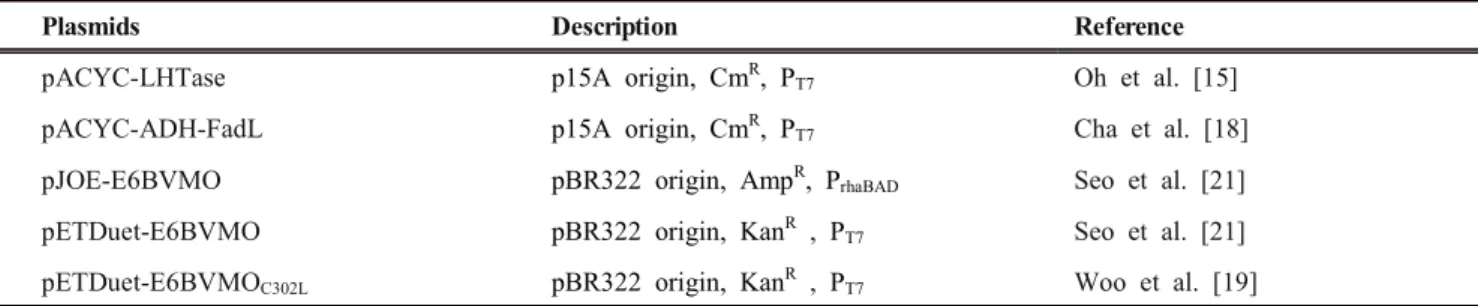
Plasmids used in this study are listed in Table 1.
Recombinant gene expression was induced by adding 0.1 mM isopropyl-β-D-thiogalactopyranoside (IPTG) and/or 2 g/L rhamnose to the culture broth.
Table 1. Plasmids used in this study.
ADH: alcohol dehydrogenase from Micrococcus luteus NCTC2665, FadL: long-chain fatty acid outer membrane transporter from Escherichia coli BL21(DE3) (Accession number: CAQ32746), LHTase: linoleate hydratase from Lactobacillus acidophilus NBRC13951, BVMO: Baeyer-Vi lliger monooxygenase from Pseudomonas putida KT2440, E6BVMO: hexa-glutamate tagged BVMO, E6BVMO
C302L: hexa-glutamate tagged BVMO C302L mutant.
Reagents
Linoleic acid, palmitic acid, n-hexanoic acid, n-pen- tanol, ethyl acetate, IPTG, Riesenberg medium com- ponents, and pyridine were obtained from Sigma (St.
Louis, MO, USA). N-Methyl-N-(trimethylsilyl)tri- fluoroacetamide (TMS) was purchased from Tokyo Chemical Industry Co. (Tokyo, Japan).
13-Hydroxyoctadec-9-enoic acid (13-HOA) was pre- pared via hydration of linoleic acid or Chlorella oil hy- drolysates with a linoleate C12 double bond-hydratase in our laboratory [17]. Chlorella oil hydrolysates were obtained from Prof. C.-G. Lee at Inha University.
Hydration of fatty acids into hydroxy fatty acids Hydration of linoleic acid or Chlorella oil hydro- lysates was carried out according to our earlier work
[17]. Briefly, the recombinant E. coli expressing the li- noleate 13-hydratase gene was cultivated in the SOC medium at 16°C. After induction of the gene ex- pression, the cell mass was harvested and resuspended into 50 mM citrate/phosphate buffer (pH 6.0) to 20 g dry cells/L. After adding linoleic acid or Chlorella oil hydrolysates with 0.25% Tween 40 into the reaction medium, the biotransformation medium was incubated in a shaking incubator (200 rpm and 35 o C). One unit (U) of whole cell activity was defined as μmol of hy- droxy fatty acid produced per min at 35°C by 1.0 g dry cells.
Biotransformation of hydroxy fatty acids into ester fatty acids
The biotransformation was carried out as previously
Plasmids Description Reference
pACYC-LHTase p15A origin, Cm
R, P
T7Oh et al. [15]
pACYC-ADH-FadL p15A origin, Cm
R, P
T7Cha et al. [18]
pJOE-E6BVMO pBR322 origin, Amp
R, P
rhaBADSeo et al. [21]
pETDuet-E6BVMO pBR322 origin, Kan
R, P
T7Seo et al. [21]
pETDuet-E6BVMO
C302LpBR322 origin, Kan
R, P
T7Woo et al. [19]
reported [6,18-20]. In brief, the biotransformation was in- itiated at the stationary growth phase, usually 8 h after the induction of gene expression with 0.1 mM IPTG and/or 2 g/L rhamnose. After changing the pH of the culture broth to 8.0 and increasing the temperature to 35°C, hydroxy fatty acids and 0.5 g/L Tween80 were added into the culture broth containing a cell concen- tration of approximately 3 g dry cells/L. Cultivation and biotransformation was performed in a 100 mL flask (working volume: 10 mL) in a shaking incubator (200 rpm).
Product analysis by gas chromatography-mass spectrometry (GC-MS)
Concentrations of the remaining fatty acids and ac- cumulating carboxylic acids in the medium (e.g., lino- leic acid, 13-HOA, 13-keto-octadec-9-enoic acid, ester fatty acids, and carboxylic acids) were determined as described previously [6,18,19]. The reaction medium was mixed with an equal volume of ethyl acetate con- taining 0.5 g/L methyl palmitate as an internal standard. The organic phase was harvested after vigo- rous vortexing and then subjected to derivatization with N-methyl-N-(trimethylsilyl) trifluoroacetamide (TMS). The TMS derivatives were analyzed using a Thermo Ultra Trace GC system connected to an ion trap mass detector (Thermo ITQ1100 GC-ion Trap MS, Thermo Scientific (Indianapolis, IN, USA)). The derivatives were separated on a non-polar capillary column (30 m length, 0.25 mm film thickness, HP-5MS, Agilent Technologies (Palo Alto, CA, USA)). A linear temperature gradient was pro- grammed as 90°C, 5°C/min to 280°C. The injection port temperature was 230°C. Mass spectra were ob- tained by electron impact ionization at 70 eV. Mass spectra were obtained within 100–600 m/z. Selected ion monitoring was used for the detection and frag- mentation analyses of the reaction products.
Results and Discussion
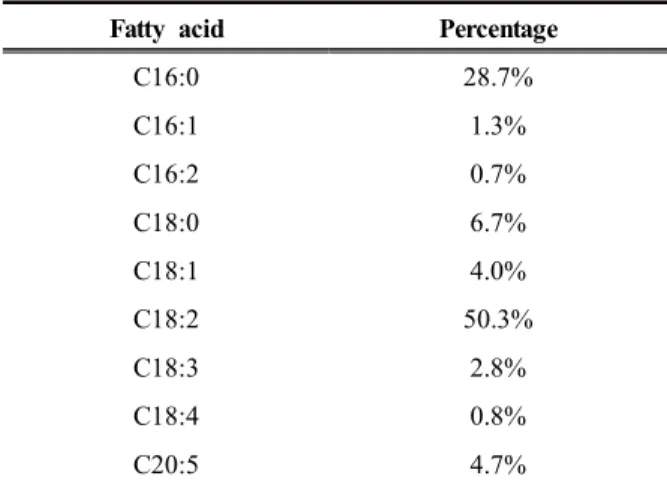
Firstly, we analyzed the composition of Chlorella
oil hydrolysates. As shown in Table 2, composition of Chlorella oil hydrolysates in this study was differ- ent from the previous report [10]. The major compo- nent was linoleic acid (50.3%), which was more than half of all the fatty acids. This result means that pro- duction of MCFAs from Chlorella oil hydrolysates would be successful only if linoleic acid is success- fully utilized using LHTase. Among the LHTase, we found that LHTase from Lactobacillus acidophilus NBRC13951 (LHTase_Laci) has unique activity compared to other LHTases. According to Oh et al., LHTase_Laci has substrate specificity to linoleic acid as well as weak activity to oleic acid [15]. For example, LHTase_Laci produced ~7.5 mM of hy- drated product of linoleic acid after 6 hr of reaction whereas it produced less than 2 mM of hydrated product of oleic acid [15]. Therefore, after the evalu- ation of substrate specificities of known double bond hydratases, we selected the LHTase_Laci as a double bond hydratase of our multi-enzyme synthetic pathway.
Table 2. Composition of Chlorella oil hydrolysates
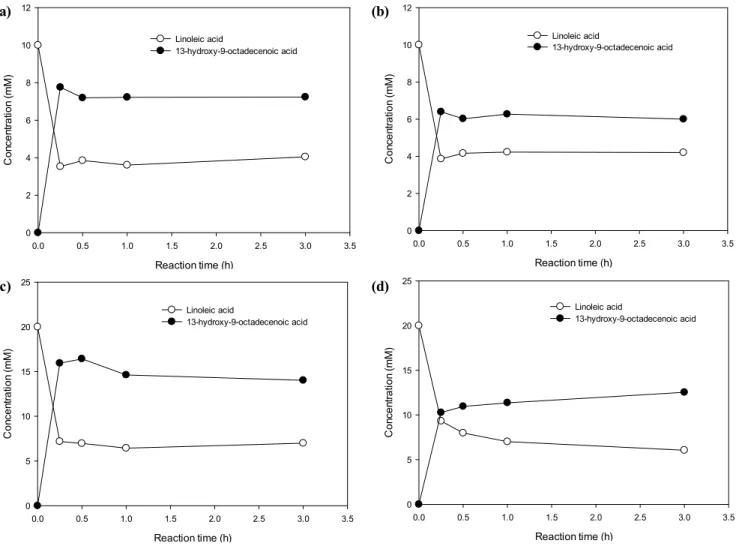
Next, we examined the production of 13-HOA usin g LHTase_Laci, Chlorella oil hydrolysates and linol eic acid. When 10 mM Chlorella oil hydrolysates or 10 mM linoleic acid was used as substrate, E.
coli ER2566::pACYC-LHTase_Laci produced ~6 m M or ~7 mM of 13-HOA, respectively. Conversions of reactions using 10 mM of Chlorella oil hydrolysat es or linoleic acid were ~60% and ~70%, respectivel y. These conversions were similar when 20 mM of
Fatty acid Percentage
C16:0 28.7%
C16:1 1.3%
C16:2 0.7%
C18:0 6.7%
C18:1 4.0%
C18:2 50.3%
C18:3 2.8%
C18:4 0.8%
C20:5 4.7%
Chlorella oil hydrolysates or 20 mM of linoleic acid were used as substrates. Among the two substrates, i.e. linoleic acid and Chlorella oil hydrolysates, linol eic acid was more efficient for biotransformation yiel ding about 70% conversion. This result was promisin g because about 70% of conversion is similar to the value of conversion when oleic acid was converted to 10-hydroxystearic acid [5]. Therefore, we thought that, thanks to the LHTase_Laci, utilization of linolei c acid became as efficient as the utilization of oleic acid. In addition, high conversion of linoleic acid by LHTase_Laci was also confirmed by ~60% conversi on of Chlorella oil hydrolysates into 13-HOA. Becau se about 50% of Chlorella oil in this study is linoleic acid, high activity of LHTase_Laci to linoleic acid should be helpful to the conversion of Chlorella oil hydrolysates.
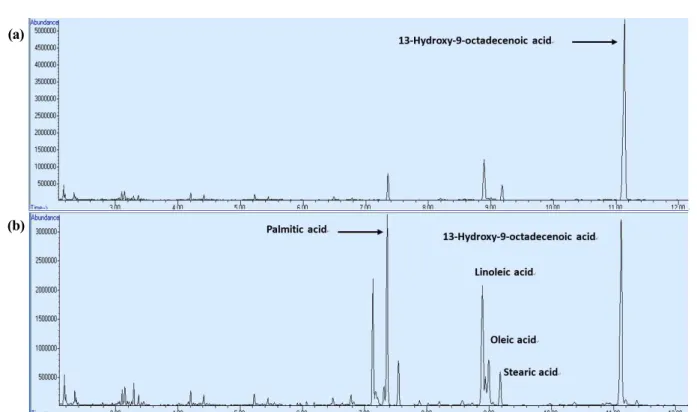
After the enzymatic reaction of LHTase_Laci, we analyzed the reaction using GC-MS after the ex- traction of organic materials using ethyl acetate. When linoleic acid was used as substrate, a peak containing 13-HOA was well separated with the 13-HOA purity of 75% (Fig. 3 (a)). When Chlorella oil hydrolysates were used as substrate, a peak containing 13-HOA was also well separated (Fig. 3 (b)). However 13-HOA pu- rity was 25%, which was very low compared to the reaction using linoleic acid. Using the reaction me- dium extract, we further tested the alcohol de- hydrogenase (ADH) and Baeyer-Villiger mono- oxygenase (BVMO) reactions using recombinant E.
coli. Although it has been constantly overcome, the main problem in synthetic pathway in Fig. 1 was low stability of BVMO. To improve the low stability of BVMO from Pseudomonas putida KT2440 (BVMO_Pput), various protein engineering were ap- plied to BVMO_Pput [19,21] as well as the screening of other BVMOs [20]. Because hexa-glutamate tag [21] and C302L mutation [19] were the successful en- gineering cases, we investigated the activity of hexa-glutamate-tagged BVMO (E6BVMO) and C302L mutant of E6BVMO. In addition, we tested the vector effect for the activity of cells express- ing BVM O by incorporating another BVM O -ex- pressing vector. Therefore, recombinant hosts for
the production of (3) in Fig. 1 w ere E. coli BL21(DE3)::pACYC-ADH-fadL,pJOE-E6BVMO, E.
coli BL21(DE3)::pACYC-ADH-fadL,pETDuet-E6BVMO, and E. coli BL21(DE3)::pACYC-ADH-fadL,pETDuet-E6BVMO C302L
(fadL: gene encoding outer membrane long-chain fatty acid transporter). Firstly, we tested the activity of our recombinant hosts using 13-HOA from the reaction us- ing linoleic acid. As shown in Fig. 4, E. coli BL21(DE3)::pACYC-ADH-fadL,pJOE-E6BVMO, E. coli BL21(DE3)::pACYC-ADH-fadL,pETDuet-E6BVMO, and E. coli BL21(DE3)::pACYC-ADH-fadL,pETDuet-E6BVMO C3
02L produced ester fatty acids (compound 4 and 5 in Fig. 1) with conversion of 62%, 78%, and 79%, respectively. Since the conversion yield of 13-HOA from linoleic acid was 77% (Fig. 2 (a)), the overall yield of ester fatty acids from linoleic acid reached 48 to 61%.
Among all three cases, ratio between compound 4 and 5 was 2:1. Enhanced conversion by E. coli BL21(DE3)::pACYC-ADH-fadL,pETDuet-E6BVMO and E. coli BL21(DE3)::pACYC-ADH-fadL,pETDuet-E6BVMO C302L
from BL21(DE3)::pACYC-ADH-fadL,pJOE-E6BVMO seemed to be the higher expression strength of T7 pro- moter of pETDuet plasmid than rhaBAD promoter of pJOE [22]. Therefore, we thought that the difference in the amount of expressed BVMO caused the differ- ence in the production of ester fatty acids. However, interestingly, the ratio between compound 4 and 5 were same for all the reactions. Because we used same BVMO for all the reactions, ratio between compound 4 and 5 would be the same, even with C302L mutant.
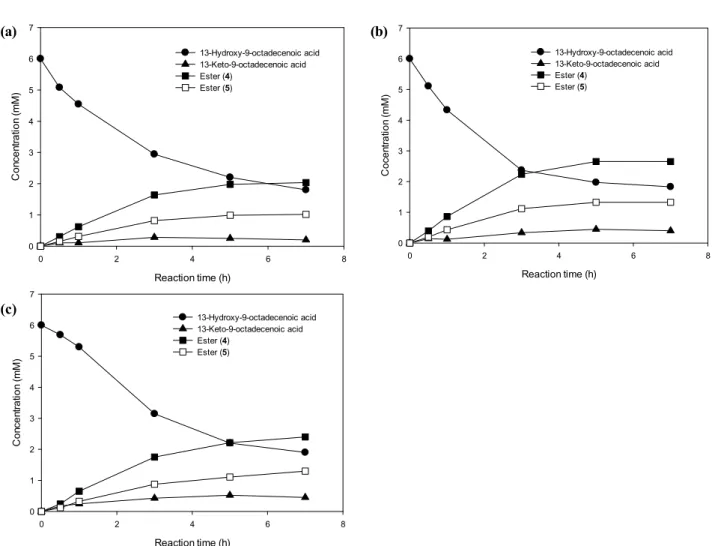
To investigate the more real substrate, we performed re- action using organic materials extracted from LHTase reaction using Chlorella oil hydrolysates. As shown in Fig. 5, E. coli BL21(DE3)::pACYC-ADH-fadL,pJOE-E6BVMO, E. coli BL21(DE3)::pACYC-ADH-fadL,pETDuet-E6BVMO, and E. coli BL21(DE3)::pACYC-ADH-fadL,pETDuet-E6BVMO C3
02L produced ester fatty acids with conversion of
51%, 66%, and 62%, and the ratio between compound
4 and 5 of 2:1, 2:1, 1.85:1, respectively. Use of more
complex starting material reduced the conversion by
11~17%, whereas the ratio between compound 4 and
5 was similar. These lower conversions may be due
to the competitive substrate inhibition by saturated fatty acids and unsaturated fatty acids included in the Chlorella oil hydrolysates such as palmitic acid, stearic acid, and oleic acid. Therefore, to make our synthetic pathway more efficient in complex starting material, competitive substrate inhibition by other fatty acids to LHTase, ADH, and BVMO should be investigated and overcome.
Although we did not investigated the hydrolysis of compound 4 and 5 using lipases, we believe that various lipases such as lipase from Candida rugosa or lipase from Thermomyces lanuginosus having substrate specificity would surely hydrolyze to produce compound 6, 7, 8, and 9.
In this study, we investigated the utilization of fatty
acids from Chlorella oil to produce MCFAs. Successful hydration of linoleic acid proved that employment of LHTase_Laci was successful. We also have shown that 13-HOA could be converted its corresponding ester fat- ty acids, which may further hydrolyzed to produce vari- ous MCFAs. Our study also showed the hurdles (e.g., unreacted fatty acids) in utilization of Chlorella oil us- ing synthetic pathway in Fig. 1. To make our synthetic pathway more robust, hurdles such as competitive sub- strate inhibition should be solved for LHTase, ADH, or BVMO. By incorporating heterologous genes into genome [23], we can construct recombinant E. coli cells which does not need expensive antibiotics, and which is more stable than E. coli with plasmid-based heterolo- gous expression.
Figure 2. Conversion of Chlorella oil hydrolysates or linoleic acid using E. coli ER2566::pACYC-LHTase_Laci. (a) Biotransform ation of 10 mM linoleic acid, (b) biotransformation of 10 mM Chlorella oil hydrolysates, (c) biotransformation of 20 mM linoleic acid, and (d) biotransformation of 20 mM Chlorella oil hydrolysates.
Reaction time (h)
0.0 0.5 1.0 1.5 2.0 2.5 3.0 3.5
C o n c e n tr a ti o n ( m M )
0 2 4 6 8 10 12
Linoleic acid
13-hydroxy-9-octadecenoic acid
Reaction time (h)
0.0 0.5 1.0 1.5 2.0 2.5 3.0 3.5
C o n c e n tr a ti o n ( m M )
0 2 4 6 8 10 12
Linoleic acid
13-hydroxy-9-octadecenoic acid
Reaction time (h)
0.0 0.5 1.0 1.5 2.0 2.5 3.0 3.5
C o n c e n tr a ti o n ( m M )
0 5 10 15 20 25
Linoleic acid
13-hydroxy-9-octadecenoic acid
Reaction time (h)
0.0 0.5 1.0 1.5 2.0 2.5 3.0 3.5
C o n c e n tr a ti o n ( m M )
0 5 10 15 20 25
Linoleic acid
13-hydroxy-9-octadecenoic acid
(a) (b)
(d)
(c)
Figure 3. GC-MS spectrum of organic materials in reaction medium extracted using ethyl acetate. (a) GC-MS spectrum of organic materials in reaction medium using linoleic acid, (b) GC-MS spectrum of organic materials in reaction medium using Chlorella oil hydrolysates.
Figure 4. Alcohol hydrogenase (ADH) and Baeyer-Villiger monooxygenase (BVMO) reaction using 13-HOA from the LHTase reaction using linoleic acid. (a) E. coli BL21(DE3)::pACYC-ADH-fadL,pJOE-E6BVMO, (b) E. coli BL21(DE3)::pACYC-ADH-fadL,pETDuet-E6BVMO, (c) E. coli BL21(DE3)::pACYC-ADH - fadL,pETDuet-E6BVMO
C302L. Ester (4) and Ester (5) means compounds 4 and 5 in Fig. 1, respectively.
(a)
Reaction time (h)
0 2 4 6 8
Concentration (mM)
0 1 2 3 4 5 6 7
13-Hydroxy-9-octadecenoic acid 13-Keto-9-octadecenoic acid Ester (4)
Ester (5)
(b)
Reaction time (h)
0 2 4 6 8
Concentration (mM)
0 1 2 3 4 5 6 7
13-Hydroxy-9-octadecenoic acid 13-Keto-9-octadecenoic acid Ester (4)
Ester (5)
(c)
Reaction time (h)
0 2 4 6 8
Concentration (mM)
0 1 2 3 4 5 6 7
13-Hydroxy-9-octadecenoic acid 13-Keto-9-octadecenoic acid Ester (4)
Ester (5)
(a)
(b)
Figure 5. ADH and BVMO reaction using 13-HOA from the LHTase reaction using Chlorella oil hydrolysates. (a) E. coli BL21(DE3)::pACYC-ADH-fadL,pJOE-E6BVMO, (b) E. coli BL21(DE3)::pACYC-ADH-fadL,pETDuet-E6BVMO, (c) E. coli BL21(DE3)::pACYC-ADH-fadL,pETDuet-E6BVMO
C302L. Ester (4) and Ester (5) mean compound 4 and 5 in Fig. 1, respectively.
Acknowledgments
This study was supported by the Marine Biomaterials Research Center grant from Marine Biotechnology Program funded by the Ministry of Oceans and Fisheries, Korea (No. D11013214H480000100). J.-H.
Seo was supported by a grant (2017R1D1A1B03033525) of the Basic Science Research Program through the National Research Foundation of Korea (NRF) funded by the Ministry of Education, Republic of Korea.
References
1. Orsavova, J., Misurcova, L., Ambrozova, J. V., Vicha, R.
and Mlcek, J. 2015. Fatty acids composition of vegetable
oils and its contribution to dietary energy intake and dependence of cardiovascular mortality on dietary intake of fatty acids. Int. J. Mol. Sci. 16, 12871-12890.
2. Volkman, J. K., Jeffrey, S. W., Nichols, P. D., Rogers, G. I. and Garland, C. D. 1989. Fatty acid and lipid composition of 10 species of microalgae used in mariculture. J. Exp. Mar. Biol. Ecol. 128, 219-240.
3. Patil, V., Källqvist, T., Olsen, E., Vogt, G. and Gislerød, H. R. 2007. Fatty acid composition of 12 microalgae for possible use in aquaculture feed. Aquacult. Int. 15, 1-9.
4. Soares, A. T., da Costa, D. C., Silva, B. F., Lopes, R.
G., Derner, R. B. and Antoniosi Filho, N. R. 2014.
Comparative analysis of the fatty acid composition of microalgae obtained by different oil extraction methods and direct biomass transesterification. Bioenerg. Res. 7, 1035-1044.
5. Jeon, E.-Y., Seo, J.-H., Kang, W.-R., Kim, M.-J., Lee, J.-H., Oh, D.-K. and Park, J.-B. 2016. Simultaneous enzyme/whole-cell biotransformation of plant oils into C9
Reaction time (h)
0 2 4 6 8
C o n c e n tr a ti o n ( m M )
0 1 2 3 4 5 6 7
13-Hydroxy-9-octadecenoic acid 13-Keto-9-octadecenoic acid Ester (4)
Ester (5)
Reaction time (h)
0 2 4 6 8
C o c e n tr a ti o n ( m M )
0 1 2 3 4 5 6 7
13-Hydroxy-9-octadecenoic acid 13-Keto-9-octadecenoic acid Ester (4)
Ester (5)
Reaction time (h)
0 2 4 6 8
C o n c e n tr a ti o n ( m M )
0 1 2 3 4 5 6 7
13-Hydroxy-9-octadecenoic acid 13-Keto-9-octadecenoic acid Ester (4)
Ester (5)
![Figure 1. Production scheme of medium chain fatty acids from linoleic acid using multi-step enzyme reactions, which had been reported in our previous studies [15]](https://thumb-ap.123doks.com/thumbv2/123dokinfo/5232135.621964/2.892.157.736.716.1067/figure-production-scheme-linoleic-reactions-reported-previous-studies.webp)