• 검색 결과가 없습니다.

Variation in Agronomic Traits and Fatty Acid Compositions of the Seed Oil in Germplasm Collection of Brassica spp.

N/A
N/A
Protected

Academic year: 2021

Share "Variation in Agronomic Traits and Fatty Acid Compositions of the Seed Oil in Germplasm Collection of Brassica spp."

Copied!
11
0
0

로드 중.... (전체 텍스트 보기)

전체 글

(1)

Introduction

The genus Brassica, a member of the Brassicaceae family, includes a diverse group of species comprising of major vegetables, oilseed crops and fodder crops (Christopher et al., 2005; Rakow, 2004). The genus Brassica includes 41 species and among them, B. carinata A. Braun, B. juncea L. Czern., B. rapa L. and Brassica (Sinapis) alba L. are important.

Brassica species play an important role in agriculture and overall, it contributes to the economy and health of people (Zhao, 2007).

Variability assessment is important in germplasm charac- terization and conservation. Morphological variation in plant species is controlled by a single or multiple genes for the traits but the variation in morphological traits are the result of both genetic and environmental attributes (Rohlf, 2000). Generally,

morphological traits have been used to assess the genetic variation and relationships among populations of different Brassica species (Balkaya et al., 2005; El-Esawi et al., 2012).

B. juncea L. and B. rapa L. are the most important source of vegetable oil in world (Friedt and Lauhs, 1995). In addition, palmitic, stearic, oleic, linoleic, linolenic, eicosanoic and erucic acids are major fatty acids extract in genus Brassica but Brassica oil has more variation in fatty acid compositions than other vegetable oils (Sovero, 1993). Oils containing high erucic acid content are suitable for industrial application.

Therefore, screening of Brassica species for high erucic acid content and free erucic acid have a present need to develop new varieties. In the study of Velasco et al. (1998), the highest erucic acid content (>55% of the total fatty acids) was reported in B. napus L., B. oleracea L., B. rapa L., and B.

incana Ten. Highest content of linolenic (20%) and linoleic (19%) acid had also been reported in B. juncea (Sharafi et al., 2015). Generally, fatty acid composition controls functional and nutritional values of vegetables oils but it varies on the

Variation in Agronomic Traits and Fatty Acid Compositions of the Seed Oil in Germplasm Collection of Brassica spp.

Ho-Cheol Ko

1

, Jung-Sook Sung

1

, On-Sook Hur

1

, Hyung-Jin Baek

1

, Myung-Chul Lee

1

, Binod Prasad Luitel

1,3

, Kyoung-Yul Ryu

2

and Ju-Hee Rhee

1

*

1

National Agrobiodiversity Center, NAS, RDA, Jeonju 54874, Korea

2

Korea Program on International Agriculture Div. Technology Cooperation Bureau, RDA, Jeonju 54875, Korea

3

Horticulture Research Station, Nepal Agricultural Research Council (NARC), Dailekh 5459, Nepal

Abstract - A total of 447 accessions consisting of seven Brassica spp.; Brassica carinata (34), B. juncea (199), B. rapa subsp. dichotoma (18), B. rapa. subsp. oleifera (14), B. rapa subsp. rapa (36), B. rapa subsp. trilocularis (56) and B. alba subsp. alba (90) were studied for their morphological characters and fatty acid compositions. There was a wide variation for morphological traits, oil content and fatty acid composition among Brassica species. Seed number/silique and yield/plant were varied from 4.2 (B. alba) to 25.1 (B. rapa subsp. trilocularis) and from 170.7 g (B. rapa subsp. oleifera) to 351.9 g (B.

juncea L. Czern.), respectively. Among Brassica species, B. rapa subsp. trilocularis exhibited the highest oil (29.2%), stearic (20.4%) and erucic acid (45.3%) content. B. carinata had the highest content of palmitic (5.2%), oleic (21.2%) and linolenic acid (11.1%). B. rapa subsp. dichotoma and B. rapa subsp. oleifera exhibited the highest content of linoleic (8.1%) and behenic (26.9%) acid, respectively. B. rapa subsp. trilocularis exhibited the highest (45.3%) erucic acid content and significant positive relationship was observed between oleic acid and linoleic acid. This variation of agronomic and fatty acid compositions in Brassica species can be utilized to develop new varieties.

Key words - Brassica, Fatty acid, Silique, Variation, Yield

*Corresponding author. E-mail : [email protected] Tel. +82-63-238-4813

ⓒ 2017 by The Plant Resources Society of Korea

Original Research Article

(2)

plant species. In Korea, previous studies were focused mainly on growth and flowering characters (Kim et al. 2015) and fatty acid compositions (Lee et al., 2014) on rapeseed (Brassica napus L.) cultivars but information on agronomic and fatty acid compositions in the germplasm of different Brassica species are not documented yet. National Agrobiodiversity Center (NAC) of Rural Development Administration (RDA), Korea has been collected many germplasm of Brassica species for few years and these germplasm may contain the valuable traits for breeding new cultivars. Therefore, this study was conducted to investigate the variation for agronomic characters and fatty acid compositions in different Brassica species.

Materials and Methods

Plant materials

Seeds of 447 accessions of Brassica species consisting of B. carinata A. Braun (34), B. juncea (L). Czern (199), B. rapa subsp. dichotoma (Roxb.) Hanelt (18), B. rapa L. subsp.

oleifera (DC.) Metzg (14), B. rapa L. subsp. rapa (36), B.

rapa L. subsp. trilocularis (56) and B. alba L. subsp. B. alba (90) were received from NAC, Korea. For raising the seedlings, seeds were sown in the plug trays, contained horticultural soil (Bio-media Co., Ltd., Seoul, Korea) in January 2013 at Pyeongtaek. Twenty-four seedlings were transplanted at 20 × 20 ㎝ spacing in the plastic house in March 5, 2013 at each plot. Accessions from each species were isolated by nylon net during flowering period to prevent cross-pollination among species, and RDA recommendation for agronomic practices and plant protection measures were followed in the field.

Fertilizers were applied at the rate of 25-20-20 N-P

2

O

5

-K

2

O

㎏/10a and irrigation was applied uniformly at each plot through drip system.

Observation on agronomic characters

Days to 50% flowering were recorded by counting number of days from seed sowing until 50% plants have at least one flower in each accession. Silique length ( ㎜) was measured as the distance from the base to the tip of individual silique whereas width (㎜) measured as distance across the widest point of the same silique. Peduncle length (㎜) was measured using measuring scale and number of seeds/silique was

counted after harvesting. Seed yield (g) was recorded at five randomly selected plants for each accession and maintained moisture content at 13%. Weight of 100 random dried seed was calculated and, then converted to 1000 seed weight by multiplying 10.

HPLC analysis for fatty acids

The mature seeds were used for fat content and fatty acid analysis. Bulk seed samples from each accession were taken, dried to 5% moisture level in oven at 108°C for 16-18 h.

Samples of Brassica were freshly ground through homogenizer and weighted. Oil content and fatty acid compositions (palmitic, stearic, oleic, linoleic, linolenic, behenic and erucic acid) were analyzed using Gas Chromatography (Hewlett-packard, HP5890, USA) with an HPLC as the procedure described by Velasco et al. (1998).

Statistical analyses

The data on agronomic characters and fatty acid composi- tions of a seed from all the accessions were subjected to R Program (Version 3.2.0). Descriptive statistics (mean, minimum, maximum and standard deviation) was used to interpret the data. Pearson correlation coefficient was calculated among the agronomic characters and the fatty acid compositions using SPSS Statistics 17.0 (SPSS Inc., Chicago, IL, USA) and Principal component analysis (PCA) was used to analyze the agronomic and biochemical variables using Microsoft Excel (version 10.0, Microsoft, Redmond, WA, USA), Multibase program (http://www.numericaldynamics.com).

Results and Discussion

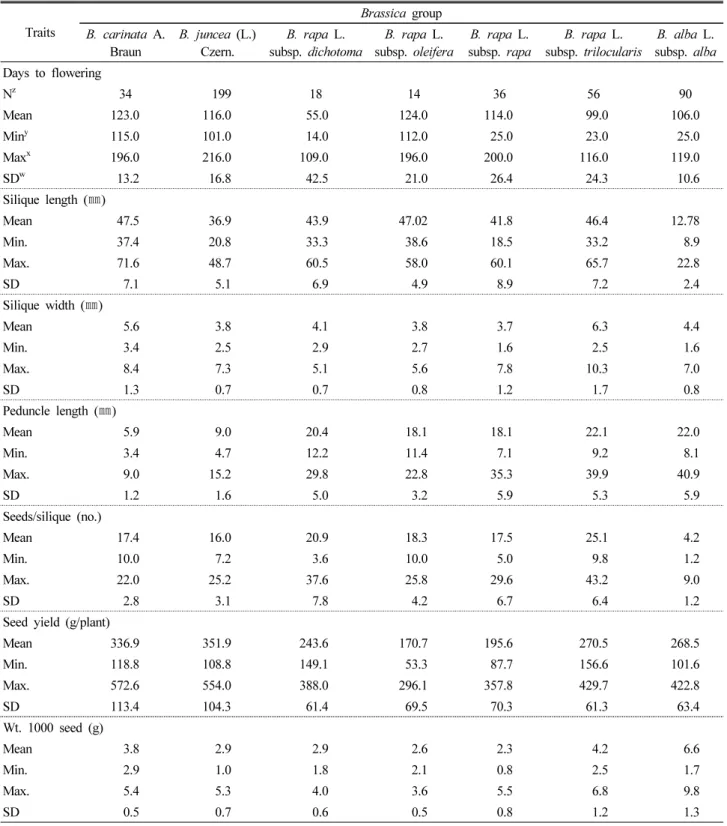
Variation of agronomic characters in different accessions of different Brassica species is presented in Table 1. Flowering days of Brassica species varied from 55.0 (B. rapa subsp.

dichotoma) to 124.0 (B. rapa subsp. dichotoma). Days to

flowering in B. rapa subsp. rapa varied from 25.0 to 200.0

with an average of 114.0. The average silique length was the

highest (47.5 ㎜) in B. carinata but variation for silique

length was the highest in B. rapa subsp. rapa. The highest

silique width was observed in B. rapa subsp. trilocularis with

an average of 6.3 ㎜. B. rapa subsp. trilocularis had the

(3)

highest peduncle length (22.1 ㎜) followed by B. alba subsp.

alba (22.0 ㎜). The highest (25.1 ㎜) seed number/silique was recorded in B. rapa subsp. trilocularis while B. alba

subsp. alba was the lowest (4.2 ㎜). The highest seed yield (351.9 g) was recorded in B. juncea followed by B. carinata (336.9 g) while 1000 seed weight was higher in B. alba subsp.

Table 1. Agronomic traits and seed yield of 447 accessions in different Brassica species

Traits

Brassica group B. carinata A.

Braun

B. juncea (L.) Czern.

B. rapa L.

subsp. dichotoma

B. rapa L.

subsp. oleifera

B. rapa L.

subsp. rapa

B. rapa L.

subsp. trilocularis

B. alba L.

subsp. alba Days to flowering

N

z

34 199 18 14 36 56 90

Mean 123.0 116.0 55.0 124.0 114.0 99.0 106.0

Min

y

115.0 101.0 14.0 112.0 25.0 23.0 25.0

Max

x

196.0 216.0 109.0 196.0 200.0 116.0 119.0

SD

w

13.2 16.8 42.5 21.0 26.4 24.3 10.6

Silique length ( ㎜)

Mean 47.5 36.9 43.9 47.02 41.8 46.4 12.78

Min. 37.4 20.8 33.3 38.6 18.5 33.2 8.9

Max. 71.6 48.7 60.5 58.0 60.1 65.7 22.8

SD 7.1 5.1 6.9 4.9 8.9 7.2 2.4

Silique width ( ㎜)

Mean 5.6 3.8 4.1 3.8 3.7 6.3 4.4

Min. 3.4 2.5 2.9 2.7 1.6 2.5 1.6

Max. 8.4 7.3 5.1 5.6 7.8 10.3 7.0

SD 1.3 0.7 0.7 0.8 1.2 1.7 0.8

Peduncle length ( ㎜)

Mean 5.9 9.0 20.4 18.1 18.1 22.1 22.0

Min. 3.4 4.7 12.2 11.4 7.1 9.2 8.1

Max. 9.0 15.2 29.8 22.8 35.3 39.9 40.9

SD 1.2 1.6 5.0 3.2 5.9 5.3 5.9

Seeds/silique (no.)

Mean 17.4 16.0 20.9 18.3 17.5 25.1 4.2

Min. 10.0 7.2 3.6 10.0 5.0 9.8 1.2

Max. 22.0 25.2 37.6 25.8 29.6 43.2 9.0

SD 2.8 3.1 7.8 4.2 6.7 6.4 1.2

Seed yield (g/plant)

Mean 336.9 351.9 243.6 170.7 195.6 270.5 268.5

Min. 118.8 108.8 149.1 53.3 87.7 156.6 101.6

Max. 572.6 554.0 388.0 296.1 357.8 429.7 422.8

SD 113.4 104.3 61.4 69.5 70.3 61.3 63.4

Wt. 1000 seed (g)

Mean 3.8 2.9 2.9 2.6 2.3 4.2 6.6

Min. 2.9 1.0 1.8 2.1 0.8 2.5 1.7

Max. 5.4 5.3 4.0 3.6 5.5 6.8 9.8

SD 0.5 0.7 0.6 0.5 0.8 1.2 1.3

z

Number of accessions,

y

Minimum,

x

Maximum,

w

Standard deviation.

(4)

alba (6.6 g) compared to Brassica species.

The morphological traits used in this study showed wide variation among Brassica species. The breeding program of any crop relies on the magnitude of morphological variability (Koffi et al., 2008). Variation for days to flowering in the varieties of B. campestris was also reported by Yousuf et al.

(2011). Asghari et al. (2011) reported that seed yield/plant was varied among the cultivars of B. napus L. In the study of Zada et al. (2013), they reported the variation in seed yield/

plant and 1,000 seed weight in different accessions of B.

carinata A. Braun. Variation for morphological traits had also been reported in the accession of B. carinata (Muthone, 2010) and B. oleracea (El-Esawi et al., 2012). Variation in morphological traits could be attributed to differences in accessions and species, which might be influenced by environ- mental factors, geographical origin and soil fertility.

Variation in oil compositions

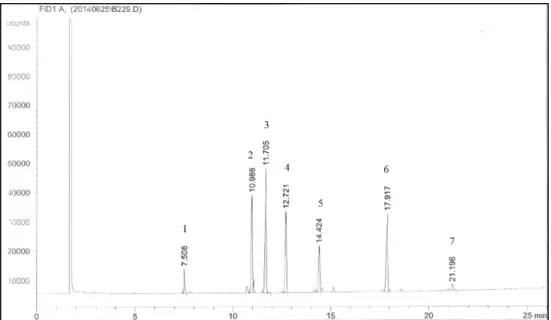
HPLC method was used to evaluate the lipid composition of seed in Brassica plants and fatty acid compositions of different Brassica seeds were separated and quantified. This method allowed the separation of seven (palmitic acid, stearic acid, oleic acid, linoleic acid, linolenic acid, behenic acid and erucic acid) with different peaks (Fig. 1). Beermann et al.

(2003) were established a reliable HPLC method to evaluate the lipid composition of useful plants in different Brassica napus L. varieties.

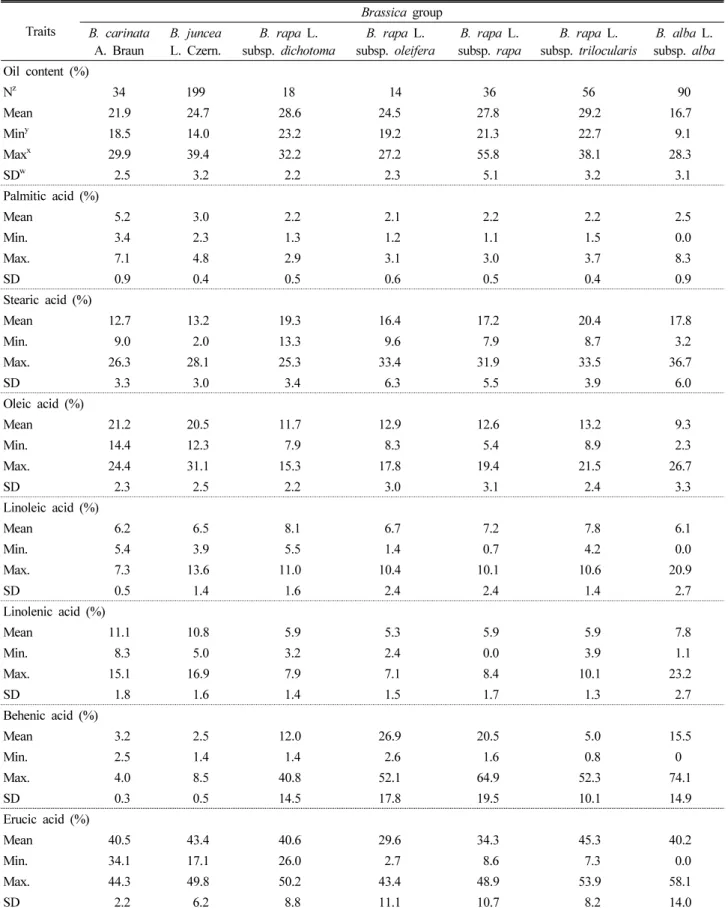
The oils extracted from different Brassica species were analyzed to determine oil content and their fatty acid composi- tions and the result showed inter and intra-specific variability for the oil content and fatty acid composition (Table 2). Oil content was the highest (29.2%) in B. rapa subsp. trilocularis while oil content was ranged from 14.0 to 39.4%. in B. juncea.

B. carinata exhibited the highest (5.2%) palmitic acid. Variation for palmitic acid was the highest in B. alba subsp. alba, ranged from 0.0 to 8.3%. Stearic acid was the highest (20.4%) in B.

rapa subsp. trilocularis whereas the lowest (12.7%) was in B.

carinata. B. carinata had the highest (21.2%) oleic acid content followed by B. juncea (20.5%). B. rapa subsp.

dichotoma exhibited higher linoleic acid (8.1%) but the most remarkable variation for linoleic acid content was in B. alba subsp. alba, ranged from 0.0 to 20.9%. The highest (11.1%) linolenic acid content was recorded in B. carinata but B. alba subsp. alba exhibited the highest variation of linolenic acid ranging from 1.1 to 23.2%. B. rapa subsp. rapa showed the highest (20.5%) behenic acid content followed by B. alba (15.5%). Erucic acid was the highest (45.3%) in B. rapa subsp. trilocularis with a ranged from 7.3 to 53.9%. B. alba

Fig. 1. HPLC identification of fatty acid composition from seed oil in Brassica species. Peak refers to following identified

compounds; 1 = Palmitic acid, 2 = Stearic acid, 3 = Oleic acid, 4 = Linoleic acid, 5 = Linolenic acid, 6 = Behenic acid and 7 = Erucic

acid.

(5)

Table 2. Oil content and fatty acid compositions in seed oil of 447 accessions in different Brassica species

Traits

Brassica group B. carinata

A. Braun

B. juncea L. Czern.

B. rapa L.

subsp. dichotoma

B. rapa L.

subsp. oleifera

B. rapa L.

subsp. rapa

B. rapa L.

subsp. trilocularis

B. alba L.

subsp. alba Oil content (%)

N

z

34 199 18 14 36 56 90

Mean 21.9 24.7 28.6 24.5 27.8 29.2 16.7

Min

y

18.5 14.0 23.2 19.2 21.3 22.7 9.1

Max

x

29.9 39.4 32.2 27.2 55.8 38.1 28.3

SD

w

2.5 3.2 2.2 2.3 5.1 3.2 3.1

Palmitic acid (%)

Mean 5.2 3.0 2.2 2.1 2.2 2.2 2.5

Min. 3.4 2.3 1.3 1.2 1.1 1.5 0.0

Max. 7.1 4.8 2.9 3.1 3.0 3.7 8.3

SD 0.9 0.4 0.5 0.6 0.5 0.4 0.9

Stearic acid (%)

Mean 12.7 13.2 19.3 16.4 17.2 20.4 17.8

Min. 9.0 2.0 13.3 9.6 7.9 8.7 3.2

Max. 26.3 28.1 25.3 33.4 31.9 33.5 36.7

SD 3.3 3.0 3.4 6.3 5.5 3.9 6.0

Oleic acid (%)

Mean 21.2 20.5 11.7 12.9 12.6 13.2 9.3

Min. 14.4 12.3 7.9 8.3 5.4 8.9 2.3

Max. 24.4 31.1 15.3 17.8 19.4 21.5 26.7

SD 2.3 2.5 2.2 3.0 3.1 2.4 3.3

Linoleic acid (%)

Mean 6.2 6.5 8.1 6.7 7.2 7.8 6.1

Min. 5.4 3.9 5.5 1.4 0.7 4.2 0.0

Max. 7.3 13.6 11.0 10.4 10.1 10.6 20.9

SD 0.5 1.4 1.6 2.4 2.4 1.4 2.7

Linolenic acid (%)

Mean 11.1 10.8 5.9 5.3 5.9 5.9 7.8

Min. 8.3 5.0 3.2 2.4 0.0 3.9 1.1

Max. 15.1 16.9 7.9 7.1 8.4 10.1 23.2

SD 1.8 1.6 1.4 1.5 1.7 1.3 2.7

Behenic acid (%)

Mean 3.2 2.5 12.0 26.9 20.5 5.0 15.5

Min. 2.5 1.4 1.4 2.6 1.6 0.8 0

Max. 4.0 8.5 40.8 52.1 64.9 52.3 74.1

SD 0.3 0.5 14.5 17.8 19.5 10.1 14.9

Erucic acid (%)

Mean 40.5 43.4 40.6 29.6 34.3 45.3 40.2

Min. 34.1 17.1 26.0 2.7 8.6 7.3 0.0

Max. 44.3 49.8 50.2 43.4 48.9 53.9 58.1

SD 2.2 6.2 8.8 11.1 10.7 8.2 14.0

z
Number of accessions,

y

Minimum,

x

Maximum,

w

Standard deviation.

(6)

subsp. alba exhibited wide variation for erucic acid which ranged from 0.0 to 58.1%.

This study showed the variation in oil and fatty acid compositions in different Brassica species. The nutritional properties of Brassica seed oil depend on the contents of oleic, linoleic, linolenic and erucic acid which constitute unsaturated fatty acid, have great importance in human nutrition. High oleic acid has cholesterol lowering properties while saturated fatty acid including palmitic and stearic acid tend to raise blood levels (Rakow and Raney, 2003). High oleic acid has heat stability properties and it can be heated to a higher temperature without smoking so that the cooking time can be reduced and as a result, foods take up less oil (Miller et al., 1987). In our study, B. carinata showed the highest content of oleic acid but Sharafi et al. (2015) have reported as high as 61% oleic acid in B. napus. Our study showed the highest linoleic acid content in the collections of B. rapa subsp. dichotoma whereas the highest linoleic acid have reported in the accessions of B. juncea (Sharafi et al., 2015). We found the highest linolenic acid ranged from 8.3 to 15.1% in B. carinata but it was ranged from 52.7 to 58.9% in the varieties of B. botrytis (Velasco et al., 1998).

Erucic acid is the most important fatty acid, found in Brassica but it is harmful to human health. In this study, some accessions in B. alba showed zero-erucic acid and most of Brassica species exhibited more than 40% erucic acid except B. rapa subsp. oleifera (29.6%) and B. rapa subsp. rapa (34.3%). But in the study of Sharafi et al. (2015), they have reported the highest (>40%) erucic acid in the accession of B.

rapa whereas Mandal et al. (2002) have reported 23.64%

erucic acid in Sinapis alba which contradicts to our findings.

High erucic acid is a valuable raw material to manufacture industrial products such as plasticizers, detergents, surfactants, polyesters (Beare-Rogers et al., 1971). The accessions containing high erucic acid content is a priority in Brassica breeding because of its industrial value (Friedt and Lauhs, 1995).

Recently, rapeseed genotypes with 78% erucic acid are developed and recommended them for emollient industries (Nath et al., 2016). Our study also identified some accessions containing high erucic acid content which might be useful for breeding new cultivar and industrial usages.

Correlation among the agronomic characters

Correlation among the agronomic characters in each Brassica group was analyzed and results are presented in Table 3.

Silique length had a significant positive correlation with seeds/silique whereas a significant negative association was observed between seeds/silique and wt. 1000 seed in B.

carinata. In B. juncea, silique length was a significant positive association with silique width, peduncle length, seeds/silique and wt. 1000 seed but seed yield had a significant negative correlation with wt. 1000 seed. In B. rapa subsp. dichotoma, silique length had highly significant positive correlation with seeds/silique. In B. rapa subsp. oleifera, significant positive relationship was observed between silique length and seeds/

silique, and silique length and wt. 1000 seed. In B. rapa subsp.

rapa, silique length had a significant positive correlation with silique width, peduncle length, seeds/silique, and seed yield.

Likewise, silique width was also a significant positive associa- tion with peduncle length, seeds/silique and wt. 1000 seed.

Seeds/silique was significantly positively associated with seed yield and wt. 1000 seed. Silique length and width were significantly positively correlated with seeds/silique and wt.

1000 seed in B. rapa subsp. trilocularis. Silique length had a significant and positive association with seeds/silique but peduncle length was significantly negatively associated with seeds/silique and seed yield in B. alba subsp. alba. In this study, silique length was significantly positively correlated with seeds/silique in all the Brassica species which is close to the finding of Khan and Khalil (2008). Seeds/silique was not significantly associated with seed yield except B. juncea, B.

rapa subsp. rapa and B. alba subsp. alba and Malik et al.

(2000) reported the similar results. Correlation between seed yield and wt. 1000 seed was non-significant in all the Brassica species except B. juncea subsp. but seed yield was significantly negatively correlated with wt. 1000 seed in B. juncea and this result was agreed with the findings of Malik et al. (2000).

Sandhu and Gupta (1996) reported negative correlation between

days to flowering and seed yield in Brassica species but our

study showed the similar results in B. juncea. Zhang and

Zhou (2006) observed that number of seeds/silique and 1000

grain weight positively correlated with seed yield and our

study agreed to this finding in the result of B. juncea, B. rapa

and B. alba but wt. 1000 seed were mostly non-significantly

(7)

associated with seed yield which contradicts with the findings of Zhang and Zhou (2006). Our result of correlation among the agronomic traits was not consistent in Brassica species.

Generally, seed yield is complex trait determined by many characters have positive or negative effects on this trait and association of traits with seed yield would be great importance to select the particular trait of interest.

Relationship among fatty acid compositions

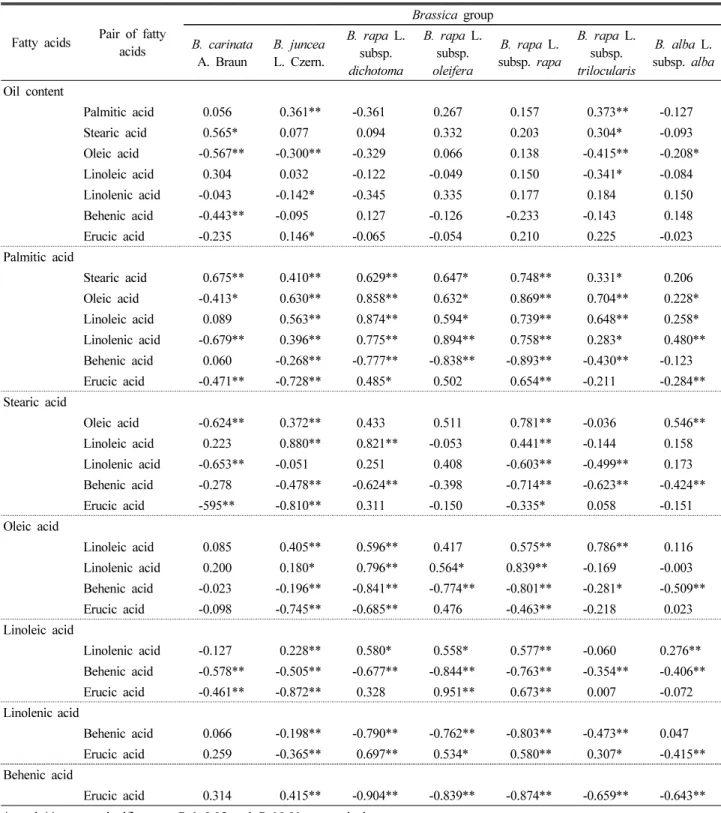
Relationship among the fat content and fatty acid composi- tions among Brassica species is shown in Table 4. Fat content had positively correlated with palmitic acid in B. juncea and B. rapa subsp. trilocularis. The association between fat content and stearic acid was positive in B. carinata and B. rapa subsp.

trilocularis. However, a negative correlation was found between fat content and oleic acid in the germplasm of B. carinata, B.

juncea and B. rapa subsp. trilocularis. For the association Table 3. Correlation co-efficient between agronomic characters in germplasm collections of different Brassica species

Characters Pair of characters

Brassica group B. carinata

A. Braun

B. juncea L. Czern.

B. rapa L.

subsp.

dichotoma

B. rapa L.

subsp.

oleifera

B. rapa L.

subsp.

rapa

B. rapa L.

subsp.

trilocularis

B. alba L.

subsp.

alba Days to flowering

Silique length -0.029 -0.185** -0.188 -0.172 -0.324 0.100 0.220*

Silique width -0.108 -0.031 0.063 -0.105 -0.255 0.527** 0.296**

Peduncle length 0.035 -0.038 -0.143 0.114 -0.243 0.087 -0.301**

Seeds/silique -0.118 0.076 0.364 0.060 -0.293 0.294* 0.309**

Seed yield -0.202 -0.232** 0.396 -0.234 -0.170 0.272* 0.350**

Wt. 1000 seed 0.072 -0.236** -0.400 -0.362 -0.307 0.439** -0.093

Silique length

Silique width -0.074 0.209* 0.207 0.037 0.339* 0.179 0.039

Peduncle length 0.017 0.368** 0.254 0.422 0.732** 0.243 -0.205

Seeds/silique 0.406* 0.339** 0.567* 0.698** 0.773** 0.564** 0.734**

Seed yield -0.137 -0.090 0.122 0.122 0.491** 0.205 0.194

Wt. 1000 seed 0.225 0.387** 0.293 -0.038 0.212 0.549** -0.227*

Silique width

Peduncle length -0.138 0.156* 0.177 0.342 0.409* 0.083 0.042

Seeds/silique -0.174 -0.145* 0.283 0.190 0.589** 0.635** 0.041

Seed yield -0.305 -0.049 -0.006 0.403 0.311 0.153 0.209*

Wt. 1000 seed 0.070 0.394** 0.157 0.610* 0.743** 0.459** 0.367**

Peduncle length

Seeds/silique 0.200 0.058 -0.097 0.441 0.678** 0.024 -0.411**

Seed yield -0.262 -0.071 -0.157 -0.081 0.429** 0.194 -0.373**

Wt. 1000 seed -0.367* 0.139 0.400 0.046 0.246 0.040 0.374**

Seeds/silique

Seed yield 0.181 0.140* 0.426 0.304 0.461** 0.146 0.240*

Wt. 1000 seed -0.369* -0.362** 0.086 -0.187 0.371* 0.128 -0.368**

Seed yield

Wt. 1000 seed 0.081 -0.151* 0.048 0.420 0.285 0.117 0.058

*, and ** means significant at P≤ 0.05 and P≤0.01, respectively.

(8)

between palmitic and stearic acid, significant positive rela- tionship was observed in all the Brassica species except B.

alba L. subsp. alba. Significant positive correlation has reported between palmitic and stearic acid in B. rapa var. tori

(Mandal et al., 2002). Significant negative correlation was observed between palmitic and oleic acid in the B. species except B. carinata. Palmitic acid had a significant positive association with linoleic and linolenic acid in all B. species

Table 4. Correlation co-efficient between individual fatty acids present in the oils of germplasm collections in different Brassica species

Fatty acids Pair of fatty acids

Brassica group B. carinata

A. Braun

B. juncea L. Czern.

B. rapa L.

subsp.

dichotoma

B. rapa L.

subsp.

oleifera

B. rapa L.

subsp. rapa

B. rapa L.

subsp.

trilocularis

B. alba L.

subsp. alba Oil content

Palmitic acid 0.056 0.361** -0.361 0.267 0.157 0.373** -0.127

Stearic acid 0.565* 0.077 0.094 0.332 0.203 0.304* -0.093

Oleic acid -0.567** -0.300** -0.329 0.066 0.138 -0.415** -0.208*

Linoleic acid 0.304 0.032 -0.122 -0.049 0.150 -0.341* -0.084

Linolenic acid -0.043 -0.142* -0.345 0.335 0.177 0.184 0.150

Behenic acid -0.443** -0.095 0.127 -0.126 -0.233 -0.143 0.148

Erucic acid -0.235 0.146* -0.065 -0.054 0.210 0.225 -0.023

Palmitic acid

Stearic acid 0.675** 0.410** 0.629** 0.647* 0.748** 0.331* 0.206

Oleic acid -0.413* 0.630** 0.858** 0.632* 0.869** 0.704** 0.228*

Linoleic acid 0.089 0.563** 0.874** 0.594* 0.739** 0.648** 0.258*

Linolenic acid -0.679** 0.396** 0.775** 0.894** 0.758** 0.283* 0.480**

Behenic acid 0.060 -0.268** -0.777** -0.838** -0.893** -0.430** -0.123

Erucic acid -0.471** -0.728** 0.485* 0.502 0.654** -0.211 -0.284**

Stearic acid

Oleic acid -0.624** 0.372** 0.433 0.511 0.781** -0.036 0.546**

Linoleic acid 0.223 0.880** 0.821** -0.053 0.441** -0.144 0.158

Linolenic acid -0.653** -0.051 0.251 0.408 -0.603** -0.499** 0.173

Behenic acid -0.278 -0.478** -0.624** -0.398 -0.714** -0.623** -0.424**

Erucic acid -595** -0.810** 0.311 -0.150 -0.335* 0.058 -0.151

Oleic acid

Linoleic acid 0.085 0.405** 0.596** 0.417 0.575** 0.786** 0.116

Linolenic acid 0.200 0.180* 0.796** 0.564* 0.839** -0.169 -0.003

Behenic acid -0.023 -0.196** -0.841** -0.774** -0.801** -0.281* -0.509**

Erucic acid -0.098 -0.745** -0.685** 0.476 -0.463** -0.218 0.023

Linoleic acid

Linolenic acid -0.127 0.228** 0.580* 0.558* 0.577** -0.060 0.276**

Behenic acid -0.578** -0.505** -0.677** -0.844** -0.763** -0.354** -0.406**

Erucic acid -0.461** -0.872** 0.328 0.951** 0.673** 0.007 -0.072

Linolenic acid

Behenic acid 0.066 -0.198** -0.790** -0.762** -0.803** -0.473** 0.047

Erucic acid 0.259 -0.365** 0.697** 0.534* 0.580** 0.307* -0.415**

Behenic acid

Erucic acid 0.314 0.415** -0.904** -0.839** -0.874** -0.659** -0.643**

*, and ** means significant at P≤ 0.05 and P≤0.01, respectively.

(9)

except B. carinata. A positive and significant correlation has been reported between palmitic and oleic acid (Islam et al., 2009; Lee et al., 1974; Sharafi et al., 2015) and palmitic and linoleic acid (Islam et al., 2009) in Brassica species. Palmitic acid exhibited a significant negative association with behenic acid in all B. species except B. carinata and B. alba. Collections of B. carinata, B. juncea and B. alba exhibited a significant negative association between palmitic and erucic acid.

Relationship between stearic and oleic was positive for the B. juncea, B. rapa subsp. rapa and B. alba subsp. alba but negative for B. carinata. Stearic acid had positively correlated with linoleic acid in the collections of B. juncea, B. rapa subsp. dichotoma, B. rapa subsp. rapa but it had negatively correlated with linolenic acid in B. carinata, B. rapa subsp.

rapa and B. rapa subsp. trilocularis. Association between stearic and behenic acid was negative for the collections of B.

juncea, B. rapa subsp. dichotoma, B. rapa subsp. rapa and B.

rapa subsp. trilocularis. Similar positive relationship was observed between oleic and linoleic acid in the collections of B. juncea, B. rapa subsp. dichotoma, B. rapa subsp. rapa and B. rapa subsp. trilocularis. Significant positive correlation was observed between oleic and linolenic acid among the collections under B. juncea, B. rapa subsp. dichotoma, B.

rapa subsp. oleifera, and B. rapa subsp. rapa. While the association between oleic and behenic acid was negative in all the B. species except B. carinata. But unlike, B. juncea, B.

rapa subsp. dichotoma and B. rapa subsp. rapa collections, correlation between oleic and erucic acid was negative in nature.

Except B. carinata and B. rapa subsp. trilocularis, all the collections of B. species exhibited significant positive associa- tion between linoleic and linolenic acid but relationship between linoleic and behenic acid was negative in the collections of entire B. species. Except B. carinata and B.

alba, linolenic and behenic acids of B. species oil were found negatively associated. Significant negative correlation was also found between behenic and erucic acid in all the B.

species except B. carinata and B. juncea. In this study, mean individual fatty acid concentrations among different species of Brassica are not similar and therefore, we observed different kinds of significant relationship among the individual fatty acids. Mandal et al. (2002) have reported the similar

result in the study of different cruciferous species and the relationship between various pairs of fatty acids has also been studied by many researchers (Genet et al., 2004; Mandal et al., 2002).

PCA on agronomic characters and fatty acid compositions PCA on morphological and fatty acid compositions revealed that the first four principal components accounted 96.0% of the variation (Table 5). The first principal component (PC1) accounted for 39.0% of the total variance, the second a further 28.0% and the third 17.0% of the total variance. The first component had high positive loadings from behenic acid, stearic acid, and linoleic acid while it had high negative loadings from linolenic acid, oleic acid, palmitic acid and silique length. The second principal component (PC2) received higher contributions from weight of 1000 seed, number of seeds/silique, peduncle length, erucic and stearic acid. The third principal component (PC3) received higher contributions from linoleic, silique length and erucic acid while it had high negative loadings from silique width, fat content and seed yield. Four groups were identified by reducing the number of variables. For the first group, linolenic acid would be best choice; weight 1000 seed would be the best in the second group, silique width for the third and flowering days for the fourth. Multivariate statistical analysis including PCA has been used by previously (Dawood et al., 2009; El-Esawi et al., 2012; Jatoi et al., 2011; Zada et al., 2013) to study morphological traits and fatty acid compositions.

This study found the variation in agronomic characters and

fatty acids composition in different Brassica species. Wide

variation was observed in days to flowering, silique length

and width, seed number/silique, seed yield and weight of

1000 seed among Brassica species. Wide variation encountered

in fatty acid composition of Brassica species will be a high

potential to improve the varieties. Palmitic acid had positively

correlated with stearic, oleic, linoleic and linolenic acid in

most of the Brassica species. The first three principal com-

ponents together explained 84.0% of the variation. Brassica

species containing high oleic and linoleic acid content are

useful for nutrition while Brassica species germplasm having

high erucic acid content can be a potential value for breeding

program and industry as well.

(10)

Acknowledgment

This study was carried out with the support of “Research Program for Agricultural Science & Technology Develop- ment (Project No. PJ01192203)” National Institute of Agri- cultural Sciences, Rural Development Administration, Republic of Korea.

References

Asghari, A., M. Shokrpour, H.M. Chamanabad and O. Sofalian.

2011. Evaluating genetic diversity of canola cultivars using morphological traits and molecular markers. Rom. Biotechnol.

Lett. 16:6305-6312.

Balkaya, A., R. Yanmaz and A.A. Kar. 2005. Morphological characterization of white head cabbage (Brassica oleracea var. capitate subvar. alba) genotypes in Turkey. New Zeal.

J. Crop Hort. 33:333-341.

Beare-Rogers, J.L., E.A. Nera and H.A. Heggtvert. 1971.

Cardiac lipid changes in rats fed oils containing long-chain

fatty acids. Can. I. Food Sc.Tech. J. 4:120-124.

Beermann, C., A. Green, M. Mobius, J.J. Schmitt and G.

Boehm. 2003. Lipid class separation by HPLC combined with GC FA analysis: Comparison of seed lipid compositions from different Brassica napus L. varieties. J Am. Oil Chem.

Soc. 80:747-753.

Christopher, G.L., J.R. Andrew, A.C.L. Geraldine, J.H. Clare, B. Jacqueline, B. Gary, C.S. German and E. David. 2005.

Brassica ASTRA: an integrated database for Brassica genomic research. Nucleic Acids Res. 33:656-659.

Dawood, A., A. Kikuchi, S.A. Jatoi, F. Kiuchi and K.N.

Watanable. 2009. Genetic variation in the chloroplast DNA (cp DNA) of Zingiberaceae taxa from Myanmar envisaged by the PCR-RFLP analysis. Ann. Appl. Biol. 155:91-101.

EI-Esawi, M.A., P. Bourke, K. Germaine and R. Malone.

2012. Assessment of morphological variation in Irish Brassica oleracea species. J. Agr. Sci. 4:20-34.

Friedt, W. and W. Lauhs. 1995. Development in the breeding of rapeseed oil for industrial purposes. Breeding: Oil. pp. 437-448.

Genet, T., M.T. Labuschagne and A. Hugo. 2004. Capillary gas chromatography analysis of Ethiopian mustard to Table 5. Eigenvectors and eigenvalues generated by PCA applied on agronomic characters and fatty acid composition of 447 accessions in different Brassica species

Characters Eigenvectors

PC1 PC2 PC3 PC4

Flowering days -0.17 -0.15 0.08 -0.62

Silique length -0.36 0.10 0.18 0.23

Silique width -0.08 -0.02 -0.61 -0.04

Peduncle length -0.17 0.37 -0.07 -0.16

No of seeds/silique 0.17 0.43 -0.09 -0.13

Seed yield -0.02 -0.34 -0.39 0.26

Wt. of 1000 seed -0.01 0.47 -0.06 -0.19

Oil content 0.08 0.12 -0.56 0.18

Palmitic acid -0.36 -0.10 0.04 -0.02

Stearic acid 0.32 0.30 -0.05 0.10

Oleic acid -0.38 -0.11 -0.15 0.01

Linoleic acid 0.27 -0.13 0.25 0.42

Linolenic acid -0.41 0.02 -0.01 0.06

Erucic acid -0.21 0.34 0.12 0.34

Behenic acid 0.33 -0.22 -0.02 -0.28

Eigenvalues

Eigenvalue 2.76 1.97 1.17 0.82

Total variance (%) explained 39.0 28.0 17.0 12.0

Cumulative percent of Total variance (%) explained 39.0 68.0 84.0 96.0

(11)

determine variability of fatty acid composition. J. Sci.

Food Agric. 84:1663-1670.

Islam, M.S., L. Rahaman and M.S. Alam. 2009. Correlation and path coefficient analysis in fat and fatty acids of rapeseed and mustard. Bangladesh J. Agric. Res. 34:247- 253.

Jatoi, S.A., A. Javaid, M. Iqbal, O.U. Sayal, M.S. Masood and S.U. Siddiqui. 2011. Genetic diversity in radish germplasm for morphological traits and seed storage proteins. Pakistan J. Bot. 43:2507-2512.

Khan, S. and I.H. Khalil. 2008. Phenotypic correlation analysis of elite F

3:4

Brassica populations for quantitative and qualitative traits. J. Agric. Biol. Sci. 3:38-42.

Kim, K.S., S.O. Ha, Y.H. Lee, Y.S. Jang and I.H. Choi. 2015.

Study on growth and flowering characteristics in the spring sowing for selection of rapeseed (Brassica napus L.) varieties. Korean J. Plant Res. 28:111-118 (in Korean).

Koffi, K.K., A.A. Gbotto, M. Malice, Y. Dje, P. Bertin, J.

Baudoin and I.A. Zoro Bi. 2008. Morphological and allozyme variation in a collection of Cucumeropsis mannii Naudin (Cucurbitaceae) from Coˆte d’Ivoire. Biochem.

Sys. Ecol. 36:777-789.

Lee, J.I., K. Takayanagi and T. Shiga. 1974. Breeding for improvement of fatty acid composition in rapeseed, Brassica napus L. I. Fatty acid composition in rapeseed oil of Asian and European varieties. Bull. Nat. Inst. Agric. Sci. 25:1-16.

Lee, T.S., Y.H. Lee, K.S. Kim, H.K. Lee, Y.S. Jang, I.H. Choi and K.S. Kim. 2014. Effect of sowing time on oil content and fatty acid composition characteristics in rapeseed cultivars. Korean J. Plant Res. 27:202-208 (in Korean).

Malik, M.A., A.S. Khan, S., M.A. Khan, B.R. Khan and A.S.

Mohmand. 2000. Study of correlation among morphological parameters in different varietites/accessions of Brassica species. Pakistan J. Biol. Sci. 3:1180-1182.

Mandal, S., S. Yadav, R. Singh, G. Begum, P. Suneja and M.

Singh. 2002. Correlation studies on oil content and fatty acid profile of some cruciferous species. Genet. Resour.

Crop Ev. 49:551-556.

Miller, J.F., D.C. Zimmerman and B.A. Vick. 1987. Genetic control of high oleic acid content in sunflower oil. Crop Sci. 27:923-926.

Muthone, J. 2010. Characterization of Ethiopean mustard (Brassica carinata A. Braun) lines for vegetative agro- morphological traits at Arusha, Tanzania J. Hort. For. 2:1-6.

Nath, U.K., H.T. Kim, K. Khatun, J.I. Park, K.K. Kang and I.S.

Nou. 2016. Modification of fatty acid profiles of rapeseed (Brassica napus L.) oil for using as food, industrial feed- stock and biodiesel. Plant Breed. Biotech. 4:123-134 (in Korean).

Rakow, G. 2004. Species origin and economic importance of Brassica. In Pua, E.C. and C.J. Douglas (eds.), Bio- technology in Agriculture and Forestry, New York (USA), Springer-Verlag Berlin Heidelberg, Germany. pp. 3-11.

. and J. P. Raney. 2003. Present status and future perspectives of breeding for seed quality in Brassica oilseed crops. Proceedings 11

th

International Rapeseed Congress, Copenhagen, Denmark. pp. 181-185.

Rohlf, F.J. 2000. NTSYSpc, Numerical Taxonomy and Multi- variate Analysis System, Version 2.1. User Guider. Exeter Pub. Ltd. Setauket, New York (USA).

Sandhu, S.K. and V.P. Gupta. 1996. Genetic divergence and correlation studies in Brassica species. Crop Improvement 23:253-256.

Sharafi, Y., M.M. Majidi, S.A.H. Goli and F. Rashidi. 2015.

Oil content and fatty acids composition in Brassica species.

Int. J. Food Prop. 18:2145-2154.

Sovero, M. 1993. Rapseed a new oilseed crop for the United States. In Janick, J. and J.E. Simon (eds.), New Crops, John Wiley and Sons, New York (USA). pp. 302-307.

Velasco, L., F.D. Goffman and H.C. Becker. 1998. Variability for the fatty acid composition of the seed oil in a germplasm collection of the genus Brassica. Genet. Resour. Crop Ev.

45:371-382.

Yousuf, M., S.U. Ajmal, M. Munir and A. Ghafoor. 2011.

Genetic diversity analysis for agro-morphological and seed quality traits in rapeseed (Brassica campestris L.). Pakistan J. Bot. 43:1195-1203.

Zada, M., N. Zakir, M.A. Rabbani and Z.K. Shinwari. 2013.

Assessment of genetic variation in Ethiopean mustard (Brassica carinata A. Braun) germplasm using multivariate techniques. Pakistan J. Bot. 45:583-593.

Zhang, G. and W. Zhou. 2006. Genetic analyses of agronomic and seed quality traits of synthetic oil seed Brassica napus produced from interspecific hybridization of B. campestris and B. oleracea. J. Genet. 85:45-51.

Zhao, J. 2007. The genetics of phytate content and morphological traits in Brassica rapa. Ph.D. Thesis, Wageningen University, The Netherlands. pp. 7-10.

(Received 27 April 2017 ; Revised 7 August 2017 ; Accepted 18 August 2017)

수치

Table 1. Agronomic traits and seed yield of 447 accessions in different  Brassica species
Fig. 1. HPLC identification of fatty acid composition from seed oil in  Brassica  species
Table 2. Oil content and fatty acid compositions in seed oil of 447 accessions in different  Brassica species Traits Brassica  group B
Table 4. Correlation co-efficient between individual fatty acids present in the oils of germplasm collections in different  Brassica species

참조

관련 문서

In the current study, the unsaturated fatty acids (oleic acid, linoleic acid, linolenic acid, and elaidic acid) were more pronounced in toxicity to three mosquito species larvae

PE was distinguished from PC by its high contents of stearic acid, eicosapentenoic acid (EPA) and docosahexenoic acid (DHA) while low in palmitic, oleic and linoleic acids. In

Four fatty acids (linoleic acid, oleic acid, palmitic acid, and stearic acid) determined in OM-1 were responsible for high enzyme inhibitory effects of the hexane extract of

Key Words: Carthamus tinctorius, Agro-morphological Trait, Fatty Acid Ratios, Linoleic Acid, Total Phenolic Content, Oleic Acid, Unsaturated Fatty Acids.. † Corresponding

condition on yield, oil content and fatty acid composition of sunflower kernel. Sunflower Conf., 15th, Toulouse, France. Sunflower early history. In 'sunflower technology

This study summarizes about the fatty acid com- position in various parts of broccoli cultivars in different seasons in that major fatty acids were palmitic,