ARTICLE
Received: March 17, 2018 Revised: March 23, 2018 Accepted: March 25, 2018
†These authors contributed equally to this study.
*Corresponding author : Kwang-Young Song
Dept. of Biological Engineering, Yanbian University of Science & Technology, Yanji, China, and Center for One Health, College of Veterinary Medicine, Konkuk University, Seoul, Korea.
Tel : +82-2-450-4121 Fax : +82-2-3436-4128 E-mail : [email protected]
Copyright © 2018 Korean Society of Milk Science and Biotechnology.
This is an Open Access article distributed under the terms of the Creative Commons Attribution Non-Commercial License (http://
creativecommons.org/ licenses/by-nc/3.0) which permits unrestricted non-commercial use, distribution, and reproduction in any medium, provided the original work is properly cited.
ORCID Long Jin
0000-0002-0354-7859 Jeong Seok Sim 0000-0002-8512-5309 Kwang-Young Song 0000-0002-5619-8381 Dong-Hyeon Kim 0000-0003-0585-2432 Jung-Whan Chon 0000-0003-0758-6115 Hyunsook Kim 0000-0001-7345-4167 Kun-Ho Seo 0000-0001-5720-0538
Use of Lipid Extracts from Various Oil Grains to Supply Dietary Omega-3 Fatty Acids for Dairy Foods
- A Preliminary Study
Long Jin
1†, Jeong Seok Sim
1†, Kwang-Young Song
1,2*, Dong-Hyeon Kim
2, Jung-Whan Chon
2, Hyunsook Kim
3, and Kun-Ho Seo
2†1Dept. of Biological Engineering, Yanbian University of Science & Technology, Yanji, China
2Center for One Health, College of Veterinary Medicine, Konkuk University, Seou, Korea
3Dept. of Food & Nutrition, College of Human Ecology, Hanyang University, Seoul, Korea
Abstract
The objective of this research was to determine the grain oil most suitable for the production of omega-3 fatty acids (FAs) in China, in order to supply dietary omega-3 FAs.
This study focused on the nutritional significance of omega-3 FAs and the wide search of sources of dietary omega-3 FA from oil grains produced in China. Five oil grains produced in the Yanbian region, namely sesame, flax, peanut, soybean, and corn, were selected and analyzed for their fat content and FA composition. Results showed that the lipid content in sesame, flax, and peanut, which was more than 30%, was higher than that in soybean and corn. The polyunsaturated FA content was found to be directly proportional to omega-3 FA content. Flax showed a considerably higher omega-3 FA content (53.43%) than other samples, suggesting its potential as a source of dietary omega-3 FA. The optimal daily intake of flax for males and females was determined to be 2.99 g (over one table spoon) and 2.06 g (nearly one table spoon), respectively. Flax showed the lowest ratio of omega-6 and omega-3 FA (0.32%), which can help reduce this ratio in the human body; the intake of equal amounts of flax and corn could achieve an optimum ratio of 1:1. These results can prove to be valuable in the preparation of various functional dairy foods in the future.
Keywords
fatty acids, omega-6 fatty acids, omega-3 fatty acids, omega diet, dairy foods
Introduction
Modern agribusiness and food processing industry have dramatically altered the pattern
of nutrients and lifestyles in the human diet (Uauy et al., 2001; Sim et al., 2010). Public
awareness of the crucial link between nutrition and health is growing rapidly, especially
in the role that diets play in combating age-associated chronic diseases, such as car-
diovascular disease, malignant disease, diabetes, osteoporosis, arthritis, and Alzheimer's
disease (Heird et al., 1997; Tapiero et al., 2002). Research conducted over the past
fifteen years has shown that dietary fat is more than just fuel, but that it is an essential
nutrient that influences every aspect of physiological and metabolic processes of human
body (Liang et al., 2008). Eating a healthy balanced food will reduce risk of a host of
diseases. It might even save one’s life. Essential fatty acids must be supplied from foods
we eat to sustain human-gene expression and overall metabolic homeostasis (Koo,
2003; Gleissman et al., 2010). Today’s industry and consumers alike are searching new
food fat sources supplying both long chain omega-3 and omega-6 polyunsaturated fatty
acids in an adequately balanced ratio, ideally 1:1 (Takeuchi et al., 2008; Sim et al.,
of 4/1 was associated with a 70% decrease in total mortality (Kris-Etherton et al., 2002).
A ratio of 2.5/1 reduced rectal cell proliferation in patients with colorectal cancer, whereas a ratio of 4/1 with the same amount of omega-3 PUFA had no effect (Sim et al., 2010). The lower omega-6/omega-3 ratio in women with breast cancer was associ- ated with decreased risk (Simonsen et al., 1998). A ratio of 2-3/1 suppressed inflamma- tion in patients with rheumatoid arthritis, and a ratio of 5/1 had a beneficial effect on patients with asthma, whereas a ratio of 10/1 had adverse consequences (Sim et al., 2010).
Hence, the objective of this research project is to collect local oil grain samples, to determine their physicochemical properties and lipid content, and finally to subject them to GC analysis for their fatty acid compositions. The presence and absence of omega-3 fatty acids and the degree of omega-3 fatty acid are to be suggested as new oil sources for the supply of dietary omega-3 fatty acid in China including finding out the usability for functional diary foods.
Materials and Methods
1. Oil grain seeds collection
Situated in the east of Jilin Province, Yanbian Korean Autonomous Prefecture is bordered by Russia in the east, and is separated by the Tumen River from North Korea.
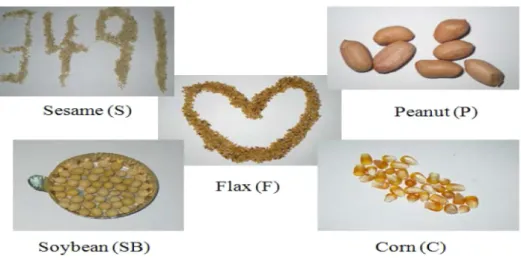
Purchased oil grain seeds (S, F, P, SB, and C) from West Market that is the most famous market in Yanji City (Fig. 1). And then, materials were dried at YUST which is short for Yanbian University of Science and Technology.
2. Seed weight determination
Weighed 10 g of five oil grain seeds respectively and counted the quantity. Afterwards, weighed one spoon of each samples by three times and counted them.
3. Chloroform methanol extraction
Before lipid extraction, five samples (S, F, P, SB, and C) with equal dried condition
should be put into drying oven, and then were ground using an electronic grinder. Total
lipids were extracted from S, F, P, SB, and C with chloroform: ethanol (2:1, vol/vol) by
the Folch method.
Fig. 1. Oil grain seeds.
One gram of sample were weighed into a test tube with 20 mL of chloroform: ethanol (2:1, vol/vol), and made sure it was homogenized well and well sealed. It was left over- night extraction to separate into phases. The homogenate was filtered through a What- man filter paper into a 100-mL graduated cylinder, and filtered it with another 10 mL Folch’s solution plus 4 mL DDW twice, and shook it well. It was left overnight to separate into obvious phases. After phase separation, the volume of the lipid layer was recorded, and the top layer was completely siphoned off, which contains water soluble and alcohol soluble substances. The volume of chloroform soluble lipids (bottom phase) was recorded as V mL. Lipid contents were determined gravimetrically for S, F, P, SB, and C.
Two mL of bottom layer was taken on a pre-weighted Aluminum foil (A
0g). Then it was dried under room temperature. Weighed the dried aluminum foil and recorded it as A g.
Calculation method: (A—A
0) g/2 mL × V mL = Total extract yield = E mg E g / 1 g sample = % of fatty acid yield from sample
4. Gas chromatography analysis
The analysis of fatty acid composition and omega-3 fatty acid content of oil grain seeds was performed on an Agilent 6890 gas chromatograph (Agilent Technologies, Santa Clara, CA, USA) equipped with a flame ionization detector (FID) and fitted with a fused silica capillary column (DB-23, 60 m × 0.25 mm; film thickness 0.25 μm; J&W Scientific Co, Folsom, CA, USA). Helium gas was used as a carrier with a flow rate of 2.0 mL/min, and a split ratio of 20:1. The temperature of the inlet and the FID were 260℃ and 270℃, respectively. The sample size was 1 μL.
Results and Discussion
1. Seed weight determination
Weigh 10 g of oil grain seeds respectively and count the number, then come out to the
quantity of samples per 10 grams, namely average (Table 1). Because of different sizes
is bigger than others so 13 pieces of peanut is about 10 g. Similarly, 10 g of sesame seed with more quantity is 349. Quantity from largest to smallest order is sesame (S), flax (F), soybean (SB), corn (C), and peanut (P).
Even though table spoon method is much more available naturally, it is not easy to count. Therefore, consumers need a simpler and more convenient method.
According to report of adequate intake levels for linolenic acid by the institute of medicine at the national academy of sciences in 2002 (Pan et al., 2012), 1.6 grams per day were recommended for male teenagers and adult men, the recommended amount were 1.1 grams per day for female teenagers and adult women.
It could be figured out that 2.99 grams flax contains 1.6 grams omega-3 fatty acids.
Also it can be calculated that 2.99 grams flax are equal to 544 pieces flax and 1.3 table spoon (more than 1 spoon) flax. And the female daily intake 2.06 grams (375) flax or 0.9 table spoon (about 1 spoon) flax is equal to 1.1 grams omega-3 fatty acids.
2. Lipid content determination
According to Fig. 2, the average of lipid component of sample S as 36.13%, F as 32.43%, and P as 31.75% are more than 30%, but SB as 16.47% and C as 2.93% are less than 30%.
3. Omega-6 and omega-3 fatty acids
In general, the ω-6 and ω-3 PUFAs when consumed in the form of dietary triglyceride from various food sources undergoes digestion in the small intestine which allows for absorption, transport in the blood, and subsequent assimilation within tissues them- selves through the body (Tekeuchi et al., 2008; Mita et al., 2010).
The ratio between omega-6 and omega-3 fatty acids was very important for human’s
health. According to Table 2, flax contains the highest omega-3 FA and others are very
few, including corn least. However, omega-6 FA content is much higher than omega-3
FA, including S, P, SB exceeded 40%, and even SB is nearly to 50%. By contrast, flax
contains the least omega-6 FA, which is only 16.86%. Also among the content of SAFA,
MUFA and PUFA, corn contains highest content of SAFA, which is more than four times
of flax. S and P contain more than 40% of the MUFA (Table 2). Hence, it could be
explained that omega-3 FA influence the content of PUFA. In general, PUFA is pro-
Fig. 2. Lipid content of air-dried oil grain seeds.
Table 2. Weight % of fatty acid and ratio between omega-6 and omega-3 fatty acids
Fatty acids Oil seeds (unit: weight %)Sesame seed Flax seed Peanut Soybean Corn
Myristic acid (14:0) 0.00 0.00 0.07 0.00 0.00
Myristic acid (14:1) 0.15 0.20 0.07 0.41 3.25
Palmitic acid (16:0) 9.83 5.45 11.83 11.65 21.56
Palmitoleic acid (16:1) 0.13 0.24 0.10 0.24 4.46
Stearic acid (18:0) 6.73 3.84 4.84 3.73 9.69
Oleic acid (18:1n9) 39.80 19.78 39.27 25.20 23.46
Linoleic acid (18:2n6) 42.38 16.86 40.97 49.08 37.57
Linolenic acid (18:3n3) 0.35 53.43 0.33 9.17 0.00
Arachidic acid (20:0) 0.44 0.21 1.82 0.51 0.00
Arachidic acid (20:1) 0.18 0.00 0.72 0.00 0.00
SAFA 17.00 9.49 18.55 15.89 31.24
MUFA 40.27 20.22 40.15 25.86 31.18
PUFA 42.74 70.29 41.30 58.25 37.57
Total 100.00 100.00 100.00 100.00 100.00
ω6 /ω3 120.63 0.32 124.47 5.35
Footnote: SAFA = saturated fatty acids, MUFA = monounsaturated fatty acids, and PUFA = polyun- saturated fatty acids.