재조합 대장균에서 MaoC를 이용한 지방산으로부터의 중간사슬길이 폴리하이드록시알칸산 생산 연구
박시재1, 이승환2, 오영훈2, 이상엽3*
MaoC Mediated Biosynthesis of Medium-chain-length Polyhydroxyal- kanoates in Recombinant Escherichia coli from Fatty Acid
Si Jae Park1, Seung Hwan Lee2, Young Hoon Oh2, and Sang Yup Lee3*
접수: 2014년 7월 3일 / 게재승인: 2014년 7월 22일
© 2014 The Korean Society for Biotechnology and Bioengineering
Abstract: Biosynthesis pathway of medium-chain-length (MCL) polyhydroxyalkanoates (PHA) from fatty acid β-oxi- dation pathway was constructed in recombinant Escherichia coli by introducing the Pseudomonas sp. 61-3 PHA synthase gene (phaC2) and the maoC genes from Pseudomonas putida, Sinorhizobium meliloti, and Ralstonia eutropha. The meta- bolic link between fatty acid β-oxidation pathway and PHA biosynthesis pathway was constructed by MaoC, which is homologous to P. aeruginosa (R)-specific enoyl-CoA hydra- tase (PhaJ1). When the E. coli W3110 strains expressing the phaC2 gene and one of the maoC genes from P. putida, Sino- rhizobium meliloti, and Ralstonia eutropha were cultured in LB medium containing 2 g/L of sodium decanoate as a car- bon source, MCL-PHA that mainly consists of 3-hydroxyhex- anoate (3HHx), 3-hydroxyoctanoate (3HO) and 3-hydroxyde-
canoate (3HD), was produced. The monomer composition of PHA and PHA contents varied depending on MaoC employed for the production of PHA. The highest PHA content of 18.7 wt% was achieved in recombinant E. coli W3110 expressing the phaC2 gene and the P. putida maoC gene. These results suggest that MCL-PHA biosynthesis pathway can be construc- ted in recombinant E. coli strains from the b-oxidation path- way by employing MaoC able to supply (R)-3-hydroxyacyl- CoA, the substrate of PHA synthase.
Keywords: Escherichia coli, MaoC, β-oxidation, Polyhydro- xyalkanoates, Fatty acid
1. INTRODUCTION
폴리하이드록시알칸산 (polyhydroxyalkanoates, PHAs)은 미 생물이 탄소원이 풍부하고 N, P, S, O 등의 생장에 필요한 요 소들이 부족할 때 에너지 및 환원력 보존을 위하여 세포내에 축적하는 생분해성 고분자 물질이다. PHA는 생분해성과 생 적합성을 지닌 바이오폴리머이고, 모노머의 종류에 따라서 다양한 물성을 나타내기 때문에 기존의 석유화학 유래의 합 성고분자를 대체하기 위한 바이오폴리머로서 많은 관심을 받고 있다 [1,2]. PHA의 합성에 가장 중요하고 핵심적인 효소 는 PHA synthase이다. PHA synthase는 미생물의 대사회로를
1명지대학교 환경에너지공학과
1Department of Environmental Engineering and Energy, Myongji Uni- versity, Yongin 449-728, Korea
2한국화학연구원 바이오화학연구센터
2Industrial Biochemicals Research Group, Research Center for Bio- based Chemistry, Division of Convergence Chemistry, Korea Rese- arch Institute of Chemical Technology, Daejeon 305-600, Korea
3한국과학기술원 생명화학공학과
3Metabolic and Biomolecular Engineering National Research Labora- tory, Department of Chemical and Biomolecular Engineering (BK21 Plus Program), Center for Systems and Synthetic Biotechnology, and Institute for the BioCentury, KAIST, Daejeon 305-701, Korea Tel: +82-42-350-3930, Fax: +82-42-350-8800
e-mail: [email protected]
연구논문
통해 생성된 다양한 hydroxyacyl-CoA (HA-CoA)를 기질로 사용하여 PHA를 합성한다. 만약에 HA-CoA이 광학활성을 지닌다면 모두 (R)-form이기 때문에 PHA의 모노머는 R-form 의 광학이성질체이다 [3]. PHA synthase는 3, 4, 5, 6- hydroxy- acyl-CoA를 기질로 사용할 수 있으나, 이 중에 가장 효율적으 로 이용하는 기질은 (R)-3-hydroxyacyl-CoA (R3HA-CoA) 이 다 [1-3]. 탄소수가 4~12개인 R3HA-CoA들이 미생물의 다양 한 대사회로의 대사중간산물을 이용하여 만들어 질 수 있다.
이 중, 탄소수가 4개인 (R)-3-hydrobutyryl-CoA (R3HB-CoA) 는 주로 acetyl-CoA로부터 두 효소, β-ketothiloase (PhaA)와 NADPH dependent acetoacetyl-CoA reductase (PhaB)에 의해 서 합성되며, 탄소수가 6개 이상인 R3HA-CoA는 지방산 대 사회로의 대표적인 대사중간산물들인 enoyl-CoA, 3-ketoa- cyl-CoA, (S)-3-hydroxyacyl-CoA, (R)-3-hydroxyacyl-acyl car- rier protein (ACP) 등으로부터 합성될 수 있다 [1,2]. 현재까지 이러한 대사중간산물을 R3HA-CoA로 전환할 수 있는 다양 한 효소들이 발견되어져 왔으며, 대표적인 효소로 (R)-speci- fic enoyl-CoA hydratase, 3-ketoacyl-ACP reductase, epimerase, 3-hydroyacyl-ACP:CoA transferase 등이 알려져 있다 [4-15].
이러한 효소들의 대사회로 상의 정확한 기능의 규명을 통해 PHA 합성에 관여된 대사회로에 대해 더욱 명확하게 이해할 수 있으며, 효율적으로 PHA를 합성하는 재조합 미생물의 제 작이 가능하게 되었다.
지방산을 이용하여 PHA를 합성하는 미생물이 효율적으로 이용하는 대사중간산물은 enoyl-CoA로서, enoyl-CoA를 3HA- CoA로 전환하는 효소인 (R)-specific enoyl-CoA hydratase가 다양한 미생물, 특히 Pseudomomas 균주에서 많이 스크리닝 되어져 왔다. 특히, Pseudomonas aeruginosa PAO1균주는 적 어도 네 개 이상의 (R)-specific enoyl-CoA hydratase를 코딩하 는 유전자 (phaJ1, phaJ2, phaJ3 and phaJ4 gene)를 지니고 있 는 것으로 알려져 있으며, 각각의 PhaJ는 다른 기질특이성을 보유하고 있는 것으로 알려져 있다 [10,14,15]. 이에 반해 P.
putida와 P. oleovorans 균주는 비교적 적은 숫자의 phaJ 유전
자를 보유하고 있는 것으로 알려져 있으며, 최근에 PhaJ에 대한 연구가 활발히 진행되고 있다 [14,15].
최근에 우리 그룹은 P. aeruginosa PhaJ1이 MaoC like do- main을 지니고 있는 정보를 기반으로 하여 대장균의 MaoC 단백질이 enoyl-CoA를 R3HA-CoA로 전환하는 역할을 하는 것을 밝힌 바 있다 [13]. 또한 대장균 MaoC 단백질을 이용하 여 재조합 대장균에서 지방산 대사회로를 이용한 medium- chain-length (MCL)-PHA를 합성 대사회로를 제작할 수 있다 는 보고를 한 바 있다 [13]. 최근에는 P. putida에서도 MaoC domain을 보유한 단백질 (P0580)이 enoyl-CoA hydratase 기 능을 한다는 보고가 있었다 [14,15].
본 연구에서는 P. putida, Ralstonia eutropha, Sinorhizobium meliloti에 존재하는 MaoC 단백질을 MaoC domain를 이용한 homology search를 이용하여 스크리닝하였다. 스크리닝된 MaoC 단백질을 이용하여, 지방산을 탄소원으로 사용해서 MCL-PHA를 합성하는 재조합 대장균을 개발하였다.
2. MATERIALS AND METHOD 2.1. 균주 및 플라스미드
본 연구에 사용된 균주와 플라스미드를 Table 1에 정리하였 다. 플라스미드 제작을 위하여 대장균 XL1-Blue를 호스트 균 주로 이용하였다. 지방산으로부터 PHA를 생산하기 위하여 대장균 W3110 (KCTC 2223)을 호스트 균주로 사용하였다.
MaoC 유전자는 P. putida KT2440, S. meliloti 1021, R. eutro- pha NCIMN11599 균주의 크로모좀으로부터 Table 2에 정리 된 프라이머를 이용하여 PCR을 통해 증폭하였다. 프라이머 는 P. putida KT2440, S. meliloti 1021, R. eutropha NCIMB 11599의 유전체 정보를 기반으로 제작하였다. PCR은 PCR Thermal Cycler MP (Takara Shuzo Co., LTD., Shiga, Japan)을 이용하여 Expand‰ High Fidelity PCR System (Roche Mole- cular Biochemicals, Mannheim, Germany)으로 수행하였다. 플 Table 1. Bacterial strains and plasmids used in this study
Strains or Plasmids Relevant Characteristics Reference or Source
Strains
E. coli XL1-Blue recA1, endA1, gyrA96, thi, hsdR17, suppE44, relA1, l-, lac-, F’[proAB laclq lacZ∆
M15, Tn10 (tet)r] Stratagenea
E. coli W3110 F- mcrA mcrB IN(rrnD-rrnE)1λ- KCTCb
Pseudomonas putida wild type Lab stock
Sinorhizobium meliloti wile type KCTCb
Ralstonia eutropha wild type KCTCb
Plasmids
p10499A pTrc99A derivative; Apr; gntT104 promoter 9, 13
pMCS104613C2 pBBR1MCS derivative; gntT104 promoter, Pseudomonas sp. 61-3 phaC2 gene 13
p10499P0580 p10499A derivative; P. putida KT2442 maoC(P0580) gene This study
p10499SmMaoC p10499A derivative; S. meliloti maoC gene This study
p10499ReMaoC p10499A derivative; R. eutropha maoC gene This study
a
Stratagene Cloning System, La Jolla, CA, USA
b
Korean Collection for Type Cultures, Daejeon, Republic of Korea
라스미드 pMCS104613C2 는 gntT104 promoter를 이용하여 Pseudomonas sp. 61-3 phaC2 gene를 발현하는 벡터이다 [13].
P. putida KT2440, S. meliloti 1021, R. eutropha NCIMN11599 의 maoC 유전자를 발현하는 벡터는 PCR을 통해 획득한 maoC 유전자를 p10499A 벡터 [9]의 EcoRI 과 HindIII 제한 효소 사이트에 클로닝하여 제작하였다.
2.2. 배양조건
대장균 XL1-Blue 는 Luria-Bertani (LB) medium (리터당: 10 g tryptone, 5 g yeast extract, 5 g NaCl 함유)에서 37oC로 배양하 였다. PHA의 생산을 위하여, maoC 유전자와 phaC2 유전자 를 발현하는 재조합 대장균 W3110을 100 mL의 LB medium 을 함유하고 있는 250 mL 플라스크에서 96시간 동안 배양하 였다. 2 g/L의 sodium decanoate (Sigma Co., St. Louis, MO, USA)를 기질로 LB medium에 첨가하였다. 플라스크 배양은 진탕배양기에서 250 rpm과 30oC에서 수행하였다. 결과는 세 번 반복하여 평균값을 구하였다. Ampicillin (Ap, 50 mg l-1)과 chloramphenicol (Cm, 34 mg l-1)을 균주의 플라스미드 안정성 을 위하여 배지에 첨가하였다.
2.3. 분석조건
PHA의 농도와 PHA 모노머의 조성을 fused silica capillary column (Supelco SPBTM-5, 30 m× 0.32 mm ID 0.25 mm film, Bellefonte, PA, USA)이 장착된 gas chromatography (6890N GC System, Agilent Technologies, Palo Alto, CA, USA)로 ben- zoic acid methyl ester를 internal standard로 사용하여 분석하 였다 [16]. PHA의 농도와 PHA 모노머 조성을 측정하기 위하 여 다음과 같이 3-hydroxyacid methyl ester를 만들었다. PHA 를 합성한 재조합 대장균을 원심분리하여 수득한 후 95oC에 서 24시간 건조하여 수분을 모두 제거하였다. 건조된 재조합 대장균 30~100 mg (PHA content에 따라 양을 달리하였음)을 chloroform 2 mL과 PHA solution 1 mL을 넣은 바이알에서 95
oC oven에서 overnight하여 반응하였다. PHA solution은 970 mL의 메탄올에 30 mL의 H2SO4과 8 g의 benzoic acid를 넣어 서 제조하였다. Methanolysis 반응 후 상온에서 식으면 증류 수 1 mL을 첨가하여 약 1분 간 vortexing하여 섞어준 후 분리 된 두 개의 층 중 아래의 chloroform 층을 GC로 분석하였다.
건조균체중량 (dry cell weight per liter of culture broth)은 기 존에 보고된 방법으로 측정하였다 [17]. PHA content (wt%) 는 건조균체중량과 PHA 농도의 비율로 정의된다.
3. RESULTS AND DISCUSSION
3.1. Identification and cloning of the maoC genes from P.
putida , S. meliloti, and R. eutropha
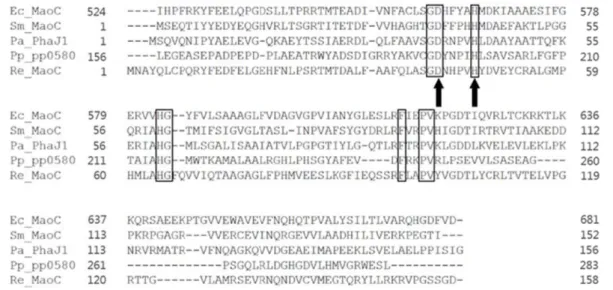
P. putida, S. meliloti, R. eutropha 의 maoC 유전자는 E. coli maoC 유전자와 P. aeruginosa phaJ1 유전자서열을 기반으로 BLAST (http://www.ncbi.nlm.nih.gov/BLAST/)의 protein ho- mology search를 통해 스크리닝하였다. E. coli maoC 유전자 의 발현을 통해 재조합 대장균에서 지방산으로부터 MCL- PHA를 합성할 수 있었기 때문에 [13], 본 연구에서는 P. pu- tida, S. meliloti, R. eutropha 로부터 스크리닝된 maoC 유전자 의 발현을 통하여 재조합 대장균에서 MCL-PHA의 합성대사 회로를 구축하고자 하였다. MaoC 유전자의 발현은 p10499A 플라스미드에 클로닝하여, 지속적으로 발현할 수 있도록 유 도하였다. P. putida KT2440에 존재하는 MaoC (PP0580)은 (R)-specific enoyl-CoA hydratase로 알려져 있으며, P. putida 에서 발현 및 활성이 확인되었으나 [14,15], 실제로 대장균을 비롯한 재조합 균주에서 PHA 합성에 응용된 적이 없기 때문 에 이번 실험에서 PHA 합성에 응용하였다. Fig. 1에 MaoC 효소의 multiple alignment 결과를 정리하였다. BLAST search 결과를 통해 P. putida, S. meliloti, R. eutropha의 MaoC 효소 모두 E. coli MaoC 효소와 마찬가지로 MaoC domain이 잘 보 존되어 있는 것을 알 수 있었다. P. putida, S. meliloti, R. eutro- pha MaoC 효소 모두의 경우 E. coli MaoC의 경우와 같이 효 소활성에 중요한 아미노산 잔기인 히스티딘 (H)과 아스파틱 산 (D)가 잘 보존되어 있었다 [13]. PCR를 통해 획득한 각각 의 MaoC 유전자를 p10499A에 클로닝하여 재조합 대장균 제 작에 사용하였다. p10499A는 대장균 gntT104 프로모터를 보 유한 발현벡터로서, 해당 유전자를 지속적으로 발현할 수 있 는 벡터로 많이 사용되어 왔다 [9,13]. Fig. 2에 현재까지 PHA 합성에 사용된 β-oxidation pathway의 대사공학 전략과 본 연 구에서 적용된 MaoC를 이용한 대사공학 전략을 정리하였다.
β-oxidation pathway의 주 효소인 FadB 혹은 FadA를 제거할 경우 β-oxidation pathway의 대사산물들이 PHA synthase의 기질인 R3HA-CoA로 전환되어 PHA synthase의 발현만으로 도 PHA가 합성된다는 보고가 있어왔다 [4-6,12,13]. 하지만 정상적인 β-oxidation pathway를 지닌 재조합 대장균에서는 enoyl-CoA hydratase 혹은 3-ketoacyl-CoA reductase 등을 플 라스미드를 통해 과다발현 해야만 β-oxidation pathway의 대 사산물들이 R3HA-CoA로 전환되어 PHA 합성에 이용될 수 Table 2. List of primers used in PCR expriments for the amplification of the maoC genesa
Primer Primer sequence Template used
Primer1 5- GGAATTCATGAGCCGACAATGGCACGAC
P. putida chromosomal DNA
Primer2 5- CCCAAGCTTTTACAGGCTCTCCCAACGGCC
Primer3 5-GGAATTCATGAGCGAGCAGACGATCTAT
S. meliloti chromosomal DNA
Primer4 5-CCCAAGCTTTTATTGGATAGTTCCCTCAGGTTT
Primer5 5- GGAATTCATGAACGCCTATCAACTTTGTC
R. eutropha chromosomal DNA
Primer6 5- CCCAAGCTTTCAGTCCCCGCTGCTGCC
a
Restriction enzyme sites are shown in bold.
있다 [7-11,13]. 따라서, 본 실험에서 β-oxidation pathway의 enoyl-CoA를 R3HA-CoA로 전환하기 위해서는 MaoC의 플 라스미드를 통한 발현이 필수적이기 때문에 p10499A 벡터 에 MaoC 유전자를 클로닝하여, β-oxidation pathway를 통해 PHA를 합성할 수 있는 재조합 대장균을 제작하였다.
3.2. Production of PHA in recombinant E. coli strains harboring the PHA synthase gene and the maoC gene MaoC를 이용한 PHA 합성대사회로 구축을 확인하기 위하여, pMCS104613C2와 MaoC 유전자를 발현하는 p10499A 기반 플라스미드를 이용하여 E. coli W3110을 형질전환하여 세 종 류의 재조합 대장균을 제작하였다. 제작된 재조합 대장균을 Fig. 1. Alignment of the deduced amino acid sequence of MaoC from E. coli, P. putida, S. meliloti, R. eutropha with that of P. aeruginosa (R)-specific enoyl-CoA hydratase (PhaJ1). Conserved amino acids are shown in boxes. The catalytically important residues Asp and His are indicated by arrows.
Fig. 2. Metabolic pathways for MCL-PHA biosynthesis in recombinant E. coli strain through fatty acid b-oxidation pathway. Enoyl-CoA hydratase, epimerase and 3-ketoacyl-CoA or ACP reductase have been employed to supply PHA precursors. Characters in parenthesis represent: A, enzymes that have not been elucidated in E. coli; B, amplified enzymes to supply PHA precursors in active b-oxidation pathway - FabG [7-9], RhlG [9], PhaJ [10,11] and MaoC [13-15, this study]; X, enzymes that have been inactivated to supply PHA precursors from fatty acid [4-6,12,13].
2 g/L의 sodium decanoate 가 함유된 LB medium에서 30oC에 서 96시간 동안 배양하였다(Table 3). P. putida , S. meliloti, R.
eutropha의 MaoC효소와 PHA synthase를 발현하는 재조합 대 장균들은 모두 PHA를 배지에 첨가된 2 g/L의 sodium deca- noate으로부터 합성하였으며, 합성된 PHA의 모노머는 3-hy- droxybutyrate (3HB), 3-hydroxyhexanoate (3HHx), 3-hydroxy- octanoate (3HO), 3-hydroxydecanoate (3HD)이었다. PHA의 모노머 조성은 MaoC 종류에 따라 달랐으며, P. putida MaoC 가 이용되었을 때, 3HD 모노머의 고분자 내의 분율이 50 mol%에 달했고, S. meliloti와 R. eutropha의 MaoC 효소를 적 용하였을 때에는 3HO의 몰분율이 제일 높았다 (Table 3). 이 는 같은 조건에서 E. coli MaoC를 이용했을 때 고분자 내의 몰분율이 3HO가 74 mol%로 제일 높았고, 3HD의 몰분율이 7 mol%였던 예전 결과와 비교해도, 고분자 생산에 적용되는 MaoC의 기질특이성에 따라 생성된 고분자의 몰분율이 상이 해질 수 있음을 의미한다. 생성된 고분자의 PHA content는 P.
putida MaoC가 적용되었을 때 18.7 wt%로 제일 높았고, R.
eutropha MaoC가 이용되었을 때에는 3.2 wt%로 제일 낮았 다.
4. CONCLUSION
본 연구진은 P. putida, S. meliloti, R. eutropha의 MaoC 효소를 클로닝하여 β-oxidation pathway의 enoyl-CoA를 R3HA-CoA 로 전환하는 대사회로를 제작하였고, 이를 이용하여 지방산 으로부터 PHA를 합성하는 재조합 대장균 시스템을 개발하 였다. 본 연구진이 개발한 MaoC를 이용한 PHA 생산시스템 을 활용한다면, 다양한 모노머 조성을 지닌 MCL-PHA를 지 방산으로부터 효율적으로 생산할 수 있어, 다양한 물성을 지 닌 MCL-PHA을 합성할 수 있을 것으로 기대된다.
ACKNOWLEDGEMENTS
본 연구는 한국연구재단을 통한 미래창조과학부 기후변화대 응 바이오리파이너리를 위한 시스템대사공학 원천기술개발 사업 (NRF-2012-C1AAA001-2012M1A2A2026556)과 교육부 일반연구자사업 연구비 (NRF-2013R1A1A2058379)의 지원
으로 이루어졌으며, 이에 감사드립니다.
REFERENCES
1. Lee, S. Y. (1996) Bacterial polyhydroxyalkanoates. Biotechnol.
Bioeng. 49: 1-14.
2. Madison, L. L. and G. W. Huisman (1999) Metabolic engineering of poly(3-hydroxyalkanoates): from DNA to plastic. Microbiol.
Mol. Biol. Rev. 63: 21-53.
3. Steinbüchel, A. and H. E. Valentin (1995) Diversity of bacterial polyhydroxyalkanoic acid. FEMS Microbiol. Lett. 128: 219-228.
4. Qi, Q., B. H. A. Rehm, and A. Steinbüchel (1997) Synthesis of poly(3-hydroxyalkanoates) in Escherichia coli expressing the PHA synthase gene phaC2 from Pseudomonas aeruginosa: comparison of PhaC1 and PhaC2. FEMS Microbiol. Lett. 157: 155-162.
5. Langenbach, S., B. H. A. Rehm, and A. Steinbüchel (1997) Func- tional expression of the PHA synthase gene phaC1 from Pseudo- monas aeruginosa in Escherichia coli results in poly(3-hydroxyal- kanoate) synthesis. FEMS Microbiol. Lett. 150: 303-309.
6. Qi, Q., A. Steinbüchel, and B. H. A. Rehm (1998) Metabolic rout- ing towards polyhydroxyalkanoic acid synthesis in recombinant Escherichia coli (fadR): inhibition of fatty acid beta-oxidation by acrylic acid. FEMS Microbiol. Lett. 167: 89-94.
7. Ren, Q., N. Sierro, B. Witholt, and B. Kessler (2000) FabG, an NADPH-dependent 3-ketoacyl reductase of Pseudomonas aerugi- nosa, provides precursors for medium-chain-length poly-3-hydro- xyalkanoate biosynthesis in Escherichia coli. J. Bacteriol. 182:
2978-2981.
8. Taguchi, K., Y. Aoyagi, H. Matsusaki, T. Fukui, and Y. Doi (1999) Co-expression of 3-ketoacyl-ACP reductase and polyhydroxyal- kanoate synthase genes induces PHA production in Escherichia coli HB101 strain. FEMS Microbiol. Lett. 176: 183-190.
9. Park, S. J., J. P. Park, and S. Y. Lee (2002) Metabolic engineering of Escherichia coli for the production of medium-chain-length polyhydroxyalkanoates rich in specific monomers. FEMS Micro- biol. Lett. 214: 217-222.
10. Tsuge, T., T. Fukui, H. Matsusaki, S. Taguchi, G. Kobayashi, A.
Ishizaki, and Y. Doi (2000) Molecular cloning of two (R)-specific enoyl-CoA hydratase genes from Pseudomonas aeruginosa and their use for polyhydroxyalkanoate synthesis. FEMS Microbiol.
Lett. 184: 193-198.
11. Tsuge, T., K. Taguchi, S. Taguchi, and Y. Doi (2003) Molecular characterization and properties of (R)-specific enoyl-CoA hydrata- Table 3. Results of flask cultures of recombinant E. coli W3110 strains harboring pMCS104613C2 and a p10499A derivative containing different maoC genesa
Condition DCW
(g/L)
PHA conc.
(g/L)
PHA content (wt%)
Monomer composition (mol%)
3HB 3HHx 3HO 3HD
pMCS104613C2 + p10499P0580 1.03±0.01 0.19±0.01 18.7±0.03 2±2 8±2 39±2 51±2
pMCS104613C2 + p10499SmMaoC 1.45±0.01 0.1±0.01 6.9±0.7 0 12±2 50±2 38±2
pMCS104613C2 + p10499ReMaoC 1.56±0.01 0.05±0.01 3.2±0.7 0 22±2 47±2 31±2
a
Cells were cultivated for 96 h at 30
oC in LB medium supplemented with 2 g l
-1of sodium decanoate. Cultures were carried out in triplicates.
Abbreviation: 3HB, ( R)-3-hydroxybutyric acid; 3HHx, (R)-3-hydroxyhexanoic acid; 3HO, (R)-3-hydroxyoctanoic acid; 3HD, (R)-3-
hydroxydecanoic acid
ses from Pseudomonas aeruginosa: metabolic tools for synthesis of polyhydroxyalkanoates via fatty acid β-oxidation. Int. J. Biol.
Macromol. 31: 195-205.
12. Snell, K. D., F. Feng, L. Zhong, D. Martin, and L. L. Madison (2002) YfcX enables medium-chain-length poly(3-hydroxyalka- noate) formation from fatty acids in recombinant Escherichia coli fadB strains. J. Bacteriol. 184: 5696-5705.
13. Park, S. J. and Lee, S. Y. (2003) Identification and characteriza- tion of a new enoyl-coA hydratase involved in the biosynthesis of medium-chain-length polyhydroxyalkanoates in recombinant Es- cherichia coli. J. Bacteriol. 185: 5391-5397.
14. Wang, Q., R. C. Tappel., C. Zhu., and C. T. Nomura. (2012) De- velopment of a new strategy for production of medium-chain-length polyhydroxyalkanoates by recombinant Escherichia coli via inex-
pensive non-fatty acid feedstocks. Appl. Environ. Microbiol. 78:
519-527.
15. Sato, S., H. Kanazawa., and T. Tsuge (2011) Expression and char- acterization of (R)-specific enoyl coenzyme A hydratases making a channeling route to polyhydroxyalkanoate biosynthesis in Pseu- domonas putida. Appl. Microbiol. Biotechnol. 90: 951-959.
16. Braunegg, G., B. Sonnleitner, and R. M. Lafferty (1978) A rapid gas chromatographic method for the determination of poly-β-hyd- roxybutyric acid in microbial biomass. Eur. J. Appl. Microbiol.
Biotechnol. 6: 29-37.
17. Choi, J., S. Y. Lee, K. Shin, W. G. Lee, S. J. Park, H. N. Chang, and Y. K. Chang (2002) Pilot scale production of poly(3-hydroxy- butyrate-co-3-hydroxyvalerate) by fed-batch culture of recombi- nant Escherichia coli. Biotechnol. Bioprocess Eng. 7: 371-374.