
The Effect of Hydrogen Peroxide Bleaching on the Properties of Hardwood Kraft Pulp Absorbed with Birchwood Xylan
12
0
0
전체 글
(2) and Paul Gatenholm showed that tensile strength improvement of softwood pulps by xylan adsorption is more pronounced for once-dried fibers than for never-dried fibers4). Sch□nberg et al. investigated the importance of xylan for strength properties of bleached kraft pulp fibres by using enzymatic removal and chemical sorption experiments5). The research of Linder et al. concentrated on the mechanism of assembly of xylan onto cellulose surfaces6). However, with the amount of xylan adsorbed on fiber increasing, the optical properties of paper decreased remarkably and caused limitation for the use of xylan7). In order to acquire both enhanced strength and high brightness, an applicable bleaching process is thereby desired. In recent years, environmental demands have directed bleaching conditions to elemental chlorine-free (ECF) or totally chlorine-free (TCF) bleaching sequences. Hydrogen peroxide bleaching gains more importance in industrial application, in particular, for chemical pulp bleaching8). Peroxide primarily works in alkaline conditions when the perhydroxyl ion, OOH-, is formed as follows: H2O2 + OH OOH- + chromophore. OOH- + H2O bleaching (chromophore destroyed). (1) (2). Alkaline peroxide bleaching can change the chemical, physical and optical properties of pulp significantly, accordingly adjusting the conditions of bleaching appears fairly essential to meet specific requirements of different paper products9,10). The primary objective of the study presented here was to evaluate the influence of hydrogen peroxide bleaching with different operating variables (bleaching temperature, time, initial pH and MgSO4 dosage) upon hardwood kraft pulp with adsorbed birchwood xylan. The brightness, whiteness, opacity, bulk and tensile strength were examined to characterize the optical properties and physical properties of handsheets. According to the results, both good physical properties and optical properties could be obtained if the process parameters were controlled properly and hydrogen peroxide bleaching was therefore proved applicable for bleaching hardwood kraft pulp adsorbed with birchwood xylan. 2. Materials and Methods 2.1 Adsorption of Xylan on Kraft Pulp Fibers A thoroughly washed (400 meshes), never-dried, non-beaten, industrially produced, bleached hardwood kraft pulp was used in our research. The physical and optical properties are presented in Table 2.1. 0.30% Poly-DADMAC (molecular. 196.
(3) weight 400,000~500,000, Aldrich®, USA) based on oven dried pulp was added into pulp to promote the interaction of xylan with fibers. The pulp suspension was then washed to remove poly-DADMAC that did not adsorb on fibers. The xylan (from birchwood, SIGMA®, Germany) solution was pretreated at 90℃ for 15minutes and allowed to cool down to room temperature prior to mixing with pulp suspension for 20minutes. The characterizations of the kraft pulp adsorbed with xylan are also showed in Table.1. Table. 1.. The properties of untreated pulp ana xylan treated pulp. Untreated Xylan treated. Whiteness, % 77.81 59.13. Brightness, % 86.99 78.26. Opacity, % 80.89 84.71. Bulk, cm3/g 2.87 2.94. Tensile index 4.75 6.15. Tear index 1.32 1.52. 2.2 Chelation Stage (Q Stage) The chelation stage was performed at 70℃, 5% pulp consistency for 30 minutes, followed by a wash. For this stage, 0.30% DTPA (Diethylenetrianime pentaacetic acid, Samchun Pure Chemical Co., Ltd, Korea) based on oven dried pulp was added to the pre-warmed water and mixed well with pre-warmed pulp. The pulp was placed in a heat-proof polystyrene bag, sealed, and fully immersed in a pre-heated constant temperature water bath. The pulp was mixed every fifteen minutes for the duration of the experiment. 2.3 Hydrogen Peroxide Stage (P Stage) All the hydrogen peroxide stages were processed at 10% pulp consistency with 2.0%odp hydrogen peroxide (Junsei Chemical Co., Ltd, Japan) in plastic bags placed in water bath. 3.0%odp Sodium silicate (Samchun Pure Chemical Co., Ltd, Korea) was used as hydrogen peroxide stabilizer. Before adding bleaching chemicals, the pulp was pre-warmed. During the bleaching experiment, the pulp was mixed every fifteen minutes. The bleaching time, temperature, initial pH and MgSO4 (Junsei Chemical Co., Ltd, Japan) dosage varied according to different experiment designs. After bleaching, the pulp was washed to neutral pH. 2.4 Handsheets Forming and Measurements of Properties Handsheets were made from the bleached pulp and conditioned. The optical properties including brightness, whiteness, opacity, and physical properties including bulk, tensile index, tearing index were measured according to TAPPI Test Method. 3. Results and Discussion. 197.
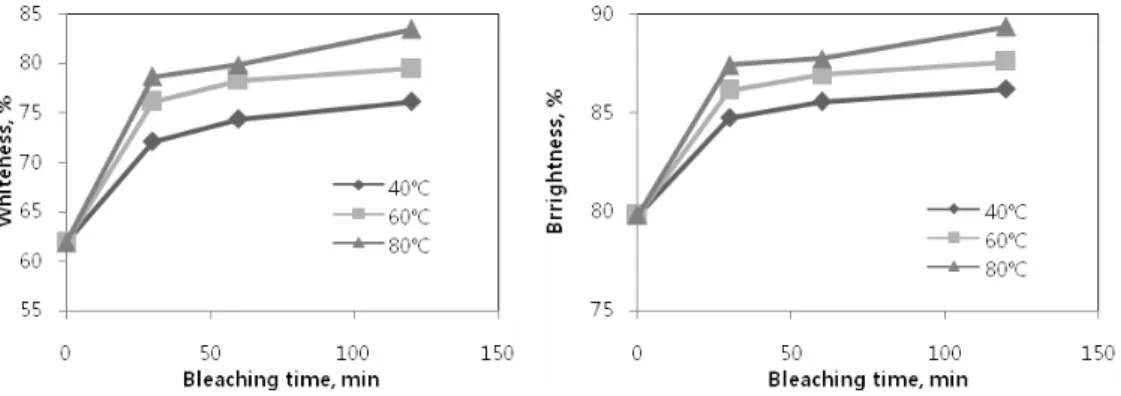
(4) 3.1 The effect of Bleaching Time and Temperature All the hydrogen peroxide stages for researching the effect of bleaching time and temperature were performed with 0.05% MgSO4 dosage and from initial pH 11.. Fig. 1. The effect of bleaching time and temperature on whiteness and brightness. Fig. 1 indicates that whiteness and brightness were enhanced, with increasing of bleaching time and temperature, as the effect of delignification was enforced. Besides, in the first 30 minutes, the tendency was much more evident than later.. Fig. 2. The effect of bleaching time and temperature on opacity. Fig. 2 shows that when bleaching temperature was 40 ℃ , the opacity kept decreasing with increase of bleaching time. The reason is that some components, especially lignin, were dissolved out and resulting in the collapse of cell walls. At the same time, alkaline swelling made the fibers more flexible and softer. As a. 198.
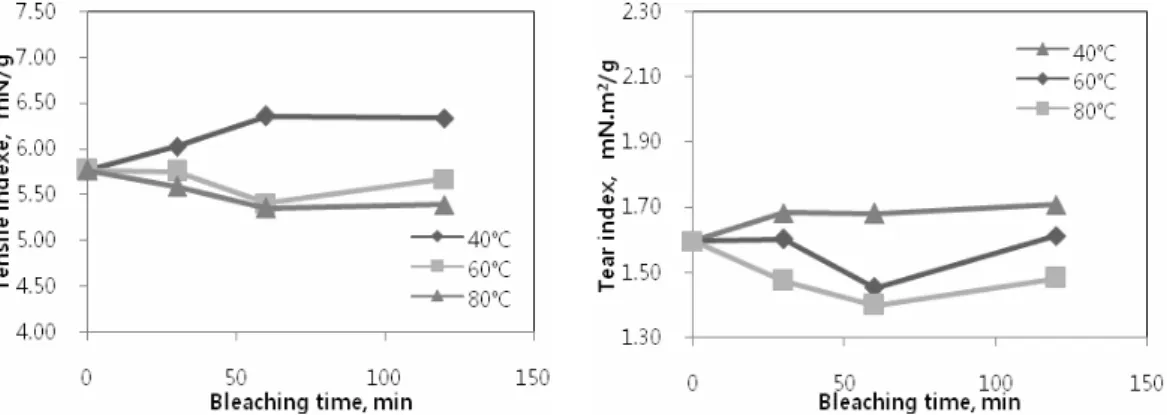
(5) result, the contact area between fibers was increased and the light scattering coefficient of paper sheet was reduced, which caused the decrease of opacity. In terms of 60℃ and 80℃, the opacity decreased firstly and then increased again. That is because in the later stage of bleaching, xylan which had been dissolved out and removed of acetyl groups began to redeposit on fiber surface. Some research proved that the removal of acetyl groups happened in the earlier stage of bleaching could facilitate the re-adsorption of xylan and other hemicelluloses on fibers, as the solubility of the hemicelluloses without acetyl groups was much lower than the one with acetyl groups10).. Fig. 3. The effect of bleaching time and temperature on tensile index and tear index. In Fig. 3, it can be observed that the mechanical properties (i.e. tensile index and tearing index) were promoted steadily when the bleaching temperature was 40 ℃. However, in case of 60℃ and 80℃, the tensile index and tearing index dropped firstly and went up again after bleaching for 60 minutes. To understand this phenomenon, analyzing the chemical and physical change of pulp in bleaching stage is necessary. Basically, there were mainly five factors affecting the properties of pulp. a). The dissolving of both adsorbed xylan on fiber surface and native one located in the cell wall of fiber had negative effect on the physical properties of pulp. b). The bleached reaction species of alkaline hydrogen peroxide were the hydroperoxy anion HOO− and its decomposition intermediates as hydroxyl HO· and superoxide anion O2−• radicals, which had generally undesirable influence in bleaching process and also attacked the carbohydrate resulting in strength loss of the fibers11). c). The collapse of cell walls caused by delignification and dissolving of other wood components increased the contacting area between fibers, and therefore the fiber-. 199.
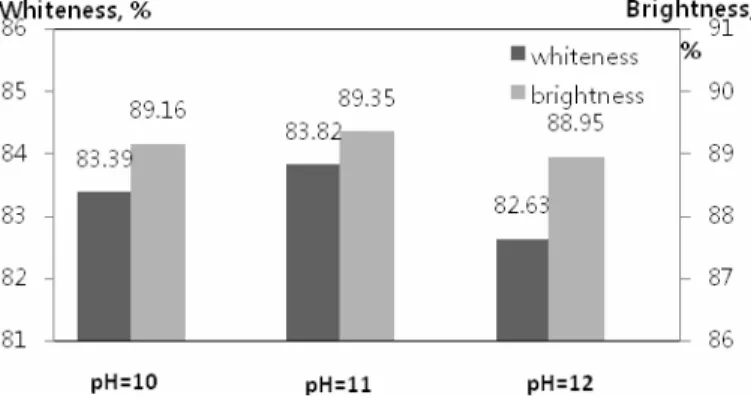
(6) to-fiber bonding was strengthened, which facilitated the development of mechanical properties of paper sheet12). d).The alkaline environment of bleaching increased the swelling of the cellulose fiber, thereby increased the surface area, which was believed to result in improved paper strength. e). The removal of acetyl groups from hemicelluloses species promoted the re-disposition of xylan and other hemicelluloses, which gave rise to the strength properties of sheet13). When the bleaching temperature was 40℃, the effect of c) and d) played a main role and the effect of a) ,b) and e) were weak due to the mild reaction condition, which lead to the steady increasing of paper strength. On the other hand, when the bleaching temperature was raised to 60℃ or 80℃, the influence of a) and b) played a primary role in the earlier stage while the impact of c), d) and e) overcame the effect of a) and b) in the later stage. 3.2 The effect of Initial pH All the hydrogen peroxide stages for researching the effect of initial pH were performed at 80℃, with 0.05% MgSO4 dosage for 120 minutes.. Fig. 4. The effect of initial pH on whiteness and brightness. The data in Fig. 4 demonstrates that the peroxide bleaching from initial pH 11 provided both highest whiteness and brightness value. The explanation is that lower initial pH made weak alkaline condition which could not supply enough OOHfor the bleaching system. As a result, insufficient bleaching caused lower whiteness and brightness. On the other hand, when the initial pH was too high, excess alkali would increase hydroxyl ion, which in turn caused producing perhydroxyl ion too rapidly to be used. That could lead to the following reaction:. 200.
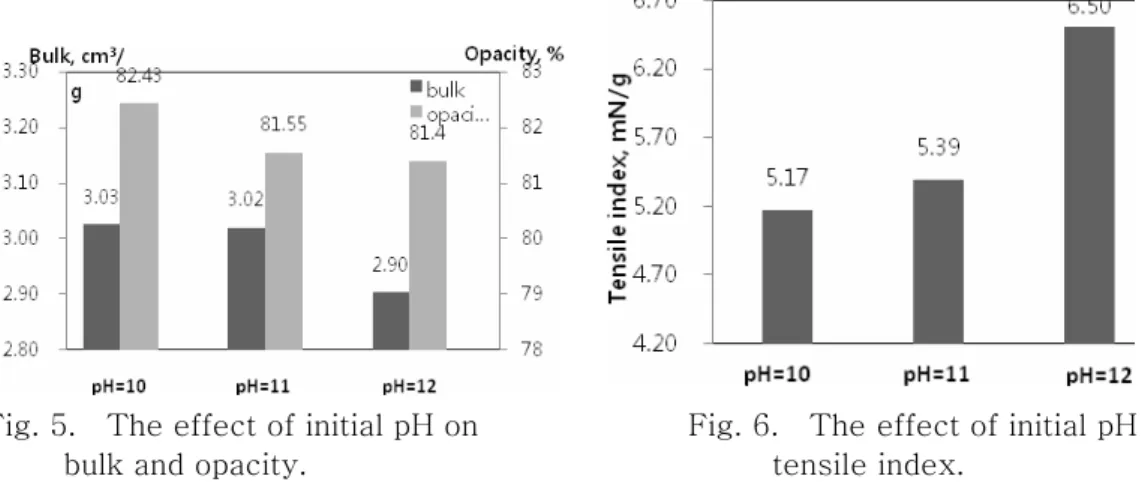
(7) H2O2 + OOH-. OH- + O2 (g) + H2O. (3). Consequently, hydrogen peroxide would be decomposed before it was used for bleaching9). At the same time, pulp can also darken due to alkali darkening reactions, simply described as: Lignin + OHChromophore groups (4) where phenolic lignin units could be oxidized by alkali to light absorbing structures and resulted in lower optical properties.9). Fig. 5. The effect of initial pH on bulk and opacity.. Fig. 6. The effect of initial pH on tensile index.. The experimental results for the effect of initial pH on bulk, opacity and tensile index are shown in Fig. 5 and Fig. 6 respectively. It is obvious that both bulk and opacity declined with the increasing of initial pH, whereas the tensile index boosted largely. The reason is higher initial pH created stronger alkaline environment which facilitated the collapse of fiber cell walls caused by delignification and dissolving of other wood components. As a result, the bulk was decreased. But the collapse of fiber cell walls increased the contacting area between fibers. In addition to the better swelling of fibers, the tensile index of sheet was promoted evidently. At the same time, owing to the reduction of noncontacting areas between fibers, the light scattering coefficient went down and thereby the opacity declined.. 3.3 The effect of MgSO4 dosage. 201.
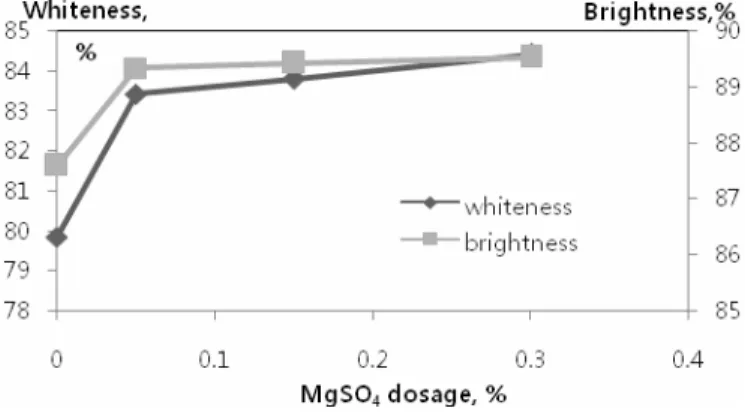
(8) All the hydrogen peroxide stages for researching the effect of MgSO4 dosage were performed at 80℃, with initial pH 11 and for 120 minutes.. Fig. 7. The effect of MgSO4 dosage on whiteness and brightness.. Fig. 8. The effect of MgSO4 dosage on bulk and opacity.. Fig. 9. The effect of MgSO4 dosage on tensile index.. According to Fig. 7, 8 and 9, it appears that both optical properties and mechanical properties were improved with the addition of MgSO4 increasing. Previous studies proved that peroxide could be catalytically decomposed by some transition metal ions such as iron, manganese, and copper as following: H2O2 + M2+. M3+ + OH- + OH•. 202. (5).
(9) H2O2 + M3+ OOH• H• +. M2+ + H• + OOH•. (6). O2 (g) + H•. (7). H2O. (8). Therefore the peroxide would be consumed without having bleaching effect14). In addition, the new created free radicals would attack the carbohydrates and caused loss of fiber strength. However, magnesium sulfate, as compound of alkaline earth metal, could inhibit this catalytic decomposition, stabilize peroxide and protect carbohydrates. As a result, both better optical properties and physical properties could be obtained with the usage of MgSO4. 3.4 The comparison of pulp in different phases. Fig. 10. The comparison of whiteness and brightness.. 203.
(10) Fig. 11. The comparison of tensile index and tear index. Fig. 10 and Fig. 11 compare the properties of untreated pulp, xylan treated pulp, chelating treated pulp and pulp bleached at different temperatures, with 0.05% MgSO4 dosage, initial pH 11, for 120 minutes. The results demonstrate that the adsorption of xylan improved the strength properties of pulp by 29.5% for tensile index and 15.2% for tear index, but whiteness and brightness were decreased by 24.0% and 10.0% respectively. Chelation treatment with DTPA provided a slight increase in optical properties and a reduction in strength properties. Most importantly, when the bleaching parameters were set properly, both better optical qualities and physical properties were enhanced. For example, when bleaching temperature was 60℃ and bleaching time was 120 minutes, the whiteness and brightness of bleached pulp were as high as 79.44% and 87.59% and also the tensile index and tear index were promoted by 19.4% and 22.0% compared to the untreated pulp. Finally, it is proved that hydrogen peroxide bleaching is a suitable bleaching process for the hardwood kraft pulp adsorbed with birchwood xylan. 4. Conclusions To summarize the results of this study, several important conclusions can be made: 1) The adsorption of xylan could improve the strength properties of paper, but the whiteness and brightness were decreased. 2) At low bleaching temperature, for example 40℃, the whiteness and brightness were enhanced, the opacity kept decreasing, the mechanical properties (i.e. tensile index and tearing index) were promoted steadily with increasing of bleaching time. When the bleaching temperature was high, for example 60℃ and 80 ℃ , whiteness and brightness were increased, opacity and physical properties were decreased firstly and then improved again with bleaching time increasing. 3) Higher temperature of bleaching provided better whiteness and brightness, lower opacity, tensile index and tear index. 4) Bleaching from initial pH 11 showed both highest whiteness and brightness value. In addition, bulk and opacity declined with the increasing of initial pH, whereas the tensile index was boosted largely. 5) More MgSO4 dosage increased whiteness, brightness, opacity, bulk and strength properties.. 204.
(11) 6) Hydrogen peroxide bleaching is an applicable method for bleaching hardwood kraft pulp with adsorption of birchwood xylan. With that, both good mechanical properties and optical properties of pulp could be achieved. References 1) 2) 3) 4). 5). 6) 7). 8) 9). 10) 11) 12). 13). Joseleau, J.P., Comatat, J., Ruel, K., Progress in biotechnology, Elsevier Science Publiser, 7: pp 1-15 (1992). Schimizu, K., Chemistry of hemicelluloses, Wood and Cellulosic Chemistry, 177-214 (1991). Spiegelberg, H.L., The effect of hemicelluloses on the mechanical properties of individual pulp fibers, TAPPI J. 49(9): 388-396 (1966). K□hnke, T., Gatenholm, P., Modification of cellulose fibres by controlled xylan adsorption and its effect on softwood pulp properties, 14th International Symposium on Wood, Fibre and Pulping Chemistry, Durban, South Africa, 2528 (2007). Sch□nberg, C., Oksanen, A., Suurn□kki, A., Kettunen, H., Buchert, J. The importance of xylan for the strength properties of spruce kraft pulp fibres, Holzforschung, 55(6): 639-644 (2001). Linder, □., Bergman, R., Bodin, A., Gatenholm, P., Mechanism of assembly of xylan onto cellulose surfaces, Langmuir, 19: 5072-5077 (2003). Lee, S.H., Lee, H.L., Youn, H.J., Zhu, H.X., The investigation to apply birchwood xylan for improvement of dry strength of paper, PAPTAC Annual Meeting, Montreal, QC (2010). Zeronian, S.H., Inglesby, M.K., Bleaching of cellulose by hydrogen peroxide, Cellulose, 2: 265-272 (1995). Johnson, D.A., Park, S., Genco, J.M., Gibson, A., Wajer, M., Branch, B., Hydrogen peroxide bleaching of TMP pulps using Mg(OH)2, Proceedings of TAPPI Pulping & Engineering Conference, San Diego, Ca (2002). Ni, Y., He, Z., Zhou, Y., Alkaline peroxide bleaching and properties of high yield pulp, Word Pulp and Paper, 26(3): 10-18 (2007). Potucek, F., Milichovsky, M., Kraft pulp bleaching with hydrogen peroxide and peracetic acid, Chemical Papers, 56(6a): 406-411 (2000). Pan, G.X., Relationship between dissolution of fiber materials and development of pulp strength in alkaline peroxide bleaching of mechanical pulp, Holzforschung, 58(4): 369 (2004). Thornton, J., Ekman, R., Holmbom, B., Polysaccharides dissolved from Norway spruce intherno-mechanical pulping and peroxide bleaching, Journal of Wood Chemistry and Technology, 14(2): 159 (1994). 205.
(12) 14) Persley, J.R., Hill, R.T., Peroxide Bleaching of (Chemi) Mechanical Pulps.. Section V, Chapter 1, Pulp Bleaching, Principles and Practice, TAPPI Press, pp 459-489 (1996). 206.
(13)
수치
+2
관련 문서
_____ culture appears to be attractive (도시의) to the
– A collection of molecules (or atoms) in continuous random motion – Average speeds increases as T is raised.. – The molecules of a gas are widely separated (negligible
【판결요지】[1] [다수의견] 동일인의 소유에 속하는 토지 및 그 지상 건물에 관하여 공동저 당권이 설정된 후 그 지상 건물이 철거되고 새로 건물이 신축된 경우에는
It considers the energy use of the different components that are involved in the distribution and viewing of video content: data centres and content delivery networks
1 John Owen, Justification by Faith Alone, in The Works of John Owen, ed. John Bolt, trans. Scott Clark, "Do This and Live: Christ's Active Obedience as the
Based on the parametric study on the characteristic of solid NaBH 4 hydrolysis using the NaHCO 3 agent, a prototype of the hydrogen generation system was developed
7 Effect of annealing temperature on the tensile properties of high manganese austenitic stainless steel with two phases of reversed austenite and
The purpose of this study was to investigate the impact of social capital and positive psychology capital on the will of start-up according to experience
