KOREAN JOURNAL OF ENGLISH LANGUAGE AND LINGUISTICS
ISSN: 1598-1398 / e-ISSN 2586-7474 http://journal.kasell.or.kr
Differential Contribution of English Suprasegmentals to L2 Foreign- Accentedness and Speech Comprehensibility: Implications for Teaching EFL Pronunciation, Speaking, and Listening*
In Young Yang (Catholic Kwandong University)
This is an open-access article distributed under the terms of the Creative Commons License, which permits unrestricted non-commercial use, distribution, and reproduction in any medium, provided the original work is properly cited.
ABSTRACT
Yang, In Young. 2021. Differential contribution of English suprasegmentals to L2 foreign-accentedness and speech comprehensibility: Implications for teaching EFL pronunciation, speaking, and listening. Korean Journal of English Language and Linguistics 21, 818-836.
This study investigated how English suprasegmentals contribute to two aspects of pronunciation proficiency—comprehensibility and foreign-accentedness. Further, it discussed their implications for teaching English as a foreign language. The read speech of 35 volunteers, who were second language (L2) English speakers in Korea, was analyzed in terms of the following seven variables concerning English suprasegmentals: the number of pauses, total duration of pauses, articulation rate, mean length of run, pitch range, prominence frequency, and sentence stress appropriacy. The results of a multiple regression analysis showed that the number of pauses, the sentence stress appropriacy, and the articulation rate were significant predictors of L2 speech comprehensibility. Speech rate factors and prominence frequency were the strongest predictors of foreign-accentedness. In addition, these results suggest that better understanding in communicative contexts requires teaching learners about the placement of sentence stress without overemphasizing the mere rhythmic pattern of spoken English. The discussion explains how discourse-level pronunciation practice and information structures can be integrated into L2 speaking and listening to improve student benefits.
Received: July 18, 2021 Revised: September 20, 2021 Accepted: September 25, 2021
Assistant Professor, Dept. of English Education, Catholic Kwandong University Tel: 033) 649-7762 Email: [email protected]
* This study reports a part of the author’s unpublished doctoral dissertation
KEYWORDS
L2 pronunciation, foreign-accentedness, comprehensibility, English prosody, sentence stress
1. Introduction
The advent of the communicative language teaching (CLT) paradigm has made what to teach in English pronunciation a central issue in second language (L2) research. In the CLT paradigm, fluency is valued more than accuracy, and some aspects of pronunciation are omitted from instructions because of their relatively minor contributions to communicative situations. The primary assertion of CLT regarding pronunciation is that strong foreign-accentedness among L2 learners does not necessarily hinder their overall communication or native listeners’ comprehension of their speech. Therefore, education prioritizes fluency over accuracy, and suprasegmentals such as stress and intonation have received more focus in pronunciation teaching than segmental aspects (Celce-Murcia et al. 1996).
Similarly, considerable research has been conducted on L2 learners’ speech production and their perception by native listeners. It focuses on the relationship between foreign-accentedness, speech intelligibility, and comprehensibility, emphasizing that the ultimate goal of L2 pronunciation instruction should be to achieve maximum comprehensibility for the learner’s language (e.g., Derwing and Munro 1997, Munro and Derwing 1995a, 1995b, 1999). Furthermore, efforts have been made to propose content standards for teaching English as an international language (EIL). Jenkins (2002) has suggested that certain features of English pronunciation are essential for its use as a lingua franca.
Moreover, pronunciation is also deeply concerned with the listening and speaking ability of L2 learners. Several teachers and researchers in the Korean EFL context, either native or non-native English speakers, focused more on reduced and fast (deaccented) pronunciations to help learners enhance their listening ability and, consequently, their speaking ability (Kang 2017, Lee 2013, among others). According to them, many EFL learners struggle to comprehend what they hear, especially deaccented pronunciations. This approach is certainly effective. However, the concern in the context of English discourse is that these parts are less informative. Those segments that are familiar to both the speaker and listener (i.e., given information) are deaccented (Halliday 1967), and they are thus produced relatively fast and shortened (Halliday and Greaves 2008). It can also burden learners because many of them are unfamiliar with the reduced forms when their native language does not mainly employ a prosodic device to indicate new and given information. Therefore, the goals of this study were as follows: first, to compare various prosodic aspects of English and inform what to teach in EFL classrooms to enhance learners’ speech. The second goal was to derive implications for English speaking and listening education by comparing those aspects of English prosody known to contribute to speech comprehension, such as speech rate, pause, prominence, and sentence stress.
Specifically, the study aimed to answer the following research questions:
1) What aspects of English prosody crucially determine the L2 speech comprehensibility?
2) What aspects of English prosody crucially determine the L2 foreign-accentedness?
3) Considering communication efficiency, where should Korean learners focus on in English prosody?
2. Previous Research
2.1 Foreign-Accentedness and Speech Comprehensibility
For almost 25 years, the concepts of L2 foreign-accentedness and comprehensibility have been the central issue, and numerous studies have explored both ESL and EFL environments. The two constructs are operationalized
based on native listeners’ perceptions of speech. Accentedness can be defined as “how different a pattern of speech sounds compared to the local variety” and comprehensibility as “the listener’s perception of how easy or difficult it is to understand a given speech sample” (Derwing and Munro 2009, p. 478). Initially, relevant research discussed the following three pronunciation-related concepts: foreign-accentedness, intelligibility, and comprehensibility.
Usually, the Likert scale is used to measure foreign-accentedness and comprehensibility, and intelligibility has been measured by having native listeners dictate the heard speech (Munro and Derwing 1995a, among others).
This study, like many others (Trofimovich and Isaacs 2012, among others), focuses solely on foreign-accentedness and comprehensibility.
Attempts to disassociate two key aspects of L2 pronunciation — degree of foreign-accentedness and perceived comprehensibility — stem from Munro and Derwing (1995a, 1995b, 1999), and there has been much subsequent research on the factors predicting them. Many of them focused on the relative contribution of each speech feature, including segmental and suprasegmental features, to foreign-accentedness and/or comprehensibility (Derwing et al. 1998, Flege et al. 1995, Kang 2010, Munro and Derwing 1995a, 2001). Generally, evidence suggests that strong foreign-accentedness does not necessarily decrease the comprehensibility of non-native speech. Furthermore, comprehensibility is more closely related to the intonation and structural aspects of learner language, whereas phonetic/phonemic difficulties interfere with the perceived nativelikeness of pronunciation.
Isaacs and Trofimovich approached the issue in a more comprehensive manner, determining vocabulary, grammatical, and discourse factors (Isaacs and Trofimovich 2012, Trofimovich and Isaacs 2012). For foreign- accentedness, rhythm (specifically, vowel reduction) and word stress were the most powerful predictors in the stepwise multiple regression, whereas type frequency, word stress, and grammatical accuracy were the best predictors of comprehensibility ratings (Trofimovich and Isaacs 2012). Saito et al. (2015) studied the predictors of accentedness and comprehensibility in terms of the oral proficiency of non-native speakers and showed that learners with different ability levels showed different correlates. Recently, Crowther et al. (2018) developed this observation further into various task types of speaking and found that comprehensibility and foreign-accentedness are highly related in speaking tasks with complex cognitive loads, such as the integrated speaking tasks of the Test of English as a Foreign Language.
Despite the significant volume of relevant research, there is still much to be studied. First, considerable research has explored the issue in the ESL context, with participants from diverse native language backgrounds grouped as one. As the native language of research participants is also a critical variable in phonetic/pronunciation research, the relevant issue needs a more specific and targeted environment while considering a specific phonological feature that Korean learners find difficult. Therefore, Section 2.2 will discuss English suprasegmentals, including sentence stress, which Korean learners of English find challenging to produce, along with other speech variables attested in previous literature. Furthermore, as pronunciation is closely linked to speaking and listening ability, a discussion concerning teaching L2 speaking and listening in the Korean EFL context should be ongoing.
2.2 English Suprasegmentals in L2 Pronunciation Research
So far, many L2 speech studies have been conducted in terms of English suprasegmentals. According to Munro and Derwing (1995a), foreign-accentedness was shown to correlate with a wide variety of variables, such as phonemic errors, phonetic errors, intonation appropriateness, and grammatical errors. However, comprehensibility correlated most highly with intonation, followed by grammatical errors and phonemic errors. Kang et al. (2010) have also confirmed the relative importance of suprasegmentals in comprehensibility. These authors presented comprehensive empirical evidence that 50 % of the variance in ratings of comprehensibility and oral proficiency
can be accounted for by suprasegmental features. Furthermore, the effect of suprasegmental instruction has been proved empirically by Derwing, Munro, and Wiebe (1998). These researchers compared two groups of L2 learners, those who received segment-focused instruction, and those who received suprasegmental-focused instruction.
Both groups showed significant improvement in both foreign-accentedness and comprehensibility at the sentence level. However, only the suprasegmental instruction group showed significant improvement in comprehensibility at the discourse level.
The suprasegmentals, mainly addressed in studies, include speech rate, pauses, intonation, and prominence. The relative contribution of each suprasegmental feature to foreign-accentedness has been sometimes the focus of research related to age of arrival (AOA) and length of residence (LOR) variables in many studies. A comprehensive study by Flege et al. (1995) revealed that higher AOA led to stronger foreign-accentedness, showing a negative correlation between AOA and foreign-accentedness. Trofimovich and Baker (2006), in turn, examined the effect of LOR in the US (3 months, 3 years, and 10 years) among adult native speakers of Korean on their production of suprasegmentals namely stress timing, peak alignment, speech rate, and pause frequency and duration and on their foreign-accentedness ratings. Regression analysis revealed that pause duration and speech rate were the most powerful predictors of foreign-accentedness. Further research by Trofimovich and Baker (2007) focused on 20 Korean L1 children whose LOR in the US varied (1 vs. 11 years). Increased LOR was shown to contribute to the development of the same five English suprasegmentals measured in Trofimovich and Baker (2006). In addition, Korean L1 speakers who had arrived in the US in their childhood and stayed 11 years did not differ significantly from English L1 adults in terms of four of these suprasegmentals; only speech rate was slower, implying that this is a difficult suprasegmental feature to master. A single linear regression analysis of each suprasegmental to accentedness ratings indicated that speech rate was the best predictor of accentedness, followed by pause duration.
Munro and Derwing (1998) carried out two experiments on the effect of speech rate on foreign-accentedness judgments. They expected that the slower rate of non-native speech would be of benefit in terms of accentedness, but when slowed speech materials were presented to native English listeners, they were rated as more accented than when spoken at the normal rate. Furthermore, when foreign-accented non-native speech materials were manipulated to make the speech rate equivalent to that of native speakers, they were perceived as too fast. It seems that the ‘optimally’ slower rate of non-native speech may be better understood by native listeners. Munro and Derwing (2001) continued their previous research on the speech rate variable and found that the optimal rate would be 4.76 and 4.23 syllables per second for foreign-accentedness and comprehensibility, respectively. Furthermore, increasing the non-native speech rate by 10% resulted in improved comprehensibility and reduced perception of accentedness.
In Kang (2010), a total of 11 suprasegmental variables (including variables of speech rate, pause use, prominence, and pitch range) were tested in terms of their contribution to foreign-accentedness and comprehensibility. In the final regression model of foreign-accentedness, the overall pitch range, which was measured from syllables with prominence, was the most powerful predictor. A wider pitch range reduced the perceived degree of foreign accent. She calculated pace (the number of prominent points per minute) and space (the proportion of the prominent word to the total number of words produced) for English rhythm measurements (Vanderplank 1993), and found space alone to be significant, but in such a way that more frequent prominence increased perceived accentedness. The other predictors of accentedness were pause and speech rate variables. For the comprehensibility model, three speech rate variables and one pause-related variable were shown to have a significant effect.
Sentence stress is another English suprasegmental that needs to be included in the research on L2 speech1. Contrary to word-level prominence (or “lexical stress”), sentence-level prominence (henceforth, “sentence stress”) refers to the more prominent syllable in a tone unit, making a specific word more prominent than other words (Kreidler 2004). Generally, when an utterance is “discourse-new” (i.e., new information), the sentence stress falls on the stressed syllable of the last lexical word. For example, when a speaker says, “Mary told John all the secrets,”
and all of the words are discourse-new, “secrets” receives the most prominent stress (or default stress). However, based on the speaker’s emphasis, sentence stress could be placed on any word of the sentence cited above (Kreidler 2004, pp. 146–147). Generally, the features of English sentence stress directly affect speech comprehension (Cutler 1976, among others). For example, misplaced sentence stress confuses the listener regarding the speaker’s intended meaning, causing low intelligibility or communication breakdown (Hahn 2004, Jenkins 2002).
Although sentence stress has long been recognized as a crucial factor in understanding English speech, it has not received considerable attention in L2 speech studies. Nevertheless, some studies have emphasized the importance of sentence stress or the necessity of teaching sentence stress in L2 English education. First of all, among the essential features that have been suggested by Jenkins (2002), the appropriate placement of the sentence-level prominence (that is, nuclear (tonic) stress; Jenkins 2002) is the only suprasegmental item aside from consonant inventory. In Hahn’s (2004) study, three versions of a text were prepared: one with appropriate sentence stress placement, another with no sentence stress, and a third with sentence stress placed on incorrect items. A Korean L1 teaching assistant read the three texts, and English L1 undergraduates’ content processing and comprehension were measured. The native listeners’ reaction time was quickest when a tone was heard during the text with appropriately placed sentence stress, while it was slowest for a tone with misplaced sentence stress. These findings imply that the proper use of sentence stress reduced the cognitive load of the listeners in processing the content, enabling them to react faster to the tones. The listeners were also shown to remember more of the content of the text in the well-placed sentence stress condition.
L2 learners must learn how to effectively express their intended meaning and reduce the processing load for listeners. However, L2 speech comprehensibility research has not investigated sentence stress appropriacy extensively. Few studies have directly investigated the effect of sentence stress appropriacy on L2 speech comprehensibility and foreign-accentedness while accounting for other critical factors such as pauses and speech rate. This study aimed to incorporate sentence stress appropriacy into the rating of two aspects of pronunciation proficiency: foreign-accentedness and comprehensibility. The differential contribution that prosodic variables such as speech rate and pause features in English detailed by previous research make to these aspects are revealed by comparing sentence stress appropriacy. This comparison has significance when we consider what is teachable and not readily teachable in L2 classrooms. Speech rate and pause length or frequency factors are undoubtedly important in comprehension, but focusing on sentence stress would bear more significance in classrooms than those that are consequences of language processing.
1 Sentence stress has been called several names by different linguists: “normal stress” by Newman (1946, as cited in Ladd 1996); “nuclear stress” by Chomsky and Halle (1968) (excluding contrastive stress); “(pitch) accent” by Bolinger (1958, 1972);
“sentence stress” by Bresnan (1971) and Schmerling (1976); “tonic(ity)” by Halliday (1967), Wells (2006), and Brazil (1997).
In the present study, the term “sentence stress” is maintained throughout, referring to both default and contrastive stress.
3. Methods
3.1 Speaker Participants
Participants were 39 Korean speakers with different English proficiency levels, aged 19 to 39. They were enrolled at a university in Korea as students (either undergraduate or graduate) at the time of recording. All were female; gender was controlled to eliminate any complications caused by gender differences such as pitch range.
Of the 39 participants, 21 had experience living in an English-speaking country (such as attending an international school, regular school, or ESL program), with various LORs: nine participants had relatively long residence period of 8 or more years, 12 had relatively short length of residence of six weeks to two years, and 18 had no experience in the English-speaking countries at all. 11 of the participants were majoring in English or English education, and the other participants were majoring in French, Korean, social sciences, natural sciences, food and nutrition, medicine, nursing, and humanities.
Only the read speech of 35 of the 39 participants was adequate for inclusion, based on comprehensibility and foreign-accentedness ratings. Among the four excluded, one had severely unintelligible segment pronunciation, while the other three had noticeable British accents resulting from residency in regions where British English was spoken, which may have affected the foreign-accentedness ratings since the listeners were all native speakers of North American English. The decision about excluding those with noticeable British accents was made by the author, who specializes in phonetics because the excluded participants had differing realizations of vowel sounds.
As an interlocutor for dialogue reading, a male native speaker participated in the recordings. He was 25 years old and was born and raised in Florida, USA. All procedures performed in this study involving the participants were in accordance with the ethical standards of the institutional committee. Approval was granted by Seoul National University IRB [No. 1405/001-006].
3.2 Recordings
Recordings were conducted in a place with a soundproof facility. A SONY PCM-M10 recorder was used with a built-in microphone. To control vocabulary and grammatical structure effects, a reading task was chosen for this experiment, since both vocabulary and grammar are critical factors of speech comprehensibility judgment (Trofimovich and Isaacs, 2012, among others). Some may argue that a reading task might result in unnatural production of the target dialogue, thus hindering the validity of the speech material rating. However, Munro and Derwing (1994) found that foreign-accentedness ratings do not statistically differ between extemporaneous and read speech when the vocabulary and grammar used are within the limit of the learners’ familiarity or language ability; the level of difficulty of the dialogue used in the present study was low enough to elicit natural and fully understood utterances from the participants.
To support the adequacy of the research design, extemporaneous speech samples from the same participants were also collected, for which participants were provided with a picture and asked to describe designated parts.
Statistical analysis was then conducted to verify that the rating between the read and extemporaneous speech did not significantly differ, and the author also listened to the raters’ comments on the contributing factors in the speech. Therefore, correlation analysis was performed. In foreign-accentedness ratings, the listeners showed very high agreement, with .829** (**p < .001) correlation between read and extemporaneous speech materials. In comprehensibility ratings, the listeners showed .674** (**p < .001), which is still statistically significant and strongly correlated. In providing comprehensibility ratings for extemporaneous speech, listeners commented that
the incorrect use of articles and prepositions disturbed their understanding of the speech most, and a slightly lower value may have resulted from these grammatical errors or vocabulary choices. To avoid possible effects of read speech, furthermore, before recording, the Korean participants were given enough time to read through and understand the recording material2.
The recording dialogue was drawn from Kreidler (2004), who explicitly explains the correct placement of English sentence stress. A slight modification to the placement of contrastive focus was made by the researcher, as explained in footnotes in the Appendix. Vertical lines express tonalities, and these marks are inserted for reference; the Korean learners were provided with the dialogue without any marks of sentence stress position or prosodic boundaries.
3.3 Listener Participants
Ten native speakers of North American English, six male and four female, voluntarily participated as listeners.
Their length of residence in Korea varied from four months to ten years at the time of data collection. All but one reported that they were familiar with Korean-accented English. They scored utterances of all 35 Korean-speakers’
read speech on a 7-point Likert-type scale of comprehensibility. The same listeners also rated foreign-accentedness to allow for comparison of how seven English suprasegmentals, described in the next section, work similarly or differently with respect to these two evaluative norms. To verify that the different lengths of residence in Korea did not lead to a considerable difference in the perception of foreign-accentedness and comprehensibility, interrater reliability was calculated and presented in Section 4.1.1. Each listener conducted his or her ratings individually in a quiet room with the researcher. Before starting the ratings of the actual data, they were given five practice rating tasks to familiarize themselves with the tasks. They also rated a speech sample from a female native speaker of English, born and raised in Canada, to provide them with a baseline and to test the validity of their rating.
3.4 Data Analysis
3.4.1 Dependent Variables
Two dependent variables were measured using a 7-point Likert-type scale. For comprehensibility rating, the listeners marked 1 when their comprehension was severely hindered and 7 when they had no problem understanding the speech. For foreign-accentedness, they marked 1 when the speaker’s pronunciation severely deviated from the native norm and 7 when it did not differ from native speakers’ pronunciation.
3.4.2 Independent Variables
A total of seven suprasegmental variables were measured and calculated: pitch range, number of silent pauses, total duration of silent pauses, mean length of run, articulation rate, space (frequency of prominence), and sentence stress appropriacy ratio. Details of the measurements are described in subsections A–E.
2 Suprasegmentals, especially pause and speech rate, would manifest more naturally in an extemporaneous speech because pause and speaking rate is a by-product of speech planning. However, O’Connell et al. (1969) also employed read speech, in part to examine the distributional pattern of hesitation pauses within a sentence, and showed that the occurrence of pause was evident in read speech as well.
A. Pitch Range
The pitch range was calculated as the average of the difference between the maximum and minimum f0 for each sentence in the dialog. A narrow pitch range denotes insufficiently realized prosodic aspects, such as prominence, boundary tones, and paratones. This variable was adopted to examine whether changes in voice pitch would benefit learner speech comprehensibility (or foreign-accentedness), based on the work of Kang (2010) and Trofimovich and Isaacs (2012).
In Trofimovich and Isaacs (2012), pitch range was not found to be significant in a correlation test for French native learners of English. In that study, it seems that the pitch range of the participants was measured on the basis of the whole discourse to ascertain the effect of paratones. In contrast, Kang (2010) measured the overall pitch range based on the maximum and minimum f0 of prominent syllables and revealed that foreign-accentedness was best predicted by the overall pitch range. It is also worth noting that Korean native speakers (such as my participants) are known to have more compressed speech than native English speakers (Kang et al. 2012).
In the present study, individual measurements were conducted on each sentence to examine any effect of sentence-level intonation realization. The measurements were conducted using the speech analysis software Praat (version 5.3.82), and the voicing threshold was set at 0.7 to eliminate the pitch errors at the edge of the vowels (Yang 2003).
B. Pause
The pauses were measured in two phases. The first phase was to count the total number of pauses, with a “pause”
defined as a silence of longer than 0.1 seconds as in Kang (2010) and Trofimovich and Isaacs (2006), though the present study only counted those within a tonality. This means that pauses at the tonality boundaries were excluded from the counting. This is because pauses within a tonality and at a tonality boundary may affect the comprehensibility and foreign-accentedness of L2 speech differently. Frequent pauses within a tonality may hinder speech comprehension and make speech perceived as more stuttering, while pauses at tonality boundaries may enhance speech comprehension and make the speech considered more fluent (Laver 1994). Pauses of 0.1 seconds or shorter were considered as silence needed for articulatory processes, following Kang (2010). Trofimovich and Isaacs (2012) indicated that the total number of silent pauses over 0.4 seconds was weakly but significantly correlated with comprehensibility, but not with foreign-accentedness. In addition, the pause error measures in their study, which counted the number of pauses within a clause that did not correspond to the grammatical unit, showed a significant, moderate correlation with both comprehensibility and foreign-accentedness.
The second phase was to add together the durations of all pauses longer than 0.1 seconds, producing a total duration of silent pauses. In this case, pauses longer than 0.1 seconds were included in the calculation. The pause duration variable was significantly correlated with foreign-accentedness in Trofimovich and Baker (2006), with the duration of pauses being a significant predictor of foreign-accentedness in the final regression model of predictors. In short, the first pause variable reflects some tonality characteristics of the participants’ read speech, while the second pause variable (total duration of pauses) provides only a quantitative perspective. In the present study, participants did not frequently produce filled pauses, such as uuh or hmm. Only two cases of filled pauses were identified; therefore, the use of filled pauses was not considered separately from that of silent pauses.
C. Speech Rate
Two measures of the speech rate were included in the experiment. First, the mean length of run (MLR) was calculated based on the average number of syllables between pauses longer than 0.1 seconds. Second, the articulation rate, that is, the average number of syllables per minute when pause time was excluded, was calculated.
These two measures were found to be strong predictors of comprehensibility (Kang 2010). Originally, syllables per second and the phonation–time ratio were also calculated as speech rate measures, but multicollinearity testing showed that some of the variables were highly correlated and could be predicted from the others. Therefore, syllables per second, which had the highest variance inflation factor (VIF) value and which was not shown to be significant for comprehensibility in Kang (2010), were first excluded. In Kang (2010), the other three speech rate variables—MLR, articulation rate, and phonation–time ratio—all revealed a contribution to comprehensibility.
However, these variables still showed high multicollinearity when considered together in the present study.
Therefore, the phonation ratio was excluded in the regression analysis, since MLR and articulation rate were the first two variables entered in the regression model in Kang (2010).
D. Prominence Frequency
To determine the variable of prominence frequency in Korean learners’ speech, space was measured (Vanderplank 1993), calculated as the number of prominent words out of the total number of words. For prominence frequency, the appropriateness of the placement was not considered. Vanderplank (1993) originally suggested that pace (the number of prominence occurrences per minute) and space be used to measure English rhythm, and Kang (2010) showed that space alone had a significant correlation with foreign-accentedness; that is, the greater the proportion of prominent words the L2 speaker produced, the more severe his or her foreign accent appeared to the native listeners. However, since the speakers in Kang (2010) were international teaching assistants with various linguistic backgrounds, including three Chinese, two Japanese, two Arabic, one Korean, one Russian, one Hindi, and one Nepali, these results are unlikely to be reflected among participants with a single native language. If different L1 backgrounds are excluded and prominence appropriacy is factored in, the results will be different. Pace was also calculated, but the variable showed multicollinearity with other variables, and as previous research has shown space alone to be significant, the researcher decided that pace should be excluded from the analysis to avoid possible problems in multiple regression analysis. Therefore, only space variables were included in the analysis.
E. Sentence Stress Appropriacy Ratio
The number of appropriate sentence stress placements observed was divided by that of expected sentence stress placements to obtain the degree of the appropriate use of sentence stress. This analysis required the recruitment of four additional American listeners. All of them were born and raised in the United States. They were also all linguistics majors who had taken phonetics or phonology courses, and therefore already had some knowledge of prominence. To calculate the appropriacy of sentence stress use, the participants’ speech samples were first marked for prominence by the listeners. The prominence-marking procedures were adopted from Mo’s (2010) Rapid Prosody Transcription (RPT) technique, with some modifications to fit the research methodology of the present study3.
The procedure for determining sentence stress appropriacy ratio was as follows. The native listeners were provided with a script of parts of the speech, sentence by sentence in a randomized order, but not the whole
3In Mo (2010), the listeners were naïve listeners who had not been trained in ToBI transcription and marked prominence and boundaries solely based on their auditory perception. This procedure showed high reliability among listeners in terms of the perception of prominence and boundaries. A pilot procedure had been carried out with a naïve native listener to test prominence-marking procedures, but the listener had difficulty grasping the concept of prominence. In addition, given that only a small number of listeners were available in our Korean context, it was decided by the researcher that native listeners with some background knowledge would be more appropriate to ensure familiarity with prominence.
dialogue, so that they would not form their own expectations of sentence stress placement. Sentences may potentially have had more than one tonality (and indeed, some did), which is a matter that falls under the domain of tone assignment. Therefore, listeners were first asked to mark boundaries to indicate prosodic chunks (tonality), if there were any. Next, they were told to circle the most prominent word in a chunk; if they could not hear any prominence in a chunk, they left that chunk unmarked. Speech errors, such as false starts and pauses, were also included in the transcription of the participants’ read speech.
Words were accepted as “prominent” by the study only when three or more native listeners agreed on the placement of prominence. Among the words determined to bear prominence, the number of correct placements was divided by the total number of expected sentence stresses (N = 13). It was expected that an increase in the accuracy of sentence stress placement would enhance the comprehensibility of a participant’s speech.
3.4.3 Statistical Treatment
Stepwise multiple regression analyses were conducted to reveal the significant predictors of L2 speech comprehensibility. The experiment ultimately included 35 participants with one comprehensibility and one foreign-accentedness score for each subject as dependent variables.4 Two separate stepwise multiple regression analyses were performed using SPSS 22, each with seven independent variables and one dependent variable (that is, either the comprehensibility score or foreign-accentedness score).
4. Results and Discussion
4.1 Results
4.1.1 Rating Scores and Suprasegmental Measurements
Before conducting stepwise multiple regression analysis, the ratings by the 10 listeners were tested for inter- rater reliability, and intraclass correlation coefficient analysis was performed for comprehensibility and foreign- accentedness rating. The average measures of intraclass correlation coefficients were .950, and .966 for comprehensibility and foreign-accentedness, respectively; this confirms that the listeners in this research showed high agreement in their perception of learners’ speech. Therefore, the values from the 10 listeners were averaged, which yielded one comprehensibility and one foreign-accentedness score for each of the 35 Korean participants and one native speaker.
The speech of the Canadian native speaker, included to provide a baseline, was scored at 6.5 and 6.7 for comprehensibility and foreign-accentedness, respectively. Although these ratings did not reach the full score of 7,
4One might consider that each rating score, for each of the 10 raters, could be a dependent variable, rather than averages, and there is some research from this perspective. For example, Kang (2010) performed stepwise multiple regression with 11 speech samples x 58 raters for 11 suprasegmental and fluency independent variables. However, the focus of those studies was on how each rater responded to the same limited set of speech samples. It seems that this posits a research question somewhat different from my own, whose focus is on how learners’ speech comprehensibility is defined in terms of several suprasegmental and fluency factors. In sum, I believe that the comprehensibility and foreign-accentedness scores for each learner participant should be averaged ones. This is also in line with the research methodology employed in Trofimovich and Baker (2006) and Trofimovich and Isaacs (2012).
6.5 and 6.7 are high enough to conclude that the listeners’ ratings were valid, as in Munro and Derwing (1995).
Means of the measurements of the seven suprasegmental variables and two dependent variables from the read speech samples are presented in Table 1.
Table 1 Descriptive Statistics of Rating Scores and Seven Measurements
N Min. Max. M SD
Comprehensibility 35 2.60 6.80 5.2629 1.13632
Foreign-Accentedness 35 2.40 6.90 4.6600 1.26426
Sentence Stress Appropriacy Ratio 35 .00 .69 .2440 .14145
Space 35 .02 .16 .0652 .03633
Pitch Range 35 90.00 232.00 161.5429 37.64411
N of Pauses 35 .00 11.00 3.7714 2.95143
Total Duration of Pauses 35 1.54 8.08 3.8605 1.65201
Mean Length of Run 35 3.68 13.00 7.4670 2.46991
Articulation Rate 35 220.71 389.52 305.2113 36.55999
Note. N, M, and SD indicate number, mean, and standard deviation, respectively.
As in previous research on comprehensibility and foreign-accentedness, the mean score for comprehensibility was rated a bit higher, at 5.26, than foreign-accentedness, at 4.66. The correlation between the two dependent variables was very high (r = .956, p < .001).
The use of accurate sentence stress varied from 0% (no use of appropriate sentence stress at all) to about 70%
accuracy, with a mean value of 24%. This indicates that the participants in this research generally did not make good use of sentence-level prominence in English. As for the space variable, the number of prominences varied by participant, from one prominent word to a maximum of nine prominent words, corresponding to a frequency of 2% to 16%. The participants showed great variation in pitch range. The average pitch range was about 160 Hz, with the smallest being 90 Hz and the largest 232 Hz. As for pauses, they ranged from 0 to 11 across participants, with total durations between 1.54 seconds and 8.08 seconds. The average number of syllables produced between pauses (MLR) ranged from 3.68 to 13. The mean articulation rate was 305, with a minimum of 220.71 and a maximum of 389.52. This means that the slowest speaker read the dialogue at 3.68 syllables per second, and the fastest speaker at 6.5 syllables per second.
4.1.2 Predictors of L2 Comprehensibility and Foreign-Accentedness
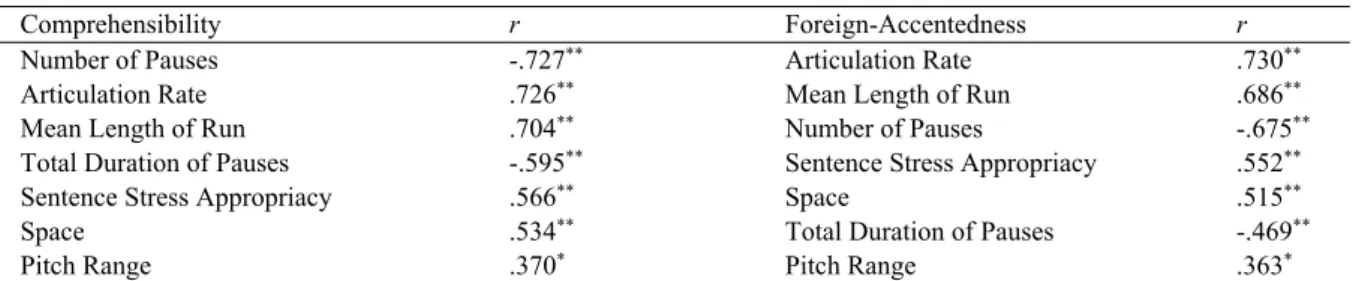
The first step in determining the predictors of the dependent variables was to conduct correlation analyses between the seven independent variables and each dependent variable (that is, comprehensibility and foreign- accentedness). The results are seen in Table 2.
Table 2 Correlation of Suprasegmentals with Comprehensibility and Foreign-Accentedness
Comprehensibility r Foreign-Accentedness r
Number of Pauses -.727** Articulation Rate .730**
Articulation Rate .726** Mean Length of Run .686**
Mean Length of Run .704** Number of Pauses -.675**
Total Duration of Pauses -.595** Sentence Stress Appropriacy .552**
Sentence Stress Appropriacy .566** Space .515**
Space .534** Total Duration of Pauses -.469**
Pitch Range .370* Pitch Range .363*
Note. r indicates Pearson correlations; ** indicates p < .01; * indicates p < .05.
The comprehensibility scores of the participants were found to be best correlated with the number of pauses (r = -.727**). In addition, two strong correlations were found between comprehensibility and two speech rate variables (articulation rate: r = .726**; MLR: r = .704**). Total duration of silent pauses (r = -.595**), sentence stress appropriacy ratio (r = .566**), and space (r = .534**) showed similarly moderate correlations with comprehensibility scores. Pitch range also proved to be significantly, positively correlated with comprehensibility (r = .370*).
For foreign-accentedness scores, two speech rate factors were the strongest correlates (articulation rate:
r = .730**; mean length of run: r = .686**). Two pause variables showed lower r scores for foreign-accentedness than for comprehensibility (N of pauses: r = -.675**; total duration of pauses: r = -.469**). For both of the dependent variables, speech samples with an increased number of pauses lowered comprehensibility and strengthened foreign-accentedness, while those with increased speech rate, frequent and appropriate use of prominence (space:
r = .515**, sentence stress appropriacy ratio: r = .552**), and/or broader pitch changes (pitch range: r = .363*) were perceived as easier to comprehend, with lower foreign-accentedness.
Results of stepwise multiple regression analyses are presented in Tables 3 and 4. As shown in Table 3, stepwise multiple regression arrived at a final regression model for comprehensibility scores with three significant predictors: number of silent pauses, sentence stress appropriacy ratio, and articulation rate.
Table 3 Final Regression Model of Comprehensibility
Variables B β t-value sig. p Step Entered R2 Change VIF
N of Pauses -.145 -.377 -3.243 .003 1 .529 1.764
Sentence Stress
Appropriacy 2.937 .366 3.994 .000 2 .148 1.091
Articulation Rate .012 .387 3.337 .002 3 .085 1.751
Final model R2 = .762, F(3, 31) = 33.095, p < .000, Adjusted R2 = .739, Durbin Watson = 2.362 Note. B indicates unstandardized coefficients; β indicates standardized coefficients.
The R2 score (.762) in the final model shows that the variables have high correlations when they are combined, and the final model explains about 76% of the variance of comprehensibility scores. The standardized coefficient (β) values in the final model indicate that the three variables are more or less the same in their strength of relationship to the learners’ comprehensibility score. Overall, learners’ speech was more comprehensible when they spoke with a high speech rate, as well as with fewer pauses and more appropriate sentence stress within a tonality.
However, Table 4 shows that, unlike predictors of comprehensibility, foreign-accentedness was mainly detected by speech rate and frequency of prominence (space), which seems to reflect English rhythm characteristics. The strongest predictor, entered first, was articulation rate, followed by space and MLR. With these variables in the final model, about 75% of the variance can be explained. β values for the three variables indicate that articulation rate is most strongly related to the dependent variable, followed by space and MLR.
Table 4 Final Regression Model of Foreign-Accentedness
Variables B β t-value sig. p Step Entered R2 Change VIF
Articulation Rate .017 .489 4.158 .000 1 .532 1.718
Space 13.301 .382 4.160 .000 2 .172 1.050
Mean Length of Run .147 .287 2.411 .022 3 .047 1.766
Final model R2 = .751, F(3, 31) = 31.116, p < .000, Adjusted R2 = .727, Durbin Watson = 2.308 Note. B indicates unstandardized coefficients; β indicates standardized coefficients.
4.2 Discussion
The results of this study have important implications in two areas: teaching L2 English pronunciation and teaching L2 English speaking and listening.
4.2.1 Teaching L2 English Pronunciation
The first and second research questions were about the aspects of English prosody that crucially determine L2 speech comprehensibility and foreign-accentedness, respectively. First, consistent with the findings of previous research (Munro and Derwing 1995a, 1999, among others), native listeners scored slightly higher on comprehensibility than foreign-accentedness. This means that listeners perceive the comprehensibility and foreign-accentedness of the same speech as distinct (at least partially), and that L2 speech with a foreign accent may also potentially be comprehended without handicap. This suggests that the ultimate goal of pronunciation teaching should not be to remove the foreign accent itself, but to improve comprehensibility, as first claimed by Munro and Derwing (1995).
This study follows previous research on the relative contribution of several components of learner speech (e.g., Kang 2010, Trofimovich and Isaacs 2012), but with more focus on sentence stress appropriacy. The final regression results show that pause frequency, sentence stress appropriacy, and speech rate contributed substantially to comprehensibility ratings, as speech rate and prominence frequency did to foreign-accentedness. This implies that the use of prominence itself with a moderate speech rate would enable learners to remove foreign-accentedness.
In other words, maintaining a so-called regular English rhythm, with its alternation of strong and weak words, contributes to the nativelikeness of pronunciation.
More importantly, the results suggest that to improve the comprehensibility of learners’ speech, appropriate placement of sentence stress and decreased pause production are important. It is therefore expected that the benefit of one accurate placement of sentence stress will override the regular production of sentence-level prominence in the communicative situation. Further, given that what was measured was the number of pauses within a tonality, the results imply (albeit indirectly) that both the tonality and tonicity (that is, sentence stress appropriacy) as a whole significantly contribute to L2 speech comprehensibility. This is because sentence stress affects the natural pause distribution of an utterance. Pauses tend to attract the listener’s attention when they are placed before or after new information. Too many pauses within a tonality and before a piece of given information disturb the comprehension of L2 speech (Hahn and Dickerson 1999). The results also indicate that learners should be informed to place pauses appropriately. Additionally, they should be aware of the fact that frequent pauses may disturb listeners’ understanding of the message. However, when we consider the instructional effects of pronunciation teaching, this may not be effective. Pauses are by-products of language processing and are not likely to be under the control of L2 learner-speakers. The importance of pauses in speech cannot be undermined. However, given the instructional effects of what can and cannot be easily taught and learned in language classrooms, it would be desirable to focus on what learners can take in—the appropriate placement of sentence stress.
Given that the general goal of English teaching is to improve learners’ communicative language ability, it is fundamental for learners to be aware of the importance of sentence stress and information structure in the communicative context. Even advanced learners might face communication breakdown due to a lack of awareness of the communicative functions of sentence stress. As mentioned above, the use of English sentence stress requires discourse-level knowledge as well as phonetic and phonological knowledge in English. It is especially important for learners to be informed at an early stage of English learning that the information structure of an utterance is
reflected in prosody in English. Being aware of information structure is also a very important principle in communication (Clark and Haviland 1977). Even more importantly, using appropriate sentence stress based on the given or new status of linguistic items helps speakers to construct a coherent discourse, thus reducing the comprehension effort of listeners (Baumann 2006).
4.2.2 Teaching L2 English Speaking and Listening
What, then, should learners focus on to speak and listen efficiently? Focusing more on sentence stress in the classroom will benefit learners in terms of listening since appropriate sentence stress provides information on what the listener should really focus on. At present, it is often assumed in English classrooms that learners have difficulty with L2 English listening because they are not familiar with the features of the spoken language such as reduced sounds, linking, etc. However, if learners are instructed to focus on the way information is prosodically structured, their English listening ability can be supported and improved. This is because, given learner’s limited capacity to process an L2, it may be more efficient for them to focus on the most informative parts of speech. If learners’
attention is drawn instead to features such as reduced sounds (i.e., deaccented), they may overlook more important aspects such as sentence stress on new information (i.e., accented).
This also seems to reflect the natural process of prosody planning in speaking. According to Baumann (2006), nuclear accent is considered foremost (“planned first,” p. 64) in an utterance, and this ultimately determines the utterance’s rhythm. For example, the prenuclear accent is sometimes placed on the subject position, as required by the rhythm. However, this placement of the prenuclear accent is subsidiary to the placement of the nuclear accent. This can also be applied to the vowel reduction or stress-timing of L2 speech—what determines the English rhythm and stress-timing is the placement of sentence stress, not the reduction in vowel duration itself. Further, maintaining stress-timing does not significantly affect comprehension in the EIL context (Jenkins 2002).
One of the motivations of this study was the high importance of sentence stress in communicative contexts. The contribution made by the accentuation or de-accentuation of new versus given information to speech comprehension has been examined in a number of previous studies on English as a native language (Birch and Clifton 1995, Bock and Mazzella 1983, Cutler 1976, Cutler and Fodor 1979, Terken and Nooteboom 1987). In L2 contexts, Hahn (2004) proved the significance of sentence stress in speech comprehension and showed that the proper use of sentence stress reduced the cognitive load of the listeners while processing the content of the speech.
However, focus marking carries substantial cross-linguistic variations across several layers of linguistic features (Baker, 2010); therefore, it is especially significant. Notably, English speakers employ language-specific rules to locate sentence stress. When the whole utterance (either a phrase or a sentence) provides new information, the sentence stress falls on the last lexical item, although it has no additional informative value than the other words.
In other words, the structural rule determines sentence stress (Kreidler 2004). The rule of assigning sentence stress can be further modified to reflect the information structure of the utterance on site—the use of sentence stress considers the informativeness of each lexical item in each utterance at the discourse level determined directly by the ongoing discourse content (Fuchs 1984, Halliday 1967).
More importantly, research has suggested that languages vary in their realization of focus marking (Baumann 2006, Cutler 1984, Jun 2013, MacWhinney and Bates 1978, Sohn 1999). MacWhinney and Bates (1978) found that English and Hungarian children differed in their preferred devices to display the informativeness of their utterances. Prosodic devices overrode structural realization in the speech of English children, represented by the more frequent appearance of emphatic stress for new items. Meanwhile, Hungarian children adopted structural devices for the same context most of the time because of the characteristics of their native language with free word
order. This shows that Korean learners of English whose native language also allows syntactic operations to display informativeness, such as scrambling, may be unfamiliar with the prosodic manifestation of information structure.
They have difficulty listening to and speaking L2 English, which highlights the value of sentence stress placement education for L2 English in the Korean context.
It is difficult to prioritize the teaching of sentence stress in this EFL context, where diverse English language skills must be addressed in a limited period. Therefore, to use the given time efficiently, sentence stress in English can be considered in classrooms related to the manifestation of anaphoric and referential expressions. Sentence stress appropriacy always refers to the discourse-level informativeness of each lexical item. Therefore, the prosodic aspects of English pronunciation may be better integrated into L2 English instruction to Korean learners when the grammatical aspects are combined with them at the discourse level.
5. Conclusion
The present study has some limitations that hinder the interpretation of its results. To control the vocabulary and grammar effect, the experiment employed read speech materials. Also, the contribution of sentence stress appropriacy was compared with prosodic features such as speech rate and pause features. For future research with extemporaneous speech data, it would be possible to compare the contribution of sentence stress appropriacy to speech comprehensibility with other grammatical and/or lexical variables. It would be especially interesting to compare different aspects of English information structure, one with the prosodic realization (that is, sentence stress appropriacy) and the other with grammatical realizations such as the use of articles or canonical/non- canonical structure. Therefore, further research that relies on natural speech samples obtained from extemporaneous speech would allow for more generalizations. Moreover, a larger number of participants would increase the explanatory power.
Despite these limitations, the study findings have clear implications for EFL instruction. This study first shows both the what and the how of pronunciation teaching in the communicative context. Effectiveness and efficiency in achieving the communicative aims of English learning should be prioritized in classrooms that provide L2 students with limited target language input and speaking time. Learners generally wish to know how to convey their intended meaning effectively and modify their speech accordingly. Specifically, teachers can encourage learners to become more engaged in using sentence stress appropriately, focusing on the information structures of their utterances to help them produce more comprehensible speech in an L2 context. To verify the pedagogical implications of this study, future research can address the effect of sentence-stress-focused listening and speaking instruction on speech comprehension by native and non-native listeners at both the sentence and discourse levels.
References
Baker, R. E. 2010. The Acquisition of English Focus Marking by Non-native Speakers. Doctoral dissertation, Northwestern University, IL, USA.
Baumann, S. 2006. The Intonation of Givenness: Evidence from German. Tübingen, Germany: Niemeyer.
Birch, S. and C. Clifton. 1995. Focus, accent, and argument structure: Effects on language comprehension.
Language and Speech 38(4), 365–391.
Bock, J. K. and J. R. Mazzella. 1983. Intonational marking of given and new information: Some consequences for
comprehension. Memory and Cognition 11(1), 64–76.
Bolinger, D. L. 1958. A theory of pitch accent in English. Word 14(2–3), 109–149.
Bolinger, D. L. 1972. Accent is predictable (if you're a mind-reader). Language 48(3), 633–644.
Brazil, D. 1997. The Communicative Value of Intonation in English. Cambridge: Cambridge University Press.
Bresnan, J. W. 1971. Sentence stress and syntactic transformations. Language 47(2), 257–281.
Celce-Murcia, M., D. M. Brinton and J. M. Goodwin. 1996. Teaching Pronunciation: A Reference for Teachers of English to Speakers of Other Languages. Cambridge: Cambridge University Press.
Chomsky, N. and M. Halle. 1968. The Sound Pattern of English. New York: Harper and Row.
Clark, H. H. and S. E. Haviland. 1977. Comprehension and the given-new contract. In R. Freedle, ed., Discourse Production and Comprehension, 1–40. Norwood, NJ: Ablex.
Crowther, D., P. Trofimovich, K. Saito and T. Isaacs. 2018. Linguistic dimensions of L2 accentedness and comprehensibility vary across speaking tasks. Studies in Second Language Acquisition 40(2), 443–457.
Cutler, A. 1976. Beyond parsing and lexical look-up. In R. J. Wales and E.C. T. Walkers, eds., New Approaches to Language Mechanisms: A Collection of Psycholinguistic Studies, 133–149. Amsterdam: North-Holland Pub.
Cutler, A. 1984. Stress and accent in language production and understanding. In D. Gibbon and H. Ritcher eds., Intonation, Accent and Rhythm: Studies in Discourse Phonology 8, 76–90. New York: Walter de Gruyter.
Cutler, A. and J. A. Fodor. 1979. Semantic focus and sentence comprehension. Cognition 7(1), 49–59.
Derwing, T. M. and M. J. Munro. 1997. Accent, intelligibility, and comprehensibility: Evidence from four L1s.
Studies in Second Language Acquisition 19(1), 1–16.
Derwing, T. M. and M. J. Munro. 2009. Putting accent in its place: Rethinking obstacles to communication.
Language Teaching 42(4), 476-490.
Derwing, T. M., M. J. Munro and G. Wiebe. 1998. Evidence in favor of a broad framework for pronunciation instruction. Language Learning 48(3), 393–410.
Flege, J. E., M. J. Munro and I. R. MacKay. 1995. Factors affecting strength of perceived foreign accent in a second language. The Journal of the Acoustical Society of America 97(5), 3125–3134.
Fuchs, A. 1984. Deaccenting and default accent. In D. Gibbon and H. Ritcher, eds., Intonation, Accent and Rhythm:
Studies in Discourse Phonology 8, 134–164. New York: Walter de Gruyter.
Hahn, L. D. 2004. Primary stress and intelligibility: Research to motivate the teaching of suprasegmentals. TESOL Quarterly 38(2), 201–223.
Hahn, L. D. and W. B. Dickerson. 1999. Speech Craft: Discourse Pronunciation for Advanced Learners. Ann Arbor: The University of Michigan Press.
Halliday, M. A. K. 1967. Notes on transitivity and theme in English: Part 2. Journal of Linguistics 3(2), 199–244.
Halliday, M. A. K and W. S. Greaves. 2008. Intonation in the Grammar of English. London: Equinox Pub.
Isaacs, T and P. Trofimovich. 2012. Deconstructing comprehensibility. Studies in Second Language Acquisition 34(3), 475–505.
Jenkins, J. 2002. A sociolinguistically based, empirically researched pronunciation syllabus for English as an international language. Applied Linguistics 23(1), 83–103.
Jun, Y. 2013. Hangugeo Myeongsagu-ui Uimiron: Hanjeongseong/Teukjingseong, Chongchingseong, Boksuseong [A Semantics for Korean Noun Phrases: Definiteness/Specificity, Genericity, Plurality]. Seoul:
Seoul National University Press.
Kang, O. 2010. Relative salience of suprasegmental features on judgments of L2 comprehensibility and accentedness. System 38(2), 301–315.