© 2018 The Korean Ophthalmological Society
This is an Open Access article distributed under the terms of the Creative Commons Attribution Non-Commercial License (http://creativecommons.org/licenses /by-nc/3.0/) which permits unrestricted non-commercial use, distribution, and reproduction in any medium, provided the original work is properly cited.
Original Article
Influence of Sodium Hyaluronate Concentration on Corneal Aberrations in Soft Contact Lens Wearers
Jong Soo Lee1, Jong Moon Park2, Hyun Kyung Cho2, Su Jin Kim2, Hyoun Do Huh2, Young Min Park2
1Department of Ophthalmology, Pusan National University Hospital, Pusan National University School of Medicine and Medical Research Institute, Yangsan, Korea
2Department of Ophthalmology, Gyeongsang National University Changwon Hospital, Gyeongsang National University School of Medicine, Changwon, Korea
Purpose: This study aimed to evaluate the influence of varying concentrations of sodium hyaluronate (SH) eye drops on corneal aberrations in normal individuals wearing silicone hydrogel contact lenses.
Methods: Normal individuals wearing silicone hydrogel contact lenses were enrolled in this study. Subjects were classified into two groups depending on the concentration of the preservative-free SH used (group 1, 0.1% SH;
group 2, 0.3% SH). All subjects were asked to blink five times after instillation of the SH eye drop and before the Galilei measurements. Corneal aberrations were measured over the contact lenses before and after SH eye drop instillation. Visual acuity (VA) over the contact lenses was also measured both before instillation of the SH eye drop and after the subjects completed the five blinks.
Results: There was no change in VA after SH instillation in group 1; however, group 2’s VA significantly deteri- orated after SH instillation. Changes in VA after SH instillation compared to baseline were significantly higher in group 2 than in group 1. Similarly, the increase in corneal aberrations after SH instillation was significant in group 2 but not significant in group 1. Among the significantly increased corneal aberration parameters, defo- cus was the main type in group 2. Changes in corneal aberrations after SH instillation compared to baseline were significantly higher in group 2 than in group 1.
Conclusions: A 0.3%-concentration of SH increases corneal aberration and decreases VA in soft contact lens wearers. Defocus is the main type of aberration that increased in the 0.3% SH instillation group.
Key Words: Contact lenses, Hyaluronic acid, Visual acuity, Wavefront aberration
Contact lens-induced tear film abnormalities are a common reason for patients to discontinue use of their contact lenses [1].
Approximately 50% of contact lens wearers experience symp- toms of contact lens-induced tear film abnormality such as lacrimation, discomfort, dryness, burning, itching, blurry vi- sion, and foggy vision [1-3]. Dryness and ocular symptoms are often relieved by application of ocular lubricants. Approxi- mately 20% of lens wearers use ocular lubricants, and many practitioners opt for ocular lubricants as first-line treatment [4].
In addition, lubrication drop instillation is considered the most common strategy in the management of contact lens-induced
Received: August 7, 2017 Accepted: August 29, 2017
Corresponding Author: Young Min Park, MD, PhD. Department of Ophthalmology, Gyeongsang National University Changwon Hospital, Gyeongsang National University School of Medicine, #11 Samjeongja-ro, Seongsan-gu, Changwon 51472, Korea. Tel: 82-55-214-3851, Fax: 82-55- 214-3257, E-mail: [email protected]
tear film abnormality [5-7].
Sodium hyaluronate (SH) is a glycosaminoglycan that con- sists of a naturally occurring linear biopolysaccharide with exceptional hygroscopic, lubricating, and viscoelastic proper- ties [8]. SH eye drops are known to increase tear film stabili- ty, maintain corneal moisture, and reduce tear evaporation, which all promote increased healing time for the corneal epi- thelium [9-11]. When SH is classified according to concentra- tion, a relatively increased number of high-order aberrations (HOAs) are observed after instillation of 0.3% SH eye drops [12].
This study aimed to evaluate the influence of various con- centrations of SH eye drops on the corneal aberrations in normal individuals wearing silicone hydrogel contact lenses.
Materials and Methods
Study design and subjects
Normal fifty individuals wearing silicone hydrogel con- tact lenses (Acuvue Oasys, Vistakon; Division of Johnson
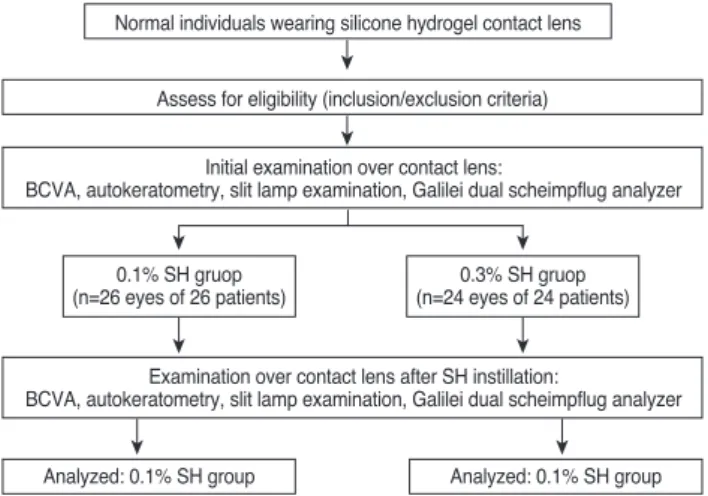
& Johnson Vision Care, Jacksonville, FL, USA; 14-mm di- ameter, 8.4-mm base curve, and 0.070-mm central thick- ness) were enrolled in this study (Fig. 1). Subjects were in- cluded in this study if they were found to have a best- corrected visual acuity of 10 / 10, a healthy ocular surface,
a keratometry range between 41 and 45 diopters (D), a maximum spherical refraction of 0.25 D (minus and plus), and a cylindrical refraction of 0.50 D (minus). Subjects with signs of microbial keratitis, including corneal stromal infil- tration, purulent discharge, conjunctival and episcleral hy- peremia, and anterior chamber reaction before or during lens wear were excluded from the study. Moreover, all sub- jects with a previous history of corneal refractive surgery, dry eye syndrome, or blepharitis were excluded from the study. We certify that all applicable institutional and gov- ernmental regulations concerning the ethical use of human volunteers were followed during this research study.
Measurements over contact lenses
The right eyes of all contact lens wearers were initially ex- amined by assessment of best-corrected visual acuity, auto- keratometry, and slit-lamp examination, as well as measure- ment of corneal aberrations using the noninvasive Galilei Dual Scheimpflug Analyzer system (Ziemer, Port, Switzer- land). The scanning process of the Galilei system acquires a series of Scheimpflug images and two Placido images, each 90 degrees apart. The Galilei system displays all corneal wavefront aberrations calculated from the front and back sur- faces, while centered on the pupil. The following values were recorded with a 6.0-mm pupil: root-mean-square total, low- order aberrations, HOAs of the third to sixth orders, and spherical aberrations. Corneal aberrations were measured over the contact lenses before and after SH eye drop instilla- tion. All measurements were performed with non-dilated pu- pils under identical lighting conditions.
Subjects wearing silicone hydrogel contact lenses were classified into two groups based on the concentration of the preservative-free SH used (group 1, 0.1% SH; group 2, 0.3%
SH). All subjects were asked to blink five times after instilla- tion of the SH eye drop and before the Galilei measurements, which were performed according to the manufacturer’s guidelines. The device was brought into focus, and the pa- tient’s eye was aligned along the visual axis using a central fixation light. Visual acuity (VA) over the contact lenses after instillation of the SH eye drop was also measured after the subjects completed the five blinks.
Statistical analysis
All data are presented as mean ± standard deviation. The
Normal individuals wearing silicone hydrogel contact lens Assess for eligibility (inclusion/exclusion criteria)
0.1% SH gruop (n=26 eyes of 26 patients)
Analyzed: 0.1% SH group Analyzed: 0.1% SH group Initial examination over contact lens:
BCVA, autokeratometry, slit lamp examination, Galilei dual scheimpflug analyzer
Examination over contact lens after SH instillation:
BCVA, autokeratometry, slit lamp examination, Galilei dual scheimpflug analyzer 0.3% SH gruop (n=24 eyes of 24 patients)
Fig. 1. Flow chart of the current study. Subjects wearing silicone hydrogel contact lenses were classified into two groups based on the concentration of preservative-free sodium hyaluronate (SH) used (group 1, 0.1% SH; group 2, 0.3% SH). Corneal aberrations were measured over the contact lenses before and after each SH eye drop instillation. BCVA = best-corrected visual acuity.
differences between pre-instillation and post-instillation values were analyzed using the Wilcoxon signed-rank test.
A p-value <0.05 was considered statistically significant.
The Mann-Whitney U-test was used to compare the results between groups. All calculations were performed using SPSS ver. 12.0 (SPSS Inc., Chicago, IL, USA).
Results
The right eyes of 50 subjects wearing silicone hydrogel contact lenses (23 males and 27 females; mean age, 30 ± 5.7 years) were included in this study (group 1, 26 subjects;
group 2, 24 subjects). VA measured over the contact lens before SH instillation was recorded as 0 ± 0 logarithm of the minimum angle of resolution (logMAR) in both groups.
In group 1, there was no change in VA after SH instillation (0.03 ± 0.06 logMAR; Wilcoxon signed-rank test, p > 0.05).
However, group 2 showed significantly deteriorated VA af- ter SH instillation (0.08 ± 0.11 logMAR; Wilcoxon signed- rank test, p = 0.04). Changes in VA after SH instillation compared to baseline were significantly higher in group 2 than in group 1 (0.08 ± 0.06, 0.03 ± 0.02 logMAR, respec- tively; Mann-Whitney U-test, p = 0.03).
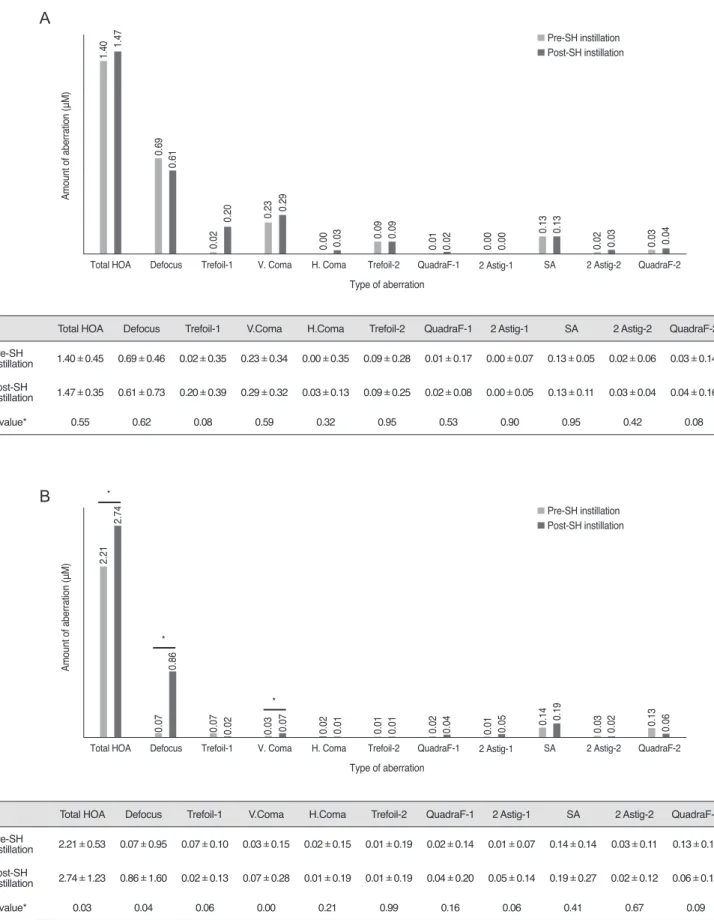
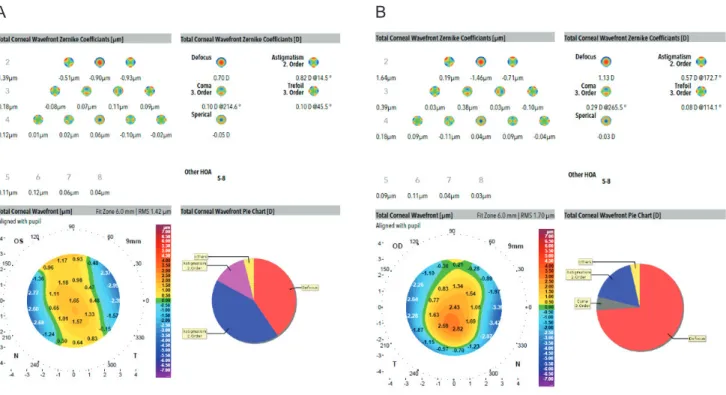
Similarly, the increase in corneal aberrations after SH instillation was significant in group 2 but not in group 1 (Wilcoxon signed-rank test) (Fig. 2A, 2B). Among the sig- nificantly increased corneal aberration parameters, defocus was the main type in group 2 (Fig. 2, 3A, 3B). Unlike group 1, the defocus aberrations of group 2 increased significantly from 0.073 to 0.857 μm after SH instillation (Wilcoxon signed-rank test, p = 0.04) (Fig. 2). Changes in corneal ab- errations after SH instillation compared to baseline were significantly higher in group 2 than in group 1 (Fig. 4).
Discussion
In order to reduce the symptoms of contact lens-induced tear film abnormalities, soft contact lens wearers common- ly use lubricating eye drops [5-7]. Among lubricating eye drops, SH is a frequently used agent. Although a previous study on naked eyes showed that highly viscous SH drops resulted in significantly higher HOAs than did less viscous SH drops [12], no study has investigated the influence of SH concentration on corneal aberration or VA in contact
lens wearers.
In the current study, 0.3% SH eye drops significantly de- teriorated the VA of normal individuals wearing silicone hydrogel contact lenses, while 0.1% SH eye drops did not.
In addition, significantly increased corneal aberration was observed only in the 0.3% SH instillation group, with a particular increase in defocus aberrations. Taken together, the results of the current study suggest that defocus might be the main cause of increased corneal aberrations and de- creased VA in the 0.3% SH instillation group.
Defocus is a low-order aberration that encompasses both myopia (positive defocus) and hyperopia (negative defo- cus). In the current study, positive defocus was significantly induced in the 0.3% SH instillation group. There are two possible explanations for the increased defocus in this group. Given that a high concentration of SH is known to have a longer pre-corneal residence time [12,13], the pre- lens residence time of the 0.3% SH instillation group might have been longer than that of the 0.1% SH instillation group. Second, because 0.3% SH resides for a longer time on the ocular surface, there is a higher possibility of 0.3%
SH infiltrating into the space between the posterior lens surface and the cornea during lens movement. Moreover, the fluid space between the lens and the cornea might move the lens anteriorly, resulting in the increased positive defo- cus aberration. The increase in positive defocus also ex- plains the decreased distant VA of subjects in the 0.3% SH instillation group.
The interblink interval in normal eyes is reported to be 5.97 seconds [14]. After the instillation of SH, all subjects were asked to blink five times before the measurements were performed. This means that the increase in corneal aberration and decrease in VA can last for at least 24 sec- onds. In addition, this finding is consistent with the study by Koh et al. [12] on naked eyes. The limitations of the cur- rent study are the inability to measure the actual time until vision is restored and the time until aberrations improve.
Future research will be conducted to investigate the actual precorneal residence time of 0.3% SH in contact lens wearers.
The current study shows that 0.3% SH increases corneal aberration and decreases VA in soft contact lens wearers.
We think it is advisable to prescribe low-concentration SH to contact lens wearers engaged in occupations that require rapid reactions, such as vocational drivers.
Amount of aberration (μM)Amount of aberration (μM) 1.40 0.69 0.61 0.02 0.20 0.23
0.00 0.03 0.09 0.09
0.01 0.00 0.00
0.13 0.13
0.02 0.03 0.03 0.04
0.02
0.29
1.47 Pre-SH instillation
Post-SH instillation
Pre-SH instillation Post-SH instillation Type of aberration
Total HOA Defocus Trefoil-1 V. Coma H. Coma Trefoil-2 QuadraF-1 2 Astig-1 SA 2 Astig-2 QuadraF-2
Type of aberration
Total HOA Defocus Trefoil-1 V. Coma H. Coma Trefoil-2 QuadraF-1 2 Astig-1 SA 2 Astig-2 QuadraF-2
2.21 0.86 0.070.07 0.02 0.03 0.010.010.02 0.01 0.02 0.01 0.05 0.14 0.19 0.03 0.02 0.13 0.060.040.07
2.74
*
*
*
Amount of aberration (μM)Amount of aberration (μM) 1.40 0.69 0.61 0.02 0.20 0.23
0.00 0.03 0.09 0.09
0.01 0.00 0.00
0.13 0.13
0.02 0.03 0.03 0.04
0.02
0.29
1.47 Pre-SH instillation
Post-SH instillation
Pre-SH instillation Post-SH instillation Type of aberration
Total HOA Defocus Trefoil-1 V. Coma H. Coma Trefoil-2 QuadraF-1 2 Astig-1 SA 2 Astig-2 QuadraF-2
Type of aberration
Total HOA Defocus Trefoil-1 V. Coma H. Coma Trefoil-2 QuadraF-1 2 Astig-1 SA 2 Astig-2 QuadraF-2
2.21 0.86 0.070.07 0.02 0.03 0.010.010.02 0.01 0.02 0.01 0.05 0.14 0.19 0.03 0.02 0.13 0.060.040.07
2.74
*
*
*
Fig. 2. Comparison of corneal aberrations before and after sodium hyaluronate (SH) instillation in contact lens wearers. (A) 0.1% SH and (B) 0.3% SH. HOA = high-order aberration; SA = spherical aberration. *Wilcoxon signed-rank test.
A
B
Total HOA Defocus Trefoil-1 V.Coma H.Coma Trefoil-2 QuadraF-1 2 Astig-1 SA 2 Astig-2 QuadraF-2 Pre-SH
instillation 1.40 ± 0.45 0.69 ± 0.46 0.02 ± 0.35 0.23 ± 0.34 0.00 ± 0.35 0.09 ± 0.28 0.01 ± 0.17 0.00 ± 0.07 0.13 ± 0.05 0.02 ± 0.06 0.03 ± 0.14 Post-SH
instillation 1.47 ± 0.35 0.61 ± 0.73 0.20 ± 0.39 0.29 ± 0.32 0.03 ± 0.13 0.09 ± 0.25 0.02 ± 0.08 0.00 ± 0.05 0.13 ± 0.11 0.03 ± 0.04 0.04 ± 0.16
p-value* 0.55 0.62 0.08 0.59 0.32 0.95 0.53 0.90 0.95 0.42 0.08
Total HOA Defocus Trefoil-1 V.Coma H.Coma Trefoil-2 QuadraF-1 2 Astig-1 SA 2 Astig-2 QuadraF-2 Pre-SH
instillation 2.21 ± 0.53 0.07 ± 0.95 0.07 ± 0.10 0.03 ± 0.15 0.02 ± 0.15 0.01 ± 0.19 0.02 ± 0.14 0.01 ± 0.07 0.14 ± 0.14 0.03 ± 0.11 0.13 ± 0.11 Post-SH
instillation 2.74 ± 1.23 0.86 ± 1.60 0.02 ± 0.13 0.07 ± 0.28 0.01 ± 0.19 0.01 ± 0.19 0.04 ± 0.20 0.05 ± 0.14 0.19 ± 0.27 0.02 ± 0.12 0.06 ± 0.19
p-value* 0.03 0.04 0.06 0.00 0.21 0.99 0.16 0.06 0.41 0.67 0.09
0.1% SH 0.3% SH
*
*
* *
0.00 0.10 0.20 0.30 0.40 0.50 0.60 0.70 0.80
Amount of aberration (μM)
Type of aberration
Total HOA Defocus Trefoil-1 V. Coma H. Coma Trefoil-2 QuadraF-1 2 Astig-1 SA 2 Astig-2 QuadraF-2
Fig. 4. Changes in corneal aberrations (∆) after sodium hyaluronate (SH) instillation compared to baseline in contact lens wearers. HOA
= high-order aberration; SA = spherical aberration. *Mann-Whitney U-test.
Total HOA Defocus Trefoil-1 V.Coma H.Coma Trefoil-2 QuadraF-1 2 Astig-1 SA 2 Astig-2 QuadraF-2 0.3% SH 0.53 ± 1.11 0.78 ± 1.75 0.05 ± 0.12 0.11 ± 0.16 0.03 ± 0.10 0.00 ± 0.28 0.06 ± 0.19 0.04 ± 0.10 0.05 ± 0.29 0.01 ± 0.11 0.08 ± 0.21 0.1% SH 0.06 ± 0.53 0.13 ± 0.7 0.17 ± 0.50 0.07 ± 0.48 0.04 ± 0.17 0.00 ± 0.41 0.02 ± 0.15 0.00 ± 0.09 0.00 ± 0.09 0.01 ± 0.07 0.07 ± 0.18
p-value* 0.03 0.04 0.13 0.34 0.04 0.49 0.08 0.04 0.20 0.46 0.42
A B
Fig. 3. Corneal aberration changes after 0.3% sodium hyaluronate (SH) instillation. (A) Before 0.3% SH instillation and (B) after 0.3% SH instillation. HOA = high-order aberration.
Conflict of Interest
No potential conflict of interest relevant to this article was reported.
References
1. Glasson MJ, Stapleton F, Keay L, Willcox MD. The effect of short term contact lens wear on the tear film and ocular surface characteristics of tolerant and intolerant wearers.
Cont Lens Anterior Eye 2006;29:41-7.
2. Caffery BE, Richter D, Simpson T, et al. CANDEES: the Canadian Dry Eye Epidemiology Study. Adv Exp Med Biol 1998;438:805-6.
3. Young G, Veys J, Pritchard N, Coleman S. A multi-centre study of lapsed contact lens wearers. Ophthalmic Physiol Opt 2002;22:516-27.
4. Dumbleton K, Woods C, Fonn D. An investigation of the effica- cy of a novel ocular lubricant. Eye Contact Lens 2009;35:149-55.
5. Begley CG, Caffery B, Nichols KK, Chalmers R. Respons- es of contact lens wearers to a dry eye survey. Optom Vis Sci 2000;77:40-6.
6. Subbaraman LN, Bayer S, Glasier MA, et al. Rewetting drops containing surface active agents improve the clinical performance of silicone hydrogel contact lenses. Optom Vis
Sci 2006;83:143-51.
7. Chalmers RL, Begley CG. Dryness symptoms among an unselected clinical population with and without contact lens wear. Cont Lens Anterior Eye 2006;29:25-30.
8. Nichols JJ, Ziegler C, Mitchell GL, Nichols KK. Self-re- ported dry eye disease across refractive modalities. Invest Ophthalmol Vis Sci 2005;46:1911-4.
9. Johnson ME, Murphy PJ, Boulton M. Effectiveness of so- dium hyaluronate eyedrops in the treatment of dry eye.
Graefes Arch Clin Exp Ophthalmol 2006;244:109-12.
10. Hamano T, Horimoto K, Lee M, Komemushi S. Sodium hyaluronate eyedrops enhance tear film stability. Jpn J Ophthalmol 1996;40:62-5.
11. Shimmura S, Ono M, Shinozaki K, et al. Sodium hyaluro- nate eyedrops in the treatment of dry eyes. Br J Ophthal- mol 1995;79:1007-11.
12. Koh S, Maeda N, Ikeda C, et al. Effect of instillation of eyedrops for dry eye on optical quality. Invest Ophthalmol Vis Sci 2013;54:4927-33.
13. Snibson GR, Greaves JL, Soper ND, et al. Precorneal resi- dence times of sodium hyaluronate solutions studied by quantitative gamma scintigraphy. Eye (Lond) 1990;4(Pt 4):594-602.
14. Johnston PR, Rodriguez J, Lane KJ, et al. The interblink interval in normal and dry eye subjects. Clin Ophthalmol 2013;7:253-9.