REVIEW ARTICLE
국내 Helicobacter pylori 의 제균 치료
김승영, 정성우
고려대학교 의과대학 내과학교실
Helicobacter pylori Eradication Therapy in Korea
Seung Young Kim and Sung Woo Jung
Department of Internal Medicine, Korea University College of Medicine, Seoul, Korea
Helicobacter pylori (H. pylori) is known to be associated with many gastrointestinal diseases including peptic ulcer. In Korea, eradication of H. pylori is recommended for peptic ulcer disease, low grade gastric mucosa-associated lymphoid tissue lymphoma, and early gastric cancer. Standard triple therapy using proton pump inhibitor, clarithromycin, and amoxicillin and bismuth-contain- ing quadruple therapy have been the main first-line and second-line therapy for H. pylori in Korea. Although eradication rate of second-line quadruple therapy remains similar to that of the past, the success rate of eradication with triple therapy has decreased with increasing antimicrobial resistance to H. pylori. There is no standard third-line therapy, and some regimens that incorporate levofloxacin, moxifloxacin, and rifabutin can be used. New regimens such as sequential or concomitant therapy are suggested as alternative treatment for H. pylori. We need more well designed randomized controlled studies to choose proper treatment for H. pylori infection. (Korean J Gastroenterol 2011;58:67-73)
Key Words: Helicobacter pylori; Drug therapy; Combination
CC This is an open access article distributed under the terms of the Creative Commons Attribution Non-Commercial License (http://creativecommons.org/licenses/
by-nc/3.0) which permits unrestricted non-commercial use, distribution, and reproduction in any medium, provided the original work is properly cited.
교신저자: 정성우, 425-707, 경기도 안산시 단원구 고잔 1동 516, 고려대학교 의과대학 안산병원 내과학교실
Correspondence to: Sung Woo Jung, Department of Internal Medicine, Korea University Ansan Hospital, Korea University College of Medicine, 516, Gojan-dong, Danwon-gu, Ansan 425-707, Korea. Tel: +82-31-412-5580, Fax: +82-31-412-5582, E-mail: [email protected]
Financial support: None. Conflict of interest: None.
서 론
Helicobacter pylori (H. pylori)는 전세계 인구의 약 50%
감염률을 보이는 가장 흔한 인체 감염균 중의 하나로, 상부위 장관 질환의 중요한 원인 중 하나로 알려져 있다. 현재까지 H. pylori는 소화성궤양, 위암 및 변연부 B세포 림프종 발생에 있어 중요한 원인 인자로 밝혀졌고, 기능성 소화불량증, 위의 과형성 용종, 철결핍성 빈혈 등 기타 질환과의 연관성들이 제 시되고 있다.1 H. pylori와 위장관 질환의 연관성이 밝혀지면 서, 국내에서도 1998년 대한 Helicobacter 및 상부위장관 연 구학회에서 H. pylori 치료에 대한 합의가 발표되었고, 지난 10여 년간 제균 치료가 활발하게 이루어져 왔다. 제균 치료는 H. pylori 관련 소화성궤양의 재발을 줄이는데 크게 기여하였 으며, 위의 변연부 B세포 림프종 관해에도 중요한 역할을 하
고 있다.2-4 그러나 최근 H. pylori의 항생제 내성의 증가로 인해 일차 치료의 성공률이 점차 감소하고 있어 이에 대한 검토와 새로운 제균 치료 정립의 필요성이 대두되고 있다.
이 글에서는 국내 H. pylori 제균 치료의 현황을 살펴보고, 제균율 감소와 함께 연구되고 있는 여러 제균 치료법들을 정 리해 보고자 한다.
본 론
1. 제균의 적응증
국내 H. pylori 유병률은 1998년 66.8%에서 2005년 59.6%
로 감소하고 있으나, H. pylori 항체에 대한 혈청학적 유병률 은 약 50%로 국민의 반수가 감염되어 있고 특히, 16세 이상 의 성인에서는 약 2/3가 감염되어 있다.5 각국의 지침에서는
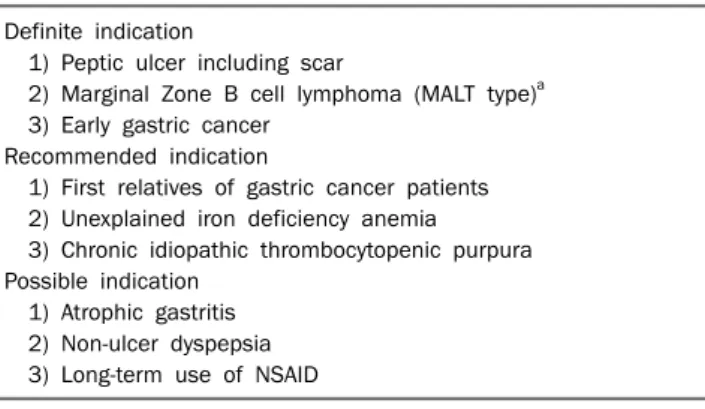
Table 1. Indication for Helicobacter pylori Eradication Definite indication
1) Peptic ulcer including scar
2) Marginal Zone B cell lymphoma (MALT type)a 3) Early gastric cancer
Recommended indication
1) First relatives of gastric cancer patients 2) Unexplained iron deficiency anemia 3) Chronic idiopathic thrombocytopenic purpura Possible indication
1) Atrophic gastritis 2) Non-ulcer dyspepsia 3) Long-term use of NSAID
MALT, mucosa-associated lymphoid tissue.
aLow grade MALToma has been renamed as Marginal zone B cell lymphoma (MALT type).
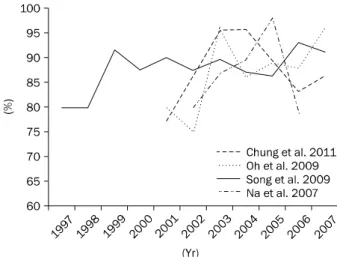
Fig. 1. The change of per protocol eradication rates of standard triple therapy in Korea.11,14-18 Studies maked with * showed significant decreasing trend of eradication rate.
모든 소화성궤양 환자에서 H. pylori의 제균치료를 권고하고 있으며, 위의 변연부 B세포 림프종, 조기위암의 내시경 절제 후, 위암의 가족력이 있는 경우 및 만성 위축성 위염 등이 제 균 치료의 대상이 되고 있다.6-8 국내에서는 1998년 대한 Helicobacter 및 상부위장관 연구학회에서 “한국인에서의 헬 리코박터 파일로리의 진단과 치료”에 대한 합의 도출 이후 2009년 대한상부위장관ㆍ헬리코박터 학회에서 국내외에서 발표된 다양한 문헌들을 검토하여 치료에 대한 적응증을 제시 하였다(Table 1). 새로운 가이드라인에서는 H. pylori 제균 대 상으로, 반흔을 포함한 소화성 궤양 및 변연부 B세포 림프종 과 함께 조기 위암 환자를 추가하였고, 위암 직계가족, 설명되 지 않는 철분결핍빈혈, 만성 특발 혈소판 감소증에서 제균 치 료를 추천하였다.9
2. 표준 제균 치료 1) 일차 치료
최근 전세계적으로 clarithromycin을 포함하는 삼제 요법 의 제균율이 감소하고 있음에도 불구하고,10,11 프로톤펌프 억 제제(proton pump inhibitor, PPI)와 amoxicillin, clarithro- mycin을 사용하는 삼제요법은 최근까지 대부분의 국가에서 표준 치료로 사용하고 있다. 2009년 대한상부위장관ㆍ헬리코 박터 학회에서 발표된 가이드라인에서도 PPI (standard dose bid)와 clarithromycin (0.5 g bid), amoxicillin (1 g bid)을 이용한 삼제요법의 1주 내지 2주 투여를 표준 일차 치료법으 로 권고하고 있다. 표준삼제요법의 제균율은 1998년까지는 90% 이상을 보여 매우 효과적인 것으로 인정받았으나, 그 이 후 점차 성공률이 감소하여 75%까지 보고된 바 있다.12,13 국 내 단일기관에서 5년 이상의 기간 동안 제균율의 변화를 본 연구들을 보면 6개 연구 중 세 연구에서 통계적으로 의미 있 는 감소 추세를 보였다(Fig. 1).11,14-18
제균율이 감소하는 가장 큰 원인은 항생제 내성률의 증가 이다. 국내 한 연구에서 clarithromycin 내성률은 1994년에 2.8%에서, 2003년 13.8%로 급격히 증가하였으며, 다른 연구 에서도 2005년 이전의 경우 16.7%에서 2007년부터 2009년 까지는 38.5%로 내성률 증가를 보고하였다.19,20
치료 기간에 따른 삼제 요법의 제균율을 살펴보면, 2007년 다기관 전향 연구에서 7일에서 14일로의 기간 연장이 의미 있는 제균율 상승을 보여주지 못하였으나,21 2008년 국내 연 구를 대상으로 한 메타 분석에서는 7일에서 14일로의 기간 연장이 약 10% 정도의 제균율 상승을 보였다.22 PPI 종류에 따른 제균율은 몇몇 연구들에서 CYP219 유전자 다형성에 영 향을 덜 받는 rabeprazole이나 esomeprazole이 다른 약제에 비해 비교적 더 좋은 제균율을 보였으나 임상적으로 고려할 만한 차이를 보인 연구는 드물었다.23,24 또한, PPI의 특허약 (original)과 복제약(generic)에 따른 제균율 차이에 대하여 pantoprazole을 대상으로 분석한 연구에서 특허약과 복제약 에 따른 제균율의 차이는 없었다.25 표준 삼제 요법에서 amo- xicillin의 약리학적 특성을 고려하여 동일 용량의 amox- icillin을 하루 두 번과 네 번으로 나누어 투여하여 제균율을 비교한 연구에서도 제균율의 차이는 보이지 않았다.26 표준 삼 제 요법에 probiotics를 추가하였을 때 더 나은 제균율을 보인 연구들이 있으나 아직 더 많은 추가 연구가 필요한 실정이 다.27,28
2) 이차 치료
대한상부위장관ㆍ헬리코박터 학회에서 발표된 가이드라인 에서는 이차 치료제로 PPI (standard dose bid)와 metroni- dazol (0.5 g tid), bismuth (120 mg qid), tetracycline (0.5 g qid)의 사제요법을 1주 내지 2주 투여할 것을 권고하고 있 다. Bismuth를 포함하는 사제 요법은 복용 방법이 복잡하고
Fig. 2. The change of per protocol eradication rates of second-line bismuth-containing quadruple therapy in Korea.11,16,18,30
There was no decreasing trend in eradication rates.
부작용 발생률이 30% 이상 높으나 전세계적으로 가장 많이 사용되고 있다. 국내 사제요법의 제균율은 7일 투여 시 63-81%로 보고되며, 현재까지 제균율의 감소 추세는 뚜렷하 지 않다(Fig. 2).11,16,18,29,30 치료 기간을 7일에서 14일로 연장 하였을 때, 제균율은 69-96%로 보고되며, 최근 연구에서는 1 주 투여보다 2주 투여의 제균율이 의미 있게 높아 향후 투여 기간에 대한 논의가 다시 필요할 것으로 생각된다.31 3) 삼차 치료
H. pylori의 이차 제균 치료에 실패하였을 경우, 삼차 치료 에 대해서는 아직 표준화된 치료법이 없다. 지금까지 연구들 에서는 levofloxacin이나 moxifloxacin, rifabutin을 이용한 방법들이 보고되었다.
Levofloxacin을 이용한 치료법으로 PPI (standard dose bid)와 levofloxacin (200-500 mg bid), amoxicillin (1 g bid) 을 7일 또는 10일 투여할 경우 국내에서는 53.3-74% 정도의 제균율을 보이고 있다.32,33 이는 국외 제균 성적에 비해 낮은 것으로, 국내에서 floroquinolone계 항생제 사용 증가에 따른 내성률 증가가 원인으로 생각된다.
같은 floroquinolone 제제인 moxifloxacin은 이차 치료법 으로 esomeprazole, amoxicillin과 같이 10일간 사용하였을 때, 71.9%의 제균율을 보였다.34 그러나 호흡기 질환 및 이비 인후과 질환에서 국내 moxifloxacin 사용이 증가하고 있으며, 내성 획득이 빠르기 때문에 시간이 지남에 따라 치료 성공률 이 감소할 것으로 생각한다.
Rifabutin은 국내에서 삼차 치료로 사용한 연구는 없지만, PPI, amoxicillin과 사용하였을 때 66.6-86.6%의 제균율을 보 여 하나의 대안으로 사용될 수 있을 것으로 기대된다. 그러나 우리나라는 결핵 유병률이 높아 비정형결핵이나 다약제 내성
결핵 치료제로 사용되는 rifabutin에 대한 내성 획득 우려가 있어 사용에 제한이 있겠다.
흥미롭게도 한 연구에서 bismuth 포함 사제 요법의 이차 치료에 실패한 40명의 환자들에게 다시 한 번 같은 치료법을 사용하였을 때, 75%의 제균율을 보여35 삼차치료를 시도하기 전 이차 사제 요법으로 재치료하는 것을 고려해 볼 수 있겠다.
3. 새로운 제균 치료법
표준 삼제 요법의 제균율이 감소하면서 여러 치료 방법들 이 경험적 일차 치료의 대안으로 제시되고 있다.
1) Sequential therapy
순차적인 10일 치료는 PPI와 amoxicillin 2제를 5일간 투 여 후 PPI와 clarithromycin, 그리고 tinidazole이나 metro- nidazole 3제를 5일간 순차적으로 투여하는 방법이다. 순차 적인 치료의 이론적 근거는 초기 amoxicillin을 사용하는 이 제 요법으로 위 내의 H. pylori균 수를 감소시켜 이후 투여하 는 삼제 요법의 효과를 높이고, amoxicillin이 세포벽을 약화 시킴으로써 clarithromycin 내성 발현을 줄인다는 것이
다.36,37 외국의 메타 분석에서는 표준 삼제 요법과 비교하였을
때 우수한 제균 성적을 보였으나,10,38,39 국내에서 최근 발표된 연구에서는 두 치료법의 제균율이 의미 있는 차이가 없거나 오히려 삼제 요법에 못 미치는 결과를 보여 기간 및 용량의 변화나 추가적인 연구가 필요할 것으로 생각된다.40,41 2) Concomitant therapy
Bismuth를 사용하지 않는 사제 요법으로 순차 치료에 사 용되는 세 가지 항생제, amoxicillin, clarithromycin, metro- nidazole 또는 tinidazole을 PPI와 함께 동시에 투여하는 방 법이다. 최근 메타 분석에서 제균율은 90% (intention to treat) 정도로 삼제 요법에 비해 우수한 결과를 보였으나 메타 분석에 포함된 대부분의 연구들이 2000년대 초반까지의 연구
였다.42,43 이에 저자들은 소화성궤양 환자들을 대상으로 con-
comitant 5일 치료의 제균효과를 분석하였다.44 제균율은 in- tention-to treat 분석에서 80.7%, per protocol 분석으로 91.4%로 우수한 제균율을 보였다. 그러나 경미하지만 부작용 발생이 27-51%로 비교적 높았고, 사제 요법을 일차 치료로 사용하였을 때 H. pylori의 내성 획득에 대하여 아직 연구된 바가 없어 이차 치료로 사용할 수 있는 약제의 선택에 어려움 이 있을 수 있다는 제한이 있다.
3) Dual therapy (이제 요법)
PPI와 amoxicillin만을 사용하는 이제 요법은 치료 성공에 중요한 위내 산도를 적절히 억제하여 내성 발생이 적은 amoxicillin의 제균 효과를 높이려는 의도에서 출발한 치료이 다. H. pylori의 제균에 있어서 위산도를 pH 4 이상으로 유지 하는 것이 항생제 효과를 증가시키며, PPI를 고용량으로 또,
같은 용랑이라도 자주 투여하는 것이 위산 억제에 더 효과적 임이 증명되었다.45-47 특히 CYP21C9 유전자 다형성에서 ex- tensive metabolizer가 많은 아시아에서는 PPI를 하루 여러 번 투여하여 위산을 억제하는 것이 중요하다. 이제 요법에 대 한 국내 연구는 2000년대 초반까지의 연구가 대부분이며, 삼 제 요법과 동일한 용량의 amoxicillin을 PPI와 같이 사용하여 33.3-65.4% 정도의 만족스럽지 못한 제균율을 보였다.48-50 그 러나 약리학적 특성을 고려하여 PPI 및 amoxicillin을 더 자 주 투여하고, PPI 용량을 늘려 투여하였을 경우 이제 요법은 90.3-100%의 높은 제균율을 보였다.51-54 최근 국내의 연구에 서 2009년부터 2010년까지 lansoprazole 30 mg tid와 amoxicillin 750 mg tid를 14일간 투여하는 이제 요법의 제 균율은 78.4% (per protocol)로 같은 기간 삼제요법의 제균율 82.8%와 비슷한 성공률을 보였다.55 제균율 면에서 일차 치료 로 사용하기에는 무리가 있으나, PPI (standard dose)와 amoxicillin (500 mg)을 하루 네 번 투여하는 고용량 이제 요법은 구제요법의 하나로 제시되고 있다.56
4) Tailored therapy (맞춤 개별화 치료)
H. pylori 제균 성공에는 적절한 위산 억제와 H. pylori 균 주의 내성 여부가 중요하기 때문에 PPI를 기본으로 하는 표준 삼제 요법에서 CYP2C19 유전자형은 제균 성공을 판가름하 는 중요한 인자가 될 수 있다.57,58 국내에서는 lansoprazole과 rabeprazole을 이용한 삼제 요법의 제균율은 CYP2C19 유전 자형에 영향을 받지 않았으나, 다른 연구에서는 pantopra- zole과 esomeprazole 포함 삼제 요법에서 extensive metab- olizer 환자의 제균율이 poor metabolizer 환자의 제균율보다 의미있게 떨어져 있는 결과를 보였다.59,60 일본의 한 연구에서 는 H. pylori를 치료하기 전 대상 환자들의 CYP2C19형과 H.
pylori 23S rRNA genotype 분석을 통하여 clartirhomycin 내성 여부를 조사하고, 이에 맞추어 PPI의 투여 간격과 clari- thromycin 사용 여부를 결정하는 맞춤형 치료를 제안하였고, 95% 이상의 제균 성공으로 표준 삼제 요법에 비해 우수한 성적을 보여준 바 있다.61 그러나 아직까지 국내에서 CYP2C19형이나 clarithromycin 내성을 임상에서 검사하기 는 쉽지 않아 적용하기는 어렵다.
4. 효과적인 제균치료
H. pylori는 생체 외에서는 많은 항생제에 감수성을 가지고 있으나, 임상에서의 제균 치료는 어려움이 있을 수 있다. 그 이유들로는 metronidazole이나 clarithromycin 같은 항생제 에 대한 내성이 발현 될 수 있고, 위 안의 H. pylori 수가 많기 때문에 발생하는 표준 접종량 효과(inoculum effect)가 나타 날 수 있으며, 위내의 높은 산성 환경과 H. pylori가 위점막 겔층에 존재하여 항생제 침투가 어려운 환경적인 요인 등이
있을 수 있다.62-64 또한 제균 실패는 낮은 순응도, 흡연 등의 환경적 요인과 항생제 내성 H. pylori 균주, cagA(−)나 vagA s2형같은 균주의 병원인자(virulence factor), PPI의 용 량이나 투여 간격과 관련되는 불충분한 위산 억제 등의 여러 요인과 관련되어 있다.65
Clartithromycin 내성이 발생하였을 때, clarithromycin을 포함하는 제균 요법의 성공률은 70%정도 감소하며, nitro- imidazole내성은 삼제나 사제 요법의 효과를 50%정도로 감 소시킨다.66,67 항생제 내성으로 인한 제균 실패를 줄이는 가장 좋은 방법은 치료 전에 H. pylori 균주의 항생제 내성 검사를 실시하는 것이지만, 현재로서 임상에서 clarithromycin 내성 검사를 접하기 쉽지 않으며, 가격 대비 효과적이지 않다. 따라 서, amoxicillin이나 tetracycline, bismuth 같이 내성이 거의 생기지 않는 항생제들이 중요한 구성 약제가 될 수 있으며, 지역에 맞는 효과적인 제균 치료법을 찾기 위해서는 그 지역 의 H. pylori의 항생제 내성률을 알고, 가장 효과적인 항생제 조합을 선택해야 한다.
위산이 충분히 억제되지 않으면, clarithromycin이나 amo- xicillin같은 항생제가 불안정해져 제균 효과가 감소하기 때문 에 산도 조절은 H. pylori 제균에 중요한 요소이다.47 위산 억 제에 중요한 PPI는 그 종류에 따라 경구 생체 이용률이나 표 준 용량이 다르므로, H. pylori를 제거하기 위한 보다 적당한 산도를 유지하기 위해서는 각 약제의 특성을 고려하여 투여 간격 및 용량을 결정해야 한다.68
2010년 발표된 연구에서는 H. pylori 제균 실패를 줄이기 위한 몇 가지 규칙을 제시하기도 하였는데69 1) PPI/amox- icillin/clarithromycin 조합의 표준 삼제 요법은 per protocol (PP)로 90% 이상의 제균 성공을 보이는 지역에서만 사용할 것, 2) 약제는 저용량으로 효과가 증명되지 않았다면 고용량 으로 사용할 것, 3) 짧은 기간으로 효과가 증명되지 않았다면 14일간 치료할 것, 4) clarithromycin을 상용 처방하는 지역 에서는 clarithromycin 포함 삼제요법은 사용하지 말 것, 5) fluoroquinolone이 여타의 감염 질환에 사용이 된다면 제균 치료에서 사용하지 말 것, 6) 제균 실패 이후에는 내성이 있을 것으로 예상되는 약제(즉, clarithromycin이나 fluoroquino- lone)는 사용하지 말아야 한다는 것이다.
H. pylori 제균 치료법으로 적합하기 위해서는 PP 분석에 서 90% 이상, intention to treat 분석에서 80% 이상의 치료 성공률을 보여야 하며 심각한 부작용 발생률이 5% 이하여야 한다.9 또한 H. pylori는 치료에 실패한 경우 사용된 약제에 대한 내성 발현율이 높아 치료 후 내성균 발현율이 30% 이하 인 약제 조합이 바람직하다.
국내 clarithromycin 내성률이나 최근 일차 치료의 성적을 고려하였을 때, 표준 삼제 요법을 효과적인 일차 치료법으로
생각하기는 어렵다. 그러나 현재까지의 국내의 연구들만으로 는 표준 삼제 요법보다 우월한 효과를 보이면서 치료 실패 시 이차 및 삼차 치료의 다음 항생제 선택까지 용이한 치료법 을 정하는 데는 어려움이 있는 실정이다.
결 론
H. pylori 제균에 있어 일차 치료는 삼제 요법이 사용되고 있으며, 최근 항생제 내성의 증가와 함께 제균율은 점차 감소 하고 있어 80% 정도로 보고하고 있다. 일차 치료 실패 시에 사용하는 이차 치료로는 bismuth를 포함하는 사제 요법이 사 용되고 있으며 이차 치료의 제균 성공률은 아직까지는 크게 감소하지 않고 있다. 현재 표준으로 사용하는 삼제 요법은 그 효과가 급격히 떨어짐에 따라 일차 치료로 다른 치료법을 고 려해야 할 시점이 다가오고 있으며, 여러가지 새로운 치료법 들이 제시되고 있다. 새로운 일차 치료법이나 이차 치료에 실 패하였을 때 구제 요법에 대하여 국내 연구들이 부족한 실정 이며 명확한 가이드라인이 없는 실정이다. 이를 위해 H. py- lori의 항생제 내성 조사 및 이를 바탕으로 하는 여러 새로운 제균 요법에 대한 대규모 전향 연구들이 필요하다고 생각한 다.
REFERENCES
1. Suerbaum S, Michetti P. Helicobacter pylori infection. N Engl J Med 2002;347:1175-1186.
2. Korean H. pylori Study Group. Diagnosis and treatment of Helicobacter pylori infection in Korea. Korean J Gastroenterol 1998;32:275-289.
3. Graham DY, Lew GM, Klein PD, et al. Effect of treatment of Helicobacter pylori infection on the long-term recurrence of gas- tric or duodenal ulcer. A randomized, controlled study. Ann Intern Med 1992;116:705-708.
4. Bayerdörffer E, Neubauer A, Rudolph B, et al. Regression of pri- mary gastric lymphoma of mucosa-associated lymphoid tissue type after cure of Helicobacter pylori infection. MALT Lymphoma Study Group. Lancet 1995;345:1591-1594.
5. Yim JY, Kim N, Choi SH, et al. Seroprevalence of Helicobacter py- lori in South Korea. Helicobacter 2007;12:333-340.
6. Asaka M, Kato M, Takahashi S, et al. Guidelines for the manage- ment of Helicobacter pylori infection in Japan: 2009 revised edition. Helicobacter 2010;15:1-20.
7. Chey WD, Wong BC; Practice Parameters Committee of the American College of Gastroenterology. American College of Gastroenterology guideline on the management of Helicobacter pylori infection. Am J Gastroenterol 2007;102:1808-1825.
8. Malfertheiner P, Megraud F, O'Morain C, et al. Current concepts in the management of Helicobacter pylori infection: the Maastricht III Consensus Report. Gut 2007;56:772-781.
9. Kim N, Kim JJ, Choe YH, Kim HS, Kim JI, Chung IS. Diagnosis and
treatment guidelines for Helicobacter pylori infection in Korea.
Korean J Gastroenterol 2009;54:269-278.
10. Jafri NS, Hornung CA, Howden CW. Meta-analysis: sequential therapy appears superior to standard therapy for Helicobacter pylori infection in patients naive to treatment. Ann Intern Med 2008;148:923-931.
11. Song JG, Lee SW, Park JY, et al. Trend in the eradication rates of Helicobacter pylori infection in the last 11 years. Korean J Med 2009;76:303-310.
12. Lee JY, Kim W, Gwak GY, et al. Reinfection rate and clinical mani- festation of Helicobacter pylori-positive peptic ulcer disease af- ter triple therapy containing clarithromycin. Korean J Gastroen- terol 2002;39:93-100.
13. Kim BW, Choi MG, Choi H, et al. Pooled analysis of antibiotic ther- apy for Helicobacter pylori eradication in Korea. Korean J Gastroenterol 1999;34:42-49.
14. Cho DK, Park SY, Kee WJ, et al. The trend of eradication rate of Helicobacter pylori infection and clinical factors that affect the eradication of first-line therapy. Korean J Gastroenterol 2010;
55:368-375.
15. Choi YS, Cheon JH, Lee JY, et al. The trend of eradication rates of first-line triple therapy for Helicobacter pylori infection: single center experience for recent eight years. Korean J Gastroenterol 2006;48:156-161.
16. Chung JW, Lee GH, Han JH, et al. The trends of one-week first-line and second-line eradication therapy for Helicobacter pylori in- fection in Korea. Hepatogastroenterology 2011;58:246-250.
17. Chung WC, Lee KM, Paik CN, et al. Inter-departmental differ- ences in the eradication therapy for Helicobacter pylori infection:
a single center study. Korean J Gastroenterol 2009;53:221-227.
18. Na HS, Hong SJ, Yoon HJ, et al. Eradication rate of first-line and second-line therapy for Helicobacter pylori infection, and re- infection rate after successful eradication. Korean J Gastroen- terol 2007;50:170-175.
19. Hwang TJ, Kim N, Kim HB, et al. Change in antibiotic resistance of Helicobacter pylori strains and the effect of A2143G point mu- tation of 23S rRNA on the eradication of H. pylori in a single cen- ter of Korea. J Clin Gastroenterol 2010;44:536-543.
20. Kim JM, Kim JS, Jung HC, Kim N, Kim YJ, Song IS. Distribution of antibiotic MICs for Helicobacter pylori strains over a 16-year period in patients from Seoul, South Korea. Antimicrob Agents Chemother 2004;48:4843-4847.
21. Kim BG, Lee DH, Ye BD, et al. Comparison of 7-day and 14-day proton pump inhibitor-containing triple therapy for Helicobacter pylori eradication: neither treatment duration provides accept- able eradication rate in Korea. Helicobacter 2007;12:31-35.
22. Jung HS, Shim KN, Park H, et al. Meat-analysis of the H. pylori eradication rates according to the duration of the first-line therapy. Korean J Helicobacter Upper Gastrointest Res 2008;
8:9-14.
23. Gisbert JP, Khorrami S, Calvet X, Pajares JM. Systematic review:
Rabeprazole-based therapies in Helicobacter pylori eradi- cation. Aliment Pharmacol Ther 2003;17:751-764.
24. Laine L. Review article: esomeprazole in the treatment of Helicobacter pylori. Aliment Pharmacol Ther 2002;16(Suppl 4):115-118.
25. Jung SW, Lee SW, Koo JS, et al. Comparison of proton pump in- hibitor-based triple therapy with generic product of pan- toprazole and original pantoprazole for the efficacy for Helico- bacter pylori eradication: A randomized study. Helicobacter 2007;12:434.
26. Kim SY, Lee SW, Jung SW, et al. Comparative study of Helicobacter pylori eradication rates of twice-versus four-times- daily amoxicillin administered with proton pump inhibitor and clarithromycin: a randomized study. Helicobacter 2008;13:
282-287.
27. Kim MN, Kim N, Lee SH, et al. The effects of probiotics on PPI-tri- ple therapy for Helicobacter pylori eradication. Helicobacter 2008;13:261-268.
28. Song MJ, Park DI, Park JH, et al. The effect of probiotics and mu- coprotective agents on PPI-based triple therapy for eradication of Helicobacter pylori. Helicobacter 2010;15:206-213.
29. Cho EJ, Lee DH, Chun JY, et al. Recent trends in the eradication rates of second-line quadruple therapy for Helicobacter pylori and the clinical factors that potentially affect the treatment outcome. Korean J Gastrointest Endosc 2009;38:14-19.
30. Oh JH, Kim TH, Cheung DY, et al. Eradication rates of bis- muth-based quadruple therapy as a second-line treatment for Helicobacter pylori infection. Korean J Gastrointest Endosc 2009;39:131-135.
31. Lee BH, Kim N, Hwang TJ, et al. Bismuth-containing quadruple therapy as second-line treatment for Helicobacter pylori in- fection: effect of treatment duration and antibiotic resistance on the eradication rate in Korea. Helicobacter 2010;15:38-45.
32. Jung HS, Shim KN, Baik SJ, et al. Efficacy of levofloxacin-based triple therapy as second-line Helicobacter pylori eradication.
Korean J Gastroenterol 2008;51:285-290.
33. Lee JH, Hong SP, Kwon CI, et al. The efficacy of levofloxacin based triple therapy for Helicobacter pylori eradication. Korean J Gastroenterol 2006;48:19-24.
34. Kang JM, Kim N, Lee DH, et al. Second-line treatment for Helicobacter pylori infection: 10-day moxifloxacin-based triple therapy versus 2-week quadruple therapy. Helicobacter 2007;
12:623-628.
35. Lee SK, Lee SW, Park JY, et al. Effectiveness and safety of re- peated quadruple therapy in Helicobacter pylori infection after failure of second-line quadruple therapy. Helicobacter 2011. in press.
36. Murakami K, Fujioka T, Okimoto T, Sato R, Kodama M, Nasu M.
Drug combinations with amoxycillin reduce selection of clari- thromycin resistance during Helicobacter pylori eradication therapy. Int J Antimicrob Agents 2002;19:67-70.
37. Zullo A, De Francesco V, Hassan C, Morini S, Vaira D. The sequen- tial therapy regimen for Helicobacter pylori eradication: a pooled-data analysis. Gut 2007;56:1353-1357.
38. Gatta L, Vakil N, Leandro G, Di Mario F, Vaira D. Sequential ther- apy or triple therapy for Helicobacter pylori infection: systematic review and meta-analysis of randomized controlled trials in adults and children. Am J Gastroenterol 2009;104:3069-3079.
39. Tong JL, Ran ZH, Shen J, Xiao SD. Sequential therapy vs. stand- ard triple therapies for Helicobacter pylori infection: a meta-ana- lysis. J Clin Pharm Ther 2009;34:41-53.
40. Choi WH, Park DI, Oh SJ, et al. Effectiveness of 10 day-sequential therapy for Helicobacter pylori eradication in Korea. Korean J Gastroenterol 2008;51:280-284.
41. Park S, Chun HJ, Kim ES, et al. M1053 The 10-day sequential therapy for Helicobacter pylori eradication in Korea: less effec- tive than expected. Gastroenterology 2009;136(5 Suppl 1):A-339-A-340.
42. Essa AS, Kramer JR, Graham DY, Treiber G. Meta-analysis:
four-drug, three-antibiotic, non-bismuth-containing "concomi- tant therapy" versus triple therapy for Helicobacter pylori eradication. Helicobacter 2009;14:109-118.
43. Fischbach LA, van Zanten S, Dickason J. Meta-analysis: the effi- cacy, adverse events, and adherence related to first-line an- ti-Helicobacter pylori quadruple therapies. Aliment Pharmacol Ther 2004;20:1071-1082.
44. Kim SY, Lee SW, Kwon BS, et al. Comparative study of Helicobacter pylori eradication rates of 5-day quadruple
"concomitant" therapy and 7-day standard triple therapy.
Gastroenterology 2011;140(5 Suppl 1):S-878.
45. Sugimoto M, Furuta T, Shirai N, et al. Different dosage regimens of rabeprazole for nocturnal gastric acid inhibition in relation to cytochrome P450 2C19 genotype status. Clin Pharmacol Ther 2004;76:290-301.
46. Sugimoto M, Furuta T, Shirai N, et al. Evidence that the degree and duration of acid suppression are related to Helicobacter py- lori eradication by triple therapy. Helicobacter 2007;12:317- 323.
47. Grayson ML, Eliopoulos GM, Ferraro MJ, Moellering RC Jr. Effect of varying pH on the susceptibility of Campylobacter pylori to anti- microbial agents. Eur J Clin Microbiol Infect Dis 1989;8:888- 889.
48. Shin SK, Lee YC, Youn YH, et al. Comparison of lansoprazole and omeprazole in therapy for Helicobacter pylori infection. Korean J Gastroenterol 2000;35:716-723.
49. Park GT, Lee SH, Lee HL, et al. Helicobacter pylori eradication by high dose rabeprazole and amoxicillin dual therapy and influ- ence of CYP2C19 genotype on eradication rate. Korean J Helicobacter Res Prac 2002;2:192-196.
50. Lee DH, Park HJ, Song SY, et al. Evaluation of therapeutic regi- mens for the treatment of Helicobacter pylori infection. Yonsei Med J 1996;37:270-277.
51. Shirai N, Sugimoto M, Kodaira C, et al. Dual therapy with high doses of rabeprazole and amoxicillin versus triple therapy with rabeprazole, amoxicillin, and metronidazole as a rescue regi- men for Helicobacter pylori infection after the standard triple therapy. Eur J Clin Pharmacol 2007;63:743-749.
52. Furuta T, Shirai N, Takashima M, et al. Effect of genotypic differ- ences in CYP2C19 on cure rates for Helicobacter pylori infection by triple therapy with a proton pump inhibitor, amoxicillin, and clarithromycin. Clin Pharmacol Ther 2001;69:158-168.
53. Furuta T, Shirai N, Takashima M, et al. Effects of genotypic differ- ences in CYP2C19 status on cure rates for Helicobacter pylori infection by dual therapy with rabeprazole plus amoxicillin.
Pharmacogenetics 2001;11:341-348.
54. Bayerdörffer E, Miehlke S, Mannes GA, et al. Double-blind trial of omeprazole and amoxicillin to cure Helicobacter pylori in-
fection in patients with duodenal ulcers. Gastroenterology 1995;108:1412-1417.
55. Kim SY, Jung SW, Kim JH, et al. Effectiveness of three-times daily lansoprazole/amoxicillin dual therapy for Helicobacter pylori in- fection in Korea. Br J Clin Pharmacol 2011. [Epub ahead of print]
56. Rimbara E, Fischbach LA, Graham DY. Optimal therapy for Helicobacter pylori infections. Nat Rev Gastroenterol Hepatol 2011;8:79-88.
57. Sugimoto M, Furuta T, Shirai N, et al. Treatment strategy to erad- icate Helicobacter pylori infection: impact of pharmacoge- nomics-based acid inhibition regimen and alternative antibiotics. Expert Opin Pharmacother 2007;8:2701-2717.
58. Furuta T, Graham DY. Pharmacologic aspects of eradication therapy for Helicobacter pylori infection. Gastroenterol Clin North Am 2010;39:465-480.
59. Lee JH, Jung HY, Choi KD, Song HJ, Lee GH, Kim JH. The influence of CYP2C19 polymorphism on eradication of Helicobacter pylo- ri: A prospective randomized study of lansoprazole and rabeprazole. Gut Liver 2010;4:201-206.
60. Kang JM, Kim N, Lee DH, et al. Effec of the CYP2C19 poly- morphism on the eradication rate of Helicobacter pylori infection. Korean J Gastroenterol 2007;50(5 Suppl):171.
61. Furuta T, Shirai N, Kodaira M, et al. Pharmacogenomics-based tailored versus standard therapeutic regimen for eradication of
H. pylori. Clin Pharmacol Ther 2007;81:521-528.
62. Graham DY, Shiotani A. New concepts of resistance in the treat- ment of Helicobacter pylori infections. Nat Clin Pract Gastroen- terol Hepatol 2008;5:321-331.
63. Megraud F. Helicobacter pylori and antibiotic resistance. Gut 2007;56:1502.
64. Gisbert JP. The recurrence of Helicobacter pylori infection: in- cidence and variables influencing it. A critical review. Am J Gastroenterol 2005;100:2083-2099.
65. Sugimoto M, Yamaoka Y. Virulence factor genotypes of Helicobacter pylori affect cure rates of eradication therapy. Arch Immunol Ther Exp (Warsz) 2009;57:45-56.
66. Mégraud F. H pylori antibiotic resistance: prevalence, im- portance, and advances in testing. Gut 2004;53:1374-1384.
67. Houben MH, van de Beek D, Hensen EF, de Craen AJ, Rauws EA, Tytgat GN. A systematic review of Helicobacter pylori eradication therapy--the impact of antimicrobial resistance on eradication rates. Aliment Pharmacol Ther 1999;13:1047-1055.
68. Qasim A, O'Morain CA, O'Connor HJ. Helicobacter pylori erad- ication: role of individual therapy constituents and therapy duration. Fundam Clin Pharmacol 2009;23:43-52.
69. Graham DY, Fischbach L. Helicobacter pylori treatment in the era of increasing antibiotic resistance. Gut 2010;59:1143- 1153.