Thermal Acid Hydrolysis Pretreatment, Enzymatic Saccharification and Ethanol Fermentation from Red Seaweed, Gracilaria verrucosa
Chae Hun Ra, Jin Gyu Choi, Chang-Han Kang, In Yung Sunwoo, Gwi-Taek Jeong, and Sung-Koo Kim * Department of Biotechnology, Pukyong National University, Busan 608-737, Republic of Korea
Received: October 24, 2014 / Revised: January 3, 2015 / Accepted: January 16, 2015
Introduction
In this study, the red seaweed Gracilaria verrucosa was used as a bioethanol producing biomass. G. verrocosa has a high content of easily degradable carbohydrates, making it a potential substrate for the production of liquid fuels [8].
The carbohydrates in G. verrucosa can be categorised according to their chemical structures: alginate, carra- geenan, and agar. Carrageenan and agar, which are plenti- ful in the seaweed, can be used as a source of galactose and glucose.
Various pretreatment techniques have been introduced to enhance the overall hydrolysis yield, and can be catego- rized into physical, chemical, biological, enzymatic or a combination of these [1]. Dilute acid hydrolysis is commonly
used to prepare seaweed hydrolysates for enzymatic sac- charification and fermentation for economic reasons [13].
However, thermal acid hydrolysis pretreatment for 3,6- anhydrogalactose from G. verrucosa have produced 5- hydroxymethylfurfural (HMF), an inhibitory compound for ethanol production [8].
One of the problems encountered in G. verrucosa fer- mentation has been high concentrations of NaCl due to its origin from sea water [3]. High-salt stress to yeasts is a sig- nificant impediment on the production of ethanol from sea- weed hydrolysates. Salt stress in yeasts results in two phenomena: ion toxicity and osmotic stress [11]. Defense responses to salt stress are based on osmotic adjustments by osmolyte synthesis and cation transport systems for sodium exclusion [20].
The preferential utilization of glucose over non-glucose sugars by yeast often results in low overall ethanol produc- tion and yield. When yeast grows on a mixture of glucose and galactose, the glucose is metabolized first, whereas The seaweed, Gracilaria verrucosa, was fermented to produce bioethanol. Optimal pretreatment conditions were determined to be 12% (w/v) seaweed slurry and 270 mM sulfuric acid at 121
oC for 60 min. After thermal acid hydrolysis, enzymatic sacchari- fication was carried out with 16 U/ml of mixed enzymes using Viscozyme L and Celluclast 1.5 L to G. verrucosa hydrolysates. A total monosaccharide concentration of 50.4 g/l, representing 84.2% conversion of 60 g/l total carbohydrate from 120 g dw/l G.
verrucosa slurry was obtained by thermal acid hydrolysis and enzymatic saccharification. G. verrucosa hydrolysate was used as the substrate for ethanol production by separate hydrolysis and fermentation (SHF). Ethanol production by Candida lusita- niae ATCC 42720 acclimated to high-galactose concentrations was 22.0 g/l with ethanol yield (Y
EtOH) of 0.43. Acclimated yeast to high concentrations of specific sugar could utilize mixed sugars, resulting in higher ethanol yields in the seaweed hydroly- sates medium.
Keywords: Thermal acid hydrolysis, enzymatic saccharification, ethanol fermentation, Gracilaria verrucosa, Candida lusitaniae
*Corresponding author
Tel: +82-51-629-5868, Fax: +82-51-629-5863 E-mail: [email protected]
© 2015, The Korean Society for Microbiology and Biotechnology
the galactose is not metabolized until the glucose has been exhausted by glucose repression of GAL repressor genes [17]. To overcome the problems caused by the mixed sug- ars of seaweed hydrolysates, the acclimation of yeast to high concentrations of specific sugar has been developed [4, 6]. Thus, acclimated yeast to a high concentration of specific sugar before fermentation is the method emplloyed for mixed sugar utilization boosting the efficiency of sugars uptake in order to obtain high ethanol production.
A number of yeasts and several bacterial strains have been studied for cellulose, glucose, cellobiose, and/or xylose fermentations. Candida (Clavispora) lusitaniae has been used in various fermentation studies for ethanol pro- duction. Liu et al. [9] reported that the temperature and inhibitor tolerant strain of Clavispora Y-50464 produces suf- ficient native β-glucosidase to grow on cellobiose as the sole source of carbon and energy fermenting it to ethanol.
C. lusitaniae displays a fast initial ethanol production rate and attains high ethanol conversions [15]. The objective of this study was to optimize the pretreatment conditions, such as thermal acid hydrolysis, enzymatic saccharification and ethanol fermentation for the red seaweed G. verrucosa.
Materials and Methods
Culture of C. lusitaniae ATCC 42720 and Medium The culture of C. lusitaniae ATCC 42720, purchased from the American Type Culture Collection (ATCC), was grown in YPD medium containing 10 g/l yeast extract, 20 g/l pep- tone and 20 g/l glucose. The culture was incubated with agitation at 150 rpm for 24 h at 30
oC. The acclimation of yeasts was developed to improve the uptake of specific monosaccharides, and ethanol production from the mixed monosaccharides, in seaweed hydrolysates. Thus, 5 ml of culture was transferred to 50 ml of Yeast extract, Peptone and High Galactose (YPHG) medium composed of 10 g/l yeast extract, 20 g/l peptone and 120 g/l galactose, and cul- tured under the same conditions. The cells were centri- fuged at 1390 × g for 10 min to remove the YPHG medium and transferred to a 250 ml Erlenmeyer flask containing 100 ml of 0.2 μm filtered seaweed hydrolysate.
G. verrucosa was obtained from Wan-do, Jeonnam, Korea. The seaweed was grounded by hammer mill and separated with a 200-mesh sieve prior to pre-treatment.
The composition and analyses of G. verrucosa were carried
out by the Feed and Foods Nutrition Research Center (FFNRC, Busan, Korea).
Thermal Acid Hydrolysis and Enzymatic Saccharification Optimal conditions for thermal acid hydrolysis pretreat- ment of G. verrucosa were evaluated. The determination of optimal treatment conditions was carried out by 90-450 mM of sulfuric acid, 8-18% of seaweed slurry and 30-150 min of thermal hydrolysis time at 121
oC. G. verrucosa hydroly- sates were then neutralized to pH 5.0 using 5 N NaOH. The enzymatic saccharification of thermal acid hydrolysate was carried out by the addition of 16 U/ml of single and mixed enzymes using Spirizyme Fuel (862 amyloglucosidase unit (AGU)/ml, Novozymes, Bagsvaerd, Denmark), Viscozyme L (121 β-glucanase unit (FBG)/ml, Novozymes) and Cellu- clast 1.5 L (854 endo-glucanase unit (EGU)/ml, Novo- zymes) with a proper dilution of single enzyme, or dilution with 1:1 ratio of mixed enzymes, to 100 ml of seaweed slurry. A previous study reported [16] 16 U/ml as an optimal enzyme activity for enzymatic saccharification. Thus, enzyme saccharifications by Viscozyme L, Celluclast 1.5 L and Spirizyme Fuel were carried out with 16 U/ml of equal activities with single or mixed enzymes, respectively. Spiri- zyme Fuel contains amyloglucosidase that hydrolyzes α- (1,4) or α-(1,6) linkages in D-glucans. Viola et al. [18]
reported on starch metabolism in red aglae. Red algae (Rhodophyceae) are photosynthetic eukaryotes that accu- mulate starch granules (floridean starch) outside of their plastids. Therefore, Spirizyme Fuel was used in this study.
Viscozyme L contains endo- β-glucanase that hydrolyzes (1,3)- or (1,4)-linkages in β-D-glucans with side activities of xylanase, cellulase and hemicellulose. Celluclast 1.5L con- tains cellulase that hydrolyzes (1,4)- β-D-glucosidic linkages in cellulose and other β-D-glucans [7, 10]. The reaction was carried out with a shaking incubator at 45
oC, 150 rpm for 60 h. The efficiency of pretreatment and saccharification were calculated as follow:
In which E
psis the efficiency of thermal acid hydrolysis pretreatment and enzymatic saccharification (%), ∆S
PSis monosaccharide increase (g/l) during thermal acid hydroly- sis pretreatment and enzymatic saccharification, and TC is the total carbohydrate (g/l) in seaweed G. verrucosa.
E
ps( ) % Δ S
ps--- 100 TC ×
=
Ethanol Fermentation
Ethanol fermentation was performed with 100 ml of G.
verrucosa hydrolysate in a 250 ml Erlenmeyer flask under semi-anaerobic conditions. Acclimated C. lusitaniae ATCC 42720 to high galactose concentrations was pre-cultured for 48 h and 7.58 g dcw/l of yeast were inoculated into 100 ml of G. verrucosa hydrolysate. The seaweed hydroly- sates were fermented to produce ethanol at 30
oC and 150 rpm with acclimated yeast. Samples were taken peri- odically and stored at -20
oC prior to the measurements of ethanol, residual sugars, and HMF concentrations. The eth- anol yield (Y
EtOH, g/g) was defined as the maximum ethanol concentration (g/l) relative to the total initial fermentable sugar (galactose + glucose) concentration at the onset of fermentation (g/l).
Analytical Methods
The glucose, galactose, HMF and ethanol concentrations in the samples were determined by HPLC (Agilent 1100 Series, Agilent. Inc., Santa Clara, CA, USA) equipped with a refractive index detector. The Bio-Rad Aminex HPX-87H column (300.0 × 7.8 mm) was maintained at 65
oC and samples were eluted with 5 mM H
2SO
4at a flow rate of 0.6 ml/min. Salinity was measured using a salinometer (Salinity Refractometer, ATAGO Inc., Japan).
Results and Discussion
Chemical Composition of G. verrucosa
The composition of G. verrucosa was analyzed by the AOAC method which revealed 66.9% carbohydrate, 10.6%
crude fiber, 9.5% crude protein, 0.6% crude lipid, and 12.4% crude ash among other minor components. The weight ratio of galactose to AHG in the agar content was reported to be 0.51:0.49 [5]. The maximum galactose con- tent was calculated as 0.38 g/g in G. verrucosa: (0.669 g agar/g G. verrucosa) × (0.51 g galactose unit/g agar) × (180 g galactose/162 g galactose unit). The maximum glucose content was calculated as 0.12 g/g in G. verrucosa: (0.106 g cellulose/g G. verrucosa) × (180 g glucose/162 g glucose unit of cellulose). Therefore, the total fermentable mono- saccharides of galactose and glucose in G. verrucosa were 0.38 + 0.12 = 0.50 g/g.
Optimization of Seaweed Slurry Contents
As shown in Fig. 1A, thermal acid hydrolyses with various
slurry contents were carried out using 100 ml of 8-18%
(w/v) seaweed slurry in a 250 ml Erlenmeyer flask with 270 mM H
2SO
4at 121
oC for 60 min. Fig. 1A shows that the monosaccharide and HMF concentrations increased with increasing slurry contents. The maximum E
pswith mono- saccharide concentration of 50.4 g/l was obtained with 12%
(w/v) slurry content. Increasing the slurry contents to 18%
during thermal acid hydrolysis and enzymatic saccharifica- tion resulted in the decrease of E
psfrom 84.2 to 57.6%.
As shown in Fig. 1B, the effect of seaweed slurry con- tents on ethanol production was evaluated at 30
oC and 150 rpm in various G. verrucosa hydrolysates using wild type of C. lusitaniae ATCC 42720 after enzymatic sacchari- fication. High slurry content increased the practical salinity unit (psu) of the seaweed hydrolysate from 70 to 120 psu as illustrated in Fig. 1B. Use of seaweed slurry over 12%
(w/v) decreased ethanol production due to the increase of
salt concentrations. Omori et al. [12] reported high salt con-
centrations resulted in the rapid inhibition of cell growth and
ethanol fermentation. Therefore, 12% (w/v) seaweed con-
Fig. 1. Effect of thermal acid hydrolysis using various
slurry contents on (A) pretreatment and saccharification
and (B) ethanol production using C. lusitaniae ATCC 42720
(experimental conditions: slurry content = 8-18% (w/v),
H
2SO
4= 270 mM, thermal hydrolysis = 121
oC, 60 min).
tent with E
psof 84.2% was selected as the optimal sea- weed slurry content for ethanol production.
Evaluation of Sulfuric Acid Concentrations in Pretreat- ment
As shown in Fig. 2A, B, the effects of sulfuric acid con- centrations were evaluated with 12% (w/v) slurry content at 121
oC for 60 min. The determination of optimal conditions was carried out with sulfuric acid concentrations of 90- 450 mM.
Redding et al. [14] reported that high acid concentrations resulted in the release of high amounts of monosaccharide.
However, E
psafter treatment with 360-450 mM sulfuric acid was not greater than that with 270 mM sulfuric acid with 12% (w/v) slurry content, as shown in Fig. 2A.
As shown in Fig. 2B, the effect of sulfuric acid concentra- tion on ethanol production was evaluated using the wild type of C. lusitaniae ATCC 42720 after enzymatic sacchari- fication. The usage of sulfuric acid over 270 mM decreased ethanol production due to the increase in salt concentra-
tion. Therefore, 270 mM sulfuric acid concentration was chosen as the optimal thermal acid hydrolysis and ethanol production condition.
Optimization of Thermal Acid Hydrolysis Time
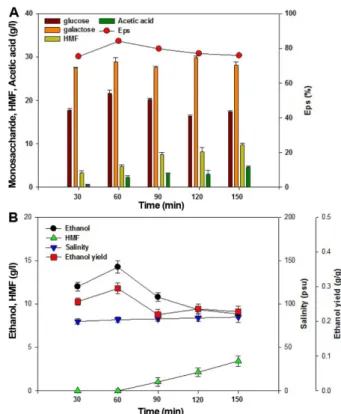
Efficiencies of pretreatments with 12% (w/v) slurry and 270 mM sulfuric acid with various thermal hydrolysis times are shown in Fig. 3A. Monosaccharide concentrations increased slightly with increasing thermal hydrolysis time.
Thermal hydrolysis times of 30-150 min at 121
oC showed similar E
psof 75.3-84.2%. However, E
psreached a maxi- mum within 60 min of thermal hydrolysis, as shown in Fig.
3A.
As shown in Fig. 3B, the effects of pretreatment and sac- charification on ethanol production were assessed using the wild type of C. lusitaniae ATCC 42720. Use of thermal hydrolysis times of over 60 min decreased ethanol produc- tion due to the inhibitory effect of HMF. Therefore, a 60 min thermal hydrolysis time was used in subsequent experi- Fig. 2. Effect of thermal acid hydrolysis using various acid
concentrations on (A) pretreatment and saccharification and (B) ethanol production using C. lusitaniae ATCC 42720 (experimental conditions: slurry content = 12% (w/v), H
2SO
4= 90-450 mM thermal hydrolysis = 121
oC, 60 min).
Fig. 3. Effect of thermal acid hydrolysis using various ther-
mal hydrolysis durations on (A) pretreatment and saccha-
rification and (B) ethanol production using C. lusitaniae
ATCC 42720 (experimental conditions: slurry content =
12% (w/v), H
2SO
4= 270 mM, thermal hydrolysis = 121
oC,
30-150 min).
ments. From these results, the optimal acid hydrolysis con- ditions for ethanol production were obtained with 12% (w/v) slurry content, 270 mM sulfuric acid, at 121
oC for 60 min.
Effect of Enzymatic Saccharification on Glucose Release
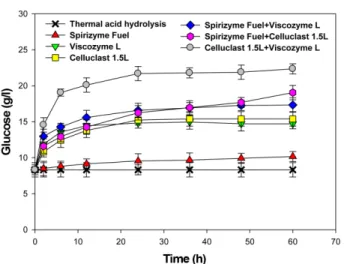
Glucose content after enzymatic saccharification of G.
verrucosa was determined and is displayed in Fig. 4. Spiri- zyme Fuel, Viscozyme L and Celluclast 1.5 L treatments of thermal acid hydrolysate were evaluated for glucose release from 12% (w/v) slurry of G. verrucosa following thermal acid hydrolysis. The initial glucose concentration was 8.3 g/l after thermal acid hydrolysis pretreatment. Fig.
4 shows the glucose conversion between single and mixed enzyme treatments. The optimum enzyme reaction time was 24 h. The increase in reaction time up to 60 h had no significant effect on enzymatic saccharification. The glu- cose concentration of mixed enzyme treatments was higher than that of single enzyme treatments from G. verru- cosa hydrolysate. As shown in Fig. 4, mixtures of Celluclast 1.5 L and Viscozyme L resulted in the best result for G. ver- rucosa hydrolysate. Ahn et al. [2] reported that mixed enzyme treatments increased the release of glucose con- tent when compared to single enzyme treatments. Spiri- zyme Fuel treatment is a dual enzyme system and it did not result in an increase of glucose content due to the small amount of starch in G. verrucosa. The maximum glucose
concentration was 21.7 g/l with mixed enzymes of Visco- zyme L and Celluclast 1.5 L from in 120 g dw/l G. verrucosa slurry hydrolysate.
Batch Fermentations with Wild Type and Acclimated C.
lusitaniae ATCC 42720
A culture of four yeast strains was carried out using C.
lusitaniae, P. stipitis, S. cerevisiae and K. marxianus. The highest growth observed was from C. lusitaniae ATCC 42720 (data not shown). Thus, ethanol fermentation was carried out using C. lusitaniae ATCC 42720 using G. verru- cosa hydrolysate. Separate hydrolysis and fermentation (SHF) was carried out by the addition of C. lusitaniae ATCC 42720 non-acclimated (wild type), or acclimated to high- galactose concentrations, shown in Fig. 5A and 5B, respec- tively. Glucose was consumed for 36 h, and then galactose was consumed for 24 h. However, the galactose was not totally consumed until 120 h, and 14.0 g/l of galactose remained, as is shown in Fig. 5A. The ethanol concentra- Fig. 4. Effect of enzyme treatments on glucose release
from G. varrucosa hydrolysate pretreated with 12% (w/v) slurry after thermal acid hydrolysis. The initial glucose was 8.3 g/l after thermal acid hydrolysis pretreatment. 16 U/ml of single and mixed enzymes with Spirizyme Fuel, Celluclast 1.5 L and Viscozyme L were added to 120 g dw/l of seaweed slurry.
Fig. 5. Ethanol production from G. verrucosa by SHF using
(A) non-acclimated and (B) acclimated C. lusitaniae ATCC
42720 to high concentrations of galactose.
tion after 96 h of fermentation with wild type C. lusitaniae ATCC 42720 was 15.1 g/l with Y
EtOH= 0.29.
C. lusitaniae ATCC 42720 was found to be acclimated to high concentrations of galactose, as revealed when glu- cose and galactose were simultaneously consumed, shown in Fig. 5B. After the glucose was almost exhausted at 24 h, the galactose was then consumed due to the pref- erence of glucose to galactose. When the glucose was exhausted, ethanol fermentation slowed, resulting in a lag phase known as a diauxic shift from 36 to 48 h. The fer- mentation using acclimated C. lusitaniae ATCC 42720 pro- duced an ethanol concentration of 22.0 g/l and a yield of 0.43 after 96 h of fermentation. Ethanol production at 36 h in Fig. 5A is different from that of Fig. 5B. The preferential utilization of glucose over galactose, however, often results in a low yield and productivity for ethanol. Wikandari et al.
[19] reported that the addition of acetic acid of up to 6 g/l still resulted in acceptable ranges for both ethanol yield and productivity. Thus, acetate concentrations of lower than 3 g/l did not significantly influence the conversion of sugar to ethanol in the overall fermentation process. Therefore, the acclimation of yeasts to high concentrations of galactose successfully improved the efficiency of the ethanol fermen- tation of mixed sugars as shown in Fig. 5A and 5B. Cho et al. [4] reported acclimated yeasts produced a higher etha- nol concentration than non-acclimated (wild type) yeasts.
Therefore, the acclimation of yeasts to a high concentration of galactose could facilitate the simultaneous utilization of glucose and galactose for the increased production of etha- nol from the seaweed G. verrucosa.
In conclusion, the optimal pretreatment conditions of sea- weed G. verrucosa were determined to be 12% of slurry and 270 mM of sulfuric acid at 121
oC for 60 minutes. After thermal acid hydrolysis and enzymatic saccharification, monosaccharide was obtained at 50.4 g/l from 60 g/l total carbohydrate of 120 g dw/l G. verrucosa slurry. A mixture of Celluclast 1.5 L and Viscozyme L achieved the best result for the enzymatic saccharification of G. verrucosa hydroly- sate.
Acclimated yeast with high-galactose concentrations increased the sugar uptake more than non-acclimated yeast. The ethanol production and yield from C. lusitaniae ATCC 42720 non-acclimated and acclimated with high- galactose concentrations were 15.1 g/l with Y
EtOHof 0.29 and 22.0 g/l with Y
EtOHof 0.43, respectively. These optimal pretreatment and saccharification conditions and fermenta-
tion profiles provide a basis for ethanol fermentation from the red seaweed, G. verrucosa.
Acknowledgments
This work was supported by a Research Grant from Pukyong National University (2014).
References
1. Agbor VB, Cicek N, Sparling R, Berlin A, Levin DB. 2011. Bio- mass pretreatment: Fundamentals toward application. Bio- technol. Advan. 29: 675-685.
2. Ahn DJ, Kim SK, Yun HS. 2012. Optimization of pretreatment and saccharification for the production of bioethanol from water hyacinth by Saccharomyces cerevisiae. Bioprocess Biosyst. Eng. 35: 35-41.
3. Cho YK, Kim HJ, Kim SK. 2013. Bioethanol production from brown seaweed, Undaria pinnatifida, using NaCl acclimated yeast. Bioprocess Biosyst. Eng. 36: 713-719.
4. Cho HY, Ra CH, Kim SK. 2014. Ethanol production from the seaweed, Gelidium amansii using specific sugar acclimated yeasts. J. Microbiol. Biotechnol. 24: 264-269.
5. Jol CN, Neiss TG, Penninkhof B, Rudolph B, De Ruiter GA.
1999. A novel high-performance anion-exchange chromato- graphic method for the analysis of carrageenans and agars containing 3,6-anhydrogalactose. Anal. Biochem. 268: 213- 222.
6. Kim HJ, Ra CH, Kim SK. 2013. Ethanol production from sea- weed (Undaria pinnatifida) using yeast acclimated to specific sugars. Biotechnol. Bioprocess Eng. 18: 533-537.
7. Kubicek CP. 1982. β-glucosidase excretion by Trichoderma pseudokoningii correlation with cell wall bound β-1,3-gluca- nase activities. Arch. Microbiol. 132: 349-354.
8. Kumar S, Gupta R, Kumar G, Sahoo D, Kuhad RC. 2013.
Bioethanol production from Gracilaria verrucosa, a red alga, in a biorefinery approach. Bioresour. Technol. 135:150-156.
9. Liu ZL, Weber SA, Cotta MA. 2012. Isolation and characteri- zation of a β-glucosidase from a Clavispora strain with poten- tial applications in bioethanol production from cellulosic materials. BioEnergy Research. 6: 65-74.
10. Mandels M, Andreotti R, Roche C. 1976. Measurement of saccharifying cellulase. Biotenchnol. Bioeng. Symp. 6: 21-23.
11. Marger WH, Siderius M. 2002. Novel insights into the osmotic stress response of yeast. FEMS Yeast Res. 2: 251-257.
12. Omori T, Ogawa K, Shimoda M. 1995. Breeding of high glyc- erol-producing Shochu yeast (Saccharomyces cerevisiae) with acquired salt tolerance. J. Ferment. Bioeng. 79: 560-565.
13. Park JH, Hong JY, Jang HC, Oh SG, Kim SH, Yoon JJ, et al.
2012. Use of Gelidium amansii as a promising resource for
bioethanol: A practical approach for continuous dilute-acid
hydrolysis and fermentation. Bioresour. Technol. 108: 83-88.
14. Redding AP, Wang Z, Keshwani DR, Cheng J. 2010. High temperature dilute acid pretreatment of coastal Bermuda grass for enzymatic hydrolysis. Bioresour. Technol. 102: 1415- 1424.
15. Spindler DD, Wyman CE, Mohagheghi A, Grohmann K. 1988.
Thermotolerant yeast for simultaneous saccharification and fermentation of cellulose to ethanol. Appl. Biochem. Biotech- nol. 17: 279-293.
16. Sunwoo IY, Ra CH, Kwon SJ, Heo JH, Kim YJ, Kin JW, et al.
2014. Ethanol production from red, brown and green sea- weeds and biosorption of heavy metals by waste seaweed slurry from ethanol production. Korean J. Biotechnol. Bioeng.
29: 1-7.
17. Timson DJ. 2007. Galacotse metabolism in Saccharomyces cerevisiae. Dyn. Biochem. Process Biotechnol. Mol. Biol. 1:
63-73.
18. Viola R, Nyvall P, Pedersén M. 2001. The unique features of starch metabolism in red algae. Proc. R. Soc. Lond. B. 268:
1417-1422.
19. Wikandari R, Millati R, Syamsiyah S, Muriana R, Ayuningsih Y. 2010. Effect of furfural, hydroxymethyfurfural and acetic acid on indigeneous microbial isolate for bioethanol produc- tion. Agricultural J. 5: 105-109.
20. Yancey PH. 2005. Organic osmolytes as compatible, meta- bolic and counteracting cytoprotectants in high osmolarity and other stresses. J. Exp. Biol. 208: 2819-2830.
국문초록