Review: Soil/Pesticidal/Environmental Sciences
Application of X-ray Absorption Spectroscopy (XAS) in the Field of Stabilization of As and Heavy Metal Contaminated Soil
Jung Eun Lim · Deok Hyun Moon · Kwon-Rae Kim · Yong Sik Ok*
비소 및 중금속 오염토양 안정화 분야에서의 X선 흡수분광법(XAS) 활용
임정은 · 문덕현 · 김권래 · 옥용식*
Received: 13 November 2014 / Accepted: 12 January 2015 / Published Online: 31 March 2015
© The Korean Society for Applied Biological Chemistry 2015
Abstract X-ray absorption fine structure (XAFS) analysis using X-ray absorption spectroscopy is being applied as a state-of-the- art method in a wide range of disciplines. This review article summarizes the overall procedure of XAFS analysis from the preparation of soil samples to the analysis of data in X-ray absorption near edge structure (XANES) region and extended X- ray absorption fine structure (EXAFS) region. The previous studies on application of XANES and EXAFS techniques in environmental soil science field are discussed and classified them according to metal(loid)s (As, Cd, Cu, Ni, Pb, and Zn). A significant number of previous studies of XAFS application in the environmental soil science field have focused on the identification of Pb chemical species in soil. Moreover, XANES and EXAFS techniques have been widely used to investigate the contamination source via identification of metal species. Similarly, these
techniques were applied to identify the mechanisms of metal stabilization in soil after application of various amendments, phytoremediation, etc.
Keywords extended X-ray absorption fine structure · heavy metal · immobilization · mechanism · metal speciation · soil contamination · X-ray absorption fine structure · X-ray absorption near edge structure
토양 내 중금속의 안정화와 기작 규명
중금속(heavy metal)으로 인한 토양오염은 주로 가행 및 휴·폐 광산 인근 지역, 군 사격장 부지, CCA (chromated copper arsenate) 방부목 설치 부지, 일반 농경지, 금속 제련소와 같은 산업부지, 도시 등 광범위한 지역에서 보고되고 있다(Manceau 등, 1996;
Lim 등, 2010; Kumpiene 등, 2011; Ok 등, 2011a, 2011b;
Ahmad 등, 2012; Usman 등, 2012; Lim 등, 2013a, 2013b;
Ahmad 등, 2014b). 중금속으로 인한 토양오염은 오염된 토양에 서 재배되는 농작물의 섭취, 직접 흡입 등을 통해 인간건강에 중대한 위협요인이 되고 있어, 이를 정화하기 위한 다양한 방 법들이 연구·개발되어 왔다(Kumpiene 등, 2008; Ok 등, 2010). 특히 토양 내 존재하는 중금속을 생물체가 이용할 수 없 도록 화학적으로 안정한 형태로 변환시킴으로써 중금속의 생물 유효도(bioavailability)를 낮추는 중금속 안정화(metal stabilization) 에 대한 연구가 활발하게 진행되고 있다(Ok 등, 2011c). 예를 들어, 토양에 대한 석회처리는 pH를 상승시키는데 이 때 토양 의 음전하(negative charge)가 증대되어 양이온성 중금속의 토양 흡착이 증가하고, 이와 함께 알칼리 조건에서 중금속 양이온은 자유 양이온보다 흡착계수가 더 높은 수산화물(hydroxides)을 형 성하여 토양 입자에 흡착되거나 탄산염 형태로 침전하게 되는 J. E. Lim · Y. S. Ok
Korea Biochar Research Center & Department of Biological Environment, Kangwon National University, Chuncheon 200-701, Republic of Korea D. H. Moon
Department of Environmental Engineering, Chosun University, Gwangju 501-759, Republic of Korea
K.-R. Kim
Department of Agronomy and Medicinal Plant Resources, Gyeongnam National University of Science and Technology, Jinju 660-758, Republic of Korea
*Corresponding author (Y. S. Ok: [email protected])
This is an Open Access article distributed under the terms of the Creative Commons Attribution Non-Commercial License (http://creativecommons.
org/licenses/by-nc/3.0/) which permits unrestricted non-commercial use,
distribution, and reproduction in any medium, provided the original work is
properly cited.
등, 2008).
오염토양 내 중금속을 안정화하기 위한 기술들을 적용한 후 에는 사후 관리를 위해서 안정화 효율 및 해당 중금속의 장기 적 안정성 등에 대한 평가와 더불어 사후 예측이 필요하다. 이 를 위한 방법으로 안정화 전·후 토양 내 중금속의 화학종 (species) 을 정확하게 규명하여 비교평가 하는 것이 가장 직관적 인 방법이라고 할 수 있다(McNear Jr. 등, 2007; Hashimoto 등, 2009a). 토양 내 안정화 기술 도입 초기부터 최근까지 중금 속의 화학종 분석은 화학적 연속추출(chemical sequential extraction) 을 통한 분획화(fractionation) 방법이 널리 사용되어 왔다. 그러나 연속추출 방법은 토양 내 중금속의 대략적인 존 재 형태(form)를 평가하는 방법으로, 엄밀하게 말해서 중금속의 화학종을 직접적으로 분석하는 방법은 아니다(Manceau 등, 1996). 더욱이 연속추출 방법은 시간과 노동력이 많이 소모될 뿐만 아니라 추출용 시약과 시료를 반응시키는 파괴적인 방법 이므로 시료의 회수가 불가능하며, 추출과정에서 화학종 간의 평형관계가 변하기 때문에 측정되는 불용성/가용성 중금속 형태 에 대한 과소평가(underestimation) 및 과대평가(overestimation) 의 가능성도 있음이 보고되었다(Scheckel 등, 2005; Hashimoto 등, 2009a). 한편, 비소(As)의 경우 자연계에서 As(III) (arsenite) 및 As(V) (arsenate) 상태로 존재하는데 As(III)가 As(V)에 비 해 25−60배 정도 독성이 강하며 이동성도 더 큰 것으로 알려져 있다(Dutré와 Vandecasteele, 1995; Oremland와 Stolz, 1995). 그 러므로 토양 내 비소의 산화상태(oxidation state)를 파악하는 것 은 복원기술을 적용하는데 있어 매우 중요할 뿐만 아니라 오염 토양 처리 후 독성 및 이동성 평가 측면에 있어서 매우 중요하다.
최근 토양 중 중금속의 화학종을 비파괴적(non-destructive)인 방법으로 정확하게 분석할 수 있는 X선 흡수분광법(X-ray absorption spectroscopy, XAS) 의 활용이 증가하고 있다. XAS 를 활용하는 연구는 주로 방사광 가속기(synchrotron radiation) 시설 내에서 이루어지며, 특정 원소의 X선 흡수미세구조(X-ray absorption fine structure, XAFS)를 측정하게 된다(Scheckel 등, 2005). XAFS 는 특정 원소가 흡수하는 에너지 영역에 따라 X 선 흡수 끝머리 부근 미세구조(X-ray absorption near edge structure, XANES)와 광범위 X선 흡수 미세구조(Extended X- ray absorption fine structure, EXAFS) 로 구분하며 이들에 대한 분석을 통해 각각 원자의 산화상태, 공유결합 정도, 이웃한 원 자의 종류, 원자간 결합거리(bond distance), 배위수(coordination number) 등을 구할 수 있다(Sparks, 2002; Gräfe 등, 2014).
토양 내 중금속 화학종을 정확하게 규명할 수 있는 것도 위에 기술한 원리와 같이 중금속 원소에 대한 XAFS 해석을 통해서 가능하다(Hashimoto 등, 2009a). 특히 이 방법은 장거리 배열 (long range order)을 이루는 물질에만 적용이 가능했던 X선 회 절법(X-ray diffraction analysis, XRD)과는 달리 비정질 (amorphous) 물질 및 저농도(수십−수백 mg/kg) 중금속 등의 화 학종 분석이 가능하므로, 비소, 납, 아연(Zn), 구리(Cu), 카드뮴 (Cd) 과 같은 미량원소(trace elements)들에 대한 화학종 분석에 적합하다(Scheckel 등, 2005; Hashimoto 등, 2009a; Hesterberg
에서 XAFS 기술의 국내 토양환경 분야 활용은 중금속 오염 토 양 복원 및 사후 관리에 있어 기술 발전을 위한 필수 사항이라 할 수 있다. 따라서 본 총설에서는 XAFS를 이용한 방법 중 XANES 및 EXAFS 데이터를 얻기까지 일련의 과정을 살펴보고, XANES 및 EXAFS 해석을 통해 오염토양 내 중금속의 화학종 을 정확하게 규명하여 보고한 선행연구 결과들을 취합/정리하였 다. 이를 통해 우리나라에서 XAFS 기술의 토양환경분야의 적 용을 위한 계획 수립에 기여하고자 하였다.
토양시료의 XAFS 측정
토양환경분야에서 XAFS 활용을 위한 시료준비에서부터 측정, 데이터 추출 및 분석에 대해서는 Kelly 등(2008)에 자세히 기 술되어 있으며, 본 총설에서는 아래와 같이 각 항목별로 대략 적인 과정을 기술하였다.
1) XAFS 측정용 시료준비. XAFS 측정을 위한 토양 시료의 준 비는 다음과 같다. 대상 토양은 채취한 후 풍건(air dry)을 실시 하고 agate mortar 등으로 곱게 파쇄하여 사용한다. 입자는 대 체로 50 µm 이하의 크기를 사용하는데(Kelly 등, 2008), 100 µm 이하(Ahmad 등, 2012; Moon 등, 2013; Ahmad 등, 2014a), 75 µm 이하 또는 20 µm 이하(Hashimoto 등, 2009b) 등으로도 체거름하여 사용할 수 있다.
토양시료와의 비교평가를 위한 표준물질(reference standards) 들은 해당계(system)에서 광물 조성, 화학적 조성, pH 조건 등 을 감안했을 때 실제 존재할 것으로 판단되는 것을 선택하여 사용한다(Kelly 등, 2008). 일례로 Hashimoto 등(2011)은 토양 내 납 화학종 규명연구에서 표준물질의 선정을 위해 해당계에 대한 열역학 모델링(thermodynamic modeling)을 통해 예측된 물질과 자연적으로 존재하는 것으로 알려진 납 화합물들을 표 준물질로 선택하였다. 이렇게 선정된 표준물질은 토양시료와 동 일하게 파쇄 및 체거름하여 사용한다.
사용하고자 하는 크기의 입자로 체거름을 마친 시료는 시료 홀더에 압착시켜 투명 Kapton tape로 고정시킨다. 이 후 토양 시료가 고정된 시료 홀더를 방사광 가속기 시설의 빔라인 (beamline) 장비에 45
o로 장착하여 X-ray가 시료에 입사 (incidence) 될 수 있도록 한다(Kelly 등, 2008). 한편, 투과방식 (transmission mode) 의 측정 시 시료에 의한 X-ray 흡수를 최적 화하고, 형광방식(fluorescence mode)의 측정 시 self-absorption effect 를 저감하기 위해서 boron nitride (BN)을 사용하여 시료 를 희석(dilution)한 후 XAFS 측정을 실시하기도 한다(Kelly 등, 2008).
2) XAFS 측정. 대상 시료에 대한 XAFS 측정은 전술한 바와
같이 가속기 시설 내의 XAFS 빔라인에서 이루어지고 있다. 우
리나라의 경우 3세대(third generation) 가속기 시설로서 빔에너
지 3.0 GeV, 저장링 빔전류 400 mA로 운용되고 있는 포항가속
기연구소(Pohang Accelerator Laboratory)에서 그 측정이 가능하
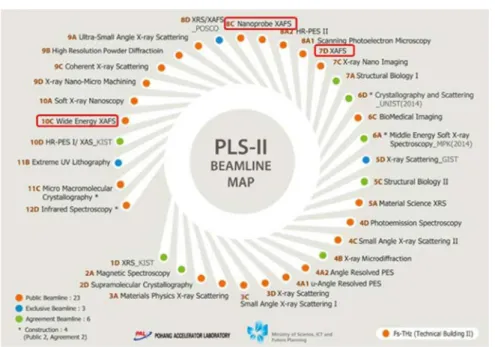
다(Fig. 1). XAFS 빔라인에서는 주로 투과방식과 형광방식으로
XAFS 의 측정이 이루어지는데, 일반적으로 시료 내 목적원소의 함량이 1% 이상일 때에는 투과방식을 사용하며, 수십에서 수백 mg/kg 의 수준일 때는 형광방식을 사용하는 것이 적절하다(Kelly 등, 2008). 실제 XAFS 측정 시에는 두 방식을 동시에 적용할 수 있으므로 두 방식에 의한 XAFS 스펙트럼 해석을 통해서 최 적의 결과 도출이 가능하다(Kelly 등, 2008).
실제 측정 시에는 앞서 언급한 바와 같이 시료를 XAFS 빔 라인에 장착한 후에 분석하고자 하는 목적원소 고유의 X선 흡 수 edge energy로 X선의 세기를 조정한다. 이 후 시료로 X선 을 입사시켜 빔라인에 설치된 검출기로 동일 시료에 대한 XAFS 를 반복 측정하여 XAFS 스펙트럼 해석을 위한 데이터로 사용한다. 한편, 토양환경분야에서 연구되고 있는 주요 중금속 원소에 대한 X선 흡수 edge energy는 Table 1과 같다.
3) XANES 및 EXAFS 데이터 추출 및 분석. 측정된 XAFS 데이터는 주로 Athena software (Ravel과 Newville, 2005)을 활용하여 스펙트럼을 해석 한다. 먼저 각각의 XAFS 데이터는 스펙트럼 상의 pre-edge를 이용하여 background를 제거한 후 XANES 스펙트럼과 k
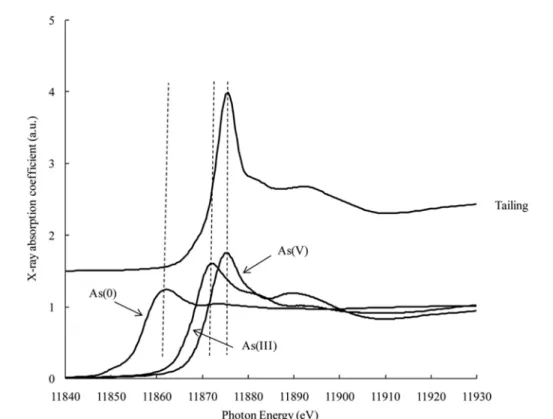
n-weighted EXAFS 스펙트럼을 추출할 수 있다(Kelly 등, 2008). 일례로 비소로 오염된 토양 내 광미에
존재하는 비소의 존재 형태를 보여주는 XANES 스펙트럼은 Fig. 2 와 같다.
또한 토양시료 내 대상 화학종에 대한 정량분석은 표준물질 과 토양시료 각각에 대한 EXAFS 스펙트럼을 추출한 후에 k
n- weighted EXAFS 스펙트럼 간의 linear combination fitting (LCF) 을 통하여 이루어진다. LCF는 미지시료의 스펙트럼과 이 미 알고 있는 표준물질 스펙트럼 간의 통계적인 linear combination fitting 을 통해 미지시료가 함유한 실제 화학종에 대 한 정량화를 가능하게 하는 방법이다(Scheckel 등, 2005; Kelly 등, 2008). 일례로 납으로 오염된 토양에 콩줄기(soybean stover) 를 이용해 생산한 바이오차(biochar)를 10 wt% 처리한 후 토양 내 존재하는 납 화학종을 EXAFS 스펙트럼 간의 LCF를 통해 정량화한 결과는 Fig. 3과 같다(Moon 등, 2013).
토양환경 분야에서 XAFS의 활용
XAFS 기술은 토양환경 분야에 다양한 목적으로 활용할 수 있 다. 첫째, 중금속 오염 토양에서 유입된 중금속의 기원을 밝히 Fig. 1 Beamline map of Pohang Accelerator Laboratory (PAL). Red boxes indicate the XAFS beamlines (Source: Pohang Accelerator Laboratory).
Table 1 X-ray absorption edge energies for the frequently studied elements via XAFS in the field of environmental soil science
Elements Atomic
number
Energy (eV)
Absorption
Edge References
Arsenic (As) 33 11872.2 [As(III)]
11875.2 [As(V)] Yoon et al., 2010
Cadmium (Cd) 48 26,711 K Khaokaew et al., 2011
Copper (Cu) 29 8,979 K Strawn and Baker, 2008; Kumpiene et al., 2011; Yang et al., 2014 Lead (Pb) 82 13,035 L3 Ahmad et al., 2014a; Hashimoto et al., 2009b; Moon et al., 2013
Nickel (Ni) 28 8,333 K McNear Jr. et al., 2007; Sheng et al., 2011
Zinc (Zn) 30 9,659 K Roberts et al., 2002; Kirpichtchikova et al., 2006;
Baker et al., 2012
는 목적으로 활용이 가능하다. 중금속 오염원을 정확하게 밝히 는 것은 오염 책임과 더불어 오염 부지에 대한 관리 방안 모색 을 위해서 매우 중요한 일이며, 이는 토양 내 존재하는 중금속
의 정확한 화학종 분석을 통해서 가능하다. 둘째, 토양 내 중금 속의 화학적 거동 해석에 이용할 수 있다. 각 중금속 원소별 그 리고 오염원별 해당 중금속의 시간 흐름, 혹은 토양환경인자에 따른 화학종 분화에 대한 이해는 각 중금속 원소별로 다른 양 상을 나타내며, 오염 부지 관리를 위한 기초 자료로 활용할 수 있다. 셋째, 중금속 오염 복원(안정화) 기술 선발 및 기술 적용 후 사후 평가에 활용할 수 있다. 부지별로 밝혀진 오염원 및 해 당 부지에서 중금속의 화학적 거동을 바탕으로 최적의 복원 기 술을 선발하여 적용할 수 있으며, 궁극적으로 복원 기술에 대 한 평가(안정화 효율, 안정성, 지속성 등)는 대상 중금속에 대 한 정확한 화학종 분석을 통해서 이루어질 수 있다.
1) 중금속 오염원 추적 및 오염원별 중금속 화학종 분석. 토양 으로 유입되는 중금속의 오염원은 광산, 사격장, 그리고 산업부 지(제련소, 과거에 사용되었던 가솔린의 폭연 방지제 제조, 건 전지 제조 공장 등) 등을 들 수 있다. 각 오염원별로 토양에 유 입된 각각의 중금속은 서로 다른 화학종으로 존재하게 되는데 이는 XAFS 기술을 적용하여 확인할 수 있다. 이를 통해 토양 에 존재하는 중금속 오염원의 추적이 가능하며 중금속의 화학 적 거동에 대한 정보 제공을 통해 오염토양의 최적 정화와 관 리를 위한 기초자료로 사용할 수 있다. 이에 대한 실제 XAFS 활용의 예들을 중금속 원소별로 아래와 같이 정리하였다.
1-1) 카드뮴(Cadmium, Cd). O’day 등(1998)은 광산 지역 내 수계의 저질토(sediment, 카드뮴 농도: 48−328 mg/kg)에 대한 카드뮴 화학종의 EXAFS 연구결과, 카드뮴은 CdS의 형태로 존 재하였으며 이는 아연의 황화광(sulfide ore)인 sphalerite (ZnS) 의 아연이 카드뮴에 의해 치환되어 생성된 것임을 보고하였다 (O’day 등, 1998).
Khaokaew 등(2011)은 광산 인근 알칼리성 논토양(카드뮴 농 Fig. 2 X-ray absorption near edge structure (XANES) spectra of the As standards and tailing sample (adopted from Moon et al., 2011).
Fig. 3 Pb-L
IIIedge extended X-ray absorption fine structure (EXAFS)
spectra for treated soil with biochar derived from soybean stover with an
application rate of 10 wt%, along with reference standards giving the best
linear combination fit (LCF). Solid line: measured; dotted line: LCF
(adopted from Moon et al., 2013).
도: 142 mg/kg)의 담수(flooding) 및 배수(draining) 조건 하에서 토양 내 카드뮴 화학종을 EXAFS 분석을 통해 규명하였다. 연 구결과, 시간 경과에 따라 카드뮴의 주 화학종은 부식산 흡착 형태(Cd
HA, Cd-humic acid) 에서 CaCO
3와 kaolinite에 흡착된 카드뮴 및 CdCO
3, CdS 형태로 변환되었다. 이는 pH 6 이상에 서 kaolinite edge site로의 카드뮴 흡착, carbonate mineral의 카드뮴 흡착 및 CdCO
3침전물 형성에 의한 결과라고 하였다 (Khaokaew 등, 2011).
1-2) 구리(Copper, Cu). Strawn과 Baker(2008)는 CuSO
4살균 제(fungicide)가 50년 이상 사용된 농장의 토양(구리 농도:
4,167 mg/kg, 유기물 함량: 6.75%) 내 구리 화학종에 대한 EXAFS 연구를 실시하였다. 연구결과 토양 내 구리는 carboxyl 및 amine ligand와 bidentate inner-sphere coordination을 통해 토양 유기물과 복합체를 형성하고 있는 것으로 나타났다(Strawn 과 Baker, 2008).
Yang 등(2014)은 구리 폐광산의 토양(구리 농도: 5,080 mg/kg, 유기물 함량: 0.55% 미만) 내 구리 화학종 평가를 위해 EXAFS 연구를 실시하였다. 연구결과, 토양 내 구리는 goethite와 같은 철 산화물(Fe-oxide)에 흡착된 형태로 존재하여 오염된 농경지 토양에서 구리가 주로 토양유기물(SOM, soil organic matter)과 결합된 형태로 존재한다는 선행연구들과 다른 결과임을 보고하 였다(Yang 등, 2014). 이는 유기물 함량이 낮은 토양에서 구리 의 광물 표면 흡착이 증대된다는 것에 기초하여, 상대적으로 낮 은 유기물 함량과 높은 철(Fe)함량을 보유한 오염토양의 특성 에 의한 결과라고 하였다(Yang 등, 2014).
1-3) 니켈(Nickel, Ni). McNear Jr. 등(2007)은 니켈 제련소 (nickel refinery) 인근 지역의 유기물 함량이 상이한 2종의 토 양(QM-soil, 니켈: 3,516−4,902 mg/kg, 유기물: 71.7−72.3% 및 WL-soil, 니켈: 3,468−4,700 mg/kg, 유기물: 8.2−9.8%)에 대해 EXAFS를 이용한 니켈 화학종 평가를 실시하였다. 2종의 토양 (QM-soil, WL-soil)에는 과거 니켈의 정화를 위해 석회 (dolomitic lime)가 처리된 바 있으며, 연구결과 2종의 토양 모 두 NiO 화학종이 존재하였으며, WL-soil에서는 Ni-Al layered double hydroxide (LDH)가 존재하였고, QM-soil에서는 유기물 과 결합된 니켈 화합물(Ni-fulvic acid)이 존재하였다. 이는 석회 처리에 따른 토양의 pH상승으로 인해 Ni-Al LDH 및 유기물과 결합된 니켈 화합물의 생성이 촉진된 결과라고 보고하였다 (McNear Jr. 등, 2007).
1-4) 납(Lead, Pb). Manceau 등(1996)은 가 솔린 엔진의 폭연 방지제(antiknock)인 알킬납(alkyl lead)을 생산하는 공장 인근의 오래된 공원 지역 토양(납 농도: 1,670 mg/kg) 내 납 화학종을 EXAFS-LCF로 분석한 결과, 토양 내 납은 유기납 형태인 Pb salicylate (62%) 와 Pb catechol (38%)로 존재하였으며 이는 알 킬납 생산 공장의 영향에 의한 것이라고 하였다. 이와 함께 납 건전지 재생 공장의 영향을 받은 초지(납 농도: 3,200 mg/kg) 및 공장 내 부지(납 농도: 52,000 mg/kg)의 납 화학종은 각각 PbSiO
3와 anglesite (PbSO
4) 였으며, 이는 각각 토양의 사질적 (sandy) 특성에 의한 규산-납의 침전 및 건전지 내 전해질 (electrolyte)인 황산(sulfuric acid)에 기인함을 보고하였다 (Manceau 등, 1996).
Scheckel과 Ryan (2004)은 납 제련소 인근 토양(납 농도:
1,100−5,300 mg/kg)에 대한 납 EXAFS-LCF 연구에서 납은 anglesite가 32−43%, galena (PbS)가 16−21%, 유기물에 흡착된 납(Pb
org) 이 32−37%로 존재하였으며, 이는 납 제련소에서 발생
한 galena와 산화를 통해 생성된 anglesite 및 토양에 존재하는 유기물과 납의 결합에 기인한 결과라고 하였다.
한편, 사격장 토양의 납 화학종은 유입된 총알(bullet)의 납 해리 에 의해 주로 cerussite (PbCO
3), hydrocerussite [Pb(CO
3)
2(OH)
2] 의 형태로 존재한다고 알려져 있다(Cao 등, 2003). 실제로 사격장 토양의 EXAFS-LCF를 통한 납 화학종 보고에서 Hashimoto 등 (2009b) 은 cerussite가 25%, Hashimoto 등(2012)은 cerussite가 37%, Moon 등(2013)은 hydrocerussite가 23.3%, Ahmad 등 (2014a) 은 cerussite가 10.3% 수준으로 존재함을 보고하였다. 이 와 같은 결과들은 납 오염토양의 실제 오염원에 대한 정확한 추적을 가능하게 해준다.
1-5) 아연(Zinc, Zn). 비철금속 제련소 인근 운하(canal) 의 준설 토(아연 농도: 6,600 mg/kg)에 함유된 아연에 대한 EXAFS 연 구결과에서 준설토 내 아연의 화학종은 제련소로부터 발생한 막 대한 양의 먼지와 잔유물의 영향으로 인해 sphalerite, willemite (Zn
2SiO
4), zincite (ZnO) 로 존재하였으며, 이들의 풍화(weathering) 로부터 방출된 아연과 흡착된 Fe(oxyhydr)oxides 및 아연을 함 유한 phyllosilicate (Zn
phyl) 가 존재하는 것으로 보고되었다(Isaure 등, 2002).
Roberts 등(2002)은 아연 제련소(Zn smelter) 인근의 오염토 양 내 아연의 화학종을 EXAFS-LCF로 평가하였다. 연구결과, 표면 3−6 cm의 토양층(아연 농도: 6,200 mg/kg) 내 아연은 66% 가 franklinite (ZnFe
2O
4), 34% 가 sphalerite로 존재하였으나, 하부 20 cm 두께의 토양층(아연 농도: 890 mg/kg) 내 아연은 대부분 gibbsite와 결합된 형태(Zn
gib) 및 Fe/Mn (hydr)oxide에 결합한 형태(Zn
Fe/Mn, Zn bound to ferrihydrite and birnessite) 로 존재하였다(Roberts 등, 2002). 이는 제련소에서 사용한 아 연광(Zn ore)인 sphalerite의 제련 시 생성된 franklinite와 일부 sphalerite 가 대기로 방출된 후 토양에 침적(deposition)된 것에 기인한 것이며, 토양에 유입된 sphalerite의 산화를 통해 생성된 Zn sulfate (ZnSO
4) 가 Zn
2+및 SO
42-로 방출되어 토양 하부로 이동한 후 Al, Fe, Mn 등에 결합하여 발생된 결과로 보고하였 다(Roberts 등, 2002).
Voegelin 등(2005)은 황동 제조소(brass foundry)의 zincite 함 유 여과먼지(filter dust)로 토양을 인공오염 시켰다(아연 농도:
2,800 mg/kg). 이 후 시간경과에 따른 화학종의 변화를 EXAFS- LCF 를 통해 평가한 결과, zincite는 토양에 유입된 직후 90%
가량 존재하였으나, 9개월 경과 후에는 존재하지 않았다. 또한 47 개월 후에는 전체 아연의 37%가 Zn-LDH, 14.1%가 Zn
phyl의 형태로 침전된 것으로 나타났으며, 나머지는 유·무기 입자에 흡착된 형태(Zn
phyt/Mn, Zn sorbed on phytate and birnessite)로 존재한다고 하였다(Voegelin 등, 2005).
한편, Kitpichtchikova 등(2006)은 100년간의 하수(sewage water) 관개로 오염된 농경지 토양(아연 농도: 1,103 mg/kg)에 대한 EXAFS-LCF 연구에서, 아연은 Zn
Fe(30%), Zn phosphate (28%), Zn
phyl(24%), willemite (11%), gahnite (ZnAl
2O
4, 10%
이하)의 형태로 존재하고 있음을 보고하였다.
2) 중금속 오염 복원 기술 적용 후 사후 평가. 중금속 오염토 양 복원 기술에 대한 사후 평가(안정화 효율, 안정성, 지속성 등) 를 위한 화학종 분석에도 XAFS 기술을 적용할 수 있다. 이에 대한 실제 XAFS활용의 예들을 중금속 원소별로 아래와 같이 정리하였다.
2-1) 비소(Arsenic, As). Yoon 등 (2010)은 비소로 오염된 토양
( 비소 농도: 1,333 mg/kg)에 대한 복원을 위해 포틀랜드 시멘트
성에 기인하고 As(V)인 경우 NaCaAsO
4· 7.5H
2O 형성에 기인 한다고 보고되었다(Yoon 등, 2010).
2-2) 구리(Copper, Cu). Kumpiene 등(2011)은 중금속 함유 목 재방부제로 오염된 토양(구리 농도: 2,600 mg/kg)에 대한 정화 연구를 실시하였다. 이를 위해 5 wt% compost와 2 wt% zerovalent iron (ZVI) 이 혼합된 개량제를 식물안정화법(phytostabilization) 과 함께 토양에 적용하였으며, 2년 경과 후 토양 내 구리 화학 종의 변화를 EXAFS를 통해 평가하였다. 연구결과 무처리구 토 양 내 구리는 대부분 Cu(II)-C-O의 형태로써 유기물과 결합된 화합물로 존재하였으나, 개량제와 식물안정화법이 적용된 토양 내 구리는 화학적으로 상대적으로 안정한 형태인 Fe oxyhydroxide와 결합된 형태로 존재함을 보고하였다(Kumpiene 등, 2011).
2-3) 니켈(Nickel, Ni). Sheng 등(2011)은 수용액 중 규조토 (diatomite) 의 Ni(II) 흡착 기작 규명을 위해 EXAFS 연구를 실 시하였다. 연구결과 pH 5.0일 때, diatomite의 inter-layer space 내 이온교환부위(ion exchange site)에서 니켈의 외부계면복합체 (outer-sphere complex) 형성, pH 7.0 및 8.0에서 내부계면복합 체(inner-sphere complex) 형성 및 표면 coprecipitation, pH 10.0 에서 Ni surface precipitates 및 Ni phyllosilicate-like surface coprecipitation 에 의한 니켈의 제거 기작을 보고하였다. 이 연구 를 통해 Sheng 등(2011)은 니켈과 점토광물의 상호작용에 대한 기초자료를 제공하였으며, EXAFS의 활용이 diatomite의 각기 다른 니켈 흡착 기작을 구분할 수 있음을 제시하였다(Sheng 등, 2011).
2-4) 납(Lead, Pb). Scheckel과 Ryan (2004)은 납 오염토양의 정화를 위해 인(P) 함유물질인 triple super phosphate (TSP), rock phosphate (RP), phosphoric acid (H
3PO
4) 을 1% 수준으 로 처리하였다. 처리 후 EXAFS-LCF을 통해 토양 내 납 화학 종을 살펴본 결과, anglesite, galena, Pb
org형태의 납은 화학적 으로 매우 안정한 화합물인 pyromorphite 형태로 변환되었으 며, 처리구 별로 각각 29, 33, 45%까지 변환됨을 보고하였다 (Scheckel 과 Ryan, 2004).
이와 유사한 결과로 Hashimoto 등(2009b)은 사격장 토양(납 농도: 18,100 mg/kg)에 가금류 폐기물(incinerated poultry waste) 개량제를 처리한 후 토양 내 납의 화학종에 대해 EXAFS-LCF 연구를 실시하였다. 연구결과 무처리구 토양에서 납은 Pb
org가 38%, massicot (PbO)가 20%, cerussite가 25%였으나, 개량제 처리구 토양의 납은 Pb
org6%, massicot 18%, cerussite 7%, hydrocerussite [Pb
3(CO
3)
2(OH)
2] 18%였으며, 특히 chloro- pyromorphite [Pb
5(PO
4)
3Cl] 가 32%로 새롭게 형성되는 것으로 나타났다. 이를 통해 인을 함유한 가금류 폐기물 개량제 처리 는 토양 내 납을 안정한 형태인 chloropyromorphite로 변환하여 안정화함을 보고하였다(Hashimoto 등, 2009b).
한편, 퇴비(compost)의 처리는 혐기성 세균(anaerobic bacteria) 에 의한 SO
4환원을 증가시켜 오염토양 내 납을 생물유효도가 낮은 galena로 변환한다(Hashimoto 등, 2011). 이에 착안하여 Hashimoto 등(2011)은 수렵 지역 내에서 사격활동에 따른 인근 강 유역 및 습지(wet land)에 대한 납 오염토양의 정화를 위해
으나 galena의 형성은 오히려 감소하였다. 이는 불충분한 혐기 성 조건으로 인해 토양에서 galena 형성이 증진되지 못한 것에 기인한다고 하였다(Hashimoto 등, 2011).
Ahmad 등(2012)은 군 사격장 토양(납 농도: 4,626 mg/kg) 내 납을 안정화하기 위해 폐석회 물질인 달걀껍질(eggshell)과 소성 (calcination) 한 달걀껍질을 처리하였다. EXAFS 연구를 통해 납 의 화학종 변화를 평가하였으며, 연구결과, 소성한 달걀껍질 처 리구 토양 내 납은 Pb(OH)
2및 PbSiO
3의 형태로 변환되어 안 정화되는 것으로 나타났다(Ahmad 등, 2012). 이는 알칼리 물질 인 소성한 달걀껍질 처리 후 수산화물인 Pb(OH)
2이 생성되었 고, 급격한 토양 pH 상승을 통해 토양 내 층상규산염광물 (phyllosilicates) 의 해리 후 규소와 납이 반응하여 PbSiO
3의 생 성이 촉진된 것에 기인한다고 보고하였다(Ahmad 등, 2012).
Moon 등(2013)은 사격장 오염토양(납 농도: 11,885 mg/kg) 정화를 위해 콩줄기로 생산한 바이오차를 처리하였다. 토양 내 납 화학종 변화를 EXAFS-LCF를 통해 평가한 결과, 무처리구 (hydrocerussite: 23.3%, Pb
org: 31.5%, Pb
Fe: 19.0%) 와 비교하여 바이오차 처리 토양 내 납은 hydrocerussite (19.3%), chloro- pyromorphite (11.3%) 및 Pb-phosphate (22.4%) 침전물로 변환 되면서 안정화되었는데 이는 바이오차에 함유된 인과 토양 내 납의 반응에 기인한다고 보고하였다(Moon 등, 2013).
Ahmad 등(2014a)은 사격장 오염토양(납 농도: 3,970 mg/kg) 정화를 위해 홍합껍질(mussel shell), 소뼈(cow bone), 바이오차 를 처리하였다. 토양 내 납 화학종 변화를 EXAFS-LCF를 통해 평가한 결과, 홍합껍질, 소뼈, 바이오차의 알칼리적 특성과 함 유된 인에 의하여 처리구 토양 내 납의 화학종은 각각 상대적 으로 안정한 형태인 Pb(OH)
2, chloropyromorphite, Pb-phosphate 로 존재하였고, 이를 통해 납이 안정화되는 것으로 나타났다 (Ahmad 등, 2014a).
2-5) 아연(Zinc, Zn). Baker 등(2012)은 납/아연 제련소(Pb/Zn smelter) 토양(아연 농도: 72,900 mg/kg) 내 아연의 정화를 위해 인 함유물질을 처리하는 연구를 수행하였다. 개량제 형태에 따 른 정화효율성 비교평가를 위해 입상(granular) 및 액상(fluid) 형태의 인 함유물질을 처리한 후 토양에 대한 EXAFS-LCF를 실시하였다. 연구결과, 입상의 RP와 TSP는 토양 내 아연과 반응 하여 각각 scholzite [CaZn
2(PO
4)
2· 2H
2O]와 hopeite [Zn
3(PO
4)
2· 4H
2O] 를 형성하였다. 이와 달리 액상의 H
3PO
4는 토양의 pH를 낮추어 아연을 상대적으로 용해도(solubility)가 높은 Zn sulfate, Zn hydroxide [Zn(OH)
2] 로 존재하게 하여 식물에게 악영향을 미칠 수 있다고 보고하였다. 그러므로 토양이 아연과 납이 동 시에 오염되었을 경우 인 함유물질의 처리를 위해서는 입상인 RP 의 사용이 적절함을 제안하였다(Baker 등, 2012).
결 론
토양에 존재하는 중금속의 화학종을 정량·정성적으로 정확하
게 규명하는 것은 오염토양에 대한 최적 정화방법 선정을 위해
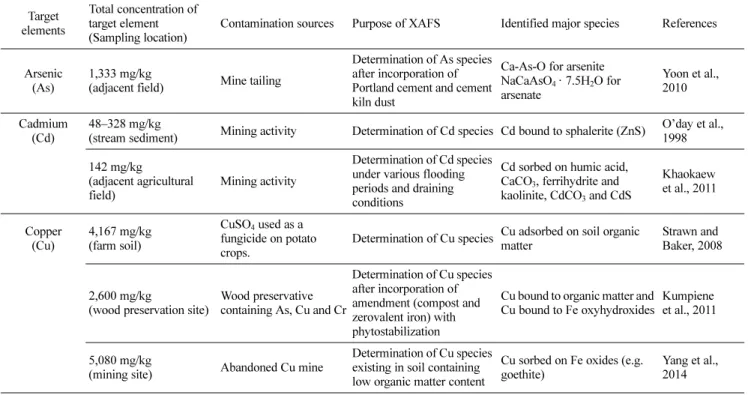
서 매우 중요하다. 특히 이는 토양 내 중금속의 안정화 방법을 통한 정화과정 후에 기 적용된 방법의 효율성 및 해당 중금속 의 장기적 안정성을 평가하기 위하여 필수적인 과정이다. 이를 위해 과거부터 화학적 연속추출을 통한 토양 내 중금속의 분획 화 방법이 사용되고 있으나, 최근 이 방법이 토양에 존재하는 중금속에 대한 과대·과소평가 등 여러 가지 문제점을 야기할 수 있음이 보고되고 있다. 이를 보완하기 위하여 선진국을 중 심으로 여러 가지 분광학적 기법을 활용하는 연구가 진행되고 있으며, 그 중에서도 XAS를 이용하여 XAFS를 분석함으로써 토양 내 중금속 화학종의 정확한 규명이 가능한 첨단기법이 활 용되고 있다. 그러나 현재 국내 토양환경 분야의 경우 중금속 화학종 규명에 XAFS 분석을 활용하는 연구는 미미한 실정이 다. 이에 본 연구에서는 XAFS 분석을 활용하는 방법 중 XANES 및 EXAFS 데이터를 사용하기 위한 과정과, XANES 및 EXAFS 데이터를 연구에 활용한 외국 선행 연구들에 대해 살펴보았다. 토양환경 분야에서 EXAFS 응용은 납의 화학종 규 명에 관한 연구가 주를 이루고 있었으며, 특히 오염지역 토양 에 존재하는 중금속 화학종과 이것의 발생 또는 유입 원인을 규명하기 위한 연구 및 오염토양에 대한 개량제의 처리 후 안 정화된 중금속 화학종을 EXAFS를 통해 규명함으로써 중금속 의 안정성을 평가하는 연구들이 활발하게 진행되고 있었다. 이 와 같이 본 연구에서 조사된 EXAFS 선행연구들에 대한 주요 사항은 요약하여 Table 2에 제시하였다. 한편, 토양환경 분야 연 구에서 XANES 및 EXAFS 데이터의 수집을 위해서는 방사광 가속기 시설의 이용이 필수적이다. 그러나 국내의 경우 가속기 시설은 국가 핵심 연구시설로 분류되어 연구장비의 이용이 쉽 지 않은 실정이다. 그러므로 가속기 시설의 이용 기회 확대를 통해 토양환경 분야 연구자들의 XAS 활용이 증가되어 관련 연 구의 활성화가 필요할 것으로 판단되며, 이와 더불어 XANES
및 EXAFS 데이터의 활용이 활발한 타 학문분야와의 공동연구 를 통해 토양에 대한 XANES 및 EXAFS 연구방법 및 결과해 석의 질적 수준을 한 단계 높일 수 있을 것으로 판단된다.
초 록
X 선 흡수분광법(X-ray absorption spectroscopy, XAS)을 이용하 는 X선 흡수미세구조(X-ray absorption fine structure, XAFS) 의 분석은 다양한 학문분야에서 적용되고 있다. 본 연구에서는 XAFS 분석을 위한 토양 시료의 준비에서부터 XAFS 측정 후 X 선 흡수 끝머리 부근 미세구조(X-ray absorption near edge structure, XANES) 및 광범위 X선 흡수 미세구조(extended X- ray absorption fine structure, EXAFS) 데이터를 추출하여 연구 에 활용하는 것에 대해 간략하게 소개하였다. 특히 토양환경 분 야에서 XANES 및 EXAFS 분석을 활용한 선행연구들에 대해 비소(As) 및 중금속 주요 원소(Cd, Cu, Ni, Pb, Zn)별로 그 내 용을 정리하였다. 토양환경 분야에서 XAFS의 응용은 납(Pb)의 화학종 규명에 관한 연구가 가장 많은 것으로 나타났다. 이와 함께 대부분의 연구들은 오염토양 내 중금속 화학종의 규명을 통해 중금속의 유입 원인 등에 대해 기술하고 있으며, 이를 정 화하기 위한 다양한 방법들(개량제 처리, 식물정화)을 적용한 후, 안정화된 중금속 화학종을 XANES 및 EXAFS 분석을 통해 규 명하여 정화 방법들의 효율성과 안정성에 대해 보고하였다.
Keywords extended X-ray absorption fine structure · heavy metal · immobilization · mechanism · metal speciation · soil contamination · X-ray absorption fine structure, X-ray absorption near edge structure
Table 2 Summary of the XAFS application study in the field of environmental soil science Target
elements
Total concentration of target element (Sampling location)
Contamination sources Purpose of XAFS Identified major species References
Arsenic (As)
1,333 mg/kg
(adjacent field) Mine tailing
Determination of As species after incorporation of Portland cement and cement kiln dust
Ca-As-O for arsenite NaCaAsO
4· 7.5H
2O for arsenate
Yoon et al., 2010
Cadmium (Cd)
48–328 mg/kg
(stream sediment) Mining activity Determination of Cd species Cd bound to sphalerite (ZnS) O’day et al., 1998 142 mg/kg
(adjacent agricultural field)
Mining activity
Determination of Cd species under various flooding periods and draining conditions
Cd sorbed on humic acid, CaCO
3, ferrihydrite and kaolinite, CdCO
3and CdS
Khaokaew et al., 2011
Copper (Cu)
4,167 mg/kg (farm soil)
CuSO
4used as a fungicide on potato crops.
Determination of Cu species Cu adsorbed on soil organic matter
Strawn and Baker, 2008
2,600 mg/kg
(wood preservation site)
Wood preservative containing As, Cu and Cr
Determination of Cu species after incorporation of amendment (compost and zerovalent iron) with phytostabilization
Cu bound to organic matter and Cu bound to Fe oxyhydroxides
Kumpiene et al., 2011
5,080 mg/kg
(mining site) Abandoned Cu mine
Determination of Cu species existing in soil containing low organic matter content
Cu sorbed on Fe oxides (e.g.
goethite)
Yang et al.,
2014
3,200 mg/kg
(grassland located 100 m from the factory)
Former lead battery
reclamation factory Determination of Pb species PbSiO
3Manceau et al., 1996
52,000 mg/kg (former factory field)
Former lead battery
reclamation factory Determination of Pb species Anglesite (PbSO
4) Manceau et al., 1996
1,100–5,300 mg/kg (adjacent residential area)
Pb smelter emission
Determination of Pb species after incorporation of triple superphosphate (TSP), rock phosphate (RP), phosphoric acid (H
3PO
4), iron-rich waste and composted biosolid
Pb sorbed on fulvic acid (organic-matter sorbed Pb), anglesite (PbSO
4), galena (PbS), chloropyromorphite [Pb
5(PO
4)
3Cl] and hydroxypyromorphite [Pb
5(PO
4)
3OH]
Scheckel and Ryan, 2004
18,100 mg/kg
(shooting range) Bullet fragment
Determination of Pb species after incorporation of incinerated poultry waste
Pb sorbed on fulvic acid (Pb
org), massicot (PbO), cerussite (PbCO
3), hydrocerussite [Pb
3(CO
3)
2(OH)
2] and chloropyromorphite [Pb
5(PO
4)
3Cl]
Hashimoto et al., 2009b
19,600 mg/kg
(shooting range) Pellet fragment
Determination of Pb species after incorporation of compost and gypsum with(out) vegetation (watercress, Nasturtium officinale W.T.
Aiton) in flooded soil
Galena (PbS) and Pb sorbed on organic matter (Pb
org), ferrihydrite (Pb
Fe) and birnessite (Pb
Mn)
Hashimoto et al., 2011
Unknown
(shooting range) Spent pellet
Determination of Pb species affected by rhizosphere process and amended with (calcined) shell
Cerussite (PbCO
3), Pb sorbed on organic matter (Pb
org), ferrihydrite (Pb
Fe) and kaolinite, Pb(OH)
2and PbSiO
3Hashimoto et al., 2012
4,626 mg/kg
(shooting range) Bullet fragment
Determination of Pb species after incorporation of eggshell and calcined eggshell
Pb(OH)
2and PbSiO
3Ahmad et al., 2012
11,885 mg/kg
(shooting range) Bullet fragment
Determination of Pb species after incorporation of soybean derived biochar
Hydrocerussite
[Pb
3(CO
3)
2(OH)
2], Pb sorbed on humic acid and ferrihydrite, chloropyromorphite
[Pb
5(PO
4)
3Cl] and Pb- phosphate
Moon et al., 2013
3,970 mg/kg
(shooting range) Bullet fragment
Determination of Pb species after incorporation of mussel shell, cow bone and biochar
Pb sorbed on organic matter and birnessite, cerussite (PbCO
3), Pb(OH)
2, Pb-phosphate and chloropyromorphite [Pb
5(PO
4)
3Cl]
Ahmad et al., 2014a
Nickel (Ni)
3,516 and 4,902 mg/kg (land adjacent to a Ni refinery, high SOM)
Aerial deposition of Ni from Ni refinery
Determination of Ni species after liming
NiO and Ni complexed to organic matter (Ni-fulvic acid)
McNear Jr.
et al., 2007 3,468 and 4,700 mg/kg
(land adjacent to a Ni refinery, low SOM)
Aerial deposition of Ni from Ni refinery
Determination of Ni species after liming
NiO and Ni and Al layered doubled hydroxide (Ni-Al LDH)
McNear Jr.
et al., 2007
10 mg/L of Ni(II) in
water Spiking Investigation of Ni(II)
sequestration on diatomite
Outer-sphere complex, inner- sphere complex, surface coprecipitation, Ni surface precipitates and Ni phyllosilicate-like surface coprecipitation
Sheng et al.,
2011
감사의 글 본 연구는 2012년도 정부(교육과학기술부)의 재원으로 한국연구 재단의 기초연구사업(과제번호 2012R1A1B3001409)지원 및 2014년도 경남 과학기술대학교 기성회 연구비 지원에 의하여 수행되었습니다. 포항방사광 가속기에서의 실험은 미래창조과학부와 포항공대의 지원을 받았습니다.
References
Ahmad M, Hashimoto Y, Moon DH, Lee SS, and Ok YS (2012) Immobilization of lead in a Korean military shooting range soil using eggshell waste: an integrated mechanistic approach. J Hazard Mater 209-210, 392–401.
Ahmad M, Lee SS, Lim JE, Lee SE, Cho JS, Moon DH et al. (2014a) Speciation and phytoavailability of lead and antimony in a small arms range soil amended with mussel shell, cow bone and biochar: EXAFS spectroscopy and chemical extractions. Chemosphere 95, 433–41.
Ahmad M, Rajapaksha AU, Lim JE, Zhang M, Bolan N, Mohan D et al.
(2014b) Biochar as a sorbent for contaminant management in soil and water: A review. Chemosphere 99, 19–33.
Baker LR, Pierzynski GM, Hettiarachchi GM, Scheckel KG, and Newville M (2012) Zinc speciation in proximity to phosphate application points in a lead/zinc smelter-contaminated soil. J Environ Qual 41, 1865–73.
Cao X, Ma LQ, Chen M, Hardison Jr DW, and Harris WG (2003) Weathering of lead bullets and their environmental effects at outdoor shooting ranges. J Environ Qual 32, 526–34.
Dutré V and Vandecasteele C (1995) Solidification/stabilization of arsenic- containing waste: leach tests and behavior of arsenic in the leachate, Waste Manage 15, 55–62.
Gräfe M, Donner E, Collins RN, and Lombi E (2014) Speciation of metal(loid)s in environmental smaples by X-ray absorption spectroscopy:
A critical review. Anal Chim Acta 822, 1–22.
Hashimoto Y, Matsufuru H, Takaoka M, and Tanida H (2009a) Incomplete
transformations of Pb to pyromorphite by phosphate-induced immobilization investigated by X-ray absorption fine structure (XAFS) spectroscopy. Chemosphere 76, 616–22.
Hashimoto Y, Matsufuru H, Takaoka M, Tanida H, and Sato T (2009b) Impacts of chemical amendment and plant growth on lead speciation and enzyme activities in a shooting range soil: an X-ray absorption fine structure investigation. J Environ Qual 38, 1420–8.
Hashimoto Y, Ok YS, and Takaoka M (2012) Chemical speciation of Pb in contaminated soils: (Im)mobilization by plant root growth and chemical amendments. Spring 8 Res Front 2012, 106–7.
Hashimoto Y, Yamaguchi N, Takaoka M, and Shiota K (2011) EXAFS speciation and phytoavailability of Pb in a contaminated soil amended with compost and gypsum. Sci Total Environ 409, 1001–7.
Hesterberg D, Duff MC, Dixon JB, and Vepraskas MJ (2011) X-ray microspectroscopy and chemical reactions in soil microsites. J Environ Qual 40, 667–78.
Isaure MP, Laboudigue A, Manceau A, Sarret G, Tiffreau C, Trocellier P et al.
(2002) Quantitative Zn Speciation in a contaminated dredged sediment by ì-PIXE, ì-SXRF, EXAFS spectroscopy and principal component analysis. Geochim Cosmochim Acta 66, 1549–67.
Kelly SD, Hesterberg D, and Ravel B (2008) Chapter 14 - Analysis of soils and minerals using X-ray absorption spectroscopy. In Methods of Soil Analysis. Part 5 - Mineralogical methods, Ulery AL and Drees LR (eds.), pp.387–463. Soil Science Society of America, USA.
Khaokaew S, Chaney RL, Landrot G, Ginder-Vogel M, and Sparks DL (2011) Speciation and release kinetics of cadmium in an alkaline paddy soil under various flooding periods and draining conditions. Environ Sci Technol 45, 4249–55.
Kirpichtchikova TA, Manceau A, Spadini L, Panfili F, Marcus MA, and Jacquet T (2006) Speciation and solubility of heavy metals in contaminated soil using X-ray microfluorescence, EXAFS spectroscopy, chemical extraction, and thermodynamic modeling. Geochim Cosmochim Acta 70, 2163–90.
Table 2 Continued Target elements
Total concentration of target element (Sampling location)
Contamination sources Purpose of XAFS Identified major species References
Zinc (Zn)
6,600 mg/kg
(Dredged sediment) Nonferrous smelter Determination of Zn species
Sphalerite (ZnS), willemite (Zn2SiO4), zincite (ZnO), Zn- sorbed Fe(oxyhydr)oxide and Zn-containing phyllosilicate
Isaure et al., 2002
Topsoil - 6,200 mg/kg Subsoil - 890 mg/kg (adjacent mountain trail)
Aerial deposition of Zn compounds (franklinite and sphalerite) from Zn smelter
Determination of Zn species
Franklinite (ZnFe
2O
4), sphalerite (ZnS), Zn sorbed on ferrihydrite, birnessite and gibbsite and aqueous Zn
2+Roberts et al., 2002
2,800 mg/kg (field lysimeter)
Artificial contaminated soil with ZnO containing filter dust from a brass foundry
Determination of Zn species
ZnO, Zn-layered double hydroxide(LDH), Zn- phyllosilicate and Zn sorbed on phytate and birnessite)
Voegelin et al., 2005
1,103 mg/kg (former truck farming area)
Irrigation of untreated sewage water for 100 years
Determination of Zn species
Zn sorbed on ferrihydrite, Zn phosphate, Zn bound to phyllosilicate, willemite and gahnite
Kitpichtchikova et al., 2006
72,900 mg/kg (abandoned Pb/Zn smelter soil)
Smelter slag- contaminated soil
Determination of Zn species after incorporation of P containing materials (fluid and granular types)
Willemite (Zn
2SiO
4), hemimorphite [Zn
4Si
2O
7(OH)
2·H
2O], franklinite
[Zn
0.6Mn
0.32+Fe
0.12+Fe
1.53+Mn
0.53+
O
4], scholzite
[CaZn
2(PO
4)
2·2H
2O], hopoite [Zn
3(PO
4)
2·4H
2O], Zn sulfate (ZnSO
4) and Zn hydroxide [Zn(OH)
2]
Baker et al.,
2012
phytoavailability of cadmium and lead in contaminated soil. Clean-Soil Air Water 41, 1235–41.
Lim JE, Ahmad M, Usman ARA, Lee SS, Jeon WT, Oh SE et al. (2013b) Effect of natural and calcined poultry waste on Cd, Pb and As mobility in contaminated soil. Environ Earth Sci 69, 11–20.
Lim JE, Kim KR, Lee SS, Kwon OK, Yang JE, and Ok YS (2010) Stabilization of As (arsenic(V) or roxarsone) contaminated soils using zerovalent iron and basic oxygen furnace slag. J Korean Soc Environ Eng 32, 631–8.
Manceau A, Boisset MC, Sarret G, Hazemann JL, Mench M, Cambier P et al.
(1996) Direct determination of lead speciation in contaminated soils by EXAFS spectroscopy. Environ Sci Technol 30, 1540–52.
McNear Jr DH, Chaney RL, and Sparks DL (2007) The effects of soil type and chemical treatment on nickel speciation in refinery enriched soils: A multi-technique investigation. Geochim Cosmochim Acta 71, 2190–208.
Moon DH, Kim KY, Yoon IH, Grubb DG, Shin DY, Cheong KH et al. (2011) Stabilization of arsenic-contaminated mine tailings using natural and calcined oyster shells. Environ Earth Sci 64, 597–605.
Moon DH, Park JW, Chang YY, Ok YS, Lee SS, Ahmad M et al. (2013) Immobilization of lead in contaminated firing range soil using biochar.
Environ Sci Pollut Res 20, 8464–71.
O’day PA, Carroll SA, and Waychunas GA (1998) Rock-water interactions controlling zinc, cadmium, and lead concentrations in surface waters and sediments, U.S. tri-state mining district. 1. Molecular identification using X-ray absorption spectroscopy. Environ Sci Technol 32, 943–55.
Ok YS, Kim SC, Kim DG, Skousen JG, Lee JS, Cheong YW et al. (2011a) Ameliorants to immobilize Cd in rice paddy soils contaminated by abandoned metal mines in Korea. Environ Geochem Health 33, 23–30.
Ok YS, Lim JE, and Moon DH (2011b) Stabilization of Pb and Cd contaminated soils and soil quality improvements using waste oyster shells. Environ Geochem Health 33, 83–91.
Ok YS, Oh SE, Ahmad M, Hyun S, Kim KR, Moon DH et al. (2010) Effects of natural and calcined oyster shells on Cd and Pb immobilization in
analysis for X-ray absorption spectroscopy using IFEFFIT. J Synchrot Radiat 12, 537–41.
Roberts DR, Scheinost AC, and Sparks DL (2002) Zinc speciation in a smelter-contaminated soil profile using bulk and microspectroscopic techniques. Environ Sci Technol 36, 1742–50.
Scheckel KG and Ryan JA (2004) Spectroscopic speciation and quantification of lead in phosphate-amended soils. J Environ Qual 33, 1288–95.
Scheckel KG, Ryan JA, Allen D, and Lescano NV (2005) Determining speciation of Pb in phosphate-amended soils: Method limitations. Sci Total Environ 350, 261–72.
Sheng G, Yang S, Sheng J, Hu J, Tan X, and Wang X (2011) Macroscopic and microscopic investigation of Ni(II) sequestration on diatomite by batch, XPS, and EXAFS techniques. Environ Sci Technol 45, 7718–26.
Sparks DL (2002) In Environmental Soil Chemistry, (2nd ed.), Academic Press, USA.
Strawn DG and Baker L (2008) Speciation of Cu in a contaminated agricultural soil measured by XAFS, ì-XAFS, and ì-XRF. Environ Sci Technol 42, 37–42.
Usman ARA, Lee SS, Awad YM, Lim KJ, Yang JE, and Ok YS (2012) Soil pollution assessment and identication of hyperaccumulating plants in chromated copper arsenate (CCA) contaminated sites, Korea.
Chemosphere 87, 872–8.
Voegelin A, Pfister S, Scheinost AC, Marcus MA, and Kretzschmar R (2005) Changes in zinc speciation in field soil after contamination with zinc oxide. Environ Sci Technol 39, 6616–23.
Yang J, Liu J, Dynes JJ, Peak D, Regier T, Wang J et al. (2014) Speciation and distribution of copper in a mining soil using multiple synchrotron- based bulk and microscopic techniques. Environ Sci Pollut Res 21, 2943–54.
Yoon IH, Moon DH, Kim KW, Lee KY, Lee JH, and Kim MG (2010) Mechanism for the stabilization/solidification of arsenic-contaminated soils with Portland cement and cement kiln dust. J Environ Manage 91, 2322–8.