Introduction
Dynamic balance can be defined as the amount of volitional movement of a person’s center of mass within the limits of stability (de Bruin and Murer, 2007). As such, it involves many coordinated neuro- muscular processes (Jones, 2000; Stelmach et al, 1989).
Control over dynamic balance is regulated by both
the central nervous system (CNS) and sensorimotor system. The CNS generates appropriate motor com- mands and corrects for errors through a feed-forward, feedback mechanism based on sensory information from the visual, vestibular, and somatosensory systems (Diener and Dichgans, 1988).
Sensorimotor functionality degrades with age (Sturnieks et al, 2008). Overall deterioration in vision, function-
Corresponding author: Hye-seon Jeon [email protected]
The authors would like to acknowledge financial and administrative supports provided from “Brain Korea 21 Project”
sponsored by the Korean Research Foundation.
Motor Learning in Elderly: Effects of Decision Making Time for Self-Regulated Knowledge of Results During a
Dynamic Balance Task
Min-jae Jeon1, MSc, PT, Hye-seon Jeon2,3, PhD, PT
1Dept. of Physical Therapy, The Graduate School, Yonsei University
2Dept. of Physical Therapy, College of Health Science, Yonsei University
3Dept. of Ergonomic Therapy, The Graduate School of Health and Environment, Yonsei University
Abstract
1)Background: Deficiencies in the ability to maintain balance are common in elderly. Augmented feedback such as knowledge of results (KR) can accelerate learning and mastering a motor skill in older people.
Objects: We designed this study to examine whether one session of Wii-Fit game with self-regulated KR is effective for elderly people, and to compare the effect of two different timings of self-regulated KR conditions.
Methods: Thirty-nine community-dwelling elders, not living in hospice care or a nursing home, participated in this study. During acquisition, two groups of volunteers were trained in 10 blocks of a dynamic balancing task under the following 2 conditions, respectively: (a) a pre-trial self-regulated KR (n1=18), or (b) a post-trial self-regulated KR (n2=21). Immediate retention tests and delayed retention tests of balancing performance were administered in 15 minutes and 24 hours following acquisition period, respectively.
Results: In both groups, significant improvements of balancing performances scores were observed during the acquisition period. Regardless of the group, mean of balancing performance scores on retention tests were well-maintained from the final session. There were no significant differences between groups in balancing performance scores during the acquisition period (p>.05); however, the post-trial self-regulated KR group exhibited significantly higher balancing performance scores in both the immediate retention test and delayed retention test than that of the pre-trial self-regulated KR group (p<.05).
Conclusion: Therefore, subjects who regulated their feedback after a dynamic balancing task, during the acquisition period, experienced more efficient motor learning during the retention period than did subjects who regulated their feedback before a dynamic balancing task. Accordingly, in case of presenting the KR of motor learning in clinical settings to elders who reduced dynamic balance abilities, the requesting time of KR is imperative according to self-estimation processes as well as types of KR and practice.
Key Words: Dynamic balance; Elderly; Knowledge of results; Self-regulation.
ality of the semicircular canals and otoliths, and pro- prioception are common age-related ailments. Together, these ailments tend to result in a loss of control over dynamic balance and a degraded ability to re- cover from moments of imbalance episode such as falling (Agrawal et al, 2012; Barrett and Lichtwark, 2008; Goble et al, 2009; Lord, 2006; Perrin et al, 1997).
Nintendo Wii Fit (Nintendo, Kyoto, Japan), the force plate-controlled virtual reality platform is be- coming an increasingly popular therapeutic tool for patients with a variety of illnesses and balancing disorders (Agmon et al, 2011). Because of changes in the center of pressure (COP) experienced on a Wii balance board (WBB) (Nintendo, Kyoto, Japan) which had a good intra-class correlation coefficient=.86∼.99 (Chang et al, 2013), it can be considered as com- parable to those obtained from a typical force plate (Clark et al, 2010). Therefore, this system could po- tentially be used to measure and train dynamic bal- ance while standing and moving in elderly (Clark et al, 2010; Holmes et al, 2013). Accordingly, Wii Fit videogames have been adopted in rehabilitation train- ing programs for the elderly population up to now (Young et al, 2011), and many researches have stud- ied its applications in recovering the reduced balanc- ing abilities (Bateni, 2012; Bieryla and Dold, 2013;
Nitz et al, 2010).
Knowledge of results (KR) is putative form of augmented feedback in motor learning. KR is the in- formation provided to a learner about the consequences of his or her movement (s) (e.g., temporal or spatial) relative to the goals of the movement (Schmidt and Lee, 2011; Wulf and Shea, 2004). KR also refers to information regarding task success provided to the performer following a pre-determined set of practice trials (Winstein and Schmid, 1990). This information serves as a basis for error correction in subsequent trials, which can, ideally, be instinctively applied to real-world situations (Winstein and Schmid, 1990).
Visual biofeedback and force plate systems using KR information are often used to exercise and re-train balance and mobility in the aging population (Lange
et al, 2010). Scheduling frequency, timing, KR type, and KR determiner significantly impact performance and motor learning.
Self-regulation is a widely accepted technique used in motor learning studies in which learners determine how to schedule the practice or when to receive the feedback (Schmidt and Lee, 2011). A self-regulated KR involves receiving feedback only when the par- ticipant wants to know the results of a given trial, which means learner have an option of receiving KR or not. According to previous researches, self-regu- lated KR has been found to be a more important component in acquisition and retention when learning a motor skill than other feedback types such as summary KR and Yorked KR (Chiviacowsky and Wulf, 2002; Chiviacowsky and Wulf, 2005; Janelle et al, 1995; Janelle et al, 1997; Wulf et al, 2005).
Self-regulated KR gives learners control over their own practice regimes, which serves as a powerful motivator (Bandura, 1993; Boekaerts, 1996). This en- courages self-directed strategies (Kirschenbaum, 1984), as well as active involvement of the learner in the motor learning process which can lead to im- proved information processing (Ferrari, 1996;
McCombs, 1989; Watkins, 1984). However, empirical data explaining the cognitive underpinnings of these learning benefits are limited and inconsistent.
Self-regulated KR can be varied by the timing of KR divulgence. In such cases, learners are asked to decide whether they will receive KR before starting a trial (pre-trial, self-regulated KR); whereas, post-trial, self-regulated KR involves learning of KR only after a trial has finished. In either case, there should be no differences in the results in the two groups, as subjects in both groups can regulate feedback de- livery (Chiviacowsky and Wulf, 2005). The only dif- ference between two groups’ experimental conditions is the timing of their decision-making (Chiviacowsky and Wulf, 2005). However, there are lack of re- search on the influence of timing in self-regulated KR to date.
We designed this study to examine whether one
session playing a virtual reality-based Wii Fit game with self-regulated KR can be effective in motor skill learning in elderly people. Two different self-regu- lated KR delivery times were compared (‘pre-trial self-regulated KR’ vs. ‘post-trial self-regulated KR’).
Methods
Subjects
Twenty-one males and eighteen females, aged 65
∼84, were recruited from an welfare center of com- munity-dwelling elderly in Samcheock, Gangwon-do, South Korea. ‘Pre-trial self-regulation KR group’ is comprised eighteen elderly participants which are provided the KR feedback of dynamic balance task by requesting before the each acquisition trial. ‘Post-tri- al self-regulation KR group’ consisted of twenty-one elderly participants, who are provided with the KR feedback of dynamic balance task by the requests after the each acquisition trial.
Inclusion criteria necessitated being a resident of Samcheock, a Berg Balance Scale (BBS) score of ≥ 40; a Mini-Mental State Examination, Korean version (MMSE-K) score of ≥24; as well as being able to understand verbal instructions and watch a television screen without losing focus. Participants were also
required to have the ability to walk independently with or without a device for 10 m. Exclusion criteria were any neurological or medical disorders that can cause seizures, dizziness, fainting, or paralysis; a neuro- logical or vestibular disorder that would prevent a nor- mal range of balance; difficulty standing for more than 5 consecutive minutes; and medications that could af- fect the ability to balance. All subjects participating in this study were informed of the purposes of and pro- cedures involved in this research. Each participant re- ceived credit for their involvement from the center’s director, and signed an informed consent from the Institutional Review Board of Yonsei University, Wonju Campus (approval number: 1041849-201511-BM-082-02) prior to participation.
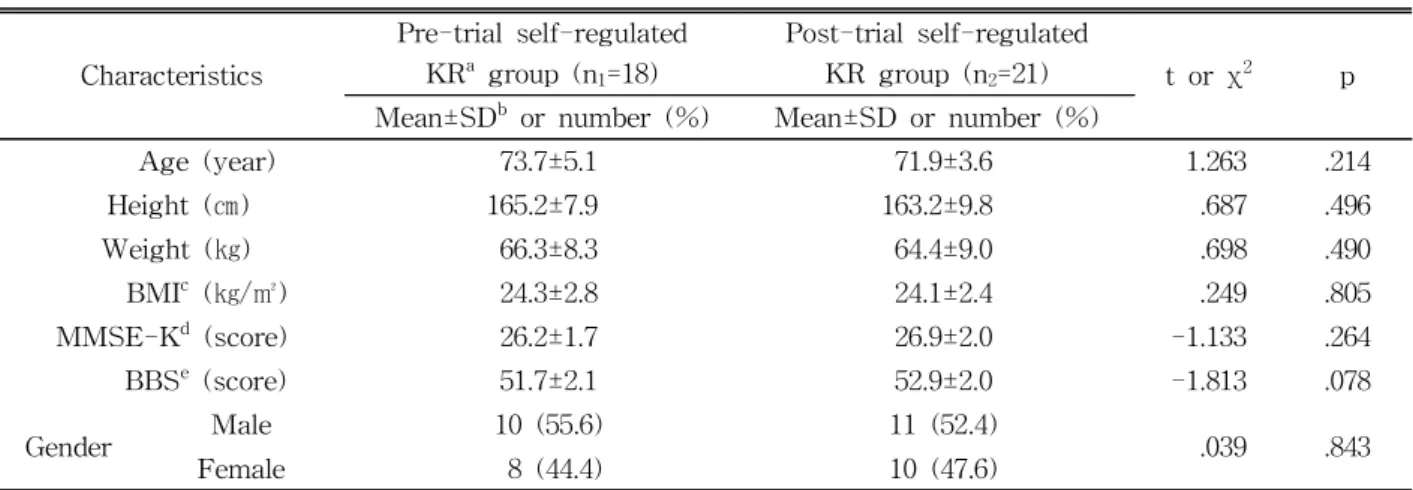
During the first meeting, basic demographic data was gathered from interviews. Afterward, partic- ipants took MMSE-K and BBS tests to assess cog- nition and dynamic balance ability. Participants who completed interviews and assessments were randomly assigned to either the pre-trial self-regulated KR group (10 males, 8 females) or the post-trial self-regulated KR group (11 males, 10 females). Table 1 presents the demographic characteristics of each group. A comparative analysis found no significant differences in age, gender, height, weight, body mass index, MMSE-K, or BBS between the two groups (p>.05).
Characteristics
Pre-trial self-regulated KRa group (n1=18)
Post-trial self-regulated
KR group (n2=21) t or χ2 p Mean±SDb or number (%) Mean±SD or number (%)
Age (year) 73.7±5.1 71.9±3.6 1.263 .214
Height (㎝) 165.2±7.9 163.2±9.8 .687 .496
Weight (㎏) 66.3±8.3 64.4±9.0 .698 .490
BMIc (㎏/㎡) 24.3±2.8 24.1±2.4 .249 .805
MMSE-Kd (score) 26.2±1.7 26.9±2.0 -1.133 .264
BBSe (score) 51.7±2.1 52.9±2.0 -1.813 .078
Gender Male 10 (55.6) 11 (52.4)
.039 .843
Female 8 (44.4) 10 (47.6)
aknowledge of results, bmean±standard deviation, cbody mass index, dmini-mental state examination-Korean version,
eBerg balance scale.
Table 1. Demographic characteristics of pre-trial KR group and post-trial KR Group (N=39)
Instruments
1. Wii Fit balance game
A Wii Fit (RVL-001, Nintendo, Kyoto, Japan) comes with a balance board (RVL-021, Nintendo, Kyoto, Japan) for dynamic movements, and includes four strain gauge load sensors (one mounted in each corner of the board) to extrapolate the center of gravity and track motions derived from weight transfer (Agmon et al, 2011). The Wii balance board has four transducers to measure force spreading and consequential motions in the COP. During gameplay, users experience instantaneous feedback on a tele- vision screen in order to make corrections to their positioning in real time (Agmon et al, 2011).
2. Berg balance Scale
The BBS was used to measure balance in study participants. The BBS consists of fourteen metrics which are scored on a scale of 0∼4. A score of 0 indicates that a subject is incapable of doing a task,
while a score of 4 signifies task competency based on the criterion which has been assigned to it. The max- imum score on this assessment is 56. The items contained in this scale include both simple mobility tasks (eg, sit-to-stand, standing unsupported, trans- fers) and demanding tasks (eg, single-leg standing, turning 360°, tandem standing) (Berg et al, 1989).
Procedure
1. Task
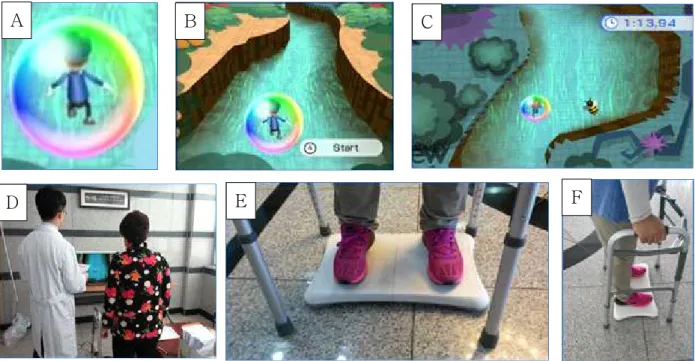
‘Balance Mii’, a virtual reality videogame (RVL-R- RFNK, Nintendo, Kyoto, Japan) which utilizes the Wii Fit platform, exercises dynamic balance in a continuous movement task. Thus, this game was se- lected from a set of 9 video games included in the category of balance game from the Wii Fit package (Figure 1). During gameplay, the participant is rep- resented as an avatar which is positioned inside a bubble floating on a river. The player has to use his or her body position and movements to guide the
A B C
D E F
Figure 1. Wii Fit-based dynamic balance tracking game using a Wii balance board: (A) a game character called ‘Mii’ represented as a participant, (B) tracking pathway, (C) obstacle and time constraint during a game, (D) game trial under the instructions, (E) participant’s foot position on a WBB, (F) standard walker for safety.
bubble along the river to its destination (1200 m away from the start point) without hitting the sur- rounding landscape or obstacles. Each trial has a time limit of 90 seconds. If the bubble does not reach successfully arrive at its destination within the time limit, or if the bubble hits the riverbank, it will burst and the game will end. All subjects from both groups played at the beginner difficulty level.
Each participant was asked to stand erect on the WBB with his or her arms in a comfortable position by his or her sides until the investigator started the game. To move the bubble, the player had to shift their bodies on the WBB by leaning to the left and right, back and forth, looking at the bubble of a tel- evision screen. The final score is measured by the total distance floated, from 0 to 1200, it displays on the screen at the end of the game trial. A higher score indicated that bubble was reached in the closer to the goal point, which a subject had a particularly adept sense of dynamic balance. For safety, a stand- ard walker was placed in front of the balance board.
Participants were allowed to hold the walker for bal- ance support, but were instructed not to hold the walker if possible.
The final score was used as KR information in this experiment. The KR information was provided only when the participant requested it. Otherwise, the KR information was obscured by hiding the score with a screen in front of the television monitor.
2. Process
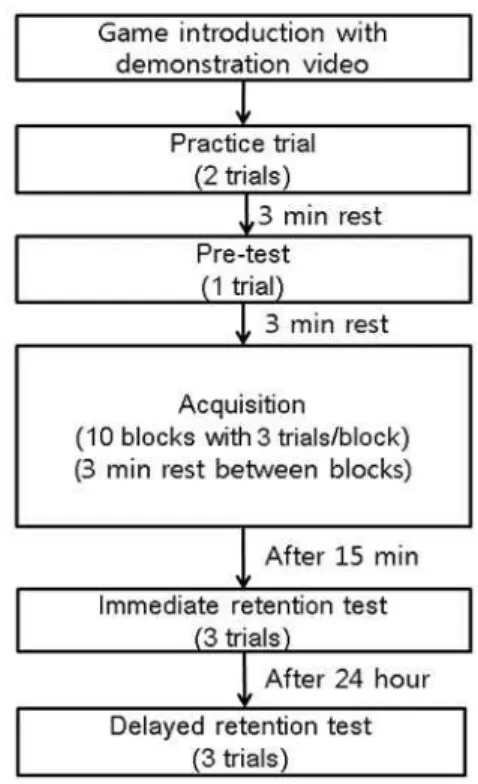
A brief summary of the experimental procedures for tests of acquisition and retention of balance tasks is represented in Figure 2. Firstly, participants were shown a demonstration video to explain the nature of the study and how to perform the videogame task.
This instructional video was recorded by the inves- tigator while an elderly model subject played the videogame. Whenever necessary, the investigator pro- vided additional verbal instructions on the game.
Subsequently, participants performed 2∼3 practice trials for familiarization. After the practice trials, par-
ticipants were administered a pre-test and were not provided with their final scores (KR).
After the pre-test trials, participants took part in an acquisition phase consisting of ten blocks in which participants performed 3 trials of the game during each acquisition block. There was a 15 sec- onds inter-trial interval. Participants in the pre-trial self-regulated KR group were asked to decide wheth- er or not to receive KR before performing each trial.
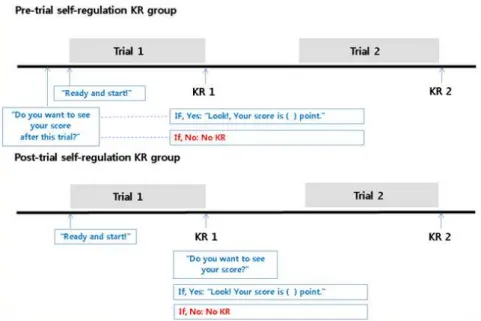
Participants in the post-trial self-regulated KR group were asked to decide whether or not to receive KR after each trial. There were 3 minutes of resting time every 10 blocks during which participants would watch an unrelated video. The verbal instructions associated with each experimental condition are pre- sented in Figure 3.
Subsequently, there were 15 minutes of retention intervals after completing each of the acquisition tri- als, and immediate retention tests were administered immediately. During the immediate retention tests,
Figure 2. Flowchart of study procedure:
Test, acquisition, and retention of the balance tasks with resting and time interval.
participants performed three trials of a Wii-based balance task (Balance Mii) in the absence of visual or verbal KR. Delayed retention tests were administered 24 hours after the immediate retention tests, in which participants performed the same three balance tasks in the absence of visual and verbal KR.
During the acquisition and retention periods, all par- ticipants performed the game tasks in a large, quiet room, individually.
Following the delayed retention tests, a post-ex- perimental interview was conducted to identify par- ticipants’ strategies for learning and retaining motor skills during the acquisition and retention periods.
After each phase, participants answered the question,
“What did you think about before and after the trial started?”
Dependent Measures
The dependent measures in this study included balance performance during acquisition and retention.
Balance performance was defined as the absolute point value during each trial. The change in mean score during acquisition was calculated by subtract- ing the performance score on acquisition block 1 from that of block 10. Total mean frequencies of KR
requests were calculated by adding the requests for KR feedback during acquisition block 1 and those during acquisition block 10.
Statistical Analysis
The Kolmogorov-Smirnov test was used to con- firm the normality of the data. According to whether or not a normal distribution of the data, independent t-test, chi-square analysis, and Mann-Whitney U test were used to examine the balance performance between group differences. A one-way, repeated measure analysis of variance (ANOVA) was used to compare balance performance during 3 motor learning periods (acquisition, immediate retention, and delayed retention) of two different self-regulated KR conditions. After data collection, the data was vali- dated, coded, and analyzed using the SPSS ver. 21.0 (SPSS Inc., Chicago, IL, USA), with statistical sig- nificance set at p>.05.
Results
Requests for feedback
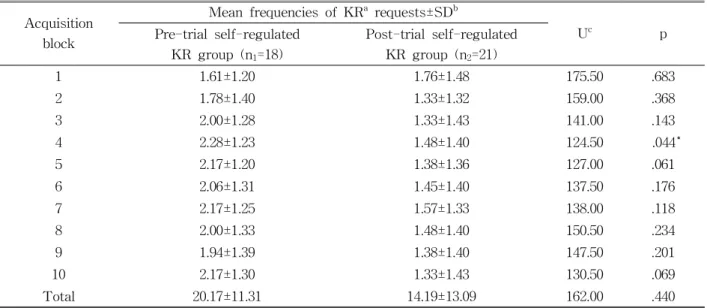
Table 2 presents comparisons of mean KR request Figure 3. Presentation of KR and verbal commands for each group (KR: knowledge of result).
frequencies between groups during the acquisition period. The overall number of KR requests was greater in the ‘pre-trial self-regulated KR group’
than those of the ‘post-trial self-regulated KR group’. However, a comparative analysis found no significant differences in any of the acquisition blocks, excluding acquisition block 4 (p<.05), between the two self-regulated KR groups (p>.05).
Performance changes during acquisition and retention
Figure 4 shows the mean performance scores dur- ing acquisition blocks 1∼10, 15 minutes immediate retention, and 24 hours retention. Up to block 3, the
‘pre-trial self-regulated KR group’ achieved higher scores than did the ‘post-trial self-regulated KR group’. From block 4 to block 10, the ‘post-trial self-regulated KR group’ performed better than the
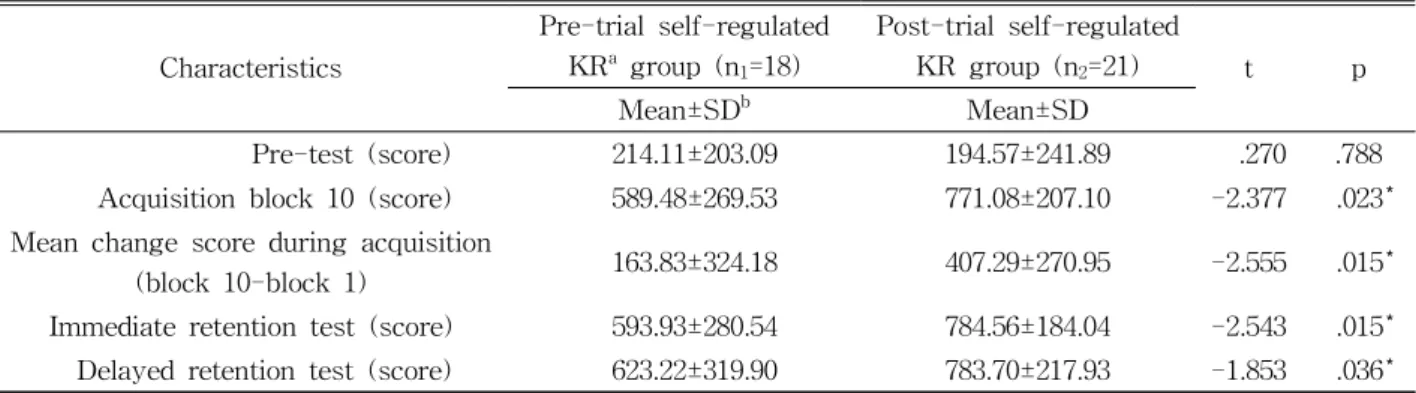
‘pre-trial self-regulated KR group’. The mean change in performance during the acquisition period (block 10 score-block 1 score) was significantly greater in the ‘post-trial self-regulated KR group’ (mean changes=407.29, standard deviation; SD=270.95) than the ‘pre-trial self-regulated KR group’ (mean=163.83, SD=324.18) (Table 3). The mean performance scores
for immediate retention were significantly greater in the ‘post-trial self-regulated KR group’ (mean=784.56, SD=184.04) than the ‘pre-trial self-regulated KR group’ (mean=593.93, SD=280.54), (p=.015) (Table 3).
Delayed retention test scores also indicated that learned dynamic balance in the ‘post-trial self-regulated KR group’ (mean=783.70, SD=217.93) were significantly higher than those of the ‘pre-trial self-regulated KR group’ (mean=623.22, SD=319.90), (p=.036) (Table 3).
Figure 4. Mean game score for both KR conditions across acquisition blocks and retention tests (higher scores indicate better performance, KR: knowledge of result, imm-ret:
immediate retention, del-ret: delayed retention).
Acquisition block
Mean frequencies of KRa requests±SDb
Uc p
Pre-trial self-regulated KR group (n1=18)
Post-trial self-regulated KR group (n2=21)
1 1.61±1.20 1.76±1.48 175.50 .683
2 1.78±1.40 1.33±1.32 159.00 .368
3 2.00±1.28 1.33±1.43 141.00 .143
4 2.28±1.23 1.48±1.40 124.50 .044*
5 2.17±1.20 1.38±1.36 127.00 .061
6 2.06±1.31 1.45±1.40 137.50 .176
7 2.17±1.25 1.57±1.33 138.00 .118
8 2.00±1.33 1.48±1.40 150.50 .234
9 1.94±1.39 1.38±1.40 147.50 .201
10 2.17±1.30 1.33±1.43 130.50 .069
Total 20.17±11.31 14.19±13.09 162.00 .440
aknowledge of results, bstandard deviation,cMann-Whitney U-test, *p<.05.
Table 2. Mean frequencies of requests for KR feedback, by group, during acquisition (N=39)
The results of the one-way, repeated measure ANOVA showed no significant difference in the per- formance scores between acquisition block 10 and the immediate retention test (p>.05) between the two groups. Further, no significant difference in the per- formance scores was found between the immediate retention test and delayed retention test (p>.05). No significant difference was found in the performance scores between acquisition block 10 and the delayed retention test (p>.05) (Table 4).
Discussion
In this study, we examined whether or not one session of a virtual reality-based balance training task, using Nintendo Wii Fit, with a self-regulated KR could be an effective for learning of dynamic balance in older adults. The research further exam- ined the differential effects of two different timings for self-regulated KR (‘pre-trial self-regulated KR’
vs. ‘post-trial self-regulated KR’) on motor learning.
The main finding of this study was that one 90-minute supervised session playing a Wii Fit dy- namic balance game with self-regulated KR engen- dered instant improvements in dynamic balance scores during retention tests, and accelerated the ac- quisition period in elderly subjects. Regardless of the KR presentation timing, improvements in dynamic balance were well-maintained in both the immediate and delayed retention tests. This result is consistent with a previous study, which found that Wii Fit games were effective in improving dynamic balance in an elderly population (Toulotte et al, 2012).
However, our research did not evaluate long-term learning and transfer effects of the Wii Fit training to functional tasks which required dynamic balance in real world situations.
According to a previous study (Chiviacowsky and Wulf, 2002), using a sequential timing task, self-regu- lated feedback schedules engendered learning benefits.
These findings were consistent with the results of
Group Mean±SDa (score)
F p
Acquisition block 10 Immediate retention test Delayed retention test Pre-trial
self-regulation KRb 589.48±269.53 593.93±280.54 623.22±319.90 .164 .850 Post-trial
self-regulation KR 771.08±207.10 784.56±184.04 783.70±217.93 .037 .964
amean±standard deviation, bknowledge of results.
Table 4. Comparisons between acquisition block 10, immediate retention, and delayed retention (N=39) Characteristics
Pre-trial self-regulated KRa group (n1=18)
Post-trial self-regulated
KR group (n2=21) t p
Mean±SDb Mean±SD
Pre-test (score) 214.11±203.09 194.57±241.89 .270 .788
Acquisition block 10 (score) 589.48±269.53 771.08±207.10 -2.377 .023*
Mean change score during acquisition
(block 10-block 1) 163.83±324.18 407.29±270.95 -2.555 .015*
Immediate retention test (score) 593.93±280.54 784.56±184.04 -2.543 .015*
Delayed retention test (score) 623.22±319.90 783.70±217.93 -1.853 .036*
aknowledge of results, bmean±standard deviation, *p<.05.
Table 3. Mean differences in performance between the pre-trial self-regulated KR group and post-trial
self-regulated KR group (N=39)
our study. Another previous study has demonstrated that a self-regulated KR schedule is advantageous for motor learning in elders (Carter and Patterson, 2012); however, the underlying cognitive and sensor- imotor mechanisms responsible for these findings were not clearly explained. One possible explanation of these results might be that self-regulation allowed learners to tailor the delivery of KR to suit their immediate performance request (Schmidt and Lee, 2011).
According to Chiviacowsky and Wulf (2005), self-regu- lated KR served a strong motivational role in con- firming the learner’s hunch about their own perform- ance because they were better able to personalize the subject’s temporal needs than in externally controlled feedback schedules.
Compared to the ‘pre-trial self-regulated KR group’, the subjects in the ‘post-trial self-regulated KR group’ showed significantly enhanced learning in the final acquisition block, immediate retention period, and delayed retention period. These results are commen- surate with those of Chiviacowsky and Wulf (2005), who compared self-regulated KR conditions in which subjects requested KR either before or after the trial while learning a discrete throwing task. The authors found that subjects who requested KR ‘after’ each trial were significantly better at the throwing task, similar to the results of our study. When a learner can determine after a trial whether to get KR feed- back, the decision process probably includes an self-es- timation of performance on that trial (Chiviacowsky and Wulf, 2005). Based on the results of this self-es- timation process, the learner can then determine whether or not to request KR feedback. These seems to support a interpretation that self-regulated feed- back is more effective in motor learning by facilitat- ing a self-estimation process of performance espe- cially when the externally provided KR information works together with the inherent source of feedback received while they performed the given trial. Compared to Chiviacowsky and Wulf (2005) sequential timing task of discrete movement, participants in our study were allowed continuous tracking type task in a vir-
tual reality environment. Therefore, this task pro- vides too much extrinsic feedback with learner dur- ing task performance, compared to discrete move- ment task in many previous study (Chiviacowsky and Wulf, 2002; Janelle et al, 1995; Janelle et al, 1997; Wulf et al, 2005).
According to previous research of motor learning by age group using self-regulated feedback (Carter and Patterson, 2012), the young group showed significantly better motor learning in immediate and delayed re- tention tests than elderly group. Therefore, the results of our research regarding an elderly population are difficult to generalize to other populations. Further studies into the more clear causes for the advantages of ‘post-trial self-regulation KR condition’ should lead to the design of more effective feedback conditions and to a better explanation of this absorbing phenomenon.
Conclusion
The goal of the present study was to examine whether one session of Wii-fit game with self-regu- lation KR is effective for elderly people, and to com- pare the effect of two different timings of self-regu- lated KR conditions on Wii-based dynamic balance task in motor learning.
The results showed that one 90 minutes session of a Wii Fit dynamic balance game with self-regulated KR induced significant improvements in dynamic bal- ance scores during retention tests as well as in the acquisition period of motor learning in elderly people.
However, subjects in ‘post-trial self-regulated KR group’ consistently achieved significantly higher scores during the acquisition, immediate, and delayed retention periods. In both groups, improved dynamic balance ac- quired during the training periods was well-maintained in immediate and delayed retention tests.
Those elderly subjects who regulated their feedback after each dynamic balance task during the acquisition period achieved higher motor learning of dynamic bal- ance during retention periods than those who regu-
lated their feedback before each dynamic balance task.
Therefore, in case of presenting the KR of motor learning in clinical settings to the elderly who reduced dynamic balancing ability, requesting time of the KR is imperative according to critical factor such as self-estimation as well as the types of the KR.
References
Agrawal Y, Zuniga MG, Davalos-Bichara M, et al.
Decline in semicircular canal and otolith function with age. Otol Neurotol. 2012;33(5):832-839.
https://doi.org/10.1097/MAO.0b013e3182545061 Agmon M, Perry CK, Phelan E, et al. A pilot study
of Wii Fit exergames to improve balance in older adults. J Geriatr Phys Ther. 2011;34(4):161-167.
https://doi.org/10.1519/JPT.0b013e3182191d98 Bandura A. Perceived self-efficacy in cognitive de-
velopment and functioning. Educational Psychologist.
1993;28(2):117-148.
Barrett RS, Lichtwark GA. Effect of altering neural, muscular and tendinous factors associated with aging on balance recovery using the ankle strat- egy: A stimulation study. J Theor Biol. 2008;
254(3):546-554. https://doi.org/10.1016/j.jtbi.2008.06.018 Bateni H. Changes in balance in older adults based on
use of physical therapy vs the Wii Fit gaming system: A preliminary study. Physiotherapy. 2012;
98(3):211-216. https://doi.org/10.1016/j.physio.2011.02.004 Berg KO, Wood-Dauphinee SL, Williams JI, et al.
Measuring balance in elderly: Preliminary devel- opment of an instrument. Physiother Can.
1989;41(6):304-311.
Bieryla KA, Dold NM. Feasibility of Wii Fit training to improve clinical measures of balance in older adults. Clin Interv Aging. 2013;8:775-781.
https://doi.org/10.2147/CIA.S46164
Boekaerts M. Self-regulated learning at the junction of cognition and motivation. Eur Psychol.
1996;1(2):100-112.
Carter MJ, Patterson JT. Self-controlled knowledge
of results: Age-related differences in motor learning, strategies, and error detection. Hum Mov Sci. 2012;31(6):1459-1472. https://doi.org/
10.1016/j.humov.2012.07.008
Chang WD, Chang WY, Lee CL, et al. Validity and reliability of wii fit balance board for the as- sessment of balance of healthy young adults and the elderly. J Phys Ther Sci. 2013;25(10):
1251-1253. https://doi.org/10.1589/jpts.25.1251 Chiviacowsky S, Wulf G. Self-controlled feedback:
Does it enhance learning because performers get feedback when they need it? Res Q Exerc Sport. 2002;73(4):408-415.
Chiviacowsky S, Wulf G. Self-controlled feedback is effective if it is based on the learner’s performance. Res Q Exerc Sport. 2005;76(1);42-48.
Clark RA, Bryant AL, Pua Y, et al. Validity and reli- ability of the Nintendo Wii Balance Board for as- sessment of standing balance. Gait Posture. 2010;
31(3):307-310. https://doi.org/10.1016/j.gaitpost.2009.11.012 de Bruin ED, Murer K. Effect of additional functional exercises on balance in elderly people. Clin Rehabil. 2007;21(2):112-121.
Diener HC, Dichgans J. On the role of vestibular, visual and somatosensory information for dy- namic postural control in humans. Prog Brain Res. 1988;76:253-262.
Ferrari M. Observing the observers: Self-regulation in the observational learning of motor skills.
Dev Rev. 1996;16(2):203-240.
Goble DJ, Coxon JP, Wenderoth N, et al. Proprioceptive sensibility in the elderly: Degeneration, functional consequences and plastic-adaptive processes.
Neurosci Biobehav Rev. 2009;33(3):271-278.
https://doi.org/10.1016/j.neubiorev.2008.08.012 Holmes JD, Jenkins ME, Johnson AM, et al. Validity
of the Nintendo Wii® balance board for the as- sessment of standing balance in Parkinson’s disease. Clin Rehabil. 2013;27(4):361-366.
https://doi.org/10.1177/0269215512458684
Janelle CM, Barba DA, Frehlich SG, et al.
Maximizing performance feedback effectiveness
through videotape replay and a self-controlled learning environment. Res Q Exerc Sport. 1997;68(4):
269-279.
Janelle CM, Kim J, Singer RN. Subject-controlled performance feedback and learning of a closed motor skill. Percept Mot Skills. 1995;81(2):627-634.
Jones GM. Posture. In: Kandel E ,Schwartz J, Jessel T eds. Principles of Neural Science. 4th ed.
New York, McGraw-Hill, 2000.
Kirschenbaum DS. Self-regulation and sport psychology:
Nurturing an emerging symbiosis. Journal of Sport Psychology. 1984;6(2):159-183.
Lange B, Flynn S, Proffitt R, et al. Development of an interactive game-based rehabilitation tool for dy- namic balance training. Top Stroke Rehabil. 2010;17 (5):345-352. https://doi.org/10.1310/tsr1705-345 Lord SR. Visual risk factors for falls in older people.
Age ageing. 2006;35:ii42-ii45.
McCombs BL. Self-regulated learning and academic achievement: A phenomenological view. In:
Zimmerman BJ, Schunk DH eds. Self-Regulated Learning and Academic Achievement Theory, Research, and Practice: Progress in cognitive development research. 1st ed. New York, Springer-Verlag, 1989.
Nitz JC, Kuys S, Isles R, et al. Is the Wii Fit a new-generation tool for improving balance, health and well-being? A pilot study. Climacteric. 2010;
13(5):487-491. https://doi.org/10.3109/13697130903395193 Perrin PP, Jeandel C, Perrin CA, et al. Influence of visual control, conduction, and central integration on static and dynamic balance in healthy older adults. Gerontology. 1997;43(4):223-231.
Schmidt RA, Lee TD. Augmented feedback. In:
Schmidt RA, Lee TD eds. Motor Control and Learning: A behavioral emphasis. 5th ed.
Champaign, Human Kinetics, 2011.
Stelmach GE, Teasdale N, Di Fabio RP, et al. Age related decline in postural control mechanisms.
Int J Aging Hum Dev. 1989;29(3):205-223.
Sturnieks DL, St George R, Lord SR. Balance dis- orders in the elderly. Neurophysiol Clin. 2008;
38(6):467-478.
Toulotte C, Toursel C, Olivier N. Wii Fit® training vs. Adapted Physical Activities: Which one is the most appropriate to improve the balance of independent senior subjects? A randomized con- trolled study. Clin Rehabil. 2012;26(9):827-835.
https://doi.org/10.1177/0269215511434996
Watkins D. Student perceptions of factors influencing tertiary learning. Higher Education Research and Development. 1984;3(1):33-50.
Winstein CJ, Schmidt RA. Relative frequency of in- formation feedback in motor performance and learning. J Exp Psychol Learn Mem Cogn.
1990;16(4):677-691.
Wulf G, Raupach M, Pfeiffer F. Self-controlled ob- servational practice enhances learning. Res Q Exerc Sport. 2005;76(1):107-111.
Wulf G, Shea CH. Understanding the role of aug- mented feedback: The good, the bad and the ugly. In: Williams AM, Hodges NJ eds. Skill Acquisition in Sport: Research, theory and practice. 1st ed. London, Routledge, 2004.
Young W, Ferguson S, Brault S, et al. Assessing and training standing balance in older adults: A novel approach using the ‘Nintendo Wii’ Balance Board.
Gait Posture. 2011;33(2):303-305. https://doi.org/
10.1016/j.gaitpost.2010.10.089
This article was received September 19, 2016, was reviewed September 19, 2016, and was accepted November 10, 2016.