http://www.jdapm.org 179
Letter to the Editor pISSN 2383-9309❚eISSN 2383-9317
J Dent Anesth Pain Med 2021;21(2):179-181❚https://doi.org/10.17245/jdapm.2021.21.2.179
Telesimulation training applying flipped classroom in the dental clinic for medical emergencies
Naotaka Kishimoto
1, Bich Hong Nguyen
2, Simon D Tran
3, Kenji Seo
11Division of Dental Anesthesiology, Faculty of Dentistry & Graduate School of Medical and Dental Sciences, Niigata University, Niigata, Japan
2CHU Sainte Justine Hospital, Montreal, QC, Canada
3Faculty of Dentistry, McGill University, Montreal, QC, Canada
Keywords: Emergencies; Flipped Classroom; Telesimulation.
This is an Open Access article distributed under the terms of the Creative Commons Attribution Non-Commercial License (http://creativecommons.org/licenses/by-nc/4.0/) which permits unrestricted non-commercial use, distribution, and reproduction in any medium, provided the original work is properly cited.
Received: February 16, 2021•Revised: February 22, 2021•Accepted: March 4, 2021
Corresponding Author: Naotaka Kishimoto, Division of Dental Anesthesiology, Faculty of Dentistry & Graduate School of Medical and Dental Sciences, Niigata University, 2-5274, Gakkocho-dori, Chuo-ku, Niigata 951-8514, Japan
Phone: +81-25-227-2972 Fax: +81-25-227-0812 E-mail: [email protected] Copyrightⓒ 2021 Journal of Dental Anesthesia and Pain Medicine
Dear Editor:
Telesimulation combines the resources from telecommunication and simulation to educate and evaluate off-site learners [1]. Although telesimulation has been introduced in various fields, its application in medical education, such as teaching ultrasound-guided supraclavicular block [2] and intraosseous insertion techniques, [3] is relatively new. However, telesimulation in dentistry has not yet been reported. Recently, we organized a study group called “AneStem” to manage sudden medical emergencies in dental patients at the chairside and created a simulation course to treat these conditions [4]. Due to the COVID-19 pandemic and traveling restrictions, we remotely delivered our course to dental practitioners through telesimulation. This report provides an overview of this course, wherein we connected a private dental clinic to our university hospital.
Prior to the course, the learners (comprising dentists, hygienists, and dental assistants) watched YouTube
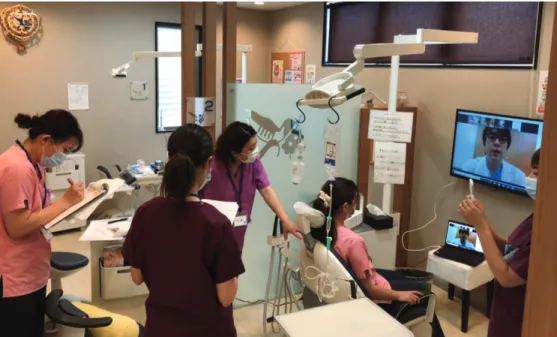
videos created by AneStem on the pathophysiology of vasovagal reflex and anaphylaxis. Additionally, items such as an infusion set, oxygen mask, syringe labeled with medicine, and stethoscope were mailed in advance to the dental office. On the day of the course, the dental team (learners) gathered around the dental chair, one of whom sat on it as the simulated patient. Ten minutes before starting the course, we established an environment with interactive video communication between the dental clinic in Itami, Japan and the Niigata University Hospital, Niigata, Japan, using Zoom (Zoom Video Communi- cations, Inc., San Jose, CA, USA). An educator located at the university hospital presented scenarios of vasovagal reflex and anaphylaxis that arose during the simulated dental visit. The learners at the clinic, under the mentoring of the educator, had to diagnose the medical emergency and provide initial treatments to the simulated patient (Fig. 1). Changes in vital signs were simulated using the SimMon software (Castle Andersen ApS, Hillerød, Denmark). After the training, there was a debriefing
Naotaka Kishimoto, et al
180 J Dent Anesth Pain Med 2021 April; 21(2): 179-181
Fig. 1. Telesimulation training of medical emergencies for a team of dental providers (learners) located in a private dental clinic while the educator is at a remote location.
period, during which the learners discussed improvements to be made, and the educator facilitated the discussion.
A questionnaire was provided after the course, and some of the learners’ comments were: “Being able to learn through a telesimulated case scenario and with a practical training was most useful” and “I performed the telesimulation emergency smoothly because of the basic knowledge provided by the video in advance.” This course uses a flipped-classroom approach to prepare learners with videos before starting the telesimulation. We reported that adopting a flipped classroom strategy in dental education improves learners’ comprehension [4].
We speculate that the flipped classroom strategy used for our telesimulation course improved learners’ compre- hension and resulted in positive feedback via the questionnaire. We noted that even when Zoom was disconnected for 5 min due to Wi-Fi problems, there was no complaint from the learners regarding this inconvenience.
In conclusion, it is possible to remotely learn medical emergency management in dental clinics using Zoom.
The positive feedback obtained via the questionnaire suggests that our course using telesimulation by applying a flipped classroom is useful for dental practitioners.
AUTHOR ORCIDs
Naotaka Kishimoto: https://orcid.org/0000-0002-8716-5056 Bich Hong Nguyen: https://orcid.org/0000-0002-8746-7783 Simon D Tran: https://orcid.org/0000-0001-5594-359X Kenji Seo: https://orcid.org/0000-0001-9126-9344
AUTHOR CONTRIBUTIONS
Naotaka Kishimoto: Conceptualization, Writing – original draft Bich Hong Nguyen: Writing – review & editing
Simon D Tran: Supervision, Writing – review & editing Kenji Seo: Writing – review & editing
ACKNOWLEDGMENT: We would like to thank Dr. Katsumi Kinoshita (Kinoshita Dental Clinic) for his cooperation in organizing the course.
DECLARATIONS OF INTEREST: None.
FUNDING: None.
REFERENCES
1. Papanagnou D. Telesimulation: A Paradigm Shift for Simulation Education. AEM Educ Train 2017; 1: 137-9.
2. Burckett-St Laurent DA, Cunningham MS, Abbas S, Chan
Telesimulation training for medical emergencies
http://www.jdapm.org 181 VW, Okrainec A, Niazi AU. Teaching ultrasound-guided
regional anesthesia remotely: a feasibility study. Acta Anaesthesiol Scand 2016; 60: 995-1002.
3. Mikrogianakis A, Kam A, Silver S, Bakanisi B, Henao O, Okrainec A, et al. Telesimulation: an innovative and effective tool for teaching novel intraosseous insertion
techniques in developing countries. Acad Emerg Med 2011;
18: 420-7.
4. Kishimoto N, Mukai N, Honda Y, Hirata Y, Tanaka M, Momota Y. Simulation training for medical emergencies in the dental setting using an inexpensive software application. Eur J Dent Educ 2018; 22: e350-7.