INTRODUCTION
Paroxysmal nocturnal hemoglobinuria (PNH) is an acquired clonal hematopoietic stem cell disorder that manifests as hemo- lytic anemia, venous thrombosis, and cytopenia. Although allogeneic stem cell transplantation (allo-SCT) is considered the only curative treatment, this treatment is associated with high treatment-related mortality (1, 2). Non-myeloablative stem cell transplantation (NST) uses reduced intensity con- ditioning regimens to decrease regimen-related toxicity and is used in patients who are not eligible for myeloablative stem cell tranplsantation due to advanced age or medically debilitat- ed patients unable to tolerate myeloablative conditioning regimen (3, 4). Recently there was a case report of a patient with PNH who underwent NST (5). However, further studies are needed to establish the role of allo-SCT, especially reduced intensity conditioning therapy and its incidence of graft-versus- host disease (GVHD), in the treatment of PNH.
Chronic GVHD is one of the most frequent complications after both myeloablative allo-SCT and NST (3, 4). Giralt et al. (6) reported that actuarial risk of chronic GVHD was 68
±9% in 86 patients who had undergone NST due to a vari- ety of hematologic malignancies and poor candidates for con- ventional myeloablative allo-SCT. It is immune-mediated and involves autoantibodies generated by donor T-lymphocyte
reactivity to major histocompatibility complex (MHC) anti- gens (7, 8). Many of the features seen in chronic GVHD are similar to various immune complex disorders such as collagen vascular disease. Although glomerular disease has been describ- ed as one of the rare manifestations of chronic GVHD fol- lowing the usual myeloablative allo-SCT (9-18) and murine GVHD has been studied as a model of lupus nephritis (19), membranous glomerulopathy as a manifestation of chronic GVHD after allo-SCT is particularly unusual.
We describe a patient who underwent non-myeloablative allo-SCT for PNH and received cyclosporine A as GVHD prophylaxis. After 25 months of allo-SCT, she developed ne- phrotic syndrome following extensive chronic GVHD.
CASE REPORT
A 22-yr-old woman with PNH underwent non-myeloab- lative stem cell transplantation from an HLA-matched sibling donor (her younger sister) in December 1999 because of refrac- tory hemolysis and aggravating cytopenia. She received Bu- Fludara-ATG (busulfan 4 mg/kg/day for 2 days, fludarabine 30 mg/m2/day for 6 days, and ATG 20 mg/kg/day for 4 days) for conditioning therapy and G-CSF mobilized peripheral blood stem cells. Cyclosporin A (CsA) alone was administered
Gyeong-Won Lee, Je-Hwan Lee, Soon-Bae Kim, Eun-Sil Yu*, Jae-Lyun Lee, Min-Hee Ryu, Eunkyoung Kim, Seong-Jun Choi, Woo-Kun Kim, Jung-Shin Lee, Kyoo-Hyung Lee
Departments of Medicine and Pathology*, Asan Medical Center, University of Ulsan, Seoul, Korea
Address for correspondence Je-Hwan Lee, M.D.
Department of Medicine, Asan Medical Center, 388-1 Poongnap-dong, Songpa-gu, Seoul 138-040, Korea
Tel : +82.2-3010-3218, Fax : +82.2-3010-6961 E-mail : [email protected]
901 J Korean Med Sci 2003; 18: 901-4
ISSN 1011-8934
Copyright � The Korean Academy of Medical Sciences
Allogeneic stem cell transplantation (allo-SCT) using related or unrelated donor could eradicate paroxysmal nocturnal hemoglobinuria (PNH) clones and may cure the disease. Chronic graft-versus host disease (GVHD) is a major complication of patients who have undergone allo-SCT. Nephrotic syndrome has been described as one of the rare manifestations of chronic GVHD following the usual myeloabla- tive allo-SCT. We report a case of nephrotic syndrome that developed 25 months after non-myeloablative allo-SCT for PNH. The patient had grade II acute GVHD and extensive chronic GVHD after non-myeloablative allo-SCT. Typically the patient presented with preserved renal function and full nephrotic syndrome including gen- eralized edema, proteinuria, hypoalbuminemia, and hypercholesterolemia. Renal biopsy revealed findings of membranous glomerulopathy (MG). The patient is alive with a stable engraftment and full donor chimerism under the administration of tacrolimus for control of chronic GVHD and MG without refractory hemolysis and cytopenia.
Key Words :Graft vs Host Disease; Hemoglobinuria, Paroxysmal; Glomerulonephritis, Membranous; Stem Cell Transplantation
Received : 24 September 2002 Accepted : 13 February 2003
Membranous Glomerulopathy as a Manifestation of Chronic Graft-versus-Host-Disease After Non-myeloablative Stem Cell
Transplantation in a Patient with Paroxysmal Nocturnal Hemoglobinuria
902 G.-W. Lee, J.-H. Lee, S.-B. Kim, et al.
for GVHD prophylaxis. An erythematous maculopapular skin lesion developed on the 45th day of post-stem cell transplan- tation as a manifestation of acute GVHD; stage II skin lesion;
with no evidence of jaundice or gastrointestinal involvement.
Skin biopsy revealed interface dermatitis consistent with GVHD. After improvement of the skin lesion, CsA was ta- pered from 90 days after stem cell transplantation and was withdrawn after 140 days. After 1 week, the patient presented with an erythematous maculopapular rash on trunk and upper and lower extremities, a dry mouth, and conjunctival hyper- emia. Opthalmological evaluation confirmed GVHD syn- drome involving both eyes as a sicca-like syndrome. Methyl- prednisolone (Methyl-pd) was administered for treatment of extensive chronic GVHD.
In February 2002, the patient presented with edema, hema- turia, proteinuria, and hypoalbuminemia. Proteinuria pro- gressed to the nephrotic range and the patient was admitted to the hospital. On admission, blood pressure was normal and skin rash, jaundice and gastrointestinal symptoms were absent.
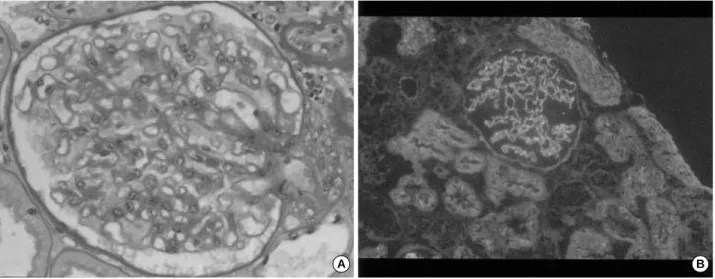
Results of hematologic studies were normal. Laboratory data indicated the presence of nephrotic syndrome, with proteinuria of 3.6 g/day, serum total protein 4.1 g/dL, serum albumin 2.5 g/dL, BUN 16 mg/dL, creatinine 0.7 mg/dL, and total cholesterol 254 mg/dL. Urinalysis indicated a red blood cell count of 21 to 30 cells/HPF with pyuria. Creatinine clearance was 116 mL/min. Antinuclear antibody, anti-ds DNA, cryo- globulin, and hypocomplementemia were not present. Tests for the hepatitis B virus surface antigen and antibody and the hepatitis C antibody showed negative results. Two cores of renal cortex and medulla contained 13 glomeruli, one of which was globally sclerotic under light microscopy. The mesangium was moderately expanded due to the increase in the matrix with focal hypercellularity. Microscopic findings were com- patible with MG (Fig. 1, 2)
Treatment with tacrolimus was initiated and close follow-up was scheduled. The patient is well with a stable engraftment and full donor chimerism and does not have any evidence of nephrotic syndrome from the treatment with tacrolimus alone.
She is still on regular follow-up at the outpatient clinic.
DISCUSSION
We described a patient who had undergone non-myeloab- lative allo-SCT for PNH and received CsA as GVHD prophy- laxis. She experienced an erythematous maculopapular rash, aggravation of liver function, and conjunctivitis-sicca syndrome
A B
Fig. 1.Membranous glomerulonephropathy. (A) Light micrograph (×200, PAS stain) reveals minimal glomerular changes with focal tubular atrophy, mild interstitial fibrosis and mild diffuse thickening of glomerular basement membrane without evidence of Inflammation or cellular proliferation consistent with membranous nephropathy. (B) Immunofluorescence (C3, ×100) demonstrats granular deposition of C3 along glomerular capillary wall and disclosed a 1+ peripheral granular diffuse positivity for IgG.
Fig. 2.Membraneous glomerulonephropathy: electron micrograph shows dense subepithelial immune deposits and diffuse effacement of the foot processes of epithelial cells consistent with membranous nephropathy.
MG as a Manifestation of cGVHD After NST in a Patient with PNH 903
after CsA withdrawal as her first manifestation of chronic GVHD. After 25 months of non-myeloablative allo-SCT, diagnosis of membranous glomerulopathy was diagnosed by a kidney biopsy.
In the setting of chronic GVHD following allogeneic stem cell transplantation, possible etiologies of generalized edema and hypoalbuminemia include hepatic dysfunction, intractable diarrhea, and other debilitating infectious diseases. Renal insult following allo-SCT can be due to several conditions such as CsA, TBI, and other nephrotoxic agents (20). In our patient, TBI was not incorporated in the conditioning regimen. CsA was not used at presentation, and the biopsy findings were not compatible with CsA toxicity. In addition, there was no history of a nephrotoxic drug in our patient.
The present case differs from those in other reports (9-18) in several ways; this is the first case of membranous glomeru- lonephropathy associated with chronic GVHD that developed following non-myeloablative allo-SCT. Second, PNH is not a common hematologic disease where allo-SCT is indicated.
There are supportive data of the relationship between GVHD and the development of MG. GVHD is a condition in which donor T cells become reactive against the major or minor his- tocompatibility antigens of the hosts. Therefore, a change of glomerular permeability may occur through the cytokine release of donor T-lymphocytes (21). Although approximately one quarter of patients who undergo allo-SCT do not develop GVHD, all patients developing MG after allo-SCT had evi- dence of GVHD. This finding suggests that GVHD is closely related to MG. MG associated with GVHD has similarities with de novo MG occurring in the renal allograft. In both settings, the development of MG is associated with allogeneic tissue transplantation and immunosuppression with agents such as CsA. A proposed mechanism for de novo MG involves host alloreactivity to donor MHC or non-MHC antigens expressed on glomerular podocytes. The activity could be demonstrated experimentally by antibody to angiotensin-con- verting enzyme in a porcine model (22). The observation that de novo MG occurs only in the transplanted kidney, sparing the native kidney, strongly supports the mechanism of host- antibody formation to locally expressed donor alloantigen (23).
In conclusion, glomerular diseases such as MG should be considered as a manifestation of chronic GVHD in all patients with hypoalbuminemia, proteinuria, and edema following allo-SCT. Further investigation is needed to further elucidate the pathogenesis and relationship between GVHD and MG.
REFERENCES
1. Saso R, Marsh J, Cevreska L, Szer J, Gale RP, Rowlings PA, Passweg JR, Nugent ML, Luzzatto L, Horowitz MM, Gordon-Smith EC. Bone marrow transplants for paroxysmal nocturnal hemoglobinuria. Br J Haematol 1999; 104: 392-6.
2. Bemba M, Guardiola P, Garderet L, Devergie A, Ribaud P, Esperou
H, Noguera MH, Gluckman E, Socie G. Bone marrow transplantation for paroxysmal nocturnal haemoglobinuria. Br J Haematol 1999; 105:
366-8.
3. Lee K-H, Lee J-H, Lee J-H, Kim W-K, Chi H-S, Lee J-S. Non-mye- loablative conditioning regimen of fludarabine, busulfan, anti-thymo- cyte globulin and methylprednisolone for allogeneic peripheral blood hematopoietic cell transplantation. Haematologica 2001; 86: 999-1001.
4. Khouri IF, Keating M, Korbling M, Przepiorka D, Anderlini P, O’Brien S, Giralt S, Ippoliti C, von Wolff B, Gajewski J, Donato M, Claxton D, Ueno N, Andersson B, Gee A, Champlin R. Transplant- lite: intro- duction of graft versus malignancy using fludarabine based nonabla- tive chemotherapy and allogeneic blood progenitor-cell transplan- tation as treatment for lymphoid malignancies. J Clin Oncol 1998;
16: 2817-24.
5. Suenaga K, Kanda Y, Niiya H, Nakai K, Saito T, Saito A, Ohnishi M, Takeuchi T, Tanosaki R, Makimoto A, Miyawaki S, Ohnishi T, Kanai S, Tobinai K, Takaue Y, Mineishi S. Successful application of non- myeloablative transplantation for paroxysmal nocturnal hemoglobin- uria. Exp Hematol 2001; 29: 639-42.
6. Giralt S, Thall PF, Khouri I, Wang X, Braunchweig I, Ippolitti C, Clax- ton D, Donato M, Bruton J, Cohen A, Davis M, Anderson BS, Ander- lini P, Gajewski J, Kornblau S, Andreeff M, Przepiorka D, Ueno NT, Molldrem J, Champlin R. Melphalan and purine analog containing preparative regimens: reduced-intensity conditioning for patients with hematologic malignancies undergoing allogeneic progenitor cell trans- plantation. Blood 2001; 97: 631-7.
7. Gale RP. Graft-versus-host disease. Immunol Rev 1985; 88: 193-214.
8. Wick MR, Moore SB, Gastineau DA, Hoagland HC. Immunologic, clinical and pathologic aspects of human graft-versus-host disease.
Mayo Clin Proc 1983; 58: 603-12.
9. Hiesse C, Goldschmidt E, Santelli G, Charpentier B, Machover D, Fries D. Membranous nephropathy in a bone marrow transplant recipient.
Am J Kidney Dis 1988; 11: 188-91.
10. Gomez-Garcia P, Herrera-Arroyo C, Torres- Gomez A, Gomez-Car- rasco J, Aljama-Garcia P, Lopez-Rubio F, Martinez-Guibelalde F, Fornes-Torres G, Rojas-Contreras R. Renal involvement in chronic graft-versus-disease: Report of two cases. Bone Marrow Transplant 1988; 3: 357-62.
11. Barbara JA, Thomas AC, Smith PS, Gillis D, Ho JO, Woodrofe AJ.
Membranous nephropathy with graft-versus host disease in a bone marrow transplant recipient. Clin Nephrol 1992; 37: 115-8.
12. Muller G, Muller C, Markovic-Lipkowski J, Bross-Bach U, Schmidt H, Ehninger G, Bohle A, Risler T. Membranous nephropathy after bone marrow transplantation in ciclosporin treatment. Nephron 1989;
51: 555-6.
13. Sato N, Kishi K, Yagisawa K, Kasama J, Karasawa R, Shimada H, Nishi S, Ueno M, Ito K, Koike T, Takahashi H, Moriyama Y, Arakawa M, Shibata A. Nephrotic syndrome in a bone marrow transplant recipi- ent with chronic-graft-versus-host disease. Bone Marrow Transplant 1995; 16: 303-5.
14. Yorioka N, Taniguchi Y, Shimote K, Komo T, Yamakido M, Hyodo H, Kimura A, Taguchi T. Membranous nephropathy with chronic graft-versus host disease in a bone marrow transplant recipient. Ne- phron 1998; 80: 371-2.
904 G.-W. Lee, J.-H. Lee, S.-B. Kim, et al.
15. Nergizoglu G, Keven K, Ates K, Ustun C, Tulunay O, Beksac M, Karatan O, Ertug AE. Chronic graft-versus-host disease complicat- ed by membranous glomerulonephritis. Nephrol Dial Transplant 1999; 14: 2461-3.
16. Oliveira JS, Bahia D, Franco M, Balda C, Stella S, Kerbauy J. Nephrot- ic syndrome as a clinical manifestation of graft-versus-host disease in a marrow transplant recipient after cyclosporine withdrawal. Bone Marrow Transplant 1999; 23: 99-101.
17. Ohsawa I, Ohi H, Fujita T, Endo M, Ito T, Sawada U,Yamaguchi Y.
Glomerular and extraglomerular immune complex deposits in a bone marrow transplant recipient. Am J Kidney Dis 2000; 36(E3): 1-5.
18. Lin J, Markowitz GS, Nicolaides M, Hesdorffer CS, Appel GB, D’Agati VD, Savage DG. Memebranous glomerulopathy associat- ed with graft- versus-host disease following allogeneic stem cell trans- plantation-report of 2 cases and review of the literature. Am J Nephrol 2001; 21: 351-6.
19. Brujin JA, Van Elven EH, Hogendoorn PCW, Corver WE, Hoede- maeker PJ, Fleuren GJ. Murine chronic graft-versus-host disease as
a model for lupus nephritis. Am J Pathol 1988; 130: 639-41.
20. Bergstein J, Andreoli SP, Provisor AJ, Yum M. Radiation nephritis following total-body irradiation and cyclophosphamide in preparation for bone marrow transplantation. Transplantation 1986; 41: 63-6.
21. Ponticelli C, Rizzoni G, Edefonti A, Altieri P, Rivolta E, Rinaldi S, Ghio L, Lusvarghi E, Gusman R, Locatelli F, Pasquali S, Castellani A, Casa-Alberighi OD. A randomized trial of cyclosporin in steroid-resis- tant idiopathic nephrotic syndrome. Kidney Int 1993; 43: 1377-84.
22. Maruyama S, Cantu E 3rd, Demartino C. Vladutiu A. Caldwell PRB, Wang CY, D’Agati V, Goldman G, Stern DM, Andres G. Membra- nous glomerulonephritis induced in the pig by antibody to angiotensin- converting enzyme: considerations on its relevance to the pathogen- esis of human idiopathic membranous glomerulonephritis. J Am Soc Nephrol 1999; 10: 2102-8.
23. Truong L, Gelfand J, D’Agati V, Tomaszewski J, Appel G, Hardy M, Pirani CL. De novo membranous glomerulonephropathy in renal allo- grafts: a report of ten cases and review of the literature. Am J Kidney Dis 1989; 14: 131-44.