150
Original Article Korean College of Clinical Pharmacy
pISSN 1226-6051 eISSN 2508-786X https://doi.org/10.24304/kjcp.2017.27.3.150 Korean journal of clinical pharmacy (Online) URL: http://www.ekjcp.org
C형 간염 바이러스 감염 치료를 위한 grazoprevir 및 elbasvir의 유효성 및 안전성에 대한 메타 분석
강민구#·강민정#·지은희·유봉규*
가천대학교약학대학
(2017년 7월 3일접수· 2017년 9월 21일수정· 2017년 9월 22일승인)
Meta-analysis of the Efficacy and Safety of Grazoprevir and Elbasvir for the Treatment of Hepatitis C Virus Infection
Min Gu Kang#, Min Jung Kang#, Eunhee Ji, Bong Kyu Yoo*
College of Pharmacy, Gachon University, Incheon 21936, Republic of Korea (Received July 3, 2017 · Revised September 21, 2017 · Accepted September 22, 2017)
In July 2016, the World Health Organization (WHO) reported that approximately 130-150 million people are infected with chronic hepatitis C virus (HCV) globally and a significant number of those are likely to develop liver cirrhosis or hepatocellular carcinoma.1,2) Furthermore, approximately 700,000 people die of HCV-related liver diseases annually.3) The standard treatment regimen for HCV infection used to be a combination therapy of peginterferon plus ribavirin (PR), with or without direct- acting antiviral (DAA) agents.4-6) However, since the advent
of various DAAs, the American Association for the Study of Liver Diseases (AASLD) and the Infectious Diseases Society of America (IDSA) have recommended a combination of two DAAs as drugs of choice in the treatment of HCV infection.7) Recently, the US Food and Drug Administration (FDA) approved a fixed-dose combination of grazoprevir and elbasvir (GE), the new DAAs, for the treatment of HCV infection caused by genotype (GT) 1 or 4 viruses, with or without ribavirin (R).8,9) The inclusion of GE in the arsenal of ABSTRACT
Background: Recently, a fixed combination of grazoprevir and elbasvir (GE) has been introduced to the arsenal of chemotherapeutics to fight against this virus. The study aimed to provide information on the efficacy and safety of GE for the treatment of HCV infection by performing a meta-analysis of literature data. Methods: PubMed and EMBASE database searches were conducted. Among the literature retrieved, pivotal Phase III clinical studies were analyzed. Statistical analysis of the data was performed by RevMan. Results: Four pivotal Phase III clinical studies compared the efficacy and safety of GE. When HCV patients were treated with GE for 12 weeks, the sustained virologic response, defined as the viral RNA level below the lower limit of quantification at 12 weeks after the cessation of therapy (SVR12), was 94.7%. The clinical advantage of GE involves its use by patients with cirrhosis and/or renal failure without dose adjustment. If the genotype (GT) of the causative virus was GT1a with NS5A polymorphism or GT4 with resistance to peginterferon/ribavirin, treatment with GE plus ribavirin for 16 weeks resulted in a better outcome compared to treatment with GE alone for 12 weeks. Adverse events reported during the four clinical studies were 71.09%
in the GE arms and it was 76.61% in the non-GE arms, with the most frequent events being mild central nervous system symptoms.
Conclusion: GE was generally safe and effective for the treatment of HCV infection. However, since HCV mutates very rapidly and becomes resistant to antiviral agents, long-term monitoring should be mandatory.
KEY WORDS: Grazoprevir, elbasvir, hepatitis C virus, sustained virologic response, adverse events
*Correspondence to: Bong Kyu Yoo, College of Pharmacy, Gachon University, 191 Hambakmoe-ro, Yeonsu-gu, Incheon 21936, Republic of Korea
Tel: +82-32-820-4937, Fax: +82-32-820-4829, E-mail: [email protected]
#These authors contributed equally to this work.
chemotherapeutics for the treatment of HCV infection is significant because it does not require dose adjustment in patients with renal insufficiency and compensated cirrhosis.10) Furthermore, GE is approved to be used without R, which is a culprit for poor adherence due to its liver toxicity, unless the causative virus belongs to (1) GT1a with NS5A polymorphism, (2) PR-resistant GT1a or GT1b, or (3) PR-resistant GT4.11-13) The US FDA recommends a treatment duration of 16 weeks with the GER regimen, if the causative virus is GT1a with NS5A polymorphism or PR-resistant GT4. Otherwise, the treatment duration is 12 weeks.
Grazoprevir exerts its activity via the inhibition of the HCV NS3/4A protease, which is necessary for the proteolytic cleavage of viral proteins (NS3, NS4A, NS4B, NS5A, and NS5B), while elbasvir directly inhibits NS5A, which is essential for viral RNA replication and virion assembly.11,14,15) Gastrointestinal absorption of GE is poor, and the time to reach the maximal plasma concentration is 2-3 h after oral administration. Grazoprevir and elbasvir are extensively bound to plasma proteins (greater than 98%). Almost the entire administered dose of each drug is excreted through feces, and the amounts of the drugs eliminated through the renal route are minimal (<1%).11,16,17)
Several reviews have been published on GE with a general scope such as the pharmacology of the drug and the assessment
of clinical studies performed during the drug development process. However, no comprehensive review of the outcomes reported by pivotal studies is available. In this study, we performed a systematic meta-analysis of pivotal studies with a particular focus on the efficacy and safety of GE to provide drug information for healthcare professionals, policy makers, and researchers.
METHOD
PubMed and EMBASE database searches were conducted using“grazoprevir” and “elbasvir” as the search terms. The limits set for the PubMed and EMBASE searches were
“English” in the Title/Abstract field and “English Article” as the Publication Type, respectively. The retrieved literature was classified as phase II and III clinical studies, meta-analyses, review articles, retrospective cohort studies, expert opinions, and brief reports. The study designs as well as the efficacy and safety outcomes of the pivotal Phase III clinical studies were analyzed.
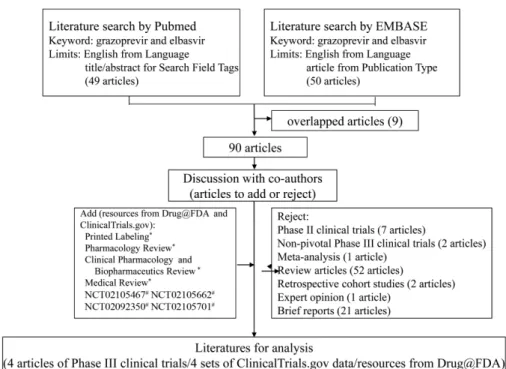
A flowchart of the article retrieval process is shown in Figure 1.
FDA resources such as printed pharmacology reviews, clinical pharmacology and biopharmaceutics reviews, and medical reviews on Drug@FDA were included. Data posted on the ClinicalTrials.gov website were also included. Statistical analysis
Fig. 1. Flowchart of the literature search process and analysis of the data for fixed-dose combination of grazoprevir and elbasvir.
was performed using the RevMan software (version 5.3.5). When data conflicts occurred between the different sources, the ClinicalTrials.gov website was selected as the primary data source.
RESULTS
We searched the PubMed and EMBASE databases using the search terms and limits described above and identified 49 and 50 articles, respectively (Figure 1). Overlapped articles, Phase II and non-pivotal Phase III clinical studies, meta-analyses, review articles, retrospective cohort studies, expert opinions, and brief reports were excluded. Resources posted on the Drug@FDA and ClinicalTrials.gov websites were included in the final analysis. This resulted in four articles on Phase III
clinical trials, four sets of ClinicalTrials.gov data, and resources posted on Drug@FDA. The four clinical trials included in this analysis were C-EDGE TN, C-EDGE CO- INFECTION, C-SURFER, and C-EDGE TE, which assessed the therapeutic efficacy and safety of GE for the treatment of HCV infection (Table 1).18-21)
The C-EDGE TN trial was a double-blind, placebo- controlled study conducted in treatment-naïve subjects with GT1, 4, or 6 infection. C-EDGE CO-INFECTION was an open-label, single-group study conducted in treatment-naïve subjects with GT1, 4, or 6 infection, who were co-infected with HIV-1. C-SURFER was also a double-blind, placebo- controlled study similar to C-EDGE TN; however, it was conducted in a different patient group, which included subjects with GT1 infection and chronic kidney disease, regardless of Table 1. Summary of study designs for the four pivotal Phase III clinical studies of fixed-dose combination of grazoprevir and elbasvir for the treatment of HCV infection.18-21)
C-EDGE TN (NCT02105467)
C-EDGE CO-INFECTION (NCT02105662)
C-SURFER (NCT02092350)
C-EDGE TE (NCT02105701) Subjects
(n) 421 218 235 420
Sites
60 in US, Australia, Czech Republic, France, Germany, Israel, Puerto Rico, Korea, Sweden, and Taiwan
37 in US, Australia, Canada, Denmark, France, Germany, Israel, Spain, UK
68 in the US, Argentina, Australia, Canada, Estonia, France, Israel,
Korea,Lithuania, Netherlands, Spain, and Sweden
65 in the US, Australia, Canada, Denmark, Finland, France, Israel, Malaysia, Netherlands, New Zealand, Poland, Puerto Rico, Korea, Spain, and Taiwan
Design db, pc OL, sg db, pc OL
Inclusion criteria
≥18yo; pt with HCV (GT1/
4/6) ≥104IU/mL; trt-naïve
≥18yo; pt with HCV (GT1/4/6) ≥104IU/mL; trt- naïve; co-infection with HIV-1
≥18yo; pt with HCV (GT1)
≥104IU/mL; CKD (stage 4–
5); trt-naïve or PR- experienced
≥18yo; pt with HCV (GT1/4/6); PR- experienced
Exclusion criteria
decompensated liver disease; hepatocellular carcinoma, HIV or HBV co- infection
decompensated liver disease; hepatocellular carcinoma, HBV co- infection
decompensated liver disease; hepatocellular carcinoma, HIV or HBV co- infection; on peritoneal dialysis
decompensated liver disease;
hepatocellular carcinoma, HIV or HBV co-infection
Duration 12 wk 12 wk, 16 wk
Treatment regimen
GE (n=316)
pboa
(n=105) GE(n=218) GE
(n=122)
pboa (n=113)
GE×12wk (n=105)
GER×12wk (n=104)
GE×16wk (n=105)
GER×16wk (n=106) Primary
endpoint proportion of patients who achieved SVR12
Secondary endpoints
proportion of patients who achieved SVR4
proportion of patients who achieved SVR24
proportion of patients who achieved SVR4
proportion of patients who achieved SVR24
CKD: chronic kidney disease; db: double-blind; GE: a fixed dose of grazoprevir (100 mg) and elbasvir (50 mg) once daily; GT: genotype; HBV: hep- atitis B virus; HCV: hepatitis C virus; HIV: human immunodeficiency virus; OL: open label; pbo: placebo; pc: placebo-controlled; PR: peginterferon and ribavirin treatment; pt: patient; R: ribavirin with weight-based dosing (<66 kg=400 mg; 66–80 kg=500 mg; 81–105 kg=600 mg; >105 kg=700 mg) twice daily; sg: single-arm; SVR4/12/24: sustained virologic response measured at week 4, 12, or 24, respectively, after completing the study therapy;
trt: treatment.
aPatients received placebo once daily for 12 weeks. Four weeks after completion of the placebo treatment, patients received open-label GE once daily for 12 weeks.
the treatment experience status. C-EDGE TE was an open- label study conducted in treatment-experienced subjects with GT1, 4, or 6 infection using four different dosing schedules to find optimal treatment duration and verify whether the addition of R was required in the treatment regimen.
These four pivotal studies shared the same primary endpoint, which was the proportion of patients who achieved a sustained
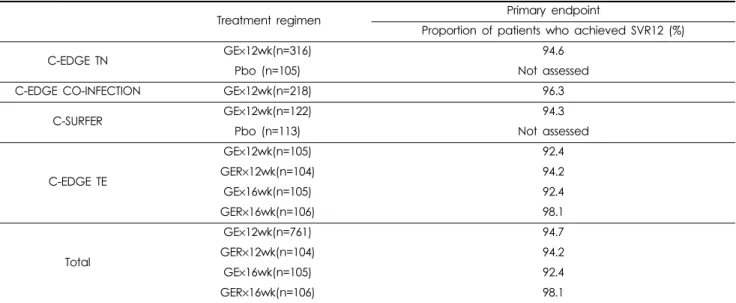
virologic response (SVR), defined as the HCV RNA level below the lower limit of quantification at 12 weeks after the cessation of the therapy (SVR12). The secondary endpoint included in the C- EDGE TN and C-SURFER trials was the proportion of patients who achieved SVR4, assessed using the same definition, four weeks after the cessation of the therapy. In contrast, C-EDGE CO-INFECTION and C-EDGE TE included SVR24 as the Table 2. Results of the primary endpoint reported by the four pivotal Phase III clinical studies.
Treatment regimen Primary endpoint
Proportion of patients who achieved SVR12 (%)
C-EDGE TN GE×12wk(n=316) 94.6
Pbo (n=105) Not assessed
C-EDGE CO-INFECTION GE×12wk(n=218) 96.3
C-SURFER GE×12wk(n=122) 94.3
Pbo (n=113) Not assessed
C-EDGE TE
GE×12wk(n=105) 92.4
GER×12wk(n=104) 94.2
GE×16wk(n=105) 92.4
GER×16wk(n=106) 98.1
Total
GE×12wk(n=761) 94.7
GER×12wk(n=104) 94.2
GE×16wk(n=105) 92.4
GER×16wk(n=106) 98.1
GE: fixed-dose combination of grazoprevir (100 mg) and elbasvir (50 mg) once daily; GER: fixed-dose combination of grazoprevir (100 mg) and elbasvir (50 mg) once daily plus ribavirin (weight-based dosing: <66 kg=400 mg; 66–80 kg=500 mg; 81–105 kg=600 mg; >105 kg=700 mg) twice daily; SVR12: sustained virologic response 12 weeks after completing the study therapy.
Table 3. Results of the secondary endpoints reported by the four pivotal Phase III clinical studies.
Treatment regimen Secondary endpoints (%)
SVR4 (95% CI) SVR24 (95% CI)
C-EDGE TN GE×12 wks (n=316) 97.2(94.7–98.7) NA
Pbo (n=105) NA NA
C-EDGE CO-INFECTION GE×12 wks (n=218) NA 93.1 (88.9–96.1)
C-SURFER GE×12 wks (n=122) 96.7* (91.8–99.1) NA
Pbo (n=113) 0.9 (0.02–4.8) NA
C-EDGE TE
GE×12 wks (n=105) NA 91.4 (84.4–96)
GER×12 wks (n=104) NA 94.2 (87.9–97.9)
GE×16 wks (n=105) NA 89.5 (82–94.7)
GER16 wks (n=106) NA 95.3 (89.3–98.5)
TOTAL
GE×12 wks (n=761) 97.0*(95–98.4) 92.6 (89.1–95.2)
GER×12 wks (n=104) NA 94.2 (87.9–97.9)
GE×16 wks (n=105) NA 89.5 (82–94.7)
GER×16 wks (n=106) NA 95.3 (89.3–98.5)
Pbo (n=113) 0.9 (0.02–4.8) NA
GE: fixed-dose combination of grazoprevir (100 mg) and elbasvir (50 mg) once daily; NA: not assessed; Pbo: placebo; R: ribavirin with weight- based dosing (<66 kg=400 mg; 66–80 kg=500 mg; 81–105 kg=600 mg; >105 kg=700 mg) twice daily; SVR4/24: sustained virologic response mea- sured at week 4 or 24, respectively, after completing the study therapy.
*p<0.001 compared to Pbo.
secondary endpoint. The results of the primary and secondary endpoints reported by the four pivotal Phase III clinical studies are summarized in Table 2 and Table 3.
Primary Endpoint
Although C-EDGE TN and C-SURFER were placebo- controlled studies, the investigators did not assess the primary endpoint in the placebo arms because it was obvious that the placebo would not result in any antiviral activity. The placebo arms in these studies were deferred treatment groups, therefore, the placebo recipients received open-label GE×12 weeks after the cessation of the studies instead. However, the SVR12 results were not released for the deferred treatment groups. C-EDGE CO-INFECTION was designed as a single- arm study, therefore, there was no arm for comparison. C- EDGE TE compared the proportion of SVR12 achievers in different treatment duration arms (12 weeks and 16 weeks), with or without R, in the treatment of HCV infection. The proportion of the SVR12 achievers in the four pivotal clinical studies with GE treatment for 12 weeks was 94.7% [95%
confidence interval (CI): 92.9-96.2], while it was 94.2% (95%
CI: 87.9-97.9) upon treatment with GER, indicating no additional benefit for the add-on therapy with R (Table 2).
Subgroup analysis of the primary endpoint achievers in C-
SURFER and C-EDGE TE also demonstrated that the addition of R did not result in any significant improvement in the SVR12 rate among the GT1 patients who failed prior treatment with PR [104/111 (93.7%)and 84/89 (94.4%) for GE and GER, respectively] (Table 4).
The C-EDGE TE study comprised four arms with the aim to compare the efficacy of different regimens, GE×12 weeks with/without R and GE×16 weeks with/without R. The patients included in this study were those who failed a prior treatment with PR. For the GT1a and GT1b patients, the odds to achieve SVR12 were 9.17 and infinity (∞), respectively, even in the GE´12 weeks arm, indicating that the additional R is not required unless viral polymorphism is identified. In Table 4. Subgroup analysis of primary endpoint achievers (SVR12) among the patients who failed prior treatment with PR.
GT1a GT1b GT4
C-SURFER GE×12 wks 8/8 6/7 NA
C-EDGE TE GE12 wks 55/61 35/35 7/9
GER×12 wks 56/60 28/29 14/15
GE: fixed-dose combination of grazoprevir (100 mg) and elbasvir (50 mg) once daily; GT: genotype; NA: not applicable; PR: peginterferon and ribavirin treatment; R: ribavirin with weight-based dosing (<66 kg=400 mg; 66–80 kg=500 mg; 81–105 kg=600 mg;>105 kg=700 mg) twice daily; SVR12: sustained virologic response measured at week 12 after completing the study therapy.
Fig. 2. Primary endpoint achievers (SVR12) of different regimens compared to the GE?12 weeks regimen in the treatment-experi- enced HCV infection.
A: GT1a subgroup; B: GT1b subgroup; C: GT4 subgroup
GE: grazoprevir (100 mg) + elbasvir (50 mg); GER: grazoprevir (100 mg) + elbasvir (50 mg) + ribavirin (weight-based dosing, <66 kg=800 mg per day, 66–80 kg=1000 mg per day, 81–105 kg=1200 mg per day, >105 kg=1400 mg per day).
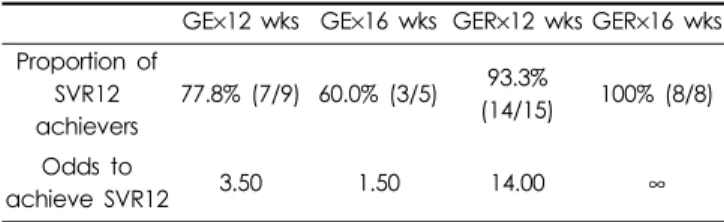
contrast, the odds for the GT4 patients were 3.50, 1.50, 14.00, and infinity (∞) in the GE×12 weeks, GE×16 weeks, GER×12 weeks, and GER×16 weeks arms, respectively (Table 5).
Although the number of the patients was small, this result
appeared to be the reason why GER×16 weeks was recommended if the causative virus was GT4 and the infection relapsed after prior treatment with PR, regardless of the virus polymorphism status. Figure 2 shows the meta-analysis data on the odds ratios for achieving SVR12 by the treatment- experienced patients who received different regimens in the C- EDGE TE and C-SURFER studies.
We compiled the results of the clinical trials and performed subgroup analysis for the primary endpoint achievers (Figure 3).
The proportions of the SVR12 achievers in the GE arms were over 95% for all subgroups assessed, except the patients whose baseline viral load was above 800,000 IU/mL. The proportion of the SVR12 achievers among these patients was 94.2% (95% CI:
91.5-96.3). Although patients with interleukin-28B non-CC genotype and/or cirrhosis were expected to be more difficult to treat, the proportion of SVR12 achievers in these subgroups in the Table 5. Proportion of primary endpoint achievers (SVR12) and
odds to achieve SVR12 in the GT4 subgroup of the C-EDGE TE study.
GE×12 wks GE×16 wks GER×12 wks GER×16 wks Proportion of
SVR12 achievers
77.8% (7/9) 60.0% (3/5) 93.3%
(14/15) 100% (8/8) Odds to
achieve SVR12 3.50 1.50 14.00 ∞
GE: fixed-dose combination of grazoprevir (100 mg) and elbasvir (50 mg) once daily; GT: genotype; R: ribavirin with weight-based dosing (<66 kg=400 mg; 66–80 kg=500 mg; 81–105 kg=600 mg; >105 kg=700 mg) twice daily; SVR12: sustained virologic response measured at week 12 after completing the study therapy.
Fig. 3. Subgroup analysis of the primary endpoint achievers (SVR12) in the Phase III pivotal studies.
SVR12: sustained virologic response 12 weeks after the treatment; GT: genotype.
GE arms was similar to that in their counterparts.22,23) The proportion of SVR12 achievers significantly varied for Asians and GT4 and treatment-experienced patients because of the small number of participants in these subgroups.
Secondary Endpoints
The secondary endpoints in the clinical studies included SVR4 and SVR24. SVR4 achievers were assessed in C-EDGE TN and C-SURFER, and the proportions were 97.2% (95%
CI: 94.7-98.7) and 96.7% (95% CI: 91.8-99.1), respectively (Table 3). SVR24 achievers were assessed in C-EDGE CO- INFECTION and C-EDGE TE, and the proportions were 93.1% (95% CI: 88.9-96.1) and 91.4% (95% CI 84.4-96), respectively. The proportion of the SVR24 achievers in the two clinical studies after the treatment with GE×12 weeks was 92.6% (95% CI: 89.1-95.2), while it was 94.2% (95% CI:
87.9-97.9) after the treatment with GER×12 weeks, indicating no extra benefit for the add-on therapy with R. In addition, the proportion of the SVR24 achievers in the two clinical studies after the treatment with GE×16 weeks was 89.5% (95% CI:
82.0-94.7), while it was 95.3% (95% CI: 89.3-98.5) after the treatment with GER´16 weeks. The lack of an added benefit for the add-on therapy with R appears to be due to the paucity of patients infected with PR-resistant GT4, who might have
benefited from the add-on therapy. Indeed, in the C-EDGE TE study, the odds to achieve SVR12 in the PR-resistant GT4 patients subgroup was equal to infinity (∞) in the GER×16 weeks arm (8 out of 8 patients), while it was only 1.5 in the GE×16 weeks arm (3 out of 5 patients).
Efficacy comparison of the GE arm versus the placebo arm with regard to the two secondary endpoints was not available since the investigators did not perform efficacy assessment for the placebo arms. Regarding the secondary endpoints in the placebo arms, only C-SURFER study reported that the proportion of the SVR4 achievers was 0.9%.
Safety and Tolerance
The four pivotal clinical studies involved 1083 participants, and the discontinuation rates were 0.53% (95% CI: 0.14-1.34), 0.96% (95% CI: 0.02-5.24), and 2.75% (95% CI: 1.01-5.89) in the GE, GER, and no-exposure arms, respectively. The incidence rates of severe adverse events (SAEs) were 6.57%
(95% CI: 4.92-8.57), 7.69% (95% CI: 3.38-14.59), and 11.47% (95% CI: 7.56-16.46), respectively (Table 6).
During the four pivotal clinical studies, 50 participants suffered from SAEs associated with the administration of GE.
The SAEs reported during the trials were pneumonia, hypertension, convulsion, ventricular arrhythmia, Meniere disease, renal colic,
Fig. 4. Discontinuation rate, SAE and AE incidences in the treatment of HCV infection.
A: Discontinuation rate; B: Incidence of severe adverse events; C: Incidence of adverse events
AE: adverse event; Exp: exposure; GE: grazoprevir (100 mg) + elbasvir (50 mg) for 12 weeks once daily; SAE: severe adverse event.
multiple fractures, skin ulcer, strangulated hiatal hernia, upper abdominal pain, and muscular weakness. The percentages of the adverse events (AEs) reported during the four pivotal clinical studies were 71.09% (95% CI: 67.7-74.3), 81.73%
(95% CI: 72.9-88.6), and 76.61% (95% CI 70.4–-82.1) in the GE,
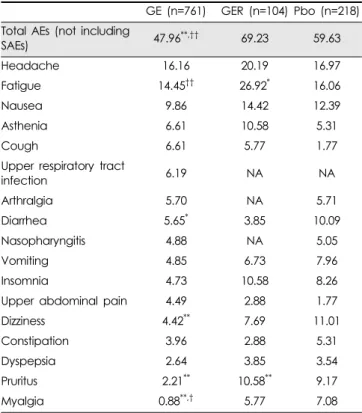
GER, and no-exposure arms, respectively (Table 6). The most common AEs associated with the use of GE were central nervous system disorders such as headache and fatigue (Table 7).
Figure 4 shows discontinuation rate, SAEs, and AEs incidence in patients treated with GE×12 weeks in comparison to placebo group. The discontinuation rates, SAEs, and AEs in the GE×12 weeks arms in the C-EDGE TN and C-SURFER studies were similar to those in the placebo arms. In C- SURFER, the odds ratio of treatment discontinuation in the GE arm was 0.08 compared to that in the placebo arm, indicating better adherence to the treatment in the GE arm. When the results of the two studies were pooled and analyzed, the GE×12 weeks arm showed a similar or lower discontinuation rate compared to that in the placebo arm (odds ratio: 0.27; 95% CI:
0.06-1.16, p=0.08). Regarding the SAE and AE incidences, the odds ratios for the GE arm were 1.14 and 0.81, respectively, compared to the placebo arm (p>0.29).
Table 6. Discontinuation rates, SAE, and AE incidences in the four pivotal Phase III clinical studies.
Discontinuation rate (%) SAE incidence (%) AE incidence (%)
exp to GE (n=761)
exp to GER (n=104)
No-exp (n=218)
exp to GE (n=761)
exp to GER (n=104)
No-exp (n= 218)
exp to GE (n= 761)
exp to GER (n= 104)
No-exp (n=218)
Total 0.53* 0.96 2.75 6.57* 7.69 11.47 71.09† 81.73 76.61
C-EDGE TN 0.95 NA 0.95 2.85 NA 2.86 67.41 NA 68.57
C-EDGE CO-
INFECTION 0.0 NA NA 3.67 NA NA 73.85 NA NA
C-SURFER 0.0* NA 4.42 22.13 NA 19.47 76.23 NA 84.07
C-EDGE TE 0.95 0.96 NA 5.71 7.69 NA 70.48 81.73 NA
AE: adverse event; Exp: Exposure; GE: fixed-dose combination of grazoprevir (100 mg) and elbasvir (50 mg) once daily for 12 weeks; NA: not applicable; R: ribavirin with weight-based dosing (<66 kg=400 mg; 66–80 kg=500 mg; 81–105 kg=600 mg; >105 kg=700 mg) twice daily for 12 weeks; SAE: serious adverse event.
*p<0.05 compared to No-exp; †p<0.05 compared to GER.
Table 7. Percentage of reported AEs in the four pivotal Phase III clinical studies.
GE (n=761) GER (n=104) Pbo (n=218) Total AEs (not including
SAEs) 47.96**,†† 69.23 59.63
Headache 16.16 20.19 16.97
Fatigue 14.45†† 26.92* 16.06
Nausea 9.86 14.42 12.39
Asthenia 6.61 10.58 5.31
Cough 6.61 5.77 1.77
Upper respiratory tract
infection 6.19 NA NA
Arthralgia 5.70 NA 5.71
Diarrhea 5.65* 3.85 10.09
Nasopharyngitis 4.88 NA 5.05
Vomiting 4.85 6.73 7.96
Insomnia 4.73 10.58 8.26
Upper abdominal pain 4.49 2.88 1.77
Dizziness 4.42** 7.69 11.01
Constipation 3.96 2.88 5.31
Dyspepsia 2.64 3.85 3.54
Pruritus 2.21** 10.58** 9.17
Myalgia 0.88**,† 5.77 7.08
AE: adverse event; GE: fixed-dose combination of grazoprevir (100 mg) and elbasvir (50 mg) once daily for 12 weeks; Pbo: placebo; R: rib- avirin with weight-based dosing (<66 kg=400 mg; 66–80 kg=500 mg;
81–105 kg=600 mg; >105 kg=700 mg) twice daily for 12 weeks; SAE: seri- ous adverse event.
*p<0.05 compared to Pbo; **p<0.01 compared to Pbo; †p<0.05 com- pared to GER; ††p<0.01 compared to GER.
Table 8. Proportion of primary endpoint achievers (SVR12) among the patients with GT1/4 treated with GE´12 weeks (TN versus TE).
TN TE
C-EDGE TN
C-EDGE CO-
INFECTION C-SURFER C-SURFER C-EDGE TE GT1 273/288 181/188 101/101 14/15 90/96
GT4 18/18 27/28 NA NA 7/9
GT1+GT4 291/306 208/216 101/101 14/15 97/105 Total 600/623 (96.31%)* 111/120 (92.50%) GE: fixed-dose combination of grazoprevir (100 mg) and elbasvir (50 mg) once daily; GT: genotype; NA: not applicable; SVR12: sustained virologic response measured at week 12 after completing the study therapy; TE: treatment-experienced; TN: treatment-naïve.
*p=0.081 compared to TE.
DISCUSSION
HCV causes both acute and chronic hepatitis. Chronic infection with HCV is usually clinically silent with or without extrahepatic manifestations such as fatigue, nausea, abdominal or musculoskeletal pain, loss of weight, and neuropsychiatric symptoms.3,24,25) The prevalence of chronic HCV infection continues to rise in many countries, and it is a major cause of cirrhosis and hepatocellular carcinoma.26,27) HCV-related cirrhosis remains the leading cause of liver transplantation in the US and accounts for nearly 40% of liver transplants in adults.28,29)
HCV has been classified into six distinct genotypic groups (GT1–GT6). Among the six genotypes, GT1 is predominant (46.2% of all HCV cases worldwide) followed by GT3 (30.1%), GT2 (9.1%), GT4 (8.3%), GT6 (5.4%), and GT5 (0.8%). Although the global estimate of the GT4 prevalence is only 8.3%, GT4 is predominant in central sub-Saharan Africa (97.6%), North Africa, and Middle East Africa (65.3%).3,30–32) Patients infected with GT1 or GT4 HCV usually show a poorer response than those with GT2 or GT3 infection when treated with currently available DAAs.28,33) Therefore, a new DAA with an improved therapeutic profile is needed against GT1 and GT4 viruses. However, selection of a second-line treatment regimen for the treatment of patients is challenging, especially if HCV is resistant to a previous treatment or if the infection relapsed. The proportion of SVR12 achievers on existing DAAs was found to range from 94 to 98% among treatment-experienced patients.3) We compiled data of the four pivotal clinical studies and found that the proportion of SVR12 achievers in the GE×12 weeks arm was not any better in this regard (92.5% of patients in the GT1 or GT4 treatment-experienced subgroup) (Table 8). For treatment- naïve patients with GT1 or GT4 HCV infection, the GE´12 weeks treatment did not show a noticeable improvement either when compared to existing DAAs (96.3%). According to the WHO guideline,3) the proportion of SVR12 achievers was always higher than 96% in the same patient subgroup treated with a combination therapy of DDAs, except 83.1% with asunaprevir/daclatasvir. Taking this data into consideration, the SVR12 result achieved with the GE´12 weeks treatment seems to be comparable to those obtained with the existing DAAs.
GE appears to have a clinical advantage because it shows favorable pharmacokinetic profiles in patients with cirrhosis and/or renal failure without requirement of dose adjustment.34) GE is metabolized by CYP 3A4 mostly in the liver, but unlike
other DAAs, no active metabolite was identified. In the case of GE, the drugs administered were predominantly found in feces, whereas the amounts recovered in urine were only 0.3%
of the dose.17,35) Therefore, patients with HCV-associated complications such as chronic kidney disease may use the drugs without dose adjustment, even though the renal function is severely damaged (stage 4–5). Dose adjustment is not required for patients with cirrhosis either, unless hepatic function is decompensated (jaundice, ascites, encephalopathy).7,11) The C- SURFER study performed on patients with chronic kidney disease demonstrated that SVR12 was similar to that found in other studies performed on patients with normal kidney function (Table 2). In the C-SURFER study, the safety profile (discontinuation rate, SAEs, and AEs) in the GE arm was also similar to that in the placebo arm (Table 6). These results confirm that there is no need for dose adjustment in patients with renal failure.
Regarding the SAE incidences observed in the C-SURFER trial, the odds ratio of the events in the patients with renal failure was 1.18 (95% CI: 0.62-2.21), while the odds ratio in those with normal kidney function was 1.00 (95% CI: 0.26- 3.75), indicating that it was slightly higher in the renal failure patients (no statistical significance). Reason for the high incidence of SAE in both arms in C-SUFFER seems to be associated with patients setting who have comorbidity of chronic renal failure. The SAEs reported in the study were hypertension and pneumonia (n=2 each).11,20) The odds ratios of AEs were 0.61 (95% CI: 0.32-1.17) in the C-SURFER trial and 0.95 (95% CI: 0.59-1.52) in the C-EDGE TN trial, representing no statistically significant differences between the patients with renal failure and those with normal renal function. These findings also support the conclusion that there is no need for dose adjustment in the patient group with renal failure (Figure 4). Reason for the lower AE incidence in the GE arm compared to no-exposure to GE arm reflects that GE relieved symptoms of HCV infection, and therefore patients reported less AE incidence.
According to the consistency analysis based on network meta-analysis, GE showed a significantly lower odds ratio of AEs when it was compared to other 10 regimens comprised of DAAs such as daclatasvir, sofosbuvir, ledipasvir, and velpatasvir.36) In particular, the ratios were 0.22 (95% CI: 0.07-0.72) and 0.19 (95% CI: 0.03-0.98) when GE was compared to sofosbuvir+R and sofosbuvir+velpatasvir+R, respectively. GE also showed a remarkably low odds ratio in comparison to
other DAA regimens. Furthermore, the odds ratios for GE and GER were 0.59 and 0.72, respectively, compared to the placebo regimen. We performed a meta-analysis of odds ratios of GE×12 weeks in comparison to the placebo arm (C- EDGETN and C-SURFER) and found that there were no significant differences in the odds of treatment discontinuation and incidences of SAEs and AEs between the GE and placebo arms (Figure 4). This result is consistent with earlier findings, which revealed a favorable safety profile of GE. The limitation of this result is that we included only two clinical Phase III studies in the meta-analysis because there was no placebo arm in the remaining two studies.
The wholesale acquisition cost for a one-day supply of GE is US $650 or US $54,600 for a 12-week supply.30,37) If the causative virus belongs to GT1a with NS5A polymorphism or PR-resistant GT4, the treatment duration is extended up to 16 weeks, and the cost climbs up to US $72,800. The costs for other AASLD-recommended regimens (12-week supplies) are US $147,000 and US $150,000 for daclatasvir+sofosbuvir and sofosbuvir+simeprevir, respectively. Although the cost for GE×12 weeks is half of that for the other two regimens, accessibility to the drug and patient compliance may not be adequate because the cost burden still seems to be significant.
Currently, the Merck Access Program sponsored by Merck covers only US citizens who do not have insurance or cannot afford to pay the drug cost due to low income.38) However, the program seems to be inadequate to provide full access to the drug for patients in the US. Furthermore, the program does not cover patients outside the US, such as those in the sub- Saharan Africa, Central Asia, and Eastern Europe regions where the viraemic HCV prevalence is very high (> 2%) and such patients constitute over 35 millions.3)
Conclusions
The introduction of GE into the arsenal of chemotherapeutics available for the treatment of HCV infection is significant in terms of offering an alternative in the fight against HCV. In particular, if the causative virus is mutated or resistant to existing DAAs, GE may be a useful option to treat such problematic HCV viruses. GE may also be used to treat patients with HIV, severe form of renal failure, or compensated cirrhosis without dosage adjustment. Considering that HCV mutates very rapidly and becomes resistant to antiviral agents, patients should be carefully monitored for therapeutic outcomes throughout their
lifespans.
FUNDING
This study was not supported by any external funding.
CONFLICTS OF INTEREST
The authors have no conflicts of interest to disclose.
REFERENCES
1. World Health Organization. Hepatitis fact sheet. Available from www.
who.int/mediacentre/factsheets/fs164/en/. Accessed July 2, 2017.
2. Mohd Hanafiah K, Groeger J, Flaxman AD, et al. Global epidemiology of hepatitis C virus infection: New estimates of age-specific antibody to hepatitis C virus seroprevalence. Hepatology 2013;57:1333-42.
3. World Health Organization. Guidelines for the screening care and treat- ment of persons with chronic hepatitis C infection: Updated version April 2016. Available from https://www.ncbi.nlm.nih.gov/books/
NBK362924/. Accessed July 2, 2017.
4. Manns MP, McHutchison JG, GordonSC, et al. Peginterferon alfa-2b plus ribavirin compared with interferon alfa-2b plus ribavirin for initial treatment of chronic hepatitis C: a randomised trial. Lancet 2001;358:958-65.
5. Nicot F, Alric L, Barange K, et al. Influence of HCV genotype 1 sub- types on the virus response to PEG interferon alpha-2a plus ribavirin therapy. J Med Virol 2011;83:437-44.
6. Fried MW, Shiffman ML, Reddy KR, et al. Peginterferon alfa-2a plus ribavirin for chronic hepatitis C virus infection. N Engl J Med 2002;347:975-82.
7. AASLD and IDSA HCV Guidance Panel. Hepatitis C guidance:
AASLD-IDSA recommendations for testing, managing, and treating adults infected with hepatitis C virus. Hepatology 2015;62:932-54.
8. Keating GM. Elbasvir/grazoprevir: First global approval. Drugs 2016;76:617-24.
9. Suraweera D, Weeratunga AN, Saab S. Spotlight on grazoprevir-elbas- vir once-daily combination and its potential in the treatment of hepatitis C. Drug Des Devel Ther 2016;10:2119-27.
10. Landaverde C, Wells J, Hamner R, et al. Dual therapy of grazoprevir and elbasvir for the treatment of hepatitis C infection. Expert Rev Gas- troenterol Hepatol 2016;10:419-29.
11. U.S. Food & Drug Administration. Prescribing information (Zepatier:
Elbasvir and Grazoprevir). Available from http://www.access- data.fda.gov/drugsatfda_docs/label/2016/208261Orig1s000lbl.pdf.
Accessed July 2, 2017.
12. Banerjee D, Reddy KR. Review article: safety and tolerability of direct- acting anti-viral agents in the new era of hepatitis C therapy. Aliment Pharmacol Ther 2016;43:674-96.
13. Ward RP, Kugelmas M. Using pegylated interferon and ribavirin to treat patients with chronic hepatitis C. Am Fam Physician 2005;
72:655-62.
14. Carrion AF, Martin P. Safety and efficacy of elbasvir and grazoprevir for treatment of hepatitis C. Expert Opin Drug Saf 2016;15:883-90.
15. Alric L, Bonnet D. Grazoprevir + elbasvir for the treatment of hepatitis
C virus infection. Expert Opin Pharmacother 2016;17:735-42.
16. U.S. Food & Drug Administration. Pharmacology review. Available from http://www.accessdata.fda.gov/drugsatfda_docs/nda/2016/208261 Orig1s000PharmR.pdf. Accessed July 2, 2017.
17. U.S. Food & Drug Administration. Medical review. Available from http://www.accessdata.fda.gov/drugsatfda_docs/nda/2016/
208261Orig1s000MedR.pdf. Accessed July 2, 2017.
18. Zeuzem S, Ghalib R, Reddy KR, et al. Grazoprevir-elbasvir combina- tion therapy for treatment-naive cirrhotic and noncirrhotic patients with chronic hepatitis C virus genotype 1, 4, or 6 infection: a randomized trial. Ann Intern Med 2015;163:1-13.
19. Rockstroh JK, Nelson M, Katlama C, et al. Efficacy and safety of gra- zoprevir (MK-5172) and elbasvir (MK-8742) in patients with hepatitis C virus and HIV co-infection (C-EDGE CO-INFECTION): a non-ran- domised, open-label trial. Lancet HIV 2015;2:319–27.
20. Roth D, Nelson DR, Bruchfeld A, et al. Grazoprevir plus elbasvir in treatment-naive and treatment-experienced patients with hepatitis C virus genotype 1 infection and stage 4-5 chronic kidney disease (the C- SURFER study): a combination phase 3study. Lancet 2015;386:1537–
45.
21. Kwo P, Gane E, Peng CY, et al. Effectiveness of elbasvir and grazopre- vir combination, with or without ribavirin, for treatment-experienced patients with chronic hepatitis C infection. Gastroenterology 2017;
152:164-175.
22. Nakamoto S, Kanda T, Shirasawa H, et al. Antiviral therapies for chronic hepatitis C virus infection with cirrhosis. World J Hepatol 2015;7:1133-41.
23. Pár A, Pár G, Tornai I, et al. IL28B CC genotype: a protective factor and predictor of the response to interferon treatment in chronic hepatitis C virus infection. Orv Hetil 2013;154:1261-8.
24. Cacoub P, Poynard T, Ghillani P, et al. Extrahepatic manifestations of chronic hepatitis C. MULTIVIRC Group. Multidepartment Virus C.
Arthritis Rheum 1999;42:2204-12
25. Tang L, Marcell L, Kottilil S. Systemic manifestations of hepatitis C infection. Infect Agent Cancer 2016;11:29.
26. Lavanchy D. Evolving epidemiology of hepatitis C virus. Clin Micro- biol Infect 2011;17:107-15.
27. Nkontchou G, Ziol M, Aout M, et al. HCV genotype 3 is associated with a higher hepatocellular carcinoma incidence in patients with ongo- ing viral C cirrhosis. J Viral Hepat 2011;18:516-22.
28. Yang HJ, Ryoo JY, Yoo BK. Meta-analysis of the efficacy and safety of sofosbuvir for the treatment of hepatitis C virus infection. Int J Clin Pharm 2015;37:698-708.
29. Dugum M, O’Shea R. Hepatitis C virus: here comes all-oral treatment.
Cleve Clin J Med 2014;81:159-72.
30. Bell AM, Wagner JL, Barber KE, et al. Elbasvir/grazoprevir: A review of the latest agent in the fight against hepatitis C. Int J Hepatol 2016;2016:3852126.
31. Messina JP, Humphreys I, Flaxman A, et al. Global distribution and prevalence of hepatitis C virus genotypes. Hepatology 2015;61:77-87.
32. Deming P, Martin MT, Chan J, et al. Therapeutic advances in HCV genotype 1 infection: insights from the society of infectious diseases pharmacists. Pharmacotherapy 2016;36:203-17.
33. Zhu Y, Chen S. Antiviral treatment of hepatitis C virus infection and factors affecting efficacy. World J Gastroenterol 2013;19:8960-73.
34. Smolders EJ, de Kanter CT, van Hoek B, et al. Pharmacokinetics, effi- cacy, and safety of hepatitis C virus drugs in patients with liver and/or renal impairment. Drug Saf 2016;39:589-611.
35. U.S. Food & Drug Administration. Clinical pharmacology and bio- pharmaceutics review. Available from http://www.accessdata.fda.gov/
drugsatfda_docs/nda/2016/208261Orig1s000ClinPharmR.pdf.
Accessed July 2, 2017.
36. Ferreira VL, AssisJarek NA, Tonin FS, et al. Safety of interferon-free therapies for chronic hepatitis C: a network meta-analysis. J Clin Pharm Ther 2016;41:478-85.
37. Woolston SL, Kim HN. Cost and access to direct-acting antiviral agents. Available from www.hepatitisc.uw.edu/go/evaluation-treat- ment/cost-access-medications/core-concept/all. Accessed July 2, 2017.
38. Merck Helps™. Zepatier. Available from http://www.merckhelps.com/
ZEPATIER. Accessed July 2, 2017.