INTRODUCTION
The hepatitis C virus (HCV) infection and hepatitis B vi- rus (HBV) are the leading causes of chronic liver disease and liver cancer in Korea. Many studies on the prevalence of HBV or HCV infection have been performed using non-represen- tative samples or small samples from a selected population.
Regarding the prevalence of the HBV, the National Health and Nutrition Survey (NHNS) in 1998 included some sero- logic markers for HBV infection (1). Unfortunately, there is no population-based serologic study that has estimated the prevalence of a HCV infection. In this study, we investigated the pooled estimates of HCV prevalence using data from 15 reports. In recent years, the pooled-analysis using published reports has been increasing for epidemiological study (2).
MATERIALS AND METHODS Identification of studies
Publications on the HCV antibody and its relationship with epidemiology (prevalence, risk factors) were obtained from PubMed and KoreaMed (www.pubmed. gov and www.kore- amed. org) (1990-2004) and by checking the reference lists to find other reports. These reports cover the prevalence of
anti-HCV in the general population, the distribution of risk factors, and the transmission route of the HCV infection. Ref- erence lists of publications were examined to identify studies.
The data from 15 reports were included in this paper. These reports had more than 500 subjects and the number of sub- jects that were positive for HCV according to age and gen- der were listed.
Data extraction
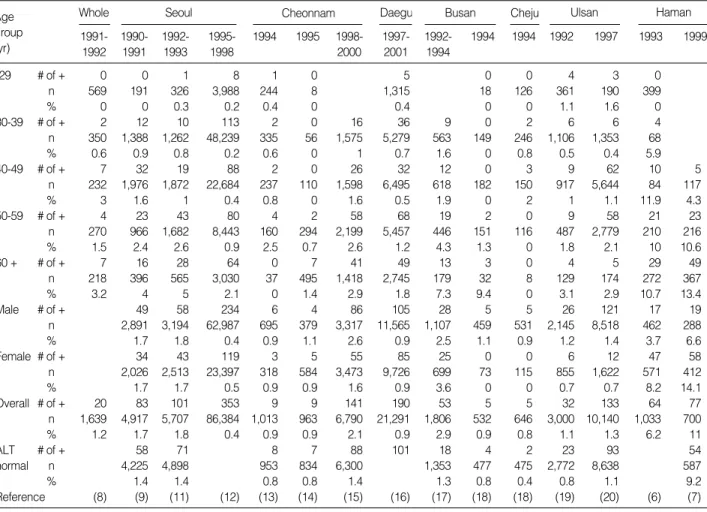
The following information was extracted: the study area, study year, method of the anti-HCV test, the distribution of study subjects according to age and gender (if available) from 15 reports on the general population (Table 2).
Statistical methods
We studied 146,561 subjects from 15 publications and 1,275 subjects were positive for HCV. HCV prevalence was estimated by multiple logistic regression analysis and is ex- pressed as a percentage according to age and gender. The HCV prevalence by time and age was estimated with the model, logit (p)= 0+ 1 time+ 2 age, where p is probability that the subject was positive for HCV, time variable was categorized by 1990-1994, 1995-2000 and age variable was categorized by 40-49, 50-59, 60+ yr. The HCV prevalence by time
Hai-Rim Shin, Soon Young Hwang, Chung-Mo Nam*
Division of Registry & Epidemiology, Research Institute for National Cancer Control & Evaluation, National Cancer Center, Goyang; Department of Preventive Medicine*,and Public Health, Yonsei University, College of Medicine, Seoul, Korea
Address for correspondence Hai-Rim Shin, M.D.
Research Institute for National Cancer Control &
Evaluation, National Cancer Center, 809 Madu 1-dong, Ilsan-gu, Goyang 411-769, Korea
Tel : +82.31-920-2003, Fax : +82.31-920-2004 E-mail : [email protected]
*This study was supported by the National Cancer Center Research Grant (0410130).
985 J Korean Med Sci 2005; 20: 985-8
ISSN 1011-8934
Copyright � The Korean Academy of Medical Sciences
The Prevalence of Hepatitis C Virus Infection in Korea:
Pooled Analysis
This study evaluated the prevalence of hepatitis C virus (HCV) infections in Korea.
Pooled estimates of the anti-HCV positivity were calculated using the data published in 15 reports on the general population and health check-up examinees. The over- all pooled estimate of the prevalence of HCV among middle-aged adults (40 yr old and above) was 1.68% (95% confidence interval: 1.51-1.86%) during the year of 1990-2000 among the general population. Most of the published data indicated that the prevalence of anti-HCV increased with age. The anti-HCV positivity was signifi- cantly higher in females than in males. Because the risk of HCV exposure in blood recipients has decreased remarkably, the spread of HCV through means other than a transfusion must be prevented.
Key Words : Hepacivirus; Hepatitis C Virus; Prevalence; Korea
Received : 3 December 2004 Accepted : 17 June 2005
986 H.-R. Shin, S. Y. Hwang, C.-M. Nam
and gender was estimated with the model logit (p)= 0+ 1 time+ 2 gender, where gender variable was categorized by male and female.
The pooled estimates of the prevalence of HCV were calcu- lated as a truncated prevalence among adults 40 yr and older due to the rarity of cases in those under 40 yr of age. The pool- ed estimates were calculated by standardizing the estimated HCV prevalence in the Korean population (Resident regis- tration population from Korea National Statistical Office) by time and age.
RESULTS Seroprevalence of anti-HCV
In the 1990s, the overall anti-HCV prevalence was approx- imately 0.68-3.54% among health check-up middle-aged
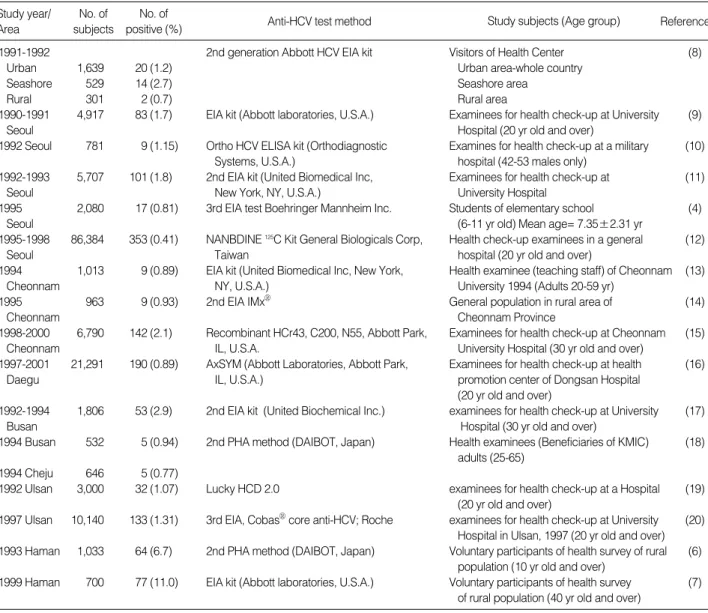
examinees (age 40 yr and over) and 0.42-1.45% among heal- thy people with a normal ALT level (Table 1). In the pooled analysis, the age-standardized prevalence truncated to those 40 yr and older was 1.68% (95% CI 1.51-1.86) (Table 3).
During 1990-1994, the prevalence was 2.90% (95% CI 2.53- 3.33), and was different from 1.39% (95% CI: 1.24-1.55) during 1995-2000. Some of the published data showed that the prevalence of anti-HCV in males was similar to that in females. However, a pooled estimate of the HCV prevalence in males (0.77%, 95% CI: 0.72-0.83) was significantly lower than in females (1.06%, 95% CI: 0.97-1.16) (Table 3).
DISCUSSION
The important goal of this study was to calculate a quanti- tative pooled estimate of the prevalence of HCV. Even though there were limitations in the publication bias and the hetero-
Study year/
Area
1991-1992 2nd generation Abbott HCV EIA kit Visitors of Health Center (8)
Urban 1,639 20 (1.2) Urban area-whole country
Seashore 529 14 (2.7) Seashore area
Rural 301 2 (0.7) Rural area
1990-1991 4,917 83 (1.7) EIA kit (Abbott laboratories, U.S.A.) Examinees for health check-up at University (9)
Seoul Hospital (20 yr old and over)
1992 Seoul 781 9 (1.15) Ortho HCV ELISA kit (Orthodiagnostic Examines for health check-up at a military (10)
Systems, U.S.A.) hospital (42-53 males only)
1992-1993 5,707 101 (1.8) 2nd EIA kit (United Biomedical Inc, Examinees for health check-up at (11)
Seoul New York, NY, U.S.A.) University Hospital
1995 2,080 17 (0.81) 3rd EIA test Boehringer Mannheim Inc. Students of elementary school (4)
Seoul (6-11 yr old) Mean age= 7.35±2.31 yr
1995-1998 86,384 353 (0.41) NANBDINE 125C Kit General Biologicals Corp, Health check-up examinees in a general (12)
Seoul Taiwan hospital (20 yr old and over)
1994 1,013 9 (0.89) EIA kit (United Biomedical Inc, New York, Health examinee (teaching staff) of Cheonnam (13)
Cheonnam NY, U.S.A.) University 1994 (Adults 20-59 yr)
1995 963 9 (0.93) 2nd EIA IMx� General population in rural area of (14)
Cheonnam Cheonnam Province
1998-2000 6,790 142 (2.1) Recombinant HCr43, C200, N55, Abbott Park, Examinees for health check-up at Cheonnam (15)
Cheonnam IL, U.S.A. University Hospital (30 yr old and over)
1997-2001 21,291 190 (0.89) AxSYM (Abbott Laboratories, Abbott Park, Examinees for health check-up at health (16)
Daegu IL, U.S.A.) promotion center of Dongsan Hospital
(20 yr old and over)
1992-1994 1,806 53 (2.9) 2nd EIA kit (United Biochemical Inc.) examinees for health check-up at University (17)
Busan Hospital (30 yr old and over)
1994 Busan 532 5 (0.94) 2nd PHA method (DAIBOT, Japan) Health examinees (Beneficiaries of KMIC) (18) adults (25-65)
1994 Cheju 646 5 (0.77)
1992 Ulsan 3,000 32 (1.07) Lucky HCD 2.0 examinees for health check-up at a Hospital (19) (20 yr old and over)
1997 Ulsan 10,140 133 (1.31) 3rd EIA, Cobas�core anti-HCV; Roche examinees for health check-up at University (20) Hospital in Ulsan, 1997 (20 yr old and over) 1993 Haman 1,033 64 (6.7) 2nd PHA method (DAIBOT, Japan) Voluntary participants of health survey of rural (6)
population (10 yr old and over)
1999 Haman 700 77 (11.0) EIA kit (Abbott laboratories, U.S.A.) Voluntary participants of health survey (7) of rural population (40 yr old and over)
Table 1.Studies of the prevalence of anti-HCV among the general population or health examinees in Korea during 1992-2003 Anti-HCV test method Study subjects (Age group) Reference No. of
subjects
No. of positive (%)
Prevalence of Hepatitis C Virus Infection in Korea 987
geneity between the studies in the pooled-analysis, our esti- mates of the prevalence are believed to be conservative.
The overall HBsAg prevalence was 5% in the NHNS (Ko- rea National Health & Nutrition Survey, 2002). HBV is by far a more important risk factor for hepatocellular carcinoma in Korea. A HCV infection shows a stronger association with hepatocellular carcinoma in elderly patients (3). In Korea, the surveillance program for anti-HCV positive people 40 yr and older was introduced by the Ministry of Health and Welfare and the National Cancer Center in 2003.
There are few papers that have reported the prevalence among children and young adults. The prevalence of anti- HCV in children (6-11 yr old) was 0.81% (17/2,080) in Seoul in 1995 (4) and 0.4% (5/1,350) among young adults (16-24 yr old) (5).
Most HCV infected persons in Korea are elderly. Howev- er, more attention should be paid to whether new infections occur in groups besides the elderly. Some of the published data showed a similar prevalence of the anti-HCV in males and females, but two reports indicated that the anti-HCV prevalence among females was higher than that among males in the rural population (6, 7). These two reports are from the same area. Therefore, the regional variation in the prevalence of the HCV should be clarified in future studies.
Most of the published data showed that the frequency of
Age group (yr)
-29 # of + 0 0 1 8 1 0 5 0 0 4 3 0
n 569 191 326 3,988 244 8 1,315 18 126 361 190 399
% 0 0 0.3 0.2 0.4 0 0.4 0 0 1.1 1.6 0
30-39 # of + 2 12 10 113 2 0 16 36 9 0 2 6 6 4
n 350 1,388 1,262 48,239 335 56 1,575 5,279 563 149 246 1,106 1,353 68
% 0.6 0.9 0.8 0.2 0.6 0 1 0.7 1.6 0 0.8 0.5 0.4 5.9
40-49 # of + 7 32 19 88 2 0 26 32 12 0 3 9 62 10 5
n 232 1,976 1,872 22,684 237 110 1,598 6,495 618 182 150 917 5,644 84 117
% 3 1.6 1 0.4 0.8 0 1.6 0.5 1.9 0 2 1 1.1 11.9 4.3
50-59 # of + 4 23 43 80 4 2 58 68 19 2 0 9 58 21 23
n 270 966 1,682 8,443 160 294 2,199 5,457 446 151 116 487 2,779 210 216
% 1.5 2.4 2.6 0.9 2.5 0.7 2.6 1.2 4.3 1.3 0 1.8 2.1 10 10.6
60 + # of + 7 16 28 64 0 7 41 49 13 3 0 4 5 29 49
n 218 396 565 3,030 37 495 1,418 2,745 179 32 8 129 174 272 367
% 3.2 4 5 2.1 0 1.4 2.9 1.8 7.3 9.4 0 3.1 2.9 10.7 13.4
Male # of + 49 58 234 6 4 86 105 28 5 5 26 121 17 19
n 2,891 3,194 62,987 695 379 3,317 11,565 1,107 459 531 2,145 8,518 462 288
% 1.7 1.8 0.4 0.9 1.1 2.6 0.9 2.5 1.1 0.9 1.2 1.4 3.7 6.6
Female # of + 34 43 119 3 5 55 85 25 0 0 6 12 47 58
n 2,026 2,513 23,397 318 584 3,473 9,726 699 73 115 855 1,622 571 412
% 1.7 1.7 0.5 0.9 0.9 1.6 0.9 3.6 0 0 0.7 0.7 8.2 14.1
Overall # of + 20 83 101 353 9 9 141 190 53 5 5 32 133 64 77
n 1,639 4,917 5,707 86,384 1,013 963 6,790 21,291 1,806 532 646 3,000 10,140 1,033 700
% 1.2 1.7 1.8 0.4 0.9 0.9 2.1 0.9 2.9 0.9 0.8 1.1 1.3 6.2 11
ALT # of + 58 71 8 7 88 101 18 4 2 23 93 54
normal n 4,225 4,898 953 834 6,300 1,353 477 475 2,772 8,638 587
% 1.4 1.4 0.8 0.8 1.4 1.3 0.8 0.4 0.8 1.1 9.2
Reference (8) (9) (11) (12) (13) (14) (15) (16) (17) (18) (18) (19) (20) (6) (7)
Table 2.Distribution of the prevalence of anti-HCV according to the area in the year 1990-2000 from 15 published data in Korea
1991- 1990- 1992- 1995- 1994 1995 1998- 1997- 1992- 1994 1994 1992 1997 1993 1999
1992 1991 1993 1998 2000 2001 1994
Study year 1990-2000 1990-1994 1995-2000
variables Prevalence Prevalence prevalence
(95% CI) (95% CI) (95% CI)
Age group (yr)
40-49 0.72% 1.31% 0.61%
(0.64-0.80) (1.13- 1.52) (0.55-0.69)
50-59 1.73% 3.04% 1.43%
(1.58-1.91) (2.67-3.46) (1.29-1.59)
60+ 3.13% 5.46% 2.61%
(2.81-3.49) (4.76-6.26) (2.32-2.93)
Age-standardized 1.68% 2.90% 1.39%
prevalence (1.51-1.86) (2.53-3.33) (1.24-1.55) truncated 40 yr
and older
No. of estimated 223,792 344,755 196,703 persons (201,436-248,573) (300,684-395,008) (175,605-220,287)
Male 0.77% 1.69% 0.65%
(0.72-0.83) (1.51-1.90) (0.60-0.71)
Female 1.06% 2.20% 0.85%
(0.97-1.16) (1.95-2.48) (0.78-0.94) Table 3.The pooled estimates of the prevalence of HCV and esti- mated number of anti-HCV positive persons during 1990-2000
Whole Seoul Cheonnam Daegu Busan Cheju Ulsan Haman
988 H.-R. Shin, S. Y. Hwang, C.-M. Nam
anti-HCV increased with age. The high prevalence of anti- HCV among older persons is most likely due to a cohort effect of the risk of acquiring a HCV infection being higher in the distant past than currently. Because HCV is rarely transmit- ted by a blood transfusion in Korea since the introduction of the HCV antibody test to screen blood donors (April 1991), the risk of HCV exposure among blood recipients has decrea- sed. Therefore, an evaluation of the behavioral risk factors other than blood transfusions is important in terms of the transmis- sion of the HCV infection.
Although the anti-HCV positive prevalence has reduced in recent years, the HCV RNA positive rates must be closely monitored in the future to determine the actual risk of HCV infection and further study for reduction of the anti-HCV po- sitive prevalence is needed.
REFERENCES
1. Blettner M, Sauerbrei W, Schlehofer B, Scheuchenpflug T, Frieden- reich C. Traditional reviews, meta-analyses and pooled analyses in epidemiology. Int J Epidemiol 1999; 28: 1-9.
2. Lee DH, Kim JH, Nam JJ, Kim HR, Shin HR. Epidemiological find- ings of hepatitis B infection based on 1998 National Health and Nutri- tion Survey in Korea. J Korean Med Sci 2002; 17: 457-62.
3. Lee HS, Han CJ, Kim CY. Predominant etiologic association of hep- atitis C virus with hepatocellular carcinoma compared with hepatitis B virus in elderly patients in a hepatitis B-endemic area. Cancer 1993;
72: 2564-7.
4. Lee JM, Yoo HS, Jang UK, Kim DJ, Kim YB, Kim HY, Park CK, Yoo JY. The prevalence of anti-HCV positivity in healthy Korean chil- dren. Korean J Hepatol 1996; 2: 160-5.
5. Ju YH, Shin HR, Oh JK, Kim DI, Lee DH, Kim BK, Kim JI, Jung KY. A seroepidemiological study of hepatitis B and C virus (HBV and HCV) infection in the young population in parts of Busan, Korea.
Korean J Prev Med Public Health 2004; 37: 253-9.
6. Shin HR, Kim JY, Ohno T, Cao K, Mizokami M, Risch H, Kim SR.
Prevalence and risk factors of hepatitis C virus infection among Kore- ans in rural area of Korea. Hepatol Res 2000; 17: 185-96.
7. Shin HR, Kim JY, Kim JI, Lee DH, Yoo KY, Lee DS, Franceschi S.
Hepatitis B and C virus prevalence in a rural area of South Korea:
the role of acupuncture. Br J Cancer 2002; 87: 314-8.
8. Shin KK, Yoon JD, Yoo JC, Kim MB, Kim KS, Suh SD. Prevalence of hepatitis C virus antibody in Korea. J Korean Soc Virol 1993; 23:
203-14.
9. Kim YS, Pai CH, Chi HS, Kim DW, Min YI, Ahn YO. Prevalence of hepatitis C virus antibody among Korean adults. J Korean Med Sci 1992; 7: 333-6.
10. Oh W. Prevalence of antibodies to hepatitis C virus among middle- aged men. Clin Path Qual Assur 1993; 15: 229-35.
11. Yoon DK, Cho KW, Hong MH, Kwon SY, Byun KS, Lee CH. Pre- valence of antibody to hepatitis C virus in Korean adults. Korean J Infect Dis 1994; 26: 237-47.
12. Seo TS, Lee SS. A study on positive rate of HBsAg, HBsAb and anti- HCV in Korean adults. Korean J Blood Transfus 1998; 9: 259-72.
13. Han SW, Park YU, Kim SM, Shin DH, Seo SP, Ryang DW, Kim SJ.
A study on positive rate of anti-HCV in Korean adults. Korean J Med 1994; 47: 744-9.
14. Kim MS, Seo KS, Kim NJ, Choi SK, Suh SP, Choi JS, Kim SJ. A study on the positivities of anti-HCV by second-generation ELISA in rural area of Chonnam Province. Korean J Med 1997; 53: 741-6.
15. Na HY, Park MH, Park KS, Sohn YH, Joo YE, Kim SJ. Geograph- ic characteristics of positivity of anti-HCV and Chonnam Province:
Survey data of 6,790 health screenees. Korean J Gastroenterol 2001;
38: 177-84.
16. Park KS, Lee YS, Lee SG, Hwang JY, Chung WJ, Cho KB, Hwang JS, Ahn SH, Park SK. A study on markers of viral hepatitis in adults living in Daegu and Gyungbuk area. Korean J Gastroenterol 2003;
41: 473-9.
17. Kim WS, Dam DO, Shin HR, Jung KY, Kim JY. Epidemiologic study of hepatitis B and C among adults in Pusan. J Pusan Med Assoc 1995;
31: 18-28.
18. Shin HR, Kim JY, Jung KY, Kim WS, Hong YS, Kim BK, Kim SR, Lee BO, Park TS, Lee YH, Ok ID, Ryan MK, Taniguchi M, Kim MM, Kim KI. Prevalence of hepatitis B and C virus infection among adults in Korea. Hepatol Res 1997; 7: 213-25.
19. Jung JI, Sohn SH, Cho WH, Jung JH, Kim YL, Lee JK: Prevalence of anti-HCV in healthy subjects in Ulsan area. Korean J Med 1993;
45: 322-7.
20. Jeong TH, Jeon TH. PCR prevalence and risk factors of hepatitis C virus infection in the adult population of Ulsan. J Korean Acad Fam Med 1998; 19: 364-73.