49 www.kjtcvs.org
KJTCVSThe Korean Journal of Thoracic and Cardiovascular Surgery
Clinical Research
https://doi.org/10.5090/kjtcs.2020.53.2.49 pISSN: 2233-601X eISSN: 2093-6516
Korean J Thorac Cardiovasc Surg. 2020;53(2):49-52
Efficacy and Cost-Effectiveness of Portable Small-Bore Chest Tube (Thoracic Egg Catheter) in Spontaneous Pneumothorax
Hyon Keun Joh, M.D., Duk Hwan Moon, M.D., Sungsoo Lee, M.D., Ph.D.
Department of Thoracic and Cardiovascular Surgery, Gangnam Severance Hospital, Yonsei University College of Medicine, Seoul, Korea
ARTICLE INFO Received July 22, 2019 Revised October 4, 2019 Accepted October 14, 2019 Corresponding author Sungsoo Lee
Tel 82-2-2019-3380 Fax 82-2-3461-8282 E-mail [email protected] ORCID
https://orcid.org/0000-0001-8998-9510
Background: Primary spontaneous pneumothorax is commonly treated with chest tube insertion, which requires hospitalization. In this study, we evaluated the efficacy, costs, and benefits of a portable small-bore chest tube (Thoracic Egg; Sumitomo Bakelite Co. Ltd., Tokyo, Japan) compared with a conventional chest tube.
Methods: We retrospectively analyzed all primary spontaneous pneumothorax patients who underwent treatment at Gangnam Severance Hospital between August 2014 and May 2018.
Results: A total of 279 patients were divided into 2 groups: the conventional group (n=236) and the Thoracic Egg group (n=43). Of the 236 patients in the conventional group, 100 were excluded because they underwent surgery during the study period. The efficacy and cost were compared between the 2 groups. There was no statistically significant differ- ence between the groups regarding recurrence (conventional group, 36 patients [26.5%];
Thoracic Egg group, 15 patients [29.4%]; p=0.287). However, the Egg group had statistically significantly lower mean medical expenses than the conventional group (433,413 Korean won and 522,146 Korean won, respectively; p<0.001).
Conclusion: Although portable small-bore chest tubes may not be significantly more efficacious than conventional chest tubes, their use is significantly less expensive. We be- lieve that the Thoracic Egg catheter could be a less costly alternative to conventional chest tube insertion.
Keywords: Pneumothorax, Chest tubes, Egg
Copyright©The Korean Society for Thoracic and Cardiovascular Surgery. 2020. All right reserved.
This is an Open Access article distributed under the terms of the Creative Commons Attribution Non-Commercial License (http://creativecommons.org/licenses/
by-nc/4.0) which permits unrestricted non-commercial use, distribution, and reproduction in any medium, provided the original work is properly cited.
Introduction
Pneumothorax is a condition characterized by the pres- ence of air in the pleural space. Its occurrence is generally spontaneous, post-traumatic, or iatrogenic. Primary spon- taneous pneumothorax (PSP) occurs in young individuals without lung disease, whereas secondary spontaneous pneumothorax (SSP) occurs in patients with clinical or ra- diological evidence of underlying lung disease, particularly in those with chronic obstructive pulmonary disease [1].
Although PSP generally has a shorter recovery time and a better prognosis than SSP, choosing the appropriate treat- ment method (i.e., surgery or conservative treatment) is crucial, as it depends solely on the patient’s situation [2,3].
At many institutions, the standard treatment method for PSP is chest tube insertion, which requires hospitalization.
However, this treatment method is controversial. Accord- ing to the British Thoracic Society guidelines, performing needle aspiration first reduces hospitalization time and healthcare costs for PSP patients [3]. The American College of Chest Physicians recommends hospitalization after chest tube insertion, regardless of tube size, for clinically stable patients with large pneumothoraces [2]. The Japan Society for Pneumothorax and Cystic Lung Diseases Guidelines Committee has not reached a full consensus on this matter and currently recommends a variety of options [4].
In the present study, we evaluated the efficacy, costs, and benefits of portable small-bore chest tube (Thoracic Egg;
Sumitomo Bakelite Co. Ltd., Tokyo, Japan) treatment for PSP without hospitalization and compared them with those of conventional chest tube (CCT) treatment requir- ing hospitalization.
50
https://doi.org/10.5090/kjtcs.2020.53.2.49
www.kjtcvs.org
KJTCVS
Methods
In this retrospective study, which took place after the in- troduction of the Thoracic Egg catheter (TEC) in Korea, we analyzed the medical records of all patients who visited the emergency department or the outpatient clinic of the thoracic surgery department and were diagnosed with first-time PSP between August 2014 and May 2018. These patients were given the choice between CCT insertion with hospitalization and TEC insertion via a portable small- bore chest tube without hospitalization. The patients made this decision after they were provided with careful expla- nations of the advantages and disadvantages of each meth- od. Based on their choice, patients were divided into either the CCT group or the TEC group for a comparative analy- sis. Patients with SSP, recurrent PSP, signs of pleural effu- sion or hemothorax on chest X-rays, or hemodynamic in- stability were excluded from the present study. Medical records, including patient characteristics and outpatient records and images, were reviewed and analyzed. This study was reviewed and approved by the Institutional Eth- ics Committee and Review Board of Gangnam Severance Hospital (IRB approval no., 3-2018-0261). The requirement for informed consent was waived due to the retrospective nature of the analysis. The TEC was approved by the Kore- an Ministry of Food and Drug Safety in December 2016 and has been used in Japan for the past 20 years.
In cases where patients chose CCT with hospitalization (the CCT group), a 12F catheter (Argyle suture rib trocar catheter; Covidien, Mansfield, MA, USA) was inserted at the fifth intercostal space on the anterior axillary line prior to hospitalization. Among these patients, surgery was sub- sequently performed if prolonged air leakage was observed for more than 5 days, if the patient chose surgery due to concerns of recurrence, or if lung expansion was unsuc- cessful according to serial chest X-ray.
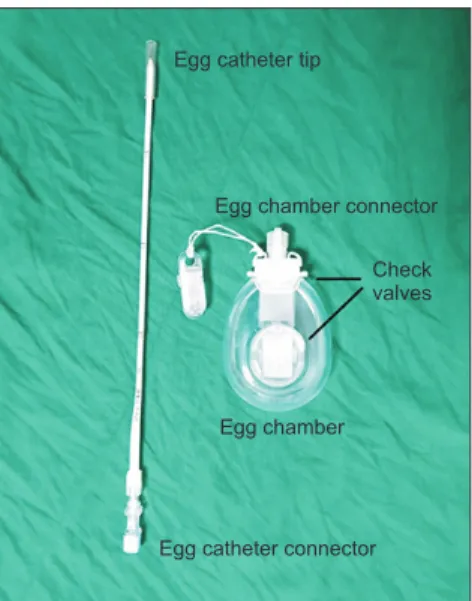
In cases where patients instead chose the portable tho- racic drainage device (the TEC group), the Thoracic Egg was applied. The Thoracic Egg consists of a flexible 9F sili- cone catheter with two 1-way Heimlich valves and a small plastic chamber (Fig. 1). In brief, a 5-mm skin incision was made under local anesthesia; following a test puncture, a catheter was inserted in the third to fifth intercostal space on the anterior axillary line. After pleural puncture, the needle was removed from the catheter, and the catheter was inserted into the thoracic cavity, which was then fixed to the chest wall and connected to a plastic chamber using adhesive tape. Thirty minutes to 1 hour after Thoracic Egg insertion, a chest X-ray examination was performed. Pa-
tients were discharged after (1) confirmation of the posi- tion of the catheter in the thoracic cavity, (2) resolution of symptoms, and (3) confirmation of lung expansion. Pa- tients were advised to visit our outpatient clinic within 1 week from discharge, at which time the catheter was re- moved. The TEC was removed from all patients at the out- patient clinic; however, patients were admitted as inpatients upon request.
In the CCT group, medical expenses were calculated based on the total days prior to discharge. In the TEC group, medical expenses were calculated by the members of the outpatient clinic and emergency department includ- ing the period until the day of device removal. These ex- penses included the catheter, which was assigned a cost of 100,000 Korean won (KRW). In Korea, the cost of the Tho- racic Egg has not yet been established; hence, we estimated the cost based on its usage in Japan.
Descriptive statistics were used to compare the variables between the 2 groups, using the chi-square test or the Fish- er exact test for categorical variables and the Student t-test for continuous variables. All statistical analyses were per- formed using IBM SPSS ver. 21.0 (IBM Corp., Armonk, NY, USA).
Results
In this study, a total of 279 patients were included for analysis: 236 patients in the CCT group and 43 patients in the TEC group. The mean follow-up duration was 24.1 months in the CCT group and 35.5 months in the TEC group. There were no significant differences between the CCT and TEC groups with respect to age, sex, body mass index, and laterality. Among those in the CCT group, 100 patients (42.4%) underwent surgery during hospitalization.
However, no patients in the TEC group underwent surgery.
The catheter indwelling time was 2.8 days in the CCT group and 6.1 days in the TEC group, constituting a statis- tically significant difference (p<0.001) (Table 1).
To facilitate a better comparison, we excluded patients who underwent surgery in the CCT group and compared those in the CCT group who only underwent chest tube treatment with those in the TEC group with respect to re- currence during follow-up. We found that 36 patients (26.5%) in the CCT group and 15 patients (34.9%) in the TEC group experienced recurrence. The difference was not statistically significant (p=0.287). However, medical ex- penses were significantly lower in the TEC group (mean, 433,413 KRW) than in the CCT group (mean, 522,146 KRW; p<0.001) (Table 2).
51
Hyon Keun Joh, et al. Thoracic Egg Catheter in Pneumothorax
www.kjtcvs.org
KJTCVS
Discussion
Many outpatient studies of PSP treatment have been conducted. Ho et al. [5] showed that 60% of PSP patients underwent successful treatment using needle aspiration or a Heimlich valve and 12F chest tube. They also showed that there was no statistically significant difference with respect to the size of the tube; however, smaller tubes have been shown in some previous studies to result in less pain and greater stability [5-7]. Therefore, we believe that the TEC used in this study is highly suitable for treating PSP.
According to the results of the present study, chest tube indwelling time was significantly shorter in the CCT group than in the TEC group. This may be attributable to serial follow-up and care during the hospitalization of the CCT patients. Since the majority of PSP patients in this study were in their late teens to mid-20s, the purpose of outpa- tient follow-up was to minimize patient disconnect with everyday life (i.e., school and social life) [4,6,8]. We believe the TEC to be highly suitable in such circumstances. Al- though it may be difficult to precisely calculate the socio- economic effect or to perform an exact cost-benefit analy- sis of TEC for the treatment of PSP, we firmly believe that this device may be particularly advantageous for younger PSP patients without any underlying disease.
Karasaki et al. [6] showed that the TEC had a resolution rate of 95.8% and a recurrence rate of 32.9%. Our findings were similar, with a resolution rate of 100% and a recur- rence rate of 29.4%. Moreover, Woo et al. [9] found that thoracic egg insertion can provide social and economic
benefits for patients. In the present study, TEC insertion was performed in the emergency department, rather than in the outpatient clinic. Despite the added cost of using the emergency department, the mean overall medical expenses for those in the TEC group were significantly lower than that for those in the CCT group.
The TEC has some limitations. Given its thinness, it is prone to kinking and may easily become disconnected from the chamber [6]. Moreover, it can cause infection from self-dressing and insufficient pain control. However, there were no such complications in our study, as we pro- vided patients with thorough education as well as appro- priate antibiotics and analgesics. It is worth noting that this lack of complications may be attributable to the fact that our patients were all young and healthy with good compliance. Another limitation is that we were unable to observe exactly when the lung fully expanded and pneu- mothorax was completely resolved in patients receiving TEC insertion, because their follow-up date depended on their availability for a visit to the outpatient clinic. There- fore, it was difficult to draw an accurate comparison of chest tube indwelling time between the TEC and CCT groups. In addition, concerns may exist regarding whether the location of the TEC interferes with lung expansion, al- though no cases triggered such concern in this study. An- Table 1. Comparison of baseline characteristics between groups
Characteristic
Conventional chest tube
group
Thoracic Egg catheter
group
p-value
Age (yr) 28.3±15.5 27.7±15.2 0.797
Gender (male) 200 (83.0) 41 (95.3) 0.062
Body mass index (kg/m²) 20.20±2.89 20.27±2.96 0.912 Laterality (right:left) 101:135 21:22 0.463
Underwent surgery 100 (42.4) 0 <0.001
Catheter indwelling time (day)
2.8±1.2 6.1±2.6 <0.001
Follow-up duration (mo) 24.1±11.6 35.5±12.1 <0.001 Values are presented as mean±standard deviation or number (%).
Table 2. Comparison of recurrence and total costs between groups, excluding patients who underwent surgery
Variable
Conventional chest tube group
(n=136)
Thoracic Egg catheter group
(n=43)
p-value
Recurrence 36 (26.5) 15 (34.9) 0.287
Total cost (Korean won)
522,146±398,270 433,413±105,632 <0.001 Values are presented as mean±standard deviation or number (%).
Fig. 1. Thoracic Egg catheter and chamber.
Egg catheter tip
Egg chamber connector
Check valves
Egg chamber
Egg catheter connector
52
https://doi.org/10.5090/kjtcs.2020.53.2.49
www.kjtcvs.org
KJTCVS
other limitation of this study may be the inevitability of se- lection bias, as it took place at a single institution and patients chose to be admitted for treatment or to receive treatment at the outpatient clinic. A future, large-scale, prospective randomized trial is needed to overcome these limitations.
In conclusion, in this study, we found that a portable small-bore chest tube may not be significantly more effica- cious than a CCT. However, given that CCT usage normal- ly requires hospitalization, while use of a portable small- bore chest tube does not, the latter produces significantly lower medical expenses. Therefore, we believe that the TEC could be a less costly alternative to CCT insertion, espe- cially for young, otherwise healthy PSP patients.
Conflict of interest
No potential conflict of interest relevant to this article was reported.
Acknowledgments
This study was supported by a Grant of the Samsung Vein Clinic Network (Daejeon, Anyang, Cheongju, Cheonan;
Fund no. KTCS04-133).
ORCID
Hyon Keun Joh: https://orcid.org/0000-0001-9163-8859 Duk Hwan Moon: https://orcid.org/0000-0003-1388-2471 Sungsoo Lee: https://orcid.org/0000-0001-8998-9510
References
1. Sahn SA, Heffner JE. Spontaneous pneumothorax. N Engl J Med 2000;342:868-74.
2. Baumann MH, Strange C, Heffner JE, et al. Management of sponta- neous pneumothorax: an American College of Chest Physicians Del- phi consensus statement. Chest 2001;119:590-602.
3. MacDuff A, Arnold A, Harvey J; BTS Pleural Disease Guideline Group. Management of spontaneous pneumothorax: British Thoracic Society Pleural Disease Guideline 2010. Thorax 2010;65 Suppl 2:
ii18-31.
4. Kurihara M, Kataoka H, Ishikawa A, Endo R. Latest treatments for spontaneous pneumothorax. Gen Thorac Cardiovasc Surg 2010;58:
113-9.
5. Ho KK, Ong ME, Koh MS, Wong E, Raghuram J. A randomized controlled trial comparing minichest tube and needle aspiration in outpatient management of primary spontaneous pneumothorax. Am J Emerg Med 2011;29:1152-7.
6. Karasaki T, Shintomi S, Nomura Y, Tanaka N, Saito H, Yoshida Y.
Outcomes of outpatient treatment for primary spontaneous pneumo- thorax using a small-bore portable thoracic drainage device. Thorac Cardiovasc Surg 2014;62:516-20.
7. Santos C, Gupta S, Baraket M, Collett PJ, Xuan W, Williamson JP.
Outcomes of an initiative to improve inpatient safety of small bore thoracostomy tube insertion. Intern Med J 2019;49:644-9.
8. Conces DJ Jr, Tarver RD, Gray WC, Pearcy EA. Treatment of pneu- mothoraces utilizing small caliber chest tubes. Chest 1988;94:55-7.
9. Woo WG, Joo S, Lee GD, Haam SJ, Lee S. Outpatient treatment for pneumothorax using a portable small-bore chest tube: a clinical re- port. Korean J Thorac Cardiovasc Surg 2016;49:185-9.