ORIGINAL ARTICLE
JMBSJournal of Metabolic and Bariatric Surgery J Metab Bariatr Surg 2016;5(2):67-72
Received: December 3, 2016, Revised: December 10, 2016, Accepted: December 12, 2016 Corresponding author: Sang-Moon Han, 566 Nonhyun-ro, Gangnam-gu, Seoul 06135, Korea
Department of Surgery, CHA Gangnam Medical Center, CHA University School of Medicine Tel: 82-2-3468-3369, Fax: 82-2-3468-3507, E-mail: [email protected]
CC This is an open access article distributed under the terms of the Creative Commons Attribution Non-Commercial License (http://creativecommons.org/licenses/by-nc/4.0) which permits unrestricted non-commercial use, distribution, and reproduction in any medium, provided the original work is properly cited.
Copyright © 2016, The Korean Society for Metabolic and Bariatric Surgery
One-Year Outcomes of Laparoscopic Adjustable Gastric Banding Based on Bariatric Analysis and Reporting Outcome System (BAROS) in Morbidly Obese Korean Patients
Department of Surgery, CHA Gangnam Medical Center, CHA University School of Medicine, Seoul, Korea
Jong Seob Park, Sang-Moon Han
Purpose:This study aimed to compare amount of weight loss, serum laboratory results, and bariatric analysis and reporting outcome system (BAROS) scores obtained before surgery with those obtained 1 year after laparoscopic adjustable gastric banding (AGB). Materials and Methods: From January 2013 to November 2014, 32 consecutive patients who underwent AGB were enrolled in this study. This study was a retrospective analysis of our prospectively collected database. The BAROS score included BAROS weight, medical condition, quality of life, and complications recorded 1 year after AGB. Demographic and post-operative data were also collected and analyzed. Results: Thirty-two patients were enrolled in this study, com- prising 26 women and 6 men, with an average body mass index of 39.0±6.1 kg/m2. The total BAROS score 1 year post AGB was 4.6±1.7, and it was classified as excellent grade. Among them, the quality of life score was 1.8±0.6. Four minor complications were noted. The serum laboratory values improved 1 year post surgery, including hemoglobin A1c, c-peptide, insulin, Homeostatic model assessment of estimated insulin resistance (HOMA IR), Homeostatic model assessment of beta-cell function (HOMA B), triglyceride, total protein, and uric acid. Conclusion: AGB showed that it is acceptable in aspect of BAROS outcome as well as weight loss, and serum laboratory result in short-term period.
Key Words: Bariatric surgery, Adjustable Gastric banding, BAROS
INTRODUCTION
Laparoscopic adjustable gastric banding (AGB) is a res- trictive operation that has the advantages that it is readily performed by minimally invasive surgery, is adjustable, and can be reversed if necessary. In Korea, from 2003 to 2013, AGB (67.2%) was the most popular operation compared to any other surgical methods such as sleeve gastrectomy (14.2%) and Roux-en-Y gastric bypass (12.7%) [1].
Several methods to evaluate the outcomes of bariatric surgery have been introduced. Bariatric analysis and reporting outcome system (BAROS) is one of the most acceptable questionnaires. It is easy to use among several evaluation tools such as SF-36 scale [2], Sickness Impact Profile [3], and Bariatric Quality of Life [4]. BAROS provides a standard for comparing outcomes of different bariatric procedures using a simple, objective, unbiased method in an evidence-based fashion [5,6]. This system is a simple
Fig. 1. The questionnaires of quality of life.
scoring system and consists of mainly three areas: per- centage of excess weight loss, changes in medical condi- tions, and assessment of quality of life (QOL) [5].
This study aimed to compare weight loss, serum labo- ratory results, and bariatric analysis and reporting outcome system (BAROS) scores before and 1 year post laparoscopic adjustable gastric banding (AGB).
MATERIALS AND METHODS
From January 2013 to November 2014, 32 consecutive patients who underwent gastric adjust banding were enrolled in this study. This study was a retrospective analysis of our prospectively collected database. The following demographic data were collected and analyzed:
age, sex, weight, body mass index (BMI), conversion bariatric surgery, reason for conversion, medical history, duration of follow-up, and BAROS score at 1 year post surgery. This study was approved by the institutional review board of
CHA Gangnam Medical Center, CHA University.
The BAROS score consisted of BAROS weight, medical condition, QOL, and complications at 1 year post surgery.
BAROS weight was reported by calculating percentage of excess weight loss (%EWL), which is stratified into five categories from −1 to +3 points. Changes in medical condition were defined by improvement or worsening of comorbidities. Resolution of comorbidities gives +2 points, their improvement gives +1 point, no change is scored 0, and worsening is given −1 points. QOL was measured by using the BAROS questionnaire that was given out when the patients visited at 1 year after gastric adjust banding. All 32 patients completed the quality of life questionnaires. The minimum follow-up was 13 months.
Quality of life was based on self-esteem, physical activity, social life, work conditions, and sexual activity. Self-es- teem was counted from −1.0 to +1.0 point. Other aspects were evaluated from −0.5 to +0.5 point (Fig. 1). Points were deducted for complications and reoperation in the
Table 1. Patients’ general characteristics Characteristics (n=32)
Age 33.0±8.7
Sex
Female 26 (81.3%)
Male 6 (18.7%)
Weight (kg) 104.6±17.9
Height (cm) 163.7±8.7
Body mass index (kg/m2) 39.0±6.1
Co-morbiditiesa
Fatty liver 23
Dyslipidemia 20
Arthritis & back pain 18
Obstructive sleep apnea 15
Hypertension 11
Dys- or amenorrhea 10
Type II diabetes mellitus 8
Reflux esophagitis 7
Gout 2
Hiatal hernia 2
GB stone 1
Asthma 1
Period of follow up (Months) 32.3±7.9
aIncluded in duplication.
perioperative period. Each major complication led to deduction of one point and a minor complication led to deduction of 0.2 points. Outcomes of BAROS were cla- ssified into five groups according to the total score: failure (0 points or less), fair (>0 to 1.5 points), good (>1.5 to 3 points), very good (>3 to 4.5 points), and excellent (>4.5 to 6 points) [5].
Percentage excess body mass index loss (%EBMIL) was calculated by using the formula (Initial BMI–current BMI)×100 / (initial BMI−25). The %EBMIL was calculated every 3 months until 1 year.
Data were analyzed by descriptive statistical methods with the Statistical Package for the Social Sciences for Windows, version 18.0 (SPSS Inc., Chicago, IL). They were then presented as either means±standard deviations or percentages. The comparisons of serum laboratory values and %EBMIL before and after surgery were performed by a paired T-test or the Wilcoxon signed rank test. The data were evaluated by the normality test through Kolmo- gorov-Smirnov test and Shapiro-Wilk test.
RESULTS
1. General characteristics
Thirty-two patients, comprising 26 women and 6 men, were enrolled in this study. The mean age was 33.0±8.7 years, and the average BMI, before adjusting gastric banding, was 39.0±6.1 kg/m2. They had an average of 3.7 comorbidities (range, 0 to 6). Twenty-nine patients had 1 or more co-morbidity. Five patients underwent a revisional or conversion operation. All operations were performed after 1 year from the primary adjusting gastric banding. The mean interval of re-operation from primary surgery was 27.8±9.2 months. Two patients underwent sleeve gastrec- tomy. Three patients underwent a revisional surgery, in- cluding included band reposition, band removal, and gastric plication during their follow-up period,. The mean period of follow up was 32.3 months (Table 1).
2. Bariatric analysis and reporting outcome system score at 1 year post AGB
No patients gained weight at 1 year post surgery. Two patients (6.3%) reported between 0% EWL and 24.9% EWL,
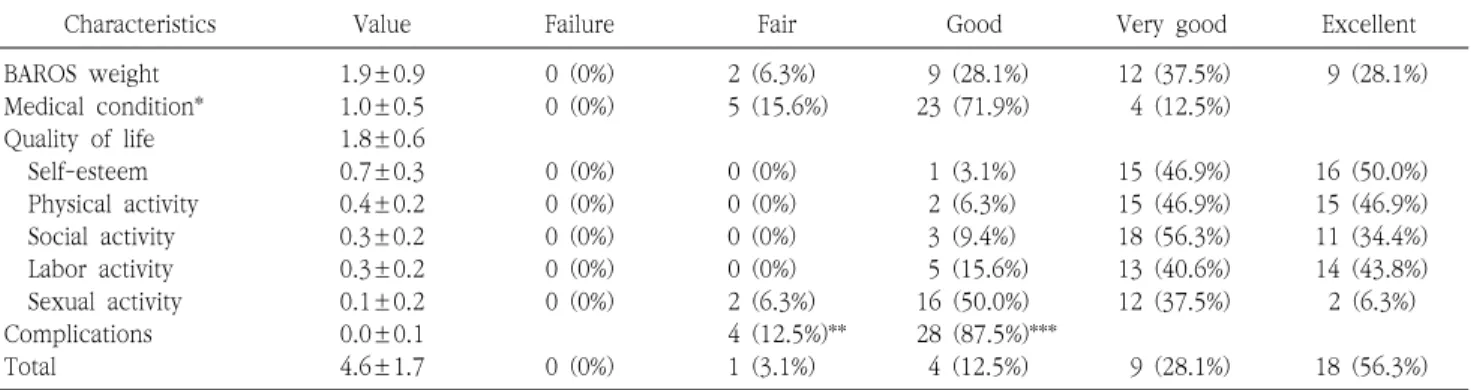
9 (28.1%) reported 25% EWL to 49.9% EWL, 12 (37.5%) reported 50% EWL to 74.9% EWL, and 9 (28.1%) achieved greater than 75% EWL. No patients had aggravated medical condition. The number of patients with no change in medical condition was 5 (15.6%). Twenty-three (71.9%) patients showed improvement and 4 (12.5%) patients showed resolved comorbidities. The average of total QOL scores was 1.8. The mean score of self-esteem was 0.7±0.3 (range, 0 to 1.0), physical activity was 0.4±0.2 (range, 0 to 0.5), social activity was 0.3±0.2 (range, 0 to 0.5), labor activity was 0.3±0.2 (range, 0 to 0.5), and sexual activity was 0.1±0.2 (range, −0.25 to 0.5), respectively.
The number of patients with minor complications was 4 (12.5%), and the other 28 patients (87.5%) did not have any complications. All 4 patients who were noted to have minor complications developed pouch dilatation that resolved with defiling hand.
The mean combined BAROS score was 4.6±1.7 and it belonged to excellent grade. According to this system, no patients were classified as having a failure. One patient (3.1%) had a fair outcome, 4 patients (12.5%) had a good outcome, 9 patients (28.1%) had very good outcome, and 18 patients (56.3%) had an excellent outcome (Table 2).
Table 2. Bariatric analysis and reporting outcome system score 1 year after AGB
Characteristics Value Failure Fair Good Very good Excellent
BAROS weight 1.9±0.9 0 (0%) 2 (6.3%) 9 (28.1%) 12 (37.5%) 9 (28.1%)
Medical condition* 1.0±0.5 0 (0%) 5 (15.6%) 23 (71.9%) 4 (12.5%)
Quality of life 1.8±0.6
Self-esteem 0.7±0.3 0 (0%) 0 (0%) 1 (3.1%) 15 (46.9%) 16 (50.0%)
Physical activity 0.4±0.2 0 (0%) 0 (0%) 2 (6.3%) 15 (46.9%) 15 (46.9%)
Social activity 0.3±0.2 0 (0%) 0 (0%) 3 (9.4%) 18 (56.3%) 11 (34.4%)
Labor activity 0.3±0.2 0 (0%) 0 (0%) 5 (15.6%) 13 (40.6%) 14 (43.8%)
Sexual activity 0.1±0.2 0 (0%) 2 (6.3%) 16 (50.0%) 12 (37.5%) 2 (6.3%)
Complications 0.0±0.1 4 (12.5%)** 28 (87.5%)***
Total 4.6±1.7 0 (0%) 1 (3.1%) 4 (12.5%) 9 (28.1%) 18 (56.3%)
*Comorbidities resolution gives +2 points (very good), its improvement gives +1 point (good), no change is scored 0 (fair) and worsening gives 1 point (failure).
**Minor complication = deduct 0.2 points.
***No complication.
Table 3. Changes in serum laboratory values
Parameter Before surgery After 1 year P-value
HbA1c (%)* 6.3±2.0 5.5±0.6 0.003
C-peptide (ng/ml) 3.5±2.0 2.5±1.3 0.043
Insulin (uU/ml)* 19.9±11.8 8.6±5.0 <0.001
HOMA IRa* 5.2±3.3 2.1±1.4 <0.001
HOMA Bb* 519.8±1708.4 96.5±58.1 <0.001
Fasting blood glucose (mg/dl)* 110.6±46.8 96.5±11.6 0.091
Total cholesterol (mg/dl) 202.7±33.2 200.7±32.0 0.835
High density lipid (mg/dl)* 54.9±12.2 55.7±10.1 0.330
Low density lipid (mg/dl) 126.2±26.9 125.3±32.1 0.909
Triglyceride (mg/dl) 148.4±68.3 109.7±56.6 0.007
Total protein (g/dl) 7.3±0.4 7.1±0.4 0.021
Albumin (g/dl) 4.6±0.4 4.6±0.3 0.297
Uric acid (mg/dl)* 5.9±1.5 5.3±1.7 0.027
*They were analyzed by a non-parametric statistical test.
aHomeostatic model assessment of estimated insulin resistance.
bHomeostatic model assessment of beta-cell function.
3. Changes in serum laboratory values
The laboratory results related to type 2 diabetes mellitus had improved significantly at 1 year post surgery, including HbA1c (from 6.3±2.0 to 5.5±0.6 %, P=0.003), C-peptide (from 3.5±2.0 to 2.5±1.3 ng/ml, P=0.043), insulin (from 19.9±11.8 to 8.6±5.0 uU/ml, P<0.001), Homeostatic model assessment of estimated insulin resistance (HOMA IR) (from 5.2±3.3 to 2.1±1.4, P<0.001), and Homeostatic model assessment of beta-cell function (HOMA B) (from 519.8±1708.4 to 96.5±58.1, P<0.001). In addition, the results of triglyceride (from 148.4±68.3 to 109.7±56.6 mg/dl, P=0.007), total protein (from 7.3±0.4 to 7.1±0.4
g/dl, P=0.021), and uric acid (from 5.9±1.5 to 5.3±1.7 mg/dl, P=0.027) had also improved (Table 3).
4. Changes of percentage of excess body mass index loss (%EBMIL)
The weight loss presented with a mean 30.8±14.6%
EBMIL in the first 3 months and 48.0±22.1% EBMIL at 6 months, 61.8±28.6% EBMIL at 9 months, and 73.0±33.9%
at 12 months after surgery. Moreover, there were signi- ficant differences in the values between 3 months and 6 months (P<0.001), between 6 months and 9 months (P<
0.001), and between 9 months and 12 months (P<0.001) (Fig. 2).
Fig. 2. Changes in percentage of excess body mass index loss (%EBMIL).
DISCUSSION
AGB is a restrictive bariatric operation that is reversible, safe, and relatively simple to perform. The outcomes of AGB have been well–known in Western countries and also demonstrated through several reports in Korea [1,7-9].
However, there were no reports of Korean owned data to be evaluated by BAROS score, yet. Whether the results of bariatric surgery in Korea are comparable with those in Western countries remains unknown. This study is the first in Korea that reports that the outcome of AGB when evaluated by BAROS.
The result of BAROS score in this study was better than that of other study. There was no “failure” grade, and 56.3% of patients belonged to the “excellent” category. In contrast, one study reported that about 22% of patients were categorized as having “fair”, about 39% of patients as having “good”, about 18.5% of patients as having “very good”, and about 2% of patients as having “excellent”
outcomes [9]. The other study demonstrated that the out- come was considered “very good” in 3%, “good” in 7%, “fair”
in 40%, and “failure” in 50% patients [10]. We postulated that our result was better compared to that of studies because the time to fill in the BAROS questionnaire was as short as 12 months compared to 55 months [9] and 48 months [10] in those studies. AGB appeared to result in relatively poor long-term outcomes associated with several complications and a high incidence of reoperation [11-14].
BAROS gives a broader assessment of the outcome than
soley the use of percentage of the excess weight loss [5].
Among the limitations of BAROS is an exclusion of patients with perioperative deaths and the ones lost to follow-up.
However, BAROS is a valuable and easy tool for the eva- luation of patients who have undergone bariatric surgery.
It is simple to apply, does not depend on the bariatric operation, and takes complications, reoperations and agg- ravated medical diseases easily into consideration. Several other evaluation tools of QOL are available and several studies have reported improvement in the quality of life using all of the indices, which has given inconsistent results [6,15-17]. One study was introduced as Bariatric Quality of Life-questionnaire of Weiner, which contained 24 diffi- cult questions, and complication, reoperation, and agg- ravated medical diseases were not included [18]. With BAROS, the objective, as well as subjective information, was used to derive the score and compare operations and centers [19].
In our study, 4 minor complications were noted in year 1.
All these patients suffered from pouch dilatation and the complications were resolved by non-surgical intervention.
Interestingly, during the total follow-up period, 5 patients had a revisional or conversion operation performed after 1 year of primary AGB. Out of the 5 patients, 2 patients un- derwent a sleeve gastrectomy and 3 patients had a band reposition, band removal, and gastric plication. The mean interval between primary AGB and a revisional or con- version operation was 27.8±9.2. However, the 4 patients with minor complications who were included in BAROS score of this study were not included in the group of revi- sional or conversion operations. Although AGB has many advantages, only 30% of patients with gastric bands rated their life as “good” 10 and 14 years after surgery [8]. Indeed, several long-term studies on AGB have reported that re- vision or conversion operations are frequently required to manage the ensuing complications [11-14]. After 1 year, the BAROS score in this study presented a good outcome.
However, because major complications might occur 1 year after surgery, another long-term study about BAROS scoring will be needed.
The main limitations of this study were that it was a small case series conducted at a single institution and utilized a retrospective study design that might have resulted in bias.
However, this is the first study using BAROS scoring to evaluate the outcome of AGB for Korea patients after 1 year.
In conclusion, in a short-term period, AGB showed acceptable BAROS outcomes as well as weight loss and serum laboratory result.
CONFLICT OF INTEREST
No potential conflict of interest relevant to this article was reported.
REFERENCES
1. Lee HJ, Ahn HS, Choi YB, et al. Nationwide survey on bariatric and metabolic surgery in Korea: 2003-2013 results. Obes Surg 2016;26:691-5.
2. Ware JE Jr, Sherbourne CD. The MOS 36-item short-form health survey (SF-36). I. Conceptual framework and item selection. Med Care 1992;30:473-83.
3. Karlsson J, Sjöström L, Sullivan M. Swedish obese subjects (SOS)--an intervention study of obesity. Two-year follow-up of health-related quality of life (HRQL) and eating behavior after gastric surgery for severe obesity. Int J Obes Relat Metab Disord 1998;22:113-26.
4. Weiner S, Sauerland S, Fein M, Blanco R, Pomhoff I, Weiner RA.
The bariatric quality of life index: a measure of well-being in obe- sity surgery patients. Obes Surg 2005;15:538-45.
5. Oria HE, Moorehead MK. Bariatric analysis and reporting out- come system (BAROS) Obes Surg 1998;8:487-99.
6. Myers JA, Clifford JC, Sarker S, Primeau M, Doninger GL, Shayani V. Quality of life after laparoscopic adjustable gastric banding us- ing the baros and moorehead-ardelt quality of life questionnaire II. JSLS 2006;10:414-20.
7. Favretti F, Segato G, Ashton D, et al. Laparoscopic adjustable gas- tric banding in 1,791 consecutive obese patients: 12-year results.
Obes Surg 2007;17:168-75.
8. Aarts EO, Dogan K, Koehestanie P, et al. Long-term results after laparoscopic adjustable gastric banding: a mean fourteen year follow-up study. Surg Obes Relat Dis 2014;10:633-40.
9. Branson R, Potoczna N, Brunotte R, et al. Impact of age, sex and body mass index on outcomes at four years after gastric banding.
Obes Surg 2005;15:834-42.
10. Martikainen T, Pirinen E, Alhava E, et al. Long-term results, late complications and quality of life in a series of adjustable gastric banding. Obes Surg 2004;14:648-54.
11. Tran TT, Pauli E, Lyn-Sue JR, Haluck R, Rogers AM. Revisional weight loss surgery after failed laparoscopic gastric banding: an institutional experience. Surg Endosc 2013;27:4087-93.
12. O’Brien PE, MacDonald L, Anderson M, Brennan L, Brown WA.
Long-term outcomes after bariatric surgery: fifteen-year fol- low-up of adjustable gastric banding and a systematic review of the bariatric surgical literature. Ann Surg 2013;257:87-94.
13. Himpens J, Cadière GB, Bazi M, Vouche M, Cadière B, Dapri G.
Long-term outcomes of laparoscopic adjustable gastric banding.
Arch Surg 2011;146:802-7.
14. DeMaria EJ, Sugerman HJ, Meador JG, et al. High failure rate after laparoscopic adjustable silicone gastric banding for treatment of morbid obesity. Ann Surg 2001;233:809-18.
15. Dymek MP, Le Grange D, Neven K, Alverdy J. Quality of life after gastric bypass surgery: a cross-sectional study. Obes Res 2002;10:1135-42.
16. Weiner R, Blanco-Engert R, Weiner S, Matkowitz R, Schaefer L, Pomhoff I. Outcome after laparoscopic adjustable gastric band- ing - 8 years experience. Obes Surg 2003;13:427-34.
17. Ballantyne GH. Measuring outcomes following bariatric surgery:
weight loss parameters, improvement in co-morbid conditions, change in quality of life and patient satisfaction. Obes Surg 2003;13:954-64.
18. Weiner R, Datz M, Wagner D, Bockhorn H. Quality-of-life out- come after laparoscopic adjustable gastric banding for morbid obesity. Obes Surg 1999;9:539-45.
19. Wolf AM, Falcone AR, Kortner B, Kuhlmann HW. BAROS: an effec- tive system to evaluate the results of patients after bariatric surgery. Obes Surg 2000;10:445-50.